Full diagnostic. Growth Opportunity Diagnostic and Recommendations for Abbott Diabetes Care. Public-record research pass and top-up pass, October 2026.
A sample Radar from the public record
Growth Opportunity Diagnostic and Recommendations for Abbott Diabetes Care, Sawhney Enterprises, October 2026, public-record research pass with a top-up pass. Arena and opportunity scores are illustrative judgments from the public record. Contributions are the report's risk-adjusted 2030 totals spread across the lead bets in proportion to their composite, so the coverage read reproduces the report.
Context
This report diagnoses where Abbott Diabetes Care, the continuous glucose monitoring and biosensing business of Abbott Laboratories, can grow and recommends which growth opportunities it should pursue, which it should watch, and which it should refuse. It applies the Growth Radar, a diagnostic instrument that asks two questions of a growth agenda: whether the unit's ambition can be reached from its core trajectory, and if not, where the winnable opportunity lies to close the distance. The framework scans eight growth arenas in four families, scores each arena on whether the space is real, whether the prize is worth taking, and whether the unit can win, and then generates a broad set of net-new opportunities and screens each one with the same three questions, multiplied so that a weak answer on any one vetoes the bet. The method is set out in Sawhney, M. (2026), The Growth Radar and the Growth Canvas: A Playbook for Finding and Evaluating Growth Opportunities, SSRN Working Paper, forthcoming.
Executive Summary
Abbott Diabetes Care is a large, profitable business whose growth has slowed from 17 percent in 2025 to about 8 percent in the first half of 2026, and whose chief executive has said that without new reimbursement the business settles at 8 to 9 percent a year. Its stated ambition is USD 10 billion of Libre sales by 2028 and, in the words used on the January 2026 earnings call, about a billion dollars of new sales every year. Held to 2030, that implies about USD 12.6 billion of sensor sales. The core, growing at 7 to 9 percent, reaches USD 10.7 to 11.7 billion. The gap, meaning the sales the unit must find beyond what its current business will deliver on its own, is USD 0.9 to 1.9 billion of 2030 sales, and USD 0.2 to 0.7 billion on the 2028 horizon.
The 40 net-new opportunities this scan surfaced do not close that gap on their own. After discounting each for the chance that it fails, they are worth about USD 0.4 to 0.85 billion of 2030 sales, roughly a fifth to a half of the gap. The gap closes only if a decision already in motion lands: Medicare coverage of sensors for the roughly 10 million beneficiaries with type 2 diabetes who do not take insulin, which Abbott and Dexcom expect before the end of 2026 with coverage from mid-2027. That decision is Abbott's plan, so this scan excluded it. The honest reading is that growth to 2028 depends on reimbursement the unit does not control and on holding share through the expansion, and that the net-new bets are the hedge against delay and the engine for the years after 2028.
The search should concentrate in three of the eight arenas. Adjacent Categories scores highest because the dual glucose-ketone sensor cleared by FDA in August 2026 and the sensor manufacturing base give Abbott a right to win in new analytes that no rival holds. New Segments ties it because coverage expansion, the GLP-1 wave and the 97.6 million U.S. adults with prediabetes are structural shifts and Lingo gives Abbott a consumer beachhead. Ecosystem and Platform comes third because the broadest pump network, the Epic integration and the Google Health partnership let Abbott orchestrate pharma, payers and app makers.
Two opportunities reach the pursue-now band. The first is a sensor companion for people on GLP-1 therapy, sold through the drug makers' patient-support programs and the telehealth firms that prescribe the drugs; it scores 80 out of 125 on the screen described in this report. The second is a companion-data platform for insulin and GLP-1 makers, scoring 64. Of the 40 candidates, 34 survived, six were vetoed (five because Abbott cannot win them, among them a consumer smartwatch, drug development and an Abbott-owned prescribing service, and one because the prize is immaterial), and 17 announced initiatives were set aside as already in motion.
Leadership must make one decision: fund the two lead bets and their European and employer extensions at a scale that builds a second growth engine before 2028, or accept that the unit's organic ambition after the Medicare expansion is about 8 to 9 percent a year. The verdict rests on the GLP-1 companion and the pharma platform; if either fails, coverage falls below a quarter of the gap.
1 The business in brief
Abbott Diabetes Care sells the FreeStyle Libre family of continuous glucose monitors (Libre 2 Plus, Libre 3 Plus and, from late 2026, the dual glucose-ketone Libre Duo 10 Day), the Lingo over-the-counter biosensor, the cleared but unlaunched Libre Rio, the Bigfoot Unity connected pen cap, the LibreView and LibreLinkUp software, and FreeStyle blood-glucose strips (Abbott 2026g, p. 13; Abbott 2026i). The value chain runs from sensor chemistry and electronics, through four sensor plants in Ireland, the United Kingdom and the United States, to pharmacies, durable-medical-equipment suppliers, national tenders and mass retail, with the sensor's data flowing into pumps, pens, electronic health records and, since August 2026, the Google Health app (Abbott 2024b; Abbott 2025b; Abbott 2026l). The unit is one reporting line within Abbott's Medical Devices segment. It sold USD 7,998 million in 2025, up 17.5 percent reported and 16.3 percent organic, with USD 3,181 million in the United States and USD 4,817 million abroad; continuous glucose monitors accounted for about USD 7.6 billion of that, the third year in which they grew by more than a billion dollars (Abbott 2026a; Abbott 2026b; Abbott 2026g, p. 45). Abbott does not disclose the unit's profit. The Medical Devices segment earned USD 1,893 million of operating profit on USD 5,539 million of sales in the first quarter of 2026 (Abbott 2026h, p. 21), and the chief executive has called Libre one of Abbott's most profitable products (MedTech Dive 2024a).
The core is slowing. Sensor sales grew 19.5 percent in the second quarter of 2025, 17 percent in the third, 12 percent in the fourth, 7.5 percent in the first quarter of 2026 and 9.5 percent in the second (Abbott 2025a; Abbott 2025b; Abbott 2026b; Abbott 2026d; Abbott 2026f). Management attributed the first-quarter dip to a delayed international tender renewal and to restocking in 2025 after the Libre 3 Plus launch, and in July 2026 the chief executive described the arithmetic plainly: with about 15 million people on a sensor out of 75 to 80 million who could be, growth without new reimbursement plateaus at 8 to 9 percent, and coverage expansion is what accelerates it (Abbott 2026f). Two quality events mark the year. In November 2025 Abbott corrected about 3 million Libre 3 and 3 Plus sensors in the United States that could read low, with 736 severe adverse events and seven deaths reported worldwide at the time, later counted by FDA as 860 serious injuries and seven deaths in a Class I recall (MedTech Dive 2025; AHA 2026). In January 2026 FDA issued a warning letter to the Alameda, California site over finished-device accuracy testing and sampling plans; analysts at Leerink and J.P. Morgan expected no material financial effect, and the dual-analyte sensor was cleared seven months later (MedTech Dive 2026a; Abbott 2026i).
The right-to-win inventory is unusually concrete. Abbott holds the largest installed base in the category, more than 8 million Libre users in over 60 countries, against a global sensor market of about USD 12 to 14 billion in which it held about 53 percent of 2025 shipments to Dexcom's 34 percent (Abbott 2026i; Pure Global 2026). It holds the only dual-analyte sensor, cleared by FDA through the De Novo pathway on 25 August 2026 as the first system to meet both the iCGM and the new iCGK standards (Abbott 2026i). It holds manufacturing scale: the Kilkenny plant opened in November 2024 as the largest Libre site in the world, the fourth plant makes 100 million sensors a year, and a fifth plant of about USD 1 billion is in final planning (Abbott 2024b; Abbott 2026f). It holds the broadest pump network, supplying the MiniMed Instinct sensor exclusively, the Omnipod 5, Tandem, Beta Bionics and Sequel integrations, and the forthcoming Libre Duo integrations (Diabetech 2025; Insulet 2026; Abbott 2026i). It holds clinical software reach: LibreView data flows into Epic for more than 575,000 U.S. providers (Abbott 2025d). It holds a consumer beachhead in Lingo, sold at Amazon, Walmart, Walgreens, Best Buy and Publix at about USD 49 a sensor, with a multi-year Google Health partnership that puts Lingo data into Google's coaching app (DDB 2025; Abbott 2026l; Sahha 2026). It holds evidence: the REFLECT registry studies linked Libre use to a 78 percent reduction in cardiovascular hospitalizations among type 1 patients with prior severe hypoglycemia, and the FreeDM2 trial of 303 adults on basal insulin showed a 0.6 point greater HbA1c reduction than fingersticks (Abbott 2025c; Abbott 2026k). It holds patents that European courts have enforced against SiBionics and Sinocare (Pure Global 2026), and it owns Bigfoot Unity, a connected pen cap that works with Libre and every major U.S. disposable pen (DDB 2024). What it does not hold is disclosed: the number of Lingo users, the share of Libre sales under subscription, and the unit's margin are not public, and the Win scores below assume the manufacturing cost advantage the chief executive describes is real (MedTech Dive 2024a).
The ambition is public. In January 2024 the chief executive said he felt "very, very confident in our ability to deliver that USD 10 billion by 2028" and would like to go beyond it, a path requiring about 15 percent a year (MedTech Dive 2024a). In July 2025 he tied the path to USD 10 billion to coverage for non-insulin type 2 patients (Abbott 2025b), and in January 2026 he framed the expectation as a billion dollars of growth every year (Abbott 2026b). Three assumptions convert that into a gap, labeled illustrative. The ambition held to 2030 is the 2028 target plus the stated cadence, USD 12.6 billion of sensor sales. The core rate is 7 to 9 percent, the band the first half of 2026 delivered and the plateau the chief executive described. The base is USD 7.6 billion of 2025 sensor sales. On those assumptions the core reaches USD 10.7 to 11.7 billion in 2030 and the gap is USD 0.9 to 1.9 billion (equation 5 in Appendix B); on the 2028 horizon the core reaches USD 9.3 to 9.8 billion and the gap to USD 10 billion is USD 0.2 to 0.7 billion. One in-flight event dominates both: Medicare coverage for about 10 million type 2 beneficiaries not on insulin, which the chief executive called a multi-billion-dollar opportunity that "could happen in the fall" and which Dexcom expects to take effect in mid-2027 (Abbott 2026f; MedTech Dive 2026c). If 15 to 25 percent of those beneficiaries adopt a sensor by 2030 at about USD 950 of annual sales per user, the unit's current average, and Abbott holds half of them, the expansion alone adds USD 0.7 to 1.2 billion. The gap this scan must close is therefore conditional: USD 0.9 to 1.9 billion if the decision slips or Abbott loses share through it, and about USD 0.2 to 0.8 billion if it lands as planned.
2 Where the unit can grow
The Radar scores each arena on three lenses, each an integer from 1 to 5: whether the growth spaces in the arena are real and durable (Real), whether the prize is deep and material against the gap (Worth), and whether the unit holds named, transferable assets there (Win). The radius of each spoke is the geometric mean of the three (equation 1), so an arena with a large prize the unit cannot win is pulled toward the center. Scores are absolute and illustrative. The area of the polygon is a diagnostic of winnable opportunity; it is not a budget allocation.
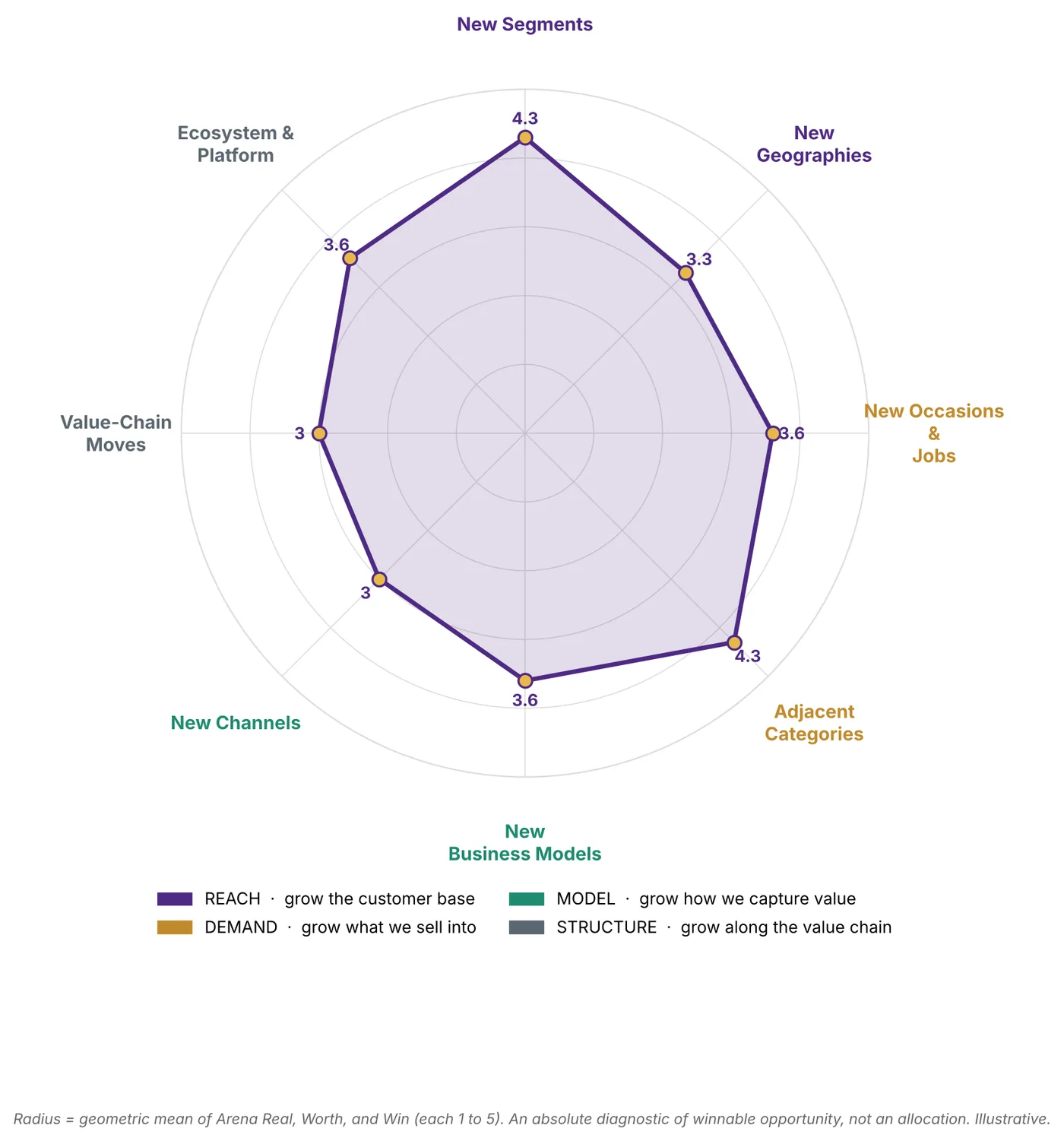
Table 1. The eight arenas: Real, Worth, and Win lenses and the resulting radius.
| Arena | Family | Real | Worth | Win | Radius |
|---|---|---|---|---|---|
| Adjacent Categories | Demand | 4 | 4 | 5 | 4.3 |
| New Segments | Reach | 5 | 4 | 4 | 4.3 |
| Ecosystem and Platform | Structure | 4 | 3 | 4 | 3.6 |
| New Occasions and Jobs | Demand | 4 | 3 | 4 | 3.6 |
| New Business Models | Model | 4 | 4 | 3 | 3.6 |
| New Geographies | Reach | 4 | 3 | 3 | 3.3 |
| New Channels | Model | 3 | 3 | 3 | 3.0 |
| Value-Chain Moves | Structure | 3 | 3 | 3 | 3.0 |
Adjacent Categories (4.3) leads on Win, the only 5 on the radar. The dual-analyte De Novo of August 2026, the four sensor plants and the enforced patent estate are assets no rival can buy quickly, and the lactate sensor now entering a sepsis trial shows the chemistry travels (Abbott 2026i; Abbott 2026f). Real is 4 rather than 5 because ketone monitoring itself is now in motion and the remaining adjacent analytes are at trial stage.
New Segments (4.3) leads on Real. Coverage expansion is a regulatory shift, 12 percent of U.S. adults currently take a GLP-1 drug, and 97.6 million U.S. adults have prediabetes (KFF 2025; Sahha 2026). Win binds at 4: Lingo is a proven beachhead, and Dexcom's Stelo contests the same consumer with a redesigned app and an Oura partnership (Dexcom 2026b; Medical Device Network 2025).
Ecosystem and Platform (3.6) has Win at 4 on named assets: the pump network, the Epic integration and the Google partnership. Worth binds at 3 because platform revenue in this category is mostly indirect; it pulls sensors through rather than earning a fee.
New Occasions and Jobs (3.6) is balanced at 4 on Real and Win. New jobs for the sensor, from medication starts to hospital discharge, are real and the owned app carries them. Worth is 3 because each job monetizes through the same sensor at modest volume.
New Business Models (3.6) leads on Worth. Outcome contracts, employer programs and data services are each material against the gap. Win binds at 3: Abbott sells devices through durable-equipment codes and pharmacies, has not run outcome contracts at scale, and the Peterson Health Technology Institute's 2024 assessment found that digital diabetes programs raised spending without meaningful clinical benefit (Fierce Healthcare 2024).
New Geographies (3.3) is real, with three in four adults with diabetes living in low- and middle-income countries and international intensive-insulin penetration at about half (IDF 2025; Abbott 2026b). Worth and Win bind at 3: Chinese sensors are priced 30 to 40 percent below Abbott, and cash-pay markets are thin (Pure Global 2026).
New Channels (3.0) and Value-Chain Moves (3.0) are the weakest spokes. The over-the-counter shift has already been taken by Lingo, the remaining channel moves are shared with rivals, and forward moves into monitoring services would compete with the clinics that bill those codes today.
3 The three arenas to focus
3.1 Adjacent Categories
This arena lights up because Abbott now owns the only sensor that measures two analytes continuously, and the manufacturing base to make it at a cost rivals have not matched. Libre Duo 10 Day was authorized on 25 August 2026 after breakthrough designation, meets both the iCGM and the new iCGK standards, is indicated from age 2, and will integrate with Beta Bionics and Sequel pumps by the end of 2026 and Insulet, Tandem and MiniMed in 2027 (Abbott 2026i). The chief executive has said the sensor will take share among intensive insulin users, where Abbott has been under-represented in pumps, and that about 5 to 6 million U.S. SGLT2 users, of whom about 1 million use a sensor, are the ketone opportunity (Abbott 2025b; Abbott 2026b; Abbott 2026d). The signal density beyond ketones is the lactate sensor for post-discharge sepsis, with trial enrollment starting in the fourth quarter of 2026 (Abbott 2026f).
The prize is a second curve on the same sensor economics. Every new analyte that rides the Libre form factor adds a reason to prescribe, a price premium, and a reason for pumps to integrate, without a new plant or a new channel. The right-to-win headroom is the widest on the radar: Dexcom, Medtronic, Senseonics and Roche sell glucose only (Dexcom 2026a; Senseonics 2026; MedTech Dive 2024c).
The moves this arena points to are sensors that answer a clinical question glucose alone cannot: ketones for hospitals and surgery, lactate for critical care, and a sensor-based screen for people who do not yet know they have diabetes. The trap is the different-industry adjacency: a metabolic drug, or a consumer wristwatch, both of which look adjacent and fail Win.
3.2 New Segments
Three buyer groups are growing faster than the diagnosed insulin-using population Abbott serves today. People on GLP-1 therapy: 12 percent of U.S. adults currently take one and 18 percent have tried one, including 23 percent of adults who have been overweight in the past five years (KFF 2025). Dexcom's CONNECT trial found the largest relative HbA1c improvement in its GLP-1-only cohort and described sensors and incretins as complementary (Dexcom 2026b). People with prediabetes: 97.6 million U.S. adults, four in five unaware (Sahha 2026). And type 2 adults abroad who have no coverage: only four of the ten largest markets cover basal insulin users fully, international basal penetration is under 5 percent, and Abbott holds about 70 percent of basal share globally (Abbott 2025a; Abbott 2025b; Abbott 2026d).
The right-to-win headroom is the Lingo beachhead and the retail shelf. Lingo sells through Amazon, Walmart, Walgreens, Best Buy and Publix; 78 percent of Americans live within five miles of a Walgreens (DDB 2025). The Google Health partnership adds coaching and a large real-world study (Abbott 2026l). Arena Win is 4 rather than 5 because Stelo contests the same shelf, Dexcom holds commercial coverage for all type 2 patients at the four largest pharmacy benefit managers, and Stelo's 2024 start was small, about 140,000 users and USD 22 million (Dexcom 2026b; Sahha 2026).
The trap is a segment that wants a different product. A person on a GLP-1 for weight does not want a diabetes device; she wants to see what the drug and her food are doing, for a few weeks at a time, inside the app she already uses. The sensor must be sold as an intermittent companion through the people who prescribe the drug, never as a chronic prescription.
3.3 Ecosystem and Platform
Abbott now holds a position between every party in diabetes care. Its sensor feeds six pump makers, including MiniMed exclusively for smart dosing from 2027 (Abbott 2026i; Diabetech 2025). Its data reaches clinicians inside Epic (Abbott 2025d). Its consumer data reaches Google Health (Abbott 2026l). Its pen cap reads the sensor and tells the patient how much insulin to take (DDB 2024). No rival spans pumps, pens, records and a consumer platform at once; Dexcom's platform reach is Oura and the Apple Watch (Medical Device Network 2025).
Ecosystem and Platform was chosen as the third focus ahead of New Occasions and Jobs and New Business Models, which also score 3.6, on the first tie-break rule, right-to-win headroom. The pump network, Epic and Google are named assets Abbott owns; the business-model arena's edge must be built, and the occasions arena's assets are the same owned app with a smaller prize. On the second rule, the share of the gap an arena can close, a platform contract with an insulin or GLP-1 maker reaches millions of patients at once, where a single new occasion reaches thousands. New Business Models remains strong and holds two pursue-next bets, outcome contracts and the employer benefit, that the focus arenas feed.
The trap is platform ambition without a reason for the first participant to join. Pharma companies pay for patient engagement and outcomes data when they can see adherence rise; payers pay when hospitalization falls; app makers join an open interface when the user base is large and the terms are fair. Each contract must name what the partner receives before it names what Abbott receives.
4 The opportunity set
The scan generated 40 net-new opportunities, grouped below by arena, with the three focus arenas first. Each carries a boldness tag: Extend is a small step from the core, Stretch a real reach with familiar muscles, Step out a new model or buyer, and Transform a different game.
4.1 Adjacent Categories
1. Critical-care multi-analyte sensor (glucose, lactate, ketone). One sensor for intensive-care and step-down patients that reports the three analytes clinicians chase with blood draws. Transform. The chemistry platform is named; the hospital buyer and the evidence are new.
2. Glucose-ketone surveillance for hospitalized and perioperative patients. Libre Duo worn through admission and surgery to catch diabetic ketoacidosis and euglycemic ketosis in SGLT2 users. Step out. Dexcom holds the breakthrough designation for in-hospital sensing; Abbott must build the hospital channel.
3. Fourteen-day sensor-based screen for prediabetes and undiagnosed diabetes. A single sensor with a clinician-read report, offered through primary care and employers to the 252 million people worldwide and the four in five U.S. prediabetics who do not know (IDF 2025; Sahha 2026). Step out. Lingo is cleared for wellness only, so the diagnostic claim needs its own authorization and a price above an HbA1c test.
4. Kidney biomarker sensor for people with diabetes and chronic kidney disease. Continuous potassium or creatinine for the diabetic population at highest renal risk. Transform. The chemistry is unproven in interstitial fluid.
5. Consumer metabolic smartwatch. An Abbott wrist device with glucose built in. Transform. The device layer belongs to Apple, Samsung, Google and Garmin.
6. Metabolic drug development adjacent to GLP-1. A therapeutic program built on Abbott's metabolic data. Transform. A pharmaceutical research base the unit has never built.
4.2 New Segments
7. Sensor companion for people on GLP-1 therapy, sold through pharma and telehealth partners. Lingo, or a Libre Rio variant, enrolled through the drug makers' patient-support programs and the telehealth firms that prescribe, used in two-week bursts at titration and at plateaus. Stretch. The beachhead, Libre Assist and the Google coaching carry it; Dexcom contests it with Stelo and the CONNECT data.
8. Employer and health-plan prediabetes benefit built on Lingo. A twelve-month program sold to self-insured employers and plans, with sensors shipped at intervals and coaching through Google Health or a partner. Step out. Abbott has not run a business-to-business benefit, and the Peterson assessment raises the evidence bar (Fierce Healthcare 2024).
9. Gestational diabetes program through obstetric channels. Libre prescribed at diagnosis of gestational diabetes with LibreLinkUp follow-up by the obstetric team. Stretch. The pregnancy indication exists; obstetrics is a new call point.
10. Over-the-counter type 2 sensor in European pharmacies. A Libre Rio-type sensor sold without prescription to type 2 adults in markets where basal coverage is partial. Stretch. Libre Rio is cleared in the United States and unlaunched; the Lingo U.K. retail playbook and the European brand apply.
11. Long-term care and home-health residents on insulin. Libre with remote viewing for nursing staff in skilled-nursing and home-health settings. Extend. The product fits; the buyer is fragmented and demand grows with aging at a trend pace.
12. Medicaid and safety-net primary care program. A state-by-state program with federally qualified health centers, using the Epic integration and Abbott's cost position. Extend. State formularies are contested with Dexcom.
13. Endurance athletes and performance training. A Lingo sport tier for cyclists and runners. Stretch. Supersapiens built this on Libre and closed; the pool is small.
14. Hospital inpatient glucose management as a health-system buyer. Sensors replacing point-of-care fingersticks on general wards. Step out. A new buyer with its own clearance; Dexcom is ahead.
4.3 Ecosystem and Platform
15. Companion-data platform for insulin and GLP-1 makers' patient-support programs. A contracted service through which Lilly, Novo Nordisk, Sanofi and others enroll patients on a sensor, receive engagement and outcomes data, and pay per enrolled patient. Step out. LibreView, 8 million users and the Epic link are the orchestration position.
16. Open developer interface for Libre and Lingo data with revenue share. A published interface for Levels, Nutrisense, Whoop, Oura and others, with a share of subscription revenue. Stretch. Dexcom publishes an interface; Abbott's larger base makes it worth more to app makers, and the share is thin.
17. Population glucose analytics for payers and accountable-care organizations. Time-in-range and hospitalization-risk dashboards for a plan's diabetic population, priced per member. Step out. REFLECT supports the pitch; payers run their own analytics.
18. Sensing layer supplied inside wearable platforms beyond Google. Lingo data and sensors inside Samsung Health, Apple Health, Garmin and Whoop. Stretch. The Google deal proves the model; Dexcom holds Oura and direct-to-Apple-Watch, and the Google terms are not disclosed.
19. Connected-pen titration network with insulin makers (Bigfoot Unity plus Libre). Bigfoot Unity bundled with basal insulin starts through the insulin makers' programs, so that primary-care patients titrate from the sensor. Stretch. Unity works with Libre and every major U.S. disposable pen (DDB 2024).
4.4 New Occasions and Jobs
20. Medication-start response sensor prescribed with a new diabetes drug. A two-week sensor dispensed with every new metformin, SGLT2 or GLP-1 prescription so patient and clinician see the drug's effect. Stretch. Coverage for a single sensor is the open question.
21. Thirty-day post-discharge monitoring to prevent readmission. Libre applied before discharge with LibreView follow-up by the hospital's transition team. Stretch. Hospitals pay only where readmission penalties bite.
22. Sleep and recovery insight from overnight glucose in Lingo. Overnight glucose variability as a recovery signal. Step out. Oura and Whoop own the sleep screen.
23. Fasting and low-carbohydrate ketone insight for Lingo users. The Duo chemistry in a wellness sensor for fasting and ketogenic eaters. Stretch. Demand tied to eating fashions fails the durability gate.
4.5 New Business Models
25. Outcome-based payer contracts on HbA1c and hospitalization. Contracts in which part of the sensor price is at risk against measured outcomes in a plan's population. Step out. REFLECT and FreeDM2 give the evidence; the contracting muscle is unproven and Medicare pays through durable-equipment codes.
26. De-identified glucose data licensing to research and pharma. Licensed access to the largest glucose dataset in the category for trial design and real-world evidence. Step out. Consent terms and a modest pool.
27. Clinical-trial endpoint service for pharma (time in range as an endpoint). Sensors, data management and endpoint reporting sold to sponsors who already use Libre in GLP-1 and insulin trials. Step out. Small against the gap.
28. Cash-pay sensor plus virtual clinician subscription for uncovered type 2 adults. A monthly subscription that pairs Libre with a telehealth clinician, built with a telehealth partner. Step out. Run alone it conflicts with the prescribers who carry Libre.
29. Risk-bearing diabetes management provider. Abbott takes capitated risk for a diabetic population. Transform. A provider's competencies and a conflict with customers.
30. Private-label sensor manufacturing for retailers. A Walmart or Amazon own-brand sensor made by Abbott. Step out. Scale is the asset; the prize is thin and it cannibalizes Lingo.
4.6 New Channels
31. Pharmacist-initiated sensor starts in retail clinics. Standing orders that let pharmacists at Walgreens and Walmart start covered patients on Libre. Stretch. The retail relationships apply; state rules vary.
32. Telehealth GLP-1 prescriber channel bundling Lingo. Lingo offered inside the Hims, Ro and Noom GLP-1 programs. Stretch. Dexcom contests the same channel with Stelo.
33. Consumer health social application. An Abbott community app around glucose. Step out. A sensor maker holds no social-network edge.
34. Abbott-owned telehealth that prescribes Libre. A direct prescribing service. Step out. Competes with the telehealth firms, pharmacies and clinics that carry the core.
4.7 Value-Chain Moves
35. Reimbursable remote monitoring service run on LibreView for clinics. Abbott staff review data and bill the interpretation and remote-monitoring codes on the clinic's behalf. Stretch. Clinics bill those codes today; a white-label version avoids the conflict.
36. Sensor onboarding and insertion service for elderly and primary-care patients. A nurse network that applies and teaches the sensor, modeled on Senseonics' Eon Care (Senseonics 2026). Step out. Libre needs no clinician insertion, so the pool is small.
37. Paid sensor take-back and recycling program. A fee-bearing return scheme for used sensors. Extend. A cost of doing business with no revenue pool.
4.8 New Geographies
24. Latin America cash-pay sensor through pharmacy chains. Libre and Lingo through pharmacy chains in Brazil and Mexico. Stretch. Large uncovered populations; price sensitivity and local distribution limit the edge.
38. India mass-market sensor through Abbott's established pharmaceuticals channel. A lower-priced sensor sold through the parent's Indian branded-generics field force. Stretch. Libre 2 Plus is already launched in India; cash pay and local entrants limit the margin.
39. Gulf national diabetes programs through tenders. Sensor supply for national programs in Saudi Arabia and the Emirates. Stretch. Tender experience and the basal share apply.
40. Lingo expansion to Europe, Canada and Australia. The U.S. and U.K. retail playbook taken to markets where Stelo is not yet sold. Stretch. Lingo is sold only in two countries today (Abbott 2026l).
4.9 Already in motion (excluded)
The following initiatives are announced or disclosed as underway, so they were screened out of the scored set. They remain evidence of right to win: the U.S. launch of Libre Duo 10 Day and its pump integrations with Beta Bionics, Sequel, Insulet, Tandem and MiniMed (Abbott 2026i); the Lingo retail expansion to Amazon, Walmart, Walgreens, Best Buy with Withings and Publix (DDB 2025; Abbott 2026l); the Abbott and Google Health multi-year partnership and its real-world study (Abbott 2026l); Libre Assist (Abbott 2026j); the Epic integration (Abbott 2025d); preparation of the sales force and distribution for Medicare coverage of type 2 adults not on insulin (Abbott 2026f); the pursuit of basal-insulin coverage in about seven further international markets and the FreeDM2 evidence behind it (Abbott 2026f; Abbott 2026k); the fifth sensor plant (Abbott 2026f); the continuous lactate sensor for post-discharge sepsis (Abbott 2026f); Libre 5 (Abbott 2026d); the MiniMed Instinct supply and MiniMed Go (Diabetech 2025); the Omnipod 5 integration with Libre 3 Plus (Insulet 2026); Libre Rio, cleared in June 2024 and unlaunched (Longevity Benchmark 2026); the Bigfoot Unity incubation (DDB 2024); the inclusion of Libre in Omada's type 2 program (diaTribe n.d.); patent enforcement against SiBionics and Sinocare in the Unified Patent Court (Pure Global 2026); and the corrective actions under the January 2026 warning letter (MedTech Dive 2026a). Public sources reveal announced moves only; initiatives inside the unit's pipeline cannot be screened until the diagnostic runs against internal materials.
5 Which opportunities to pursue
Each opportunity is scored from 1 to 5 on Real, Worth and Win, and the three scores are multiplied (equation 2), so a composite runs from 8 to 125; any score of 1 vetoes the bet (equation 4). Scores are illustrative judgments. Verdicts follow the composite: 64 and above is pursue now, 30 to 63 pursue next, 15 to 29 watch, and below 15 re-scope.
Table 2. Live opportunities ranked by composite score (illustrative).
| \# | Opportunity | Arena | Boldness | Real | Worth | Win | Score | Verdict |
|---|---|---|---|---|---|---|---|---|
| 7 | Sensor companion for people on GLP-1 therapy, sold through pharma and telehealth partners | Segments | Stretch | 5 | 4 | 4 | 80 | Pursue now |
| 15 | Companion-data platform for insulin and GLP-1 makers' patient-support programs | Ecosystem | Step out | 4 | 4 | 4 | 64 | Pursue now |
| 3 | Fourteen-day sensor-based screen for prediabetes and undiagnosed diabetes | Adjacent | Step out | 4 | 3 | 4 | 48 | Pursue next |
| 9 | Gestational diabetes program through obstetric channels | Segments | Stretch | 4 | 3 | 4 | 48 | Pursue next |
| 10 | Over-the-counter type 2 sensor in European pharmacies | Segments | Stretch | 4 | 3 | 4 | 48 | Pursue next |
| 16 | Open developer interface for Libre and Lingo data with revenue share | Ecosystem | Stretch | 4 | 3 | 4 | 48 | Pursue next |
| 19 | Connected-pen titration network with insulin makers (Bigfoot Unity plus Libre) | Ecosystem | Stretch | 4 | 3 | 4 | 48 | Pursue next |
| 20 | Medication-start response sensor prescribed with a new diabetes drug | Occasions | Stretch | 4 | 3 | 4 | 48 | Pursue next |
| 31 | Pharmacist-initiated sensor starts in retail clinics | Channels | Stretch | 4 | 3 | 4 | 48 | Pursue next |
| 39 | Gulf national diabetes programs through tenders | Geographies | Stretch | 4 | 3 | 4 | 48 | Pursue next |
| 40 | Lingo expansion to Europe, Canada and Australia | Geographies | Stretch | 4 | 3 | 4 | 48 | Pursue next |
| 8 | Employer and health-plan prediabetes benefit built on Lingo | Segments | Step out | 4 | 4 | 3 | 48 | Pursue next |
| 25 | Outcome-based payer contracts on HbA1c and hospitalization | Bus. Models | Step out | 4 | 4 | 3 | 48 | Pursue next |
| 1 | Critical-care multi-analyte sensor (glucose, lactate, ketone) | Adjacent | Transform | 3 | 3 | 4 | 36 | Pursue next |
| 11 | Long-term care and home-health residents on insulin | Segments | Extend | 3 | 3 | 4 | 36 | Pursue next |
| 26 | De-identified glucose data licensing to research and pharma | Bus. Models | Step out | 3 | 3 | 4 | 36 | Pursue next |
| 2 | Glucose-ketone surveillance for hospitalized and perioperative patients | Adjacent | Step out | 4 | 3 | 3 | 36 | Pursue next |
| 12 | Medicaid and safety-net primary care program | Segments | Extend | 4 | 3 | 3 | 36 | Pursue next |
| 14 | Hospital inpatient glucose management as a health-system buyer | Segments | Step out | 4 | 3 | 3 | 36 | Pursue next |
| 17 | Population glucose analytics for payers and accountable-care organizations | Ecosystem | Step out | 4 | 3 | 3 | 36 | Pursue next |
| 18 | Sensing layer supplied inside wearable platforms beyond Google | Ecosystem | Stretch | 4 | 3 | 3 | 36 | Pursue next |
| 21 | Thirty-day post-discharge monitoring to prevent readmission | Occasions | Stretch | 4 | 3 | 3 | 36 | Pursue next |
| 24 | Latin America cash-pay sensor through pharmacy chains | Geographies | Stretch | 4 | 3 | 3 | 36 | Pursue next |
| 28 | Cash-pay sensor plus virtual clinician subscription for uncovered type 2 adults | Bus. Models | Step out | 4 | 3 | 3 | 36 | Pursue next |
| 32 | Telehealth GLP-1 prescriber channel bundling Lingo | Channels | Stretch | 4 | 3 | 3 | 36 | Pursue next |
| 35 | Reimbursable remote monitoring service run on LibreView for clinics | Value-Chain | Stretch | 4 | 3 | 3 | 36 | Pursue next |
| 38 | India mass-market sensor through Abbott's established pharmaceuticals channel | Geographies | Stretch | 4 | 3 | 3 | 36 | Pursue next |
| 27 | Clinical-trial endpoint service for pharma (time in range as an endpoint) | Bus. Models | Step out | 4 | 2 | 4 | 32 | Pursue next |
| 30 | Private-label sensor manufacturing for retailers | Bus. Models | Step out | 3 | 2 | 5 | 30 | Pursue next |
| 4 | Kidney biomarker sensor for people with diabetes and chronic kidney disease | Adjacent | Transform | 3 | 3 | 3 | 27 | Watch |
| 23 | Fasting and low-carbohydrate ketone insight for Lingo users | Occasions | Stretch | 2 | 3 | 4 | 24 | Watch |
| 13 | Endurance athletes and performance training | Segments | Stretch | 3 | 2 | 4 | 24 | Watch |
| 22 | Sleep and recovery insight from overnight glucose in Lingo | Occasions | Step out | 3 | 2 | 4 | 24 | Watch |
| 36 | Sensor onboarding and insertion service for elderly and primary-care patients | Value-Chain | Step out | 3 | 2 | 3 | 18 | Watch |
Table 3. Opportunities parked on a veto.
| \# | Opportunity | Arena | Failing ring | Why it fails |
|---|---|---|---|---|
| 5 | Consumer metabolic smartwatch | Adjacent | Win | Own-the-device archetype: the wrist belongs to Apple, Samsung, Google and Garmin; the winnable move is the sensing layer inside them. |
| 6 | Metabolic drug development adjacent to GLP-1 | Adjacent | Win | Different-industry archetype: a pharmaceutical R&D and regulatory base the unit has never built. |
| 29 | Risk-bearing diabetes management provider | Bus. Models | Win | Vertical-into-care archetype: actuarial and care-delivery competencies, and conflict with the providers and payers who are customers. |
| 33 | Consumer health social application | Channels | Win | Own-the-device archetype: a sensor maker holds no social-network edge. |
| 34 | Abbott-owned telehealth that prescribes Libre | Channels | Win | Channel-conflict archetype: competes with the telehealth firms, pharmacies and clinics that carry the core. |
| 37 | Paid sensor take-back and recycling program | Value-Chain | Worth | Worth veto: a cost of doing business with no revenue pool. |
The top of the list survives the false-adjacency check. Opportunity 7 earns Win 4 from the Lingo beachhead, Libre Assist and the Google coaching layer; opportunity 15 from LibreView, the installed base and the Epic integration; opportunity 10 from the European brand and the unlaunched Libre Rio design; opportunity 3 from the sensor cost position that makes a single-sensor screen affordable. Opportunity 30 earns the only Win 5 on the list, from manufacturing scale, and is held back by its thin prize. None of the live bets earned a Win 5 on a consumer or contracting asset, because each depends on a position Abbott must extend into new work, and the Win scores should be revisited with internal data on Lingo users, subscription share and sensor cost.
6 Does the portfolio close the gap
The three highest-scoring bets were sized from unit economics, with every assumption labeled illustrative and open to challenge.
The GLP-1 companion (opportunity 7) is sized from the drug user upward. Twelve percent of U.S. adults currently take a GLP-1 drug (KFF 2025); on about 260 million adults that is about 31 million people, a derived figure. Removing those on insulin, for whom Lingo is not indicated, and those whose sensors are already covered through a diabetes diagnosis leaves roughly 18 to 20 million. If pharma support programs and telehealth prescribers enroll 10 percent of them in a sensor program at any time by 2030, that is 1.8 to 2.0 million people using about six sensors a year at Lingo's six-pack price of about USD 41 a sensor, or USD 250 a year (Longevity Benchmark 2026), which yields USD 0.45 to 0.5 billion of category sales. Abbott holding 55 to 65 percent against Stelo gives USD 0.25 to 0.35 billion of net-new 2030 sales; the figure is net-new because none of these people buy a sensor today.
The pharma companion-data platform (opportunity 15) is sized from the enrolled patient upward. Insulin and GLP-1 makers run support programs for millions of patients; if Abbott contracts for 1 million enrolled patients by 2030 at USD 100 to 150 per patient per year for enrollment, data and reporting, the platform earns USD 0.1 to 0.15 billion, with the sensors themselves counted in opportunity 7 or in covered Libre sales. Overlap with opportunity 7 is deliberate: the same patient can be in both, so the two are reported as a pair worth USD 0.35 to 0.5 billion.
The European over-the-counter type 2 sensor (opportunity 10) is sized from the uncovered adult upward. In the markets where Lingo or Libre can be sold without prescription, about 20 million type 2 adults have no sensor coverage, a judgment from the chief executive's statement that only four of the ten largest markets cover basal users and that international basal penetration is under 5 percent (Abbott 2025a; Abbott 2026d). If 3 to 4 percent of them buy four sensors a year at about EUR 55, category sales are USD 0.15 to 0.2 billion, and Abbott's 70 percent basal share abroad suggests USD 0.1 to 0.15 billion net-new.
The three bets therefore contribute USD 0.45 to 0.65 billion of net-new 2030 sales before any discount for failure. The other 26 pursue-next bets could add USD 0.5 to 1.6 billion if every one succeeded, a directional sum of USD 20 to 60 million each. Discounting the pursue-now pair at a 60 percent chance of success, the European bet at 50 percent, and the remaining pursue-next bets at 30 percent gives USD 0.4 to 0.85 billion (equation 6), or about a fifth to a half of the USD 0.9 to 1.9 billion gap on central assumptions. The gap closes from net-new bets alone only if every pursue-next bet lands at the top of its range and the gap is at the bottom of its range; and no plan can rest on that combination.
The verdict rests on two bets. The GLP-1 companion and the pharma platform carry more than half of the risk-adjusted total, and both depend on things Abbott has not yet proven: a sale to pharmaceutical companies as customers rather than as co-marketers, and a consumer product used in bursts rather than continuously, with the churn that implies.
Four conditions would make even this partial coverage fail. Dexcom may close the GLP-1 segment first; its Stelo app was rebuilt in July 2026 around food logging and AI insights, it holds Oura and the Apple Watch, and its CONNECT trial gives it the clinical story (Dexcom 2026b). The Medicare decision may slip past 2027, which would widen the gap to the top of its range and leave the net-new bets covering a fifth of it. The quality record may bind: a second finished-device accuracy finding after the January 2026 warning letter would slow every clearance the adjacent-analyte bets depend on (MedTech Dive 2026a). And the pharma platform may fail its first contract if the drug makers decide that Dexcom's open interface and Abbott's closed one are substitutes and bid the price down.
The portfolio does not close the gap on its own. The organic bets can add about one to two points of growth a year by 2030, from the 8 to 9 percent plateau toward 10 percent. The remaining distance has three possible answers: scale the GLP-1 and pharma bets beyond a pilot budget before the Medicare decision lands, so that the second engine is running when the first accelerates; accept that the unit's ambition after 2028 is about 8 to 9 percent organic plus whatever coverage adds; or buy the capability the organic bets lack, which is a consumer subscription and coaching business with a retained user base, the asset Dexcom bought a stake in through Oura. The recommendation is the first, with the third held as the response if Stelo wins the GLP-1 segment by the end of 2027.
The shape of the portfolio is healthy in reach and thin at the top. Thirty-two of the 34 live bets are Stretch, Step out or Transform, and the list holds five Transform bets, so the scan did not merely defend the core. Only two bets reach pursue now, so selection is not the binding problem; scale is, since the best bets are small against a gap that one reimbursement decision can move by more than the whole net-new portfolio.
7 What the unit will not pursue
Six opportunities are refused. A consumer metabolic smartwatch and a consumer social application both fail Win on the own-the-device archetype: the wrist and the community belong to Apple, Samsung, Google, Garmin and Oura, and the winnable version is opportunity 18, the sensing layer supplied inside those platforms. Metabolic drug development fails Win as a move into another industry's value chain. A risk-bearing diabetes management provider fails Win as vertical integration into care, where Abbott would need actuarial and clinical-operations competencies and would compete with the providers and payers who buy its sensors. An Abbott-owned telehealth service that prescribes Libre fails Win on channel conflict with the telehealth firms, pharmacies and clinics that carry the core; the winnable version is opportunity 32, Lingo inside the GLP-1 prescribers' programs. The paid sensor take-back program fails Worth: it is a cost the unit will carry for regulatory and reputational reasons and holds no revenue pool.
The 17 initiatives listed as already in motion are also left out of the scored set. They are sound moves, and the diagnostic treats them as proof of the assets that make the new bets winnable, above all the Medicare preparation, the Duo launch and the Google partnership.
8 What happens next
Five bets should move into the next stage, which scopes each one onto a Growth Canvas with an owner, a budget and a date for a decision:
- The GLP-1 companion (7): which drug maker or telehealth firm signs first, at what program price, and whether burst use retains users for a second cycle.
- The pharma companion-data platform (15): what engagement and outcomes data a sponsor will pay for, and how the contract avoids conflict with Abbott's own prescribers.
- The European over-the-counter type 2 sensor (10): which markets allow non-prescription sale, and whether the Libre Rio design or Lingo carries the claim.
- The sensor-based screen (3): what regulatory pathway a diagnostic claim needs, and what price primary care and employers will pay against an HbA1c test.
- The employer prediabetes benefit (8) and the outcome-based payer contract (25), run as one experiment with two test cells and a control group, to learn whether Abbott can sell and service a contract whose price depends on measured outcomes.
Four gaps in the public record limit the scores and should be closed with internal data: Lingo's user count and repeat rate, the share of Libre sales under subscription, sensor unit cost by plant, and the unit's operating margin. The radar should be run again in April 2027, after the Medicare decision is known, the Libre Duo launch has two quarters of data, and the Google Health integration has shipped.
Appendix A. Method Note and Source Ledger
The diagnostic scanned eight growth arenas, scored each on Real, Worth and Win, and took the geometric mean as the arena radius. It generated 40 net-new opportunities, screened out 17 announced initiatives, scored each opportunity on the same three rings, multiplied the scores, and vetoed any opportunity with a ring at 1. All scores and prize ranges are illustrative judgments grounded in public evidence as of 12 October 2026. Abbott's third-quarter 2026 results, due in mid-October, were not available. Entries marked [snippet] were verified from a search result rather than a fetched document. Market-share and market-size figures from commercial research firms were used only where two sources agreed within a fifth of each other.
The deep research pass moved several scores from the earlier outside-in read of this unit. Adjacent Categories moved from 4.6 to 4.3 because Libre Duo is now cleared and in motion, so the remaining adjacent analytes are trial-stage (Real 5 to 4). New Occasions and Jobs moved from 4.0 to 3.6 because each occasion monetizes through the same sensor at modest scale (Worth 4 to 3). New Business Models moved from 4.0 to 3.6 because the contracting muscle is unproven and the device-sale operating model and the Peterson assessment weigh on Win (4 to 3). Ecosystem and Platform held at 3.6 with its composition changed: the pump network, Epic and Google are named assets (Win 3 to 4), and platform revenue is indirect (Worth 4 to 3). New Channels moved from 3.3 to 3.0 because the over-the-counter shift is already taken (Real 4 to 3), and Value-Chain Moves from 3.3 to 3.0 on the same lens. New Geographies moved from 2.9 to 3.3 because 60 percent of the unit's sales are international, it holds about 70 percent of basal share abroad and has enforced its patents in Europe (Win 2 to 3). New Segments held at 5, 4, 4. The earlier read's wedge of USD 300 to 800 million to 2028 is consistent with the USD 0.2 to 0.7 billion found here on that horizon; this report extends the horizon to 2030.
Investor and financial filings. Abbott 2026a: Fourth-quarter and full-year 2025 results release, 22 January 2026, abbott.mediaroom.com. Abbott 2026b: Q4 2025 earnings call transcript, 22 January 2026, fool.com. Abbott 2026c: First-quarter 2026 results release, 16 April 2026, abbott.mediaroom.com. Abbott 2026d: Q1 2026 earnings call transcript, 16 April 2026, fool.com. Abbott 2026e: Second-quarter 2026 results release, 16 July 2026, abbott.mediaroom.com. Abbott 2026f: Q2 2026 earnings call transcript, 16 July 2026, investing.com. Abbott 2026g: 2025 Annual Report and Form 10-K, February 2026, sec.gov. Abbott 2026h: Form 10-Q for the quarter ended 31 March 2026, 29 April 2026, abbottinvestor.com. Abbott 2025a: Q3 2025 earnings call transcript, 15 October 2025, investing.com. Abbott 2025b: Q2 2025 earnings call transcript, 17 July 2025, fool.com. MedTech Dive 2024a: Abbott CEO at the J.P. Morgan Healthcare Conference (USD 10 billion by 2028), 10 January 2024, medtechdive.com. MedTech Dive 2024b: Abbott CEO sees mass market potential for CGMs, 16 October 2024, medtechdive.com. Dexcom 2026a: Second-quarter 2026 financial results, 30 July 2026, investors.dexcom.com. Dexcom 2026b: Q2 2026 earnings call transcript, 30 July 2026, fool.com. Senseonics 2026: Second-quarter 2026 financial results, 6 August 2026, sec.gov. DDB 2026: MiniMed completes IPO as Medtronic separation continues, 9 March 2026, drugdeliverybusiness.com. OIG 2025: Medicare payments compared to prices available for CGMs and sensors (OEI-04-23-00430), completed 20 November 2025, oig.hhs.gov.
Customer and demand signals. KFF 2025: Poll on GLP-1 use among U.S. adults, 14 November 2025, kff.org. IDF 2025: IDF Diabetes Atlas, 11th edition press release, 7 April 2025, idf.org. Sahha 2026: Over-the-counter CGMs, Stelo and Lingo (CDC prevalence and Stelo 2024 figures via MedTech Dive), 3 October 2026, sahha.ai. Longevity Benchmark 2026: Over-the-counter CGM comparison (Lingo, Stelo, Libre Rio prices and availability), reviewed 10 August 2026, longevitybenchmark.com [secondary]. Fierce Healthcare 2024: Peterson Health Technology Institute assessment of digital diabetes management tools, 25 March 2024, fiercehealthcare.com. Abbott 2026k: FreeDM2 trial results, 12 March 2026, abbott.mediaroom.com. Abbott 2025c: REFLECT studies on hospitalizations, 15 May 2025, abbott.mediaroom.com.
IP and capability. Abbott 2026i: FDA De Novo authorization of Libre Duo 10 Day, 25 August 2026, abbott.mediaroom.com. Abbott 2026j: Libre Assist launch, 5 January 2026, abbott.mediaroom.com. Abbott 2024b: Opening of the Kilkenny manufacturing facility, 18 November 2024, prnewswire.co.uk. DDB 2024: Abbott's Bigfoot Biomedical acquisition nine months later, 24 June 2024, drugdeliverybusiness.com. MedTech Dive 2024c: Roche launches Accu-Chek SmartGuide in Europe, 12 September 2024, medtechdive.com. Pure Global 2026: CGM regulation and global market access (shares, Chinese entrants, UPC injunctions, reimbursement by country), 6 July 2026, pureglobal.com [secondary].
Data assets. Abbott 2025d: Integration of Libre data with Epic, 29 April 2025, nasdaq.com. Abbott 2026l: Abbott and Google Health partnership, 11 August 2026, abbott.mediaroom.com.
Brand and distribution. DDB 2025: Abbott launches Lingo in Walgreens, 17 December 2025, drugdeliverybusiness.com. Insulet 2026: Omnipod 5 compatibility with FreeStyle Libre 3 Plus, 3 June 2026, businesswire.com. Diabetech 2025: Medtronic launches the Instinct sensor for MiniMed 780G users, 2 December 2025, diabetech.info. diaTribe 2024: New AID integrations for Libre 3 Plus, iLet and Tandem, updated 31 October 2024, diatribe.org. diaTribe n.d.: Omada's type 2 coaching program to include FreeStyle Libre, diatribe.org [snippet].
Competitive and adjacency moves. MedTech Dive 2026b: Dexcom seeks expanded Medicare coverage for type 2 diabetes, 13 February 2026, medtechdive.com. MedTech Dive 2026c: Dexcom and Abbott await Medicare coverage expansion, 27 August 2026, medtechdive.com. Medical Device Network 2025: Inside Dexcom's strategy (Oura, Apple Watch, PBM coverage), 7 August 2025, medicaldevice-network.com. Sahha 2026 (Stelo users and revenue). MDD Online 2026: Medtronic MiniMed clearance for Abbott integration and type 2 use, 2026, mddionline.com [snippet]. Medical Device Network 2026: FDA clears Stelo for children, 2026, medicaldevice-network.com [snippet].
Talent signal. Job-posting analysis for the unit was not performed; this family is thin.
News and regulatory. MedTech Dive 2025: Abbott issues correction for millions of glucose sensors, 24 November 2025, medtechdive.com. AHA 2026: FDA issues most serious recall for certain glucose monitor sensors, 4 February 2026, aha.org. MedTech Dive 2026a: Abbott receives FDA warning letter over FreeStyle Libre CGMs, 3 February 2026, medtechdive.com. FDA 2026: Warning letter to Abbott Diabetes Care Inc., 23 January 2026, fda.gov [snippet]. CMS 2023: Medicare coverage of CGM for basal-insulin users and non-insulin users with problematic hypoglycemia, effective 16 April 2023, as summarized in Pure Global 2026 and diaTribe. CNBC 2024: FDA clears Libre Rio and Lingo, 10 June 2024, cnbc.com [snippet].
Appendix B. Mathematics
r_{a} = \sqrt[3]{\mathit{Real}_{a} \times \mathit{Worth}_{a} \times \mathit{Win}_{a}}(1)The radius of arena a is the geometric mean of its three lens scores, so a weak lens pulls the spoke toward the center without zeroing it.
S_{i} = \mathit{Real}_{i} \times \mathit{Worth}_{i} \times \mathit{Win}_{i}(2)The composite score of opportunity i multiplies the three ring scores and runs from 8 to 125 for a bet that survives the veto.
s_{i} = \frac{S_{i}}{125}(3)The share of the maximum expresses the composite as a fraction of a perfect score.
\min\left(\mathit{Real}_{i}, \mathit{Worth}_{i}, \mathit{Win}_{i}\right) = 1 \;\Rightarrow\; \text{veto}_{i}(4)Any ring score of 1 vetoes the opportunity, whatever its composite.
G = A_{2030} - S_{2025}\left(1 + g_{o}\right)^{5}(5)The gap is the 2030 ambition A_{2030} of USD 12.6 billion less 2030 sensor sales at the core rate g_{o}; with S_{2025} of USD 7.6 billion and g_{o} between 7 and 9 percent, G is USD 0.9 to 1.9 billion.
C = \frac{\sum_{i} h_{i} P_{i}}{G}(6)Coverage is the sum of each bet's net-new 2030 prize P_{i} weighted by its probability of success h_{i}, divided by the gap.
References
Sawhney, Mohanbir. 2026. The Growth Radar and the Growth Canvas: A Playbook for Finding and Evaluating Growth Opportunities. SSRN Working Paper, forthcoming.
Growth Radar (Sawhney Enterprises). Scores and prize ranges are illustrative judgments grounded in public evidence as of 12 October 2026.