Full diagnostic. AI Project Portfolio Diagnostic and Recommendations for Astral. Public-record research pass and top-up pass, October 2026.
A sample Radar from the public record
AI Project Portfolio Diagnostic and Recommendations for Astral, Sawhney Enterprises, October 2026, public-record research pass with a top-up pass. Read from the public record only. Astral discloses no AI spend and no AI program, so size and shape are not read and depth reads as not started. Paints and adhesives make money differently and are offered as a second Radar. Rupees converted at 96 to the dollar.
Context
This report diagnoses the AI project portfolio of Astral's plumbing business and recommends how much the business should invest in AI, where that investment should go, and how far its programs have come. It applies the AI Radar 2.0, a portfolio framework that asks three questions of a firm's AI investment: whether the firm is investing enough for the ambition it has declared, whether the investment is going where its strategy says it should, and how far its programs have advanced on a maturity scale that compares across firms. The framework scores twelve areas of the enterprise on three rings, what AI can do today, what the industry's economics reward, and what the firm's own strategy values, and composes them multiplicatively into a recommended allocation. It then judges the programs in flight against that allocation and reads the level, the direction and the maturity of the investment as size, shape and depth. Astral does not publish AI spend or an AI program list, so this report reads the strategy and the programs from the public record and states where size and shape cannot be read. The method is set out in Sawhney, M. (2026), The AI Radar: A Portfolio Framework for Diagnosing the Level and Allocation of Enterprise AI Investment, SSRN Working Paper, July 27, 2026, https://ssrn.com/abstract=7244301.
Executive Summary
Astral's plumbing business wins on manufacturing and on supply: it runs thirteen plumbing plants placed close to demand, one of them for bathware, it is building India's first captive CPVC resin plant so that it no longer imports its most important raw material, and it grew volume 15.8 percent in fiscal 2026 and held it flat in a June quarter when the industry fell about a tenth, at a segment margin near 19 percent. The public record shows no AI model at work in any of this. What the record does show is the data foundation an AI program would need, laid in the last three years: dealer identity checks across the network, a distributor management system that tracks secondary sales, a plumber loyalty application, and a new SAP enterprise system that went live in April 2026 and halted dispatches for about ten days. The finding is a manufacturing leader that has built the plumbing for data and has not yet put models on it, in the two areas where its strategy and its industry reward them most.
The instrument asks three questions. Is the business investing enough? The record does not say, because Astral discloses no AI spend; we report size as not read and give the board an indicative bracket of about 37 to 80 crore rupees a year (3.9 to 8.3 million dollars), with about 56 crore rupees as the requirement for the growth posture management has declared. Is the investment going where the strategy says? We cannot measure it, because there is no AI spend to place; the revealed digital spend has gone to the sales channel and to the corporate spine, while the two areas of the enterprise that this diagnostic rates highest, production and supply chain, carry automation and no models. How far have the programs come? No AI program can be staged; the depth reading is not started, and eight digital foundation programs are staged in Section 4 because the starts will build on them.
The findings that matter are these. First, production and supply chain are the two areas where AI capability, the economics of plastic pipe making and Astral's own strategy all point the same way; neither carries an AI program, which is an allocation gap. Second, the resin plant is the forcing date: trials begin in the fourth quarter of fiscal 2027, and a chlorination process designed without a data plan forfeits the first year of learning. Third, the April SAP cutover cost about a third of a month of dispatch in a quarter when the business still held volume flat against an industry down about ten percent; the lesson for any AI start is protected cutover and a control line, which is an execution matter. Fourth, Astral has run its plumber loyalty program for at least four years and gives investors no member count or result, while Prince Pipes reports 1.5 lakh members and says it runs its distributor and sales-force systems for data-led decisions.
We recommend that the business lead with production and supply chain through two starts with named sponsors: process and yield models on the extrusion lines, designed into the resin plant before construction completes in December, and resin and inventory planning built on the distributor data it already collects. Sales follows as a selective bet, funded where it is cheap and next to the starts, and the plumber program earns more money only after a measured read in test districts against control districts; quality enters as a narrow bet inside the production start at the resin plant. Service, smart products and finance are starved. Leadership must decide one thing: whether AI is part of how Astral defends its plumbing margin through the next resin cycle. The 90-day commitments are two sponsors and budget lines, a data design for the resin plant before December, a test-cell design for the loyalty program, and a count of AI spend under the rule this report sets out.
1. How the business is positioned to absorb AI
Astral Limited, listed in Mumbai and headquartered in Ahmedabad, reports two segments, and this diagnostic scopes one of them. The plumbing segment makes CPVC and PVC pipes and fittings, water tanks and bathware, and from 2027 will make the CPVC resin those pipes consume. The paints and adhesives segment makes Resinova adhesives under the Bondtite brand, construction chemicals, Gem Paints, the Seal It and Bond It sealants in the United Kingdom and the United States, and, under an agreement of June 2026, specialty chemicals through a 60 percent stake in Differentiated and Sustainable Solutions (DSS) for 39.11 crore rupees (Astral 2026a; Investywise 2026a; Sahi 2026).
The first gate of the instrument asks whether the parent runs one value chain or several. The two segments share a brand, part of a dealer network and the plumbers who buy solvent cement with their pipe, and they differ in everything that decides where AI pays. Plumbing converts a traded polymer into pipe by continuous extrusion and moulding, sells by the tonne through a distribution-led channel, and earned a 19.6 percent margin in fiscal 2026; paints and adhesives formulate specialty chemistry, sell consumer brands built on film-star endorsement, run under a separate chief executive, Saumya Engineer, and earned 10.2 percent (Astral 2026c; Astral 2026e). The board settled the question itself. On June 25, 2026 it approved a composite scheme to move the chemicals business into a separately listed Astral Chemie to "create sharper business focus, improve capital allocation and support margin improvement," and to merge Al-Aziz Plastics, the maker of specialised fittings, into Astral (Tijori Alerts 2026; Indian Chemical News 2026a; Multibagg 2026). The shares fell about 9 percent on the announcement (Angel One 2026). On July 5 the board commissioned an independent review, and on July 29 it withdrew the scheme on the consultant's advice, finding that the chemicals business "lacks the necessary scale and financial strength" to stand alone and weighing feedback from shareholders and investors and the prevailing business environment (ScanX 2026). The chief financial officer said on the next call that the idea could return once chemicals revenue reaches 5,000 to 6,000 crore rupees, which he put at a minimum of five years away (Astral 2026e). None of these reasons disputes the difference in economics that motivated the scheme, so this report reads the plumbing business alone and offers the paints and adhesives segment as a second Radar.
The plumbing business is the larger and the more profitable. It sold 263,026 tonnes in fiscal 2026, up 15.8 percent, for revenue of 46,787 million rupees (4,679 crore, or about 487 million dollars at 96 rupees to the dollar, the rate of October 12, 2026) and earnings before interest, tax, depreciation and amortization of 9,166 million rupees (Astral 2026c; Frankfurter 2026; ExchangeRate-API 2026).[^fx] The fourth quarter grew volume 24 percent at a margin near 23 percent (Axis 2026a; PL Capital 2026a). The first quarter of fiscal 2027 held volume flat at 56,146 tonnes while the industry fell about ten percent, at a margin of 18.9 percent, and the chief financial officer, Hiranand Savlani, explained the weak April plainly: "we implemented our new SAP HANA," and "our business operation was ... practically shut for the dispatch for 10 days" (ICICI Securities 2026a; Astral 2026e). July volume rose about 40 percent (Astral 2026e). Rivals had a harder quarter: Supreme Industries' piping volume fell 15 percent and Prince Pipes' fell 7 percent (ICICI Securities 2026c; IDBI Capital 2026).
[^fx]: Rupee figures are converted at 96 rupees to the dollar, between the ECB reference rate of 95.78 and the market rate of 96.96 on October 12, 2026. One crore is ten million; one lakh is one hundred thousand.
1.1 The strategy in the company's own words
Astral publishes no single strategy statement, and the annual report's vision, "to be a global leader in the building materials industry," declares no asymmetry. The strategy is nonetheless stated, in the six strategic priorities of the fiscal 2026 annual report and in four earnings calls, and it discriminates (Astral 2026a). Three priorities carry the plumbing business. The first is decentralised manufacturing and distribution: the chief financial officer writes that the "decentralised manufacturing strategy has further improved supply chain agility," and plants at Kanpur (in commercial production since October 6, 2025), Hyderabad, Cuttack and Guwahati, with Khambhat to follow, put capacity of 421,445 tonnes within freight distance of demand (Astral 2026a; Astral 2026c; ScanX 2025). The second is backward integration into CPVC resin through an 80 percent stake in Nexelon Chem: a 40,000-tonne plant that the chairman says "will reduce import dependence, currency exposure" and "is expected to improve volumes and margins on CPVC pipes and fittings from FY28," which management described at the deal as cutting raw-material inventory from about 90 days to one or two weeks (Astral 2026a; ICICI Securities 2025). The third is an expanding product portfolio: stock-keeping units rose from 6,939 to 8,103 in one year, with OPVC pipe made on a machine Astral built "with our own in-house technology," PEX-aluminium-PEX pipe from the third quarter of fiscal 2027, and fire, drainage and industrial systems (Astral 2026c; Astral 2026d).
Management states the theory of advantage on every call. "We are giving growth, but at the same time we are giving the best margins," said the chairman, Sandeep Engineer, in February 2026, and the executive director who runs pipes, Kairav Engineer, said the resin plant is there to "gain market share" (Astral 2026d). The refusals are thinner than the priorities and they exist. The chief financial officer refuses volume at any price ("it is not that we are going to sell at any price"), refuses per-kilogram profit as the measure of the business, and holds the margin band at 16 to 18 percent while passing plant economies to the market for share (Astral 2025a). Kairav Engineer refuses a direct-sales model: "we are following the distribution led model," with the channel holding its own inventory (Astral 2025a). Nothing in the record names connected products, service contracts or finance as a source of advantage. A sharper refusal on categories would help the board judge the next acquisition, and its absence is a finding in its own right.
1.2 How the strategy maps to the twelve areas of the enterprise
The diagnostic scores twelve areas of the enterprise, called dimensions, grouped under four anchors: customer (marketing, sales, service), offerings (innovation, smart products, pricing), operations (supply chain, production, quality) and enabling functions (people, finance, risk). Read against the priorities above, the strategy lifts two dimensions to the top of the strategy ring. Production scores 5 as an advantage: the plants, their utilisation and the resin plant are where management says the margin comes from. Supply chain scores 5 as an advantage: decentralised manufacturing and distribution is a named priority, and the resin plant is a sourcing decision before it is a production one. Sales scores 4: the company added about a fifth more channel partners in fiscal 2026 and reaches about 13,000 towns against a target of 20,000, it tracks secondary sales through its distributor system, and share gain is the stated purpose of the resin plant (Astral 2026c; BOBCAPS 2026; Astral 2026d). Innovation scores 4 on the portfolio priority. Pricing and quality score 4 as necessities, and the report labels them so: resin swings cost the business 20 to 25 crore rupees of inventory loss in a weak quarter and management passes resin increases through in steps, and a premium brand and a new resin chemistry depend on quality the brand can stand behind (Astral 2026d; ICICI Securities 2025). Marketing, people and risk score 3. Service, smart products and finance score 2, because the record does not name them.
1.3 Data, workflow and the governance debt
The data foundation is younger than the plants. Astral ran a know-your-customer exercise across all its dealers in 2023 and accepted a "sizeable sales loss" in that quarter to complete it; it implemented SAP at Gem Paints the same year; it tracks secondary demand through a distributor management system; it runs a loyalty application in which plumbers, contractors and dealers earn points on the pre-tax value of purchases after identity checks; and it moved the business onto SAP HANA in April 2026 (Astral 2023; Astral 2026d; Astral 2025b; Astral 2026e). The business responsibility report filed in July 2026, which carries reasonable assurance on its core indicators, adds an ISO 27001 certification, a disaster-recovery site, a customer-relationship team that takes pipe and bathware service calls, a plan to "invest in CRM systems," and a digital system for environmental data (Astral 2026b). The annual report uses the words technology and digital, and we found no use of the words automation, analytics or artificial intelligence in it; the company's own website describes plants with "automated material handling and feeding systems" (Astral 2026a; Astral 2025b).
The governance debt is concentrated in two places. The April cutover shows that the business can change a core system and that it paid for the change in dispatch days; no AI start should go live on a production line without a cutover plan and a control line. The second debt is personal data. The loyalty application holds identity and bank details of plumbers, and India's Digital Personal Data Protection Rules bring the notice, consent and data-principal obligations into force on May 13, 2027 (AZB 2025). The data-and-workflow sub-score is read at DIY depth here, because no public document describes how plant data, distributor data and loyalty data are joined, and it is where the next increment of diligence belongs.
1.4 The public record this diagnostic rests on
The pass read the fiscal 2026 annual report, the fiscal 2026 business responsibility report, the May 2026 investor presentation, transcripts of the November 2025, February 2026 and August 2026 earnings calls and broker readings of the May 2026 analyst meet, result updates from Axis, ICICI Securities, Motilal Oswal, PL Capital, BOB Capital Markets, Anand Rathi and Sharekhan, the filings and coverage of the demerger and its withdrawal, the Nexelon and DSS announcements, and the competitor record of Supreme, Finolex, Prince Pipes, Ashirvad and, for the second Radar, Pidilite. Nuvama and Kotak research could not be retrieved, and the exchange filings of the demerger are read through dated reports of them; Nuvama's questions on the November 2025 and August 2026 calls are read from the transcripts. Appendix A lists 72 dated sources.
2. Is the ambition funded
The public record does not answer the size question. Astral reports capital spending by segment (137 crore rupees in the first quarter of fiscal 2027, of which 87 crore went to plumbing and 16 crore to the resin plant) and nothing for AI or for information technology (Axis 2026b). We therefore report size as not read, and we do not estimate it. The AI Investment Index (the ratio of actual to recommended investment, equation 2) and the funding gap (equation 3) are not computed.
The record does supply the bracket. The only systematic cross-industry source for AI spend as a share of revenue is BCG's AI Radar of January 2026, which reports self-reported planned spend of about 1.7 percent of revenue in 2026 across 2,360 executives in 16 markets, with industrial and real-estate firms at 0.8 percent, and which found roughly three-quarters of Indian chief executives confident that AI will pay off (BCG 2026a). BCG's September 2026 survey of 1,330 executives reports 3.3 percent, with more than 80 percent of AI spend outside the technology budget; it is a different sample and definition and marks the upper end of what peers claim (BCG 2026b). The chain-ratio check runs well below both: median information-technology spend of 2.9 percent of revenue times an AI share of the technology budget between 1.9 percent and the 15 percent that high performers exceed gives 0.06 to 0.44 percent (Avasant 2025; McKinsey 2026). The divergence is consistent with the BCG figures being plans and with most AI spend now booked in operating budgets outside IT.
The posture decides the multiplier. Management guides to double-digit plumbing volume growth and group capital spending of 300 to 350 crore rupees for fiscal 2027, and describes its major expansion cycle as nearly complete (Astral 2026e; ICICI Securities 2026a). That is a growth posture, and it is short of the transformation of the business model that would justify a leadership anchor. At the industrial peer baseline of 0.8 percent, plumbing revenue of 4,679 crore rupees implies about 37 crore rupees a year at the use-case layer; at the growth multiplier of 1.5, about 56 crore; at the cross-industry plan of 1.7 percent, about 80 crore. The use-case layer counts model licences, vendor fees, integration, change management, sponsor time and the incremental data work each program consumes; the SAP system, the data platforms and security are foundation spend and are excluded. One point of plumbing margin was worth about 47 crore rupees in fiscal 2026, so the growth requirement is a little more than one margin point.
Table 1. The indicative envelope bracket for Astral's plumbing business, on fiscal 2026 segment revenue of 4,679 crore rupees, before the actual envelope is counted.
| Anchor | Share of revenue | Vintage and nature | Envelope, crore rupees | Envelope, million dollars |
|---|---|---|---|---|
| Industrial peer baseline | 0.8 percent | BCG, January 2026, planned | 37 | 3.9 |
| Growth posture, multiplier 1.5 | 1.2 percent | Derived from BCG, January 2026 | 56 | 5.8 |
| Cross-industry plan | 1.7 percent | BCG, January 2026, planned | 80 | 8.3 |
| Cross-industry reported | 3.3 percent | BCG, September 2026, reported | 154 | 16.1 |
| Chain ratio, IT share times AI share | 0.06 to 0.44 percent | Avasant 2025/2026; McKinsey, August 2026 | 3 to 20 | 0.3 to 2.1 |
Source: BCG (2026a, 2026b); Avasant (2025); McKinsey (2026); segment revenue from Astral (2026c); 96 rupees to the dollar.
3. Where the business invests today, and where its strategy says it should
The shape question asks whether the investment goes where the strategy and the industry say it should. The capability ring is the shared September 2026 reading of what AI can do at the median serious enterprise; the strategy ring is read from Section 1; the industry ring needs an argument first, because the seed vector for industrial manufacturing was built for discrete makers of machines and the plumbing business makes a commodity-polymer product sold through a dealer and plumber channel.
3.1 Refining the industry ring for Indian building materials
Seven of the twelve seed weights move, and Table 2 gives the reasons. Three structural facts drive them. Raw material is the largest cost: materials were 59 percent of consolidated revenue in the first quarter of fiscal 2027, India makes 1.8 million tonnes of PVC a year against demand of 4.7 million, and inventory gains and losses on resin move every listed pipe maker's quarterly profit (ICICI Securities 2026a; Business Standard 2025). The product is passive: a pipe carries no electronics, generates no usage data and earns no service revenue after the sale. And demand is pulled through dealers and plumbers, so every major rival runs a plumber program: Prince Pipes' Udaan has more than 1.5 lakh members and has paid more than 125 crore rupees in rewards since 2016, and Ashirvad's Experts Club moves points from dealer to plumber by a scanned code and teaches through its app (Prince Pipes 2026; Ashirvad 2026). PwC's July 2026 study of Indian industrial manufacturers points the same way: the automation they plan over five years leads with data capture and analytics (82 percent), then quality assurance (69 percent), planning and forecasting (65 percent) and customer interactions (63 percent) (PwC India 2026).
Table 2. The industry ring for Indian plastic pipe making, refined from the industrial and manufacturing seed.
| Dimension | Seed | Refined | Reason | Source |
|---|---|---|---|---|
| Marketing | 2 | 3 | Brands now compete for the end customer through endorsement and media; the shift from trade-led to consumer-led is industry-wide | Astral 2026c |
| Sales | 3 | 4 | Dealer and plumber conversion is the contested ground; every major rival runs a plumber points program | Prince Pipes 2026; Ashirvad 2026 |
| Service | 4 | 2 | No installed base and no aftermarket revenue; service is complaint handling | Astral 2026b |
| Innovation | 4 | 3 | New products come from machines and standards (OPVC, PEX-aluminium-PEX); AI shortens little of that cycle | Astral 2026d |
| Smart Products | 4 | 2 | A pipe carries no electronics; leak sensing is a separate business | None needed |
| Pricing | 3 | 4 | Price lists follow resin within days; pass-through timing and channel schemes move margin by quarter | Astral 2026d; Business Standard 2025 |
| Supply Chain | 5 | 5 | Resin is the largest cost and India imports most of its PVC; inventory gains and losses move quarterly profit | ICICI Securities 2026a; Business Standard 2025 |
| Production | 5 | 5 | Continuous extrusion where material, scrap and energy per tonne set cost; process plants earn from AI process control | WEF 2026; SIKORA 2025 (ceiling only) |
| Quality | 5 | 4 | Mature standardised products with in-line gauging; the material giveaway that quality control governs is a production pool | PwC India 2026 |
Supply chain and production hold the seed weight of 5, because resin and extrusion are where the value pool of the industry lies; the rows carry their sources. People holds at 3, finance at 2 and risk at 3. The refinement is recorded for the archetype library as a building-materials sub-archetype, a seed until a second engagement confirms it.
3.2 The recommended allocation
Table 3 gives the twelve dimensions with their three ring scores, the composite and its band, and what the record shows in flight. The composite is the geometric mean of the three rings (equation 1), so a floor on any ring parks the dimension. Composites fall into bands that carry an instruction: concentrate (4.2 and above, allocate capital and attention), selective (3.7 to 4.1, fund where cheap and adjacent), wedge (2.9 to 3.6, narrow entry bets only), drop (2.3 to 2.8, refuse for now) and veto (any ring at its floor or a composite below 2.3, park with a dated trigger).
Table 3. The twelve-dimension profile for Astral's plumbing business: capability, industry and strategy ring scores, composite, band and what the record shows in flight, October 2026.
| Dimension | Capability | Industry | Strategy | Composite | Band | In flight on the record |
|---|---|---|---|---|---|---|
| Marketing | 4 | 3 | 3 | 3.3 | Wedge | No AI program |
| Sales | 4 | 4 | 4 | 4.0 | Selective | No AI program; distributor system (S3) and loyalty app (S2) |
| Service | 4 | 2 | 2 | 2.5 | Drop | No AI program; planned CRM system (S1) |
| Innovation | 3 | 3 | 4 | 3.3 | Wedge | No AI program |
| Smart Products | 3 | 2 | 2 | 2.3 | Veto (boundary) | None |
| Pricing | 3 | 4 | 4 | 3.6 | Wedge | No AI program |
| Supply Chain | 3 | 5 | 5 | 4.2 | Concentrate (boundary) | No AI program |
| Production | 4 | 5 | 5 | 4.6 | Concentrate | No AI program; plant automation (S2) |
| Quality | 3 | 4 | 4 | 3.6 | Wedge | No AI program |
| People | 5 | 3 | 3 | 3.6 | Wedge | No AI program; learning system (S3) |
| Finance | 3 | 2 | 2 | 2.3 | Veto (boundary) | No AI program; SAP HANA (S3) |
| Risk | 3 | 3 | 3 | 3.0 | Wedge | No AI program; information security (S3), environmental data (S3) |
Every score of 4 or 5 rests on a dated source. On the strategy ring: production and supply chain on the decentralisation priority, the CFO's supply-chain statement and the resin plant (Astral 2026a; Astral 2026c; ICICI Securities 2025); sales on the channel expansion, the distributor system and the share-gain purpose of the resin plant (BOBCAPS 2026; Astral 2026d); innovation on the portfolio priority and the stock-keeping-unit count (Astral 2026a; Astral 2026c); pricing and quality as necessities on the inventory losses and the resin-quality claims (Astral 2026d; ICICI Securities 2025). On the industry ring, the sources in Table 2. On the capability ring, each 4 and 5 carries its anchor in Appendix A: production on industrial deployments at lighthouse plants, the people, sales, service and marketing scores on the shared library. Two capability scores are read below the shared library for this business. Quality is held at 3: the industrial evidence for AI inspection is leader-level and bundled with other solutions (a 35 percent defect reduction at Rockwell Automation's Singapore lighthouse among more than fifty solutions, a 49 percent reduction at Agilent in 2024), and no independent source shows it broadening, so the score is a coverage gap (WEF 2026; McKinsey 2024). Risk is held at 3, because the library's lift to 4 rests on voluntary standards, an announcement-grade source that cannot carry a score above 3 on its own.
Two dimensions reach the concentrate band, and neither carries an AI program. Production composes to 4.6: the capability is scaling, with leaders such as DCM Shriram's chlor-alkali complex in Gujarat, which joined the World Economic Forum's Global Lighthouse Network in June 2026 with AI-enabled process control among its solutions and EBITDA up eleven percentage points and power cost down 32 percent, as reported, and CITIC Pacific's blast-furnace models, which raised throughput 15 percent; the strategy rests the margin on the plants (WEF 2026; Indian Chemical News 2026b; McKinsey 2024). For a pipe maker the pool is the material in the wall. In-line radar gauging that holds wall thickness to the minimum the standard allows is sold on a claim of up to eight percent less material, and AI-supported X-ray evaluation is sold on shorter start-up scrap; both claims are the vendor's own and set the ceiling (SIKORA 2025; Extrusion-info 2024). Supply chain composes to 4.2, inside the band by two hundredths: the industry weight and the strategy are at the top, and the capability score is held at 3 because the best forecast-accuracy evidence in the shared library is more than two years old. Section 8 treats it as a boundary case.
One dimension reaches the selective band. Sales composes to 4.0 on a scaling capability, an industry that competes for the plumber and a strategy that added a fifth more channel partners last year.
Six dimensions are wedges. Quality reaches 3.6, seven hundredths below the selective edge, on a capability score held at 3; its strongest use is at the new resin plant, where lot consistency sets the cost and the reputation of the CPVC pipe that consumes it, and it enters as a narrow bet inside the production start. Pricing also reaches 3.6, because pass-through timing is real money and AI pricing is still emerging; people reaches 3.6 on the strongest capability score in the library held down by a moderate industry weight; marketing and innovation reach 3.3, and risk 3.0. Service is dropped at 2.5. Smart products and finance compose to 2.29, a hundredth below the floor, and are parked.
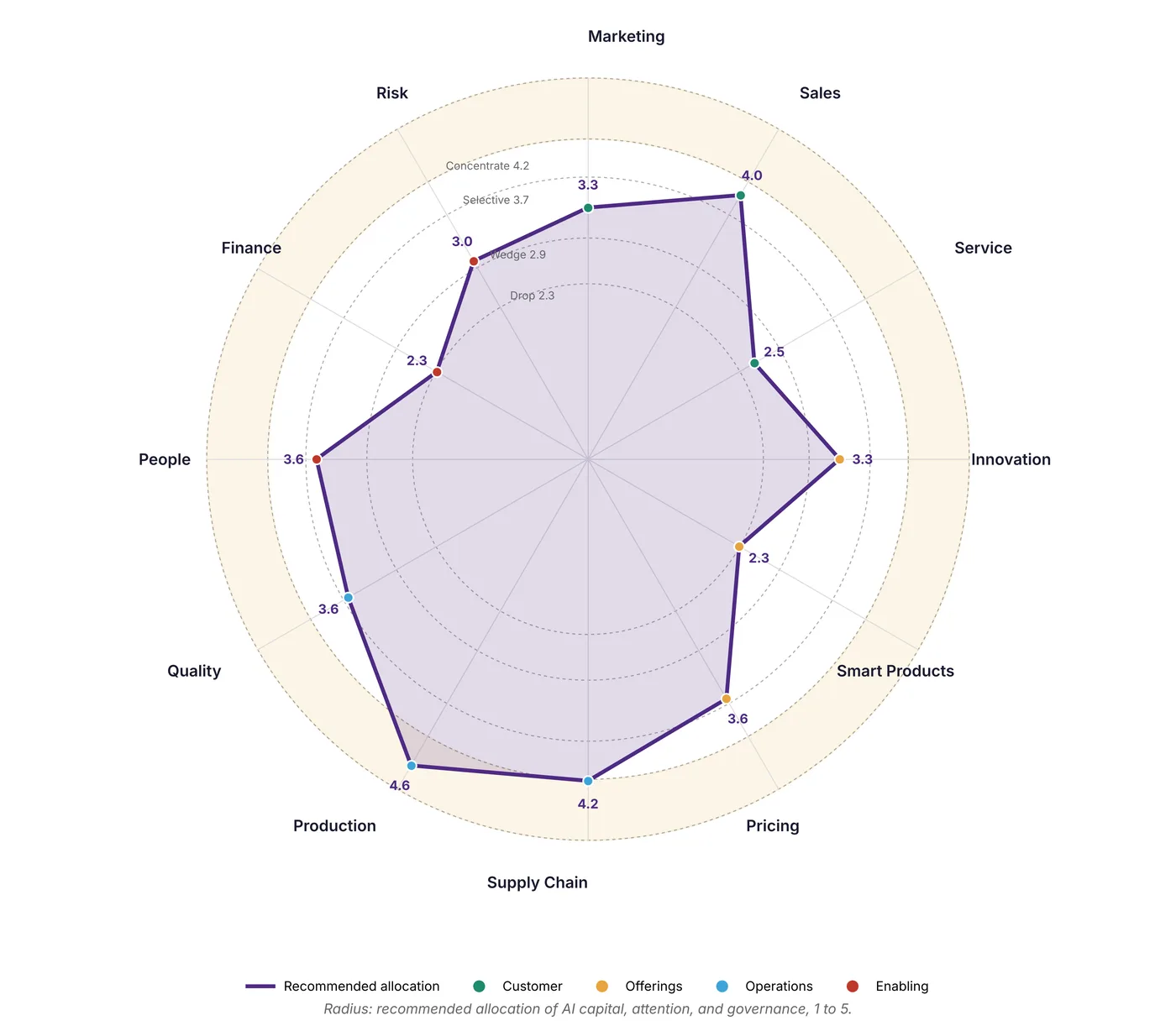
The polygon leans hard toward the operations anchor. It peaks at production and supply chain, holds a shoulder at sales, runs a wedge plateau through quality, pricing, people, marketing, innovation and risk, and falls away at service, smart products and finance. The actual-portfolio overlay, the Shape Drift Index (the share of the portfolio that would have to move to another dimension to match the recommended shape, equation 5) and the tilt by dimension are not drawn, because they require AI spend by dimension and the record shows no AI spend. What the record shows is where the digital money has gone. Of eight digital programs, three serve the customer anchor (the distributor system, the loyalty application and the planned CRM system), four serve the enabling spine (SAP, information security, environmental data and learning), and one serves operations, as automation of material handling. Read against the polygon, the revealed priority runs to the channel and the spine, and the operations anchor, where the allocation peaks, holds machines without models.
The stance this report takes is that, on the public record, the gap is an allocation failure, and a recoverable one. Astral discloses its plants, its capacities and its product launches in detail; an AI program on a line would be the kind of fact it publishes. The strongest counter-reading is that plant engineers already run statistical process control and gauging that do some of this work without calling it AI. That is plausible, and the starts in Section 4 would then begin from instruments already on the lines. The record does not show it, and until a quarterly review finds such a program the start stands.
4. What the business should grow, hold and stop, and how far each bet has come
No AI program can be evidenced in the plumbing business from the public record. The inventory in Table 4 is therefore of digital foundation programs, each homed to the dimension it would serve and staged on the same five absolute stages the instrument uses for AI programs: exploring (a sponsor and a scope, no committed budget or users), piloting (committed budget and a stated hypothesis, no measurement against a control group), scaling (production deployment with measurement in place), producing (full deployment with reported outcomes and a named owner) and compounding (a capability other programs build on). None of the eight runs a model on the record, so none counts toward the AI envelope under the use-case rule of Section 2. They are staged because the two starts stand on them. The four verdicts are grow, hold, fix-or-kill and stop; a start is an allocation act where a concentrate dimension carries no program. Past spend plays no part.
Table 4. The programs in flight and the starts: eight digital foundation programs with sponsor, dimension, evidenced stage, verdict and forward condition, and two AI starts.
| Program | Dimension | Sponsor | Stage | Verdict | Forward action and condition |
|---|---|---|---|---|---|
| SAP HANA enterprise system, live April 2026 | Finance | Chief financial officer | S3 | Hold, floor | Foundation spend outside the AI envelope; the deliverable the starts need is one item, plant and resin-lot master; the ten-day dispatch halt is the cutover lesson (Astral 2026e) |
| Distributor management system tracking secondary sales | Sales | Executive director, pipes | S3 | Grow | Fund from the sales budget as the data feed of the supply-chain start; metric is secondary sales visible by district and item (Astral 2026d) |
| Astral Loyalty Program app for plumbers, contractors and dealers | Sales | Pipes marketing | S2 | Grow, with a Stage 3 milestone | Live with points and identity checks, no member count or outcome disclosed; Stage 3 by September 2027: targeted plumber offers in test-cell districts against control districts, read on purchases linked to registered plumbers (Astral 2025b) |
| Planned CRM system for service calls | Service | Customer care | S1 | Hold, floor | Named as an opportunity with no committed budget; the desk runs as an operating function and the CRM investment gets no new money in a dropped dimension (Astral 2026b) |
| Plant automation: material handling, feeding and chiller control | Production | Manufacturing | S2 | Grow | The instrumentation layer for the production start; fund from plant capital expenditure; company statement only (Astral 2025b; Astral 2026b) |
| Digital system for environmental data | Risk | Sustainability | S3 | Hold, floor | Maintain; reasonably assured reporting since fiscal 2026 (Astral 2026b) |
| Information security and recovery site, ISO 27001:2013 | Risk | Information technology | S3 | Hold, floor | Certified, with no breach count reported and the 2022 standard targeted for 2026; extend to the loyalty data before the consent and notice duties of May 13, 2027 (Astral 2026b; AZB 2025) |
| Learning management system for safety training | People | Human resources | S3 | Hold, floor | Maintain; safety training reached 81 percent of employees and 86 percent of workers in fiscal 2026, with the EHS module on the ELMS (Astral 2026b) |
| Extrusion process and yield models | Production | Executive director, pipes, with the head of manufacturing | Start | Start | A sponsor and a budget line released in the current fiscal year, by January 2027; two matched lines at Dholka or Santej, one with models and one as control; resin per tonne of good pipe and start-up scrap as metrics; the Nexelon data design written into commissioning before construction completes in December 2026 and trials begin in the fourth quarter of fiscal 2027 |
| Resin and inventory planning on distributor data | Supply Chain | Chief financial officer, with the head of supply chain | Start | Start | A sponsor and a budget line; demand sensing for the fastest-moving items at the Kanpur and Hyderabad depots against the current forecast, and a resin position model; inventory loss per quarter and raw-material days as metrics |
Nothing on the board earns a stop and nothing earns a fix-or-kill. The money that exists went to foundations, and none of them is in the wrong place. The consequence is the harder conversation the instrument names: on the public record, no release of capital funds the two starts, so they will need new envelope unless the count in Section 9 finds AI spend already under way.
Two programs earn an unconditional grow, because they are the inputs the starts consume. The distributor system already tracks secondary sales, and the supply-chain start is a model on top of it. The plant automation is the instrumentation without which a yield model has nothing to learn from. The loyalty application earns a grow conditional on its Stage 3 milestone. Astral has spent at least four years on the program, and the only public evidence of its effect is a 2023 remark by Kairav Engineer that "our plumber-related activities and the Astral Loyalty Programme made a lot of difference" (Free Press Journal 2023). The test is cheap: choose districts, give targeted offers in some and hold others as control, and read the share of purchases linked to registered plumbers after two quarters.
The holds are floors. The SAP system, information security, environmental data, the learning system and the CRM plan each maintain an obligation or an asset other programs depend on. No program is a harvest.
4.1 How deep the portfolio is
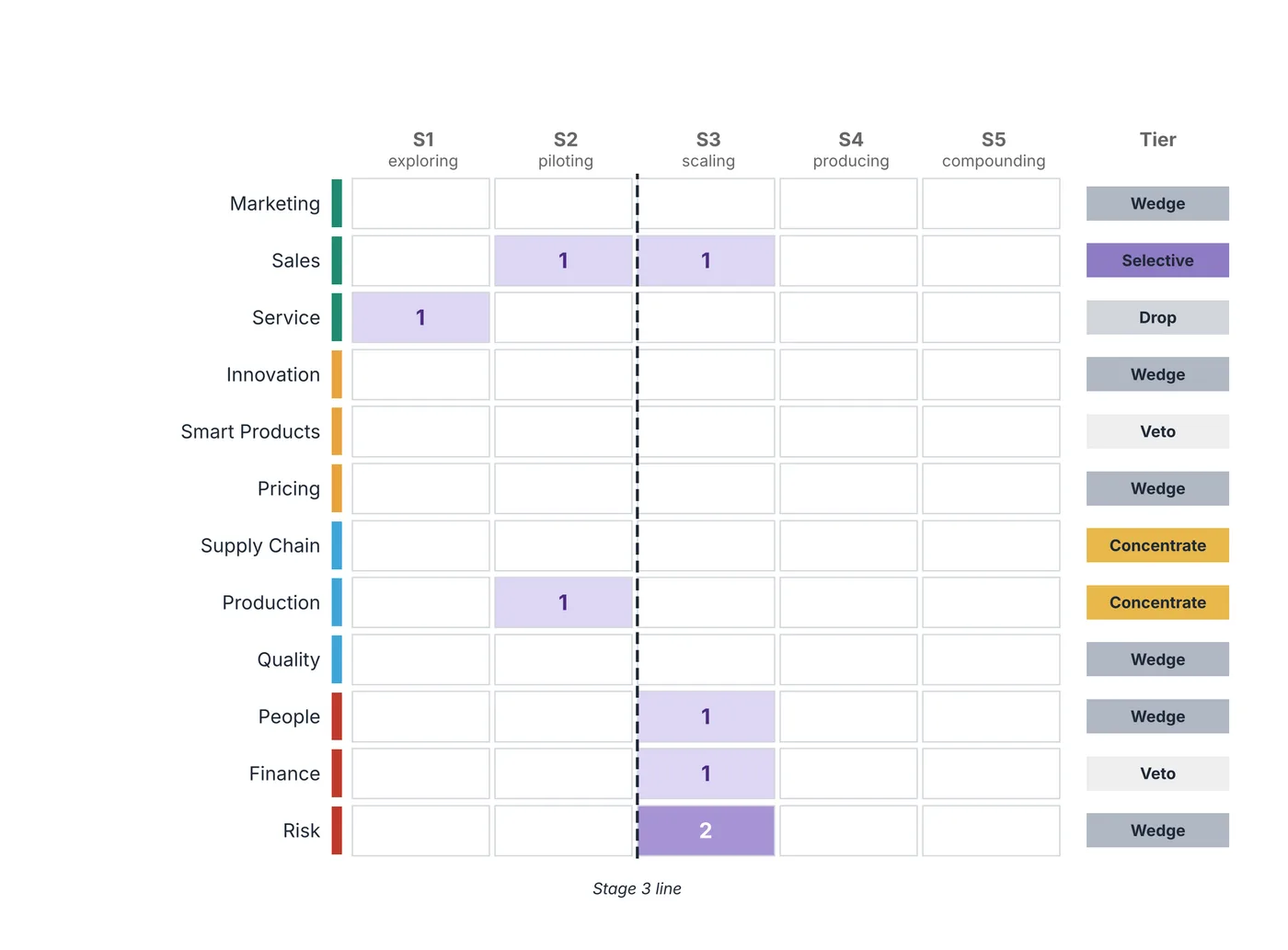
The depth reading for AI is not started: there is no AI program to stage. Of the eight foundation programs, five are at Stage 3 or beyond, 63 percent, with a mean stage of 2.5. That is a reasonable foundation, concentrated in the spine.
The three depth reads apply to the foundations and to the starts. Shallow where it matters: production and supply chain, the two concentrate dimensions, hold one program between them, plant automation at Stage 2, and no model. The next milestone for each start is Stage 3, two matched lines and a forecast against the current method, before more capital. Deep where it does not matter: none, because no program reaches Stage 4. Stalled: the loyalty application has run since at least 2022 with no disclosed measure; the quarterly review flags it until a member count or a test result appears.
4.2 The coverage question
No AI program owns production or supply chain end to end. Sales is covered on the data side by the distributor system and the loyalty application and uncovered on measurement. Quality, a wedge, is uncovered, and its first use is inside the production start at the resin plant, where lot consistency and traceability from pipe to resin lot become possible for the first time.
5. Where the business stands against the field
We found no AI program disclosed by Astral's listed pipe-making peers either, so the field is level on disclosure and uneven on foundations. Prince Pipes says it moved to a pull-based demand model and deployed a distributor management system and sales-force automation "to support data-led decisions," and it publishes the size of Udaan (IDBI Capital 2026; Prince Pipes 2026). Ashirvad, owned by Aliaxis, runs an app that carries points, learning and certification for plumbers, and its parent is building a greenfield plant in Hyderabad and integrated distribution centres in the east (Ashirvad 2026; Outlook Business 2025). Supreme Industries reports a commitment to digital transformation without programs, and Finolex's Q3 FY26 investor presentation is silent on technology (Investywise 2026b; Finolex 2026). On the plumber program Astral is behind Prince Pipes in disclosure; on distributor data it is level.
The frontier is in process plants and in adhesives. In Gujarat, DCM Shriram's chlor-alkali site shows what an Indian chemical process plant can earn from AI-enabled process control, and chlorination is the step the Nexelon plant adds to Astral's chain (WEF 2026). In adhesives, which belong to the second Radar, Pidilite set up an advanced analytics centre, an internet-of-things command centre in manufacturing, and dealer and user apps with about three lakh active dealers as early as 2022 (Pidilite 2022). Epigral has made CPVC resin at Dahej since 2022 and now runs 75,000 tonnes a year, and Lubrizol and Grasim opened a 50,000-tonne first phase at Vilayat in June 2026, so Astral's captive 40,000 tonnes will be benchmarked against two domestic suppliers from the first batch (ICIS 2024; Grasim 2026). The actionable gaps are the process models at the resin plant and the lines, and a measured plumber program.
6. What will move the outcomes
Each lead and selective dimension, and the quality bet inside the production start, carries a conversion contract of three fields: the outcome metric, the direction it should move and the lag in months before a movement is readable. The sponsor signs the three fields when a bet is funded, and the reading at the lag horizon feeds the next adjudication.
Table 5. The conversion contract for the lead and selective dimensions and the quality wedge inside the production start.
| Dimension | Outcome metric | Direction | Lag (months) | First reading |
|---|---|---|---|---|
| Production (start) | Resin consumed per tonne of good pipe and start-up scrap on the model line against the control line | Down | 6 to 18 | September 2027 |
| Supply Chain (start) | Raw-material inventory days, inventory gain or loss per quarter, forecast error on the fastest-moving items | Down | 6 to 18 | December 2027 |
| Sales | Purchases linked to registered plumbers in test-cell districts against control districts | Up | 3 to 6 | September 2027 |
| Quality (wedge) | First-pass yield of CPVC compound and conformance of resin lots at the Nexelon plant | Up | 6 to 12 | September 2027 |
The lags differ on purpose. A plumber test reads in two quarters; resin inventory reads only after the resin plant has run a full season of price movements, which is why its first reading falls in December 2027. The priced earnings bridge, which converts these movements into a profit range with unit coefficients and haircuts, belongs to the Innovation Radar 2.0 and is deferred.
7. What the business will not do
Smart products and finance are parked. A pipe carries no electronics, and a leak-sensing water tank would be a new business to be judged by a growth instrument; the dated trigger is a launched connected product with a revenue line. Finance is parked on the strategy ring, and the SAP system is the floor it needs; the trigger is the consolidation load of the resin subsidiary and the chemicals business if the demerger returns, which management puts at least five years out.
Service is dropped. Complaint handling is a floor, and the business reported no consumer complaints in fiscal 2026 (Astral 2026b). The CRM investment stays at run rate.
Marketing, innovation, pricing, quality, people and risk are wedges. In marketing the brand is built by endorsement and the channel; a narrow bet on content cost is the most it earns. In pricing the narrow bet is pass-through timing on resin moves, and it belongs inside the supply-chain start. In quality the bet is lot traceability at the resin plant, inside the production start. In people the floor is the learning system and a measured assistant in one function. In risk the floor is the consent and notice work on the loyalty data before May 13, 2027, an obligation under the data protection rules whatever the band.
8. Boundary cases and what would change the answer
Five scores fall near a band edge, three of them within the five-hundredths boundary. Supply chain composes to 4.22, inside the concentrate band by two hundredths, on a capability score of 3 that rests on aging forecast evidence; a fresh large-sample study of forecast accuracy would lift the capability score to 4 and the composite to 4.64, and a strategy score of 4 would drop it to 3.91, selective. The practical instruction holds on either side of the line, because the resin plant makes raw-material planning a new problem in fiscal 2028 whatever the band. Smart products and finance compose to 2.29, one hundredth below the floor; a strategy score of 3 for either would lift it to 2.6 and the drop band, which changes nothing that the business would fund. Pricing and quality compose to 3.63, seven hundredths below the selective edge; a capability score of 4 would lift either to 4.0.
The most sensitive judgment on the board is quality, where two readings are held below their defaults: the capability score at 3 against the shared library's 4, and the industry weight at 4 against the seed weight of 5. With the capability score at 4, quality composes to 4.0 and is selective; with both at their defaults it composes to 4.31, joins the concentrate band, and a third start for vision inspection and lot traceability would follow. We hold both because the industrial evidence for AI inspection is leader-level and bundled, and because the pipe industry's quality failures are rare and its material giveaway is a production pool. The resin plant could change that: if the first lots vary, quality becomes the binding constraint on CPVC margins and the weight moves. An independent, multi-firm study of AI inspection outcomes would move the capability score.
The shared capability library moved on September 14, 2026, when risk rose from 3 to 4 on voluntary agent-control standards. This reading holds risk at 3, and quality at 3, as method decisions under the evidence protocol's rule that announcement-grade sources cannot carry a score above 3 and its test for broadening adoption; at 4, risk would compose to 3.30, still a wedge. The smart-products capability score of 3 is the library's own caveat for physical products. Production is held at 4 on industrial anchors. The industry-ring refinement of Section 3.1 is a method change and is reported as one.
The triggers for an early reading are six: the first stable quarter of the resin plant, expected in the first half of fiscal 2028; any AI or analytics program disclosed by Astral; a decision to revisit the demerger, which management puts at least five years out and which would move the second Radar to a separate company; the ISO 27001:2022 transition targeted for 2026; the January 2027 BCG benchmark, which re-runs the bracket; and May 13, 2027, when the data protection duties take effect.
9. What happens next
The ninety-day actions are five, each with an owner.
- Kairav Engineer, executive director for pipes, with the head of manufacturing, names a sponsor, two matched extrusion lines and a budget line released by January 2027 for the production start, and signs the production contract.
- The Nexelon plant leadership writes the data design for the resin plant (process tags, laboratory results, lot identity carried to the compound and the pipe) into commissioning before construction completes in December 2026 and trials begin in the fourth quarter of fiscal 2027, and signs the quality contract.
- Hiranand Savlani, chief financial officer, with the head of supply chain, names the sponsor of the planning start on distributor data and the resin position, and signs the supply-chain contract.
- The pipes marketing head designs the test-cell and control districts for the loyalty program, and the information security owner completes the consent and notice review of loyalty data ahead of May 13, 2027.
- The finance team counts AI spend at the use-case layer, so that the next reading can place it inside the bracket in Table 1.
The quarterly portfolio review reads each funded bet's metric at its own lag, re-reads every program's stage, and flags any program that has not advanced in four quarters; the loyalty application enters the first review already flagged. The next full reading is the annual refresh in October 2027, or earlier on any trigger in Section 8. This reading is stamped as the baseline. The paints and adhesives segment can be read as a second Radar on request, against the adhesives frontier that Pidilite sets.
Appendix A. Evidence and Citations by Ring
The depth tier is Pro on the strategy ring and DIY on the data-and-workflow sub-score. Tiers follow the evidence protocol: A, filed or assured company documents, regulators, statistical and reference-rate sources, and peer-reviewed, large-sample or lighthouse production evidence; B, broker, analyst and consulting research; C, earnings-call disclosures, investor presentations, press releases, company web pages and vendor material; D, trade press and aggregators. Entries marked [snippet] were verified from a search result or a secondary summary; entries marked [library] are carried from the shared capability library of September 14, 2026 or from an October 12, 2026 Sawhney Enterprises verification of that library, and were not re-fetched here. Dates are publication dates; pages without one carry the access date of October 12, 2026.
Where this reading departs from the prior reads. An earlier Sawhney Enterprises public-record reading of Astral treated it as one company, on consolidated revenue of about 746 million dollars at 88 rupees. The board's June 2026 demerger scheme, and a withdrawal that cited scale, the consultant's advice, stakeholder feedback and the business environment without disputing the difference in economics, are the evidence that the chemicals business runs a different value chain, so this report scopes plumbing on 487 million dollars at the October 2026 rate of 96. The earlier reading staged the loyalty application as an AI program at Stage 1; it runs no model on the record and is staged here as a digital foundation program at Stage 2, because a live national deployment with paid points shows committed budget. The industry ring was refined for Indian pipe making where the earlier reading used the seed vector; quality moved from concentrate at 4.31 to a wedge at 3.63, on an industry weight of 4 and a capability score held at 3, and service and smart products moved from wedges to drop and veto on weights of 2. Supply chain moved from selective at 3.91 to concentrate at 4.22 on a strategy score of 5, read from the decentralisation priority and the resin plant's inventory purpose. Marketing's strategy score moved from 4 to 3, because the record names brand spend and no AI role for it. The earlier reading did not find the SAP HANA cutover, the demerger and its withdrawal, the slip of the resin plant from the second quarter of fiscal 2027 to construction completing in December 2026 with trials in the fourth quarter, or Motilal Oswal's reading that the plant will meet 50 to 60 percent of the CPVC requirement; each is added. It sized three starts at 5.5 to 7.0 million dollars against an unread envelope; this report gives the bracket and leaves the program budgets to the sponsors. Its industry peers, ASSA ABLOY and Fortune Brands, are replaced by the Indian pipe makers, and its employee count of 4,886 from a database by the business responsibility report's 4,611 permanent employees and 288 permanent workers. Rejected on provenance: templated internship listings naming Astral on an aggregator site, and an SAP partner profile of a different company named Astral.
Audit note, October 12, 2026. An independent audit of this reading was applied in full before release. It corrected the board-approval date to June 25, 2026 and the grounds of the withdrawal; separated channel-partner growth from town coverage (13,000 towns against a target of 20,000), with the sales strategy score re-tested and held at 4; replaced software-development anchors for production with industrial lighthouse evidence; held quality and risk capability at 3 for want of a valid anchor, which moved quality from selective to wedge; restaged information security to Stage 3 and the CRM plan to Stage 1; corrected the BRSR figures, the capacity figure, the chain-ratio bracket, the resin-plant timeline and the funding wording of the starts; and added primary or dated sources for the demerger, the domestic CPVC resin suppliers, Kanpur and the BCG baseline.
Ring 3, the company record.
- Astral 2026a. Astral Limited, Annual Report 2025-26, filed July 31, 2026. Vision; six strategic priorities; chairman on the captive 40,000-tonne CPVC resin plant, import dependence and currency exposure, benefit from FY28; CFO on decentralised manufacturing and supply chain agility; plumbing revenue 46,787 million rupees, EBITDA 9,166 million; pipes, water tanks and bathware capacity 4,21,445 tonnes; risk table (technology, cybersecurity, raw materials, competition); 21 plants across both segments; 3,990+ distributors; we found no use of automation, analytics or artificial intelligence. astralltd.com. Tier A.
- Astral 2026b. Business Responsibility and Sustainability Report FY2025-26, filed July 31, 2026, reasonable assurance on BRSR Core. 4,611 permanent employees, 288 permanent workers, 6,317 others; ISO 27001:2013 with the 2022 transition targeted for 2026; disaster-recovery site; CRM team for pipe and bathware calls; "invest in CRM systems" as an opportunity; nil consumer complaints; zero breaches stated as a target; safety training reached 81 percent of employees and 86 percent of workers, with an EHS module on the ELMS. nsearchives.nseindia.com. Tier A.
- Astral 2026c. Investor Presentation, May 2026. Plumbing volume 263.03 kilotonnes against 227.09; revenue, EBITDA and PBT by segment (paints and adhesives revenue 18,899 and EBITDA 1,926 million rupees); SKUs 6,939 to 8,103; capacity by plant (Kanpur 19,037; Hyderabad 26,124; Cuttack 31,862; Jamnagar bathware 1,055; Khambhat 11,686 upcoming); 54 depots; about 13,000 towns against a target of 20,000; trade-led to consumer-led shift; FY27 guidance. astralltd.com. Tier C.
- Astral 2025a. Q2 FY26 results conference call transcript, November 6, 2025. Volume +20 percent; "not going to sell at any price"; "following the distribution led model"; per-kilogram profit refused as the measure; resin plant could double to 80,000 tonnes; Nuvama question on advertising. astralltd.com. Tier C.
- Astral 2026d. Q3 FY26 earnings conference call transcript, February 5, 2026. Volume +17 percent, margin 18.2 percent; inventory loss 20 to 25 crore rupees; of a 7-rupee PVC increase, 5 rupees passed through and the rest due within days; "we are tracking the secondary demand through our DMS"; OPVC machine "with our own in-house technology"; resin plant to "gain market share"; "the best margins." astralltd.com. Tier C.
- Astral 2026e. Q1 FY27 earnings call transcript, August 12, 2026, astralltd.com (Equirus-Astral-Aug12-2026). Participants include Saumya Engineer, Chief Executive Officer, Adhesives and Paints. "We implemented our new SAP HANA" and "our business operation was ... practically shut for the dispatch for 10 days"; flat volume against a market down about 10 percent; July volume +40 percent; margin 18.9 percent; resin plant construction complete "by December end," trial runs and stabilisation in Q4; capital spending of 300 to 350 crore rupees for FY27; demerger only at "not less than INR5,000, INR6,000 top line," "minimum 5 years." Tier C.
- Astral 2025b. "How Astral Pipes is Leading Innovation in the Plumbing Industry," astralpipes.com, July 4, 2025. Astral Loyalty Program for plumbers, contractors and dealers; points on pre-GST purchase value; KYC in the app; "automated material handling and feeding systems." Tier C.
- Astral 2023. Press release on Q1 FY24 results, August 11, 2023. SAP implemented at Gem Paints from April 1, 2023; dealer KYC across all dealers and a "sizeable sales loss." Tier C.
- Astral n.d. Profile of Kairav Engineer, astralltd.com, accessed October 12, 2026. Oversees pipes, bathware and water tanks; brand communications; new products. Tier C.
- Free Press Journal 2023. "Our aim is to involve the end consumer in purchase decisions: Kairav Engineer," January 9, 2023. Loyalty programme "made a lot of difference"; advertising 1.5 to 2 percent of sales. Tier D.
- Axis 2026a. Axis Securities, Astral Q4FY26 Result Update, May 21, 2026. Plumbing revenue +25.8 percent, volume +24 percent, margin 22.8 percent; BUY, 1,750 rupees. Tier B.
- Axis 2026b. Axis Securities, Astral Q1FY27 Result Update, August 13, 2026. SAP HANA disrupted dispatches for about ten days in April; capex 137 crore rupees (plumbing 87, resin 16); FY27 guidance; BUY, 1,750 rupees. Tier B.
- ICICI Securities 2025. Astral Q1FY26 Result Update, August 13, 2025. Nexelon project cost 150 crore rupees, Astral 120 crore; commercial production targeted Q2FY27; inventory from about 90 days to one or two weeks; inventory loss about 25 crore rupees. Tier B.
- ICICI Securities 2026a. Astral Q1FY27 Result Update, August 13, 2026. Plumbing volume 56,146 tonnes, largely flat; margin 18.9 percent; raw materials 938 crore of 1,578; 2.7 lakh dealers, 3,990+ distributors; BUY, 1,830 rupees. Tier B.
- ICICI Securities 2026b. Company update, September 23, 2026, as summarized by DSIJ. Healthy pipe demand in Q2 FY27; resin plant commercial production Q4 FY27; failure to commercialise listed as a risk; BUY, 1,831 rupees. Tier B [snippet].
- Motilal Oswal 2026. Astral Q4FY26 update, May 20, 2026, as reported June 12, 2026. FY26 volume 263 kilotonnes, +16 percent; resin plant to meet 50 to 60 percent of the CPVC requirement; about 200 basis points of margin; BUY, 1,950 rupees. Tier B [snippet].
- PL Capital 2026a. Prabhudas Lilladher, Astral Q4FY26 Result Update, May 19, 2026. Pipe volume +24.2 percent; margin 22.9 percent; resin plant full benefit FY28; BUY, 1,813 rupees. Tier B.
- PL Capital 2026b. Prabhudas Lilladher, Astral Q1FY27 Result Update, August 12, 2026. Share gains against an industry down 9 to 10 percent; Hyderabad at about 50 percent; BUY, 1,684 rupees. Tier B.
- BOBCAPS 2026. BOB Capital Markets, Astral Q4FY26 Result Review, May 21, 2026. Channel partners +20 percent; BOBCAPS states reach of 20,000 towns, against the company's 13,000 current and 20,000 target; only domestic CPVC pipe maker with captive resin; execution risk on resin and Khambhat; BUY, 1,700 rupees. Tier B.
- Anand Rathi 2026. Astral Q1FY27 result note, August 13, 2026, as summarized by DSIJ. Ten-day dispatch disruption during the SAP HANA implementation; CPVC volumes up high single digits; HOLD, 1,650 rupees. Tier B [snippet].
- Sharekhan 2026. Stock idea, February 9, 2026. Resin plant to "deliver better margins than existing CPVC manufacturers"; about 1,400 crore rupees of capex over four years; decentralised manufacturing. Tier B.
- Indian Chemical News 2025. "Astral to acquire 80% in Nexelon Chem," August 12, 2025. Stake, up to 120 crore rupees of investment; Nexelon incorporated 2023 to make CPVC resin. Tier D.
- Tijori Alerts 2026. "Astral Ltd board approves composite scheme to demerge chemicals business," June 25, 2026, with the company's July 5 and July 29, 2026 disclosures. Board approval on June 25; chemicals to Astral Chemie, 1:1; Al-Aziz Plastics to be amalgamated into Astral; independent review with an appointed adviser on July 5; withdrawal on July 29. Tier D (reports exchange filings).
- Indian Chemical News 2026a. "Astral plans chemicals demerger into Astral Chemie," June 29, 2026. Scope of the chemicals business; plumbing stays; rationale. Tier D.
- Multibagg 2026. "Astral demerger: Stock drops 8% on 1:1 Chemie plan by FY27," June 29, 2026. "Sharper business focus, improve capital allocation and support margin improvement"; chemicals 1,266 crore rupees in FY26; JPMorgan to Neutral. Tier D.
- Angel One 2026. "Astral share price drops nearly 9 percent after chemicals business demerger announcement," June 29, 2026. Tier D.
- ScanX 2026. "Astral withdraws chemical business demerger scheme on consultant advice," July 29, 2026. First approval June 25, 2026; consultant "recommended against proceeding with the scheme in its present form"; "lacks the necessary scale and financial strength"; feedback from shareholders, investors and market participants; "the prevailing business environment." Tier D.
- ScanX 2025. "Astral Limited expands manufacturing footprint with new Kanpur plant," October 6, 2025, quoting the exchange filing: commercial production from October 6, 2025. Tier D.
- Investywise 2026a. "Astral Limited Acquires 60% Stake in Specialty Chemicals Firm DSS," June 11, 2026. Through Astral Chemie; 39.11 crore rupees; Vilayat, Bharuch; polyamines, bismaleimides, benzoxazines. Tier D.
- Sahi 2026. "Astral Limited expands chemical footprint via 60% DSS LLP acquisition worth 39.11 crore," June 11, 2026. An agreement to acquire; no completion on the record. Tier D [snippet].
- Frankfurter 2026. ECB reference rate, US dollar to Indian rupee, October 12, 2026: 95.78. api.frankfurter.dev. Tier A.
- ExchangeRate-API 2026. Open market rate, US dollar to Indian rupee, as of October 12, 2026: 96.96. open.er-api.com. Tier C.
Ring 2, the industry overlay and the envelope benchmark.
- Business Standard 2025. "Supreme Industries, Astral stock outlook on PVC anti-dumping duty," August 21, 2025. Domestic PVC capacity 1.8 million tonnes against demand of 4.7 million; Q1 FY26 inventory losses (Astral 25 crore, Supreme about 50 crore). Supports Supply Chain 5 and Pricing 4. Tier D.
- PwC India 2026. "Rewriting the rules: The next chapter of Indian industrial manufacturing," as reported by Business Today, July 29, 2026; the report itself was not retrieved. Planned automation: data capture and analytics 82 percent, quality assurance 69, planning and forecasting 65, customer interactions 63. Supports Quality 4. Tier B [snippet].
- Prince Pipes 2026. Prince UDAAN loyalty program page, accessed October 12, 2026. Launched November 2016, digital 2018, UDAAN 2.0 August 2024; over 1.5 lakh members; over 125 crore rupees in rewards. Supports Sales 4. Tier C.
- Ashirvad 2026. Ashirvad Experts Club page, accessed October 12, 2026. Dealer-to-plumber points by QR scan and OTP; learning and certification in the app. Supports Sales 4. Tier C.
- IDBI Capital 2026. Prince Pipes Q1FY27 Result Review, August 5, 2026. Volume -7 percent; distributor management system and sales-force automation "to support data-led decisions." Tier B.
- ICICI Securities 2026c. Supreme Industries Q1FY27 Result Update, July 29, 2026. Piping volume -15 percent; FY27 guidance of 15 to 17 percent; no technology disclosure. Tier B.
- Investywise 2026b. Supreme Industries FY2025-26 Annual Report highlights, June 1, 2026. 6,07,487 tonnes of pipe, +15 percent; "digital transformation" as a commitment. Tier D.
- Finolex 2026. Finolex Industries investor presentation, Q3 FY26, January 31, 2026. Volume -14 percent; no technology disclosure. Tier C.
- Outlook Business 2025. "Aliaxis calls India its 'most realistic growth market'," November 19, 2025. India about 15 percent of a 4 billion euro group; Hyderabad greenfield; integrated distribution centres; "What we do not want to do is buy market share." Tier D.
- Pidilite 2022. Pidilite Industries investor presentation, February 9, 2022. Advanced analytics centre; IoT command centre; dealer and user apps with about three lakh active dealers and 2.5 lakh users. Tier C.
- Grasim 2026. Grasim Industries press release, "Grasim and Lubrizol inaugurate CPVC resin plant at Vilayat," June 16, 2026. Phase 1 of 50,000 tonnes a year at Grasim's chlor-alkali complex, Vilayat, Gujarat. Tier C.
- ICIS 2024. "India's Epigral commissions 45,000 tonne/year chlorinated PVC resin line," April 4, 2024. Total CPVC resin capacity 75,000 tonnes a year at Dahej, Gujarat. Tier D.
- WEF 2026. World Economic Forum, "New Global Lighthouse Sites Demonstrate How AI Is Rewiring Manufacturing and Supply Chains," June 22, 2026. 238 sites; DCM Shriram, Gujarat: EBITDA +11 points, power cost -32 percent; Rockwell Automation Singapore: AI-enabled quality control among more than fifty solutions, defects -35 percent. Supports Production 5 (industry) and Production 4 (capability). Tier A.
- Indian Chemical News 2026b. "DCM Shriram Jhagadia plant joins global elite of manufacturing lighthouses," June 24, 2026. AI-enabled process control and a GenAI maintenance manager among 45 solutions; "an 11-percentage-point improvement in EBITDA"; power costs -32 percent; material costs -15 percent. Tier D.
- SIKORA 2025. Press release ahead of K 2025, June 16, 2025. CENTERWAVE 6000 radar gauging, material reduction of up to 8 percent; X-RAY 6000 PRO C-PIPEAI with AI-supported software for start-up scrap. Vendor claims, ceiling only. Tier C.
- Extrusion-info 2024. "Sikora presents system for the measurement of corrugated pipes," May 24, 2024. AI-based evaluation of X-ray data; no quantified outcome. Tier C.
- AZB 2025. AZB & Partners, "India's Digital Personal Data Protection framework comes into effect," November 19, 2025. Rules notified November 13, 2025; consent managers November 13, 2026; substantive duties May 13, 2027. Tier B.
- BCG 2026a. BCG press release, "As AI Investments Surge, CEOs Take the Lead," January 15, 2026. 2,360 executives, 16 markets; about 1.7 percent of revenue planned for 2026; industrial and real estate at 0.8 percent; roughly three-quarters of Indian CEOs confident AI will pay off; more than 30 percent of AI investment to agents. Self-reported plans. Tier B.
- BCG 2026b. BCG Applied AI Index 2026, September 30, 2026, as reported by People Matters. 1,330 executives; 3.3 percent of revenue; more than 80 percent outside the IT budget. Tier B [library].
- Avasant 2025. IT Spending and Staffing Benchmarks 2025/2026. Median IT spend 2.9 percent of revenue; AI 1.9 percent of the IT budget. Tier B [library].
- McKinsey 2026. The State of AI in 2026, August 25, 2026, n=1,719. 28 percent spend more than 10 percent of the technology budget on AI; high performers twice as likely to exceed 15 percent. Tier B [library].
- Menlo Ventures 2025. The State of Generative AI in the Enterprise, December 9, 2025. Measured floor: 37 billion dollars of US enterprise generative-AI spend in 2025. Tier B [library].
Ring 1, the capability frontier.
- McKinsey 2024. "How manufacturing's Lighthouses are capturing the full value of AI," April 9, 2024. 21 newest lighthouses and more than 50 applied AI use cases; CITIC Pacific Special Steel blast-furnace AI, throughput +15 percent; VitrA Karo kiln computer vision, scrap -68 percent; Agilent computer vision across 57 work centres, defect rate -49 percent in under four months. Supports Production 4 with WEF 2026; leader-level evidence for Quality, insufficient alone for a 4. Tier B.
- Microsoft and Edelman 2026. 2026 Work Trend Index, May 5, 2026, n=20,000. Agent usage up 15 times; organisational design explains twice the variance of individual effort. Supports People 5. Tier A [library].
- Dell'Acqua, McFowland, Mollick et al. 2026. Preregistered randomized trial of the jagged technological frontier, Organization Science, March 11, 2026, n=758. 22 to 34 percent gains inside the frontier. Supports People 5. Tier A [library].
- Anthropic 2026. Economic Index, June 26, 2026. 93 percent of conversations produce a work artifact. Supports People 5. Tier A [library].
- Google Cloud DORA 2026. ROI of AI-Assisted Software Development, May 11, 2026, about 5,000 respondents. Cross-cutting software evidence, not dimension-specific for this business. Tier A [library].
- METR 2025. Developer productivity randomized trials, July and December 2025. Cross-cutting software evidence, not dimension-specific for this business. Tier A [library].
- arXiv 2026. "Security in the Age of AI Teammates," arXiv 2601.00477, January 2026, n=33,000+ pull requests. Software code quality; not used for this business's Quality score. Tier A [library].
- Salesforce 2026a. State of Sales, February 3, 2026, n=4,050. 87 percent use some AI; 54 percent deployed agents. Supports Sales 4. Tier A [library].
- Salesforce 2026b. State of Service, sixth edition, May 2026 (Spanish-language release May 26, 2026), n=3,075. Agent adoption 39 to 66 percent. Supports Service 4. Tier A [library] [snippet for the date].
- Gartner 2026a. CMO Spend Survey, May 11, 2026, n=401. AI 15.3 percent of marketing budget. Supports Marketing 4. Tier B [library].
- Gartner 2026b. Supply Chain Leaders Survey, February 25, 2026. Holds Supply Chain at 3 on aging outcome evidence. Tier B [library].
- Growth Unhinged 2026. State of B2B SaaS and AI Monetization, May 2026, n=230+. Holds Pricing at 3. Tier B [library].
- Gartner 2026c. CFO survey, May 28, 2026, n=204. Holds Finance at 3. Tier B [library].
- McKinsey 2026b. State of AI Trust in 2026, March 25, 2026, n about 500. Responsible-AI maturity 2.0 to 2.3; supports caution on Risk, held at 3 for this business. Tier B [library].
- OWASP 2026. Agent Control Standard and 2026 LLM Top 10, August 3, 2026. The event behind the library's Risk 4; an announcement-grade source that cannot carry a score above 3 alone. Tier C [library].
- ICONIQ 2026. State of AI 2026, Q2 2026. Software-only evidence for Smart Products; the physical-product caveat applied here. Tier B [library].
- Deloitte 2026. State of AI in the Enterprise 2026, n=3,235. Holds Innovation at 3. Tier B [library].
- McKinsey 2026c. The State of AI in 2026, August 25, 2026, n=1,719. 37 percent report any EBIT impact; usage outruns value. Cross-cutting. Tier B [library].
Ring 1 refresh note. The shared library moved risk from 3 to 4 on September 14, 2026. This reading holds risk and quality at 3 and smart products at 3 as method decisions under the evidence protocol, and anchors production at 4 on industrial lighthouse evidence (sources 45 and 55).
Appendix B. Mathematics
The seven equations define the quantities used in the body. Equations (2), (3), (5), (6) and (7) need the actual portfolio by dimension, which is not public, and are stated so that the reading can be completed once the envelope is counted.
C_d = \sqrt[3]{R^{(1)}_d \, R^{(2)}_d \, R^{(3)}_d}(1)The composite for dimension d is the geometric mean of the capability, industry and strategy ring scores, so a floor on any ring parks the dimension whatever the other two say.
\mathrm{AII} = k = \frac{\sum_{d=1}^{12} a_d}{\sum_{d=1}^{12} r_d} = \frac{\bar{a}}{\bar{r}}(2)The AI Investment Index is the ratio of the mean actual radius \bar{a} to the mean recommended radius \bar{r}; between 0.9 and 1.1 the envelope is adequate, below 0.75 it is severely short.
E^{*} = \beta \, m \, S, \qquad G = (1-k)\,E^{*}(3)The required envelope E^{*} is the peer baseline \beta times the posture multiplier m times revenue S; the funding gap G is the shortfall implied by the index.
s^{a}_d = \frac{a_d}{\sum_{j=1}^{12} a_j}, \qquad s^{r}_d = \frac{r_d}{\sum_{j=1}^{12} r_j}(4)The shares express each polygon's radii as fractions of its own total, which removes the size effect before shape is read.
\mathrm{SDI} = \tfrac{1}{2} \sum_{d=1}^{12} \left| s^{a}_d - s^{r}_d \right|(5)The Shape Drift Index is the total variation distance between the two share vectors: the share of the portfolio that must move to match the recommended shape.
g_d = a_d - r_d = (k-1)\, r_d + \left( a_d - k\, r_d \right)(6)Each spoke's raw gap splits without residual into a size part, in proportion to its recommendation, and a mix part, the reallocation argument proper.
\sum_{d=1}^{12} \left( a_d - k\, r_d \right) = 0, \qquad \mathrm{SDI} = \frac{\sum_{d=1}^{12} \left| a_d - k\, r_d \right|}{2 \sum_{d=1}^{12} a_d}(7)The mix parts sum to zero, and half their absolute sum over the actual total equals the Shape Drift Index, so the two indices are halves of one identity.
References
Sawhney, Mohanbir. 2026. The AI Radar: A Portfolio Framework for Diagnosing the Level and Allocation of Enterprise AI Investment. SSRN Working Paper, July 27, 2026. https://ssrn.com/abstract=7244301.
Sawhney, Mohanbir. 2026. The Innovation Radar 2.0: A Framework for Measuring and Diagnosing Business Innovation. SSRN Working Paper. https://ssrn.com/abstract=7244520.
Sawhney, Mohanbir, Robert C. Wolcott, and Inigo Arroniz. 2006. "The 12 Different Ways for Companies to Innovate." MIT Sloan Management Review 47 (3): 75–81.
AI Radar 2.0 (Sawhney Enterprises). Scores, drift, and recommendations grounded in evidence as of October 12, 2026.