Full diagnostic. AI Project Portfolio Diagnostic and Recommendations for Axtria. Public-record research pass and top-up pass, October 2026.
A sample Radar from the public record
AI Project Portfolio Diagnostic and Recommendations for Axtria, Sawhney Enterprises, October 2026, public-record research pass with a top-up pass. Axtria is privately held; revenue, margin and AI spend are not disclosed, so size and shape are not read. Program stages rest on the evidence, with Axtria's claimed stage recorded beside each. An independent verification pass checked every citation and number before release.
Context
This report diagnoses the AI project portfolio of Axtria Inc., the privately held provider of data, analytics and AI software and services for the commercialization of medicines, and recommends where the business should concentrate its AI investment and how far each program in flight has come. It applies the AI Radar 2.0, a portfolio framework that asks three questions of a firm's AI investment: whether the firm is investing enough for the ambition it has declared, whether the investment is going where its strategy says it should, and how far its programs have advanced on a maturity scale that compares across firms. The framework scores twelve dimensions of the enterprise on three rings, what AI can do today, what the industry's economics reward, and what the firm's own strategy values, composes them multiplicatively into a recommended allocation, adjudicates the portfolio in flight against that allocation, reads the level and the allocation of investment as size and shape, and reads the maturity of the programs in flight as depth. Axtria publishes no revenue, margin or AI spend, so this report reads the strategy, the programs and their depth from the public record and states where size and shape cannot be read. The method is set out in Sawhney, M. (2026), The AI Radar: A Portfolio Framework for Diagnosing the Level and Allocation of Enterprise AI Investment, SSRN Working Paper, July 27, 2026, https://ssrn.com/abstract=7244301.
Executive Summary
Axtria has staked its next chapter on one proposition: drug companies will pay for AI that runs inside their commercial operations, and the supplier that wins will both build the software and send its own engineers into the client to make it work. In the eighteen months to October 2026 the company launched an agentic analytics platform, built a governance layer for agents with LangChain, bought a CRM services firm, shipped agents inside its data and marketing products, and set a target of 1,000 forward deployed engineers by December 2026. The strategy is coherent and this diagnostic endorses its direction. The public record does not yet show that the AI works at scale. Of ten AI programs we can identify, one reports a result against a control group, at one unnamed client, on Axtria's word alone. The engineering target is stated as a headcount, and independent workforce data show Axtria's total headcount flat to slightly down in the year to March 2026 (a decline of between 2 and 5 percent in Revelio Labs' series, depending on the baseline, and about 1 percent in LinkedIn counts). A company that sells measured outcomes to its clients has published almost none of its own, and that is the central finding.
The diagnostic asks three questions. Is Axtria investing enough? We cannot say, because the company discloses neither revenue nor AI spend; for a firm of its ambition the benchmark implies about 4.2 million dollars of AI spend a year for every 100 million dollars of revenue on its own operations, before the product development that makes Axtria's software intelligent. Is the investment going where the strategy says? The direction matches: the areas of the enterprise where AI capability, the economics of an AI-native software and services firm and Axtria's strategy align are the intelligence in the products, the delivery of work to clients, and the skills of its people, and that is where the programs are. How far have the programs come? One of ten has reached the third of five maturity stages, the stage at which results are measured against a comparison group, and only provisionally, on Axtria's own account. The Radar calls a portfolio with fewer than a quarter of its programs at that stage shallow, and Axtria's is.
Four findings matter. First, the claims Axtria makes about its own scale stand mostly on its own word: no named client stands behind its platform outcome figures, one release claims "over two decades of commercialization expertise" for a company founded in 2010, and its analyst standing rests on a 2025 Everest Group assessment that places it among ten Leaders, alongside ZS, IQVIA and Indegene, on Everest's own data, since Axtria did not submit inputs. Second, the forward deployed engineering program is announced against an input, a headcount, when its economics depend on outputs: deployments per engineer, time to production and reuse of platform components, the measures that separate a software margin from a services margin. Third, the platform launched in April 2025 with more than thirty agents has produced no named-client outcome in eighteen months, a gap in evidence even if not in use. Fourth, the governance message Axtria takes to clients (fix the foundation before scaling agents) sits uneasily with its own engineer careers page, which tells candidates to push updates "live to production, no pilot environment, no sandbox". The first three are execution findings; none calls for moving money between areas.
We recommend that Axtria lead with smart products, delivery and people, and change how it manages each. Grow the next-best-action engine, the agent platform and the new data-management agents on condition of a published read at named clients; restructure the forward deployed engineering program around output targets with a review on March 31, 2027; grow the Axtria Institute against a certification-to-deployment rate; grow the agent governance layer in step; hold the CRM business as a floor through the Veeva migration wave; and decide by June 2027 whether the domain-trained language models earn their keep. Nothing earns a stop. Leadership must decide whether Axtria will publish evidence program by program before December 2026 locks its cost base around the engineering model. The 90-day commitments are a measurement plan for the engineers, two client-approved outcome publications, and an AI spend count that separates product development from the use of AI in Axtria's own delivery.
1. How the business is positioned to absorb AI
Axtria sells to the commercial side of drug companies: the functions that decide which physicians to call on, what to say to them through which channel, how to align and pay a sales force, how to forecast a launch, and how to govern the data beneath all of it. The company was founded in 2010 by Jaswinder (Jassi) Chadha, its president and chief executive, and Navdeep (Navi) Chadha, its co-founder and chief technology officer (Axtria 2025d; Venture Intelligence 2025). It is headquartered in Berkeley Heights, New Jersey, and delivers most of its work from India, where it runs centres in Gurugram, Noida, Bengaluru, Pune and Hyderabad (Outlook Business 2023; Axtria 2024). The business is one value chain from data to field execution, and it is scoped here as one business: there is no second value chain with different economics to separate out. One offering falls outside it. Axtria Rapid CSR applies generative AI to clinical study reports, which belongs to the research and development value chain of its clients (Axtria 2026n); it is excluded from this diagnostic and its presence is noted in Section 7.
1.1 The business and the record behind it
Axtria's products cover the commercial chain. DataMAx manages and governs commercial data, with a variant for emerging companies; InsightsMAx.ai is the agentic analytics platform launched in April 2025 with more than thirty agents, apps and interfaces; SalesIQ handles sales planning, territory alignment and operations; MarketingIQ measures promotional channel effectiveness; and CustomerIQ produces next-best-action recommendations for physician engagement (Axtria 2026h; Axtria 2025a). In its Summer 2026 releases Axtria added four agents to DataMAx (data quality, job monitoring, bulk ingestion and rule authoring) and two to MarketingIQ 8.6 (a campaign coach and a channel-health agent), and showcased HIQ, a natural-language data analyst (Axtria 2026o; Axtria 2026p; TipRanks 2026). In April 2026 Axtria bought Conexus Solutions, a technology and managed-services firm that implements and runs CRM systems on Veeva and Salesforce and holds Veeva's Vault CRM migration credentials; the terms were not disclosed (Axtria 2026a; ROI-NJ 2026; Conexus Solutions 2025). The services side spans data engineering, analytics, incentive compensation, forecasting and market access. In mid-2025 Axtria added a forward deployed engineering organization that places engineers inside clients to put AI into production, and in August 2026 it committed to grow that organization to 1,000 engineers by December 2026, through the Axtria Institute, which converts life sciences analysts into certified AI engineers, and through hiring (Axtria 2026d; Axtria 2026j).
The financial frame is thin and partly contradictory, and the report says so rather than filling the gap. Bain Capital Tech Opportunities led a 150 million dollar investment in May 2021, at a valuation reported as 850 million, 900 million and about one billion dollars by different sources (Venture Intelligence 2025; multiples.vc 2026; Bain Capital 2021). In September 2025 Kedaara Capital led a 240 million dollar transaction that combined a secondary purchase with a company-sponsored buyback for current and former employees and early investors; no primary capital and no valuation were disclosed (Axtria 2025d), and the deal counsel's announcement confirms only that the target was Axtria, Inc. and its subsidiaries, with no stake or price (Bar & Bench 2025). The only revenue figure in circulation, about 105 million dollars, is unsourced in the database that carries it (GetLatka 2026). Inc42's compilation of statutory filings shows revenue of 867.5 crore rupees (about 105 million dollars) for fiscal 2024 and 675.1 crore for fiscal 2023, with profit after tax of 88.8 crore in fiscal 2024 (Inc42 2026), and an Indian deal report gives the same fiscal 2024 figures (Venture Intelligence 2025); Indian statutory filings cover the Indian company, which reported more than 500 crore rupees of operating revenue in fiscal 2023 (Tofler 2026). The 105 million dollars is therefore most likely the revenue of Axtria India Private Limited, the delivery entity. A captive delivery arm typically earns its revenue from its parent at cost plus a margin, and at about 25,000 dollars per South Asia employee the figure fits that pattern; we have no filing that shows the transfer-pricing basis. We treat group revenue as not read.
Headcount is the one scale measure with independent data, and it does not move with the announcements. Revelio Labs, which builds its counts from public professional profiles, puts Axtria at 4,956 employees in the first quarter of 2026, against a prior-year figure that its page gives as both 5,189 and 5,041, and a peak of 5,270 at the end of 2024, with 86 percent in South Asia and 13 percent in North America; the page's own growth labels are inconsistent, so the series carries medium confidence (Revelio Labs 2026). LinkedIn-based counts are lower and also flat: 3,683 in June 2024 and 3,637 in November 2025 (GetLatka 2026); Inc42 shows 3,650 (Inc42 2026). Over the same period the company announced plans to hire more than 1,000 people in India in 2023, reported about 700 hires in 2023, planned about 800 more in 2024 and now plans 1,000 forward deployed engineers in 2026 (Outlook Business 2023; Axtria 2024; Axtria 2026d). Hiring at that pace with a flat total means attrition and reassignment absorb it. Axtria's own release says the Axtria Institute converts domain experts into engineers, so the engineering target will be met mainly by conversion of existing staff, which is consistent with the company's plan and changes what the target measures.
1.2 The strategy in the company's own words
Axtria publishes no strategy statement. The statement below is assembled from the chief executive's and chief technology officer's words in the four 2026 releases and the April 2025 platform launch, and it is the reading on which the strategy scores rest.
We will win in life sciences commercialization by joining an agentic AI platform built for pharma to end-to-end CRM, so that systems of intelligence and systems of engagement work as one, and by putting that AI into production inside client systems through the largest pharma-specific AI engineering team in the industry. Our edge is the combination of life sciences domain knowledge and AI engineering, and governed agents that meet pharma's accuracy and compliance bar. We will prove impact rather than compete on price, and we will not sell loosely connected point tools.
The passages behind it are specific. The Conexus release states the aim of bridging "systems of engagement with systems of intelligence" and criticizes the industry's habit of stitching together tools from separate vendors (Axtria 2026a). The engineering release names the shortage of people who combine AI engineering with life sciences knowledge as the gap the model closes, and the chief technology officer says that "success now depends on execution" (Axtria 2026d). The Ignite keynote names four foundations for agents, an AI-ready data supply chain, a semantic layer, software guardrails and a governance framework for digital workers, and sets pharma's accuracy bar at 99.5 percent (Axtria 2026c). The LangChain release describes AgentOps, a governance layer for agents in regulated work (Axtria 2026b). A Frost & Sullivan analyst, in the release on the award Axtria won in March 2026, writes that Axtria "prioritizes proof of impact rather than aggressive discounting" (Axtria 2026f).
The statement passes the strategy gate. It names where Axtria plays (commercial operations of life sciences firms), how it wins (integration of platform, CRM and embedded engineers), why the edge holds (scarce combined expertise and governance), and what it refuses (point tools and price competition). The refusal is real: a large and easier business in standalone analytics projects exists, and the CRM acquisition commits Axtria to the integrated route.
1.3 What the record can and cannot confirm
Because Axtria's product is evidence for its clients, every Axtria-issued claim on which the report relies has been treated as self-reported and checked against a source that generates its own data. Table 1 sets out the result. Most of Axtria's scale claims stand on its word alone; the claims that an independent source can test are partly confirmed and partly contradicted.
Table 1. Axtria's claims about itself, the independent check available, and what the check shows.
| Axtria's claim | Independent check | What the check shows |
|---|---|---|
| 1,000 forward deployed engineers by December 2026; current number undisclosed | Revelio Labs and LinkedIn headcount; open postings | Total headcount flat to down 1 to 5 percent to March 2026; 214 postings in 2026 (Revelio) and 36 (Simplify); the target will be met mainly by converting existing staff |
| Industry's largest pharma-specific AI engineering team | None | Axtria's word alone; no rival's AI engineering headcount is public for comparison |
| 16 (2024, April 2025), then 18 (September 2025), of the top 20 as clients | None; IQVIA claims 19 of the top 20 for its own agents | Axtria's word alone, on denominators that switch between life sciences and pharmaceutical companies; top-20 coverage does not discriminate |
| Over 100 life sciences clients in 75 countries | None | Axtria's word alone |
| InsightsMAx.ai: 90 percent decision accuracy, 40 percent lower operating cost, used by 6 of the top 10 | None; no named client | Axtria's word alone; no method published |
| CustomerIQ: 21 percent prescription growth against a control group in 11 months | None; unnamed client, no sample or control design | Axtria's word alone; the only control-group claim in the record |
| MarketingIQ: 8 percent brand revenue at a top-five company | None; unnamed client, no method | Axtria's word alone |
| SalesIQ: 7 times faster delivery at Quest Diagnostics | None independent; Axtria named Quest as the recipient of its Bedrock Honor at Ignite 2026 | The deployment is named by Axtria (34 role types, about 1,300 field staff); the 7 times metric is undefined; Axtria's word alone |
| Leader in life sciences AI and analytics services | Everest Group PEAK Matrix 2025 | Confirmed: one of ten Leaders, assessed without Axtria's own inputs |
| Number one in maturity and penetration (AIM Research 2026) | AIM's public summary (vendor questionnaire inputs) | Axtria is one of five Leaders among fourteen vendors; no ranking within the group is public |
| Over two decades of commercialization expertise | Company founding date | Inconsistent with a 2010 founding (2009 in one report) unless it counts the founders' prior firm |
The table supports three tensions, and each is a finding in its own right. The first is between the engineering target and the headcount: the target is real and Axtria's plan explains how it will be met, by converting existing staff through the Institute, which makes it a measure of reassignment and leaves the output question open. The second is between the platform claims and the case evidence: Axtria publishes precise outcome figures for its platform and almost no named client behind them. The third is between the governance message and the delivery practice. Axtria tells clients to fix the foundation before scaling agents, sells an evaluation and audit layer for regulated agents, and on its engineer careers page tells candidates to "push the update through governance, live to production, no pilot environment, no sandbox" (Axtria 2026c; Axtria 2026b; Axtria 2026j). The two can be reconciled if the governance gates are strong enough to replace a pilot, and that is what the client's compliance team will ask Axtria to show. The analyst record is a matter of context. In 2022 Axtria publicized two Everest Group results on different matrices: the highest Leader position in a commercial services specialists assessment, and the only provider rated both Leader and Star Performer in a life sciences operations assessment (Axtria 2022a; Axtria 2022b). Everest's 2025 assessment of life sciences AI and analytics services for commercial work places Axtria among ten Leaders alongside Accenture, Cognizant, Eversana, Indegene, IQVIA, Real Chemistry, Trinity Life Sciences, WNS and ZS, on its own transaction data, public disclosures and buyer interviews, because Axtria did not take part (Everest Group 2025). That is a genuine independent confirmation of leadership, and it is shared leadership.
Two smaller items point the same way. One release claims "over two decades of commercialization expertise" (Axtria 2026f), while the April 2025 and April 2026 releases give fourteen and fifteen years, which agree with the 2010 founding (Axtria 2025a; Axtria 2026b). The AIM Research "number one" claim on Axtria's awards page cannot be verified, because AIM's public summary lists five Leaders without ranking them (Axtria 2026i; AIM Research 2026). Its July 2025 release cites two 2025 Gartner Hype Cycles and a 2024 one; Hype Cycles name sample vendors and do not evaluate them (Axtria 2025c). No partner-side evidence corroborates the claim that its engineers are certified on six platforms; the Snowflake partner page states only that Axtria uses Snowflake for data integration (Axtria 2026m). None of these is material alone. Together they show that Axtria's public claims about itself outrun what an outsider can verify, a common pattern in a fast-growing private firm and a costly one for a firm whose product is evidence.
1.4 Data, workflow and governance
Axtria's own data position is unusual. Its clients own the commercial data, which arrives from syndicated suppliers such as IQVIA and from the clients' CRM and claims feeds, and Axtria's advantage lies in the workflow and the know-how: fifteen years of alignment, incentive and targeting work, benchmark studies on territory design and incentive compensation, and the templates its engineers reuse (Axtria 2026n). The data and workflow sub-score, which only internal access can settle, carries the widest band in this read. The most important unknown is how much of each deployment reuses platform components and how much is built for the client, because that ratio decides whether the engineering model earns software margins.
Governance is both a product and an obligation. Life sciences commercial AI touches promotional review, physician data and, through patient services, protected health information. The EU AI Act treats diagnostics, clinical decision support and device safety components as high risk (Clifford Chance 2025), and the Digital Omnibus agreed in 2026 defers the high-risk obligations to December 2, 2027 for stand-alone systems and August 2, 2028 for embedded products (Sidley 2026). Commercial targeting and promotional content are not among the high-risk use cases listed in Annex III of the Act (EU AI Act 2024), so the binding constraints for Axtria's agents are promotional review rules, privacy law and client audit. AgentOps is Axtria's answer, with look-alike and sound-alike drug-name evaluators, GxP traceability and audit trails (Axtria 2026b). The record contains no disclosure of how Axtria governs the agents its own staff use, which is the internal half of the same question.
2. Is the ambition funded
Size cannot be read. Axtria discloses neither group revenue nor AI spend, so neither the actual envelope nor the AI Investment Index, the ratio of the actual to the recommended allocation, can be computed, and the funding gap cannot be stated in dollars. The question goes to the board with a ratio and a caution.
The benchmark is refreshed and labeled. The only systematic cross-industry source for AI spend as a share of revenue is BCG's AI Radar of January 2026, which reports self-reported planned spend of about 1.7 percent of revenue in 2026 across 2,360 executives in 16 markets, with technology companies at 2.1 percent, financial institutions at 2.0 percent and industrial and real estate firms at 0.8 percent (BCG 2026a). BCG's September 2026 index of 1,330 executives reports spend of 3.3 percent of revenue with more than 80 percent of it outside the technology budget, a reported figure from a different sample (BCG 2026b). The corroborating chain runs lower, as it did in the earlier runs of this instrument: McKinsey's August 2026 survey finds 28 percent of firms spending more than 10 percent of their technology budget on AI (McKinsey 2026). All of these figures are intentions or self-reports; none is measured spend.
Axtria's nearest row is technology, because its offering is software that runs AI, and its posture is transformation: it is changing what it sells and how it delivers it. The instrument applies a multiplier of about 2.0 to the peer baseline for a transformation posture. Table 2 states the result per 100 million dollars of revenue, the only form the record allows.
Table 2. The envelope per 100 million dollars of revenue for Axtria's own use of AI, at the use-case layer, before the envelope is counted.
| Reading | Share of revenue | Source and nature | Per 100 million dollars |
|---|---|---|---|
| Technology peer baseline | 2.1 percent | BCG, January 2026, planned spend | 2.1 million dollars |
| Cross-industry reported spend | 3.3 percent | BCG, September 2026, reported spend | 3.3 million dollars |
| Transformation requirement, multiplier about 2.0 | 4.2 percent | Derived from the BCG baseline | 4.2 million dollars |
Source: BCG (2026a, 2026b).
Two cautions keep this table from being misread. First, the benchmark measures firms buying AI for their own operations. For Axtria the use-case rule counts more than that: any capability that needs a model at runtime is AI spend, so the engineering that makes InsightsMAx.ai, CustomerIQ and AgentOps work is AI spend under the rule, and it is product development that no buyer benchmark captures. The required envelope for Axtria is therefore larger than Table 2 implies, and the comparison that matters for the product side is with software firms' research and development intensity, which the company does not disclose. Second, the forward deployed engineers are delivery staff. Their payroll counts where the sponsor sits, in delivery, and only the model costs, tools and training they consume count as AI spend. As an illustration only, and never as an estimate of Axtria's revenue: if Axtria earned what Indegene, a listed Indian peer, earns per employee (more than 70,000 dollars a year on 5,497 staff), 4,956 employees would imply about 350 million dollars of revenue and a requirement near 15 million dollars a year for AI in its own operations, before product development (Indegene 2026).
The size question therefore has two parts the board can act on. The first is accounting: Axtria should count its AI spend at the use-case layer and split it into product AI and operational AI before any comparison. The second is directional: a firm that commits a fifth of its workforce to an AI delivery model, selling to clients of whom 44 percent already put more than a fifth of their commercial budget into AI (IQVIA 2025), cannot run its own operations on a benchmark built for industrial firms.
3. Where the business invests today, and where its strategy says it should
The shape question has an answer for the recommended allocation and only a qualitative answer for the actual one. Table 3 gives the twelve dimensions with their three ring scores, the composite, the band and the programs on record. The capability ring is the shared September 2026 reading of what AI can do at the median serious enterprise. The industry ring blends two library archetypes, Professional Services and the hardened Enterprise Infrastructure Software sub-archetype, for a firm that sells both software and services, as Section 3.1 explains. The strategy ring reads the passages in Section 1.2.
Table 3. The twelve-dimension profile: capability, industry and strategy ring scores, composite, band and programs on record, October 2026.
| Dimension | Capability | Industry | Strategy | Composite | Band | Programs on record |
|---|---|---|---|---|---|---|
| Marketing | 4 | 2 | 2 | 2.5 | Drop | None |
| Sales | 4 | 3 | 3 | 3.3 | Wedge | None |
| Service | 4 | 4 | 4 | 4.0 | Selective | Conexus CRM and agent integration (S1) |
| Innovation | 3 | 5 | 4 | 3.9 | Selective | Domain-trained language models with Genloop (S2) |
| Smart Products | 4 | 5 | 5 | 4.6 | Concentrate | CustomerIQ next best action (S3, provisional); InsightsMAx.ai, DataMAx agents, MarketingIQ, SalesIQ automation (S2) |
| Pricing | 3 | 4 | 3 | 3.3 | Wedge | None |
| Supply Chain | 3 | 1 | 1 | 1.4 | Veto | None |
| Production | 4 | 5 | 5 | 4.6 | Concentrate | Forward deployed engineering (S2) |
| Quality | 4 | 4 | 4 | 4.0 | Selective | None of its own |
| People | 5 | 4 | 5 | 4.6 | Concentrate | Axtria Institute (S2) |
| Finance | 3 | 2 | 2 | 2.3 | Veto | None |
| Risk | 4 | 4 | 4 | 4.0 | Selective | AgentOps governance with LangChain (S2) |
For a firm like Axtria the twelve dimensions need a translation. Smart products means the intelligence inside what Axtria sells. Production means the delivery of the work clients pay for: data engineering, analytics, and the deployment of agents inside client systems. People means how Axtria trains and equips its own staff. Service means managed services and the CRM operations from Conexus. Quality means checking that AI outputs are accurate before they reach a client; risk means keeping agents compliant, traceable and safe.
3.1 Why the industry weights differ from a consulting firm's
Axtria is a hybrid, and no single library archetype fits it. The Professional Services archetype was built for firms whose deliverable is expert work; the library routes enterprise software to its hardened Enterprise Infrastructure Software sub-archetype and notes that the Professional Services parent is wrong for software. Axtria sells software (DataMAx, InsightsMAx.ai, SalesIQ, MarketingIQ, CustomerIQ) and delivers it through people, so the industry ring takes each weight from the archetype whose value chain that dimension follows. The offering and the customer relationship follow the software value chain; delivery, people and the corporate spine follow the services value chain. Four weights differ from the Professional Services seed, and the argument for each is on the record so the blend can be folded back into the library.
Smart products takes the hardened software weight of 5. In enterprise software the intelligence in the platform is where the category competes, and the life sciences commercial category now behaves that way: IQVIA launched its IQVIA.ai agent platform with Nvidia in March 2026 and says 19 of the top 20 drug companies have begun integrating its agents (LetsDataScience 2026), ZS launched agentic medical and content products in May 2026 on its ZAIDYN platform (ZS 2026b), and Veeva is rolling out agents across every product area in 2026 (Veeva 2026). These vendor sources confirm the category fit; the weight itself rests on the hardened sub-archetype. McKinsey's estimate of 18 to 30 billion dollars a year of generative AI value in commercial functions of pharma and medtech sizes the pool (McKinsey 2024).
Service takes the hardened software weight of 4, because subscription and managed-service economics make retention and expansion the multiplier, and Conexus adds a recurring CRM managed-services business. The CRM replatforming wave enlarges that pool: Veeva expects about 14 of the top 20 drug companies to move to Vault CRM and has moved the end of support for its old CRM to December 2029 (Veeva 2026). On the buyer side, 89 percent of commercial leaders co-develop or plan to co-develop AI with vendors and 55 percent run joint governance with them, which is a long-relationship model (IQVIA 2025).
Risk rises from 3 to 4 because governance is part of what Axtria sells. As in the library's infrastructure software archetype, a vendor that sells governed agents runs governance as product development, and pharma's promotional review, accuracy and audit demands make the control layer a purchase criterion (IQVIA 2025; Clifford Chance 2025). It stops at 4, below the software sub-archetype's 5, because commercial targeting and promotional content are not among the high-risk use cases in Annex III of the EU AI Act, and the Digital Omnibus has deferred the high-risk obligations to December 2027 (EU AI Act 2024; Sidley 2026), so the regulatory pull is weaker than in clinical work.
People falls from 5 to 4 because the value of an AI-native services firm moves from people's billable time to the platform. The Indian IT services industry is repricing on exactly this point: clients ask for the same work at 25 to 30 percent less, about 80 percent of TCS's business-services contracts are now outcome-based, and a former Infosys chief financial officer says the staffing pyramid is gone (Reuters 2026). Professional services firms' billable utilization fell to 66.4 percent in 2025, the lowest in the SPI Research series (SPI Research 2026). People still matters a great deal, and Axtria's strategy holds it at 5; the industry no longer rewards it as the core of the value pool.
The other eight weights hold at the Professional Services seed. Production stays at 5 because the delivery of the deliverable remains the largest cost pool and the one clients are repricing (SPI Research 2026; Reuters 2026). Innovation stays at 5 because deciding what to build is where an AI-native firm can pull ahead: professional services firms are among the most likely to build software in-house with coding agents, and Gartner expects a third of enterprise applications to include agents by 2028 (McKinsey 2026; Gartner 2025). Pricing stays at 4 because outcome-linked pricing is spreading through services (Reuters 2026; IQVIA 2025). Quality stays at 4 because output review is where life sciences buyers feel AI risk first: privacy and regulatory constraints are the top barrier to scale for 51 percent of commercial leaders, and ZS sells agents for medical, legal and regulatory review (IQVIA 2025; ZS 2026b). Marketing at 2 and Sales at 3 reflect a concentrated, relationship-led buyer base. Finance stays at 2, and supply chain at 1, the structural veto for a firm with no physical chain.
3.2 The areas that lead
Three dimensions reach the concentrate band, where all three rings reward the bet, and all three carry programs. Smart products composes to 4.6: the capability is scaling in software (AI-embedded product revenue rose from 32 to a projected 42 percent of revenue at software firms in ICONIQ's 2026 survey), the industry weight is 5 on the evidence above, and the strategy names the agentic platform as the centre of the company (ICONIQ 2026; Axtria 2026a; Axtria 2025a). Production composes to 4.6: AI in software and analytics delivery is scaling (DORA reports about 90 percent developer adoption, with value conditional on strong engineering foundations), and the strategy stakes the company on putting AI into production inside client systems (Google Cloud DORA 2026; Axtria 2026d). People composes to 4.6: augmentation of knowledge work is the only capability the shared library scores proven, and Axtria's country head calls people "the most important investment we're making" (Microsoft and Edelman 2026; Dell'Acqua et al. 2026; Axtria 2026d).
3.3 The selective areas and the wedges
Four dimensions fall in the selective band, worth funding where cheap and adjacent. Service, quality and risk each compose to 4.0; innovation composes to 3.9. Service carries the Conexus business; quality and risk share the governance agenda, and the report treats them together in Section 4. Innovation sits in the band because the capability ring scores AI in research and development as emerging: no large study yet measures its effect on time to product or hit rate (Deloitte 2026). The strategy scores innovation at 4, below the prior read's 5, because Axtria's leadership now frames its task as execution and deployment.
Sales and pricing each compose to 3.3, wedges where narrow bets are warranted. Marketing composes to 2.5 and drops: Axtria markets through its Ignite conferences and relationships with a small number of large buyers, and generative content tools will lower the cost of that work without changing the outcome of an enterprise purchase. Finance composes to 2.29, below the 2.3 floor and within 0.05 of it, and supply chain is vetoed by the industry ring.
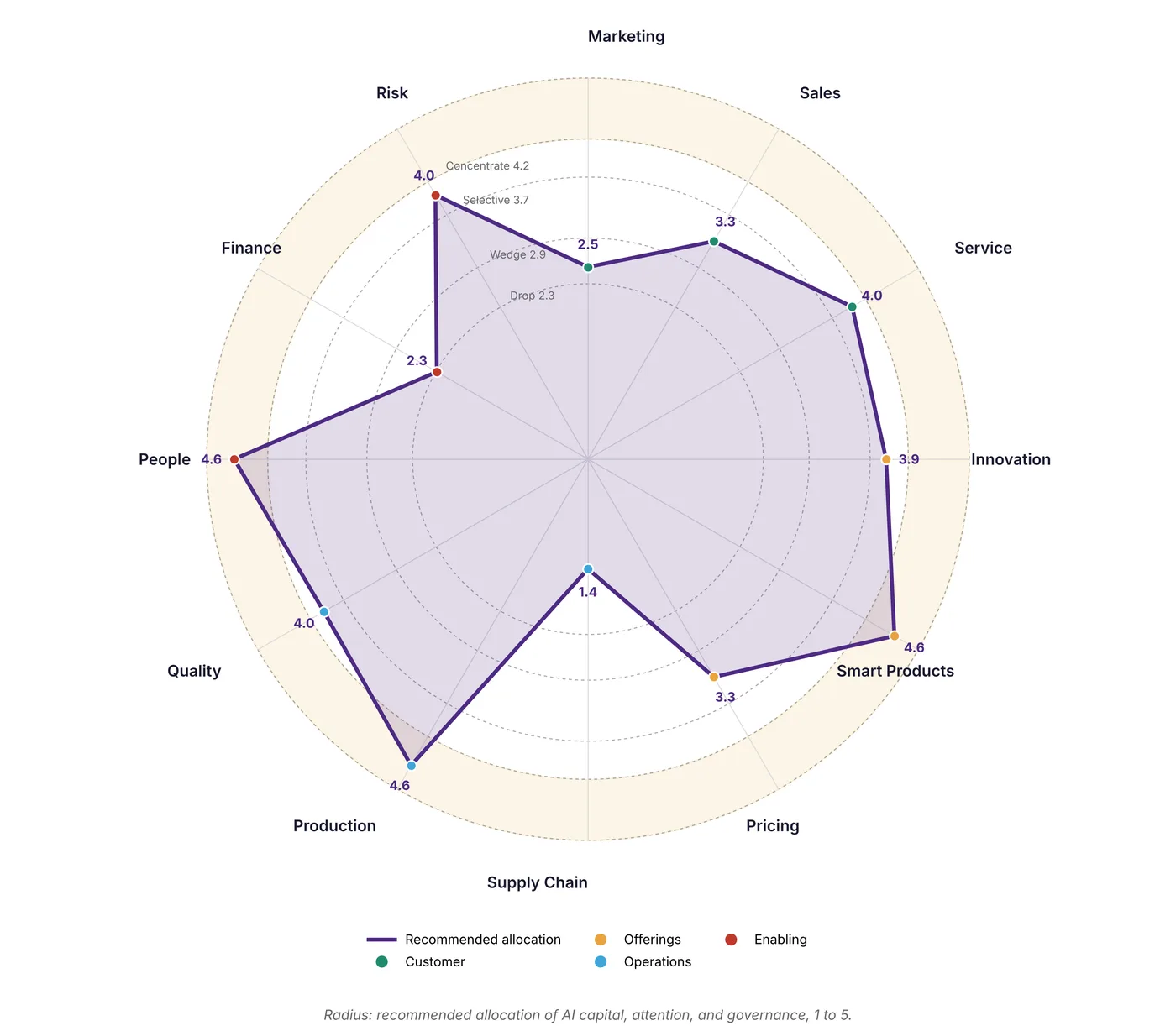
The polygon is lopsided in the way a real allocation should be: three peaks in smart products, production and people, a shoulder of four selective areas, and steep valleys at marketing, finance and supply chain. The actual-portfolio overlay cannot be drawn, because no spend by dimension is public, so the Shape Drift Index, the share of spend that would have to move to match the recommended shape, is not read and no verdict cell is named. What the record does show is the revealed shape of the programs. Five of the ten sit in smart products, one each in production, people, service, risk and innovation, and none in quality as a program of its own. Every concentrate dimension carries a program and no program sits in a dropped or vetoed dimension. On the evidence available, the direction of Axtria's AI effort matches its strategy, and the problems lie in depth and evidence, which Section 4 reads.
4. What the business should grow, hold and stop, and how far each bet has come
The instrument stages every program on five absolute stages: exploring (a sponsor and scoping, no committed budget), piloting (committed budget, a limited set of users, hypotheses stated and not yet measured against a control group), scaling (production rollout with measurement against a control group in place), producing (outcomes measured and reported, a named owner and a runbook) and compounding (the capability is infrastructure other programs reuse). A program sits at the highest stage whose evidence test passes, and a sponsor's assertion without evidence caps it at piloting. Table 4 records, for each program, the stage Axtria's own statements imply and the stage the evidence supports; where Axtria has made no claim, the claimed column says so. Where the two differ, the gap is a finding.
Table 4. The adjudication of ten AI programs: dimension, the stage Axtria claims, the stage the evidence supports, the verdict and the forward condition.
| Program | Dimension | Claimed | Evidenced | Verdict | Forward condition |
|---|---|---|---|---|---|
| CustomerIQ next best action | Smart Products | S4 | S3, provisional, self-reported | Grow | Publish the control design and sample; replicate at a second, named client by June 30, 2027; funded from product development |
| InsightsMAx.ai agent platform | Smart Products | S4 | S2, no evidenced advance since launch | Grow, conditional | One named-client read against a control group by June 30, 2027, or fix-or-kill |
| DataMAx agents (data quality, job monitoring, ingestion, rule authoring) | Smart Products | S3 | S2 | Grow, conditional | Publish a measured cut in rule-authoring or rule-setup time at a named client by June 30, 2027 |
| MarketingIQ channel effectiveness and 8.6 agents | Smart Products | S4 | S2 | Hold, floor | No new AI money until the methods behind the 8 percent and 20 to 25 percent claims are published |
| SalesIQ automation | Smart Products | S4 | S2 | Hold, floor | The product is in production at named clients; define and measure its AI content |
| Forward deployed engineering | Production | S3 | S2 | Fix-or-kill | Replace the headcount target with output targets; dated review March 31, 2027 |
| Axtria Institute | People | S3 | S2 | Grow | Publish the certification-to-deployment rate by March 31, 2027; funded from the delivery training budget |
| AgentOps governance with LangChain | Risk | S4 | S2 | Grow | Publish evaluator results at a named client and apply AgentOps to Axtria's own agents |
| Conexus CRM and agent integration | Service | No claim | S1 | Hold, floor | Protect CRM delivery through the migration wave; first joint deployment before AI money |
| Domain-trained language models with Genloop | Innovation | S2 | S2 | Fix-or-kill | Decide by June 30, 2027 whether domain models beat frontier models under AgentOps evaluation |
4.1 The programs in the lead areas
CustomerIQ next best action is the most advanced program on record and the only one whose claimed result is stated against a control group. For an unnamed company launching a treatment for schizophrenia and bipolar depression, Axtria reports 21 percent growth in total prescriptions against a control group in eleven months, a 20 to 25 percent lift in physician engagement and field adoption of 50 to 60 percent (Axtria 2026l; Axtria 2026f). The case names no client, reports no sample, does not describe how the control group was built and gives no test of significance. Read strictly, a sponsor's assertion without independent evidence caps a program at piloting; we stage it at scaling provisionally, labeled self-reported, because the claim describes the right kind of evidence (a control group) from the wrong kind of source, and we say so wherever the stage is counted. We grow it, because it is the clearest instance of the strategy working, with the condition that Axtria publish the design and replicate the result at a second client willing to be named. Independent evidence on next-best-action lift in pharma is scarce; our search found vendor material only, and that scarcity is the opportunity: the first supplier to publish a properly designed read with a named client will set the standard the others are measured against.
InsightsMAx.ai launched in April 2025 with more than thirty agents and claims of 90 percent decision accuracy, 75 percent faster insight and 40 percent lower operating cost, with use by six of the top ten drug companies (Axtria 2025a). Eighteen months later the record holds no named client, no measured outcome and one statement that AgentOps, on which the platform runs, is in production at "a leading global biopharma" (Axtria 2026b). Axtria claims production. The evidence supports piloting. The record shows no evidenced advance since launch, six quarters ago. A public-record read cannot carry a formal stalled flag, which needs Enterprise-tier evidence and a prior observation, so we record it as a provisional stalled flag, with the qualification that the stall may lie in disclosure rather than use. We grow it on a condition: the platform is the centre of the strategy and the right bet, and one named-client read against a control group by June 30, 2027 is the condition. Without it the program moves to fix-or-kill at that date.
DataMAx agents shipped in the Summer 2026 release: a data-quality agent that recommends rules, a job-monitoring agent that classifies failures, a bulk-ingestion agent and a rule-authoring agent that Axtria says cuts the time to author new rule packages by at least 30 percent (Axtria 2026o; TipRanks 2026). They are the product form of the AI-ready data supply chain the chief executive called the first foundation at Ignite (Axtria 2026c). Axtria names no client and no measured result; the agents are released and in Axtria's account available, which supports piloting. We grow them on a condition, because the agents serve the strategy's first foundation, with a published, measured cut in authoring or rule-setup time at a named client by June 30, 2027.
MarketingIQ and SalesIQ are older products with AI added. MarketingIQ's 8 percent brand revenue claim at an unnamed top-five company has no method (Axtria 2026h). Its 8.6 release in Summer 2026 added a campaign coach and a channel-health agent and Bayesian marketing mix models, with claims of campaign planning cut from days to hours and campaign ROI up 20 to 25 percent, again with no baseline, sample or client (Axtria 2026p). SalesIQ has the best-documented deployment in the record: Quest Diagnostics runs it across 34 role types and a field organization of about 1,300 people, and Axtria gave Quest its Bedrock Honor for the partnership at Ignite 2026 (Axtria 2026c). Its case study claims "7X faster delivery" without defining the measure and describes "intelligent automation" without saying whether any model is involved (Axtria 2026k). The product is producing; its AI is not shown. Both are holds as floors: MarketingIQ because the new agents are in market and the methods behind its claims are not, SalesIQ because it protects a franchise with long client relationships.
Forward deployed engineering is the program on which the strategy's economics turn, and it is announced against an input, a headcount. The release sets a target of 1,000 engineers, describes the model as about a year old and discloses no current number, no client count and no outcome (Axtria 2026d). The careers page tells engineers "you own outcomes, not tickets" and defines success as "a system live in production that a client's sales, medical, or access team depends on every single day" (Axtria 2026j). Axtria has therefore defined the right outcome for the engineer and the wrong target for the program. The economics are known from outside. Services firms run gross margins of roughly 30 to 40 percent and software firms 70 to 80 percent; Palantir, the firm best known for the model, keeps software margins because its engineers build on a common platform and feed field work back into the product, and its warning signs are an engineering headcount that grows with revenue, bespoke builds and deployment times that do not shorten (N47 2025; Constellation Research 2026). A headcount target points toward the first of those warning signs, headcount that grows with revenue, unless output per engineer rises with it. Utilization in professional services is at a record low and clients are demanding price cuts for AI-assisted work (SPI Research 2026; Reuters 2026), so a 1,000-engineer organization that does not raise output per engineer will carry services economics under a software story. The program earns fix-or-kill. The fix is to replace the headcount target with three output targets (production deployments per engineer per quarter, median time from engagement start to the first agent in production, and the share of each deployment built from platform components) and to review them on March 31, 2027. No new money should go to the program to accelerate hiring until the measures exist. The program is too important to the strategy to stop, which is why its design must change.
The Axtria Institute is the conversion engine for the engineering target, and on the headcount evidence it carries most of the load: a flat total headcount means most of the 1,000 engineers will be analysts retrained by the Institute (Revelio Labs 2026; Axtria 2026d). An example day on the careers page lists a certification module on agent-evaluation frameworks with the applied teams of six platform vendors (Axtria 2026j). It stages at piloting because no certification count, pass rate or deployment rate is published. It earns grow, funded from the delivery training budget, with the milestone of a published rate of certified engineers reaching a production deployment within six months.
4.2 The programs in the selective areas
AgentOps joins Axtria's evaluators for drug-name confusion, GxP traceability, audit trails and model version tracking to LangChain's LangSmith platform, with pre-built agents for commercial, medical affairs, patient services and data engineering work and a cost-governance feature for AI spend (Axtria 2026b). It is in production at one unnamed client by Axtria's account and stages at piloting. Risk and quality are selective dimensions, and the grow verdict reflects a double return: AgentOps is a product feature that answers the governance question every buyer now asks, and it is the natural control for Axtria's own agents and for the careers page's instruction to deploy with no pilot environment. The condition is a published evaluator result at a named client (errors caught, false alarms, review time saved) and its use on Axtria's internal agents. Quality has no program of its own, and AgentOps should carry the quality job of output evaluation against the 99.5 percent accuracy bar Axtria set at Ignite (Axtria 2026c).
The Conexus integration is a hold, as a floor. The acquisition is closed, and its purpose, joining CRM execution to the agent platform, is stated; no joint deployment has been described, and Conexus's founder told clients they would keep the same service while gaining access to Axtria's capabilities over time (Axtria 2026a). As an AI program it is exploring. As a business it arrives at a good moment: Everest Group rated Conexus a Leader and Star Performer in Veeva services in 2025 and a Major Contender in life sciences AI and analytics services, and the migration of most of the top 20 to Vault CRM or Salesforce runs to the end of the decade (Conexus Solutions 2025; Everest Group 2025; Veeva 2026). The first job is to protect that delivery through the wave. AI money follows the first joint deployment.
The Genloop language models are a fix-or-kill. In May 2025 Axtria announced privately hosted, domain-trained models for InsightsMAx.ai and its consulting work with a fixed cost of ownership, and published no accuracy or cost figure (Axtria 2025b). Seventeen months on, the record still has none, while the engineers are certified on frontier model providers including Anthropic (Axtria 2026d). The fix is a test Axtria is equipped to run: domain models against frontier models on the same tasks under AgentOps evaluation, judged on accuracy and cost, with a decision by June 30, 2027.
4.3 How deep the portfolio is
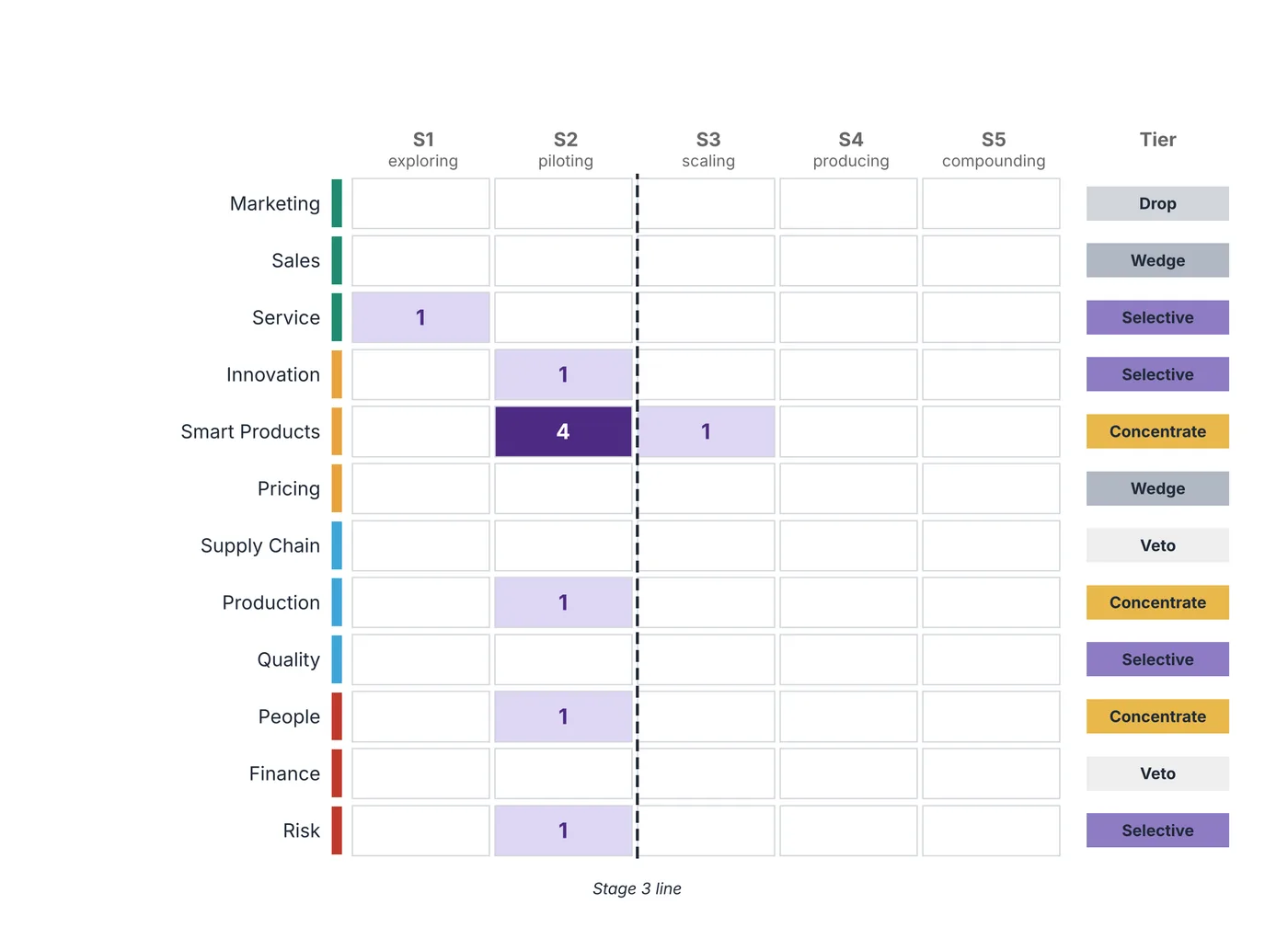
Ten programs are staged, one of them provisionally at the scaling stage, a share of 10 percent, and the mean stage is 2.0; read strictly, with CustomerIQ at piloting, the share is zero. The instrument's band for a share below 25 percent is shallow either way. Axtria's own statements would place eight of the ten at or above the scaling stage; the gap between the two readings is the size of the evidence deficit. Because the instrument derives a firm's AI maturity from the stage distribution of its programs, Axtria reads as early-stage on its own portfolio, whatever its standing as a supplier.
The three depth reads apply as follows. Shallow where it matters: every concentrate dimension carries a program, and only one of those seven programs has passed the scaling test, provisionally, so the next milestone in smart products, production and people is measurement against a comparison group, ahead of more capital. Deep where it does not matter: none, since no advanced program sits in a dropped or vetoed dimension. Stalled: InsightsMAx.ai shows no evidenced advance in the six quarters since launch, and the domain models none in five. On a public-record read these are provisional flags; the quarterly review should confirm or clear them with internal evidence.
A caution limits the depth read. Every stage rests on disclosure, and a private firm discloses less than it knows. Axtria very likely holds measurement for some clients that it has not published. The reading measures what a buyer, an investor or this diagnostic can verify, and for a supplier whose clients now ask for evidence first, that is the reading that matters commercially.
4.4 The coverage question
Two jobs inside the lead dimensions have no program that owns them end to end. The first is AI in Axtria's own delivery work. About 4,200 of its staff work in South Asia, most of them on data engineering, analytics and reporting for clients (Revelio Labs 2026). The forward deployed program covers the engineers inside clients; nothing in the record covers AI-assisted production of the everyday deliverables, the work on which clients now demand price cuts of 25 to 30 percent (Reuters 2026). The second is the loop from field to product, the mechanism by which an engineer's build at one client becomes a reusable component on the platform. That loop is what separates Palantir's economics from a consultancy's, and in Axtria's record it belongs to no one (N47 2025). Both belong inside the restructured engineering program, with their own measures, and neither needs a new start: the dimensions already have a sponsor.
Nothing in the portfolio earns a stop. That means every dollar of new allocation must come from growth in the envelope or from the two fix-or-kill programs, which is a harder conversation than a cleanup.
5. Where the business stands against the field
The field is larger and better capitalized than Axtria in every layer, and Axtria's position is defensible only as the integrator of the layers. ZS has more than 15,000 staff, says 100,000 pharmaceutical field representatives use its technology, and launched agentic medical and content products in May 2026 with reported cycle-time reductions of more than 67 percent in content work (ZS 2026a; ZS 2026b). IQVIA owns much of the underlying data and launched IQVIA.ai with Nvidia in March 2026 (LetsDataScience 2026). Veeva owns the dominant CRM and is putting agents into every product (Veeva 2026). Salesforce has won Takeda, AstraZeneca, Novartis and Chiesi for its life sciences CRM (IntuitionLabs 2026). Indegene, the closest listed comparator for an India-delivered life sciences services firm, grew revenue 30.8 percent in rupees (24.4 percent in dollars) in the December 2025 quarter at an adjusted EBITDA margin of 18.5 percent, and discloses 86 active clients and 5,497 employees (Indegene 2026). Everest Group's 2025 assessment places Axtria among ten Leaders with Indegene, IQVIA, Trinity Life Sciences and ZS (Everest Group 2025).
Against that field Axtria's argument is integration: data management, analytics products, agent governance, CRM implementation and embedded engineers under one contract, sold to clients who, in IQVIA's survey of 107 commercial leaders, name integration with existing systems (50 percent) and limited internal expertise (46 percent) among their top barriers, and of whom 89 percent co-develop or plan to co-develop AI with vendors (IQVIA 2025). The argument is plausible. Its weakness is evidence. Fewer than one in five professional services firms track the return on their AI (Thomson Reuters Institute 2026), and Gartner expects more than 40 percent of agentic AI projects to be cancelled by the end of 2027, with only about 130 of thousands of vendors offering genuine agents (Gartner 2025). Buyers sorting genuine from claimed agents will look for named clients and measured results, and rivals such as ZS and Veeva publish named customers and quantified product claims more often (ZS 2026b; Veeva 2026).
Two gaps are actionable. Axtria is well placed to close the evidence gap, because it already has the control-group habit in CustomerIQ and the governance layer in AgentOps to make published reads auditable. And the Veeva migration wave gives Conexus a few years in which CRM work is scarce and valued; the integration of agents into that work is the one place where Axtria offers something its larger rivals do not offer under one contract.
6. What will move the outcomes
Each lead and selective dimension carries three fields: the outcome metric that should move, the direction, and the lag before the movement can be read. The sponsor of each funded bet signs them as the contract of the bet.
Table 5. The conversion contract for the lead and selective dimensions, with the first reading each sponsor should commit to.
| Dimension | Outcome metric | Direction | Lag | First reading |
|---|---|---|---|---|
| Smart Products | Measured lift at named clients against a control group; platform revenue share | Up | 12 to 24 months | Second CustomerIQ read and first InsightsMAx.ai read, June 2027 |
| Production | Deployments per engineer; time to first agent in production; platform reuse share | Up, down, up | 6 to 12 months | Baseline by December 2026; first read March 2027 |
| People | Certified engineers reaching production deployment within six months | Up | 6 to 9 months | March 2027 |
| Service | Conexus CRM clients adopting the agent layer; account retention | Up | 9 to 18 months | First joint deployment, by mid-2027 |
| Quality and Risk | Agent output errors caught before release; share of agents under full audit trail | Up | 6 to 12 months | First named-client evaluator report, 2027 |
| Innovation | Accuracy and cost of domain models against frontier models | Up, down | 6 to 9 months | Decision by June 30, 2027 |
The single measure that matters most is deployments per forward deployed engineer, read beside the platform reuse share. Together they tell the board whether the 1,000-engineer commitment is building a scalable delivery model or a larger services firm. The priced earnings bridge, with unit coefficients and haircuts, belongs to the Innovation Radar 2.0 and is deferred.
7. What the business will not do
Supply chain is vetoed by the industry: Axtria has no physical chain, and the trigger to revisit would be an offering that includes physical logistics for clients, of which the record shows no sign. Finance composes just below the floor, with a strategy score of 2 because nothing in the record names it; the trigger is an integration of acquired businesses that strains the close, or preparation for a public listing, which would raise the stakes of financial reporting. Marketing is dropped. Axtria sells to a concentrated set of large buyers through conferences, benchmark studies and relationships, and its Ignite events drew 450 executives from more than 100 organizations in 2026 (Axtria 2026c); the record shows no AI program in its marketing, and none is needed.
Sales and pricing are held to narrow wedges. Pricing deserves a watch: outcome-linked contracts are spreading through services, and 38 percent of life sciences commercial leaders already use performance-linked contracts with vendors (Reuters 2026; IQVIA 2025). A credible control-group habit would let Axtria price on outcomes, which is the strongest defence against the price cuts its Indian delivery peers are absorbing. That move belongs after the evidence exists.
Clinical study reporting, through Axtria Rapid CSR, sits outside the commercialization value chain and outside this diagnostic. Its presence in the portfolio is a mild drift from the stated strategy and deserves a decision on whether it is a separate business with its own case.
8. Boundary cases and what would change the answer
Finance composes to 2.29, within 0.05 of the 2.3 line between a vetoed and a dropped dimension; the practical instruction is the same on either side, no AI program in finance now. Innovation at 3.9 is the most sensitive score on the board. If the strategy ring returned to 5, as the prior read scored it, innovation would compose to 4.2 and join the lead band; the evidence for 4 is the leadership's own shift of language to execution in 2026 (Axtria 2026d). An outcome-grade study of AI in research and development would lift the capability score to 4 and the composite to 4.3. Either change would make the field-to-product loop of Section 4.4 a start in its own right.
The people score is the second judgment to watch. The industry weight fell to 4 on the repricing of Indian IT services; if Axtria's engineering model succeeds, people will matter more to Axtria than the industry average suggests, and the strategy ring already records that at 5. The Risk weight rose to 4 on governance as product; if regulators named promotional or targeting AI as high risk, it would rise to 5.
The industry blend is itself a judgment, and its sensitivity is on the record. Under the full Enterprise Infrastructure Software vector, innovation would compose to 3.6 and fall to a wedge, people to 4.2 (concentrate, on the boundary), risk to 4.3 (concentrate) and sales to 3.6; the three lead areas would still lead. Under the full Professional Services seed, smart products would compose to 4.3 and stay in the lead band, and service would fall to 3.6, a wedge, which leaves the Conexus hold unchanged.
Every stage reading rests on disclosure. Publication of one measured, named-client outcome for InsightsMAx.ai, one for CustomerIQ and the output measures for the engineers would move three programs to scaling and the depth reading from shallow to the scaling band. The movement would be a change in the evidence and would be reported as such, apart from any change in the method.
9. What happens next
The next ninety days carry four commitments, each with an owner.
- The chief technology officer replaces the 1,000-engineer target with the three output measures of Section 4.1 and sets their baseline before December 31, 2026.
- The chief executive agrees with two clients, one for CustomerIQ and one for InsightsMAx.ai, to publish a measured outcome with the client named and the control design described.
- The chief financial officer counts AI spend at the use-case layer and splits it into product AI and operational AI, so the size question can be answered.
- The head of products applies AgentOps to Axtria's own agents and reconciles the careers page's no-pilot instruction with the governance message.
The Radar should be refreshed when the December 2026 engineering target is met or missed, again when the Conexus integration completes its first year in April 2027, and when BCG publishes its January 2027 benchmark. A quarterly review should read each program's stage and carry the provisional stalled flags on InsightsMAx.ai and the domain models until internal evidence confirms or clears them.
Appendix A. Evidence and Citations by Ring
The depth tier is Pro on the strategy ring and DIY on the data and workflow sub-score, because the read uses public sources only and Axtria is private. Entries marked [snippet] were verified from a search result rather than a fetched document. Entries marked [library] are carried from the shared capability library of September 14, 2026 and were not re-fetched on this run. Entries marked [self-reported] are issued by Axtria or its subsidiaries, or relay Axtria's own figures; they establish a ceiling on any claim of outcome, scale or program stage and cap such a claim at Stage 2, or at 3 for a capability or industry score, unless an independent source corroborates it. They remain the correct source for the strategy ring, which reads what the company says it will compete on. Tiers follow the skill: A for surveys with stated samples, peer-reviewed studies and telemetry; B for named analyst and consulting research; C for company disclosures, vendor case studies and product announcements; D for trade press, aggregators and forums. Pages without a publication date carry the access date of October 12, 2026.
Independent verification. An independent verification pass on October 12, 2026 opened every cited URL and checked every number in the body against its source. It found three broken citations, seven misquoted or misread entries, six tier or label problems and nine numbers stated wrongly or more strongly than the source allows. This version corrects all of them: the Everest Group history is restated as two different matrices, so it is context and no longer a contradiction; the careers-page quotations are verbatim; the Quest award is attributed to Axtria; the headcount change is a range of 1 to 5 percent; the claimed decline of experience, the top-20 count, the Gartner report count, the Navdeep Chadha title and the Snowflake page are withdrawn as contradictions; the smart products and service industry weights are re-anchored to the hardened Enterprise Infrastructure Software sub-archetype, which leaves every composite and band unchanged; the EU AI Act deferral and Annex III are cited directly; the DataMAx and MarketingIQ agent releases of Summer 2026 are added, which raises the program count to ten; CustomerIQ's scaling stage is labeled provisional and the stalled flags provisional; and the revenue entity is settled with Inc42's compilation of statutory filings.
Where this read departs from the prior narrative. The prior deep narrative (self-dated October 13, 2026) was read as a set of leads. Five departures matter. The industry ring blends the Professional Services seed with the hardened Enterprise Infrastructure Software sub-archetype (smart products 4 to 5 and service 3 to 4 from the sub-archetype; risk 3 to 4 and people 5 to 4 on the evidence in Section 3.1). On the strategy ring, production moved from 3 to 5, because the engineering release and the careers page make delivery into production the core of the strategy; innovation moved from 5 to 4, marketing from 3 to 2 and sales from 4 to 3. As a result production joins the lead band, innovation falls to selective and the prior innovation start is withdrawn in favour of the field-to-product loop inside the engineering program, and marketing drops. The program inventory grew from four to ten and the forward deployed engineering program moved from people to production under the sponsor rule, with the Institute staying in people. CustomerIQ reached the scaling stage provisionally, on Axtria's word, from a case the prior read did not find; Conexus moved from piloting to exploring; and the engineering verdict moved from grow to fix-or-kill. The prior read's statement that People was "the only area in any sample Radar to score 5 on all three rings" is withdrawn; it scores 4.6 here. The prior read's benchmark of 1.7 percent for professional services is withdrawn: 1.7 percent is BCG's cross-industry figure and the BCG release reports none for professional services; the technology row of 2.1 percent replaces it.
Ring 3, the company record.
- Axtria 2026a. "Axtria Acquires Conexus Solutions, Uniting Agentic AI and CRM Mastery to Redefine Life Sciences Commercialization," April 15, 2026. CRM on Veeva and Salesforce; Vault CRM expertise; systems of engagement and intelligence; no terms. Supports Smart Products 5, Service 4, the strategy statement. Tier C [self-reported]. https://www.axtria.com/press-releases/axtria-acquires-conexus-solutions-uniting-agentic-ai-and-crm-mastery-to-redefine-life-sciences-commercialization
- Axtria 2026b. "From Pilot to Production: Axtria and LangChain Partner to Govern and Scale AI Agents in Pharma," April 29, 2026. AgentOps on LangSmith; drug-name evaluators, GxP traceability, audit trails; in production at one unnamed biopharma. Supports Risk 4, Quality 4. Tier C [self-reported]. https://www.axtria.com/press-releases/from-pilot-to-production-axtria-and-langchain-partner-to-govern-and-scale-ai-agents-in-pharma
- Axtria 2026c. "Axtria Ignite 2026: 450+ Life Sciences Leaders Convene With a Contrarian Message: Fix the Foundation Before You Scale AI," June 25, 2026 (also on PR Newswire). Four foundations; 99.5 percent accuracy bar; Quest SalesIQ across 34 role types and about 1,300 field staff; Bedrock Honor to Quest. Tier C [self-reported]. https://www.axtria.com/press-releases/axtria-ignite-2026-450-life-sciences-leaders-convene-with-a-contrarian-message-fix-the-foundation-before-you-scale-ai
- Axtria 2026d. "Axtria to Build Industry's Largest Pharma-Specific AI Engineering Team, Scaling to 1,000 by December 2026," August 12, 2026 (wire copies dated August 13). Target 1,000; model about a year old; current count, clients and outcomes undisclosed; certification on six platforms; quotes of Navi Chadha and Manish Mittal. Supports Production 5, People 5 (strategy ring). Tier C [self-reported]. https://www.axtria.com/press-releases/axtria-to-build-industrys-largest-pharma-specific-ai-engineering-team-scaling-to-1000-by-december-2026
- BioSpectrum India 2026. Report of the engineering release, August 2026. Relays Axtria's figures. Tier D [self-reported] [snippet]. https://biospectrumindia.com/news/57/28312/axtria-to-build-industrys-largest-pharma-specific-ai-engineering-team-scaling-to-1000-by-dec-2026.html
- Axtria 2026e. "Industrializing Intelligence: What 450 Pharma Leaders Heard at Axtria Ignite 2026," 2026, accessed October 12, 2026. Attendee companies; GSK 30 percent cut in review cycle time (not attributed to Axtria); no internal AI use stated. Tier C [self-reported]. https://www.axtria.com/articles/industrializing-intelligence-what-450-pharma-leaders-heard-at-axtria-ignite-2026
- Axtria 2026f. "Axtria Recognized as Frost & Sullivan's 2025 Global Company of the Year in Pharma Commercial Solutions," March 25, 2026. Platform claims; unnamed launch case with 21 percent prescription growth; "over two decades of commercialization expertise"; analyst quote on proof of impact. Tier C [self-reported]; a Frost & Sullivan Best Practices recognition, and the figures in the release are Axtria-supplied. https://www.aap.com.au/aapreleases/cision20260325ae18922
- Axtria 2026g. "Axtria Announces Ignite Global 2026," February 3, 2026. Hyderabad event for more than 100 leaders; "AI-first" self-description. Tier C [self-reported]. https://www.axtria.com/press-releases/axtria-announces-ignite-global-2026-beyond-capabilities-into-ownership-fuelled-by-ai
- Axtria 2026h. Home page, accessed October 12, 2026. Product list; anonymous case claims of 25 million dollars, 8 percent revenue and 10 percent ROI; hiring banner for 1,000 engineers. Tier C [self-reported]. https://www.axtria.com/
- Axtria 2026i. Awards page, accessed October 12, 2026. AIM PeMa Quadrant "number one" claim of July 27, 2026; Frost & Sullivan; Minsky Award 2025. Tier C [self-reported]. https://www.axtria.com/about-us/awards
- Axtria 2026j. Forward Deployed Engineer careers page, accessed October 12, 2026. Locations in the United States, Europe, India, China and Japan; "Push the update through governance, live to production, no pilot environment, no sandbox"; "You own outcomes, not tickets"; success as "a system live in production that a client's sales, medical, or access team depends on every single day"; an example day with an agent-evaluation module. Tier C [self-reported], read as revealed priority. https://www.axtria.com/careers/forward-deployed-engineer/
- Axtria 2026k. "Transforming Complexity into 7X Velocity: The Quest Diagnostics and Axtria SalesIQ Story," accessed October 12, 2026. Named client; metric undefined; no model use stated. Tier C [self-reported]. https://www.axtria.com/customer-success-stories/transforming-complexity-into-7-velocity-the-quest-diagnostics-axtria-salesiq-story
- Axtria 2026l. "AI-Fueled NBA Delivers 21% Stronger TRx Performance in Under a Year," accessed October 12, 2026. CustomerIQ; 21 percent against a control group in 11 months; no sample or design. Supports the CustomerIQ stage. Tier C [self-reported]. https://www.axtria.com/customer-success-stories/ai-fueled-nba-delivers-21-stronger-trx-performance-in-under-a-year-a-win-for-top-biopharma
- Axtria 2026m. Snowflake partner page, accessed October 12, 2026. States only the use of Snowflake for data integration. Tier C [self-reported]. https://www.axtria.com/about-us/partnerships-alliances/snowflake/
- Axtria 2026n. Press release index, pages 1 to 3, accessed October 12, 2026. Release titles from 2024 to 2026 including Rapid CSR and benchmarking studies. Tier C [self-reported]. https://www.axtria.com/press-releases
- Axtria 2025a. "Axtria Unveils Transformational Agentic AI Platform," April 23, 2025. InsightsMAx.ai; more than 30 agents; 90 percent accuracy and 40 percent cost claims; 6 of the top 10 and 16 of the top 20; "14+ years". Supports Smart Products 5. Tier C [self-reported]. https://www.axtria.com/press-releases/axtria-unveils-transformational-agentic-ai-platform-to-help-life-sciences-companies-deploy-scale-and-monetize-innovation
- Axtria 2025b. "Axtria and Genloop Deliver Domain-Trained LLMs," May 15, 2025. Privately hosted domain models; fixed cost of ownership; no figures. Tier C [self-reported]. https://www.axtria.com/press-releases/axtria-and-genloop-deliver-domain-trained-llms
- Axtria 2025c. "Axtria Recognized in Two Gartner Hype Cycle Reports for 2025," July 24, 2025. Sample-vendor listings in two 2025 Hype Cycles and one 2024 Hype Cycle. Tier C [self-reported] relaying Tier B. https://www.axtria.com/press-releases/axtria-recognized-in-two-gartner-hype-cycle-reports-for-2025-for-advancing-data-science-and-analytics-in-life-sciences
- Axtria 2025d. "Axtria and Kedaara Capital Announce Strategic $240 Million Investment and Employee Share Buy Back Program," September 23, 2025 (PR Newswire India). Secondary plus buyback; founded 2010; 18 of the top 20; no valuation. Tier C [self-reported]. https://www.prnewswire.com/in/news-releases/axtria-and-kedaara-capital-announce-strategic-240-million-investment-and-employee-share-buy-back-program-302564306.html
- Axtria 2024. "Axtria Expands to Hyderabad With Its Ninth Global Innovation and Capability Centre in India," March 12, 2024. About 700 hires in 2023; about 800 planned; 16 of the top 20. Tier C [self-reported]. https://www.axtria.com/press-releases/axtria-expands-to-hyderabad-with-its-ninth-global-innovation-and-capability-centre-in-india
- Axtria 2022a. "Axtria Receives Top Leader Rankings in Everest Group Life Sciences Commercial Services Specialists PEAK Matrix Report," February 16, 2022. Tier C [self-reported] relaying Tier B. https://www.axtria.com/press-releases/axtria-receives-top-leader-rankings-in-everest-group-life-sciences-commercial-services-specialists-peak-matrix-report
- Axtria 2022b. "Axtria Named as the Only Leader and Star Performer in Everest Group Life Sciences Operations PEAK Matrix Report," July 27, 2022. Tier C [self-reported] relaying Tier B. https://www.axtria.com/press-releases/axtria-named-as-the-only-leader-and-star-performer-in-everest-group-life-sciences-operations-peak-matrix-report
- Everest Group 2025. Life Sciences AI and Analytics Services for Commercial PEAK Matrix Assessment 2025, July 2025 (excerpt hosted by IQVIA). Thirty providers; Axtria one of ten Leaders, assessed without its inputs; Conexus a Major Contender. Independent. Tier B. https://www.iqvia.com/-/media/iqvia/pdfs/library/publications/2025/everest-group-life-sciences-ai-and-analytics-services-for-commercial-peak-matrix-assessment-2025.pdf
- AIM Research 2026. Top AI Service Providers for Life Sciences and Healthcare 2026, July 8, 2026. Fourteen vendors on questionnaire inputs; Axtria one of five Leaders. Tier C. https://aimresearch.co/reports/top-ai-service-providers-for-life-sciences-and-healthcare-study
- Conexus Solutions 2025. "Conexus Solutions, Inc. Named a Leader and Star Performer in Everest Group's Veeva Services PEAK Matrix Assessment 2025," August 1, 2025 (EIN Presswire). Serving small and midsize firms since 2016; Vault CRM migration partner. Tier C relaying Tier B [self-reported]: Conexus has been an Axtria subsidiary since April 2026. https://www.einpresswire.com/article/836187628/
- Revelio Labs 2026. Axtria workforce profile, data to the first quarter of 2026, published August 2026. 4,956 employees; a prior-year figure given as both 5,189 and 5,041; peak 5,270; 86 percent in South Asia; 214 postings in 2026. Independent telemetry with an undisclosed method and internally inconsistent growth labels; medium confidence. Tier B. https://www.reveliolabs.com/companies/axtria/employees/
- Tofler 2026. Axtria India Private Limited profile from statutory filings, accessed October 12, 2026. Operating revenue above 500 crore rupees in fiscal 2023; incorporated May 17, 2010. Independent statutory data. Tier C. https://www.tofler.in/axtria-india-private-limited/company/U72200DL2010FTC202752
- Venture Intelligence 2025. "Kedaara Capital invests $240 M in life sciences-focused tech co. Axtria," September 24, 2025 (citing Mint). Bain Capital Tech Opportunities as the 2021 investor, at a valuation of 850 million dollars; fiscal 2024 operating income about 868 crore rupees, profit after tax about 89 crore; founded 2009. Tier D. https://news.ventureintelligence.com/private-equity/kedaara-capital-invests-$240-m-in-life-sciences-focused-tech-co.-axtria
- GetLatka 2026. Axtria profile, updated September 2, 2026. Revenue of 105 million dollars with no recorded source (rejected under the provenance gate); LinkedIn employee counts of 3,683 in June 2024 and 3,637 in November 2025. Tier D. https://getlatka.com/companies/axtria.com
- multiples.vc 2026. Axtria funding profile, accessed October 12, 2026. Funding rounds; 2021 valuation 900 million dollars in the table and about one billion in the text; 75 percent of staff in India in 2021. Tier D. https://multiples.vc/private-comps/axtria
- Bain Capital 2021. "Axtria Raises $150 Million From Bain Capital at $1 Billion Value," Bloomberg item, May 13, 2021. Title only; the page body could not be retrieved, and the investor is sourced to entry 28. Tier D [snippet]. https://www.baincapital.com/news/axtria-raises-150-million-bain-capital-1-billion-value
- Outlook Business 2023. "Axtria Plans To Expand India Operations, Hire Over 1,000 Techies," June 19, 2023 (PTI). About 3,000 staff in India; centres in Gurugram, Bengaluru, Noida, Pune, Hyderabad. Tier D [self-reported]. https://www.outlookbusiness.com/news/axtria-plans-to-expand-india-operations-hire-over-1-000-techies-news-295972
- ROI-NJ 2026. "Axtria acquires Conexus Solutions, enters into end-to-end CRM," April 16, 2026. No independent detail. Tier D [self-reported]. https://www.roi-nj.com/2026/04/16/healthcare/axtria-acquires-conexus-solutions-enters-into-end-to-end-crm/
- pharmaphorum 2026. "Axtria Ignite 2026: Intangible factors to enable AI success," about July 2026. Likely sponsored; Axtria-supplied quotes. Tier D [self-reported]. https://pharmaphorum.com/digital/axtria-ignite-2026-intangible-factors-enable-ai-success
- Glassdoor 2026. Axtria reviews, accessed October 12, 2026. 3.6 of 5 on 1,844 reviews; 77 percent chief executive approval. Tier D. https://www.glassdoor.ca/Reviews/Axtria-Reviews-E641281.htm
- Simplify 2026. Axtria company page, accessed October 12, 2026. 36 open roles; aggregator funding total that conflicts with other aggregators. Tier D. https://simplify.jobs/c/Axtria
- Axtria 2026o. "Axtria DataMAx Summer Release Notes 2026," Summer 2026 (the page also carries a February 28, 2025 date stamp). Data Quality, Job Monitoring, Bulk Ingestion and BRMS Rule Authoring agents; rule authoring time cut by "at least 30%"; no client named. Tier C [self-reported]. https://www.axtria.com/product-release-notes/axtria-datamax-summer-release-notes-2026
- Axtria 2026p. "Axtria MarketingIQ Summer Release Notes 2026" (version 8.6), Summer 2026. Campaign Coach and Channel Health agents; Bayesian marketing mix models; planning "from days to hours" and ROI up 20 to 25 percent without baseline; no client named. Tier C [self-reported]. https://www.axtria.com/product-release-notes/axtria-marketingiq-summer-release-notes-2026
- TipRanks 2026. "Axtria deepens agentic AI platform push with Ignite 2026 and new product releases," July 2026 (updated July 11, 2026). DataMAx agents, MarketingIQ 8.6, HIQ virtual data analyst; restates Axtria material. Tier D [self-reported]. https://www.tipranks.com/news/private-companies/axtria-deepens-agentic-ai-platform-push-with-ignite-2026-and-new-product-releases
- Inc42 2026. Axtria financials, Inc42 Datalabs, accessed October 12, 2026. Revenue 675.1 crore rupees in fiscal 2023 and 867.5 crore in fiscal 2024; profit after tax 88.8 crore in fiscal 2024; 3,650 employees; compiled from statutory filings and other records. Tier D relaying statutory data. https://inc42.com/company/axtria/financials/
- Bar & Bench 2025. "Khaitan, Akin Gump advise Kedaara Capital on $240 million investment in Axtria," October 8, 2025. Target named as Axtria, Inc. and its subsidiaries; no stake or valuation. Tier D [snippet]. https://www.barandbench.com/law-firms/dealstreet/khaitan-akin-advise-kedaara-capital-on-240-million-investment-in-axtria
Ring 2, the industry overlay (Professional Services seed blended with the Enterprise Infrastructure Software sub-archetype for a software-and-services firm in life sciences commercialization).
- BCG 2026a. "New BCG Report Shows Companies Plan to Double Their Spending on AI in 2026," January 15, 2026. 2,360 executives, 16 markets; about 1.7 percent of revenue in 2026; technology 2.1, financial institutions 2.0, industrial and real estate 0.8; more than 30 percent of AI investment to agents; planned spend. Tier B. https://www.bcg.com/press/15january2026-as-ai-investments-surge-ceos-take-lead
- BCG 2026b. Applied AI Index 2026, September 30, 2026, as reported by People Matters. 1,330 executives; AI spend from about 1.7 percent of revenue in late 2025 to 3.3 percent in 2026; more than 80 percent outside the IT budget. Tier D relaying Tier B. https://sea.peoplemattersglobal.com/amp/news/ai-and-emerging-tech/nearly-half-of-companies-are-now-generating-value-from-ai-bcg-52447
- McKinsey 2026. The State of AI in 2026: On the Road to ROI, August 2026. n=1,719, fielded May 4 to June 8, 2026; 37 percent report EBIT impact; about 6 percent high performers; 28 percent spend more than 10 percent of technology budget on AI; professional services among sectors building in-house with coding agents. Tier A. https://www.mckinsey.com/~/media/mckinsey/business%20functions/quantumblack/our%20insights/the%20state%20of%20ai/the-state-of-ai-in-2026-on-the-road-to-roi-aug-2026.pdf
- Thomson Reuters Institute 2026. 2026 AI in Professional Services Report, February 9, 2026. More than 1,500 respondents in 27 countries; about 40 percent organization-wide generative AI use; about 15 percent agentic; 18 percent track AI return. Tier A. https://www.thomsonreuters.com/en-us/posts/technology/ai-in-professional-services-report-2026
- SPI Research 2026. 2026 Professional Services Maturity Benchmark, spring 2026, as analyzed by Certinia, June 23, 2026. 509 organizations; billable utilization 66.4 percent in 2025, the series low; EBITDA 9.9 percent. Tier B. https://certinia.com/blog/analyzing-the-2026-spi-research-professional-services-maturity-benchmark-report/
- Reuters 2026. "AI reshapes India's IT services sector contracts as clients demand more for less," August 21, 2026 (via Deccan Chronicle). Outcome-based contracts; 25 to 30 percent price demands; TCS reductions. Tier D reporting company disclosures. https://www.deccanchronicle.com/technology/ai-reshapes-indias-it-services-sector-contracts-as-clients-demand-more-for-less-1981013
- N47 2025. Lak Ananth, "The Forward Deployed Engineer dilemma," September 22, 2025. Services and software margin ranges; Palantir platform-reuse model; warning signs. Tier D. https://www.n47.com/insights/the-forward-deployed-engineer-dilemma
- Constellation Research 2026. "Palantir delivers strong Q4, sees 2026 US commercial revenue surge ahead," February 2, 2026. Q4 2025 revenue 1.407 billion dollars; United States commercial up 137 percent; an AI agent doing forward deployed engineering work. Tier C. https://constellationr.com/insights/news/palantir-delivers-strong-q4-sees-2026-us-commercial-revenue-surge-ahead
- IQVIA 2025. AI in Life Sciences Commercialization, survey of May 2025, published August 2025. n=107; 44 percent spend more than a fifth of commercial budget on AI; barriers; 89 percent co-develop with vendors; 38 percent performance-linked contracts. Tier B (a competitor's survey). https://www.iqvia.com/-/media/iqvia/pdfs/library/white-papers/ai-in-life-sciences-commercialization-white-paper.pdf
- McKinsey 2024. "Early adoption of generative AI in commercial life sciences," May 6, 2024. Survey of more than 100 leaders; 18 to 30 billion dollars of annual value in commercial functions. Tier B, aging. https://www.mckinsey.com/industries/life-sciences/our-insights/early-adoption-of-generative-ai-in-commercial-life-sciences
- LetsDataScience 2026. "IQVIA Launches IQVIA.ai Agentic AI Platform with Nvidia," April 5, 2026 (launch March 16, 2026). 19 of the top 20 integrating agents, by IQVIA's account. Tier D relaying IQVIA's release of March 16, 2026 (the terminal source). https://letsdatascience.com/news/iqvia-launches-iqviaai-agentic-ai-platform-with-nvidia-b1ca210d
- Veeva 2026. Fourth quarter fiscal 2026 earnings call, March 4, 2026 (transcript via Webull). About 140 Vault CRM customers live; about 14 of the top 20 expected; end of support December 2029; agents across products. Tier C. https://www.webull.com/news/14480984063353856
- diginomica 2026. Katy Ring, "Veeva vs Salesforce services," January 21, 2026. Migration timelines; services demand; Salesforce is a partner of the publisher. Tier D. https://diginomica.com/veeva-vs-salesforce-services-questions-life-sciences-organizations-need-be-asking-and-time-running
- IntuitionLabs 2026. "Salesforce Agentforce Life Sciences: Agentic CRM in Pharma," June 3, 2026. More than 140 organizations; Takeda, AstraZeneca, Novartis, Chiesi. Tier D. https://intuitionlabs.ai/articles/salesforce-agentforce-life-sciences-agentic-crm-pharma
- ZS 2026a. ZS fact sheet, file dated June 2026, content as of November 2025. More than 15,000 staff; 100,000 field representatives on ZS technology. Tier C. https://www.zs.com/content/dam/global/master/pdfs/factsheet-june-2026.pdf
- ZS 2026b. "ZS launches agentic AI products ZAIDYN Medical and ZAIDYN Content," May 19, 2026. Human review at every step; more than 67 percent cycle-time reduction claimed. Tier C. https://www.zs.com/about/newsroom/zs-launches-agentic-ai-products-zaidyn-medical-and-zaidyn-content
- Indegene 2026. Investors presentation, third quarter fiscal 2026, filed with the National Stock Exchange January 29, 2026. Revenue 9,421 million rupees (106.1 million dollars), up 30.8 percent in rupees and 24.4 percent in dollars; adjusted EBITDA margin 18.5 percent; 86 active clients; 5,497 employees. Tier C (listed-company disclosure). https://nsearchives.nseindia.com/corporate/INDEGENE_29012026184931_Investors_Presentation.pdf
- Clifford Chance 2025. Patrice Navarro, "AI Meets Regulation: At the intersection of EU's AI Act and Pharma Compliance Strategy," November 3, 2025. Names diagnostics, patient monitoring, clinical decision support and device safety components as high risk; does not address commercial or promotional AI. Tier B. https://www.cliffordchance.com/insights/resources/blogs/healthcare-and-life-sciences-insights/2025/11/ai-meets-regulation-at-the-intersection-of-eu-ai-act-and-pharma-compliance-strategy.html
- Gartner 2025. "Gartner Predicts Over 40% of Agentic AI Projects Will Be Canceled by End of 2027," press release, June 25, 2025. About 130 genuine agentic vendors; 15 percent of daily work decisions autonomous by 2028; 33 percent of enterprise applications with agents by 2028; analyst Anushree Verma. Tier B. https://www.gartner.com/en/newsroom/press-releases/2025-06-25-gartner-predicts-over-40-percent-of-agentic-ai-projects-will-be-canceled-by-end-of-2027
- Mexico Business News 2026. "CEOs Leading Surge in Corporate AI Spending: BCG," January 19, 2026. Corroborates the BCG sample. Tier D [snippet]. https://mexicobusiness.news/talent/news/ceos-leading-surge-corporate-ai-spending-bcg
- Sidley 2026. "EU lawmakers reach provisional agreement to delay key EU AI Act obligations," Data Matters, June 2026. Digital Omnibus agreed May 7, 2026, adopted by Parliament June 16, 2026, Council approval pending; Annex III obligations to December 2, 2027; embedded-product obligations to August 2, 2028. Tier B. https://datamatters.sidley.com/2026/06/22/eu-lawmakers-reach-provisional-agreement-to-delay-key-eu-ai-act-obligations/
- EU AI Act 2024. Regulation (EU) 2024/1689, Annex III, high-risk AI systems, as published. Eight areas, none covering commercial marketing, promotional content or targeting of healthcare professionals. Primary legal text, Tier B. https://artificialintelligenceact.eu/annex/3/
Ring 1, the capability frontier. The frontier is shared by every Radar and was not re-scored on this run; no capability score moved since the September 14, 2026 library refresh, no method change affected this read, and McKinsey (2026), entry 44, re-verified the library's central pattern. The anchors below support the capability scores of 4 and 5 in Table 3.
- Microsoft and Edelman 2026. 2026 Work Trend Index, May 5, 2026. n=20,000; organizational design explains twice the variance of individual effort. People 5. Vendor telemetry that shares an incentive with Anthropic (2026), so the independent pair behind People 5 is this survey with Dell'Acqua et al. Tier A [library].
- Dell'Acqua, McFowland, Mollick et al. 2026. Field experiment on the jagged frontier of AI capability, Organization Science, March 11, 2026. Preregistered trial, n=758; gains inside the frontier, losses outside. People 5. Tier A [library].
- Anthropic 2026. Economic Index, June 26, 2026. Telemetry and about 9,700 survey respondents. People 5. Tier A [library].
- ICONIQ 2026. State of AI 2026, second quarter 2026. About 300 software executives; AI-embedded product revenue 32 to 42 percent. Smart Products 4. Tier B [library].
- Google Cloud DORA 2026. ROI of AI-Assisted Software Development, May 11, 2026. About 5,000 respondents; about 90 percent adoption; value conditional on foundations. Production 4. Tier A [library].
- METR 2025. Randomized trial of experienced developers, July 10, 2025, with a December 2025 repeat. 19 percent slower with AI. Production 4. Tier A [library].
- arXiv 2026. "Security in the Age of AI Teammates," arXiv 2601.00477, January 2026. 33,000 agent-authored pull requests; 61 percent with minimal review. Quality 4. Tier A [library].
- Salesforce 2026a. State of Service, sixth edition, fielded March to April 2026. n=3,075; agent adoption 39 to 66 percent. Service 4. Tier B [library].
- Salesforce 2026b. State of Sales, February 3, 2026. n=4,050; 54 percent deployed agents. Sales 4. Tier B [library].
- Gartner 2026a. CMO Spend Survey, May 11, 2026. n=401; AI at 15.3 percent of marketing budget. Marketing 4. Tier B [library].
- McKinsey 2026b. State of AI Trust in 2026, March 25, 2026. About 500 organizations; responsible-AI maturity 2.3. Risk 4. Tier B [library].
- OWASP 2026. Agent Control Standard and 2026 Top 10 for LLM Applications, August 3, 2026. Risk 4 (library move of September 14, 2026). Tier C [library].
- Cloud Security Alliance 2026. State of AI Cybersecurity 2026, April 2026. 1,500 security leaders; 92 percent concerned about agent security. Risk 4. Tier B [library].
- Deloitte 2026. State of AI in the Enterprise, January 2026. n=3,235; 20 percent report AI-driven revenue growth. Innovation 3. Tier B [library].
- Growth Unhinged 2026. State of B2B SaaS and AI Monetization, May 2026. n=230; 75 percent changed pricing. Pricing 3. Tier C [library].
- Gartner 2026b. CFO survey on AI in finance, May 28, 2026. n=204; forecasting lowest realized value. Finance 3. Tier B [library].
Count and tiers. Seventy-nine dated citations: Tier A 8, Tier B 18, Tier C 33, Tier D 20. Of the 79, 29 are issued by Axtria or its subsidiaries or relay Axtria's own figures and are marked [self-reported]; four carry a [snippet] mark and sixteen are marked [library]. Every score of 4 or 5 in Table 3 rests on at least one dated source in this appendix or on a hardened library archetype: the industry weights of 5 for smart products and 4 for service come from the hardened Enterprise Infrastructure Software sub-archetype, with the category evidence of Section 3.1 confirming the fit. Smart products, production and people reach 5 on the strategy ring on Axtria's own statements, which is the correct source for a strategy score; no capability or industry score of 4 or 5 rests on an Axtria source.
Appendix B. Mathematics
The seven equations below define the quantities used in the body. Equations (2), (3) and (5) to (7) need Axtria's AI spend by dimension and its revenue, which are not public.
C_d = \sqrt[3]{R^{(1)}_d \, R^{(2)}_d \, R^{(3)}_d}(1)The composite for dimension d is the geometric mean of the capability, industry and strategy ring scores, so a floor on any ring parks the dimension whatever the other two say.
\mathrm{AII} = k = \frac{\sum_{d=1}^{12} a_d}{\sum_{d=1}^{12} r_d} = \frac{\bar{a}}{\bar{r}}(2)The AI Investment Index is the ratio of the mean actual radius \bar{a} to the mean recommended radius \bar{r}; between 0.9 and 1.1 the envelope is adequate, below 0.75 it is severely short.
E^{*} = \beta \, m \, S, \qquad G = (1-k)\,E^{*}(3)The required envelope E^{*} is the peer baseline \beta times the posture multiplier m times revenue S; the funding gap G is the shortfall the index implies.
s^{a}_d = \frac{a_d}{\sum_{j=1}^{12} a_j}, \qquad s^{r}_d = \frac{r_d}{\sum_{j=1}^{12} r_j}(4)The shares express each polygon's radii as fractions of its own total, which removes the size effect before shape is read.
\mathrm{SDI} = \tfrac{1}{2} \sum_{d=1}^{12} \left| s^{a}_d - s^{r}_d \right|(5)The Shape Drift Index is the total variation distance between the two share vectors: the share of the portfolio that must move to match the recommended shape.
g_d = a_d - r_d = (k-1)\, r_d + \left( a_d - k\, r_d \right)(6)Each spoke's raw gap splits without residual into a size part, which every spoke carries in proportion to its recommendation, and a mix part, which is the reallocation argument proper.
\sum_{d=1}^{12} \left( a_d - k\, r_d \right) = 0, \qquad \mathrm{SDI} = \frac{\sum_{d=1}^{12} \left| a_d - k\, r_d \right|}{2 \sum_{d=1}^{12} a_d}(7)The mix parts sum to zero by construction, and half their absolute sum over the actual total equals the Shape Drift Index exactly, so the two indices are two halves of one identity.
References
Sawhney, Mohanbir. 2026. The AI Radar: A Portfolio Framework for Diagnosing the Level and Allocation of Enterprise AI Investment. SSRN Working Paper, July 27, 2026. https://ssrn.com/abstract=7244301.
Sawhney, Mohanbir. 2026. The Innovation Radar 2.0: A Framework for Measuring and Diagnosing Business Innovation. SSRN Working Paper. https://ssrn.com/abstract=7244520.
Sawhney, Mohanbir, Robert C. Wolcott, and Inigo Arroniz. 2006. "The 12 Different Ways for Companies to Innovate." MIT Sloan Management Review 47 (3): 75–81.
AI Radar 2.0 (Sawhney Enterprises). Scores, drift, and recommendations grounded in evidence as of October 12, 2026.