Full diagnostic. Growth Opportunity Diagnostic and Recommendations for Chipotle Mexican Grill. Public-record research pass and top-up pass, October 2026.
A sample Radar from the public record
Growth Opportunity Diagnostic and Recommendations for Chipotle Mexican Grill, Sawhney Enterprises, October 2026, public-record research pass with a top-up pass. Arena and opportunity scores are illustrative judgments from the public record. Management has not dated the $4 million restaurant target; the report tests it on a 2030 horizon. Contributions are the report's risk-adjusted totals spread across the lead bets in proportion to their composite.
Context
This report diagnoses where Chipotle Mexican Grill can grow and recommends which growth opportunities it should pursue, which it should watch, and which it should refuse. It applies the Growth Radar, a diagnostic instrument that asks two questions of a growth agenda: whether the business's ambition can be reached from its core trajectory, and if not, where the winnable opportunity lies to close the distance. The framework scans eight growth arenas in four families, scores each arena on whether the space is real, whether the prize is worth taking, and whether the business can win, and then generates a broad set of net-new opportunities and screens each one with the same three questions, multiplied so that a weak answer on any one vetoes the bet. The method is set out in Sawhney, M. (2026), The Growth Radar and the Growth Canvas: A Playbook for Finding and Evaluating Growth Opportunities, SSRN Working Paper, forthcoming.
Executive Summary
Chipotle is a USD 11.9 billion restaurant company that grows reliably by opening restaurants and has lost its second engine, sales growth in the restaurants it already runs. It opened a record 334 restaurants in 2025 and plans 350 to 370 in 2026, yet its comparable sales fell 1.7 percent in 2025 on 2.9 percent fewer transactions, and the recovery in 2026 has reached 0.5 percent in the first quarter and 2.2 percent in the second. Management's long-term plan pairs about 350 openings a year with an average restaurant of USD 4 million in sales, up from USD 3.1 million today. If that average is reached by 2030, the company's 2030 revenue is about USD 22.2 billion. On its current path, with openings at 330 to 350 a year and comparable sales of 1 to 3 percent, it reaches USD 17.3 to 19.0 billion. The gap, meaning the revenue the company must find beyond what its present business will deliver on its own, is USD 3.2 to 4.9 billion of 2030 revenue, and USD 1.7 to 2.4 billion on a 2028 horizon. Almost all of it is the distance between 1 to 3 percent comparable growth and the roughly 5 percent a year the USD 4 million restaurant requires.
The 40 net-new opportunities this scan surfaced do not close that gap. After discounting each for the chance it fails, they are worth about USD 0.34 to 0.99 billion of 2030 revenue, roughly a sixth of the gap at the midpoint. Restaurant openings carry the plan; the new bets can add perhaps a point of comparable growth a year if the strongest of them are run at scale.
The search should concentrate in three of the eight arenas. New Occasions and Jobs scores highest because group meals and catering are 2 to 3 percent of Chipotle's sales against 5 to 10 percent at peers, and the second digital makeline and 38 percent digital mix can serve occasions the dining room cannot. New Channels follows because 1,500 Chipotlane pickup lanes already sell 15 to 20 percent more than traditional restaurants. New Segments is the third focus because the guests who left in 2025, younger and lower-income diners and the growing number of people on GLP-1 weight-loss drugs, are the traffic the comparable-sales line needs.
Four opportunities reach the pursue-now band, meaning a composite score of 64 or more out of 125 on the screen this report uses. A portion-controlled menu for GLP-1 users and lighter eaters scores 80. A scheduled workplace meal program, a Chipotlane-only small format for infill sites, and a small-market prototype that raises the North American ceiling above 7,000 restaurants each score 64. Of the 40 candidates, 33 survived and seven were vetoed because Chipotle cannot win them, among them North American franchising, an owned delivery network and a full-service concept; 20 announced initiatives were set aside as already in motion.
Leadership must make one decision: date the USD 4 million restaurant later, around 2033 to 2035, and let unit growth carry the plan to 2030, or fund the traffic bets (the portion-controlled menu, the workplace program and the small format) at a scale that adds a point of comparable growth a year from 2027. The verdict rests on the portion-controlled menu and the workplace program; if both fail, coverage falls to about a tenth of the gap.
1 The business in brief
Chipotle Mexican Grill is one business with one value chain, so the company and the unit are the same entity. It owned 3,938 restaurants in the United States and 104 abroad at the end of 2025, in Canada, the United Kingdom, France and Germany, reports one segment, and runs 14 partner-operated restaurants in the Middle East with the Alshaya Group (CMG 2026c, p. 4). By 30 June 2026 it owned 4,186 restaurants and partners operated 15 (CMG 2026e). Every restaurant preps from whole ingredients each morning, builds orders on a customizable line, and serves a second digital makeline that fills app, web and delivery orders out of the guest's sight (CMG 2026c; OCBJ 2025).
The economics are those of a large, profitable and slowing operator. Revenue rose 5.4 percent to USD 11.9 billion in 2025, all of it from new restaurants: comparable sales fell 1.7 percent, transactions fell 2.9 percent and average check rose 1.2 percent (CMG 2026a). Restaurant-level margin fell from 26.7 to 25.4 percent, and net income was USD 1.54 billion (CMG 2026a). The 2026 recovery is slow. Comparable sales rose 0.5 percent in the first quarter and 2.2 percent in the second, with transactions up 1.0 percent; revenue in the second quarter rose 9.3 percent to USD 3.35 billion, but restaurant margin fell 220 basis points to 25.2 percent because pricing of about 1.6 percent trails inflation of about 3 percent (CMG 2026d; CMG 2026e; CMG 2026f). Management guides 2026 comparable sales to the low single digits and the third quarter to about 1 percent, after an industry cyclospora outbreak in July cost about 200 basis points of sales (CMG 2026f). Average restaurant sales were USD 3.10 million over the twelve months to June 2026 (CMG 2026e). Chipotle holds no debt, spent USD 0.67 billion on capital projects against USD 2.11 billion of operating cash flow in 2025, and bought back USD 2.4 billion of stock in 2025 and USD 1.35 billion in the first half of 2026 (CMG 2026c, notes; CMG 2026e). In the 2025 revenue bridge, restaurants opened in 2024 and 2025 added USD 809 million of revenue, and lower comparable sales took away USD 191 million (CMG 2026c, Item 7).
The guests who left are identifiable. In October 2025 management said guests with household income under USD 100,000 were about 40 percent of sales and guests aged 25 to 34 about 25 percent, that both had cut frequency, and that the company was losing them to "grocery and food at home" (CMG 2025a). Catering was 1 to 2 percent of sales against 5 to 10 percent at peers (CMG 2025a). By July 2026 the brand tracker showed the best affordability scores in two years and share gains in each month of 2026, with younger and lower-income guests improving most (CMG 2026f).
The right-to-win inventory is concrete. The first asset is throughput built for digital: a second makeline in every restaurant since the 2016 to 2018 investments, which the chief executive calls "a very strong competitive advantage," and a digital mix of 36.7 percent in 2025 and 38.3 percent in the second quarter of 2026 (OCBJ 2025; CMG 2026c, Item 7; CMG 2026e). The second is the Chipotlane, a pickup lane for digital orders: the 1,500th opened on 29 September 2026, about 80 percent of new restaurants carry one, and executives say Chipotlane restaurants sell 15 to 20 percent more than traditional units (NRN 2026a; CMG 2026e). The third is the rewards program: 23 million active members after the April 2026 relaunch, about 32 percent of sales in the first quarter of 2026, and a gap the company is working to close between 90 percent scan rates in the app and about 20 percent in the restaurant (CMG 2026b; CMG 2026f; CMG 2026q). The fourth is the development machine: 334 openings in 2025, 257 of them with a Chipotlane, new restaurants at about 80 percent of the productivity of the base, and second-year cash-on-cash returns of about 60 percent (CMG 2026a; CMG 2026f). The fifth is a menu engine that management says works four times faster than two years ago, with limited-time proteins that lift transactions by "hundreds of basis points" and a December 2025 high-protein line (CMG 2026f; CMG 2026g). The sixth is the partner network abroad: Alshaya in the Gulf, Alsea in Mexico and Sangmidang (formerly SPC Group) in South Korea, each an operator of global restaurant brands (NRN 2026b; CMG 2026h). What Chipotle does not hold is also clear: a catering operation at scale, any subscription or advertising business, a franchise system in North America, and control over the delivery marketplaces that carry more than 16 percent of food and beverage revenue (CMG 2026c, p. 9). Chipotlane counts by sales, rewards economics and new-unit returns by format are not disclosed, and the Win scores below assume the company statements are accurate.
The ambition is public. Chipotle is "working towards our long-term goal of 7,000 restaurants in the U.S. and Canada" (CMG 2026c, p. 9). In February 2026 management confirmed about 350 openings a year and a long-term algorithm of USD 4 million average unit volumes with restaurant margins approaching 30 percent, and in October 2025 it described volumes "above $4 million over time" (CMG 2026b; CMG 2025a). It has not dated the USD 4 million restaurant. This report tests the ambition on a 2030 horizon, on three illustrative assumptions. The ambition is about 350 company openings a year, taking the system to about 5,790 restaurants at the end of 2030, with sales per restaurant rising 5.2 percent a year from USD 3.07 million to about USD 3.96 million, which gives 2030 revenue of about USD 22.2 billion. The core trajectory is 330 to 350 openings a year, comparable sales of about 1.5 percent in 2026 and 1 to 3 percent a year after, and about 0.7 points a year of dilution from new restaurants opening at 80 percent productivity, which gives USD 17.3 to 19.0 billion. The gap is USD 3.2 to 4.9 billion of 2030 revenue (equation 5 in Appendix B). On a 2028 horizon the ambition is USD 17.6 billion against a core of USD 15.2 to 15.9 billion, a gap of USD 1.7 to 2.4 billion. If the USD 4 million restaurant is dated to 2032 instead, the 2030 gap narrows to USD 1.7 to 3.4 billion. A second gap lies beyond the horizon: at 350 openings a year the 7,000 ceiling binds around 2034, and the chief executive has warned that "if the 7,000 number doesn't move, you could hit a point of saturation in North America in the next six, seven years" (OCBJ 2025).
One event bears on the reading. On 8 October 2026 the Financial Times reported that Starbucks had worked with advisers on an early-stage takeover proposal for Chipotle, whose market value was close to USD 39 billion; Chipotle's shares rose as much as 8.6 percent during the day and closed 6.2 percent higher (NRN 2026d; Yahoo 2026). On 12 October Starbucks said it has no interest in acquiring Chipotle, and Chipotle's shares fell 3.75 percent to USD 30.40 (FastCasual 2026; Fool 2026). The diagnostic treats Chipotle as an independent company.
2 Where the business can grow
The Radar scores each arena on three lenses, each an integer from 1 to 5: whether the growth spaces in the arena are real and durable (Real), whether the prize is deep and material against the gap (Worth), and whether the business holds named, transferable assets there (Win). The radius of each spoke is the geometric mean of the three (equation 1), so an arena with a large prize the business cannot win is pulled toward the center. Scores are absolute and illustrative. The area of the polygon is a diagnostic of winnable opportunity; it is not a budget allocation.
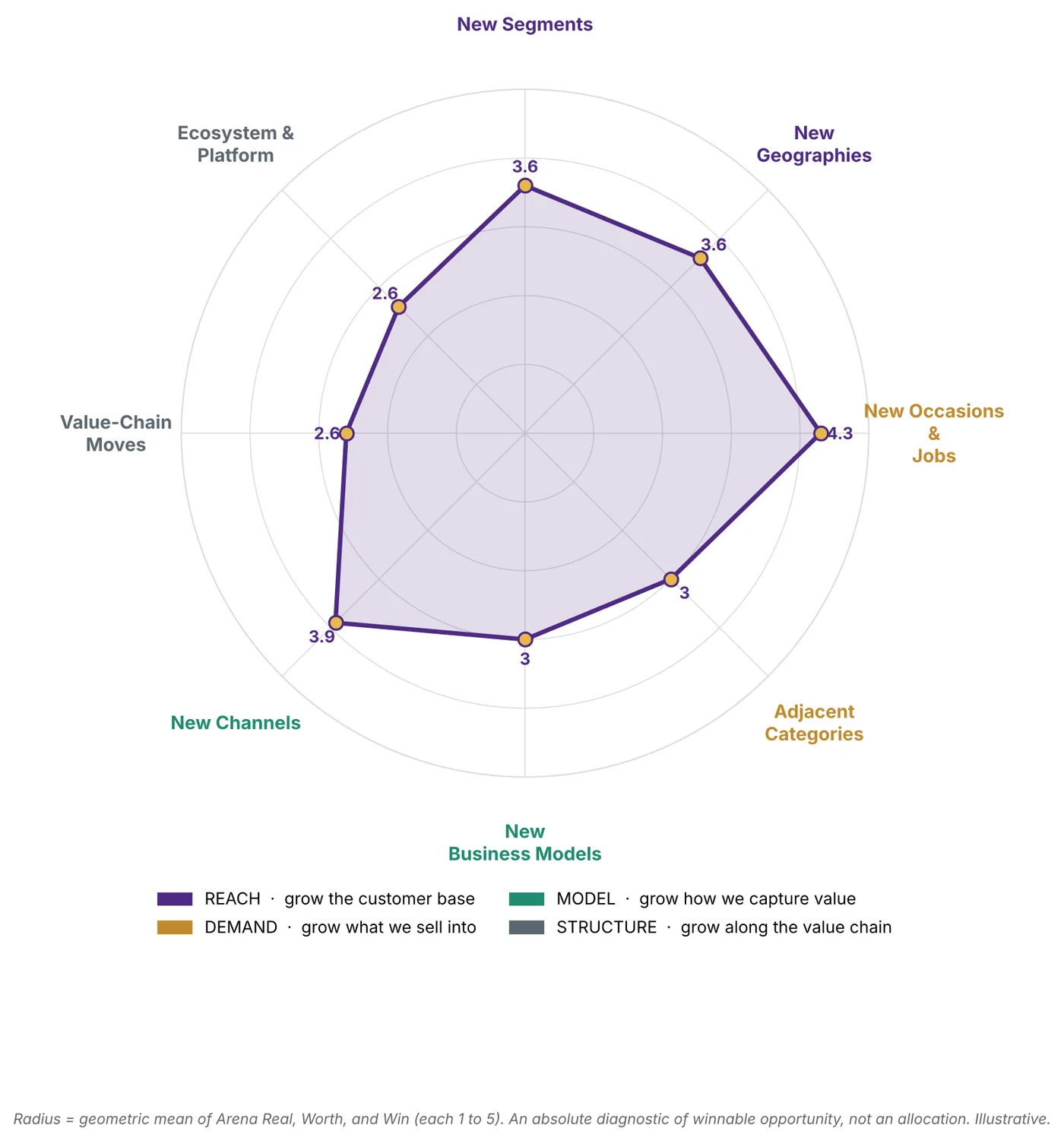
Table 1. The eight arenas: Real, Worth, and Win lenses and the resulting radius.
| Arena | Family | Real | Worth | Win | Radius |
|---|---|---|---|---|---|
| New Occasions and Jobs | Demand | 4 | 5 | 4 | 4.3 |
| New Channels | Model | 4 | 3 | 5 | 3.9 |
| New Segments | Reach | 4 | 4 | 3 | 3.6 |
| New Geographies | Reach | 5 | 3 | 3 | 3.6 |
| New Business Models | Model | 3 | 3 | 3 | 3.0 |
| Adjacent Categories | Demand | 3 | 3 | 3 | 3.0 |
| Value-Chain Moves | Structure | 3 | 2 | 3 | 2.6 |
| Ecosystem and Platform | Structure | 3 | 3 | 2 | 2.6 |
New Occasions and Jobs (4.3) leads on Worth. Group meals and catering are 2 to 3 percent of sales, management sees them reaching double digits over time, and the United States catering market is projected to grow 5.3 percent a year through 2032, against about 3 percent for restaurants in 2025 (CMG 2026b; FOD 2026). A point of sales moved into group occasions is worth about USD 0.12 billion at today's revenue. Win is 4 because the digital makeline and the Chipotlane carry large orders, while catering marketplaces, Panera and Sweetgreen already serve the workplace buyer; Sweetgreen launched a build-your-own catering bar for groups of 10 to 10,000 in February 2026, and Cava is still testing catering in two markets (RB 2026; Cava 2026b).
New Channels (3.9) holds the business's hardest-to-copy assets and scores 5 on Win: the Chipotlane network and the second makeline (NRN 2026a; OCBJ 2025). Worth binds at 3 because the largest channel gains, Chipotlanes on 80 percent of new restaurants, the rewards relaunch and delivery partnerships, are already in motion and inside the core trajectory.
New Segments (3.6) holds the lost traffic. Guests under USD 100,000 and aged 25 to 34 together drove the 2025 frequency loss, and a September 2026 survey of GLP-1 users found monthly restaurant visits halved from 9.8 to 4.9 (CMG 2025a; WB 2026). Win binds at 3 because the menu and price architecture were built for a full-size bowl at a single price ladder.
New Geographies (3.6) scores 5 on Real: Chipotle's restaurants abroad have grown from Europe to the Gulf, Saudi Arabia, Mexico and Korea within two years, and the North American ceiling is in sight (NRN 2026b; CMG 2026h). Taco Bell's plan to grow from about 1,150 restaurants abroad to more than 3,000 by 2030 through partners shows how far a Mexican-inspired brand can travel (TB 2025; RB 2025). Worth and Win bind at 3: partner-operated restaurants pay royalties, which are small against a gap measured in billions, and the company-owned European business has grown to about 30 restaurants in sixteen years while France struggles with wage and occupancy costs (NRN 2026b; CMG 2026b).
New Business Models (3.0) and Adjacent Categories (3.0) are balanced and moderate. A paid tier in the rewards program and a retail-media offer are real, and beverages, sides and desserts attach on the existing menu board; Chipotle has never run a subscription or sold advertising, and grocery products or a second brand sit on other models.
Value-Chain Moves (2.6) and Ecosystem and Platform (2.6) are the weakest spokes. The supply-chain review, the equipment package and sourcing moves free margin, which matters, but they add little revenue (Worth 2). The delivery platform belongs to DoorDash and Uber, and the USD 100 million Cultivate Next fund is a fund through which the company invests in suppliers and start-ups, carried at USD 35.5 million at the end of 2025, and holds no orchestrating position (Win 2) (CMG 2026c, p. 9 and notes; NRN 2026c).
3 The three arenas to focus
3.1 New Occasions and Jobs
This arena lights up because Chipotle is under-indexed on the occasions that grow fastest. Group meals and catering were 1 to 2 percent of sales in October 2025 and 2 to 3 percent by July 2026, against 5 to 10 percent at peers, and management says they could reach double digits of sales over time (CMG 2025a; CMG 2026b; CMG 2026f). The catering market favors operators that deliver themselves: marketplace orders are projected at 36 percent of catering orders in 2026 but carry average values 6 to 8 percent lower and thinner margins, and 60 percent of catering orders come from 5 percent of customers (FOD 2026). Those customers are offices, teams and schools that order every week.
The right-to-win headroom is the second makeline. A 20-bowl order on the guest-facing line stalls the dining room; on the digital line it does not. The Chipotlane gives a pickup point for large orders, and the rewards program can hold the account. The company has piloted catering and Build Your Own in Chicago, Boston and Phoenix, is testing a sharper group price structure, and plans a national launch in 2027 across first- and third-party marketplaces (CMG 2026q; CMG 2026f), so the launch itself is in motion and excluded. Peers show the window is narrowing: Sweetgreen sells its catering bar nationally from USD 200 for ten guests, and Taco Bell has long sold party packs whose tickets ran at about three times its average check (RB 2026; NRN 2018). The net-new moves sit on top of it: a standing weekly workplace program with employer billing, pre-ordered watch-party kits that build on the sports promotions that produced a single-day sales record, a late-night window near campuses, and meal-prep packs for the high-protein guest (CMG 2026f).
The trap is a daypart the operating model cannot serve. Breakfast is the largest new occasion by sales, but every Chipotle restaurant preps from scratch in the morning, and the breakfast habit belongs to McDonald's and Taco Bell. It is scored down on Win for that reason.
3.2 New Channels
Chipotle built its channel advantage before its rivals and still holds it. Digital sales were 38.3 percent of food and beverage revenue in the second quarter of 2026, up from 35.5 percent, and USD 1.3 billion in the quarter (CMG 2026e; CMG 2026f). The Chipotlane debuted in 2018 and added its latest 500 lanes in under two years, and the chief operating officer calls it "a powerful growth engine" that "will remain central to our development strategy" (NRN 2026a). Taco Bell, whose same-store sales rose 7 percent in the second quarter of 2026, runs 47 percent of sales through digital, which shows the headroom in a value-led Mexican brand (NRN 2026e). Rivals now copy the lane: Sweetgreen opened its first pickup lane, attached to an automated kitchen, in Costa Mesa in November 2025 (NRN 2025b). Chipotle's lead is the count, and no rival or Chipotle itself has announced a lane-only restaurant with no dining room (CMG 2026q).
The net-new moves extend the channel assets to places and interfaces the full restaurant does not reach. A Chipotlane-only small format can open infill sites where a full building with a dining room does not fit. An open ordering interface for AI assistants and car dashboards puts the customizable order where the guest already speaks. Licensed concession operators can take the brand into airports, campuses and stadiums.
The trap is channel conflict with the platforms that carry the orders. Delivery marketplaces carry more than 16 percent of food and beverage revenue, and an attempt to replace them with an owned national delivery network fails Win (CMG 2026c, p. 9).
3.3 New Segments
The comparable-sales gap is a traffic gap, and the traffic left through identifiable doors. Lower-income guests, about 40 percent of sales, and guests aged 25 to 34, about 25 percent, cut frequency in 2025 (CMG 2025a). A third group is growing: GLP-1 users eat about 1,155 fewer calories a day and cut monthly restaurant visits by half, and nearly half of them, 65 percent of those aged 35 to 44, say smaller portions would bring them back more often (WB 2026). Chipotle has already moved toward this guest with a USD 3.50 single taco and a USD 3.80 protein cup and has refreshed its high-protein campaign; extra protein reached nearly a quarter of transactions in the first quarter of 2026, though management did not address GLP-1 users or smaller portions on that call (RD 2026a; CMG 2026f; CMG 2026q). Full-service chains moved first: Olive Garden put a seven-item Lighter Portions menu in every restaurant in January 2026, The Cheesecake Factory and P.F. Chang's added smaller plates, and McDonald's said in September 2026 that it is exploring bowls for GLP-1 users (AP 2026; Forbes 2026). Among fast-casual rivals no chain has a named portion menu; Cava's chief executive said in August 2026 that some older guests now order the kids' meal for its portion (Cava 2026b).
New Segments was chosen as the third focus over New Geographies, which also scores 3.6. Both hold Win 3, so the first tie-break rule, right-to-win headroom, does not separate them. The second rule, the share of the gap an arena can close, does: every point of comparable sales recovered from these guests is worth about USD 0.17 to 0.19 billion of 2030 revenue, while partner-operated restaurants pay royalties that stay small before 2030. New Geographies remains the arena that matters most after 2030, when the 7,000 ceiling binds, and it holds one of the four pursue-now bets.
The trap is a segment that wants a different product. A half-portion bowl must be priced so that a GLP-1 guest visits more often without trading a full-price visit down; a value tier for younger guests must not reset the price ladder for the 60 percent of core guests above USD 100,000 (CMG 2026b). Both bets need test cells against a control group before national rollout.
4 The opportunity set
The scan generated 40 net-new opportunities, grouped below by arena, with the three focus arenas first. Each carries a boldness tag: Extend is a small step from the core, Stretch a real reach with familiar muscles, Step out a new model or buyer, and Transform a different game.
4.1 New Occasions and Jobs
1. Scheduled workplace meal program. Standing weekly team orders with employer billing, built on the 2027 catering launch. Stretch. The digital makeline and Chipotlane pickup carry it; the catering marketplaces, Panera and Cava contest the workplace buyer.
2. Watch-party and game-day kits. Protein trays, chips, queso and sauces ordered ahead for home viewing. Extend. The sports promotions show demand on game days; the kit makes it a home occasion.
3. Late-night daypart in college and dense urban trade areas. Stretch. Younger guests respond to protein and limited-time offers; late-hour staffing and safety must be built.
4. Weekly meal-prep packs. Bulk proteins, rice and beans for five lunches. Stretch. The high-protein menu carries it; the occasion is real for fitness-minded guests and unproven at population scale.
5. Breakfast burritos and bowls in commuter Chipotlanes. Step out. A large daypart that the scratch-prep model and the competitors' habit hold against Chipotle.
6. Post-workout recovery occasion with gyms and fitness apps. Extend. The protein cup fits; the prize is small.
4.2 New Channels
7. Chipotlane-only small format. A pickup lane and digital kitchen with no dining room, for infill suburbs. Stretch. The Chipotlane's 15 to 20 percent sales advantage is the asset; the dining-room-free model is untested at scale.
8. Agentic and voice ordering. An open menu and order interface for AI assistants and car dashboards, tied to rewards. Stretch. The app's customization data and the digital makeline are the assets; the assistant platforms set the terms.
9. Non-traditional North American venues. Airports, campuses, stadiums and hospitals through licensed concession operators. Step out. Licensing is new to a company-owned operator.
10. Delivery-only kitchens in dense urban cores. Stretch. Marketplace commissions thin the margin.
11. An owned national delivery network that replaces the marketplaces. Transform. The marketplaces control demand and couriers.
4.3 New Segments
12. Portion-controlled menu for GLP-1 users and lighter eaters. Half-portion bowls and protein plates priced to bring visits back. Stretch. The build-your-own line, the protein cup and the protein menu are named assets; every chain can shrink a portion, so the edge is speed and price architecture.
13. Everyday value tier for younger and lower-income guests. A fixed-price core entree below USD 8. Extend. Affordability scores are improving; the tier risks diluting check.
14. Redesigned kids' meal and family build-your-own sold through rewards. Extend. The Gen Alpha order of August 2026 shows the audience; the prize is modest.
15. Regional Mexican specials for bicultural guests, developed with the Mexico partner. Stretch. The culinary edge must be built.
16. Corporate wellness and insurer programs listing Chipotle meals with macro data. Step out. The buyer and the economics are thin.
4.4 New Geographies
17. Small-market prototype that raises the North American ceiling above 7,000. A smaller Chipotlane restaurant with lower occupancy and crew for towns the current model passes over. Stretch. Site analytics across 4,200 restaurants and the Chipotlane format are the assets.
18. Canada build-out to 50 or more openings a year, including Quebec. Extend. Canada performs on par with the United States (RB 2024).
19. United Kingdom and Germany cluster scale-up beyond London and Frankfurt. Stretch. Europe reported positive comparable sales in every country, double-digit restaurant margins and about 40 percent year-two returns in the first quarter of 2026 (CMG 2026q); France shows the cost risk.
20. Latin America beyond Mexico through Alsea or another master partner. Step out. The Mexico launch proves the model; royalties are small by 2030.
21. Japan, Southeast Asia and Australia through the Sangmidang joint venture or new partners. Step out. Korea is the designated reference market for Asia.
22. Continental European partner model in Spain, Italy and the Nordics. Step out. Contradicts the stated policy that Western Europe stays company-owned.
23. India through a master partner. Step out. Price points and the vegetarian mix do not fit the economics.
4.5 New Business Models
24. Paid membership tier inside Chipotle Rewards. A monthly fee for free delivery, extra protein or a weekly entree. Step out. A 23-million-member base; no subscription experience.
25. Retail media. Selling access to the rewards audience to beverage, entertainment and gaming brands. Step out. Partner demand is visible in the gaming and sports integrations; an advertising sales operation must be built.
26. University meal-plan and student-ID partnerships. Extend. The prize is small.
27. North American franchising to third-party operators. Transform. Conflicts with the company-owned model.
28. Selling the kitchen automation stack to other restaurant chains. Transform. The portfolio companies own the technology.
4.6 Adjacent Categories
29. Afternoon beverage platform. House refreshers and agua frescas sold through Chipotlanes. Stretch. A daily beverage habit needs a menu the line can make fast.
30. Second fast-casual brand on the makeline model. Mediterranean or Asian bowls. Transform. The operating model transfers; the brand does not, and Cava already runs the Mediterranean version with 9 percent same-restaurant sales growth (Cava 2026).
31. Retail grocery line of salsas, chips and sauces through a licensee. Step out. Grocery brands and private label hold the shelf.
32. Branded frozen meals manufactured at scale for grocery. Transform. Another industry's value chain.
33. Full-service sit-down dining concept under the brand. Transform. A service model the operator has never run.
4.7 Value-Chain Moves
34. Cross-border produce and avocado sourcing hub serving the Latin American partners and the United States system. Stretch. Frees cost more than it adds revenue.
35. Proprietary sauce and seasoning supply to international partners from a central commissary. Extend. The 10-K names partner consistency as a risk; the revenue is small (CMG 2026c, p. 9).
36. Own farms and ranches for beef and produce. Transform. Agriculture is another value chain.
4.8 Ecosystem and Platform
37. Shared pickup hubs with a complementary coffee or breakfast brand at Chipotlane sites. Step out. Partner terms and operations are untested.
38. Cultivate Next portfolio offered as a supplier platform to other restaurant operators. Step out. The revenue is a rounding error against the gap.
39. Consumer food super-app and delivery marketplace for multiple brands. Transform. The marketplace layer belongs to DoorDash and Uber.
40. Data cooperative with suppliers for demand forecasting. Stretch. Cook-to-Needs forecasting is the base; suppliers gain more than Chipotle earns.
4.9 Already in motion (excluded)
The scan screened out twenty initiatives because the company has announced or disclosed them as underway. They are the Recipe for Growth strategy; the 350 to 370 openings of 2026 with about 80 percent Chipotlanes and the 7,000-restaurant goal; the rewards relaunch, the earn-at-payment pilot, Summer of Extras and the college rewards program; four protein limited-time offers a year and the sauce and side launches; the high-protein menu; the catering and Build Your Own pilots, Family Meals and the 2027 national catering launch; the "happier hour" afternoon test; beverage innovation and the return of margaritas; the Gen Alpha order; the high-efficiency equipment package, the Chipotle Kitchen crew interface, Cook-to-Needs forecasting, AI phone ordering and the Ava Cado hiring assistant; the Hyphen makeline and Autocado tests and the Cultivate Next fund; the Zipotle drone delivery pilot with Zipline; the delivery partnership work with Uber and DoorDash; Alshaya in the Gulf and Saudi Arabia; Alsea in Mexico; the Sangmidang joint venture in Korea and Singapore; company-owned Europe and Canada development; remodel tests; the marketing reset under a new Chief Brand Officer and Chief Digital Officer; and the Apprentice Manager program (CMG 2026b; CMG 2026c; CMG 2026f; CMG 2026g; CMG 2026h; NRN 2024; NRN 2026a; NRN 2026b; NRN 2026c; RD 2026b; Zipline 2025). Public sources reveal what is announced, so un-announced internal initiatives cannot be screened until a run against internal materials.
5 Which opportunities to pursue
The report scores each opportunity from 1 to 5 on Real, Worth and Win and multiplies the three scores (equation 2), so a composite runs from 8 to 125; any score of 1 vetoes the bet (equation 4). Scores are illustrative judgments. Verdicts follow the composite: 64 and above is pursue now, 30 to 63 pursue next, 15 to 29 watch, and below 15 re-scope.
Table 2. Live opportunities ranked by composite score (illustrative).
| \# | Opportunity | Arena | Boldness | Real | Worth | Win | Score | Verdict |
|---|---|---|---|---|---|---|---|---|
| 12 | Portion-controlled menu for GLP-1 users and lighter eaters: half-portion bowls and protein plates priced to visit | Segments | Stretch | 5 | 4 | 4 | 80 | Pursue now |
| 1 | Scheduled workplace meal program: standing weekly team orders with employer billing | Occasions | Stretch | 4 | 4 | 4 | 64 | Pursue now |
| 7 | Chipotlane-only small format: pickup lane and digital kitchen with no dining room, for infill suburbs | Channels | Stretch | 4 | 4 | 4 | 64 | Pursue now |
| 17 | Small-market prototype that raises the North American ceiling above 7,000 restaurants | Geographies | Stretch | 4 | 4 | 4 | 64 | Pursue now |
| 2 | Watch-party and game-day kits: protein trays, chips, queso and sauces ordered ahead | Occasions | Extend | 4 | 3 | 4 | 48 | Pursue next |
| 8 | Agentic and voice ordering: an open menu and order interface for AI assistants and car dashboards, tied to rewards | Channels | Stretch | 4 | 3 | 4 | 48 | Pursue next |
| 13 | Everyday value tier for younger and lower-income guests: a fixed-price core entree below USD 8 | Segments | Extend | 4 | 3 | 4 | 48 | Pursue next |
| 18 | Canada build-out to 50 or more openings a year, including Quebec | Geographies | Extend | 4 | 3 | 4 | 48 | Pursue next |
| 19 | United Kingdom and Germany cluster scale-up beyond London and Frankfurt | Geographies | Stretch | 4 | 3 | 4 | 48 | Pursue next |
| 24 | Paid membership tier inside Chipotle Rewards: monthly fee for free delivery, extra protein or a weekly entree | Bus. Models | Step out | 4 | 4 | 3 | 48 | Pursue next |
| 4 | Weekly meal-prep packs: bulk proteins, rice and beans for five lunches | Occasions | Stretch | 3 | 3 | 4 | 36 | Pursue next |
| 3 | Late-night daypart in college and dense urban trade areas | Occasions | Stretch | 4 | 3 | 3 | 36 | Pursue next |
| 9 | Non-traditional North American venues through licensed concession operators: airports, campuses, stadiums, hospitals | Channels | Step out | 4 | 3 | 3 | 36 | Pursue next |
| 20 | Latin America beyond Mexico through Alsea or another master partner | Geographies | Step out | 4 | 3 | 3 | 36 | Pursue next |
| 21 | Japan, Southeast Asia and Australia through the Sangmidang joint venture or new partners | Geographies | Step out | 4 | 3 | 3 | 36 | Pursue next |
| 25 | Retail media: selling access to the rewards audience to beverage, entertainment and gaming brands | Bus. Models | Step out | 4 | 3 | 3 | 36 | Pursue next |
| 29 | Afternoon beverage platform: house refreshers and agua frescas sold through Chipotlanes | Adjacent | Stretch | 4 | 3 | 3 | 36 | Pursue next |
| 5 | Breakfast burritos and bowls in commuter Chipotlanes | Occasions | Step out | 4 | 4 | 2 | 32 | Pursue next |
| 6 | Post-workout recovery occasion with gyms and fitness apps | Occasions | Extend | 3 | 2 | 4 | 24 | Watch |
| 26 | University meal-plan and student-ID partnerships | Bus. Models | Extend | 3 | 2 | 4 | 24 | Watch |
| 30 | Second fast-casual brand on the makeline model, such as Mediterranean or Asian bowls | Adjacent | Transform | 4 | 3 | 2 | 24 | Watch |
| 10 | Delivery-only kitchens in dense urban cores | Channels | Stretch | 3 | 2 | 3 | 18 | Watch |
| 14 | Redesigned kids' meal and family build-your-own sold through rewards | Segments | Extend | 3 | 2 | 3 | 18 | Watch |
| 16 | Corporate wellness and insurer programs listing Chipotle meals with macro data | Segments | Step out | 3 | 2 | 3 | 18 | Watch |
| 34 | Cross-border produce and avocado sourcing hub serving the Mexico and Latin American partners and the United States system | Value-Chain | Stretch | 3 | 2 | 3 | 18 | Watch |
| 35 | Proprietary sauce and seasoning supply to international partners from a central commissary | Value-Chain | Extend | 3 | 2 | 3 | 18 | Watch |
| 40 | Restaurant-technology data cooperative with suppliers for demand forecasting | Ecosystem | Stretch | 3 | 2 | 3 | 18 | Watch |
| 15 | Regional Mexican specials for bicultural guests, developed with the Mexico partner | Segments | Stretch | 3 | 3 | 2 | 18 | Watch |
| 22 | Continental European partner model in Spain, Italy and the Nordics | Geographies | Step out | 3 | 3 | 2 | 18 | Watch |
| 31 | Retail grocery line of salsas, chips and sauces through a licensee | Adjacent | Step out | 3 | 3 | 2 | 18 | Watch |
| 37 | Shared pickup hubs with a complementary coffee or breakfast brand at Chipotlane sites | Ecosystem | Step out | 3 | 3 | 2 | 18 | Watch |
| 38 | Cultivate Next portfolio offered as a supplier platform to other restaurant operators | Ecosystem | Step out | 2 | 2 | 3 | 12 | Re-scope |
| 23 | India through a master partner | Geographies | Step out | 3 | 2 | 2 | 12 | Re-scope |
Table 3. Opportunities parked on a veto.
| \# | Opportunity | Arena | Failing ring | Why it fails |
|---|---|---|---|---|
| 11 | Exit the delivery marketplaces for an owned national delivery network | Channels | Win | Own-the-platform archetype: DoorDash and Uber control the demand and the courier network; Chipotle holds no transferable logistics asset. |
| 27 | North American franchising to third-party operators | Bus. Models | Win | Channel-conflict archetype: company ownership in North America is the operating model and the brand promise. |
| 28 | Selling the kitchen automation stack to other restaurant chains | Bus. Models | Win | Different-industry archetype: Hyphen and Vebu own the technology; Chipotle is an investor and test site. |
| 32 | Branded frozen meals manufactured at scale for grocery | Adjacent | Win | Different-industry archetype: frozen manufacturing and grocery distribution, with Food with Integrity standards at risk. |
| 33 | Full-service sit-down dining concept under the brand | Adjacent | Win | Different-model archetype: a service model the operator has never run. |
| 36 | Own farms and ranches for beef and produce | Value-Chain | Win | Different-industry archetype: agriculture is another value chain with capital and commodity risk. |
| 39 | Consumer food super-app and delivery marketplace for multiple brands | Ecosystem | Win | Own-the-platform archetype: the marketplace layer belongs to DoorDash and Uber. |
The top of the list survives the false-adjacency check. Opportunity 12 earns Win 4 from the customizable line, which can serve a smaller portion with no new equipment, and from the protein cup and protein menu that already price protein in small units; opportunity 1 from the second makeline, Chipotlane pickup and the catering pilots; opportunity 7 from the Chipotlane's documented sales advantage; opportunity 17 from site analytics across 4,200 restaurants and Canada's performance on par with the United States. None of the live bets earned a Win 5, because each faces a rival that is further along in one respect: the catering marketplaces in workplace accounts, Taco Bell in value and digital mix, and every chain in the ability to shrink a portion. The Win scores should be revisited with internal data on Chipotlane unit economics, catering pilot results and rewards cohort behavior.
6 Does the portfolio close the gap
This section sizes the four highest-scoring bets from unit economics, with every assumption labeled illustrative and open to challenge.
The portion-controlled menu (opportunity 12) is sized from the guest upward. Suppose GLP-1 users and lighter eaters account for 5 to 6 percent of Chipotle's 2030 sales of about USD 18 billion, or USD 0.9 to 1.1 billion, after halving their visits as the William Blair survey found (WB 2026). If the menu recovers 15 to 30 percent of the visits they gave up, at three-quarters of the average check, the net-new 2030 prize is USD 0.10 to 0.25 billion. Transaction data give a much lower case: a 2025 Cornell analysis of household purchases found spending at fast-food and limited-service restaurants fell about 8 percent within six months of starting a GLP-1 drug (Forbes 2026). If that is the better guide, the lost visits are about a twelfth as large and the prize falls to about USD 0.01 billion, so this report carries a range of USD 0.01 to 0.25 billion.
The workplace meal program (opportunity 1) is sized from the restaurant upward. If 5,600 restaurants each hold four to eight standing workplace accounts ordering 40 weeks a year at about USD 350 an order, against an industry average catering order of USD 416 (FOD 2026), annual sales are USD 0.31 to 0.63 billion. Half of that volume overlaps the 2027 catering launch already in the core trajectory, so the net-new prize is USD 0.15 to 0.30 billion.
The Chipotlane-only small format (opportunity 7) is sized from the site upward. If the format adds 40 to 80 restaurants a year from 2027 on sites the full building cannot use, about 160 to 320 by 2030, at USD 2.0 to 2.4 million each (a smaller box at new-unit productivity), and 20 percent of their sales come from nearby restaurants, the net-new prize is USD 0.25 to 0.60 billion. The constraint is the leadership bench; management sets the pace of openings by leaders ready to run restaurants (CMG 2026f).
The small-market prototype (opportunity 17) adds almost nothing to 2030 revenue because its restaurants fall inside the 350-a-year pace. Its value is the ceiling: each 1,000 restaurants added above 7,000 is worth about USD 3 billion of annual revenue in the mid-2030s.
The three revenue bets contribute USD 0.41 to 1.15 billion of net-new 2030 revenue before any discount for failure. The 14 pursue-next bets could add USD 0.3 to 1.0 billion if every one succeeded, a directional USD 20 to 70 million each. Discounting the lead bets at a 60 percent chance of success and the pursue-next bets at 30 percent gives USD 0.34 to 0.99 billion (equation 6), against a gap of USD 3.2 to 4.9 billion: between 7 and 31 percent of the gap, about 16 percent at the midpoint. In comparable-sales terms the portfolio adds about half a point to 1.4 points a year by 2030. Closing the gap needs about 3 points a year more than the core delivers.
The verdict rests on two bets. The portion-controlled menu and the workplace program are the only lead bets that raise traffic in existing restaurants, which is where the gap lives; the small format adds restaurants. If both fail, coverage falls to about a tenth of the gap.
Four conditions would make even this partial coverage fail. The value war may cap price: Taco Bell grew same-store sales 7 percent in the second quarter of 2026 on "compelling value," and Chipotle's pricing has trailed inflation for a year (NRN 2026e; CMG 2026f). Smaller portions may trade guests down: if more full-price visits convert to half portions than lapsed visits return, the menu reduces sales. Catering may stay a marketplace business: if the 2027 launch runs mostly through third-party platforms, the workplace program inherits lower order values and thinner margins (FOD 2026). And food safety may interrupt the recovery: a cyclospora outbreak in which Chipotle was not involved cost about 200 basis points of sales in July 2026, and Sweetgreen cut its 2026 same-store guidance to a decline of 7 to 8 percent on the same outbreak (CMG 2026f; Sweetgreen 2026). A second matter touches Chipotle directly: on 4 August 2026 the company pulled jalapenos during a Minnesota salmonella investigation in which 75 of 84 patients interviewed had eaten at Chipotle, and its guidance excludes any financial effect (Yahoo 2026).
The portfolio does not close the gap. The organic bets can lift comparable growth by up to about a point a year, which takes average restaurant sales toward USD 3.4 to 3.6 million by 2030, short of USD 4 million. The remaining distance has three answers: date the USD 4 million restaurant to 2033 to 2035 and tell investors that unit growth carries the plan to 2030; fund the traffic bets beyond pilot scale from 2027, with the portion-controlled menu in test cells against a control group in 2026; or accept a bolder bet the organic list scores low, such as breakfast in commuter Chipotlanes, which the scan scores Win 2. The recommendation is the first two together: restate the horizon and fund the traffic bets, because the comparable-sales recovery is the condition for every other part of the plan, including the restaurant margin that management wants to return toward 30 percent.
The shape of the portfolio is broad and thin at the top. Thirty-three of the 40 candidates are Stretch, Step out or Transform, and eight are Transform bets, so the scan did not merely defend the core. Only four bets reach pursue now, so selection is not the binding problem; scale is, because the best traffic bets are each worth less than a tenth of the gap in a company whose restaurant openings add about USD 1 billion of revenue a year.
7 What the business will not pursue
Chipotle should refuse seven opportunities, all on Win. North American franchising fails on the channel-conflict archetype: company ownership in North America is the operating model and the basis of the food standards, and management has said only partner markets outside North America and Western Europe will be partner-operated (CMG 2026f). An owned national delivery network and a multi-brand food super-app fail as attempts to own a platform that DoorDash and Uber control; the winnable version is opportunity 8, an ordering interface that meets the guest in the assistant or the car. Selling the kitchen automation stack fails because Hyphen and Vebu own the technology and Chipotle is their investor and test site (QSR 2024; NRN 2024). Branded frozen meals and owning farms and ranches fail as moves into other industries' value chains. A full-service dining concept fails as a service model the operator has never run.
The scored set also leaves out the 20 initiatives listed as already in motion. They are sound moves, and the diagnostic treats them as proof of the assets that make the new bets winnable, above all the Chipotlane network, the rewards relaunch, the high-protein menu and the catering pilots.
8 What happens next
Five bets should move into the next stage, which scopes each one onto a Growth Canvas with an owner, a budget and a date for a decision:
- The portion-controlled menu (12): which portions and prices bring back lapsed visits without trading full-price visits down, tested in test cells against a control group before the 2027 menu calendar is fixed.
- The workplace meal program (1): which account size and billing terms make a standing order profitable through the first-party channel, run as an extension of the Chicago, Boston and Phoenix catering pilots.
- The Chipotlane-only small format (7) with the small-market prototype (17): the box size, crew model and sales threshold at which a smaller restaurant earns the 60 percent second-year return, and how many North American sites each format adds above 7,000.
- The paid membership tier (24) with the value tier (13): whether a monthly fee raises frequency among younger and lower-income members more than a lower menu price does.
- Agentic and voice ordering (8): which assistant and car platforms will carry a customizable order and on what terms for data and rewards.
Four gaps in the public record limit the scores and should be closed with internal data: Chipotlane and non-Chipotlane unit economics, catering pilot order values and repeat rates, rewards frequency by income and age cohort, and the share of guests on GLP-1 drugs. The radar should be run again in May 2027, after the third and fourth quarters of 2026 show whether traffic growth holds, the 2027 catering launch is under way, and the results show whether the August 2026 salmonella investigation weighed on traffic.
Appendix A. Method Note and Source Ledger
The diagnostic scanned eight growth arenas, scored each on Real, Worth and Win, and took the geometric mean as the arena radius. It generated 40 net-new opportunities, screened out 20 announced initiatives, scored each opportunity on the same three rings, multiplied the scores, and vetoed any opportunity with a ring at 1. All scores and prize ranges are illustrative judgments grounded in public evidence as of 12 October 2026. Chipotle's third-quarter 2026 results, due on 28 October 2026, were not available. The FY2025 10-K was read through Item 7 (MD&A) to the operating-cost discussion, and the notes were read from the filing's XBRL pages for cash flows and equity investments; the rest of the notes were not read. The first-quarter 2026 call was read in full from a published transcript. Entries marked [snippet] were verified from a search result or a press-release index rather than a fetched document.
The deep research pass moved several scores from the earlier outside-in read. New Occasions and Jobs moved from 4.0 to 4.3 because catering is 1 to 3 percent of sales against 5 to 10 percent at peers and management sees group occasions reaching double digits (Worth 4 to 5). New Channels moved from 4.3 to 3.9 because the Chipotlane, digital and rewards gains are already in motion and inside the core trajectory (Worth 4 to 3). New Segments moved from 3.0 to 3.6 because lower-income and younger guests drove the 2025 frequency loss and GLP-1 users halve their visits (Real 3 to 4, Worth 3 to 4). New Geographies moved from 4.2 to 3.6 because partner royalties are small against a gap measured in billions (Worth 4 to 3). Adjacent Categories moved from 2.6 to 3.0 (Win 2 to 3) because beverages and sides attach on the existing line. Value-Chain Moves moved from 3.0 to 2.6 (Worth 3 to 2) and Ecosystem and Platform from 3.0 to 2.6 (Win 3 to 2). New Business Models held at 3, 3, 3. The earlier read left the wedge unsized; this report quantifies it at USD 3.2 to 4.9 billion for 2030. Of the earlier read's scored bets, the catering and group-order occasion moved to already in motion with the 2027 national launch, and the workplace program (1) carries it forward as a net-new extension; the daypart bet was split into late night (36) and breakfast (32, Win 2); partner expansion in Southeast Asia and the Gulf moved largely into motion, with Japan, Southeast Asia and Australia (21) kept live; the Chipotlane-only small format moved from Win 5 to Win 4 because a dining-room-free format has no public results; the rewards subscription moved from 27 to 48 on the 23-million-member base; the retail grocery line held at 18; the full-service concept and North American franchising vetoes held; and the Mexico entry is in motion.
A top-up pass on 12 October 2026 closed five gaps in the first run: the 10-K MD&A and notes, the full first-quarter 2026 call, peer evidence from Cava, Sweetgreen, Taco Bell and the chains that cut portions for GLP-1 users, the talent signal, and October 2026 coverage. It moved one score. The United Kingdom and Germany scale-up (19) moved from Win 3 to Win 4, from 36 to 48, because Europe reported positive comparable sales in every country, double-digit margins and about 40 percent year-two returns (CMG 2026q); it stays in pursue next. All eight arena scores held, so the polygon is unchanged. The four pursue-now bets held on re-test. The portion-controlled menu (12) held at 80 because no fast-casual rival has a named portion menu, while Olive Garden and McDonald's show the space is filling; its prize range widened at the low end from USD 0.10 to 0.01 billion on the Cornell transaction data. The workplace program (1) held at 64 against Sweetgreen's national catering bar, because Cava is still testing and Chipotle's group orders already exceed 2 percent of sales. The Chipotlane-only format (7) held because 257 of 334 openings in 2025 carried a lane and no rival has a lane-only box. The small-market prototype (17) held because management describes 7,000 as a floor and has announced no small-market format. Coverage moved from USD 0.39 to 0.99 billion (8 to 31 percent) to USD 0.34 to 0.99 billion (7 to 31 percent), about 16 percent at the midpoint; the verdict holds. Corrected numbers: rewards carry about 32 percent of sales, up from the 30 percent stated; the 2025 digital mix was 36.7 percent; Starbucks denied interest on 12 October; and the August 2026 salmonella investigation is added as a risk outside guidance. The talent family was read from public postings, which show no catering, format or portion-menu roles; the careers site renders its search results only in a browser, so the sample is small.
Investor and financial filings. CMG 2026a: "Chipotle Announces Fourth Quarter and Full Year 2025 Results," 3 February 2026, newsroomeu.chipotle.com. CMG 2026b: Q4 2025 earnings call transcript, 3 February 2026, fool.com. CMG 2026c: Annual Report on Form 10-K for fiscal 2025, filed February 2026, sec.gov (Items 1 to 5 read). CMG 2026d: First-quarter 2026 results, Form 8-K Exhibit 99.1, 29 April 2026, sec.gov. SA 2026: "Chipotle anticipates around 350 openings in 2026," Q1 2026 call summary, 29 April 2026, seekingalpha.com [secondary, machine-generated summary]. CMG 2026e: "Chipotle Raises Full Year Comparable Sales Guidance on Strong Q2 Momentum," 29 July 2026, newsroom.chipotle.com. CMG 2026f: Q2 2026 earnings call transcript, 29 July 2026, fool.com (published 7 August 2026), cross-read with Investing 2026: Q2 2026 earnings call transcript, 29 July 2026, investing.com. CMG 2025a: Q3 2025 earnings call transcript, 29 October 2025, fool.com. CMG 2026p: "Chipotle Mexican Grill to Announce Third Quarter 2026 Results on October 28, 2026," 1 September 2026, newsroom.chipotle.com [snippet]. TradingKey 2026: "Chipotle Stock Forecast," 9 October 2026, tradingkey.com [secondary]. CMG 2026q: Q1 2026 earnings call transcript, 29 April 2026, fool.com. CMG 2026c, Item 7 and notes: MD&A read to the operating-cost discussion; XBRL R7 (cash flows) and R48 (equity investments), sec.gov, read 12 October 2026. CMG 2026r: "Chipotle Announces Leadership Transitions," 12 January 2026, ir.chipotle.com. Yahoo 2026: W. Asuncion, "Chipotle Stock Jumped 6% on a Starbucks Takeover Report. Its Q3 Guide Counted One Food Scare and Left Out Another," Yahoo Finance, 9 October 2026, finance.yahoo.com [secondary].
Customer and demand signals. NRA 2026: "Persistent Cost Increases and Enduring Demand Will Shape the Restaurant Industry in 2026," National Restaurant Association, 12 February 2026, restaurant.org. WB 2026: "Why Quick Service Restaurants Are Most Impacted by GLP-1 Usage," William Blair, 23 September 2026, williamblair.com. FOD 2026: "Catering outpaces restaurant industry growth" (Monkey 2026 State of Catering), Food On Demand, 15 July 2026, foodondemand.com. RD 2026b: "Chipotle's efforts to engage customers with rewards in-restaurant pay off," Restaurant Dive, 30 July 2026, restaurantdive.com.
IP and capability. QSR 2024: "Chipotle Doubles Venture Fund to \$100 Million," QSR Magazine, 28 February 2024, qsrmagazine.com. NRN 2024: "Chipotle has moved its automation tests into restaurants," Nation's Restaurant News, 16 September 2024, nrn.com. NRN 2026c: "Chipotle invests in 6 more emerging companies," 8 July 2026, nrn.com. OCBJ 2025: "Chipotle's Scott Boatwright on Wall Street, International Growth, Innovation," Orange County Business Journal, 19 May 2025, ocbj.com.
Data assets. CMG 2026b and CMG 2026f (rewards members, scan rates, share of sales through rewards). CMG 2026c, p. 4 (digital share of revenue).
Brand and distribution. NRN 2026a: "Chipotle hits a major Chipotlane milestone," 29 September 2026, nrn.com. CMG 2026g: Chipotle newsroom press-release index, January 2025 to October 2026, newsroom.chipotle.com, read October 2026. From that index, each verified by title and date [snippet]: CMG 2026i: rewards relaunch, 13 April 2026. CMG 2026j: Chief Brand Officer appointment, 27 April 2026. CMG 2026k: "Chipotle Launches the Salish Matter Order," 19 August 2026. CMG 2026l: Apprentice Manager program expansion, 15 September 2026. CMG 2026m: return of margaritas, 28 September 2026. CMG 2025d: first high-protein menu and protein cup, 18 December 2025. CMG 2025e: Family Meals for small groups, 25 August 2025. CMG 2025b: development agreement with Alsea for Mexico, 21 April 2025. CMG 2025c: Asia expansion through a joint venture with SPC Group, 10 September 2025. CMG 2026n: Cultivate Next Fund invests in six companies, 8 July 2026. RD 2026a: "Chipotle adopts new growth plan as sales slide," Restaurant Dive, 4 February 2026, restaurantdive.com. RB 2024: "Scott Boatwright wants to spread Chipotle around the globe," Restaurant Business, October 2024, restaurantbusinessonline.com.
Competitive and adjacency moves. Cava 2026: CAVA Group second-quarter 2026 results, Form 8-K, 11 August 2026, sec.gov. Sweetgreen 2026: Sweetgreen second-quarter 2026 results, Form 8-K, 6 August 2026, sec.gov. NRN 2026e: "Yum Brands' sales rose last quarter, thanks to Taco Bell," 30 July 2026, nrn.com. NRN 2026f: "Qdoba plans dozens of restaurants in Nashville and Atlanta," 9 July 2026, nrn.com. NRN 2026d: "Starbucks is reportedly eyeing a Chipotle acquisition," 8 October 2026, nrn.com. FastCasual 2026: "Starbucks puts the brakes on Chipotle takeover rumors," 12 October 2026, fastcasual.com. Fool 2026: "Stock Market Today, Oct. 12: Chipotle Falls 4% as Starbucks Denies Takeover Bid," 12 October 2026, fool.com. Bloomberg 2026: "Chipotle Jumps on Report Starbucks Has Explored Takeover," 8 October 2026, bloomberg.com [snippet]. CNBC 2026: "Starbucks says it is not buying Chipotle after takeover speculation," 12 October 2026, cnbc.com [snippet]. Zipline 2025: "Chipotle launches Zipline drone delivery in Texas," Restaurant Dive, August 2025, restaurantdive.com [snippet]. Cava 2026b: CAVA Q2 2026 earnings call transcript, fool.com, published 18 August 2026. RB 2026: "Sweetgreen jumps on catering bandwagon with new Build Your Own option," Restaurant Business, early February 2026 (date inferred from the text), restaurantbusinessonline.com. NRN 2025b: "Sweetgreen to open a drive-thru Infinite Kitchen store," 12 November 2025, nrn.com. TB 2025: "Taco Bell Unveils Bold Business Strategy for Relentlessly Innovative Future," 4 March 2025, tacobell.com. RB 2025: "How Taco Bell plans to triple its international restaurant count," Restaurant Business, March 2025 (date inferred from the text), restaurantbusinessonline.com. NRN 2018: "Taco Bell pushes Party Packs with new campaign," 11 October 2018, nrn.com. AP 2026: "Restaurants shrink portions for GLP-1 users," Associated Press via Fortune, 12 March 2026, fortune.com. Forbes 2026: J. Pines, "McDonald's Is Going GLP-1. A Doctor Grades The New Ozempic-Friendly Menus," 5 October 2026, forbes.com (source of the 2025 Cornell transaction finding) [secondary for Cornell].
Talent signal. Public postings read as revealed priorities point to measurement, sauces and partner deals. Jobs 2026a: Senior Director, Brand and Consumer Intelligence, posted 19 January 2026, relayed by appliedeconjobs.substack.com [secondary]: consumer segmentation, menu testing and incrementality measurement, which supports the test cells the portion and value bets need. Jobs 2026b: Senior Analyst, Procurement (Commissary Ingredient), posted 21 September 2026, jobs.chipotle.com: seasonings, sauces and limited-time ingredients made by commissary manufacturers. Jobs 2026c: Vice President, Legal, Corporate Transactions, posted 9 October 2026, jobs.chipotle.com: transactions "including with international partners," restaurant development agreements and technology contracts. ZipRecruiter 2026: Chipotle corporate listings, read 12 October 2026, ziprecruiter.com. eMarketer 2025: "Chipotle ramps up hiring, with some help from AI," 19 February 2025, emarketer.com (20,000 seasonal hires and an AI hiring assistant). No public posting names catering, a new format or a portion menu, so the talent signal does not raise Win on those bets. The organizational tells are the CMO search opened on 12 January 2026 (CMG 2026r), the Chief Digital Officer and emerging-technology searches announced in February 2026, the appointment of a Chief Brand Officer in April 2026, 23,000 internal promotions in 2025, and the goal of an Apprentice Manager in every restaurant by the end of 2027 (CMG 2026b; CMG 2026g).
News and regulatory. CMG 2026h: "Chipotle Arrives in Asia with First Restaurant in Seoul," 2 September 2026, newsroom.chipotle.com. NRN 2026b: "Chipotle makes its debut in Saudi Arabia," 13 August 2026, nrn.com. NRN 2025: "Chipotle will make its debut in Asia next year," September 2025, nrn.com. CMG 2026o: "Chipotle Enters Mexico with First Restaurant in Nuevo León," 13 July 2026, ir.chipotle.com [snippet]. CMG 2026c, p. 9 (tariff exposure on ingredients, packaging and equipment from Mexico, Canada and China; partner-control risk).
Appendix B. Mathematics
r_{a} = \sqrt[3]{\mathit{Real}_{a} \times \mathit{Worth}_{a} \times \mathit{Win}_{a}}(1)The radius of arena a is the geometric mean of its three lens scores, so a weak lens pulls the spoke toward the center without zeroing it.
S_{i} = \mathit{Real}_{i} \times \mathit{Worth}_{i} \times \mathit{Win}_{i}(2)The composite score of opportunity i multiplies the three ring scores and runs from 8 to 125 for a bet that survives the veto.
s_{i} = \frac{S_{i}}{125}(3)The share of the maximum expresses the composite as a fraction of a perfect score.
\min\left(\mathit{Real}_{i}, \mathit{Worth}_{i}, \mathit{Win}_{i}\right) = 1 \;\Rightarrow\; \text{veto}_{i}(4)Any ring score of 1 vetoes the opportunity, whatever its composite.
G = \bar{N}_{2030}\, v_{2025} \left[ (1 + g_{A})^{5} - (1 + c_{26} - \delta)(1 + c - \delta)^{4} \right](5)The gap is the 2030 ambition less the core trajectory, where \bar{N}_{2030} is the average number of restaurants open in 2030 (about 5,530 to 5,615), v_{2025} is 2025 revenue per average restaurant (about USD 3.07 million), g_{A} is the 5.2 percent annual growth that reaches a USD 4 million restaurant by 2030, c_{26} is 2026 comparable growth of about 1.5 percent, c is comparable growth of 1 to 3 percent a year after, and \delta is about 0.7 points of new-unit dilution; G is USD 3.2 to 4.9 billion.
C = \frac{\sum_{i} h_{i} P_{i}}{G}(6)Coverage is the sum of each bet's net-new 2030 prize P_{i} weighted by its probability of success h_{i}, divided by the gap.
References
Sawhney, Mohanbir. 2026. The Growth Radar and the Growth Canvas: A Playbook for Finding and Evaluating Growth Opportunities. SSRN Working Paper, forthcoming.
Growth Radar (Sawhney Enterprises). Scores and prize ranges are illustrative judgments grounded in public evidence as of 12 October 2026.