Full diagnostic. Mission Innovation Diagnostic and Recommendations for Indiaspora. Public-record research pass and top-up pass, October 2026.
A sample Radar from the public record
Mission Innovation Diagnostic and Recommendations for Indiaspora, Sawhney Enterprises, October 2026, public-record research pass with a top-up pass. Postures are illustrative judgments from the public record; internal dimensions are the least observable of any sample. Smart Systems is held at the axis minimum with weight zero. The envelope shown is the midpoint of the report's range.
Context
This report diagnoses where Indiaspora should concentrate its innovation effort and recommends which of its live programs should grow, hold, be fixed or stop. It applies the Mission Radar, a diagnostic instrument built for institutions that receive their purpose from a charter and serve constituents they do not choose. The instrument derives a target posture from the institution's mandate across twelve dimensions of mission innovation, each weighted by how much the mandate depends on it and some held at a floor the charter or an outside authority sets; it scores the actual posture from dated public evidence; it reads the distance between the two as mission drift; and, before any of that, it asks whether the money available for building new capability can fund the mandate at all. Indiaspora is a United States public charity whose mandate comes from its own mission statement and board, so most of its floors are elective, and each floor below records its authority. The organization is small, its internal dimensions are the least observable of any institution read with this instrument, and the report widens its evidence bands and writes "not read" where the public record stops. The as-of date is 12 October 2026. The author served on the steering committee of Indiaspora's 2024 United States impact report and spoke at its March 2026 Forum (Indiaspora 2024b; Indiaspora 2026c); the scores rest on the cited public record only. The method is set out in Sawhney, M. (2026), The Mission Radar: A Blueprint for Innovation in Government Organizations, Working Paper v1.1, Kellogg School of Management, July 2026.
Executive Summary
Indiaspora has become skilled at bringing diaspora leaders together and at telling their story, and it cannot yet show what those gatherings produce. Founded in 2012 by M.R. Rangaswami with a forum of 100 Indian American leaders, it now runs more than fifty events a year, a global Forum that drew 500 leaders from 34 countries to Abu Dhabi in February 2025 and moved to Bengaluru in March 2026, an annual member retreat, a philanthropy summit, a virtual climate summit in its sixth year, and a research series that put India's External Affairs Minister and the United States Ambassador on the stage of its 2024 launch (Indiaspora 2025a; News On AIR 2025; Indiaspora 2024a). Its budget is small and growing: revenue of $3.75 million and expenses of $2.85 million in calendar 2024, a surplus of $0.90 million, and net assets of $3.35 million, about fourteen months of spending (ProPublica 2026).
Read against its own mandate, which is to transform the success of the Indian diaspora into meaningful impact, the organization is strong on the inputs of impact and thin on the conversion. The instrument scores twelve areas of the institution on a one-to-five scale and compares each to the level the mandate requires. The convening experience, the research capability, the partnerships and the organization's standing with governments score at or near target. Delivery, the dimension that measures whether the network's attention turns into money, investment, policy or service where it is used, scores 2 against a target of 5, the largest gap on the chart. The evidence is specific. Indiaspora's tax returns show grants of $1.86 million in the year to June 2021, two-thirds of all spending and mostly pandemic relief, and none in 2024, while program spending on everything other than grants rose from $0.71 million to $2.25 million (Philanthropy.org 2026a; Philanthropy.org 2026e). The giving day it co-founded through the India Philanthropy Alliance raised more than $5.5 million in 2024, nearly $9 million in 2025 and $5.6 million in 2026, with no share attributed to Indiaspora (India Philanthropy Alliance 2025; India Philanthropy Alliance 2026; India Philanthropy Alliance 2026b). The March 2026 report makes recommendations to India's government without a mechanism to track whether any are adopted, and by October 2026 the public record shows one of them under study by India's identity authority and another ruled out (Indiaspora 2026a; Indian Eagle 2026; Legal Lands 2026). Data and AI, read as the organization's own use of data to know its members and measure its outcomes, scores 2 against 4. The constituent base, the funding model and the partnership network each fall one point short.
The three questions the instrument asks have clear answers. Is the mandate fundable from the current envelope? Only with a board decision. Closing the weighted gaps is estimated, as a band, at $2.2 to $4.2 million over three years, a required rate of $0.7 to $1.4 million a year, against an operating surplus that was $0.90 million in 2024 and a deficit of $0.53 million in the year to June 2023. A draw on reserves or a named campaign closes the difference. Is the shortfall about allocation or execution? Allocation: the organization's effort has moved toward events and lists while the giving and measurement work that converts them has thinned. The functional expense statements of the returns, read for the first time in this edition, put numbers on the shift: grants fell from 67 percent of spending in the year to June 2021 to zero in 2024, and information technology drew 0.8 percent of 2024 spending. Is the foundation sound enough to invest on? Yes, with conditions: no element of the substrate is red, and mandate, culture and the authorizing environment read yellow.
The recommendation is to lead on delivery and on the partnerships that carry it, to build the data foundation that lets the organization count its own outcomes, and to hold the convening calendar at its current scale. Of the eighteen live programs evidenced, four should grow, eight should hold, four should be fixed or killed, and two should stop because their work is done. Twenty screened candidates are offered; the five that score highest are a public diaspora giving ledger, a commitment mechanism at every Forum, a consented member data foundation, a formal channel into India Giving Day with Indiaspora-sourced dollars counted, and a published membership model with stated tiers.
The board must make one decision in the next budget cycle: name a three-year delivery envelope, funded from the reserve and a matched campaign, with an owner and a public outcome ledger. The 90-day commitments are that owner, a first ledger built from data the organization already holds, a commitment format for the next Forum, and a written reserve policy.
1. What the mandate asks of Indiaspora
Indiaspora, Inc. is a 501(c)(3) public charity incorporated in 2013, recognized as exempt in July 2014, and headquartered in San Francisco (ProPublica 2026; Candid 2026). It grew out of a forum of 100 Indian American leaders at Mohonk, New York, in September 2012, convened by the technology investor M.R. Rangaswami, who remains its founder and chair (Indiaspora 2025a; Wikipedia 2026). It has a fully owned operating subsidiary in India since 2022, country heads in the United Kingdom, Singapore and Australia, and a regional managing director for the United States and the "Global West" (Indiaspora 2025a; Indiaspora 2026i). The mission value chain is short: the organization recruits and convenes leaders of Indian origin, produces research, lists and stories about the diaspora, and channels the network's attention toward giving, investment, civic voice and relationships with governments. The instrument is built for one mission-coherent institution, and Indiaspora passes that gate; the India subsidiary is treated as part of the same institution because it serves the same mandate under the same board.
The mandate has two faces. Inward, it is the charge stated on the organization's tax filings, "transforming the success of the Indian diaspora into meaningful impact worldwide," and on its website, to "inspire and position the Indian diaspora to be a force for good" (Candid 2026; Indiaspora 2026t). The founder and executive director restated it in August 2025 as four pillars, philanthropy, global connect, civic engagement and social impact, and entrepreneurship and innovation, with three directions: deepen "dual engagement" with both the country of residence and India, expand impact reporting to Canada, the United Kingdom, Australia and Singapore, and shape the global conversation on AI around equity and ethics (Indiaspora 2025a). The March 2026 report adds the India@100 horizon, the national goal of developed-country status by 2047, and names four pathways for diaspora contribution: business, philanthropy, academia and research, and government (Indiaspora 2026a). Outward, the mandate meets a small set of authorities: the Internal Revenue Code's bar on campaign intervention and its limit on lobbying for a 501(c)(3), the public-support test that keeps public-charity status, state charitable-solicitation registration, and for any money that reaches India through the subsidiary, India's Foreign Contribution (Regulation) Act. The subsidiary's registration status under that Act was not read.
The mandate states intent and does not state outcomes. No strategic plan, outcome target or annual impact report of the organization's own work is published; the pillar list differs across pages of the website, where it appears in one place as four pillars and in another as six focus areas (Indiaspora 2025a; Indiaspora 2026t). The report therefore derives the target profile from the four pillars and the three stated directions, scores each dimension's contribution to them, and marks the result illustrative. Table 1 sets out the derivation.
Table 1. The mandate-derived target profile: target posture, priority weight, and floors with their authority and status.
| Dimension | Target | Weight | Floor | Authority for the floor | Status |
|---|---|---|---|---|---|
| Constituents | 4 | 3 | none | ||
| Mission Experience | 4 | 2 | none | ||
| Delivery & Adoption | 5 | 3 | none | ||
| Mission Capabilities | 4 | 3 | none | ||
| Smart Systems | 1 | 0 | none | Not applicable to the mandate | |
| Data & AI | 4 | 2 | none | ||
| Mission Operations | 3 | 1 | 3 | Board commitments to members on the flagship calendar (Forum, retreat, summits) | Elective |
| Industrial Base & Sourcing | 3 | 1 | none | ||
| Partnerships & Ecosystem | 5 | 3 | none | ||
| Organization & Talent | 3 | 2 | none | ||
| Funding & Operating Model | 4 | 3 | 3 | Board fiduciary duty and reserve practice; the IRC 509(a) public-support test is compelled but sets no posture level | Elective |
| Trust & Legitimacy | 4 | 3 | 4 | IRC 501(c)(3) bar on campaign intervention and lobbying limit (compelled to 3); board's nonpartisan positioning with both governments (elective from 3 to 4) | Compelled to 3, elective to 4 |
Four dimensions carry the highest weight. Delivery and adoption carries it because the mandate's operative verb is "transform": a network that convenes without converting has not met its charge, and the organization's own report says the diaspora wants to see "total money raised, projects funded, beneficiaries reached" (Indiaspora 2026a). Partnerships and ecosystem carries it because the organization's stated method is to build bridges among leaders, governments and institutions, and it reaches capability through partners it does not own: Boston Consulting Group for research, the India Philanthropy Alliance for giving, NITI Aayog, Invest India and state governments in India (Indiaspora 2025a). Constituents carries it because the network is the asset; whom the organization reaches, and how far beyond its paying members, sets the ceiling on everything it can deliver. Mission capabilities, the research, lists and campaigns that are the organization's core outputs, and the funding model, which must pay for expansion to four more countries, carry it as well. Delivery and partnerships receive targets of 5 because the mandate asks the organization to be the channel through which a 35-million-person diaspora acts, and nothing short of a defining posture meets that charge.
The floors are mostly elective, and the report says so plainly. Only one element is compelled by law: the 501(c)(3) status that bars Indiaspora from intervening in political campaigns and limits its lobbying holds trust and legitimacy at 3 at a minimum, and the board's decision to stand as a nonpartisan bridge between the United States and India raises the floor to 4 by choice. The operations floor protects the promises the board has made to members and could be revisited at the cost of those relationships. The funding floor is a fiduciary judgment.
Smart systems, the dimension that measures intelligence embedded in platforms and sensors, does not apply to this mandate. The paper defines the target as the banded roll-up of each dimension's contribution to the stated priorities (equation (5) in Appendix B), and no priority of a convening and philanthropy organization draws on embedded intelligence, so the derivation returns the lowest posture, 1, with a weight of 0. The paper sets no separate rule for an inapplicable dimension, and the report applies its derivation rule as written: the dimension is shown on the chart at the axis minimum for both profiles, carries no gap and no weight, is excluded from the drift and intensity arithmetic, and is never a lens for candidates. The adjudication guidance the family shares asks that a deliberate absence be written as "not applicable" and never left blank, and the report does that wherever the dimension appears.
2. Is the foundation sound enough to build on
The substrate check comes before any score, because a red reading on the external face converts the whole prescription from invest to repair. Table 2 records the reading. No element is red.
Table 2. The substrate check: Mandate, Culture and Stewardship on the internal and authorizing-environment faces, as of October 2026.
| Element | Internal face | Authorizing-environment face | Reading |
|---|---|---|---|
| Mandate | Mission stated on the Form 990 and website; four pillars and three directions stated by the founder and executive director (Aug 2025); no strategic plan, outcome targets or own-impact report published | 501(c)(3) status permits every pillar; campaign-intervention bar and lobbying limit observed in the record; India subsidiary's FCRA status not read | Yellow |
| Culture | Observable conduct shows format experiment: Forum moved to Abu Dhabi (2025) and Bengaluru (2026); new programs in 2026 (250 at 250, Heritage Connect); breakouts under Chatham House rules. No outcome measurement observed. Internal risk posture not read | Public positions taken in a hostile year: statements on racial targeting (Aug 2024) and the U.S.-India "setback" (Aug 2025); October 2026 communiqué condemning attacks on people seen as outsiders | Yellow (largely unobservable) |
| Stewardship | Founder-chair since 2012; executive director compensated since fiscal 2019; board of five; leadership continuity strong, succession not disclosed | Access at ministerial level in India and the UAE (2024, 2025); IPA coalition role; no adverse oversight record found; Charity Navigator three of four stars | Green internal, yellow external |
Mandate is yellow on the internal face. The organization has a usable mission and a stated set of pillars, which is enough to derive a target, and it has never published what success on those pillars would look like. The paper treats the absence of a usable mandate as the first and most consequential finding; Indiaspora clears that bar, and the yellow records that the target in Table 1 had to be inferred from statements of intent. The external face is green: every pillar is permitted to a public charity, and the record shows the organization working inside the campaign bar, congratulating a governor on a bill after he signed it, with no record of lobbying for it, and describing itself to the press as "not a business group" and "not an ethnic group" (Indiaspora 2025e; Newsweek 2026).
Culture is yellow and mostly unobservable. The strongest observable in an institution is a costly choice. The organization made format choices that carry risk: it took its global Forum out of the United States twice in fourteen months, launched a 250-moment history of Indian Americans for the country's semiquincentennial in July 2026, and announced a 12-day heritage program in India for diaspora teenagers from six countries in August 2026 (Indiaspora 2025b; Newsweek 2026; American Bazaar 2026d). Against those, the record shows no instance of the organization measuring an outcome of its own programs, and the 2026 Forum program in the press combined plenaries with a golf tournament, a vineyard visit and a rural hospital campus (South Asian Herald 2026). The record makes a culture of convening visible and shows no practice of measured conversion, and the internal risk posture toward innovation cannot be read from outside.
Stewardship is green on the inward face and yellow on the outward one. The founder has chaired the board since 2012, and the executive director, Sanjeev Joshipura, has led the staff since at least fiscal 2019, when the filings first record his compensation (ProPublica 2026). That continuity is an asset and a concentration: the board has five members, the founder is its chair, and no succession plan is public (Indiaspora 2026j). The external face is yellow because both governments the organization bridges moved in 2025 and 2026 in ways that raise its costs. The organization described the U.S.-India relationship in August 2025 as suffering a "current setback" (Indiaspora 2025c). The $100,000 H-1B fee announced in 2025 fell on the professionals who make up much of its base; when a federal court in Massachusetts struck the fee down in June 2026, the executive director welcomed the ruling to the Press Trust of India and warned that procedural hurdles could follow (Outlook India 2026). The organization's own resource for those members remains a static page of government links, one of them broken, that does not mention the fee or the ruling (Indiaspora 2026p). The October 2026 communiqué of the philanthropy summit condemned "attacks based on ethnicity, culture, or religion" and urged governments to protect civil society organizations (American Bazaar 2026e). The relationship with India is close and warm: the 2024 report was launched with the External Affairs Minister, the subsidiary partners with NITI Aayog and Invest India, and the 2026 report and summit speak in the language of India's national goals (Indiaspora 2024a; Indiaspora 2025a). That closeness is the organization's access and, among diaspora members critical of India's government, a legitimacy exposure that a nonpartisan bridge must manage. A search of the 2025 and 2026 record found no controversy attached to the organization.
Because no element is red, the prescription remains invest. Because the mandate is yellow, the first recommendation in Section 9 is to publish outcome targets, which costs nothing and converts every later score into something the board can track.
3. Can the mandate be funded at the current envelope
The yield test asks three numbers: the annual envelope available for building new capability, the cost of closing the weighted gaps to target, and the horizon the mandate allows. The test is stated before the drift reading, because a mandate that cannot be funded makes a reallocation argument moot. The arithmetic appears as equation (6) in Appendix B.
The envelope is read from the Form 990 filings, which are the only public financial record. Table 3 sets out the five most recent filings. Revenue has grown roughly fivefold since fiscal 2019, and the organization changed its fiscal year from June to December in 2023, filing a six-month return for July to December 2023.
Table 3. Indiaspora's finances from the Form 990 filings, fiscal 2021 to calendar 2024 (US dollars).
| Period | Revenue | Expenses | Surplus | Net assets | Contributions | Program service revenue |
|---|---|---|---|---|---|---|
| Year to June 2021 | 3,611,846 | 2,751,241 | 860,605 | 1,302,321 | 1,231,982 | 2,379,938 |
| Year to June 2022 | 2,678,425 | 2,557,071 | 121,354 | 1,423,675 | 1,707,093 | 970,876 |
| Year to June 2023 | 2,838,430 | 3,367,539 | -529,109 | 899,117 | 2,667,413 | 151,500 |
| July to December 2023 | 2,812,647 | 1,297,984 | 1,514,663 | 2,447,459 | 2,786,933 | 23,838 |
| Calendar 2024 | 3,753,351 | 2,851,852 | 901,499 | 3,348,958 | 3,089,100 | 455,472 |
The organization publishes no budget for building new capability, and the report does not estimate one. What the record shows is the operating result, the only recurring internal source of discretionary money: a surplus of $0.90 million in 2024, a surplus of $0.12 million and a deficit of $0.53 million in the two full fiscal years before it, and an unusually large surplus in the short 2023 period, when contributions arrived against six months of expense (ProPublica 2026). The operating envelope is therefore carried as a band from zero to about $0.9 million a year. Outside it there is one reservoir. Net assets of $3.35 million cover about fourteen months of 2024 spending; holding back a six-month operating reserve of about $1.4 million leaves about $1.9 million the board could allocate by decision. The organization's reserve policy was not read, and the report labels that figure illustrative.
The functional expense statement of each return, which this edition reads through a line-item mirror of the filed returns, does not change the envelope. In 2024 the organization spent 79 percent of its expenses on programs, 14 percent on management and 7 percent on fundraising; management and fundraising together cost $0.60 million, and fundraising cost about 6 cents for each dollar of contributions (Philanthropy.org 2026e). No overhead line is large enough to fund the build without cutting programs. One line moved sharply: legal fees rose from $22,101 in the six months to December 2023 to $196,617 in 2024, and the return does not say why (Philanthropy.org 2026d; Philanthropy.org 2026e). If that cost does not recur, it adds up to $0.2 million to a later year's surplus, which the report treats as an upside inside the existing band. The yield test below was recomputed with the filing figures and its result holds.
The closure cost is built from the gaps in Table 4 and carried as a band, because order-of-magnitude precision is sufficient for the verdict. Lifting delivery from 2 to 5 requires people and a ledger: two to three staff who own giving, investment and policy pathways for three years at loaded costs near $150,000 each, a commitment-tracking and outcome-reporting system, and the matching money that turns a summit into a campaign. The report takes $1.2 to $2.2 million and excludes donor money passed through to nonprofits, which counts as outcome and falls outside the build cost. Lifting data and AI from 2 to 4, a consented member database, an analyst and the reporting that rides on both, is $0.4 to $0.8 million. Lifting constituents, partnerships and the funding model by one point each, mostly membership and development staff and co-funded country reports, is $0.6 to $1.2 million. The total is $2.2 to $4.2 million, labeled illustrative.
The horizon is three years. The India@2047 goal is too distant to discipline a budget, the board's own planning horizon is not published, and three annual Forum and retreat cycles are the span over which a small board can commit staff and measure a result. The required build rate is therefore $0.7 to $1.4 million a year against an operating envelope of zero to $0.9 million. The mandate cannot be funded from the operating surplus of a typical year. Unlike a public agency, Indiaspora can descope, because almost every target is elective: dropping the partnership target from 5 to 4 and the data target from 4 to 3 saves roughly $0.4 to $0.8 million and brings the required rate to about $0.6 to $1.1 million, still above the envelope in most years. A three-year draw of the $1.9 million above the reserve adds about $0.6 million a year and brings the build inside the envelope across most of the band. That draw would spend the cushion the organization built in 2023 and 2024, so the report recommends pairing it with a matched campaign aimed at the donors who already fund the organization through donor-advised funds. The compelled floor on trust is unaffected, because its cost is conduct.
Intensity, the ratio of the actual profile's magnitude to the target's, is about 0.82 on the eleven applicable dimensions (equation (4) in Appendix B). The organization's shape is mostly right where it is strong and short where the mandate converts, which is why the funding argument and the reallocation argument below carry equal weight.
4. Where Indiaspora stands against its mandate
Table 4 records the actual posture on each dimension against the target, the signed gap, the priority weight and the weighted gap, and Figure 1 draws the two profiles. The posture scale runs from 1 (dormant) to 5 (defining), with 3 the level of peer institutions, and the evidence discipline is the one in Appendix A: official records and documented outcomes can justify a 5, named oversight and research bodies and independent press a 4, and the organization's own announcements cap a score at 3. Every 4 carries a dated citation. The bands are wide on the internal dimensions, and the table states them.
Table 4. The twelve-dimension profile: target, actual with evidence band, signed gap, priority weight, weighted gap and role, as of October 2026.
| Dimension | Target | Actual | Band | Gap | Weight | Weighted gap | Role |
|---|---|---|---|---|---|---|---|
| Delivery & Adoption | 5 | 2 | 2 to 3 | -3 | 3 | -9 | Lead (allocation failure) |
| Data & AI | 4 | 2 | 1 to 2 | -2 | 2 | -4 | Build (allocation failure) |
| Constituents | 4 | 3 | 3 to 4 | -1 | 3 | -3 | Build |
| Partnerships & Ecosystem | 5 | 4 | 4 | -1 | 3 | -3 | Lead (build on strength) |
| Funding & Operating Model | 4 | 3 | 3 | -1 | 3 | -3 | Build (concentration) |
| Mission Capabilities | 4 | 4 | 3 to 4 | 0 | 3 | 0 | Sustain |
| Trust & Legitimacy | 4 | 4 | 3 to 4 | 0 | 3 | 0 | Hold floor (compelled to 3) |
| Mission Experience | 4 | 4 | 4 | 0 | 2 | 0 | Hold |
| Organization & Talent | 3 | 3 | 2 to 4 | 0 | 2 | 0 | Watch (not read) |
| Mission Operations | 3 | 3 | 3 | 0 | 1 | 0 | Hold floor (elective) |
| Industrial Base & Sourcing | 3 | 3 | 3 | 0 | 1 | 0 | Watch |
| Smart Systems | 1 | not applicable | none | 0 | 0 | 0 | Not applicable |
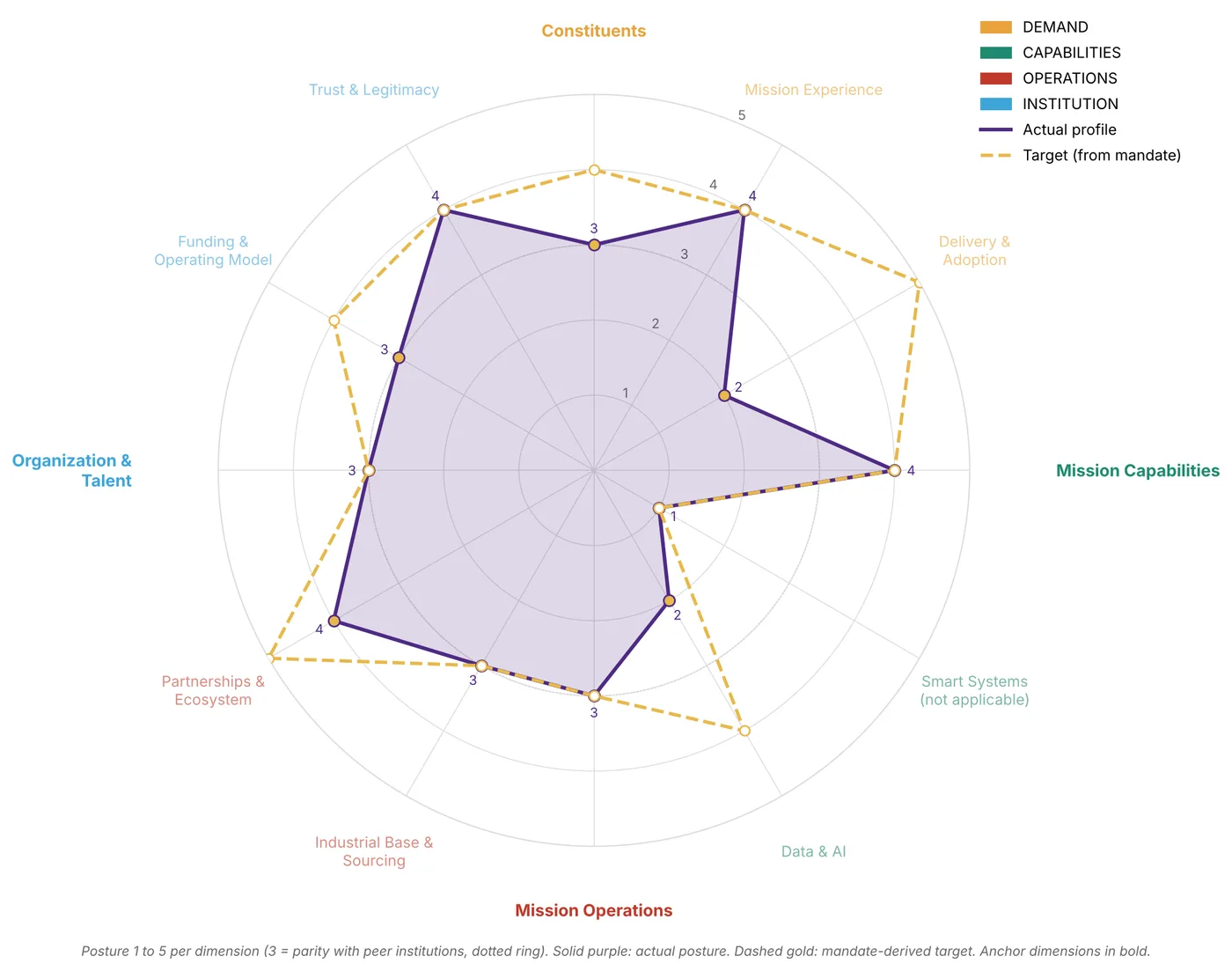
The unweighted drift, the sum of absolute gaps on the eleven applicable dimensions, is 8 of a possible 44; the priority-weighted drift is 22 (equations (1) to (3) in Appendix B). Every gap falls on a dimension weighted 2 or 3, and the single delivery gap accounts for 9 of the 22. The shape on the chart is a strong left side, where partnerships, trust and experience meet or nearly meet their targets, and a collapsed right side, where delivery and data fall away. That is the signature of an organization that has built the capacity to convene and has not yet built the machinery to convert.
4.1 Delivery is where the mandate is least met
The mandate asks the organization to turn the diaspora's success into impact, and the outcome the delivery dimension measures is reach: whether money, investment, policy or service arrives where it is used. The record shows channels for giving, investment and policy, and each has thinned.
The first channel is giving. Indiaspora's ChaloGive campaign, launched at its second philanthropy summit in 2019 and modeled on Giving Tuesday, mobilized more than $15 million for India's pandemic relief and provided over 8 million meals in 2020 (Indiaspora 2026l; India Abroad 2019). The returns name where the organization's own grants went: Feeding America, the Give Foundation (the United States arm of GiveIndia), the EdelGive Foundation in India and its American friends organization, with $849,726 of pandemic relief distributed in the year to June 2020 (NonprofitLight n.d.; Philanthropy.org 2026d). Grants paid rose to $1,855,579 in the year to June 2021, of which $643,175 went to foreign recipients, then fell to $819,939 in 2022 ($243,122 foreign), $738,038 in 2023 and zero in the six months to December 2023 and in 2024 (Philanthropy.org 2026a; Philanthropy.org 2026b; Philanthropy.org 2026c; Philanthropy.org 2026e). Giving moved to the India Philanthropy Alliance, the coalition Indiaspora joined as one of eleven founding organizations in October 2019 and in which it is now one of 25 core organizations (Stanford Social Innovation Review 2019; India Philanthropy Alliance 2026). The Alliance's India Giving Day raised more than $5.5 million for 33 nonprofits in March 2024, nearly $9 million from 2,691 donors for 36 nonprofits in March 2025 and $5,645,896 for 51 nonprofits in March 2026 (India Philanthropy Alliance 2026b; India Philanthropy Alliance 2025; India Philanthropy Alliance 2026; American Bazaar 2026c). The 2025 total stands out as a peak year, and the 2026 total returned to the 2024 level while the number of nonprofits sharing it grew by half. Indiaspora's March 2026 report counts the 2025 total as money "Indiaspora helped raise" (Indiaspora 2026a). The Alliance's own accounts name Indiaspora as a member without stating its share, and the report cannot separate the dollars Indiaspora's network sourced from those the coalition's 24 other members sourced.
The second channel is investment and talent. The March 2026 report documents that more than three-quarters of overseas angel investors in Indian startups are of the diaspora and that eight funds committed $1 billion to Indian deep technology in 2025, and it cites Startup Bridge India, a 2016 to 2019 program of another firm, as a model (Indiaspora 2026a). The organization's own vehicle in this channel is a SaaS mentorship program described on its website without dates, cohort size or outcomes (Indiaspora 2026s). The third channel is policy. The 2026 report recommends that India extend its Aadhaar identity system to Overseas Citizens of India, harmonize residency and tax rules, explore a dual-citizenship framework and relax exchange controls for diaspora investors, and it gives no mechanism for tracking whether any recommendation is taken up (Indiaspora 2026a). The record six months on shows what such a tracker would hold. In September 2026 the chief executive of India's Unique Identification Authority said it is developing a way to issue Aadhaar to Overseas Citizens of India without the 182-day residence requirement, and no source connects that work to Indiaspora (Indian Eagle 2026). The Citizenship (Amendment) Rules 2026, in force by June 2026, moved the other way: they tightened the one-passport rule for minors, and commentary on them records the government's position that the overseas citizenship scheme will not become dual citizenship (Legal Lands 2026). The September 2026 philanthropy summit closed with a communiqué of positions and calls to action, and the press account of it reports no pledges, dollars or follow-up on the 2025 summit (India West 2026). The 2024 United States report was presented in New Delhi with the External Affairs Minister and the United States Ambassador, and the 2025 UAE report was presented by the UAE Minister of Tolerance and Coexistence; both are capability wins for the research series, and neither records a policy outcome (Indiaspora 2024a; Macau Business 2025).
The honest score is 2: activity without measured outcomes attributable to the organization, with a band to 3 if the Alliance's results are credited in part. The weighted gap of 9 is the largest on the chart and about two-fifths of the total. It is an allocation failure, because the organization has shifted effort toward convening and recognition while the grantmaking line fell to zero, and the remedy is a funded owner and a ledger, which Section 7 names. The 2024 return itself shows the measurement gap: of $2.25 million in program spending, it describes $1.9 million under a line labeled only "Other expenses" and reports attendance and speaker counts, without outcomes, for the two programs it names, the Forum for Good ($159,000) and the AI summits ($93,000) (Philanthropy.org 2026e; Candid 2026).
The strongest counter-reading is that delivery is the members' business and the organization's job is to inspire it: the Forum's speakers and members give hundreds of millions through their own foundations, and the report itself records that Indian American giving rose from about 1 to 2 percent of income in 2018 to 4 to 5 percent in 2024 (Indiaspora 2026a). That figure comes from a study Dalberg ran with Indiaspora and the Alliance, which estimates Indian American giving at $4 to $5 billion in 2024, nearly triple the 2018 baseline, and which Inside Philanthropy cited in April 2026 as "commissioned by Indiaspora" (Dalberg 2025a; Inside Philanthropy 2026). The founder credits the philanthropy summits and pandemic-era donor work for the rise; the study itself rests on 433 self-selected respondents with a median household income near $300,000 and does not attribute the increase to any organization (Dalberg 2025a; Dalberg 2025b). The report accepts that the members deliver and holds the score, because the mandate charges the organization with the transformation and the organization's own research says diaspora donors want to see outcomes counted. An inspiration effect that nobody measures cannot be scored above 2.
4.2 The organization cannot yet see its own network in data
Data and AI on this instrument measures how the institution turns data into advantage across its own work. Indiaspora talks about AI often and well: it has held four AI summits since April 2024, the most recent closing the Bengaluru Forum on 25 March 2026 with two Zinnov reports on India's top 100 AI startups, which have raised over $3.6 billion and employ nearly 20,000 people, and on the AI exposure of global capability centers; its sixth virtual climate summit in April 2026 asked whether AI can be net positive for the planet; and the Patrick J. McGovern Foundation, a funder of AI for social good, granted it $100,000 in 2024 (Indiaspora 2026d; Indiaspora 2026e; Indiaspora 2026f; Philanthropy.org n.d.). Under the assignment rule those summits and reports belong to mission capabilities, because they are outputs the organization produces for its audience.
The record of the organization's own data use is thin. Membership tiers (Founders Circle, Benefactors, Patrons) are named without dues, benefits or counts; the member page shows 32 profiles; the home page claims more than 20,000 engaged leaders without a definition (Indiaspora 2026k; Indiaspora 2026n). Event registration runs on a community platform that lists offerings and capacity, 250 seats for the 2025 philanthropy summit, and no member directory or outcome view (Indiaspora 2025i). The highlights of 2025 to 2026 are published as a flipbook with no extractable data. The 250 at 250 site, launched in July 2026, labels many of its portraits "AI generated likeness," a choice that saves licensing cost and invites questions about representing real people with synthetic images (Indiaspora 2026o). The returns now give a direct read of spending on the dimension: information technology cost nothing in the years to June 2021 and June 2022 and $23,181 in 2024, 0.8 percent of expenses (Philanthropy.org 2026a; Philanthropy.org 2026b; Philanthropy.org 2026e). The score is 2, and its band narrows to 1 to 2, against 1 to 3 in the first edition, because a filing-level spending figure this small rules out an internal data system of any scale. It is an allocation failure: the dimension draws almost none of the budget, and the delivery gap in Section 4.1 cannot close until the organization can count members, commitments and outcomes in one place.
4.3 The network is broad, its funding narrow, and its partnerships one step short of defining
Constituents scores 3 against a target of 4. The organization's reach across the diaspora's elite is real and documented in its own lists: the 2024 Government Leaders list recognizes more than 300 officials of Indian origin in 20 countries, up from more than 200 in 15 countries in 2021, and the 2025 Business Leaders 2.0 list names 90 chief executives and chairs of companies worth $2 billion or more, 11 of them women, with about $20 trillion of combined revenue (Indiaspora 2024c; Indiaspora 2025g). The organization's own constituents, the members it serves, are not counted in the public record, and the reach below the leadership tier is recent and small: the IndiasporaNEXT social entrepreneurs list of December 2022 has not been renewed, and the Heritage Connect program for 17 to 19 year olds was announced in August 2026 without a cohort size or cost (Indiaspora 2026q; American Bazaar 2026d). The diaspora the mandate names is 35 million people in more than 200 countries, most of them neither executives nor officials (Indiaspora 2026a). Every item here is the organization's own publication, which caps the score at 3.
The funding and operating model scores 3 against a target of 4. The balance sheet has strengthened: net assets rose from $0.90 million in June 2023 to $3.35 million in December 2024, and program service revenue, mostly event and sponsorship income, recovered to $0.46 million (ProPublica 2026). Charity Navigator rates the organization three of four stars (Charity Navigator 2026). The returns put the program share of expenses at 93 percent in the year to June 2021, 83 percent in 2022, 85 percent in 2023, 71 percent in the six months to December 2023 and 79 percent in 2024, as management costs grew from $0.12 million to $0.40 million (Philanthropy.org 2026a; Philanthropy.org 2026e); a second aggregator reports the same 79 percent for 2024, and the 87 percent figure cited in the first edition, for a year its source does not state, matches none of the five periods read and is withdrawn (Kindora n.d.; GiveFreely n.d.). The concentration is the risk. Fifty-seven grantmakers gave $9.2 million in 157 grants from 2019 to 2024, and three of them, the Fidelity Investments Charitable Gift Fund, the Morgan Stanley Global Impact Funding Trust and the Six Four Foundation, gave $3.9 million, about 42 percent (Philanthropy.org n.d.). The first two are donor-advised fund sponsors, which means a small number of individual donors whose names are not public stand behind much of the revenue. Expansion to four more countries, which the founder has stated, cannot run on that base without new sources. Parity is the honest posture.
Partnerships and ecosystem scores 4 against a target of 5, the strongest dimension and the one closest to the organization's identity. The record shows partners across sectors and countries: Boston Consulting Group as co-author of the 2024 and 2025 impact reports, Zinnov for the 2026 AI reports, the India Philanthropy Alliance, the Dubai Future Foundation for AI summits, NITI Aayog, Invest India and state governments, Princeton's Chadha Center and Harvard's Mittal Institute for an academic conference, Dalberg and Johns Hopkins for earlier research, and India's G20 presidency in 2023, when an Indiaspora forum in New Delhi drew about 300 participants from 26 countries (Indiaspora 2024b; Indiaspora 2025a; Indiaspora 2026r; Indiaspora 2023). Independent sources confirm ministerial engagement: India's public broadcaster reported the UAE Minister of Tolerance opening the February 2025 Forum for Good, and the American Bazaar reported the October 2026 summit communiqué co-issued with the Alliance (News On AIR 2025; American Bazaar 2026e). The partners' own records describe the joint work in the same terms. The Alliance's founders list Indiaspora among the eleven organizations that launched the coalition in 2019, the Alliance's executive director described the coalition's approach to Indian American giving in a May 2026 interview, and Dalberg's 2025 giving study names Indiaspora as co-author and its 2018 study with Dalberg as the first formal survey of the community's giving (Stanford Social Innovation Review 2019; American Bazaar 2026f; Dalberg 2025b). None of these records counts an outcome the partnership produced. A 5 requires that peers copy the model and that two independent sources within twelve months document a quantified mission outcome; the partnerships produce events and reports, and the outcomes they produce are not counted. The March 2026 report carries no named research partner, which the release itself confirms by citing BCG only for the earlier reports (Indiaspora 2026b).
4.4 Where Indiaspora is at target
Mission capabilities scores 4 at its target of 4. The research series is the organization's most distinctive output: the 2024 United States report, co-authored with BCG and guided by a steering committee that included a former United States ambassador to India and a former PepsiCo chief executive, found that Indian Americans are about 1.5 percent of the United States population and pay five to six percent of its taxes; the 2025 UAE report traced a community that grew from about 5,000 in 1975 to 3.9 million; the October 2025 education report counted more than $3 billion given by Indian Americans to American universities since 2008; and the March 2026 report surveyed more than 200 diaspora members in 24 countries and 50 Indian nonprofits (Indiaspora 2024a; Indiaspora 2024b; Macau Business 2025; Indiaspora 2025d; Indiaspora 2026a). Independent outlets carried the work: the Press Trust of India's Washington correspondent on the first Government Leaders List in February 2021, ThePrint on the United States report's launch in August 2024, India's public broadcaster on the UAE report in February 2025, Inside Philanthropy on the giving study in April 2026 and Newsweek on 250 at 250 in July 2026 (ThePrint 2021; ThePrint 2024; News On AIR 2025; Inside Philanthropy 2026; Newsweek 2026). Each repeats the findings without testing them, and confidence on the dimension rises to High on two independent sources within twelve months. The band runs to 3 because the 2026 report states that its survey skews toward professionals and its findings are directional.
Mission experience scores 4 at its target. The Forum for Good in February 2025 gathered 500 leaders and 140 speakers from 34 countries across 24 sessions in Abu Dhabi and Dubai, opened by a UAE minister with India's ambassador present; the Bengaluru Forum of March 2026 drew a speaker list that included Nandan and Rohini Nilekani, Gita Gopinath and Kiran Nadar; and the September 2026 philanthropy summit in Dallas drew more than 160 leaders (Indiaspora 2025b; News On AIR 2025; Indiaspora 2026c; American Bazaar 2026e; India West 2026). The Alliance's own record puts the Forum for Good audience its director addressed at 700 delegates, above the organization's count of 500 leaders (India Philanthropy Alliance 2026b). The convening is the product members pay for, and it works.
Trust and legitimacy scores 4 at its target and on its floor. Ministers and ambassadors of three governments have appeared at its launches in the last two years, it has taken public positions on racial targeting, the bilateral relationship and the H-1B fee without partisan alignment, and the search found no adverse record (Indiaspora 2024a; News On AIR 2025; Indiaspora 2024d; Indiaspora 2025c; Outlook India 2026). The national wire service in India quoting the executive director in June 2026 and Newsweek's July 2026 feature give two independent sources within twelve months, and confidence rises to High. The band runs to 3 because two choices carry risk: the synthetic portraits on 250 at 250, and a closeness to the Indian government's agenda that a newsletter headline in June 2026 on the Prime Minister's tenure illustrates (Indiaspora 2026o; Indiaspora 2026u).
Mission operations, the industrial base and organization and talent score 3 at targets of 3. The organization holds a dense calendar on schedule: an annual Forum since 2012, a philanthropy summit since 2018, a climate summit in its sixth year, a weekly newsletter and a blog that posted twelve pieces between mid-August and early October 2026 (Indiaspora 2026h; Indiaspora 2026f; Indiaspora 2026u). It buys research and production from partners at parity. The staff page lists 16 people across the United States, India, the United Kingdom, Singapore and Australia, with four more not displayed; the 2024 filing reports $1.34 million of compensation to officers and key employees, 47 percent of expenses, with the executive director at $300,500 (Indiaspora 2026i; ProPublica 2026). Retention, morale and the depth behind the founder and the executive director were not read, and the band on talent runs from 2 to 4.
5. Why the gaps exist: effort against posture
Posture says where the organization stands; effort says why. The statement of functional expenses in each return splits spending among programs, management and fundraising and itemizes grants, and Table 5 sets out five periods read from a line-item mirror of the filed returns. The organization publishes no program-level budget, so effort cannot be assigned to every dimension. Two lines can be assigned with confidence: grants paid measure effort on delivery, and information technology bounds effort on data and AI.
Table 5. Where the money went: functional expense shares and grants paid, fiscal 2021 to calendar 2024 (US dollars and percent of total expenses).
| Period | Total expenses | Programs | Management | Fundraising | Grants paid | Grants share | Program spending other than grants |
|---|---|---|---|---|---|---|---|
| Year to June 2021 | 2,751,241 | 93.3% | 4.3% | 2.4% | 1,855,579 | 67.4% | 711,349 |
| Year to June 2022 | 2,557,071 | 82.8% | 9.2% | 8.0% | 819,939 | 32.1% | 1,297,540 |
| Year to June 2023 | 3,367,539 | 85.0% | 11.1% | 3.9% | 738,038 | 21.9% | 2,122,931 |
| July to December 2023 | 1,297,984 | 71.0% | 22.0% | 7.0% | 0 | 0.0% | 921,691 |
| Calendar 2024 | 2,851,852 | 79.1% | 14.0% | 6.9% | 0 | 0.0% | 2,254,809 |
Sources: Philanthropy.org 2026a to 2026e, Part IX of each return; percentages computed by the author.
The first reading is that effort has moved from giving to convening. In the year to June 2021 two-thirds of spending was grants; by 2024 none was, while program spending on everything else more than tripled, from $0.71 million to $2.25 million. The returns' own program descriptions trace the same path: the 2021 return leads with pandemic relief and the Alliance, the 2022 and 2023 returns with relationship building and the Khushi giving campaign, and the 2024 return with the Forum for Good and the AI summits (Philanthropy.org 2026a; Philanthropy.org 2026b; Philanthropy.org 2026c; Philanthropy.org 2026e). Compensation is about half of 2024 spending, travel $192,060, and the rest goes to events and research led by two international Forums in fourteen months in Abu Dhabi, Dubai and Bengaluru, a member retreat at a resort in New Mexico, and roadshows in Sydney, Melbourne and Brisbane (ProPublica 2026; Indiaspora 2025f; Indiaspora 2026g). Mission experience absorbs the largest effort and stands at target. Delivery draws no grant spending and data and AI 0.8 percent of expenses. Both are allocation failures, mandate dimensions starved while the institution's largest effort flows to a dimension already at target. No dimension shows the opposite signature of heavy spending at low posture, so the record shows no execution failure.
The second reading is that the giving channel was handed to a coalition. Moving giving into the India Philanthropy Alliance was a sensible partnership choice in 2019; it also moved the dollars and their measurement outside the organization's books. The giving day has raised between $5.5 million and $9 million a year since 2024, and Indiaspora cannot show what share its own network supplied.
The third reading is that the funding model has grown without diversifying. Contributions rose from $1.23 million in fiscal 2021 to $3.09 million in 2024, while program service revenue fell from $2.38 million to $0.46 million over the same span (ProPublica 2026). The 2021 figure likely reflects pandemic-era pass-through income, and the record does not say; either way, the organization now depends more on a small set of donor-advised funds than it did.
Each remedy names a different instrument. For a nonprofit the instrument is a board resolution and a budget line. Delivery needs a three-year line with an owner, funded from the reserve above six months and a matched campaign. Data and AI needs a smaller capital line for a member database and an analyst. The funding model needs a published membership offer and multi-year sponsorships tied to the research series. Trust needs conduct, which costs little.
6. What Indiaspora should grow, hold, fix and stop
Table 6 adjudicates the eighteen live programs the public record evidences, assigned to one dimension each by primary job and sponsor. The verdicts are the instrument's four: grow, hold, fix-or-kill and stop. The organization's internal pipeline was not read, and the list should be completed from internal materials.
Table 6. The adjudication of live programs: dimension, sponsor, stage, verdict and condition, October 2026.
| Program | Dimension | Sponsor | Stage | Verdict | Condition |
|---|---|---|---|---|---|
| Impact Report series (US 2024, UAE 2025, India 2026; Canada, UK, Australia, Singapore planned) | Mission Capabilities | Executive Director | Three published | Grow | A named research partner and a published method standard for each new country report |
| Indiaspora-IPA Philanthropy Summit (annual since 2018) | Delivery & Adoption | MD, USA and Global West | Dallas, Sept 2026; 160+ leaders | Grow | Each summit ends with counted commitments reported at the next |
| Participation in India Giving Day (IPA) | Delivery & Adoption | MD, USA and Global West | $9M (2025); $5.6M (2026) | Grow | Count and publish Indiaspora-sourced donors and dollars from March 2027 |
| Pathways for sustained diaspora contribution (2026 report follow-on) | Delivery & Adoption | Executive Director | Named in the report; design stage | Grow | One owner and one tracked pathway per pillar by the 2027 Forum |
| Indiaspora Forum (global flagship) | Mission Experience | Founder and Executive Director | Bengaluru, Mar 2026 | Hold | Hold scale; add a commitment format |
| Annual Member Exclusive Retreat | Constituents | Partnerships and Programs | Tamaya, NM, 9 to 11 Oct 2026 | Hold | Report member retention after each retreat |
| Government Leaders and Business Leaders lists | Mission Capabilities | Research and Events | 2024 and 2025 editions | Hold | Fixed refresh cadence and published method |
| 250 at 250: The Indian American Story | Trust & Legitimacy | Executive Director | Launched July 2026 | Hold | Replace or prominently label synthetic portraits of real people |
| Heritage Connect (ages 17 to 19, 12 days in India) | Constituents | Executive Director | Announced Aug 2026 | Hold | Publish cohort size, cost and a one-year follow-up |
| Country presence (UK, Singapore, Australia; roadshows) | Partnerships & Ecosystem | Country heads | Operating; Australia roadshows Nov 2025 | Hold | Local co-funding before each new country report |
| India subsidiary and NITI Aayog, Invest India work | Partnerships & Ecosystem | CEO, India | Since 2022 | Hold | Publish the subsidiary's program results annually |
| Weekly newsletter, blog and YouTube channel | Mission Operations | Marketing and Communications | Operating | Hold | Measure readership against membership |
| Global AI Summit (fourth edition, Mar 2026) and Zinnov reports | Mission Capabilities | Executive Director | Folded into the Forum | Fix-or-kill | A diaspora-specific contribution (AI talent or capital bridge) defined by the 2027 Forum, or stop as a separate brand |
| Virtual Climate Summit (sixth edition, Apr 2026) | Mission Experience | Executive Director | Annual, virtual | Fix-or-kill | Publish attendance and one outcome by April 2027, or fold into the Forum |
| SaaS mentorship program | Delivery & Adoption | Entrepreneurship pillar | Described without dates or cohorts | Fix-or-kill | Publish cohorts and founder outcomes by mid-2027, or close |
| Resources for H1Bs page | Constituents | Communications | Static links; one broken; fee and June 2026 ruling not covered | Fix-or-kill | Maintain with partner legal clinics, or remove |
| ChaloGive giving campaign | Delivery & Adoption | Philanthropy pillar | Dormant since pandemic relief; superseded by IPA | Stop | Record the decision; carry its donor list into candidate 4 |
| IndiasporaNEXT Social Entrepreneurs List | Constituents | Entrepreneurship pillar | Single edition, Dec 2022 | Stop | Record the decision; Heritage Connect carries the next generation |
Four programs grow, and their common condition is counting. The impact report series is the organization's most distinctive capability and the vehicle for the stated expansion to four countries; it needs a partner and a method standard so that the 2026 report's directional sample does not become the norm. The philanthropy summit, the giving day and the pathways work are the delivery machinery, and each grows only if it reports what it moved. The giving day matters most: the Alliance has set its fifth edition for 12 March 2027, which is the first date by which Indiaspora could publish its own share (American Bazaar 2026e).
Four programs are fix-or-kill, and each gets a dated decision. The AI summit competes with larger national and commercial events and in March 2026 spent part of its program on a debate over whether Bengaluru or Hyderabad is India's leading technology city (Indiaspora 2026e); its future depends on finding the contribution only a diaspora network can make. The climate summit is low-cost and outside the four pillars. The mentorship program and the H-1B page are commitments the website makes without evidence that anyone maintains them.
Two programs stop because their work is done, and the instrument records each stop as a decision. ChaloGive served its purpose in the pandemic and its donors should become the seed list for a giving circle. The 2022 social entrepreneurs list was not repeated, and Heritage Connect now carries the next generation.
7. Candidates to close the gaps
The five dimensions with weighted gaps, delivery and adoption, data and AI, constituents, partnerships and the funding model, become lenses. Each candidate is screened on three reads scored 1 to 5 and composed multiplicatively (equation (7) in Appendix B): mission value, read against the priority weight; feasibility at the level the organization can deploy today with its staff and budget; and authority, whether the organization holds the legal authority, board mandate and funding category to execute. For a United States public charity the binding authorities are the campaign bar and lobbying limit, securities and solicitation rules, and for money entering India, the Foreign Contribution (Regulation) Act. A score of 1 on any read parks the candidate with its named authority and a dated trigger. Composites of 64 and above are fund now, 30 to 63 fund next, below 30 watch. Scores are illustrative judgments on the public record. Candidates were sought in the three places the method names: idle assets and authorities the organization holds, exemplars from peer institutions, and partnership vehicles.
Table 7. Twenty screened candidates: lens, source, mission value, feasibility, authority, composite and verdict.
| # | Candidate | Lens | Source | MV | F | A | Score | Verdict |
|---|---|---|---|---|---|---|---|---|
| 1 | Public diaspora giving ledger: funds raised, nonprofits funded, beneficiaries, by year | Delivery | Idle asset | 5 | 4 | 5 | 100 | Fund now |
| 2 | Forum commitment mechanism: named, dated member commitments reported at the next Forum | Delivery | Peer exemplar | 5 | 4 | 5 | 100 | Fund now |
| 3 | Consented member data foundation: one database of members, engagement and commitments | Data & AI | Idle asset | 4 | 4 | 5 | 80 | Fund now |
| 4 | Formal Indiaspora channel into India Giving Day with sourced donors and dollars counted | Partnerships | Partnership | 4 | 4 | 5 | 80 | Fund now |
| 5 | Published membership model: tiers, dues, benefits and member count | Funding | Idle asset | 4 | 4 | 5 | 80 | Fund now |
| 6 | Board-designated operating reserve of six months with a written draw rule | Funding | Idle authority | 3 | 5 | 5 | 75 | Fund now |
| 7 | Impact report method standard with an open data appendix | Data & AI | Peer exemplar | 3 | 5 | 5 | 75 | Fund now |
| 8 | Member giving circle seeded from the ChaloGive donor list, matched on giving day | Delivery | Idle asset | 5 | 3 | 4 | 60 | Fund next |
| 9 | Country impact reports co-funded by local partners (Canada, UK, Australia, Singapore) | Partnerships | Stated aim | 4 | 3 | 5 | 60 | Fund next |
| 10 | Multi-year corporate sponsorship of the research series | Funding | Idle asset | 4 | 3 | 5 | 60 | Fund next |
| 11 | Heritage Connect alumni and next-generation membership tier | Constituents | Stated aim | 4 | 3 | 5 | 60 | Fund next |
| 12 | University research network built on the Princeton and Harvard conference | Partnerships | Partnership | 3 | 4 | 5 | 60 | Fund next |
| 13 | Academic pathway: diaspora faculty matched to India's VAIBHAV and GIAN programs | Delivery | Partnership | 4 | 3 | 4 | 48 | Fund next |
| 14 | Policy uptake tracker for the 2026 report's recommendations | Delivery | Idle asset | 3 | 4 | 4 | 48 | Fund next |
| 15 | Open online community for the 20,000 engaged leaders beyond paying members | Constituents | Idle asset | 3 | 3 | 5 | 45 | Fund next |
| 16 | Diaspora investment introductions desk for Indian startups, no fees taken | Delivery | Peer exemplar | 4 | 3 | 3 | 36 | Fund next |
| 17 | AI-assisted member matchmaking, built on candidate 3 | Data & AI | Partnership | 4 | 2 | 4 | 32 | Fund next |
| 18 | Gulf diaspora workers as a constituency: remittance-linked giving products | Constituents | Peer exemplar | 4 | 2 | 3 | 24 | Watch |
| 19 | Direct grantmaking into India through the subsidiary with foreign funds | Delivery | Idle asset | 4 | 3 | 1 | parked | Parked (FCRA) |
| 20 | Candidate scorecards or endorsements in United States elections | Constituents | External ask | 2 | 4 | 1 | parked | Parked (IRC 501(c)(3)) |
The seven candidates at fund now share a property: each uses an asset or authority the organization already holds and costs little. The giving ledger needs numbers the organization already collects or can obtain from the Alliance; its own report recommends exactly this to India's government. The commitment mechanism changes the format of an event the organization already runs, and the Clinton Global Initiative has shown for two decades that a convening can count what it produces. The member database is the prerequisite for both. A published membership model and a reserve policy are board decisions.
Candidates 1, 2, 3 and 4 reinforce one another and should be read as one bet: commitments without a database cannot be counted, a database without commitments has nothing to count, and a ledger without the giving day channel misses the largest dollar flow the organization touches. Read together they are the delivery build the yield test prices at $1.2 to $2.2 million over three years. Candidates 5, 6 and 10 are a second combination: the membership offer and the sponsorships widen the funding base, and the reserve rule decides how much of the cushion the build may spend. Candidates 19 and 20 are parked on authority, and the report records them so that nobody reopens them quietly: the first waits on confirmation that the India subsidiary is registered to receive foreign contributions, and the second is barred by the campaign-intervention rule with no trigger foreseen.
The two-currency reconciliation is honest about the limit. In posture points, the seven fund-now candidates address every weighted gap and could move delivery from 2 to 3 and data and AI from 2 to 3 within the horizon; delivery reaches 4 only if the fund-next pathways (candidates 8, 13 and 14) deliver as well, and 5 requires two independent sources to document the counted outcomes. In dollars, the fund-now set costs well under $1 million and fits inside a good year's surplus; the full build falls in the $2.2 to $4.2 million band and needs the reserve draw and the matched campaign. The adjudication in Section 6 on its own closes none of the weighted drift, because the programs it grows carry no counting today.
8. What Indiaspora should not do
The valleys are choices and the report states them with the same confidence as the peaks. Smart systems is not applicable and stays so. Mission operations and the industrial base stay at 3: the organization should keep buying research from partners and production from venues and vendors, and should not build an in-house research department or event company. Organization and talent stays at 3 by target; the delivery build adds two or three staff with specific jobs, and the organization should not add country offices ahead of local funding.
The convening calendar should hold its current scale. A third international Forum location in three years, or a second annual retreat, would add to the dimension already at target and draw from the one furthest below it. The AI and climate summits should earn their place by the dates in Table 6.
One candidate is watched. Building giving products for the Gulf diaspora's workers would widen the constituency the mandate names, and it scores low on feasibility and authority while UAE and Indian rules on cross-border giving remain unread for this organization. Two candidates are parked. Direct grantmaking into India with foreign funds waits on confirmation of the subsidiary's registration under the Foreign Contribution (Regulation) Act. The returns show the organization has already granted $886,297 to foreign recipients in the years to June 2021 and 2022, including the EdelGive Foundation in India, so a route through registered Indian recipients exists; the park applies to channeling foreign money through the subsidiary itself (Philanthropy.org 2026a; Philanthropy.org 2026b). Endorsing or scoring candidates is barred to a 501(c)(3) and no trigger is foreseen. The floor on trust and legitimacy will be held at 4 even where the organization chooses not to lead, which means synthetic portraits of real people on a public history site should be replaced or labeled before the next anniversary cycle.
9. What happens next
The 90-day actions, each with an owner:
- Name the delivery owner and envelope. The executive director brings the board a three-year delivery line funded from the reserve above six months and a matched campaign, with one senior staff member accountable for giving, investment and policy pathways (candidates 1, 2 and 6).
- Publish the first giving ledger. The managing director for the United States and the Global West assembles 2024 to 2026 figures from the organization's own books and the Alliance, separating Indiaspora-sourced dollars where possible, and publishes them before India Giving Day on 12 March 2027 (candidates 1 and 4).
- Design the commitment format for the next Forum. The Forum's managing director builds a commitment card, a follow-up cadence and a public report at the following Forum (candidate 2).
- Write the outcome targets and the reserve rule. The board adopts three to five outcome targets for the four pillars and a written operating reserve policy, and publishes both (candidates 5 and 6).
The public record leaves gaps that limit the scores and should be closed from internal data: a breakdown of the $1.9 million the 2024 return reports as "Other expenses" by program, which would turn the effort reading in Section 5 into shares of spending by dimension; the member count, tier mix and renewal rate; the India subsidiary's registration and program spending, which the return's Schedules F and R report and this edition could not read; the reason for the rise in legal fees in 2024; and the Alliance's attribution of giving day dollars by member organization. The radar should be re-run in October 2027, after the next Forum, the fifth giving day and the first ledger, with the guardrail that a score moves only on two consecutive reads or one confirmed change in evidence.
Appendix A. Method Note and Source Ledger
A.1 Method and passes
The diagnostic ran the Mission Radar's staged assessment from public sources only, at the third stage of the construction ladder (records retrieved and cited per score) without the Delphi or interview stages, which require access to the institution. Two passes ran. The strategy pass read the organization's mission, team, board and member pages, "The Indiaspora Story" (August 2025), the March 2026 report in full from its PDF, the 2024 and 2025 impact report pages and launch coverage, and the Form 990 summary data for every year filed. The dimension pass ran 22 web searches (10 extended) and 64 successful page reads across the organization's event, impact, list and press pages, ProPublica Nonprofit Explorer, Candid, Philanthropy.org, Instrumentl, the India Philanthropy Alliance, News On AIR, Newsweek, the American Bazaar, the South Asian Herald, Macau Business (GlobeNewswire) and Wikipedia. The evidence cutoff is 12 October 2026. Ten fetches failed or returned no content: ProPublica's search page, its rendered Form 990 text in three attempts and its PDF, CauseIQ, the organization's original team URL, its highlights flipbook, Philanthropy.org's financial profile, and the body of Charity Navigator's profile. The first edition therefore left functional expenses, program service descriptions and foreign grants unread; the top-up pass of 12 October 2026 recovered all three from Philanthropy.org's line-item reports on the filed returns and Candid's program descriptions, and left the detail of Schedules F and R unread (ProPublica's rendered schedules and XML are closed to automated reading, the IRS PDF image carries no text layer, and CauseIQ and GuideStar hold their financial pages behind a paywall). Entries marked [snippet] were verified from a search result only; none of the scores of 4 rests on one.
The ledger holds 79 dated sources after the top-up pass. Independence is the constraint for a nonprofit of this size: 37 of the 79 are the organization's own pages, releases and signed op-eds and three more are syndications of its releases, 51 percent of the ledger against 66 percent in the first edition. The top-up pass added 21 sources, ten of them independent press, partner records and philanthropy research, five line-item reports on the filed returns, two Indiaspora-origin items and four aggregator or commentary sources. Evidence tiers follow the posture scale: Tier A is IRS filings and their faithful mirrors; Tier B is named independent press and rating bodies; Tier C is the organization's own announcements and pages and syndicated press releases, which cap a score at 3; Tier D is aggregators and commentary, which corroborate only. Two sources count as independent only if each generates its own evidence; the organization's website, its press releases and their syndications are one source. Confidence is derived: High needs two independent Tier A or B sources within twelve months, Medium is one such source with Tier C corroboration, Low is Tier C only or a coverage gap. Source counts: Tier A 6 (the filings and five line-item reports on them), Tier B 24, Tier C 40, Tier D 9. The two Dalberg sources are tiered B because Dalberg ran its own survey; Indiaspora co-authored the study, so they corroborate the giving trend and do not count as independent evidence of Indiaspora's outcomes. Rejected at the provenance gate: 2 (a currency-news site republishing an H-1B story with no source, and a mirror of the 2026 press release on an unrelated regional site).
A.2 Where the deep pass moved scores from the shallow read
The shallow read of October 2026 scored the organization at 5 on partnerships and constituents, 4 on mission experience, mission capabilities, delivery, trust and funding, 3 on organization and talent, data and AI and mission operations, 2 on the industrial base and 1 on smart systems, with targets of 5 on partnerships, 4 on constituents, experience and trust, and 3 or below elsewhere. The deep pass moved six scores and held five, and moved most targets. Partnerships moves from 5 to 4 because a 5 requires quantified outcomes documented by two independent sources, and the shallow read's claim that India's External Affairs Minister and the United States Ambassador attended "report launches" in 2026 holds only for the August 2024 launch; the March 2026 report names no partner and records no dignitaries. Constituents moves from 5 to 3 because every reach figure is the organization's own and the member count is unpublished. Delivery moves from 4 to 2 on the grant line falling to zero in 2024 and the giving day's fall in 2026. Funding moves from 4 to 3 on donor concentration. Data and AI moves from 3 to 2 because the AI work belongs to capabilities under the sponsor rule and the internal record shows no data system. The industrial base moves from 2 to 3 because buying research from BCG and Zinnov is parity sourcing. Mission experience, mission capabilities, trust, organization and talent and mission operations hold. Smart systems is now recorded as not applicable and carries no score. The targets moved because the shallow read set them close to the actual profile, and the deep pass derives them from the mandate's operative verb: delivery from 4 to 5 and weight 3, data and AI from 2 to 4, funding from 3 to 4, partnerships held at 5. The shallow read recorded the trust floor as compelled at 4; the deep pass splits it into a compelled floor of 3 under the Internal Revenue Code and an elective step to 4.
A.3 Derivation box: the delivery score
Signal 1, shipped moves with dates: ChaloGive launched October 2019; pandemic relief above $15 million in 2020 to 2021; grants paid $1,855,579 (2021), $819,939 (2022), $738,038 (2023), $0 (2024); India Giving Day through the Alliance on 1 March 2024 (more than $5.5 million, 33 nonprofits), 14 March 2025 (nearly $9 million, 2,691 donors, 36 nonprofits) and 13 March 2026 ($5,645,896, 51 nonprofits); philanthropy summits October 2025 and September 2026 with communiqués and no counted pledges; the 2026 report's policy recommendations, March 2026, with one under study by India's identity authority (September 2026) and dual citizenship ruled out (June 2026), neither attributed to Indiaspora. Signal 2, outcome evidence on the dimension's metric (reach of money, investment and policy where used): grant totals from filings; giving day totals belong to a 25-member coalition without attribution; no investment or policy outcome recorded. Signal 3, recognition: none for delivery; recognition attaches to the convenings and reports. Anchor test: the dimension asks whether the network's attention arrives where it is used; the record shows activity and coalition outcomes the organization cannot claim alone, which the rubric calls lagging. Tier: A for grant totals and grant shares of spending, B for the giving day totals and the summit record, C for the giving day attributions. Score 2, band 2 to 3, confidence High (the filings and India West 2026 within twelve months; first edition Medium).
A.4 Top-up pass of 12 October 2026
The top-up pass ran 14 web searches (5 extended) and 41 page fetches, 30 of which returned content, aimed at three gaps: the functional expense split and program and foreign-grant detail of the returns, independent sources to rebalance a ledger dominated by the organization's own pages, and any record of outcomes from the Forum, the leaders lists and the March 2026 report. No score moved. Every score was re-checked against the new evidence and held: delivery at 2 (grants confirmed at zero in 2024 on the functional statement; the 2026 giving day total returned to the 2024 level; the 2026 summit produced no counted pledges), data and AI at 2, mission capabilities at 4, partnerships at 4, trust at 4, funding at 3 and the rest unchanged. Drift (8 unweighted, 22 weighted) and intensity (0.82) were recomputed and are unchanged.
Bands and confidence moved on evidence. The data and AI band narrows to 1 to 2 (the first edition carried 1 to 3) and its confidence rises from Low to Medium, because the returns show information technology spending of $0 in fiscal 2021 and 2022 and $23,181 in 2024. Confidence rises to High on delivery (filings plus India West 2026), mission capabilities (Inside Philanthropy 2026 and Newsweek 2026) and trust and legitimacy (Outlook India 2026 and Newsweek 2026).
The effort reading in Section 5 is now quantified from the functional statements (Table 5) and its classification holds: delivery and data and AI are allocation failures, and no dimension shows an execution failure. The yield test was recomputed with the filing figures and holds: management and fundraising cost $0.60 million in 2024, too little to release money for the build, and the envelope stays at zero to $0.9 million a year, with a possible $0.2 million upside if the 2024 legal fees do not recur.
Five numbers and one statement were corrected. The giving day series now includes 2024 (more than $5.5 million for 33 nonprofits), which recasts the 2026 total as a return to the 2024 level after a 2025 peak; the first edition's "fall of about 37 percent" framing is withdrawn. The Alliance's founding is recorded as eleven organizations, with Indiaspora among them. The program expense ratio of 87 percent cited from an aggregator is replaced by the filed ratios (79 percent in 2024). The Forum for Good audience is recorded at 700 delegates on the Alliance's count beside the organization's 500 leaders. Table 3 holds five filings, and the text that introduced it as six is corrected. The first edition's statement that the organization made no statement on the H-1B fee is corrected: the executive director commented on the June 2026 court ruling to the Press Trust of India, and the website page still omits the fee.
A.5 Source Ledger by dimension
Constituents (score 3, Medium). Indiaspora 2024c: 2024 Government Leaders List (300+ leaders, 20 countries), indiaspora.org, accessed Oct 2026, Tier C. Indiaspora 2025g: Business Leaders 2.0 List (90 leaders, data as of June 2025), Tier C. Indiaspora 2026k: Members page (three tiers, 32 profiles), accessed Oct 2026, Tier C. Indiaspora 2026n: Home page (20,000+ leaders, 50+ events, $15M+), accessed Oct 2026, Tier C. Indiaspora 2026q: IndiasporaNEXT page (list launched Dec 2022), Tier C. American Bazaar 2026d: "Indiaspora announces Heritage Connect program," 20 Aug 2026, Tier B. Indiaspora 2026p: Resources for H1Bs page (modified 9 May 2026), Tier C. Indiaspora 2026g: 2026 Annual Member Exclusive Retreat page (9 to 11 Oct 2026), Tier C.
Mission Experience (score 4, Medium). News On AIR 2025: "Indiaspora Forum for Good 2025 provides platform for discussion among Indian origin global leaders," 24 Feb 2025, Tier B. Indiaspora 2025b: Forum for Good 2025 event page (500 leaders, 140 speakers, 34 countries, 24 sessions), Tier C. Indiaspora 2026c: "Indiaspora Brings Global Leaders to Bengaluru for Landmark Indiaspora Forum," 11 Mar 2026, Tier C. South Asian Herald 2026: "Indiaspora Forum 2026 Opens in Bengaluru," Mar 2026, Tier B. American Bazaar 2026a: "Indiaspora Forum 2026, kicking off March 22 in Bengaluru," 13 Mar 2026, Tier B [snippet]. American Bazaar 2026e: "Indian American leaders spotlight growing philanthropy," 8 Oct 2026, Tier B. Indiaspora 2026f: Climate Summit 2026 page (sixth edition, 16 to 17 Apr 2026, 22 speakers), Tier C. Indiaspora 2025h: Indiaspora US Forum 2025 page (3 to 5 Oct 2025), Tier C. India West 2026: "Dallas Summit Strengthens U.S.-India Philanthropy Ties," 9 Oct 2026 (160+ leaders; communiqué; no pledges reported), Tier B. India Philanthropy Alliance 2026b: "In the News" record (Counts addressed 700 delegates at the Forum for Good, 24 Feb 2025), accessed Oct 2026, Tier B.
Delivery & Adoption (score 2, High; first edition Medium). Instrumentl n.d.: Indiaspora 990 report, grants by filing year 2015 to 2024, accessed Oct 2026, Tier D (aggregator of IRS data). India Philanthropy Alliance 2025: "2025 IGD Raises Nearly $9 Million," 31 Mar 2025, Tier B. India Philanthropy Alliance 2026: home page (IGD 2026 $5,645,896, 51 nonprofits; 25 core organizations; founded 2 Oct 2019), accessed Oct 2026, Tier B. American Bazaar 2026c: "Inside India Philanthropy Alliance's Giving Day 2026," 26 Mar 2026, Tier B. Indiaspora 2026l: Philanthropy page (ChaloGive, $15M COVID relief, 8M meals), modified 9 May 2026, Tier C. India Abroad 2019: "ChaloGive campaign launched at Indiaspora's 2nd philanthropy summit," Oct 2019, Tier B [snippet]. Indiaspora 2026a: India and its Diaspora: Partners in Progress, report PDF, Mar 2026, Tier C. Indiaspora 2026s: Entrepreneurship and Innovation page (SaaS mentorship), Tier C. GlobeNewswire 2025: "Indiaspora Announces the Philanthropy Summit in Partnership with the India Philanthropy Alliance," 29 Sept 2025, Tier C. Philanthropy.org 2026a to 2026e: line-item 990 reports for the years to June 2021, 2022 and 2023, July to December 2023 and calendar 2024 (Part IX functional columns, grants by line, Part III programs, grant recipients 2019 to 2022), accessed 12 Oct 2026, Tier A (mirror of filed returns). NonprofitLight n.d.: Indiaspora profile (FY2020 Part III: $849,726 pandemic relief to Feeding America, GiveIndia and EdelGive), accessed Oct 2026, Tier D. India Philanthropy Alliance 2026b (India Giving Day 2024: more than $5.5 million, 33 nonprofits), Tier B. India West 2026, Tier B. Indian Eagle 2026: "Aadhaar to Go Global for NRIs and OCIs," 17 Sept 2026, Tier D. Legal Lands 2026: "The Citizenship (Amendment) Rules, 2026 and the Future of India's Diaspora Policy," 11 June 2026, Tier D. Dalberg 2025a: press release on the Indian American giving study, 30 Oct 2025, Tier B (co-produced). Dalberg 2025b: From Closing the Gap to Setting the Standard, report, Oct 2025 (433 respondents), Tier B (co-produced). Inside Philanthropy 2026: Adeniji, "13 Top Indian American Donors We're Watching," 23 Apr 2026, Tier B.
Mission Capabilities (score 4, High; first edition Medium). Indiaspora 2024a: "Small Community, Big Contributions, Boundless Horizons" (launch 12 Aug 2024, New Delhi), Tier C. Indiaspora 2024b: US Impact Report page (BCG authors; steering committee), accessed Oct 2026, Tier C. VisionIAS 2024: "Report by BCG and Indiaspora highlights contributions of Indian Americans," 20 Aug 2024, Tier D. Macau Business 2025: "Indiaspora and BCG Launch Impact Report on Indian Diaspora in UAE," 6 Mar 2025 (GlobeNewswire), Tier C. Indiaspora 2025d: "From Students to Benefactors," 2 Oct 2025, Tier C. Indiaspora 2026b: "Indiaspora Releases Groundbreaking Report," 23 Mar 2026, Tier C. American Bazaar 2026b: "Indiaspora highlights diaspora's role in shaping India's rise," 23 Mar 2026, Tier B. Indiaspora 2026d: "Indiaspora-Zinnov unveils research on India's top 100 AI startups," 25 Mar 2026, Tier C. Newsweek 2026: "Indiaspora's 250 at 250 Highlights the Indian Americans That Built America," 2 July 2026, Tier B. ThePrint 2021: Jha, Lalit K., "Over 200 Indian-Origin Leaders in 15 Countries," 17 Feb 2021, Tier B. ThePrint 2024: Krishnankutty, Pia, "How Small Indian-American Community Is Contributing to US Economy," 14 Aug 2024, Tier B. Inside Philanthropy 2026, Tier B. India New England News 2026: "New Reports Highlight India's Rising AI Powerhouse," 24 Mar 2026, Tier C (syndicated release). News India Times 2026: Rangaswami and Joshipura, "India and Its Diaspora: A Partnership the World Can't Afford to Ignore," op-ed, 8 Apr 2026, Tier C.
Smart Systems (not applicable). No source; the mandate draws on no embedded intelligence (Section 1).
Data & AI (score 2, Medium; first edition Low). Indiaspora 2026e: Global AI Summit page (fourth edition, 25 Mar 2026), Tier C. Indiaspora 2025i: community.indiaspora.org, Philanthropy Summit 2025 offering (250 seats), accessed Oct 2026, Tier C. Indiaspora 2026o: 250moments.indiaspora.org ("AI generated likeness" credits; 15 categories), accessed Oct 2026, Tier C. Philanthropy.org n.d.: "Who funds Indiaspora?" (Patrick J. McGovern Foundation $100K, 2024), accessed Oct 2026, Tier D. Candid 2026: GuideStar profile (AI summits 26 Apr and 11 Oct 2024; Part III program descriptions with attendance counts only), accessed Oct 2026, Tier B. Philanthropy.org 2026a, 2026b, 2026e (information technology $0, $0 and $23,181), Tier A.
Mission Operations (score 3, Medium). Indiaspora 2026h: Indiaspora-IPA Philanthropy Summit 2026 page (annual since 2018; Dallas, 28 to 29 Sept 2026), Tier C. Indiaspora 2026u: Blogs and newsletters listings (12 posts 17 Aug to 7 Oct 2026; weekly newsletter to 4 July 2026), accessed Oct 2026, Tier C. Indiaspora 2026v: Press releases listing (8 releases, Aug 2024 to Mar 2026), Tier C.
Industrial Base & Sourcing (score 3, Low). Indiaspora 2024b (BCG co-authors), Tier C. Indiaspora 2026d (Zinnov), Tier C. Indiaspora 2026o (WordPress and Elementor build), Tier C.
Partnerships & Ecosystem (score 4, Medium). Indiaspora 2025a: Rangaswami and Joshipura, "The Indiaspora Story," 2 Sept 2025 (first published in India's World, 28 Aug 2025), Tier C. Indiaspora 2023: "Indiaspora G20 Forum: The Road to India@100," 1 Aug 2023, Tier C; Deccan Herald 2023: "Indian diaspora to host G20 forum in New Delhi," Aug 2023, Tier B [snippet]. Indiaspora 2026r: Civic Engagement and Social Impact page (Dalberg, Johns Hopkins, COP28, Princeton and Harvard conference), Tier C. Indiaspora 2026m: Global Programs page (offices in five countries), Tier C. Indiaspora 2025f: "Indiaspora Roadshows in Australia," 17 Nov 2025, Tier C. News On AIR 2025, Tier B. American Bazaar 2026e, Tier B. Stanford Social Innovation Review 2019: Counts and Venkatachalam, "How 11 Humanitarian Organizations Collaborated to Strengthen Indian Americans' Giving and Impact," 1 Oct 2019, Tier B (partner record). American Bazaar 2026f: Ramesh, "Connecting Global Resources to Local Impact," interview with Alex Counts, 20 May 2026, Tier B. Dalberg 2025b, Tier B (co-produced).
Organization & Talent (score 3, Low). Indiaspora 2026i: Our Team page (16 shown, 4 more), accessed Oct 2026, Tier C. Indiaspora 2026j: Board of Directors page (five members), accessed Oct 2026, Tier C. ProPublica 2026 (compensation by year), Tier A. Wikipedia 2026: "M. R. Rangaswami," accessed Oct 2026, Tier D.
Funding & Operating Model (score 3, High). ProPublica 2026: Nonprofit Explorer, Indiaspora, EIN 46-4246368, filings for fiscal 2015 to calendar 2024 (the 2024 return filed 2025), accessed Oct 2026, Tier A. Philanthropy.org n.d. (57 funders, $9.2M, 157 grants, 2019 to 2024), Tier D. Charity Navigator 2026: Indiaspora profile, three of four stars, accessed Oct 2026, Tier B. GiveFreely n.d.: Indiaspora profile citing Charity Navigator (program expense ratio 86.96 percent, year not stated; 12 employees), Tier D; figure withdrawn in the top-up pass. Philanthropy.org 2026a to 2026e (functional split by period), Tier A. Kindora n.d.: Indiaspora profile (program expense ratio 79 percent, 2024), accessed Oct 2026, Tier D. Candid 2026 (ruling year 2014; mission), Tier B.
Trust & Legitimacy (score 4, High; first edition Medium). Indiaspora 2024d: "Indiaspora Statement on Racial Targeting of Political Candidates," 5 Aug 2024, Tier C. Indiaspora 2025c: "The U.S.-India Relationship is Durable, Underpinned by People-to-People Ties," 7 Aug 2025, Tier C. Indiaspora 2025e: "Indiaspora congratulates Governor Gavin Newsom for signing AB 268," 8 Oct 2025, Tier C. Newsweek 2026, Tier B. News On AIR 2025, Tier B. American Bazaar 2026e (communiqué of 2 Oct 2026), Tier B. Indiaspora 2026o, Tier C. Indiaspora 2026u (newsletter of 13 June 2026), Tier C. Outlook India 2026: PTI, "Indian Diaspora Groups Welcome Court Ruling Striking Down USD 100,000 H-1B Visa Fee," 9 June 2026, Tier B.
Context and substrate. Indiaspora 2026t: Mission page, accessed Oct 2026, Tier C. Sawhney 2026, method source.
Appendix B. Mathematics
The seven equations below define the quantities used in the body. Let T be the target profile and A the actual profile, each a vector of posture scores on the one-to-five scale, and let w be the vector of mission-priority weights. The dimension index d runs over the set \mathcal{D} of applicable dimensions, which for Indiaspora is the eleven dimensions of Table 1 other than smart systems, whose weight is zero.
g_d = A_d - T_d, \qquad d \in \mathcal{D}(1)The signed gap on dimension d is actual posture minus target; a negative gap is a shortfall against the mandate and a positive gap an over-build.
D = \sum_{d \in \mathcal{D}} \left| g_d \right|(2)The unweighted drift is the sum of absolute gaps; for Indiaspora it is 8 of a possible 44.
D_w = \sum_{d \in \mathcal{D}} w_d \left| g_d \right|(3)The priority-weighted drift is the sum of weighted absolute gaps; for Indiaspora it is 22, of which delivery and adoption contributes 9.
I = \frac{\lVert A \rVert}{\lVert T \rVert} = \frac{\sqrt{\sum_{d \in \mathcal{D}} A_d^{2}}}{\sqrt{\sum_{d \in \mathcal{D}} T_d^{2}}}(4)Intensity is the ratio of the magnitudes of the two profiles. For Indiaspora it is the square root of 117 over 173, about 0.82; including smart systems at 1 for both profiles changes it by less than 0.01.
T_d = \mathrm{band}\!\left( \sum_{p} \pi_p \, c_{d,p} \right), \qquad T_d \ge F_d(5)The target posture is derived from the mandate: each dimension's contribution c_{d,p} to each stated priority p with priority share \pi_p rolls up and is banded onto the one-to-five scale, then floored at the mandate floor F_d where one is compelled or elected. A dimension with no contribution to any priority bands to 1 and carries a weight of zero, which is how the report treats smart systems.
\frac{C}{H} \gtrless E(6)The yield test compares the closure cost C divided by the mandate horizon H to the annual envelope E for new capability; when the required rate exceeds the envelope the mandate is unfundable at the current level. For Indiaspora, C is $2.2 to $4.2 million, H is three years and E is zero to $0.9 million from operations, so the required rate of $0.7 to $1.4 million a year exceeds the operating envelope across most of the band; a reserve draw of about $0.6 million a year brings it inside.
S_i = \mathrm{MV}_i \times F_i \times A_i, \qquad \min\left( \mathrm{MV}_i, F_i, A_i \right) = 1 \Rightarrow \text{parked}_i(7)The composite for candidate i multiplies mission value, feasibility and authority, each scored 1 to 5, so it runs from 8 to 125 for a candidate that survives; any read of 1 parks the candidate with its named authority and a dated trigger.
References
Sawhney, Mohanbir. 2026. The Mission Radar: A Blueprint for Innovation in Government Organizations. Working Paper, Version 1.1, Kellogg School of Management, Northwestern University, July 2026.
Sawhney, Mohanbir. 2026. The Innovation Radar 2.0: A Framework for Measuring and Diagnosing Business Innovation. SSRN Working Paper. https://ssrn.com/abstract=7244520.
American Bazaar. 2026a. "Indiaspora Forum 2026, Kicking Off March 22 in Bengaluru, to Spotlight Diaspora Power." 13 March 2026. americanbazaaronline.com.
American Bazaar. 2026b. "Indiaspora Highlights Diaspora's Role in Shaping India's Rise." 23 March 2026. americanbazaaronline.com.
American Bazaar. 2026c. "Inside India Philanthropy Alliance's Giving Day 2026 and the Rise of Diaspora-Led Giving." 26 March 2026. americanbazaaronline.com.
American Bazaar. 2026d. "Indiaspora Announces Heritage Connect Program Targeting Young Indian Diaspora." 20 August 2026. americanbazaaronline.com.
American Bazaar. 2026e. "Indian American Leaders Spotlight Growing Philanthropy." 8 October 2026. americanbazaaronline.com.
American Bazaar. 2026f. Ramesh, Keerthi. "Connecting Global Resources to Local Impact: The Evolution of Indian American Giving." Interview with Alex Counts, 20 May 2026. americanbazaaronline.com.
Candid. 2026. "Indiaspora." GuideStar profile, EIN 46-4246368. Accessed October 2026. guidestar.org.
Charity Navigator. 2026. "Indiaspora." Profile, EIN 46-4246368. Accessed October 2026. charitynavigator.org.
Dalberg. 2025a. "Indian American Philanthropy Narrows Giving Gap from $2-3 Billion to Just $1 Billion." Press release, 30 October 2025. dalberg.com.
Dalberg. 2025b. India Philanthropy Alliance, Indiaspora and Dalberg. From Closing the Gap to Setting the Standard: The State of Philanthropic Giving in the Indian American Diaspora. Report, October 2025. dalberg.com.
Deccan Herald. 2023. "Indian Diaspora to Host G20 Forum in New Delhi." August 2023. deccanherald.com.
GiveFreely. n.d. "Indiaspora." Charity directory, EIN 46-4246368. Accessed October 2026. givefreely.com.
GlobeNewswire. 2025. "Indiaspora Announces the Philanthropy Summit in Partnership with the India Philanthropy Alliance." 29 September 2025. Syndicated at markets.financialcontent.com.
India Abroad. 2019. "ChaloGive Campaign Launched at Indiaspora's 2nd Philanthropy Summit." October 2019. indiaabroad.com.
India New England News. 2026. "New Reports Highlight India's Rising AI Powerhouse and Urge Shift from Execution to Innovation." 24 March 2026. indianewengland.com.
India Philanthropy Alliance. 2025. "2025 IGD Raises Nearly $9 Million." 31 March 2025. indiaphilanthropyalliance.org.
India Philanthropy Alliance. 2026. Home page and India Giving Day 2026 results. Accessed October 2026. indiaphilanthropyalliance.org.
India Philanthropy Alliance. 2026b. "In the News." Coverage record, 2019 to 2026. Accessed October 2026. indiaphilanthropyalliance.org.
India West. 2026. "Dallas Summit Strengthens U.S.-India Philanthropy Ties." 9 October 2026. indiawest.com.
Indian Eagle. 2026. "Aadhaar to Go Global for NRIs and OCIs: All You Need to Know." 17 September 2026. indianeagle.com.
Indiaspora. 2023. "Indiaspora G20 Forum: The Road to India@100, The Diaspora Dimension." Press release, 1 August 2023. indiaspora.org.
Indiaspora. 2024a. "Small Community, Big Contributions, Boundless Horizons." Feature story on the launch of 12 August 2024. indiaspora.org.
Indiaspora. 2024b. "US Impact Report." Report page with BCG authors and steering committee. Accessed October 2026. indiaspora.org.
Indiaspora. 2024c. "2024 Government Leaders List." Accessed October 2026. indiaspora.org.
Indiaspora. 2024d. "Indiaspora Statement on Racial Targeting of Political Candidates." Press release, 5 August 2024. indiaspora.org.
Indiaspora. 2025a. Rangaswami, M.R., and Sanjeev Joshipura. "The Indiaspora Story." 2 September 2025; first published in India's World, 28 August 2025. indiaspora.org.
Indiaspora. 2025b. "Forum for Good 2025." Event page, 23 to 26 February 2025. indiaspora.org.
Indiaspora. 2025c. "The U.S.-India Relationship is Durable, Underpinned by People-to-People Ties." Press release, 7 August 2025. indiaspora.org.
Indiaspora. 2025d. "From Students to Benefactors: Indian Americans' $3 Billion Investment in American Universities." Press release, 2 October 2025. indiaspora.org.
Indiaspora. 2025e. "Indiaspora Congratulates California Governor Gavin Newsom for Signing AB 268." Press release, 8 October 2025. indiaspora.org.
Indiaspora. 2025f. "Indiaspora Roadshows in Australia: Strengthening Ties Ahead of the 2026 Bengaluru Forum." 17 November 2025. indiaspora.org.
Indiaspora. 2025g. "Business Leaders List 2.0." Data as of June 2025. indiaspora.org.
Indiaspora. 2025h. "Indiaspora US Forum 2025." Event page, 3 to 5 October 2025. indiaspora.org.
Indiaspora. 2025i. "Indiaspora and IPA Philanthropy Summit 2025." Event offering, community.indiaspora.org. Accessed October 2026.
Indiaspora. 2026a. India and its Diaspora: Partners in Progress. Report, March 2026. indiaspora.org.
Indiaspora. 2026b. "Indiaspora Releases Groundbreaking Report 'India and its Diaspora: Partners in Progress'." Press release, 23 March 2026. indiaspora.org.
Indiaspora. 2026c. "Indiaspora Brings Global Leaders to Bengaluru for Landmark 'Indiaspora Forum'." Press release, 11 March 2026. indiaspora.org.
Indiaspora. 2026d. "Indiaspora-Zinnov Unveils Landmark Research on India's Top 100 AI Startups and Global Capability Centers' AI Opportunity." Press release, 25 March 2026. indiaspora.org.
Indiaspora. 2026e. "Indiaspora Global AI Summit." Event page, 25 March 2026. indiaspora.org.
Indiaspora. 2026f. "Climate Summit 2026." Event page, 16 to 17 April 2026. indiaspora.org.
Indiaspora. 2026g. "2026 Annual Member Exclusive Retreat." Event page, 9 to 11 October 2026. indiaspora.org.
Indiaspora. 2026h. "Indiaspora-IPA Philanthropy Summit 2026." Event page, 28 to 29 September 2026. indiaspora.org.
Indiaspora. 2026i. "Our Team." Accessed October 2026. indiaspora.org.
Indiaspora. 2026j. "Board of Directors." Accessed October 2026. indiaspora.org.
Indiaspora. 2026k. "Our Members." Accessed October 2026. indiaspora.org.
Indiaspora. 2026l. "Philanthropy Impact." Modified 9 May 2026. indiaspora.org.
Indiaspora. 2026m. "Global Programs." Accessed October 2026. indiaspora.org.
Indiaspora. 2026n. Home page. Accessed October 2026. indiaspora.org.
Indiaspora. 2026o. "250: The Indian American Story." 250moments.indiaspora.org. Accessed October 2026.
Indiaspora. 2026p. "Resources for H1Bs." Modified 9 May 2026. indiaspora.org.
Indiaspora. 2026q. "IndiasporaNEXT." Accessed October 2026. indiaspora.org.
Indiaspora. 2026r. "Civic Engagement and Social Impact." Modified 9 May 2026. indiaspora.org.
Indiaspora. 2026s. "Entrepreneurship and Innovation." Modified 9 May 2026. indiaspora.org.
Indiaspora. 2026t. "Mission." Accessed October 2026. indiaspora.org.
Indiaspora. 2026u. Blogs and Newsletters listings. Accessed October 2026. indiaspora.org.
Indiaspora. 2026v. Press Releases listing. Accessed October 2026. indiaspora.org.
Inside Philanthropy. 2026. Adeniji, Ade. "13 Top Indian American Donors We're Watching." 23 April 2026. insidephilanthropy.com.
Instrumentl. n.d. "Indiaspora: 990 Report." Accessed October 2026. instrumentl.com.
Kindora. n.d. "Indiaspora." Nonprofit profile from public IRS filings. Accessed October 2026. kindora.co.
Legal Lands. 2026. "The Citizenship (Amendment) Rules, 2026 and the Future of India's Diaspora Policy." 11 June 2026. legallands.com.
Macau Business. 2025. "Indiaspora and BCG Launch Impact Report on Indian Diaspora in UAE at Indiaspora Forum for Good 2025." GlobeNewswire release, 6 March 2025. macaubusiness.com.
News India Times. 2026. Rangaswami, M.R., and Sanjeev Joshipura. "India and Its Diaspora: A Partnership the World Can't Afford to Ignore." Op-ed, 8 April 2026. newsindiatimes.com.
News On AIR. 2025. "Indiaspora Forum for Good 2025 Provides Platform for Discussion among Indian Origin Global Leaders." 24 February 2025. newsonair.gov.in.
Newsweek. 2026. Giella, Lauren. "Indiaspora's 250 at 250 Highlights the Indian Americans That Built America." 2 July 2026. newsweek.com.
NonprofitLight. n.d. "Indiaspora." Profile from the Form 990 for the year to June 2020. Accessed October 2026. nonprofitlight.com.
Outlook India. 2026. Press Trust of India. "Indian Diaspora Groups Welcome Court Ruling Striking Down USD 100,000 H-1B Visa Fee." 9 June 2026. outlookindia.com.
Philanthropy.org. 2026a. "Indiaspora: 990 Report," year to June 2021. Accessed 12 October 2026. philanthropy.org/990/report/464246368/indiaspora/2020.
Philanthropy.org. 2026b. "Indiaspora: 990 Report," year to June 2022. Accessed 12 October 2026. philanthropy.org/990/report/464246368/indiaspora/2021.
Philanthropy.org. 2026c. "Indiaspora: 990 Report," year to June 2023. Accessed 12 October 2026. philanthropy.org/990/report/464246368/indiaspora/2022.
Philanthropy.org. 2026d. "Indiaspora: 990 Report," July to December 2023. Accessed 12 October 2026. philanthropy.org/990/report/464246368/indiaspora/2023.
Philanthropy.org. 2026e. "Indiaspora: 990 Report," calendar 2024. Accessed 12 October 2026. philanthropy.org/990/report/464246368/indiaspora.
Philanthropy.org. n.d. "Who Funds Indiaspora?" Accessed October 2026. philanthropy.org.
ProPublica. 2026. "Indiaspora." Nonprofit Explorer, EIN 46-4246368. Accessed October 2026. projects.propublica.org.
South Asian Herald. 2026. "Indiaspora Forum 2026 Opens in Bengaluru with Focus on Philanthropy, Community Impact, and Cultural Celebration." March 2026. southasianherald.com.
Stanford Social Innovation Review. 2019. Counts, Alex, and Bala Venkatachalam. "How 11 Humanitarian Organizations Collaborated to Strengthen Indian Americans' Giving and Impact." 1 October 2019. ssir.org.
ThePrint. 2021. Jha, Lalit K. "Over 200 Indian-Origin Leaders in 15 Countries, Report Shows Impact of Country's Diaspora." 17 February 2021. theprint.in.
ThePrint. 2024. Krishnankutty, Pia. "How Small Indian-American Community Is Contributing to US Economy, Wielding Influence." 14 August 2024. theprint.in.
VisionIAS. 2024. "Report by BCG and Indiaspora Highlights Contributions of Indian Americans to US Society." 20 August 2024. visionias.in.
Wikipedia. 2026. "M. R. Rangaswami." Accessed October 2026. en.wikipedia.org.