Full diagnostic. Mission Innovation Diagnostic and Recommendations for the National Institutes of Health. Public-record research pass and top-up pass, October 2026.
A sample Radar from the public record
Mission Innovation Diagnostic and Recommendations for the National Institutes of Health, Sawhney Enterprises, October 2026, public-record research pass with a top-up pass. Postures are illustrative judgments from the public record with dated citations on every 4 and 5. The envelope shown is the midpoint of the FY2026 enacted range; the FY2026 operating plan is not posted.
Context
This report diagnoses where the National Institutes of Health should concentrate its innovation effort and recommends which of its live programs should grow, hold, be fixed or stop. It applies the Mission Radar, a diagnostic instrument built for institutions that receive their purpose from a charter and serve constituents they do not choose. The instrument derives a target posture from the institution's mandate across twelve dimensions of mission innovation, each weighted by how much the mandate depends on it and some held at a floor the charter compels; it scores the actual posture from dated public evidence; it reads the distance between the two as mission drift; and, before any of that, it asks whether the money available for building new capability can fund the mandate at all. The unit of analysis is the NIH as one institution with one mission value chain, funding, conducting and translating biomedical research, with ARPA-H treated as a related agency outside the radar. The evidence cutoff is 12 October 2026. The method is set out in Sawhney, M. (2026), The Mission Radar: A Blueprint for Innovation in Government Organizations, Working Paper v1.1, Kellogg School of Management, July 2026.
Executive Summary
The National Institutes of Health enters fiscal 2027 with its budget intact, its reform agenda half built and its standing with the courts, its own workforce and its grantee institutions damaged. Congress rejected a proposed 40 percent cut and an eight-institute consolidation and appropriated $47.5 billion for fiscal 2026, one percent more than the year before, in a law signed on 3 February 2026. In the same law Congress barred the agency from changing negotiated indirect-cost rates and capped the money it may commit to multi-year awards at the fiscal 2025 level. The agency's fiscal 2027 request, issued in the spring of 2026, asks again for the cut, the consolidation and a 15 percent indirect-cost cap, at $41.5 billion, five billion dollars below the enacted level. Between those two documents, a year of terminations suspended 5,844 grants, about 2,600 of which remained unrestored in January 2026, and the Government Accountability Office found in August 2025 that the agency had withheld appropriated funds in violation of the Impoundment Control Act. The agency's federal staff fell from about 19,300 full-time equivalents in fiscal 2025 to an estimated 17,800 in fiscal 2026 by its own budget tables; competing research grants fell from 10,086 in fiscal 2024 to 8,016 in fiscal 2025 and the success rate for research project grants from 19 to 13 percent; and the funding rate for early-stage investigators' first major grants fell from 26.1 percent to 18.9 percent.
Read against its mandate, the agency is strong on the two dimensions its charter turns on and weak on the three its charter compels it to hold. The instrument scores twelve areas of the institution on a one-to-five scale and compares each with the level the mandate requires. Research capability and the sourcing model that reaches 300,000 researchers at 2,500 institutions score 4, advanced, one point below the defining posture the mandate asks of the first. Data and artificial intelligence, which the Director has named a priority in every strategy document since August 2025, scores 3: the national data platform exists as a $60 million request and a twelve-site pilot, and the AI Strategic Plan, for which the agency sought public comment in June 2025 and which its fiscal 2027 justification still describes as in development, had not been published by the cutoff. Trust and legitimacy scores 2 against a floor of 4 that the Public Health Service Act and the appropriations law compel, because four federal courts enjoined the agency's indirect-cost policy, a district court found its grant terminations unexplained under the Administrative Procedure Act, the Government Accountability Office found an unlawful impoundment, and Congress wrote two statutory bars and a monthly reporting duty into the agency's appropriation; public confidence in the NIH fell from 74 to 61 percent between September 2024 and August 2026 in the Annenberg survey. Organization and talent scores 2 against a compelled floor of 3, on the fiscal 2025 collapse in early-career funding rates; the agency reports a record 1,648 early-stage awards for fiscal 2026, which the next read must confirm before the score moves. Mission operations scores 3 against a compelled floor of 4, because peer review has run in an emergency mode since November 2025 and will do so through the January 2027 council round.
The three questions the instrument asks have clear answers. Is the mandate fundable at the current level of discretionary money? Yes at the fiscal 2026 enacted level, across the lower and middle part of the cost band: closing the weighted gaps is estimated as a band of $4 to $8 billion over five years, a required build rate of $0.8 to $1.6 billion a year, against a modernization envelope of about $0.9 to $1.4 billion a year made up of the $572 million Common Fund enacted for fiscal 2026, $350 million of buildings and facilities and the Director's strategic initiatives. The problem at that level is allocation and execution, with a small shortfall at the top of the band. At the fiscal 2027 requested level, the Common Fund falls to $515 million and the envelope to about $0.85 to $1.2 billion, while the request cuts competing research grants from an estimated 9,712 to 5,145 and so widens the talent gap the band prices; the mandate becomes unfundable across most of the band. The agency's own budget request is the largest single threat to its own mandate. Is the shortfall an allocation problem or an execution problem? Data and AI is an allocation failure: a priority weighted 3 is funded at the scale of a single institute program. Organization and talent is an allocation failure by design: the department cut the agency's federal staff by about 8 percent in a year, and the agency's forward-funding policy cut early-career awards in fiscal 2025. Trust and legitimacy is an environment failure that money cannot repair; conduct can. Mission operations and the funding model are execution gaps on reforms already fielded. Is the foundation sound enough to invest on? With conditions: mandate is green inside the agency and yellow outside it, because the executive and legislative principals have given the agency contradictory instructions; culture is yellow; stewardship is yellow on both faces.
The recommendation is to lead on data and AI, on the research workforce and on the translation of discovery to use, to hold trust and legitimacy and mission operations at the floors the charter compels, which requires a climb of two points on the first, and to stop re-proposing the three measures that Congress and the courts have rejected. Of the twenty-six live programs evidenced, seven should grow, eleven should hold, four should be fixed or killed and four should stop. Twenty screened candidates are offered; the five that score highest are a published AI Strategic Plan with a dated implementation ledger, a reserve that restores the early-stage investigator funding rate to its fiscal 2024 level, a public close-out ledger for every unrestored grant with a reasoned decision on each, quarterly publication of funding decisions against percentiles with an invitation to the Government Accountability Office to audit them, and a national expansion of the Data COUNTS pilot.
Leadership must make one decision before the fiscal 2028 request is drafted: ask for the money the mandate needs and stop asking for the structure Congress has twice refused. The 90-day commitments are a published AI Strategic Plan with an owner, a close-out ledger for every unrestored award, a sunset date for emergency peer review, and an early-stage investigator reserve inside the Section 240 cap.
1. What the mandate asks of the agency
The NIH is the principal federal agency for biomedical research, chartered under Title IV of the Public Health Service Act, with 27 institutes and centers, a budget of $47.5 billion in fiscal 2026, and a stated mission to seek fundamental knowledge about living systems and apply it to enhance health, lengthen life and reduce illness and disability (Congressional Research Service 2026a; National Institutes of Health 2025a). About 82 percent of the money goes to extramural grants, nearly 50,000 competitive awards to more than 300,000 researchers at more than 2,500 institutions; about 11 percent funds the Intramural Research Program, nearly 6,000 scientists and about 1,200 principal investigators in the agency's own laboratories, including the 200-bed Clinical Center with an operating budget near $700 million (National Institutes of Health 2025a; National Institutes of Health 2026a; Bhattacharya 2026a). The mission value chain is one: the agency funds research, conducts some of it, and is charged by the 21st Century Cures Act with moving the results toward patients. ARPA-H, created in 2022 and funded at $1.5 billion in fiscal 2026, pursues a different innovation model under a different director and is excluded from this radar as a related agency (Congressional Research Service 2026b).
The mandate has two faces. Inward, it is the Director's stated strategy. The unified strategy statement of 15 August 2025 lists twelve priorities: training on merit, replication and reproducibility, a real-world data platform, an AI Strategic Plan, nutrition, autism data science, alternative testing models through a new Office of Research Innovation, Validation and Application, measurable health outcomes, solution-oriented disparities research, foreign research oversight, pediatric gender dysphoria and HIV implementation science (Bhattacharya 2025a). The fiscal 2027 Director's letter condenses these into five: improve population health, build reliable and actionable science, broaden research portfolios, accelerate discovery with next-generation tools, and ensure safety, transparency and accountability, and describes fiscal 2027 as the shift from setting direction to executing with focus and accountability (National Institutes of Health 2026b). The framework for the NIH-wide strategic plan for fiscal 2027 to 2031, released for comment in March 2026 under the Cures Act requirement for a plan every six years, adds two institutional goals: develop and sustain an interdisciplinary research workforce, and improve public trust in science through transparency and accountability (Boston University 2026). The Bio Genesis Mission, launched 22 July 2026, sets the one quantified goal in the record: halve the time from discovery to the people who need it within ten years (Bhattacharya 2026b).
Outward, the mandate is the set of authorities that permit and bar. The Public Health Service Act requires peer review of grants, inclusion of women and minorities in clinical research, and a strategic plan. The Cures Act requires the Next Generation Researchers Initiative for early-career investigators and the reduction of administrative burden. The Further Consolidated Appropriations Act, 2026 (P.L. 119-75) adds Section 224, which bars the department from developing a modified indirect-cost approach, and Section 240, which caps multi-year obligations at the fiscal 2025 level and requires monthly briefings to Congress on announcements, applications and awards (Congressional Research Service 2026a; Consortium of Social Science Associations 2026). The Impoundment Control Act requires the appropriated money to be spent. Court orders now form part of the authorizing environment: a permanent injunction against the 15 percent indirect-cost cap, affirmed by the First Circuit on 5 January 2026 and left unappealed when the certiorari deadline passed in April 2026, and a district court vacatur of the agency's 2025 grant-priority guidance that the Supreme Court left in place on 21 August 2025 even as it allowed the terminations themselves to proceed (American Council on Education 2026; Howe 2025).
From these the report derives a target posture for each of the twelve dimensions, with a priority weight that records how much the mandate depends on the dimension, and a mandate floor where the charter or an external authority compels a minimum. Table 1 sets out the derivation. The weights are statements of mission consequence and are illustrative judgments from the public record. Mission capabilities and data and AI carry the highest weight and a target of 5, because the charter turns on the first and the Director has made the second the instrument of every other priority. Delivery and adoption carries a weight of 3 because the Cures Act, the Director's letter and the Bio Genesis goal all define success as translation. Trust and legitimacy, organization and talent and the funding and operating model carry a weight of 3 because the events of 2025 and 2026 showed that the binding constraint on the mandate is now the agency's standing with its overseers, the size of its workforce and the terms on which it funds.
Table 1. The mandate-derived target profile: target posture, priority weight, and mandate floors with their authority and status.
| Dimension | Target | Weight | Floor | Authority for the floor | Status |
|---|---|---|---|---|---|
| Constituents | 4 | 2 | 3 | PHS Act 42 U.S.C. 289a-2 (inclusion in clinical research); P.L. 119-75 | Compelled |
| Mission Experience | 4 | 2 | none | ||
| Delivery & Adoption | 4 | 3 | none | ||
| Mission Capabilities | 5 | 3 | none | ||
| Smart Systems | 3 | 1 | none | ||
| Data & AI | 5 | 3 | none | ||
| Mission Operations | 4 | 2 | 4 | PHS Act 42 U.S.C. 289a (peer review); Impoundment Control Act; P.L. 119-75 Sec. 240 | Compelled |
| Industrial Base & Sourcing | 4 | 2 | none | ||
| Partnerships & Ecosystem | 4 | 2 | none | ||
| Organization & Talent | 4 | 3 | 3 | Cures Act Sec. 2021, Next Generation Researchers Initiative, 42 U.S.C. 282(b) | Compelled |
| Funding & Operating Model | 4 | 3 | 3 | Antideficiency and Impoundment Control Acts; P.L. 119-75 Secs. 224 and 240 | Compelled |
| Trust & Legitimacy | 4 | 3 | 4 | PHS Act accountability and advisory-council provisions; Cures Act strategic plan; P.L. 119-75 Sec. 240 monthly briefings; court orders in force | Compelled |
All five floors are compelled, which means they leave the starve set before any prescription is written. Smart systems receives a target of 3 because the mandate asks the agency to fund intelligence in instruments and platforms through its grantees and to field it in one hospital, and an agency that over-built this spoke would be spending on the wrong one. The target for the industrial base is 4 because the extramural model is the sourcing engine of the whole mission and the Director's domestic-focus and alternative-model priorities both run through it, and no higher because the mandate asks the agency to source research and does not ask it to manufacture research.
2. How healthy is the foundation
The substrate check comes before any score, because a red reading on the external face converts the whole prescription from invest to repair. Table 2 records the reading. No element is red; none is green on both faces.
Table 2. The substrate check: Mandate, Culture and Stewardship on the internal and authorizing-environment faces, as of October 2026.
| Element | Internal face | Authorizing-environment face | Reading |
|---|---|---|---|
| Mandate | Charge stated in statute; unified strategy (Aug 2025), five priorities (FY2027 letter), strategic plan framework FY2027 to 2031 out for comment | Executive and legislative principals in conflict: Congress rejected the 40 percent cut and the consolidation and wrote Secs. 224 and 240; the FY2027 request re-proposes all three; courts enjoined the indirect-cost cap and vacated the priority guidance | Green inside, yellow outside |
| Culture | Director promotes replication, academic freedom in the intramural program and negative results; staff dissent documented in the Bethesda Declaration (June 2025); federal staff down about 8 percent in a year; peer review in emergency mode | Political tolerance for risk low: Senate hearing of 3 Feb 2026 pressed on 300 defunded trials, vacancies and workforce; Director acknowledged the vacancies | Yellow |
| Stewardship | Sponsorship held through the Director's six months as acting CDC director (Feb to Aug 2026) and a chief-of-staff turnover; nine institute, center and office heads appointed between Sept 2025 and Sept 2026 | Appropriations relationship strong for the institution and weak for its plan: +1 percent enacted against a 40 percent cut requested; monthly briefings imposed; advisory council seats unfilled | Yellow |
Mandate is green on the internal face. The charge is statutory, the Director has stated priorities in three successive documents, and the strategic plan required by the Cures Act is on schedule for early fiscal 2027 (Boston University 2026). The external face is yellow for a reason specific to this agency: its two principals have given it contradictory instructions. The President's fiscal 2026 and 2027 requests ask for a 40 percent cut, an eight-institute structure, the elimination of four institutes and centers and a 15 percent indirect-cost cap (Congressional Research Service 2026a; National Institutes of Health 2026b). Congress refused each of these in P.L. 119-75, funded the agency at $47.5 billion, kept the 27-unit structure, barred the indirect-cost change by statute and capped multi-year funding (Consortium of Social Science Associations 2026). The courts have refused the indirect-cost cap four times and the administration did not seek Supreme Court review (American Council on Education 2026). An agency whose budget request repeats what its appropriator has refused and its courts have enjoined operates under a divided permission; a withdrawn permission would read red.
Culture is yellow on observed conduct. The Director's own program is a culture program: a Gold Standard Science implementation plan built on nine tenets including falsifiability and the acceptance of negative results (Bhattacharya 2025b), an academic-freedom framework for intramural scientists effective 29 August 2025 (Bhattacharya 2025c), a replication initiative with a prize and a published tool (National Institutes of Health 2026c), and a statement on authorship transparency in October 2026 (Bhattacharya 2026c). Against this, the Bethesda Declaration of 9 June 2025, signed by current and former staff, some marked as subject to reductions in force, protested 2,100 terminated grants worth about $9.5 billion and $2.6 billion of cancelled contracts (Stand Up for Science 2025). An institution whose federal staff fell by about 1,600 full-time equivalents in a year by its own budget tables, which lost 1,100 doctoral scientists by a senator's account in February 2026, and whose remaining reviewers discuss a third of applications instead of half, is a culture under load whatever its leadership says about risk (National Institutes of Health 2026ab; American College of Radiology 2026; National Institutes of Health 2025b). The internal risk posture toward innovation, as distinct from toward compliance, cannot be observed from outside, and the report marks it unobservable.
Stewardship is yellow on both faces. Inside, sponsorship held through turnover: the Director was simultaneously acting CDC director from 18 February to 12 August 2026; the chief of staff resigned on 9 March 2026 and was replaced on 30 March; the Deputy Director for Extramural Research was confirmed in post in September 2025 after five months acting; and permanent heads were named for the National Cancer Institute, the National Institute of Environmental Health Sciences, the National Human Genome Research Institute, the child health institute, the complementary health center, the dental institute, the Fogarty International Center, the National Library of Medicine, the Center for Scientific Review and the Clinical Center between September 2025 and September 2026 (National Institutes of Health 2025c, 2025d, 2026d, 2026e, 2026f, 2026g, 2026h, 2026i, 2026j, 2026k). The last of these ended an acting period of two years and five months. Outside, the appropriations relationship is the strongest asset the agency has and the weakest for its leadership's plan. Congress funded the institution above the prior year while refusing every structural change the leadership requested, required monthly briefings on applications and awards, directed that external scientists take part in director searches and asked for a report on how director hires are approved (Consortium of Social Science Associations 2026). The appropriator funds the agency and constrains its plan. The divide widened in September 2026: on 20 September 2026 the New York Times reported that the Office of Management and Budget was drafting an order to give an outside committee a veto over NIH grants, the chair of the Senate Appropriations Committee called any such effort contrary to congressional intent, and the continuing resolution that opened fiscal 2027 delays the proposed grants rule that would let political appointees review awards (Johnson, Stolberg and Romm 2026; DeGroot 2026). No order had been issued by the cutoff; an issued order that removes award decisions from the Director would turn the external mandate face red.
Because no element is red, the prescription remains invest. Because the external mandate face is yellow and the trust dimension is two points below a compelled floor, every investment below carries a repair condition, and the generation pass in Section 7 gives the authorizing environment four of its twenty candidates.
3. Can the mandate be funded at the current envelope
The yield test asks three numbers: the annual envelope available for building new capability, the cost of closing the weighted gaps to target, and the horizon the mandate allows. The test is stated before the drift reading because a mandate that cannot be funded makes a reallocation argument moot. The arithmetic appears as equation (6) in Appendix B.
The envelope is the discretionary money the Director controls for new capability, as distinct from the grant and intramural appropriations that are the mission itself. The public record shows three components. The Common Fund, the Director's cross-cutting program authority, was $685.0 million in fiscal 2024 and fiscal 2025 and $572.4 million as enacted for fiscal 2026, inside an Office of the Director total that fell from $2.63 billion to $2.50 billion (National Institutes of Health 2025e, 2026ac). Buildings and facilities is $350.0 million, held flat in the fiscal 2027 request against a maintenance backlog of about $4.6 billion (National Institutes of Health 2026b). The Director's strategic initiatives run through the Division of Program Coordination, Planning and Strategic Initiatives and through evaluation set-asides: the $50 million Autism Data Science Initiative, the $150 million first round of Complement-ARIE, the $87 million organoid center contracts, the $21 million hormone-modeling initiative (National Institutes of Health 2025f, 2026l, 2025g, 2026m). The agency has not posted a fiscal 2026 operating plan, so the envelope is carried as a band of $0.9 to $1.4 billion a year at the fiscal 2026 enacted level, labeled illustrative; the first pass carried $1.0 to $1.5 billion on the fiscal 2025 Common Fund level, and the enacted fiscal 2026 figure in the Office of the Director's fiscal 2027 justification corrects it. At the fiscal 2027 requested level the Common Fund falls to $515.4 million and the Office of the Director total to $2.29 billion, which puts the envelope at about $0.85 to $1.2 billion, and the request removes $5.0 billion from the agency's total (National Institutes of Health 2026ac, 2026b).
The closure cost is built from the gaps in Table 3 and carried as a band, because order-of-magnitude precision is sufficient for the verdict. Bringing data and AI from parity to a defining posture requires a national real-world data platform with agreements across CMS, FDA and VA, an implemented AI Strategic Plan, compute access through the Department of Energy platform, and a Clinical Center record system to replace one installed in 2004; comparable national data infrastructures, All of Us among them, have cost in the low billions over a decade, and the report takes $2.0 to $3.5 billion over the horizon. Restoring the early-stage investigator funding rate from 18.9 percent to its fiscal 2024 level of 26.1 percent means about 440 more first major awards a year at roughly $2.5 million each over five years, about $1.1 billion a year at full run rate, of which the report counts the ramp, $1.0 to $2.5 billion over the horizon, as the organization and talent build; the rest of that dimension's gap, review and program staff, is recurring operations and falls outside the envelope by definition. Trust, mission operations, delivery, mission experience and constituents are conduct and process builds estimated together at $0.5 to $1.0 billion, mostly return-of-results infrastructure, review capacity and the translation measurement the Bio Genesis goal requires. Smart systems, the Clinical Center record system, is $0.3 to $0.6 billion. The total is $4 to $8 billion, labeled illustrative.
The horizon is five years. The strategic plan runs from fiscal 2027 to 2031, the Bio Genesis goal has a ten-year clock whose midpoint is a defensible checkpoint, and the Cures Act innovation account expires with fiscal 2026 (National Institutes of Health 2026b). The required build rate is therefore $0.8 to $1.6 billion a year. Against an envelope of $0.9 to $1.4 billion, the mandate is fundable at the fiscal 2026 enacted level across the lower and middle part of the band, up to a closure cost of about $7 billion, and the top of the cost band requires either a reallocation inside the Common Fund or a small supplemental. That verdict licenses the drift diagnosis: at the enacted level the problem is where the money goes and how the reforms execute. Against an envelope of about $0.85 to $1.2 billion at the fiscal 2027 requested level, the required rate exceeds the envelope across most of the band, and the request's cut of competing research grants from an estimated 9,712 to 5,145 raises the cost of the early-career build that the band prices, so the mandate is unfundable at that level (National Institutes of Health 2026ab). The elective descopes available are small, because every gap lies on a weighted priority or a compelled floor; smart systems is the only elective dimension with a gap, and it is one point at a weight of 1. The arithmetic therefore returns the finding that matters most for an overseer: the agency's own budget request, if enacted, would make the agency's own mandate unfundable, and since the compelled floors cannot be descoped, the request and the charter are in contradiction. That finding escalates to the authorizing environment, which has already acted on it once.
Intensity, the ratio of the actual profile's magnitude to the target's, is about 0.73 (equation (4) in Appendix B). Every one of the twelve gaps is zero or negative. The agency has approximately the right shape and is under-built against its mandate on every spoke, which is the pattern that routes to the yield test, and the yield test says the money exists at the enacted level. The shortfall is a choice.
4. Where the agency stands against its mandate
Table 3 records the actual posture on each dimension against the target, the signed gap, the priority weight and the weighted gap, and Figure 1 draws the two profiles. The posture scale runs from 1 (dormant) to 5 (defining), with 3 the level of peer institutions, and the evidence discipline is the one in Appendix A: official records and documented outcomes can justify a 5, named oversight and research bodies a 4, and announcements cap a score at 3. Every 4 carries a dated citation.
Table 3. The twelve-dimension profile: target, actual, signed gap, priority weight, weighted gap and role, as of October 2026.
| Dimension | Target | Actual | Gap | Weight | Weighted gap | Role |
|---|---|---|---|---|---|---|
| Data & AI | 5 | 3 | -2 | 3 | -6 | Lead (allocation failure) |
| Organization & Talent | 4 | 2 | -2 | 3 | -6 | Lead (allocation failure; floor breach, compelled) |
| Trust & Legitimacy | 4 | 2 | -2 | 3 | -6 | Hold floor (breach of two, compelled) |
| Delivery & Adoption | 4 | 3 | -1 | 3 | -3 | Lead (build) |
| Mission Capabilities | 5 | 4 | -1 | 3 | -3 | Sustain and build |
| Funding & Operating Model | 4 | 3 | -1 | 3 | -3 | Fix (execution gap; floor met) |
| Constituents | 4 | 3 | -1 | 2 | -2 | Build (floor met) |
| Mission Experience | 4 | 3 | -1 | 2 | -2 | Build |
| Mission Operations | 4 | 3 | -1 | 2 | -2 | Hold floor (breach of one, compelled) |
| Partnerships & Ecosystem | 4 | 3 | -1 | 2 | -2 | Build |
| Smart Systems | 3 | 2 | -1 | 1 | -1 | Watch |
| Industrial Base & Sourcing | 4 | 4 | 0 | 2 | 0 | Sustain |
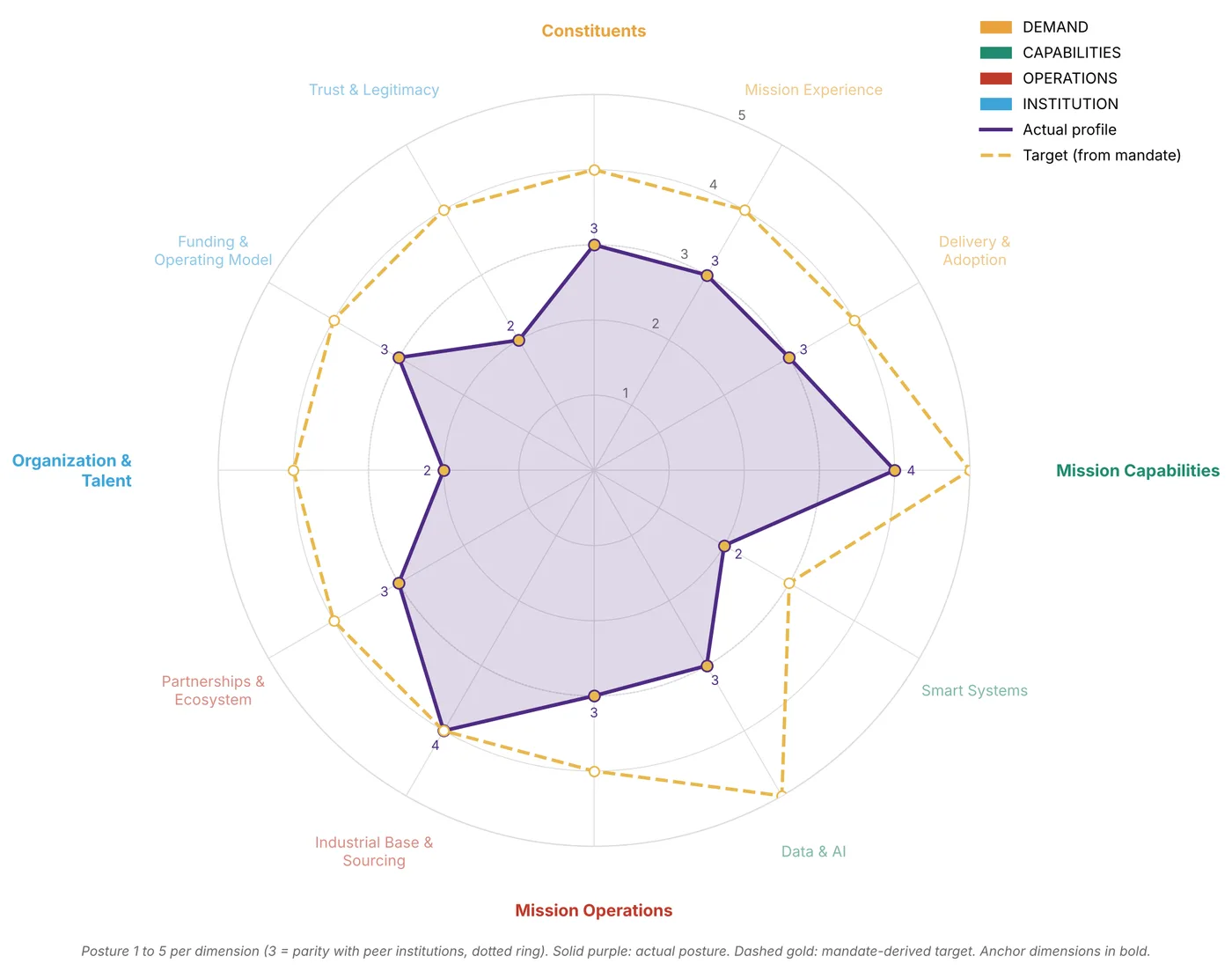
The unweighted drift, the sum of absolute gaps, is 14 of a possible 48; the priority-weighted drift is 36 (equations (1) to (3) in Appendix B). The weighted figure is two and a half times the unweighted one because the three two-point gaps all fall on dimensions the mandate weights at 3. Three of the five compelled floors are breached. That combination, a shape close to target and three floor breaches on the institutional spine, is the signature of an institution that has protected its research engine and let the institution around it erode.
4.1 Data and AI is the headline gap on the mandate's chosen instrument
The Director has named data and AI as the instrument of the mandate in every strategy document since August 2025: an AI Strategic Plan to improve model transparency, set replication standards for AI in research and validate AI in care delivery; a real-world data platform linking records, claims, wearables and genomics with CMS, FDA and VA; the Bio Genesis Mission, with more than $1.2 billion of fiscal 2026 obligations and planned fiscal 2027 funds aligned to six AI-driven challenges and a goal of halving the time from discovery to use (Bhattacharya 2025a, 2026b; National Institutes of Health 2026b). The record of what has been fielded is thinner than the record of what has been named. The agency sought public comment on its first AI Strategic Plan in June 2025, with a one-year action plan and a longer-term plan in view, and its fiscal 2027 justification for the Office of the Director still describes the plan, and an AI marketplace, as under development, with no dollar figure (Beavins 2025; National Institutes of Health 2026ac). The plan does not appear as a published document anywhere in the agency's data science, policy or news pages at the cutoff; the data science office's pages, reviewed in April 2026, carry the 2025 to 2030 Strategic Plan for Data Science and three NIH-wide AI initiatives with no dates or dollar figures (National Institutes of Health 2026n, 2025h). The real-world data platform is a $60.0 million request for fiscal 2027 and a pilot, Data COUNTS, that extracts and de-identifies records once at twelve participating health systems through a trusted data broker hosted by the Foundation for the NIH, with the FDA and VA connections still described as planned (National Institutes of Health 2026b, 2026o). The CMS connection has one fielded step: a data use agreement of May 2025 that gives the agency access to Medicare and Medicaid records of enrollees with an autism diagnosis as the platform's first pilot (Centers for Medicare & Medicaid Services 2025). The agency's own guidance paused the sharing of generative AI models trained on controlled-access genomic data in May 2025 and promised guidance that had not appeared by the cutoff (National Institutes of Health 2025i). The Clinical Center still runs the electronic record system installed in 2004 (National Institutes of Health 2026b). The Linked Discoveries tool released on 24 September 2026 is labeled experimental by its own release (National Institutes of Health 2026c). The Inspector General found in September 2025 that the agency had not ensured that the All of Us data center limited user access, prevented downloads of detailed participant data or fixed security weaknesses on time; the agency concurred with all five recommendations and closed them in April 2026 (Office of Inspector General 2025).
The strongest evidence on this dimension is the fielded data infrastructure that predates the current leadership: the All of Us program with more than 872,000 participants and more than 21,000 registered researchers, the National Clinical Cohort Collaborative, and PubMed Central with more than 1.5 million articles under a public access policy that took effect on 1 July 2025 with no embargo (National Institutes of Health 2026b, 2025j). These are fielded at a scale peers do not match, and the data science office reports one measured gain in its own operations, approval time for controlled-data access cut from 7.5 days to under an hour (National Institutes of Health 2026ac). They are the reason the score is 3 and not 2. They do not show the institution turning data into decision speed and quality across its own operations, which is the dimension's own metric: the six-application cap of July 2025 was imposed because AI-generated applications were straining review, which shows AI changing the institution's workload before the institution has put AI to work (National Institutes of Health 2025k). The honest score is 3, parity, against a target of 5 and a weight of 3. The weighted gap of 6 is one of three such gaps and it is the one the Director has chosen. It is an allocation failure: the Common Fund's Bridge2AI program fell from $56.2 million in fiscal 2025 to $0.1 million in the fiscal 2026 request, and the whole real-world data platform is requested at $60 million, about one eighth of one percent of the budget. The Office of the Director's standing data and AI lines, $135 million for new tools in data science and AI, $50 million for AI applied to chronic disease and $85 million for the data science office, are flat from fiscal 2025 to the fiscal 2027 request and together come to about 0.6 percent of the budget (National Institutes of Health 2025e, 2026b, 2026ac). The top-up pass re-tested the score against these records and held it at 3: the new evidence adds a fielded data agreement and an audited security fix, and no outcome on decision speed across the institution.
The strongest counter-reading is that the $1.2 billion of Bio Genesis funding is the allocation this report says is missing. The report does not accept it, for two reasons. The figure aggregates obligations already made under existing programs and plans for fiscal 2027 funds that Congress has not appropriated, and the statement announcing it names no compute, no milestones and no program budgets (Bhattacharya 2026b). Announcements are Tier C and cap a score at 3 whatever their size. If the funding opportunities the statement promises appear with dates and dollars, the next read should move the score.
4.2 Organization and talent is below a compelled floor by choice
Organization and talent scores 2 against a target of 4 and a compelled floor of 3. The agency's own budget tables put its federal staff at 19,089 full-time equivalents in fiscal 2024, 19,348 in fiscal 2025 and an estimated 17,769 in fiscal 2026, a fall of about 8 percent in a year, counting the environmental health institute that the request proposes to move to the CDC; the fiscal 2026 contingency staffing plan, reviewed in September 2026, implies about 16,800 staff on board (National Institutes of Health 2025r, 2026ab; Department of Health and Human Services 2026). These primary figures replace the first pass's reliance on a senator's statement at the 3 February 2026 hearing that the workforce fell from about 21,000 to about 17,300, a count that likely includes staff the budget tables do not; the same statement put the loss of doctoral scientists at 1,100 (American College of Radiology 2026). The cuts fell unevenly: the cancer institute lost about 400 full-time equivalents, the aging institute about 160 and the Office of the Director about 190, while the Center for Scientific Review grew from 492 to 735 as it absorbed review from the institutes (National Institutes of Health 2026ab). The research workforce the agency funds fared no better: the funding rate for early-stage investigators' first major awards fell from 26.1 percent in fiscal 2024 to 18.9 percent in fiscal 2025, for new non-early-stage investigators from 15.8 to 10.0 percent, and for established investigators from 27.3 to 19.6 percent, a decline the agency's own analysis attributes in part to forward funding more grants (National Institutes of Health 2026p). The Cures Act requires the Director to prioritize policies that promote opportunities for new researchers; a one-year fall of seven points in the early-stage funding rate is the dimension moving away from that requirement, which is why the report reads the floor as breached. The fiscal 2026 record points the other way and is not yet confirmed: the agency reported on 8 October 2026 a record 1,648 early-stage R01-equivalent awards against a ten-year average of 1,323 and 1,144 in fiscal 2025, while STAT's analysis of the same year's awards found that early-career support did not expand (National Institutes of Health 2026ad, 2026b; Oza, Wosen and Parker 2026). The score holds at 2 with Low confidence, and one confirmed funding-rate release for fiscal 2026 on the agency's data pages would move it to 3, at the floor.
The counter-evidence is real and is the reason the score is 2 and not 1. Between September 2025 and September 2026 the agency filled ten senior scientific leadership posts with permanent appointments, several after acting periods of a year or more, and named a permanent Deputy Director for Extramural Research, a permanent deputy for program coordination and a permanent director of the Center for Scientific Review (National Institutes of Health 2025c, 2026d through 2026k; Bhattacharya 2025d, 2026d). The academic-freedom framework for intramural scientists is a talent policy with a date (Bhattacharya 2025c). These are shipped moves on the leadership layer. The intramural program announced Generation Discovery on 8 October 2026, a plan to recruit 100 early-career principal investigators over three years with no stated budget (National Institutes of Health 2026ad). The intramural record below that layer shows strain: in fiscal 2025 the Clinical Center saw 17 percent fewer new patients, 12 percent fewer outpatient visits and 10 percent fewer admissions than in fiscal 2024, and new onsite protocols fell to 82, the lowest in five years, against 1,774 permanent federal employees (National Institutes of Health 2026ae). The score is 2, with a wide band, because retention, vacancy and time-to-hire data that would move it are internal, and because the workforce loss was a decision of the department, which places the remedy partly outside the agency's own authority.
4.3 Trust and legitimacy is two points below a compelled floor
Trust and legitimacy scores 2 against a floor of 4 that the Public Health Service Act, the Cures Act and the fiscal 2026 appropriation compel. The record is a sequence of adverse findings by the bodies whose standing the dimension measures. Four federal courts enjoined the 15 percent indirect-cost cap, the First Circuit affirmed unanimously on 5 January 2026, and the Department of Justice let the deadline for Supreme Court review pass in April 2026 (American Council on Education 2026). A district judge found that the grant terminations of 2025 violated the Administrative Procedure Act because they were not reasonably explained, and on 21 August 2025 the Supreme Court, by five votes to four, allowed the terminations to proceed on jurisdictional grounds while leaving the vacatur of the agency's priority guidance in place; the concurring justice who supplied the fifth vote on each question wrote that vacating the guidance does not necessarily void decisions made under it, and a dissenting justice described the result as Calvinball jurisprudence (Howe 2025). Of 5,844 grants cancelled or suspended at some point in 2025, about 2,600 worth about $1.4 billion had not been reinstated or unfrozen by January 2026, and the agency issued about 24 percent fewer new grants in 2025 than its ten-year average (Kozlov, Tollefson and Garisto 2026). The Government Accountability Office found on 5 August 2025 that the agency had violated the Impoundment Control Act: it obligated about $12.8 billion between February and June 2025 against about $20.6 billion in the same months of fiscal 2024 and terminated more than 1,800 grants in that period (Government Accountability Office 2025a). By 10 April 2026, on the Congressional Research Service's reading of department data, 1,392 NIH awards had been terminated with $539 million unliquidated (Congressional Research Service 2026c). Congress responded with statute: Section 224, Section 240, monthly briefings, a duty under Section 524 to notify Congress of any termination, and direction on how director searches are run (Consortium of Social Science Associations 2026; Congressional Research Service 2026c).
Public trust, the dimension's second component, is better than the oversight record and worse than it was. Pew found in October 2025 that 84 percent of adults call government investment in scientific research worthwhile, up six points since 2023, and that 77 percent have at least a fair amount of confidence in scientists, down from 87 percent in April 2020, with a 25-point partisan gap (Pew Research Center 2026a, 2026b). KFF found in June 2026 that 51 percent trust the CDC and 51 percent trust the FDA for reliable health information; it did not report the NIH separately (KFF 2026). The Annenberg Public Policy Center did: confidence in the NIH fell from 74 percent in September 2024 to 61 percent in August 2026, and the share very confident from 27 to 12 percent, a statistically significant fall that the Center dates to 2025 (Annenberg Public Policy Center 2026). The agency's trust initiatives are announcements with dates: a Gold Standard Science plan, a roadmap for engaging the public as partners in clinical research with return of results to begin in 2026, an authorship transparency statement, and a biosafety modernization initiative that produced a draft policy in August 2026 (Bhattacharya 2025b, 2025e, 2026c; National Institutes of Health 2026q).
The strongest counter-reading is that Congress funded the agency above the prior year, which is the appropriator's vote of confidence. The report accepts the fact and reads it as confidence in the institution, because the same law that funded the agency also bound its conduct. A score of 2 records an agency whose oversight standing has been adjudicated against it on its two largest policy moves of 2025, whose appropriations watchdog found an unlawful impoundment, whose public confidence fell by thirteen points in the one NIH-specific series, and whose public-trust work is at the announcement stage. The top-up pass re-tested the score against the oversight and polling record and held it at 2, now with High confidence on both components; the September 2026 reports of a White House veto over grants, and the appropriators' objection to it, add pressure from outside the agency's control. The breach is two points on a compelled floor, which no other dimension may crowd out, and because the floor is compelled the remedy is conduct that the overseers can verify, which Sections 6 and 7 specify.
4.4 The funding model and mission operations are execution gaps on reforms already fielded
The funding and operating model scores 3 against a target of 4 and meets its compelled floor of 3. The agency fielded three real funding innovations in eighteen months: a shift to funding competing awards in full up front, a unified funding strategy effective for the January 2026 council round under which institutes no longer rely on published percentile paylines, and the centralization of peer review in the Center for Scientific Review announced in March 2025 with a claimed saving of more than $65 million a year (CASRAI 2026; Bhattacharya 2026a). It also spent its entire fiscal 2025 appropriation despite the October 2025 shutdown (American College of Radiology 2026). The overseer then constrained two of the three and the courts voided a fourth. Forward funding cut competing research grants from 10,086 in fiscal 2024 to 8,016 in fiscal 2025 by the agency's final count, which corrects the estimate of 6,095 in the fiscal 2026 justification that the first pass carried; the success rate for research project grants fell from 19 to 13 percent as applications rose 13 percent; the agency made more than 2,000 multi-year awards worth $2.2 billion in fiscal 2025 against 1,067 worth $960 million in fiscal 2024; a Senate report cited one institute's success rate falling from 18 to 6 percent; and Section 240 capped the practice at the fiscal 2025 level (National Institutes of Health 2025r, 2026ab; Congressional Research Service 2026b, 2026c; Quinn 2026). Under the cap the agency estimates 9,712 competing awards for fiscal 2026, spent its full extramural budget of about $34 billion after obligating 34 percent less than in fiscal 2024 by March, and made about 58,000 awards in all against about 61,000 in fiscal 2025 (National Institutes of Health 2026ab; Association of American Medical Colleges 2026; Oza, Wosen and Parker 2026). The indirect-cost cap is enjoined and barred. The fiscal 2027 request re-proposes both at a budget $5.0 billion lower, with forward funding for every competing award and 5,145 competing awards (National Institutes of Health 2026b, 2026ab). This is an execution gap of a particular kind: the policies deployed, and their deployment damaged the agency's authority to deploy more. The remedy is to keep the two instruments Congress permitted, the unified strategy and centralized review, and to publish their outcomes.
Mission operations scores 3 against a compelled floor of 4. The October 2025 lapse in appropriations cancelled more than 370 peer review meetings covering more than 24,000 applications; the agency responded with emergency procedures that discuss 30 to 35 percent of applications instead of about 50 percent and that label the middle third competitive but not discussed, and in September 2026 it extended those procedures through the January 2027 council round because applications for that round exceed 40,000, against a previous high of 35,000 in May 2025 (National Institutes of Health 2025b, 2026r). The standing mission did not lapse: money was obligated, councils met, awards issued. Centralization is fielded: 24 review offices became one, the Center for Scientific Review took on about 30,000 more applications a year and expects to charter 52 new study sections (Reed 2026). The stewardship record is weaker: the Government Accountability Office found in 2025 that nearly 1,000 final progress reports filed from 2014 to 2024 were delinquent on awards the agency had not closed out, and that the agency did not require institutes to track large unused balances; the agency agreed with all three recommendations (Government Accountability Office 2025b). Mission operations is running on a reduced review standard for the fifth consecutive council round with fewer staff, which is below the floor the peer-review statute compels and the reason the report scores it 3. The top-up pass re-tested the score against the review and audit record and held it.
4.5 Where the agency is at or near target
Mission capabilities scores 4, advanced, one point below its target of 5. The engine remains the reference every national funder copies: nearly 50,000 competitive grants, 104 Nobel laureates supported, and in the twelve months to the cutoff a personalized gene-editing therapy delivered to an infant, a trial reducing HIV incidence by 70 percent in rural populations, and a cord-blood transplant protocol with 94 percent survival in severe aplastic anemia (National Institutes of Health 2026b; Bhattacharya 2026a; National Institutes of Health 2026s, 2025l). The portfolio moved toward the stated priorities with dated awards: $150 million for human-based methods in March 2026 and a further $88 million in facilities for them in September, $87 million for a standardized organoid center, $50 million for autism data science with independent replication hubs, and the Childhood Cancer Data Initiative doubled to $100 million (National Institutes of Health 2026l, 2026t, 2025g, 2025f, 2025m). A 5 requires two independent records within twelve months documenting a quantified outcome on the dimension's own metric, capability against priority targets, and the fiscal 2025 output data contradict it: 21 percent fewer competing research grants than the year before, and 2,600 projects unrestored. The gap is a build on a strength.
The industrial base and sourcing model scores 4 at its target of 4. The extramural model is the sourcing innovation of the whole enterprise, and in 2025 the agency changed its terms in two fielded ways: foreign subawards ended on 1 May 2025 and were replaced in September by an application structure that makes each foreign component a directly linked award, and a domestic supply base for human-based research models was contracted at the Frederick National Laboratory and through the Complement-ARIE centers (National Institutes of Health 2025n, 2025g, 2026l). The indirect-cost dispute shows the sourcing relationship's terms are contested, and the score stays at 4.
Partnerships scores 3, one point below target, and the deep pass moves it down from the shallow read's 4. The federal partnerships advanced with dates: the Department of Energy's platform for Bio Genesis, a $7 million methods challenge with the FDA and EPA, a validation network with the Foundation for the NIH, and the Data COUNTS broker (Bhattacharya 2026b; National Institutes of Health 2026l, 2026o). The academic partnership, which carries 82 percent of the mission, spent 2025 in litigation against the agency and ended the year with 2,600 awards unrestored, and the foreign partnership base was restructured by fiat. A partnership dimension whose largest partner class is a plaintiff is at parity, no higher.
Constituents, mission experience and delivery each score 3 against a target of 4. Constituents: the All of Us cohort is fielded at scale and the roadmap for engaging the public as partners commits to return of summary results from 2026, while the unified strategy redirected research on disparities and on transgender youth and the budget request would eliminate the minority health institute, so coverage of priority needs is contested among the constituents themselves (National Institutes of Health 2026b; Bhattacharya 2025a, 2025e). Mission experience: the burden-reduction package is the most completely fielded reform in the record, with letters of intent and $500,000 permission letters abolished, data management plans reduced to four questions, basic experimental studies removed from the clinical-trial definition, and a first simplified funding announcement issued in May 2026, none of it yet measured in applicant hours (National Institutes of Health 2026u, 2026v). Delivery and adoption: the zero-embargo public access policy took effect on 1 July 2025 and is a fielded outcome; the publication-cost cap announced for fiscal 2026 has no issued policy in the record; the translation clock the Bio Genesis goal requires has no published baseline; and about one in thirty trials was disrupted in 2025 by the account given at the February hearing, affecting more than 74,000 participants, with about a dozen finally terminated by the Director's own count (National Institutes of Health 2025j; Bhattacharya 2025f; American College of Radiology 2026).
Smart systems scores 2 against a target of 3: the Clinical Center record system from 2004, an autonomous human-biology laboratory announced in September 2026, a clinical-trial matching tool in development, and no fielded outcome (National Institutes of Health 2026b, 2026t).
5. Why the gaps exist: effort against posture
Posture says where the agency stands; effort says why. The agency publishes spending by research category and by institute, and it has not posted a fiscal 2026 operating plan, so the effort reading uses the appropriation structure, the Common Fund tables and the request documents, and it is partial. Four readings hold.
Data and AI is the textbook allocation failure. The dimension the Director weights highest in his own words draws the smallest identifiable effort: a $60 million platform request, a $56 million program cut to near zero in the fiscal 2026 request, about $270 million a year of standing data and AI lines held flat in the Office of the Director, and a $1.2 billion aggregate that re-labels existing obligations. Against that, 82 percent of the budget flows to extramural research project grants, where the agency's posture is already 4 (National Institutes of Health 2025a, 2025e, 2026b). The remedy is money with an owner, and the budget instrument is the Common Fund and the Director's evaluation set-aside, both of which the Director controls without new authority.
Organization and talent is an allocation failure by design. The department reduced the workforce deliberately, and the agency's own forward-funding policy reduced the number of early-career awards. Effort fell and posture fell with it. The remedy at the leadership layer has been funded and executed, as the ten appointments show; the remedy below it is a staffing target and an early-career reserve, and the budget instruments are the research management and support appropriation and the competing research project grant allocation inside the Section 240 cap.
Trust and legitimacy absorbed heavy effort for a posture that fell: four indirect-cost lawsuits defended to the appellate court and abandoned at the Supreme Court, a termination program litigated to a 5-4 stay, and a budget request drafted twice for a structure the appropriator refused. That is the budgetary signature of an environment failure. Effort on this dimension bought conflict; the posture it needs costs little and consists of conduct the overseers can verify: reasoned decisions, published data, invited audits.
Mission operations and the funding model show moderate effort and parity posture, the pattern of execution gaps where the work is funded and under way. Centralized review is deployed and its $65 million saving is a claim, not yet an audited figure; emergency review is deployed and has no sunset; the unified funding strategy is deployed and its funding decisions are not yet published against the percentiles it replaced. The budget instrument is a milestone and a date, and in one case a sunset.
6. What the agency should grow, hold, fix and stop
Table 4 adjudicates the twenty-six live programs the public record evidences, assigned to one dimension each by primary job and budget holder. The verdicts are the instrument's four: grow, hold, fix-or-kill and stop. Programs inside the institutes that the record does not reach cannot be judged, and the list should be completed from the operating plan.
Table 4. The adjudication of live programs: dimension, sponsor, stage, verdict and condition, October 2026.
| Program | Dimension | Sponsor | Stage | Verdict | Condition |
|---|---|---|---|---|---|
| AI Strategic Plan (RFI June 2025; announced Aug 2025) | Data & AI | Director; ODSS | In development per FY2027 justification; unpublished | Fix-or-kill | Publish with owner and dated ledger by the FY2028 request, or fold into Bio Genesis |
| Real-World Data Platform and Data COUNTS pilot | Data & AI | Office of the Director; FNIH broker | 12 sites; CMS data agreement May 2025; $60M FY2027 request | Grow | Signed CMS, FDA and VA agreements; governance board; site target of 50 |
| Bio Genesis Mission ($1.2B aligned) | Data & AI | Director with OSTP and DOE | Launched 22 July 2026; opportunities pending | Hold | Grow when funding opportunities, compute allocation and milestones are published |
| All of Us Research Program | Data & AI | Office of the Director | 872,000 participants | Hold | Report researcher outputs annually |
| Childhood Cancer Data Initiative ($100M) | Data & AI | NCI | Doubled Sept 2025 | Hold | Publish AI model validations |
| Generative AI model-sharing guidance (NOT-OD-25-118) | Data & AI | OSP | Pause since May 2025; guidance pending | Fix-or-kill | Issue the guidance or lift the pause by the May 2027 council |
| Replication and reproducibility initiative ($100M FY2027; Replication Prize; Linked Discoveries) | Mission Capabilities | Director; NLM | Tool live Sept 2026 | Grow | Fund the replication studies, not only the tooling; measure retraction and replication rates |
| Complement-ARIE, SOM Center and ORIVA (human-based methods) | Mission Capabilities | DPCPSI; NCI (FNLCR) | $150M + $87M + $88M awarded | Grow | Validation network delivers FDA-accepted methods by 2029 |
| Autism Data Science Initiative ($50M, 13 projects) | Mission Capabilities | DPCPSI | Awarded Sept 2025 | Hold | Replication hubs report before any policy claim |
| Centralized peer review in CSR | Mission Operations | Deputy Director for Extramural Research; CSR | Deployed over 2025 to 2026 | Grow | Audit the $65M saving; restore 50 percent discussion |
| Emergency modified peer review (NOT-OD-26-012, -069, -114) | Mission Operations | OER; CSR | Extended through Jan 2027 round | Stop | Sunset with the January 2027 round; publish the comparison of discussed and not-discussed outcomes |
| Unified Funding Strategy | Funding & Operating Model | Deputy Director for Extramural Research | Effective Jan 2026 round | Hold | Publish each institute's funding plan and decisions against percentiles quarterly |
| Multi-year (forward) funding policy | Funding & Operating Model | Office of the Director | 2,000+ awards, $2.2B in FY2025; capped by Sec. 240 | Fix-or-kill | Confine to early-stage and at-risk investigators inside the cap, or end it |
| Six-application cap (NOT-OD-25-132) | Funding & Operating Model | OER | Effective Sept 2025 | Hold | Report the number of investigators affected |
| Proposed cap on simultaneous grants per investigator | Funding & Operating Model | OER | RFI June 2026 | Hold | Decide on the comment record with published data |
| 15 percent indirect-cost cap | Funding & Operating Model | Office of the Director | Enjoined; barred by Sec. 224; re-proposed FY2027 | Stop | Withdraw from the FY2028 request; negotiate the FAIR model through the appropriations committees |
| Eight-institute consolidation | Funding & Operating Model | Department and Director | Rejected twice; re-proposed FY2027 | Stop | Withdraw; continue functional consolidation of communications, acquisitions and committee management |
| Grant termination program of 2025 | Trust & Legitimacy | Office of the Director | 1,392 terminated on HHS data (Apr 2026); about 2,600 unrestored on Nature's count (Jan 2026) | Stop | Close out with a reasoned decision per award (candidate 11) |
| Biosafety modernization (draft policy Aug 2026) | Trust & Legitimacy | OSP | Comment period | Hold | Finalize; report institutional biosafety committee resourcing |
| Public access policy, zero embargo | Delivery & Adoption | OSP; NLM | Effective 1 July 2025 | Hold | Report compliance and PMC deposits annually |
| Publication-cost cap (announced July 2025 for FY2026) | Delivery & Adoption | Office of the Director | No policy issued | Fix-or-kill | Issue through the Grants Policy Statement or withdraw |
| Burden-reduction package (letters, DMS plans, BESH, SimplerNOFO) | Mission Experience | OER; OSP | Fielded 2025 to 2026 | Grow | Measure applicant and reviewer hours; extend SimplerNOFO to all parent announcements |
| Partners in Research and return of results | Constituents | Director; NExTRAC | Roadmap Dec 2025; starts 2026 | Grow | First summary results returned in 2027 |
| Foreign component structure (PF5/RF2) | Industrial Base & Sourcing | OER | Fielded Sept 2025 | Hold | Measure collaborations lost and gained |
| Leadership recruitment (ten appointments) | Organization & Talent | Director | Largely complete Sept 2026 | Grow | Fill remaining acting posts and council seats; cap acting periods at twelve months |
| Generation Discovery (100 intramural early-career PIs) | Organization & Talent | Deputy Director for Intramural Research | Announced 8 Oct 2026 | Hold | Publish the budget, the hiring schedule and the first cohort by the FY2028 request |
Seven programs grow, and their common condition is a measured outcome. The replication initiative and the human-based methods portfolio are the best-funded expressions of the mandate's second and fourth priorities and both need the discipline of a validation result, a method accepted by the FDA or a replication rate published, before the next tranche. The data platform grows because it is the one data and AI program with a fielded pilot, and its condition is the interagency agreements the request promises. Centralized review grows because its saving should be audited and its discussion rate restored. The burden package grows because it is fielded and unmeasured. Leadership recruitment grows to completion.
Four programs are fix-or-kill, and each is a decision that has been deferred. The AI Strategic Plan has been in preparation for sixteen months since the agency sought public comment on it; a plan that exists only as a sentence in three strategy documents is not a plan. The forward-funding policy has been capped by the appropriator and blamed by the agency's own analysts for the early-career funding collapse; confined to early-stage and at-risk investigators it becomes the Next Generation Researchers instrument the Cures Act asks for, and left as a general policy it should end. The publication-cost cap and the generative AI guidance are policies announced and not issued, and an institution that announces policy it does not issue spends trust it cannot afford.
Four programs stop. The indirect-cost cap and the consolidation stop because the authorizing environment has refused each twice and re-proposing them is the single largest cost to the trust dimension that the leadership controls. The emergency review procedures stop because a floor the statute compels cannot run indefinitely on an emergency footing. The termination program stops by closing out: each unrestored award gets a reasoned written decision, which is what the Administrative Procedure Act required of the originals and what the district court found missing.
7. Candidates to close the gaps
The four dimensions with the largest weighted gaps, data and AI, organization and talent, trust and legitimacy, and the funding and operating model, become lenses, with delivery as a fifth where a candidate serves two. Each candidate is screened on three reads scored 1 to 5 and composed multiplicatively (equation (7) in Appendix B): mission value, read against the priority weight; feasibility at the level the agency can deploy today; and authority, whether the agency holds the legal authority and appropriation category to execute without a new law. A score of 1 on any read parks the candidate with its named authority and a dated trigger. Composites of 64 and above are fund now, 30 to 63 fund next, below 30 watch. Scores are illustrative judgments on the public record. Candidates were sought in the three places the method names: idle authorities and assets the agency holds, exemplars from peer agencies, and partnership vehicles.
Table 5. Twenty screened candidates: lens, source, mission value, feasibility, authority, composite and verdict.
| # | Candidate | Lens | Source | MV | F | A | Score | Verdict |
|---|---|---|---|---|---|---|---|---|
| 1 | Publish the AI Strategic Plan with a named owner, a dated implementation ledger and a compute line | Data & AI | Idle commitment | 4 | 5 | 5 | 100 | Fund now |
| 2 | Early-stage investigator reserve inside the Sec. 240 cap, sized to restore the FY2024 funding rate | Talent | Idle authority (Cures Act Sec. 2021) | 5 | 4 | 5 | 100 | Fund now |
| 3 | Public close-out ledger for every unrestored 2025 award, with a reasoned decision on each | Trust | Court record | 5 | 4 | 5 | 100 | Fund now |
| 4 | Quarterly publication of funding decisions against percentiles under the unified strategy, with a standing GAO invitation | Trust | Peer exemplar | 4 | 5 | 5 | 100 | Fund now |
| 5 | Scale Data COUNTS from 12 to 50 health systems through the FNIH broker | Data & AI | Idle asset | 5 | 4 | 4 | 80 | Fund now |
| 6 | Issue the generative AI model-sharing guidance and lift the May 2025 pause | Data & AI | Idle commitment | 4 | 4 | 5 | 80 | Fund now |
| 7 | Translation clock: a published baseline for time from discovery to use, against the Bio Genesis goal | Delivery | Stated aim | 4 | 4 | 5 | 80 | Fund now |
| 8 | Fill every advisory council seat and publish council votes on funding plans | Trust | Idle authority (PHS Act) | 3 | 5 | 5 | 75 | Fund now |
| 9 | Interagency compute agreement with DOE for the American Science and Security Platform under the Economy Act | Data & AI | Partnership | 4 | 4 | 4 | 64 | Fund now |
| 10 | Confine forward funding to early-stage and at-risk investigators and report awards monthly under Sec. 240 | Funding | Reform in flight | 4 | 4 | 4 | 64 | Fund now |
| 11 | Real-world data compact with CMS, FDA and VA under existing data-use authorities, with a privacy board | Data & AI | Partnership | 5 | 3 | 4 | 60 | Fund next |
| 12 | Intramural stabilization: publish IRP headcount and fill scientific director vacancies | Talent | Idle asset | 3 | 4 | 5 | 60 | Fund next |
| 13 | Public trust dashboard: return-of-results counts, data-use transparency, trial disruption status | Trust | Stated aim | 3 | 4 | 5 | 60 | Fund next |
| 14 | Review workforce target with Title 42 hiring to restore 50 percent discussion by the May 2027 round | Operations | Idle authority | 4 | 3 | 4 | 48 | Fund next |
| 15 | Succession rule: acting institute and center directorships capped at twelve months with external search | Talent | Peer exemplar | 3 | 4 | 4 | 48 | Fund next |
| 16 | Issue the publication-cost cap through the Grants Policy Statement with a defined allowable charge | Delivery | Idle commitment | 3 | 4 | 4 | 48 | Fund next |
| 17 | Indirect-cost reform through the FAIR model negotiated with the appropriations committees | Funding | Report language | 4 | 3 | 3 | 36 | Fund next |
| 18 | Clinical Center record-system replacement tied to the Bio Genesis autonomous laboratory's data standards | Smart Systems | Stated request | 3 | 3 | 4 | 36 | Fund next |
| 19 | Functional consolidation of shared services in place of the eight-institute proposal | Funding | Reform in flight | 3 | 4 | 3 | 36 | Fund next |
| 20 | Reissue the 15 percent indirect-cost cap by notice | Funding | Enjoined policy | 3 | 3 | 1 | parked | Authority floor: permanent injunction (Apr 2025, affirmed Jan 2026) and Sec. 224; trigger: repeal of Sec. 224 |
The ten candidates at fund now share a property: each uses an authority the agency already holds and spends almost nothing. The AI plan is written or it is not. The early-stage reserve lives inside a cap Congress has already set and a statute Congress has already passed. The close-out ledger does what the court said the law required. The publication of funding decisions is the transparency the Director has promised in every statement since August 2025, made verifiable. The council seats are vacant. The translation clock is the Director's own goal with a number attached. The compute agreement uses an interagency authority the agency has used for decades.
Candidates 1, 5, 6, 9 and 11 reinforce one another and should be read as one bet: the plan names the use cases, the pilot supplies the records, the guidance frees the models, the compute runs them and the compact brings the federal data in. Read together they are the national data and AI capability the Director has described and that the yield test prices at $2.0 to $3.5 billion over five years. Candidates 3, 4, 8 and 13 are a second combination that costs little and addresses the floor breach directly: they convert the trust posture from announcement to record. Candidate 20 is parked on authority and the report records it so that it is not reopened in the fiscal 2028 request.
The two-currency reconciliation is honest about the limit. In posture points, the ten fund-now candidates address all three weighted gaps of 6 and both floor breaches on the institutional spine, and together they could move data and AI and trust from their current scores to 4 within two council cycles; a 5 on data and AI requires the first combination to deliver as well. In dollars, the candidates are inside the $4 to $8 billion band and, with one exception, inside the envelope at the enacted level; the exception is the early-stage reserve at full run rate, which draws on the research project grant allocation and is a reallocation inside it, not a new appropriation. The dial leadership must choose is to protect the envelope, which means asking Congress for the fiscal 2026 structure in fiscal 2028.
8. What the agency should not do
The valleys are choices and the report states them with the same confidence as the peaks. Smart systems stays at a target of 3: the agency should fund intelligent instruments through its grantees and build one hospital record system, and it should not attempt to build or own biomedical AI models or compute at national scale when the Department of Energy platform exists for the purpose. The industrial base stays at 4: the agency should keep the organoid center and the validation network as sourcing vehicles for methods that regulators accept, which is what the public-private validation network is designed to deliver, and should not convert either into a captive manufacturing enterprise.
Three candidates are watched only in the sense that they rank last among those funded next. Indirect-cost reform through the FAIR model is the right route and the slow one, because the report language invites discussion and the statute bars unilateral change, so its feasibility and authority scores are capped until the committees act. The record-system replacement is a capital project with a 2029 horizon that should ride the Clinical Center expansion. Functional consolidation of shared services is already under way by the Director's own testimony and does not need a structural proposal to continue.
One candidate is parked. A reissued indirect-cost cap scores 1 on authority because a permanent injunction and a statutory bar both stand, and the only trigger is a repeal of Section 224 that the appropriations committees have given no sign of considering. Two floors will be held even where the agency will not lead: mission operations at 4, which requires the sunset of emergency review, and trust and legitimacy at 4, which requires a climb of two points that no other dimension may crowd out.
9. What happens next
The 90-day actions, each with an owner:
- Publish the AI Strategic Plan. The Director and the Office of Data Science Strategy issue the plan with a named owner, a dated ledger and a compute line before the fiscal 2028 request is drafted (candidate 1).
- Close out the terminations. The Deputy Director for Extramural Research publishes the ledger of unrestored 2025 awards with a reasoned decision on each, which satisfies the standard the district court applied (candidate 3).
- Sunset emergency review. The Center for Scientific Review names the January 2027 council round as the last under modified procedures and publishes the outcome comparison for discussed and not-discussed applications.
- Set the early-stage reserve. The Office of Extramural Research sizes a reserve inside the Section 240 cap to return the early-stage funding rate to 26 percent and reports it in the monthly briefing Congress already requires (candidates 2 and 10).
- Publish funding decisions. Each institute posts its unified-strategy funding plan and its decisions against percentiles for the January 2027 round, and the Director invites the Government Accountability Office to review the first year (candidate 4).
- Withdraw the refused proposals. The Director removes the indirect-cost cap and the eight-institute consolidation from the fiscal 2028 submission and substitutes a request for the Common Fund at its fiscal 2025 level.
The public record leaves gaps that limit the scores and should be closed from internal data: the fiscal 2026 operating plan and the Office of the Director's program ledger, which would convert the effort reading from signals to shares; vacancies and time-to-hire by institute and by the review and program functions, since the budget tables give full-time equivalents by institute and not by function; and the fiscal 2026 funding rates by career stage, which decide whether organization and talent moves to its floor. The radar should be re-run in October 2027, after the first full year of the fiscal 2027 to 2031 strategic plan, the sunset of emergency review, the first Bio Genesis funding opportunities and the fiscal 2028 request, with the guardrail that a score moves only on two consecutive reads or one confirmed change in evidence.
Appendix A. Method Note and Source Ledger
A.1 Method and passes
The diagnostic ran the Mission Radar's staged assessment from public sources only, at the third stage of the construction ladder (records retrieved and cited per score) without the Delphi or interview stages, which require access to the institution. Two passes ran. The strategy pass read the fiscal 2027 consolidated budget overview and Director's letter, the fiscal 2026 Common Fund justification, the two Congressional Research Service reports on NIH funding and on federal research and development for fiscal 2026, the COSSA analysis of the final fiscal 2026 appropriation, the strategic plan framework, the unified strategy statement, the Director's written testimony of 3 February 2026 and nineteen further Director's statements from April 2025 to July 2026. The dimension pass ran four web searches before the search budget available to this run was exhausted and then proceeded by direct document reads: 94 fetch attempts, of which 71 returned usable documents across the agency's news releases, policy notices, Nexus posts, data science and policy pages, the Supreme Court docket coverage, the First Circuit litigation page, Nature, Pew, KFF, the Department of Health and Human Services, FABBS and the Bethesda Declaration. The evidence cutoff is 12 October 2026. Twenty-three fetches failed on robots exclusions, client errors, a JavaScript wall, a site block or proxy rate limits (congress.gov, science.org three times, gao.gov twice, oig.hhs.gov three times, nytimes.com, cnn.com once, aamc.org, kff.org once, the NIH fiscal 2026 operating plan, the Office of the Director's fiscal 2027 justification, the Supreme Court order PDF, the unified funding strategy page and one Nexus post) and were replaced by alternative sources on the same facts where they existed. The Government Accountability Office, Inspector General and National Academies reports on NIH issued since 2025 were not read and no score rests on them. Entries marked [snippet] were verified from a secondary listing only; no score of 4 rests on one.
A top-up pass ran on 12 October 2026 with 22 web searches and 26 document reads, aimed at the gaps the first pass left open. It read the Government Accountability Office's impoundment decision B-337203 and a summary of its 2025 report on unused funds and delinquent reports; the Inspector General's audit of All of Us cybersecurity and its 2025 to 2026 list of NIH audits; the Congressional Research Service's April 2026 brief on NIH grants policy; the fiscal 2027 supplementary tables and the Office of the Director's fiscal 2027 justification, which give full-time equivalents by institute and the competing-award counts; the fiscal 2026 justification overview; the fiscal 2026 fiscal-policy notice; the Clinical Center's 2026 data report; the department's fiscal 2026 contingency staffing plan; the Center for Scientific Review's one-year account of centralized review; the Annenberg survey of August 2026; and press from STAT, Inside Higher Ed, Roll Call and the New York Times (through a republication). The agency has not posted a fiscal 2026 operating plan. Science articles failed to fetch and are cited from search results as [snippet]. No National Academies consensus report on the agency's operations since 2025 was found; the one report located concerns pediatric research and was read through a summary. No score moved. Four dimensions were re-tested and held: trust and legitimacy and mission operations with added support, data and AI on new but sub-threshold evidence, and organization and talent with lower confidence because the fiscal 2026 early-career record may reverse the floor breach. Six numbers were corrected: competing research grants in fiscal 2025 (6,095 to 8,016), the workforce figure (a senator's 21,000 to 17,300 replaced by the agency's full-time equivalents, 19,348 to an estimated 17,769), the fiscal 2026 Common Fund ($685.0 million to $572.4 million enacted), the envelope band ($1.0 to $1.5 billion to $0.9 to $1.4 billion), the envelope at the requested level ($0.5 to $0.8 billion to $0.85 to $1.2 billion), and the fiscal 2025 output fall cited under mission capabilities (40 to 21 percent). The yield verdict at the requested level moved from unfundable across the whole band to unfundable across most of it. One program, Generation Discovery, was added to the adjudication as hold.
Evidence tiers follow the posture scale: Tier A is statute, appropriations law, Congressional Research Service reports, court records, agency budget justifications, Guide notices and peer-reviewed outcomes; Tier B is named oversight and research bodies, named-byline press and polling organizations with stated method; Tier C is agency news releases, Director's statements and program pages, which cap a score at 3; Tier D is commentary and tertiary summaries, which corroborate only. Two sources count as independent only if each generates its own evidence; the agency's news releases, Director's statements and Nexus posts are one source. Confidence is derived: High needs two independent Tier A sources within six months, Medium is Tier B corroboration or older Tier A, Low is Tier C only or a coverage gap. Source counts after the top-up pass: Tier A 35, Tier B 27, Tier C 39, Tier D 3, of which the top-up added 29; rejected at the provenance gate: 2 (a live grant-tracking dashboard whose figures did not render in the fetched text and were replaced by the Nature analysis of the same dataset, and an encyclopedia table figure used only with a [snippet] mark).
A.2 Where the deep pass moved scores from the shallow read
The shallow read of October 2026 scored the agency at 5 on mission capabilities and the industrial base, 4 on partnerships and mission operations, 3 on data and AI, trust, delivery, organization and talent, funding, constituents and mission experience, and 2 on smart systems, with targets of 5 on mission capabilities, the industrial base, data and AI and trust. The deep pass moved six scores and held six, and moved two targets. Mission capabilities moves from 5 to 4 because a 5 requires two independent records within twelve months of a quantified outcome on the dimension's metric, and the fiscal 2025 record shows 21 percent fewer competing research grants and 2,600 unrestored projects. The industrial base moves from 5 to 4 because the sourcing changes of 2025 are fielded without measured outcomes and the terms of the sourcing relationship are in litigation. Partnerships moves from 4 to 3 because the largest partner class spent the year as a plaintiff. Mission operations moves from 4 to 3 on five consecutive council rounds of emergency review, read as a breach of the compelled floor. Organization and talent moves from 3 to 2 on the loss of federal staff and a seven-point fall in the early-stage funding rate, read as a breach of the compelled floor. Trust and legitimacy moves from 3 to 2 on the court record and the statutory constraints of P.L. 119-75, read as a breach of two on the compelled floor. Data and AI, delivery, funding, constituents, mission experience and smart systems are continuous with the shallow read. The target for the industrial base moves from 5 to 4 because the mandate asks the agency to source research and does not ask it to make research, and the target for trust moves from 5 to 4 because the floor the charter compels is advanced standing with overseers, and a category-defining target would ask of this agency what no agency's charter asks.
The top-up pass re-tested the three dimensions below their floors and data and AI against the new evidence, and moved none. Trust and legitimacy holds at 2: the impoundment finding, the termination count and the thirteen-point fall in NIH-specific confidence all confirm it. Mission operations holds at 3: centralized review is fielded and the emergency standard and the delinquent-report finding keep it below the floor. Organization and talent holds at 2 with Low confidence: the primary workforce figures show a fall of about 8 percent, smaller than the first pass reported, and the agency's record count of early-stage awards in fiscal 2026 conflicts with STAT's reading of the same year, so the move to 3 waits on the funding-rate release. Data and AI holds at 3: the CMS data agreement, the audited All of Us fixes and the faster data-access approvals are real, and the AI Strategic Plan is still unpublished.
A.3 Derivation box: the trust and legitimacy score
Signal 1, shipped moves with dates: indirect-cost cap issued 7 February 2025; permanent injunction 4 April 2025; First Circuit affirmance 5 January 2026; certiorari deadline passed April 2026; terminations from early 2025 found unexplained under the Administrative Procedure Act by the district court; Supreme Court stay of the vacatur of the terminations and refusal to stay the vacatur of the guidance, both 5-4, 21 August 2025; P.L. 119-75 signed 3 February 2026 with Sections 224 and 240 and monthly briefings; Gold Standard Science plan 22 August 2025; public-partners roadmap 19 December 2025; authorship statement 7 October 2026; draft biosafety policy 19 August 2026. Signal 2, outcome evidence on the dimension's own metric (legitimacy and oversight standing): four adverse final court outcomes on the agency's two largest policy moves; the appropriator bound the agency by statute while funding it; about 2,600 awards unrestored in January 2026; public confidence in scientists at 77 percent with a 25-point partisan gap and trust in sister agencies at 51 percent. Signal 3, recognition: the appropriation rose one percent against a 40 percent cut requested, which the report reads as confidence in the institution with constraints on its conduct; the agency's trust initiatives have no third-party evaluation. Anchor test: the dimension asks whether the institution sustains authority, oversight standing and public trust; the record shows authority contested in court and lost, oversight standing reduced by statute, and public trust stable at a lower level than 2020. Tier: A for the court and statutory record, B for the polling, C for the agency's initiatives. Top-up additions: the Government Accountability Office's impoundment finding of 5 August 2025 (Tier A); 1,392 terminated awards at 10 April 2026 (Tier A); NIH-specific public confidence down from 74 to 61 percent, September 2024 to August 2026 (Tier B). Score 2, confidence High on the oversight component and High on the public-trust component. A reader who disputes the score is invited to run the same chain against the sources below.
A.4 Source Ledger by dimension
Constituents (score 3, Medium). National Institutes of Health 2026b: Consolidated Overview of the FY 2027 Budget and Director's Letter (All of Us 872,000 participants, 21,000 researchers), Office of Budget, spring 2026, Tier A. Bhattacharya 2025e: "Roadmap for Engaging the Public as Partners in Clinical Research," 19 Dec 2025, Tier C. Bhattacharya 2025a: "Advancing NIH's Mission Through a Unified Strategy," 15 Aug 2025 (updated 2 July 2026), Tier C. Congressional Research Service 2026a: R43341, NIH Funding FY1996-FY2026, updated 18 May 2026 (proposed elimination of NIMHD, NINR, NCCIH, FIC), Tier A. CNN 2025: "NIH director lays out agency's research and funding priorities," 15 Aug 2025, Tier B.
Mission Experience (score 3, Medium). National Institutes of Health 2026u: Implementation of New Initiatives and Policies page (NOT-OD-26-019, -040, -046, -032, -067), updated 17 Sept 2026, Tier A (notices). National Institutes of Health 2026v: "Implementing SimplerNOFO at NIH," Nexus, 21 May 2026 (PAR-27-032), Tier C. National Institutes of Health 2025o: Office of Science Policy, "Accelerating Research, Cutting Red Tape: 2025 at NIH," 19 Dec 2025, Tier C. National Institutes of Health 2026r: "Continuing Modified Peer Review Processes for the January 2027 Council Round," Nexus, 18 Sept 2026, Tier C.
Delivery & Adoption (score 3, Medium). National Institutes of Health 2025j: NOT-OD-25-101, updated effective date for the 2024 Public Access Policy, 30 Apr 2025 (effective 1 July 2025), Tier A. Bhattacharya 2025f: "NIH to Establish New Policies for Allowable Publication Costs," 8 July 2025, Tier C. Bhattacharya 2026b: "Statement on the Launch of the Bio Genesis Mission," 22 July 2026, Tier C. American College of Radiology 2026: "NIH Director Outlines Agency Reforms and Priorities" (Senate HELP hearing of 3 Feb 2026: trial disruptions, 74,000 participants, a dozen terminated), 6 Feb 2026, Tier B. National Institutes of Health 2026b (PMC 1.5 million articles; Cures Act final year), Tier A.
Mission Capabilities (score 4, High). National Institutes of Health 2026b (104 Nobel laureates; program figures), Tier A. Congressional Research Service 2026a (competing RPGs 10,086 FY2024, 6,095 FY2025 as estimated in the FY2026 justification and corrected to 8,016 by National Institutes of Health 2026ab, 4,312 requested), Tier A. Bhattacharya 2026a: written testimony, Senate HELP Committee, 3 Feb 2026 (300,000 researchers, 2,500 institutions, gene-editing therapy), Tier A. National Institutes of Health 2026s: "NIH-supported trial reduces HIV incidence by 70% in rural populations," 24 Feb 2026, Tier C (peer-reviewed trial underlying, Tier A). National Institutes of Health 2025l: "Expanded umbilical cord blood transplant achieves 94% survival," 12 Dec 2025, Tier C. National Institutes of Health 2026l: "NIH invests $150 million in human-based research," 18 Mar 2026, Tier C. National Institutes of Health 2026t: "NIH makes major investments to advance human-based research infrastructure," 21 Sept 2026, Tier C. National Institutes of Health 2025g: "NIH establishes nation's first dedicated organoid development center" ($87M), 25 Sept 2025, Tier C. National Institutes of Health 2025f: "NIH launches $50M Autism Data Science Initiative," 22 Sept 2025, Tier C. National Institutes of Health 2025m: "HHS Doubles AI-Backed Childhood Cancer Research Funding," 30 Sept 2025, Tier C. National Institutes of Health 2026c: "NIH launches new PubMed tool to strengthen research replication and reproducibility," 24 Sept 2026, Tier C. National Institutes of Health 2026w: Replication and Reproducibility initiative page, reviewed 24 Sept 2026, Tier C. Kozlov, Tollefson and Garisto 2026: "US science after a year of Trump," Nature, 20 Jan 2026 (24 percent fewer new grants), Tier B.
Smart Systems (score 2, Low). National Institutes of Health 2026b (Clinical Center EHR from 2004; TrialGPT), Tier A. National Institutes of Health 2026t (Bio Genesis Autonomous Human Biology Laboratory), Tier C. National Institutes of Health 2026g: "Dr. Jonathan M. Green selected as CEO of the NIH Clinical Center" (200 beds, $700M, 2029 expansion), 21 Apr 2026, Tier C.
Data & AI (score 3, Medium). Bhattacharya 2025a (AI Strategic Plan and real-world data platform named), Tier C. National Institutes of Health 2026b ($60.0M RWD Platform request; Strategic Plan for Data Science June 2025), Tier A. National Institutes of Health 2026o: Data COUNTS program page (12 institutions, FNIH broker), reviewed 14 Aug 2026, Tier C. National Institutes of Health 2026x: Bio Genesis Mission page (EO 14363; six challenges), reviewed 11 Aug 2026, Tier C. Bhattacharya 2026b ($1.2B aligned), Tier C. National Institutes of Health 2026n: "Artificial Intelligence at NIH" and ODSS initiatives pages, reviewed 8 Apr 2026, Tier C. National Institutes of Health 2025h: NIH Strategic Plan for Data Science 2025-2030 page, reviewed 30 Dec 2025, Tier C. National Institutes of Health 2025i: NOT-OD-25-118, RFI on generative AI tools using controlled-access data (pause), 30 May 2025, Tier A. National Institutes of Health 2025k: NOT-OD-25-132, six-application cap and AI-generated applications, 17 July 2025, Tier A. National Institutes of Health 2025e: Common Fund FY 2026 Congressional Justification (Bridge2AI $56.2M to $0.1M), 2025, Tier A. National Institutes of Health 2026i: "Dr. Peter Embí to helm NIH's National Library of Medicine," 2 Sept 2026, Tier C. Top-up: National Institutes of Health 2026ac (AI Strategic Plan in development; New Tools in Data Science and AI $135M; AI to Chronic Disease $50M; ODSS $85M; access approval 7.5 days to under one hour), Tier A. Beavins 2025: "NIH seeks comment on creation of first AI strategic plan," Fierce Healthcare, 6 June 2025, Tier B. Centers for Medicare & Medicaid Services 2025: "NIH, CMS Partner to Advance Understanding of Autism," 7 May 2025, Tier C. Office of Inspector General 2025: A-18-24-06111, All of Us cybersecurity, 29 Sept 2025 (five recommendations, closed Apr 2026), Tier A.
Mission Operations (score 3, High). National Institutes of Health 2025b: NOT-OD-26-012, reopening guidance after the lapse in appropriations (370 meetings, 24,000 applications, 30 to 35 percent discussed), 24 Nov 2025, Tier A. National Institutes of Health 2026r (extension through January 2027; 40,000 applications), Tier C. Bhattacharya 2026a (centralized review announced March 2025; $65M saving), Tier A. National Institutes of Health 2026j: "Dr. Raymond Jacobson Selected as Director of CSR," Nexus, 11 June 2026, Tier C. Top-up: Reed 2026: "One Year Later: How Centralized NIH Peer Review is Strengthening Efficiency, Competition, and Transparency," Nexus, 20 Apr 2026, Tier C. Government Accountability Office 2025b: report on NIH oversight of delinquent reports and unused balances, summarized by HPN Online, 3 June 2025 (report number not read), Tier A. Office of Inspector General 2026: NIH audit listing, 2025 to 2026 (Autism Data Science other transaction awards compliant, 2 Sept 2026; Vibrent Health unallowable costs, 2 Apr 2026), Tier A [listing]. American College of Radiology 2026 (full FY2025 budget spent), Tier B. CASRAI 2026: "NIH FY2026 Funding Is Final: What It Means Now," Aug 2026 (continuing resolution, lapse, unified funding strategy effective January 2026), Tier B.
Industrial Base & Sourcing (score 4, Medium). National Institutes of Health 2025n: NOT-OD-25-104, foreign subawards (effective 1 May 2025), and NOT-OD-25-155, PF5/RF2 structure, Sept 2025, Tier A. Bhattacharya 2025g: "Maximizing and Safeguarding NIH's Investment in Foreign Collaborations," 25 Aug 2025, Tier C. National Institutes of Health 2025g (SOM Center contracts at FNLCR), Tier C. National Institutes of Health 2026l (Complement-ARIE; VQN with FNIH), Tier C. National Institutes of Health 2025a: NIH budget page (82 percent extramural, 50,000 grants, 2,500 institutions), reviewed 13 June 2025, Tier A. National Institutes of Health 2025p: NOT-OD-25-068, indirect cost rates ($35B, $26B direct, $9B indirect, FY2023), 7 Feb 2025, Tier A.
Partnerships & Ecosystem (score 3, Medium). Bhattacharya 2026b (OSTP, DOE), Tier C. National Institutes of Health 2026l ($7M challenge with FDA and EPA; VQN), Tier C. National Institutes of Health 2026o (FNIH broker; N3C, All of Us), Tier C. American Council on Education 2026: "Trump Administration Does Not Seek to Appeal to Supreme Court, Indirect Costs Cap Litigation Concluded," 13 Apr 2026 (ACE, AAU, APLU, AAMC as plaintiffs), Tier A (court record summarized). Kozlov, Tollefson and Garisto 2026 (2,600 unrestored), Tier B.
Organization & Talent (score 2, Low). American College of Radiology 2026 (senator's statement of workforce 21,000 to 17,300, superseded by the agency's FTE tables; 1,100 doctoral scientists; interim leadership and council vacancies), Tier B. Department of Health and Human Services 2025: "HHS Announces Transformation to Make America Healthy Again," 27 Mar 2025 (10,000 reductions; 82,000 to 62,000), Tier A. Wikipedia 2026: "2025 United States federal mass layoffs" table (NIH 1,200, citing Science, 21 Feb 2025), Tier D [snippet]. National Institutes of Health 2026p: "Funding Rate Data for R01-Equivalent and R21 Awards by Career Stage," Nexus, 22 Sept 2026, Tier A (agency data). National Institutes of Health 2026b (ESIs 1,144 in FY2025), Tier A. Stand Up for Science 2025: The Bethesda Declaration, 9 June 2025, Tier B. Bhattacharya 2025c: "Leading By Example: Embedding Principles of Academic Freedom at NIH," 29 Aug 2025, Tier C. Bhattacharya 2025d: statement on Dr. Jon Lorsch as Deputy Director for Extramural Research, 18 Sept 2025, Tier C. Bhattacharya 2026d: statement on Dr. Nicole Kleinstreuer as Deputy Director, 14 Jan 2026, Tier C. Bhattacharya 2026e: statement on the resignation of Chief of Staff Seana Cranston, 10 Mar 2026, Tier C. National Institutes of Health 2026f: "Dr. Elisabeth Armstrong Named NIH Chief of Staff," 30 Mar 2026, Tier C. National Institutes of Health 2025c, 2025d, 2026d, 2026e, 2026h, 2026k: appointments of Letai (NCI, 29 Sept 2025), Walsh (NIEHS, 13 Nov 2025), Schiff (FIC, 4 June 2026), Cho (NHGRI, 7 Aug 2026), Gaitanis (NICHD, 21 Aug 2026), Weber (NCCIH, 24 Aug 2026), Burke (NIDCR, 18 Sept 2026, acting since Apr 2024), Tier C. Wikipedia 2026b: "Jay Bhattacharya" (acting CDC director 18 Feb to 12 Aug 2026, citing New York Times 18 Feb 2026), Tier D [snippet]. Top-up: National Institutes of Health 2026ab (FTE 19,348 FY2025 and 17,769 FY2026 estimate including NIEHS; CSR 492 to 735), Tier A. National Institutes of Health 2025r (FTE 19,089 FY2024), Tier A. Department of Health and Human Services 2026: FY 2026 NIH Contingency Staffing Plan, reviewed 9 Sept 2026 (5,283 excepted, 31.53 percent), Tier A. National Institutes of Health 2026ad: "NIH announces record number of grants to support early career investigators, launches new recruitment initiative for intramural research," 8 Oct 2026, Tier C. National Institutes of Health 2026ae: NIH Clinical Center Data Report 2026 (FY2023 to FY2025 activity; 1,774 employees), Tier A. Oza, Wosen and Parker 2026, Tier B. Science 2026c: "NIH ends 2026 with a boost for early-career researchers, but new awards are down overall," Oct 2026, Tier B [snippet].
Funding & Operating Model (score 3, High). Congressional Research Service 2026a (program level by year; P.L. 119-75; Secs. 224 and 240; eight-institute proposal), Tier A. Congressional Research Service 2026b: R48694, Federal Research and Development Funding FY2026, updated 17 Apr 2026 (table; NIA success rate 18 to 6 percent), Tier A. Consortium of Social Science Associations 2026: Analysis of the Final FY 2026 LHHS Appropriations Bill, 4 Feb 2026, Tier B. CASRAI 2026, Tier B. National Institutes of Health 2026b (FY2027 request $41.5B; 15 percent cap; consolidation), Tier A. National Institutes of Health 2025e (Common Fund $685.0M; request $347.4M), Tier A. National Institutes of Health 2025k (six-application cap), Tier A. National Institutes of Health 2026y: "Feedback Sought: Proposal to Cap the Number of Simultaneous Research Project Grants per Principal Investigator," Nexus, 8 June 2026, Tier C [snippet]. Bhattacharya 2025f (publication-cost cap), Tier C. Top-up: National Institutes of Health 2026ab: FY 2027 Budget Overview, Supplementary Tables (competing RPGs 8,016 FY2025 final, 9,712 FY2026 enacted, 5,145 FY2027 request; FTE by institute), spring 2026, Tier A. National Institutes of Health 2025r: FY 2026 Congressional Justification Overview (competing RPGs 10,086 FY2024; FY2025 estimate 6,095; FTE 19,089 FY2024), 2025, Tier A. National Institutes of Health 2026ac: Office of the Director FY 2027 Congressional Justification (Common Fund $685.0M, $572.4M, $515.4M; OD $2.63B, $2.50B, $2.29B), spring 2026, Tier A. National Institutes of Health 2026aa: NOT-OD-26-059, Fiscal Policies in Effect for FY 2026, 18 Mar 2026, Tier A. Congressional Research Service 2026c: IF13131, NIH Grants Policy Under the Second Trump Administration, updated 17 Apr 2026 (success rate 19 to 13 percent; applications up 13 percent; Sec. 524), Tier A. Quinn 2026: Inside Higher Ed, 27 May 2026 (AAMC multi-year award counts), Tier B. Association of American Medical Colleges 2026: Tracking NIH Awards in FY 2026, 24 Mar 2026, Tier B. Oza, Wosen and Parker 2026: STAT, 2 Oct 2026 (about 58,000 awards; full extramural budget spent), Tier B. STAT 2026: "NIH head pledges to spend full budget despite slow start on grants," 17 Mar 2026, Tier B [snippet]. Science 2026a: "NIH research grant funding rates plummeted in 2025," 2026, Tier B [snippet]. US News 2026: "Drop in NIH Funding Delays Thousands of Studies," 23 Apr 2026, Tier B [snippet].
Trust & Legitimacy (score 2, High). American Council on Education 2026, Tier A. Howe 2025: "Supreme Court allows Trump administration to terminate $783 million in NIH grants linked to DEI initiatives," SCOTUSblog, 21 Aug 2025, Tier B (court record summarized). SCOTUSblog 2025: case page, NIH v. American Public Health Association, No. 25A103, Tier A. Kozlov, Tollefson and Garisto 2026 (5,844 grants; 2,600 unrestored; $1.4B), Tier B. Stand Up for Science 2025, Tier B. Consortium of Social Science Associations 2026 (monthly briefings; search direction), Tier B. Pew Research Center 2026a: "Do Americans Think the Country Is Losing or Gaining Ground in Science?", 15 Jan 2026 (fielded 20 to 26 Oct 2025, n = 5,111), Tier B. Pew Research Center 2026b: "Americans' confidence in scientists," 15 Jan 2026, Tier B. KFF 2026: KFF Tracking Poll on Health Information and Trust, June 2026 wave, published 23 July 2026 (fielded 25 to 30 June 2026), Tier B. Bhattacharya 2025b: "NIH Publishes Plan to Drive Gold Standard Science," 22 Aug 2025, Tier C. Bhattacharya 2026c: "NIH Director Statement on Transparency in Scientific Contributions," 7 Oct 2026, Tier C. Bhattacharya 2025h: "NIH Launches Initiative to Modernize and Strengthen Biosafety Oversight," 9 Sept 2025, Tier C. National Institutes of Health 2026q: draft Biosafety Policy noted in Nexus, 19 Aug 2026, Tier C. Top-up: Government Accountability Office 2025a: B-337203, Application of Impoundment Control Act to Availability of Funds for Grants, 5 Aug 2025, Tier A. Congressional Research Service 2026c (1,392 terminated awards, $539M unliquidated, 10 Apr 2026), Tier A. Annenberg Public Policy Center 2026: ASAPH survey, fielded 4 to 17 Aug 2026, n = 1,904, posted 31 Aug 2026 (NIH confidence 74 to 61 percent), Tier B. KFF 2026b: poll on agency independence, fielded 14 to 19 Apr 2026, published 14 May 2026 (NIH not reported), Tier B. Johnson, Stolberg and Romm 2026: New York Times, 20 Sept 2026, read through the Genetic Literacy Project republication of 21 Sept 2026, Tier B. DeGroot 2026: Roll Call, 21 Sept 2026 (Collins and Murray; continuing resolution delays the grants rule), Tier B. STAT 2025: "NIH Director: DEI grants restored by court order will not be renewed," 31 Dec 2025, Tier B [snippet]. Science 2026b: "White House move to seize control of NIH grant decisions upsets senators and scientists," Sept 2026, Tier B [snippet].
Context and substrate. Boston University 2026: "NIH Seeks Feedback on Framework for NIH-Wide Strategic Plan," Clinical and Translational Science Institute, 23 Mar 2026 (framework FY2027 to 2031; comments due 16 May 2026), Tier B. National Academies of Sciences, Engineering, and Medicine 2026: Strategies to Enhance NIH-Funded Pediatric Research, read through Kottyan, Cincinnati Children's Research Horizons, 6 Feb 2026, Tier B. Department of Health and Human Services 2025b: "HHS Announces Five New Agency Leaders," 24 Nov 2025 (ARPA-H director Alicia Jackson), Tier A. Federation of Associations in Behavioral and Brain Sciences 2025: "New Leadership at ARPA-H," 5 Nov 2025, Tier B. National Institutes of Health 2026a: Intramural Research Program, principal investigators page (about 1,200), updated 2022, Tier C. National Institutes of Health 2025q: "NIH Proposes Embryonic Stem Cell Research Shift," 23 Jan 2026, Tier C. Senate Committee on Health, Education, Labor and Pensions 2026: hearing page, "Modernizing the National Institutes of Health: Faster Discoveries, More Cures," 3 Feb 2026, Tier A.
Appendix B. Mathematics
The seven equations below define the quantities used in the body. Let T be the target profile and A the actual profile, each a vector of twelve posture scores on the one-to-five scale, and let w be the vector of mission-priority weights. The dimension index d runs over the twelve dimensions in the order of Table 1.
g_d = A_d - T_d(1)The signed gap on dimension d is actual posture minus target; a negative gap is a shortfall against the mandate and a positive gap an over-build. For the NIH every gap is zero or negative.
D = \sum_{d=1}^{12} \left| g_d \right|(2)The unweighted drift is the sum of absolute gaps; for the NIH it is 14 of a possible 48.
D_w = \sum_{d=1}^{12} w_d \left| g_d \right|(3)The priority-weighted drift is the sum of weighted absolute gaps; for the NIH it is 36, and the ratio of two and a half to the unweighted drift reads how far the shortfalls concentrate on the mandate's peaks.
I = \frac{\lVert A \rVert}{\lVert T \rVert} = \frac{\sqrt{\sum_{d=1}^{12} A_d^{2}}}{\sqrt{\sum_{d=1}^{12} T_d^{2}}}(4)Intensity is the ratio of the magnitudes of the two profiles; a value well below one with a defensible shape routes the diagnosis to the yield test. For the NIH it is about 0.73.
T_d = \mathrm{band}\!\left( \sum_{p} \pi_p \, c_{d,p} \right), \qquad T_d \ge F_d(5)The target posture is derived from the mandate: each dimension's contribution c_{d,p} to each stated priority p with priority share \pi_p rolls up and is banded onto the one-to-five scale, then floored at the mandate floor F_d where one is compelled or elected.
\frac{C}{H} \gtrless E(6)The yield test compares the closure cost C divided by the mandate horizon H to the annual envelope E for new capability; when the required rate exceeds the envelope the mandate is unfundable at the current level. For the NIH, C is $4 to $8 billion, H is five years and E is $0.9 to $1.4 billion at the fiscal 2026 enacted level, so the required rate of $0.8 to $1.6 billion a year lies inside the envelope across the lower and middle part of the band and exceeds it at the top; at the fiscal 2027 requested level E falls to about $0.85 to $1.2 billion and the required rate exceeds it across most of the band.
S_i = \mathrm{MV}_i \times F_i \times A_i, \qquad \min\left( \mathrm{MV}_i, F_i, A_i \right) = 1 \Rightarrow \text{parked}_i(7)The composite for candidate i multiplies mission value, feasibility and authority, each scored 1 to 5, so it runs from 8 to 125 for a candidate that survives; any read of 1 parks the candidate with its named authority and a dated trigger.
References
Sawhney, Mohanbir. 2026. The Mission Radar: A Blueprint for Innovation in Government Organizations. Working Paper, Version 1.1, Kellogg School of Management, Northwestern University, July 2026.
Sawhney, Mohanbir. 2026. The Innovation Radar 2.0: A Framework for Measuring and Diagnosing Business Innovation. SSRN Working Paper. https://ssrn.com/abstract=7244520.
American College of Radiology. 2026. "NIH Director Outlines Agency Reforms and Priorities." 6 February 2026.
American Council on Education. 2026. "Trump Administration Does Not Seek to Appeal to Supreme Court, Indirect Costs Cap Litigation Concluded." 13 April 2026. acenet.edu.
Annenberg Public Policy Center. 2026. "Public Confidence in One's Own Healthcare Provider Remains High." ASAPH survey, posted 31 August 2026.
Association of American Medical Colleges. 2026. "Tracking NIH Awards in FY 2026." 24 March 2026.
Beavins, Emma. 2025. "NIH Seeks Comment on Creation of First AI Strategic Plan." Fierce Healthcare, 6 June 2025.
Bhattacharya, Jay. 2025a. "Advancing NIH's Mission Through a Unified Strategy." NIH Director's Statement, 15 August 2025, updated 2 July 2026.
Bhattacharya, Jay. 2025b. "NIH Publishes Plan to Drive Gold Standard Science." NIH Director's Statement, 22 August 2025.
Bhattacharya, Jay. 2025c. "Leading By Example: Embedding Principles of Academic Freedom at NIH." NIH Director's Statement, 29 August 2025.
Bhattacharya, Jay. 2025d. "Statement on Dr. Jon Lorsch Being Named NIH Deputy Director for Extramural Research." 18 September 2025.
Bhattacharya, Jay. 2025e. "Roadmap for Engaging the Public as Partners in Clinical Research." NIH Director's Statement, 19 December 2025.
Bhattacharya, Jay. 2025f. "NIH to Establish New Policies for Allowable Publication Costs." NIH Director's Statement, 8 July 2025.
Bhattacharya, Jay. 2025g. "Maximizing and Safeguarding NIH's Investment in Foreign Collaborations." NIH Director's Statement, 25 August 2025.
Bhattacharya, Jay. 2025h. "NIH Launches Initiative to Modernize and Strengthen Biosafety Oversight." NIH Director's Statement, 9 September 2025.
Bhattacharya, Jay. 2026a. Written Testimony before the Senate Committee on Health, Education, Labor and Pensions, "Modernizing the National Institutes of Health: Faster Discoveries, More Cures." 3 February 2026.
Bhattacharya, Jay. 2026b. "Statement on the Launch of the Bio Genesis Mission, NIH's Component of the National Genesis Mission." 22 July 2026.
Bhattacharya, Jay. 2026c. "NIH Director Statement on Transparency in Scientific Contributions." 7 October 2026.
Bhattacharya, Jay. 2026d. "Statement on the Appointment of Dr. Nicole Kleinstreuer as NIH Deputy Director for Program Coordination, Planning, and Strategic Initiatives." 14 January 2026.
Bhattacharya, Jay. 2026e. "Statement on the Resignation of NIH Chief of Staff Seana Cranston." 10 March 2026.
Boston University. 2026. "NIH Seeks Feedback on Framework for NIH-Wide Strategic Plan." Clinical and Translational Science Institute, 23 March 2026.
CASRAI. 2026. "NIH FY2026 Funding Is Final: What It Means Now." August 2026.
Centers for Medicare & Medicaid Services. 2025. "NIH, CMS Partner to Advance Understanding of Autism through Secure Access to Select Medicare and Medicaid Data." Press release, 7 May 2025.
CNN. 2025. "NIH Director Lays Out Agency's Research and Funding Priorities in New Strategy Statement." 15 August 2025.
Congressional Research Service. 2026a. National Institutes of Health (NIH) Funding: FY1996-FY2026. Report R43341, updated 18 May 2026.
Congressional Research Service. 2026b. Federal Research and Development (R&D) Funding: FY2026. Report R48694, updated 17 April 2026.
Congressional Research Service. 2026c. NIH Grants Policy Under the Second Trump Administration. In Focus IF13131, updated 17 April 2026.
Consortium of Social Science Associations. 2026. Analysis of the Final FY 2026 LHHS Appropriations Bill. 4 February 2026.
DeGroot, Lia. 2026. "Lawmakers Bristle at Trump Effort for Tighter Control of NIH." Roll Call, 21 September 2026.
Department of Health and Human Services. 2025. "HHS Announces Transformation to Make America Healthy Again." Press release, 27 March 2025.
Department of Health and Human Services. 2025b. "HHS Announces Five New Agency Leaders." Press release, 24 November 2025.
Department of Health and Human Services. 2026. "2026 National Institutes of Health Contingency Staffing Plan." Content last reviewed 9 September 2026.
Federation of Associations in Behavioral and Brain Sciences. 2025. "New Leadership at ARPA-H." 5 November 2025.
Government Accountability Office. 2025a. Department of Health and Human Services, National Institutes of Health: Application of Impoundment Control Act to Availability of Funds for Grants. B-337203, 5 August 2025.
Government Accountability Office. 2025b. Report on NIH oversight of grant reporting and unused balances, as summarized in "Government Accountability Office Report Says NIH Did Not Consistently Track Unused Funds," HPN Online, 3 June 2025.
Howe, Amy. 2025. "Supreme Court Allows Trump Administration to Terminate $783 Million in NIH Grants Linked to DEI Initiatives." SCOTUSblog, 21 August 2025.
Johnson, Carolyn Y., Sheryl Gay Stolberg, and Tony Romm. 2026. Report on a draft order on NIH grant review. New York Times, 20 September 2026; republished by the Genetic Literacy Project, 21 September 2026.
KFF. 2026. KFF Tracking Poll on Health Information and Trust, June 2026 wave. Published 23 July 2026.
KFF. 2026b. "KFF Poll Finds That Most Adults Lack Confidence in Key Health Agencies to Act Independently." 14 May 2026.
Kozlov, Max, Jeff Tollefson, and Dan Garisto. 2026. "US Science after a Year of Trump: What Has Been Lost and What Remains." Nature, 20 January 2026.
National Academies of Sciences, Engineering, and Medicine. 2026. Strategies to Enhance NIH-Funded Pediatric Research: Optimizing Child Health. As summarized by L. Kottyan, Research Horizons, Cincinnati Children's, 6 February 2026.
National Institutes of Health. 2025a. "Budget." About NIH, reviewed 13 June 2025.
National Institutes of Health. 2025b. NOT-OD-26-012, "Updated Guidance on Reopening of NIH Extramural Activities Following the October 1, 2025 Lapse in Appropriations." 24 November 2025.
National Institutes of Health. 2025c. "Secretary Kennedy Swears in Dr. Anthony Letai as Director of the National Cancer Institute." 29 September 2025.
National Institutes of Health. 2025d. "Dr. Kyle Walsh Selected to Lead the National Institute of Environmental Health Sciences." 13 November 2025.
National Institutes of Health. 2025e. Common Fund Congressional Justification, Fiscal Year 2026. Office of Strategic Coordination.
National Institutes of Health. 2025f. "NIH Launches $50M Autism Data Science Initiative." News release, 22 September 2025.
National Institutes of Health. 2025g. "NIH Establishes Nation's First Dedicated Organoid Development Center to Reduce Reliance on Animal Modeling." 25 September 2025.
National Institutes of Health. 2025h. "NIH Strategic Plan for Data Science 2025-2030." Office of Data Science Strategy, reviewed 30 December 2025.
National Institutes of Health. 2025i. NOT-OD-25-118, "Request for Information on Responsibly Developing and Sharing Generative Artificial Intelligence Tools Using NIH Controlled Access Data." 30 May 2025.
National Institutes of Health. 2025j. NOT-OD-25-101, "Notice of Updated Effective Date for the 2024 NIH Public Access Policy." 30 April 2025.
National Institutes of Health. 2025k. NOT-OD-25-132, "Supporting Fairness and Originality in NIH Research Applications." 17 July 2025.
National Institutes of Health. 2025l. "Expanded Umbilical Cord Blood Transplant Achieves 94% Survival in Severe Aplastic Anemia Patients." 12 December 2025.
National Institutes of Health. 2025m. "HHS Doubles AI-Backed Childhood Cancer Research Funding." 30 September 2025.
National Institutes of Health. 2025n. NOT-OD-25-104 and NOT-OD-25-155, Foreign Subawards and the PF5/RF2 Application Structure. May and September 2025.
National Institutes of Health. 2025o. "Accelerating Research, Cutting Red Tape: 2025 at NIH." Office of Science Policy, 19 December 2025.
National Institutes of Health. 2025p. NOT-OD-25-068, "Supplemental Guidance to the 2024 NIH Grants Policy Statement: Indirect Cost Rates." 7 February 2025.
National Institutes of Health. 2025q. "NIH Proposes Embryonic Stem Cell Research Shift to Put Patients First." 23 January 2026.
National Institutes of Health. 2025r. NIH FY 2026 Congressional Justification Overview. Office of Budget, 2025.
National Institutes of Health. 2026a. "Principal Investigators." Intramural Research Program, updated 7 March 2022.
National Institutes of Health. 2026b. Consolidated Overview of the FY 2027 Budget, with the Director's Letter. Office of Budget, 2026.
National Institutes of Health. 2026c. "NIH Launches New PubMed Tool to Strengthen Research Replication and Reproducibility." 24 September 2026.
National Institutes of Health. 2026d. "NIH Selects Dr. Steven Schiff as Director of Fogarty International Center." 4 June 2026.
National Institutes of Health. 2026e. "NIH Selects Dr. Judy Cho to Helm the National Human Genome Research Institute." 7 August 2026.
National Institutes of Health. 2026f. "Dr. Elisabeth Armstrong Named NIH Chief of Staff." 30 March 2026.
National Institutes of Health. 2026g. "Dr. Jonathan M. Green Selected as CEO of the NIH Clinical Center." 21 April 2026.
National Institutes of Health. 2026h. "Pediatric Neurologist Dr. John Gaitanis to Lead NIH's Eunice Kennedy Shriver National Institute of Child Health and Human Development." 21 August 2026.
National Institutes of Health. 2026i. "Physician-Scientist and Informatics Leader Dr. Peter Embí to Helm NIH's National Library of Medicine." 2 September 2026.
National Institutes of Health. 2026j. "Dr. Raymond Jacobson Selected as Director of NIH Center for Scientific Review." NIH Extramural Nexus, 11 June 2026.
National Institutes of Health. 2026k. "Dr. Wendy Weber to Serve as Director of the National Center for Complementary and Integrative Health." 24 August 2026; "Dr. Jonathan Burke Selected as Director of the National Institute of Dental and Craniofacial Research." 18 September 2026.
National Institutes of Health. 2026l. "NIH Invests $150 Million in Human-Based Research to Reduce Use of Animal Models." 18 March 2026.
National Institutes of Health. 2026m. "NIH Launches $21 Million Initiative to Improve Understanding of Sex-Specific Hormonal Biology." 14 September 2026.
National Institutes of Health. 2026n. "Artificial Intelligence at NIH" and "ODSS-Led Initiatives." Office of Data Science Strategy, reviewed 8 April 2026.
National Institutes of Health. 2026o. "Data COUNTS." Program page, reviewed 14 August 2026.
National Institutes of Health. 2026p. "Funding Rate Data for R01-Equivalent and R21 Awards by Career Stage." NIH Extramural Nexus, 22 September 2026.
National Institutes of Health. 2026q. "NIH Comparative Genomics Resource Helps Improve Rigor of Genomic Studies" (noting the draft Biosafety Policy of 19 August 2026). NIH Extramural Nexus, 6 October 2026.
National Institutes of Health. 2026r. "Continuing Modified Peer Review Processes for the January 2027 Council Round." NIH Extramural Nexus, 18 September 2026.
National Institutes of Health. 2026s. "NIH-Supported Trial Reduces HIV Incidence by 70% in Rural Populations." 24 February 2026.
National Institutes of Health. 2026t. "NIH Makes Major Investments to Advance Human-Based Research Infrastructure and Technologies." 21 September 2026.
National Institutes of Health. 2026u. "Implementation of New Initiatives and Policies." Grants and Funding, updated 17 September 2026.
National Institutes of Health. 2026v. "Implementing SimplerNOFO at NIH: A Clearer, Simpler Path for Applicants." NIH Extramural Nexus, 21 May 2026.
National Institutes of Health. 2026w. "Strengthening Replication and Reproducibility of NIH-Funded Research." Program page, reviewed 24 September 2026.
National Institutes of Health. 2026x. "Bio Genesis Mission." Program page, reviewed 11 August 2026.
National Institutes of Health. 2026y. "Feedback Sought: Proposal to Cap the Number of Simultaneous Research Project Grants per Principal Investigator." NIH Extramural Nexus, 8 June 2026.
National Institutes of Health. 2026aa. NOT-OD-26-059, "Notice of Fiscal Policies in Effect for FY 2026." 18 March 2026.
National Institutes of Health. 2026ab. Overview of FY 2027 Budget: Supplementary Tables. Office of Budget, 2026.
National Institutes of Health. 2026ac. Office of the Director, Congressional Justification FY 2027. Volume V, Office of Budget, 2026.
National Institutes of Health. 2026ad. "NIH Announces Record Number of Grants to Support Early Career Investigators, Launches New Recruitment Initiative for Intramural Research." News release, 8 October 2026.
National Institutes of Health. 2026ae. NIH Clinical Center Data Report 2026. Clinical Center, 2026.
Office of Inspector General. 2025. The National Institutes of Health Needs to Improve the Cybersecurity of the All of Us Research Program to Protect Participant Data. A-18-24-06111, Department of Health and Human Services, 29 September 2025.
Office of Inspector General. 2026. Audit reports on the National Institutes of Health, 2025 to 2026. Listing at oig.hhs.gov, accessed October 2026.
Oza, Anil, Jonathan Wosen, and J. Emory Parker. 2026. "NIH Awarded All Its Grant Funding, but Delayed and Opaque Decisions Stymied Researchers." STAT, 2 October 2026.
Pew Research Center. 2026a. "Do Americans Think the Country Is Losing or Gaining Ground in Science?" 15 January 2026.
Pew Research Center. 2026b. "Americans' Confidence in Scientists." 15 January 2026.
Quinn, Ryan. 2026. "NIH's Use of 'Multiyear Funding' Grants Poses Research Risks." Inside Higher Ed, 27 May 2026.
Reed, Bruce. 2026. "One Year Later: How Centralized NIH Peer Review Is Strengthening Efficiency, Competition, and Transparency." NIH Extramural Nexus, 20 April 2026.
SCOTUSblog. 2025. Case page, National Institutes of Health v. American Public Health Association, No. 25A103, order of 21 August 2025.
Science. 2026a. "NIH Research Grant Funding Rates Plummeted in 2025." science.org, 2026. [snippet]
Science. 2026b. "White House Move to Seize Control of NIH Grant Decisions Upsets Senators and Scientists." science.org, September 2026. [snippet]
Science. 2026c. "NIH Ends 2026 with a Boost for Early-Career Researchers, but New Awards Are Down Overall." science.org, October 2026. [snippet]
Senate Committee on Health, Education, Labor and Pensions. 2026. "Modernizing the National Institutes of Health: Faster Discoveries, More Cures." Full committee hearing, 3 February 2026.
Stand Up for Science. 2025. "The Bethesda Declaration." 9 June 2025.
STAT. 2025. "NIH Director: DEI Grants Restored by Court Order Will Not Be Renewed." 31 December 2025. [snippet]
STAT. 2026. "NIH Head Pledges to Spend Full Budget Despite Slow Start on Grants." 17 March 2026. [snippet]
US News & World Report. 2026. "Drop in NIH Funding Delays Thousands of Studies." 23 April 2026. [snippet]
Wikipedia. 2026. "2025 United States Federal Mass Layoffs." Accessed October 2026.
Wikipedia. 2026b. "Jay Bhattacharya." Accessed October 2026.
Sawhney, Mohanbir, Robert C. Wolcott, and Inigo Arroniz. 2006. "The 12 Different Ways for Companies to Innovate." MIT Sloan Management Review 47 (3): 75–81.
Mission Radar (Sawhney Enterprises). Scores, drift and the yield band are illustrative judgments grounded in public evidence as of 12 October 2026.