Full diagnostic. Mission Innovation Diagnostic and Recommendations for Northwestern University. Public-record research pass and top-up pass, October 2026.
A sample Radar from the public record
Mission Innovation Diagnostic and Recommendations for Northwestern University, Sawhney Enterprises, October 2026, public-record research pass with a top-up pass. Postures are illustrative judgments from the public record with dated citations on every 4 and 5. The envelope shown is the midpoint of the report's range; spend by dimension is not public.
Context
This report diagnoses where Northwestern University should concentrate its innovation effort and recommends which of its live programs should grow, hold, be fixed or stop. It applies the Mission Radar, a diagnostic instrument built for institutions that receive their purpose from a charter and serve constituents they do not choose. The instrument derives a target posture from the institution's mandate across twelve dimensions of mission innovation, each weighted by how much the mandate depends on it and some held at a floor the charter compels; it scores the actual posture from dated public evidence; it reads the distance between the two as mission drift; and, before any of that, it asks whether the money available for building new capability can fund the mandate at all. Northwestern does not publish an innovation or modernization budget, so the funding test is carried as a band and the institution-internal dimensions are banded wide. The method is set out in Sawhney, M. (2026), The Mission Radar: A Blueprint for Innovation in Government Organizations, Working Paper v1.1, Kellogg School of Management, July 2026.
Executive Summary
Northwestern came through the hardest year in its modern history with its research engine intact and its institutional foundation bruised. The federal government froze about $790 million of research funding in April 2025; the University spent roughly $350 million of its own money to keep laboratories and clinical trials running for seven months, eliminated 425 staff positions, froze hiring, paid no raises, and in November 2025 signed a three-year agreement that restored the funding in exchange for a $75 million payment and quarterly compliance certifications. The president resigned in September 2025. A new president, a new provost and an interim vice president for research all took office between May and July 2026. Fiscal 2025 closed with an operating deficit of $147.9 million on $3.46 billion of revenue, the first deficit in years, while sponsored awards held above $1 billion for the third consecutive year.
Read against its mandate, the University is strong where the mandate asks it to be strong and thin where the mandate now depends on it most. The instrument scores twelve areas of the institution on a one-to-five scale and compares each to the level the mandate requires. Research capability, partnerships, operations and service to students all score at or near target. Four areas fall short, and three of them carry the mandate's heaviest weight. Data and artificial intelligence is the largest gap: the University names it one of its core research priorities, but the record through October 2026 is a network with five pillar leaders, seed awards of up to $35,000, an undergraduate major that enrolled its first students this autumn and a Microsoft licence, which together justify parity with peers and no more. Trust and legitimacy scores below the level the agreement and federal law compel, which the instrument records as a breach of a floor. The funding and operating model and the organization and talent dimensions each fall one point short after a year of cuts, a doubled debt load and a postdoctoral union that bargained its first contract while graduate workers prepared to bargain their second.
The three questions the instrument asks have clear answers. Is the mandate fundable at the current level of discretionary money? No. Closing the weighted gaps is estimated, as a band, at $300 to $600 million over four years, a required build rate of $75 to $150 million a year, against an operating envelope that was $54.6 million in surplus in fiscal 2024 and $147.9 million in deficit in fiscal 2025. The mandate can be funded only from philanthropy and from the $5.5 billion of endowment the trustees themselves designated. Is the shortfall an allocation problem or an execution problem? Data and AI is an allocation failure: the dimension is starved relative to its weight. Trust and legitimacy is an environment failure that money cannot fix directly. The funding model and talent gaps are execution gaps on work already begun. Is the foundation sound enough to invest on? Yes, with conditions: mandate is green, culture and stewardship are yellow, and the external authorizing face is yellow, because federal permission has been restored on terms.
The recommendation is to lead on three dimensions, data and AI, funding and operating model, and organization and talent, to hold trust and legitimacy and mission operations at their compelled floors, and to sustain the physical campus at its current scale. Of the eighteen live programs evidenced, six should grow, nine should hold, one should be fixed or killed, and two should stop because their work is done. Twenty screened candidates are offered; the five that score highest are a university-owned AI compute allocation, team-scale research awards aimed at federal centers, a baseline AI requirement for every undergraduate, a research infrastructure philanthropic initiative, and a public research-impact ledger.
Leadership must make one decision in its first budget cycle: name an innovation envelope, funded from designated endowment and the campaign, large enough that the data and AI priority stops being a label and becomes a build. The 90-day commitments are a named envelope and owner for data and AI, a quasi-endowment allocation rule for research continuity, a public reporting standard for the federal agreement that exceeds the agreement's own terms, and a settled compensation path for postdoctoral and graduate researchers.
1. What the mandate asks of the University
Northwestern is a private research university chartered in Illinois in 1851, with more than 23,000 students across twelve schools on campuses in Evanston, Chicago and Doha, a sponsored research enterprise of about $1 billion a year, and an academic medical partnership with Northwestern Memorial HealthCare that has operated under the Northwestern Medicine name since fiscal 2014 (Northwestern University 2025a, pp. 5, 12, 16). The mission value chain is education and research run as one institution: the University admits and teaches students, produces knowledge and translates some of it into use, and sustains both through tuition, sponsored funding, an endowment that supplied 22 percent of operating revenue in fiscal 2025, philanthropy and the clinical affiliation (Northwestern University 2025a, p. 1). The instrument is built for one mission-coherent institution, and the University passes that gate: education and research draw on the same faculty, the same balance sheet and the same authorizing environment, so one radar describes them.
The mandate has two faces. Inward, it is the charge to educate and to advance knowledge with impact. The University's research office states four research and innovation priorities: advancing the biosciences; leading in decarbonization, renewable energy and sustainability; applying data analytics and artificial intelligence; and interdisciplinary innovation across the social sciences and global studies (Northwestern University 2026a). The provost's stated priorities are faculty excellence, research infrastructure and the student experience (Northwestern University 2026b), and the chief financial officer's priorities for fiscal 2027 are salary increases, targeted hiring and financial stability (Northwestern University 2026c). Outward, the mandate is the set of authorities that set the limits of permission: Title VI and Title IX obligations, accreditation, tax-exempt status under a newly tiered endowment excise tax, federal research compliance, and since November 2025 a resolution agreement with the federal government that runs for three years and requires the board chair and the president to certify material compliance every quarter (Northwestern University 2025b).
From these the report derives a target posture for each of the twelve dimensions, with a priority weight that records how much the mandate depends on the dimension, and a mandate floor where the charter or an external authority compels a minimum. Table 1 sets out the derivation. The weights are a statement of mission consequence, and they are illustrative judgments from the public record. Three dimensions carry the highest weight: mission capabilities, because research with impact is the core of the charge; data and AI, because the University names it a core priority and because it amplifies the return on every other dimension; and the funding and operating model, because the year 2025 showed that the binding constraint on the mandate is now the resilience of the money, which the University's own financial update describes in those terms (Northwestern University 2026c). Trust and legitimacy also carries the highest weight, because the agreement makes oversight standing a condition of research funding for three years.
Table 1. The mandate-derived target profile: target posture, priority weight, and mandate floors with their authority and status.
| Dimension | Target | Weight | Floor | Authority for the floor | Status |
|---|---|---|---|---|---|
| Constituents | 4 | 2 | 3 | Title VI and the admissions provisions of the 2025 resolution agreement | Compelled |
| Mission Experience | 4 | 2 | none | ||
| Delivery & Adoption | 4 | 2 | none | ||
| Mission Capabilities | 5 | 3 | none | ||
| Smart Systems | 3 | 1 | none | ||
| Data & AI | 5 | 3 | none | ||
| Mission Operations | 4 | 2 | 4 | Accreditation standards, federal research and clinical-trial compliance, the academic calendar | Compelled |
| Industrial Base & Sourcing | 3 | 1 | none | ||
| Partnerships & Ecosystem | 4 | 2 | none | ||
| Organization & Talent | 4 | 2 | none | ||
| Funding & Operating Model | 4 | 3 | 3 | Trustee fiduciary policy and bond covenants on $3.07 billion of debt | Elective |
| Trust & Legitimacy | 4 | 3 | 4 | Resolution agreement of 28 November 2025 (three years, quarterly certification); Title VI and IX; tax-exempt status | Compelled |
Three of the four floors are compelled, which means they leave the starve set before any prescription is written. The funding floor is elective: the trustees could in principle run deficits for longer against a $16.2 billion net asset base, and the report names the cost of doing so: a credit rating that supports 4.94 percent taxable borrowing and the capacity that bridged the freeze. Smart systems and the industrial base receive a target of 3 because the mandate asks the University to source compute and instruments from vendors and national laboratories, and a university that over-built either would be spending on the wrong spoke.
2. How healthy is the foundation
The substrate check comes before any score, because a red reading on the external face converts the whole prescription from invest to repair. Table 2 records the reading. No element is red.
Table 2. The substrate check: Mandate, Culture and Stewardship on the internal and authorizing-environment faces, as of October 2026.
| Element | Internal face | Authorizing-environment face | Reading |
|---|---|---|---|
| Mandate | Clear charge; four stated research priorities; provost and CFO priorities published | Federal permission restored 28 Nov 2025; agreement disclaims authority over curriculum and academic speech; indirect-cost cap struck down and not appealed (Apr 2026) | Green |
| Culture | Costly mission-first choices observed: $350 million self-funded research bridge, Board-approved; refusal of the federal compact. Faculty consultation on the July 2025 cuts contested by the AAUP chapter. Internal risk posture otherwise unobservable from outside | Faculty Assembly voted 595 to 4 against the compact (Oct 2025); community divided on the agreement | Yellow |
| Stewardship | Sponsorship survived a presidential resignation, an interim presidency and three senior transitions in 2026; the Board funded the bridge and approved the agreement | Appropriations relationship repaired on conditional terms; quarterly certifications through 2028; endowment excise tax tiered from tax years after 2025; lobbying $1.14 million in nine months of 2025 | Yellow |
Mandate is green on both faces. The charge is stated, the priorities are public, and the authorities that bar or permit have been restored: the agreement says in terms that the government has no authority to dictate curriculum or the content of academic speech, the University answered no to the federal compact, and the First Circuit affirmed the permanent injunction against the 15 percent indirect-cost cap in January 2026, after which the Department of Justice let the deadline for Supreme Court review pass (Northwestern University 2025b; American Council on Education 2026).
Culture is yellow, and the reading rests on observed conduct. The strongest observable in a public institution is a costly choice, and the University made two: it spent $30 to $40 million a month of its own money for seven months to keep frozen research alive, with the Board's approval, and it declined a federal offer of preferential funding (Daily Northwestern 2026a; Daily Northwestern 2025a). Those are the acts of an institution that bears risk for its mission. Against them, the AAUP chapter president said faculty were not consulted on the July 2025 cuts, and the campus divided over the agreement, with a law and sociology professor framing it as a surrender of constitutional rights and the chair of a coalition of Jewish community members saying the government was right to fine the University (WBEZ 2025; WTTW News 2025b). The internal risk posture toward innovation, as distinct from toward survival, cannot be observed from outside, and the report marks it unobservable.
Stewardship is yellow on both faces for reasons that cut in opposite directions. Sponsorship survived political turnover: an interim president concluded the agreement, appointed a provost and lifted the hiring freeze before handing over to a permanent president on 1 July 2026 (Northwestern University 2026b; Daily Northwestern 2026b). The external face is conditional. The research-funding relationship with Washington is restored on terms, the certifications run to late 2028, the endowment excise tax became a graduated levy of 1.4, 4 or 8 percent on net investment income for tax years beginning after 31 December 2025, depending on investment assets per full-time-equivalent student (O'Melveny 2025), and a new Department of Homeland Security rule that replaces duration of status with a fixed period of admission took effect on 15 September 2026 for the 5,195 international students who were 22 percent of enrollment in 2024 to 2025 (Northwestern University 2026d; Northwestern University 2025c). On the University's own figures of about $15.5 billion of investments and more than 23,000 students, the per-student figure falls in the lowest tier, so the tax is a recurring cost of modest size; the report labels that derivation illustrative because the statutory student count differs from headcount.
Because no element is red, the prescription remains invest. Because two elements are yellow, every investment below carries a repair condition on the trust dimension, and the generation pass in Section 7 includes candidates that address the authorizing environment directly.
3. Can the mandate be funded at the current envelope
The yield test asks three numbers: the annual envelope available for building new capability, the cost of closing the weighted gaps to target, and the horizon the mandate allows. The test is stated here before the drift reading, because a mandate that cannot be funded makes a reallocation argument moot. The arithmetic appears as equation (6) in Appendix B.
The envelope is the hardest number to read, because the University does not publish an innovation or modernization budget and the report does not estimate what it cannot read. What the public record shows is the operating result, which is the only recurring internal source of discretionary money: a surplus of $54.6 million in fiscal 2024, of which most was retained by schools and units for their own purposes, and a deficit of $147.9 million in fiscal 2025 after the settlement payment and the bridge (Northwestern University 2025d; Northwestern University 2025a, p. 9). Outside the operating budget there are two reservoirs. The first is philanthropy: $303.9 million of gifts in fiscal 2025, the highest number of commitments above $100,000 in the University's history, and conditional awards outstanding of $778 million (Northwestern University 2025a, pp. 9, 16; Daily Northwestern 2026a). The second is the institution-designated endowment, $5.52 billion of the $11.69 billion of endowment net assets, which the trustees are free to allocate by policy (Northwestern University 2025a, p. 25). The operating envelope for new capability is therefore carried as a band from zero to about $50 million a year, with the two reservoirs available by trustee decision.
The closure cost is built from the gaps in Table 3 and carried as a band, because order-of-magnitude precision is sufficient for the verdict. Bringing data and AI from parity to a defining posture requires university-owned compute, cluster hiring and credentials at the scale peers have committed; comparable institution-level AI builds announced since 2018 have run from the low hundreds of millions upward, and the report takes $150 to $350 million over the horizon as the band. Lifting mission capabilities from advanced to defining, organization and talent from parity to advanced and the funding model to its target are estimated together at $120 to $200 million, mostly faculty retention and cluster hiring, the budget model build and the research continuity reserve. Trust, mission experience and delivery are estimated at $30 to $50 million. The total is $300 to $600 million, labeled illustrative.
The horizon is four years. The agreement ends in November 2028, the new president's first strategic cycle runs to 2030, and the data and AI priority has no stated date, so the report takes the longer of the two and rounds to four years from the start of fiscal 2027. The required build rate is therefore $75 to $150 million a year against an operating envelope of zero to $50 million. The mandate cannot be funded from operations at the current level. That sentence is the most useful one this report produces for the trustees, and it has two consequences. First, the elective parts of the target are the only parts that can be descoped, and they are small: the smart systems and industrial base targets are already at parity, the funding floor is elective and cannot be lowered without raising the cost of capital, and every other gap lies on a priority or a compelled floor. Second, the shortfall must be met from the reservoirs. The public-sector analog is a supplemental appropriation; the University's analog is a trustee allocation from designated endowment and a campaign envelope directed at research infrastructure. The University has already done this once, when the Board funded the $350 million research bridge; the recommendation is to do it again, on purpose and in advance.
Intensity, the ratio of the actual profile's magnitude to the target's, is about 0.8 (equation (4) in Appendix B). The University has the right shape and is systematically under-resourced against its mandate, which is the pattern that routes to the yield test. The reallocation argument below is therefore secondary to the funding argument.
4. Where the University stands against its mandate
Table 3 records the actual posture on each dimension against the target, the signed gap, the priority weight and the weighted gap, and Figure 1 draws the two profiles. The posture scale runs from 1 (dormant) to 5 (defining), with 3 the level of peer institutions, and the evidence discipline is the one in Appendix A: official records and documented outcomes can justify a 5, named oversight and research bodies a 4, and announcements cap a score at 3. Every 4 carries a dated citation.
Table 3. The twelve-dimension profile: target, actual, signed gap, priority weight, weighted gap and role, as of October 2026.
| Dimension | Target | Actual | Gap | Weight | Weighted gap | Role |
|---|---|---|---|---|---|---|
| Data & AI | 5 | 3 | -2 | 3 | -6 | Lead (allocation failure) |
| Mission Capabilities | 5 | 4 | -1 | 3 | -3 | Lead (build) |
| Funding & Operating Model | 4 | 3 | -1 | 3 | -3 | Lead (execution gap) |
| Trust & Legitimacy | 4 | 3 | -1 | 3 | -3 | Hold floor (breach, compelled) |
| Organization & Talent | 4 | 3 | -1 | 2 | -2 | Lead (execution gap) |
| Mission Experience | 4 | 3 | -1 | 2 | -2 | Build |
| Delivery & Adoption | 4 | 3 | -1 | 2 | -2 | Build |
| Constituents | 4 | 4 | 0 | 2 | 0 | Sustain |
| Mission Operations | 4 | 4 | 0 | 2 | 0 | Hold floor (compelled) |
| Partnerships & Ecosystem | 4 | 4 | 0 | 2 | 0 | Sustain |
| Smart Systems | 3 | 3 | 0 | 1 | 0 | Watch |
| Industrial Base & Sourcing | 3 | 3 | 0 | 1 | 0 | Watch |
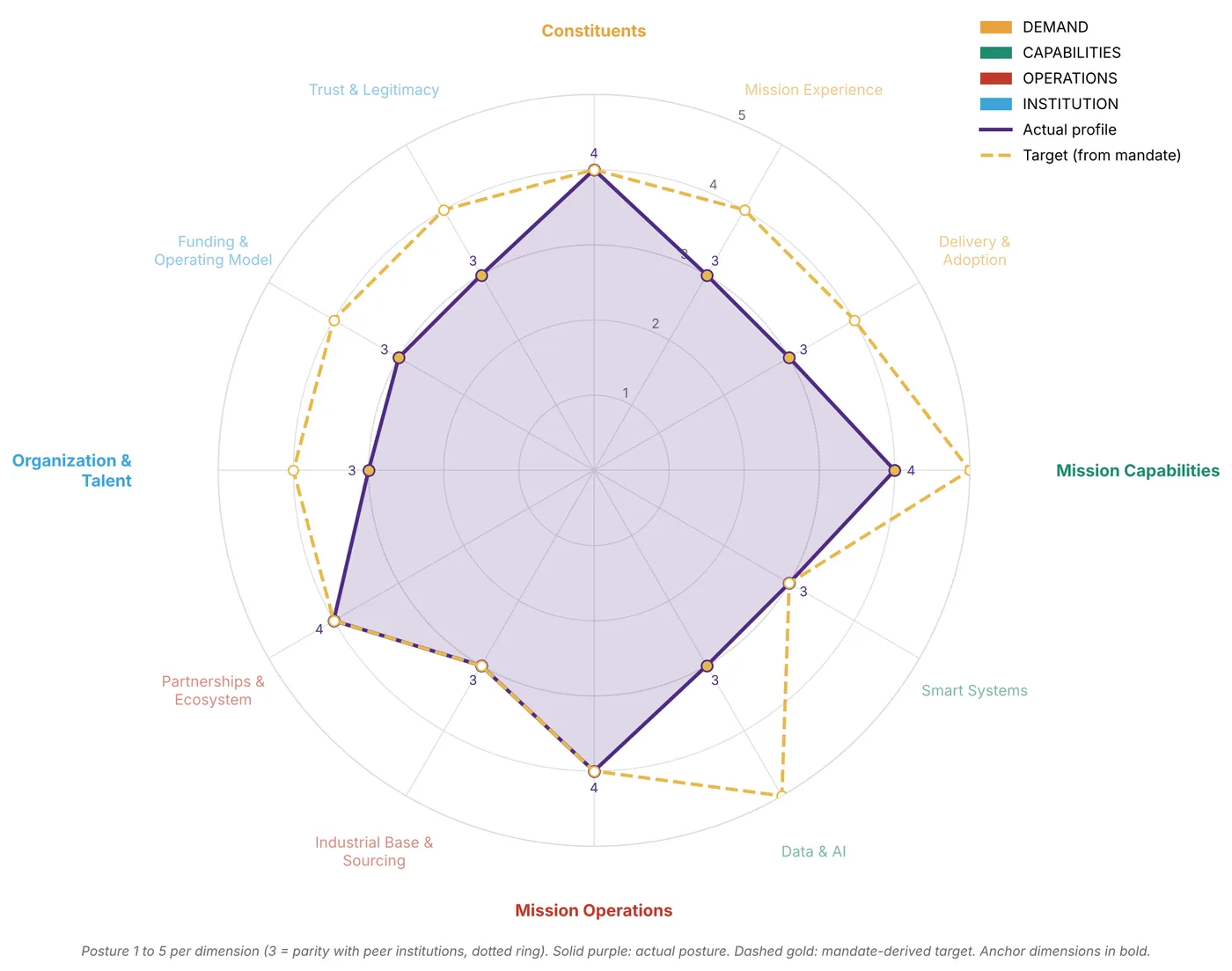
The unweighted drift, the sum of absolute gaps, is 8 of a possible 48; the priority-weighted drift is 21 (equations (1) to (3) in Appendix B). The weighted figure is more than two and a half times the unweighted one because every gap lies on a dimension the mandate weights at 2 or 3 and none on a dimension it weights at 1. That is the signature of an institution that has kept its peripheral dimensions at parity by design and let its priorities lag.
4.1 Data and AI is the headline gap
The University names data analytics and artificial intelligence as one of its core research priorities and in June 2025 created the Northwestern Network for Collaborative Intelligence inside the provost's office to carry it, with founding co-directors from engineering and medicine, three pillars for research, education and infrastructure, and five pillar leaders appointed on 1 April 2026 (Northwestern University 2025e; Northwestern University 2026e). The record of what has been fielded is thinner than the record of what has been organized. The network's Collaborative Intelligence Research Awards fund projects at up to $35,000 each for one year, with the first awards announced on 1 September 2026 and not yet published (Northwestern Network for Collaborative Intelligence 2026a). Its applied hub, The Forge, is described as emerging, and the Provost's Award for Teaching Innovations in the Age of AI closed for proposals on 16 October 2026 (Northwestern Network for Collaborative Intelligence 2026b). The engineering school's Bachelor of Science in Engineering with a major in AI enrolled its first students this autumn (McCormick School of Engineering 2026). Northwestern IT made Microsoft Copilot the primary general-use tool in March 2026, with Google Gemini still under review, and researchers run models on the Quest cluster, for which no capacity figure or expansion plan is published (Northwestern IT 2026a). The infrastructure pillar leader's charge is to find out whether the technology foundation can meet emerging AI research and education needs, which is a question still open (Northwestern IT 2026b).
The strongest evidence on this dimension is federal. The NSF-Simons AI Institute for the Sky, a $20 million national institute led by Northwestern with the University of Chicago and the University of Illinois, held its first annual conference in September 2025 with 180 researchers from 51 institutions (Northwestern University 2025f), and in July 2026 the NSF awarded $20 million over four years for an AI-directed protein engineering cloud laboratory housed in the Center for Synthetic Biology (Northwestern University 2026f). These are capability wins for the laboratories that won them. They do not yet show the institution turning data into advantage across the whole of its research and teaching, the outcome the dimension measures. The honest score is 3: parity with peers, with a priority weight of 3 and a target of 5. The weighted gap of 6 is the largest on the chart and nearly a third of the total. It is an allocation failure, because the dimension draws seed-scale money against a core-priority weight, and the remedy is funding, not a milestone review.
The strongest counter-reading is that the University's AI strength lives inside its schools and simply does not show at the center: the Feinberg Institute for AI in Medicine with eight centers and a master's in biomedical informatics, the Kellogg course whose AI teaching assistant has served more than 1,000 students, the security and AI laboratory in engineering (Feinberg School of Medicine 2026; Kellogg School of Management 2026a). The report accepts that the activity is real and holds the score, for two reasons. First, the evidence for all of it is school-issued and announcement-tier, which caps a score at parity under the discipline in Appendix A. Second, the network itself was created because the University judged that the school-level strength did not add up to an institutional posture; its co-director's stated ambition is to make Northwestern a world leader in AI plus other fields, and the research pillar leaders say the network must address a perception of limited AI research (Daily Northwestern 2026c). The gap is one the University has named for itself.
4.2 Trust and legitimacy is below a compelled floor
Trust and legitimacy scores 3 against a floor of 4 that the agreement and federal civil-rights law compel. The sequence is public: a congressional hearing in May 2024, a $790 million freeze in April 2025 on claims that the University had not protected Jewish students, a presidential resignation in September 2025 and an agreement in November 2025 that restored funding, closed the Department of Justice, Department of Education and Health and Human Services investigations, terminated the 2024 agreement with protesters, removed diversity statements from hiring, and committed the University to post admissions data annually for three years and to review its reliance on international enrollment (Inside Higher Ed 2025; Northwestern University 2025b; Higher Ed Dive 2025). The first quarterly certification was submitted on 31 March 2026 and a third-party campus-climate survey ran from 7 April to 1 May 2026 (Northwestern University 2025b).
Legally, oversight standing is restored. Legitimacy among those who authorize is contested on both sides: the Evanston mayor said the University had been blackmailed, a United States senator called the termination of the protest agreement shameful, and the faculty body that reached quorum for only the second time in its history voted 595 to 4 against any capitulation to federal demands five weeks before the agreement was signed (Higher Ed Dive 2025; Daily Northwestern 2025a). The interim president's own account was that the deal was not perfect and not everything he wanted (Daily Northwestern 2026b). A score of 3 records an institution at parity with the five other universities that signed comparable agreements, and below the posture the agreement itself requires for three years. The floor breach is the second headline finding, and because the dimension is compelled it cannot be traded against any other.
4.3 The funding model and the workforce are one point short on work already begun
The funding and operating model scores 3 against a target of 4. The balance sheet performed: $3.07 billion of liquidity within one year, $667 million of new debt including a $500 million taxable bond at 4.94 percent, $350 million of taxable commercial paper issued in October and November 2025, and an endowment payout above $770 million (Northwestern University 2025a, pp. 11, 24, 31). The operating model did not: expenses rose about 10 percent a year over five years while revenue growth fell from 12.8 percent in fiscal 2022 to 3.9 percent in fiscal 2025, and the budget model that allocates revenue across appropriated schools, non-appropriated schools, auxiliaries and administration is in a multi-year redesign with Deloitte that the chief financial officer described in January 2026 as still in design and build (Daily Northwestern 2026a; Daily Northwestern 2026d). Undergraduate tuition rose 3.5 percent to $71,802 for 2026 to 2027, and the salary pool for fiscal 2027 is 2.7 percent after a year with no raises (Northwestern University 2026g; Daily Northwestern 2026e). The posture is parity with peers who made the same moves in the same year. This is an execution gap on a reform already under way, and the remedy is to finish the model with an innovation carve-out, which Section 7 names.
Organization and talent also scores 3 against a target of 4. The academy memberships, the thirty highly cited researchers and the 2025 Nobel Prize in economics are evidence of faculty excellence, and the provost names faculty excellence as his first priority (Northwestern University 2025g; Northwestern University 2026b). The innovation posture on the workforce is lagging on the facts of 2025 and 2026: 425 positions eliminated, nearly half of them vacant, a staffing budget cut of about 5 percent, a hiring freeze from June 2025 to January 2026, postdoctoral researchers and research associates voting 515 to 13 to unionize in August 2025 with bargaining still at status quo in March 2026, and graduate workers launching their second-contract campaign in October 2026 ahead of a 31 March 2027 expiry (WBEZ 2025; Daily Northwestern 2026f; Daily Northwestern 2025b; Northwestern University 2026h; Daily Northwestern 2026g). Three of the four most senior academic offices turned over in 2026. The score is 3 with a wide band, because the retention and morale data that would move it are internal.
4.4 Where the University is at target
Mission capabilities scores 4, advanced, one point below its target of 5. Sponsored awards were $1.04 billion in fiscal 2025 across 3,306 awards, up 60 percent in a decade; grants and contracts revenue was $1.025 billion; the University led its first NSF Engineering Research Center, on robot dexterity, from August 2024 with $26 million over five years renewable to $52 million; and it ranked seventeenth among medical schools in NIH funding in fiscal 2025 with $384.8 million (Northwestern University 2025g; Northwestern University 2025a, p. 16; Northwestern University 2024; Becker's Hospital Review 2026). A 5 requires capability that peers copy and a quantified outcome documented by two independent sources; the University ranks twenty-ninth in the national survey of research expenditures and does not yet meet that test (National Science Foundation 2026). The gap is a build on a strength, and it is the one dimension where the federal retreat is itself the opportunity, because peer institutions are retrenching at the same time.
Constituents scores 4 on documented outcomes: financial aid of $638.3 million, 22 percent of undergraduates on Pell grants, 15 percent first-generation, tuition-free attendance for most families earning under $150,000, a Class of 2030 of 2,400 drawn from more than 54,000 applicants, and a $100 million ten-year community agreement attached to the new stadium (Northwestern University 2025a, pp. 3 to 4; Northwestern University 2026i; WTTW News 2026). Mission operations scores 4 because the standing mission did not lapse under stress: the University kept research and more than 398,000 clinical-trial enrollees moving through an eight-month freeze, restructured its sponsored research office into three teams in November 2025, and recovered about $330 million of the bridge by January 2026 (Northwestern University 2025g; Northwestern University 2025h; Northwestern University 2026c). Partnerships and ecosystem scores 4 on a record that is unusually dense for a private university: co-leadership of the Chan Zuckerberg Biohub Chicago, the Argonne institute with more than 100 fellows and $64 million of enabled funding, joint appointments with Fermilab, membership of the Midwest Quantum Collaboratory from August 2026, and a state grant of $3 million for wet-lab space at an incubator that reached 25 resident companies in July 2026 (Chan Zuckerberg Initiative 2023; Northwestern University n.d.; Northwestern University 2026j; Northwestern University 2026k; Northwestern University 2026l).
Mission experience, delivery and adoption, smart systems and the industrial base score 3. The first two fall one point short of a target of 4 and the last two meet a target of 3. On delivery, the translation numbers are respectable and not distinctive: 324 invention disclosures, 222 patents, eight startups and $12.3 million of licensing income in fiscal 2025 against $1 billion of research (Northwestern University 2025g). On experience, the outcomes that exist (73 percent of undergraduates with an internship, 58 percent with research experience) measure a conventional excellence, and the AI-enabled pedagogy the network promises is at the proposal stage (Northwestern University 2025a, p. 4). Smart systems and the industrial base are at parity by design, and the report keeps them there.
5. Why the gaps exist: effort against posture
Posture says where the University stands; effort says why. Northwestern does not publish spending by dimension, so the effort reading uses the capital and operating signals the record allows, and it is partial. Three readings hold.
The capital program is concentrated on the physical campus. Construction in progress rose from $275.2 million to $750.5 million in fiscal 2025 and capital acquisitions reached $666.4 million, led by an $870 million stadium that opened in October 2026 with a $480 million family gift, an executive education center for Kellogg, a social sciences hub and a library renovation (Northwestern University 2025a, pp. 1, 11, 22; WTTW News 2026). Those projects serve constituents and mission experience, and most are donor-funded. Against that, the only disclosed central spending on the data and AI priority is a seed-award program of $35,000 grants and a software licence. Data and AI is the textbook allocation failure: a mandate peak starved of effort while the institution's largest effort flows to dimensions already at target.
Trust and legitimacy absorbed heavy effort for a posture that stayed low: $75 million over three years in settlement, $1.14 million of federal lobbying in the first nine months of 2025, a bridge of $350 million, and a compliance program with quarterly certification (Daily Northwestern 2026h; Northwestern University 2026c). That is the budgetary signature of an environment failure. The money bought back permission; it could not buy legitimacy, which has to be rebuilt through conduct.
The funding model and talent dimensions show moderate effort and parity posture: a consulting-led budget redesign, a $50 million increase in compensation for fiscal 2027, and the reinstatement of the staff tuition benefit (Daily Northwestern 2026e; Northwestern University 2026c). These are execution gaps where the work is funded and under way, and the budget instrument is a milestone and a deadline.
Each remedy therefore names a different instrument. Data and AI needs a trustee allocation from designated endowment and a campaign envelope, with an owner. Trust needs conduct and public reporting beyond the agreement's own terms, which costs little. The funding model needs a completion date for the new budget model with an innovation carve-out written into it, and talent needs settled contracts and a retention pool before the next freeze arrives.
6. What the University should grow, hold, fix and stop
Table 4 adjudicates the eighteen live programs the public record evidences, assigned to one dimension each by primary job and sponsor. The verdicts are the instrument's four: grow, hold, fix-or-kill and stop. Programs inside school pipelines that the record does not reach cannot be judged, and the list should be completed from internal materials.
Table 4. The adjudication of live programs: dimension, sponsor, stage, verdict and condition, October 2026.
| Program | Dimension | Sponsor | Stage | Verdict | Condition |
|---|---|---|---|---|---|
| Northwestern Network for Collaborative Intelligence | Data & AI | Provost | Organized; first $35k awards Sept 2026 | Grow | A named envelope and compute plan by the fiscal 2027 budget; awards scaled to team level |
| NSF-Simons AI Institute for the Sky ($20M) | Data & AI | Office for Research | Operating since 2024; first conference Sept 2025 | Grow | Match federal money with University compute and hires |
| DREAM AI cloud laboratory ($20M NSF, July 2026) | Mission Capabilities | Center for Synthetic Biology | Awarded | Grow | Co-locate with incubator; publish the open-data framework |
| HAND Engineering Research Center ($26M, renewable to $52M) | Mission Capabilities | McCormick | Year 2 of 5 | Hold | Renewal review in 2029 |
| BSE major in artificial intelligence | Mission Experience | McCormick / Computer Science | First cohort autumn 2026 | Hold | Report enrollment and placement after year one |
| Kellogg AI Foundations for Managers and the Kai assistant | Mission Experience | Kellogg | Taught since 2025; >1,000 student users | Hold | Measure learning outcomes against a control group |
| Feinberg Institute for AI in Medicine | Data & AI | Feinberg | Operating; eight centers | Hold | Publish clinical deployments and outcomes with Northwestern Medicine |
| Center for Advancing Safety of Machine Intelligence ($7M UL, 2022 to 2025) | Data & AI | McCormick | Funding term ended; no news since Dec 2024 | Fix-or-kill | Renewed external funding or fold into the network by mid-2027 |
| Budget model redesign (Deloitte) | Funding & Operating Model | CFO and Provost | Design and build | Grow | A go-live date and an innovation carve-out in the model |
| Querrey InQbation Lab and N.XT awards | Delivery & Adoption | INVO | 25 resident companies (July 2026) | Grow | Capital-raised and licensing targets per cohort |
| Ryan Field and the $100M community agreement | Constituents | Athletics and Board | Opened Oct 2026 | Hold | Harvest concert and event revenue from 2027; report community spend |
| Chan Zuckerberg Biohub Chicago | Partnerships & Ecosystem | Office for Research | Operating since 2023 | Hold | Count joint outputs annually |
| INQUIRE quantum alliances (MQC, IQMP) | Partnerships & Ecosystem | Office for Research | Joined MQC Aug 2026 | Grow | Pursue the Chicago park's center awards |
| Resolution agreement compliance program | Trust & Legitimacy | President and Board | Certification 1 of 12 filed Mar 2026 | Hold at floor | Publish each certification with a narrative beyond the required text |
| Interim guidance on research support (the bridge) | Funding & Operating Model | Provost | Relaxed after Nov 2025 | Stop | Replace with a standing continuity reserve (candidate 7) |
| Hiring and Compensation Consideration Group | Organization & Talent | Provost and CFO | Disbanded 5 Jan 2026 | Stop | Executed; record the decision |
| Microsoft Copilot rollout and AI tool review | Industrial Base & Sourcing | Northwestern IT | Deployed Mar 2026; Gemini under review | Hold | Publish usage and the data-boundary policy |
| Medill media and science communication certificate | Delivery & Adoption | Medill and Office for Research | Operating | Hold | Scale to all doctoral programs |
Six programs grow, and their common condition is money with an owner. The network is the carrier of the headline priority and has no published envelope; the two $20 million federal awards are the strongest external votes of confidence the University has received on AI and both need University match in compute and people to become capability the whole institution can use. The budget redesign grows because it is the instrument through which every other remedy must flow, and a design phase that runs past fiscal 2027 would leave the new president without a model to allocate against. The incubator and the quantum alliances grow because both convert partnership into delivery at low cost.
One program is fix-or-kill. The Center for Advancing Safety of Machine Intelligence was funded with $7 million over three years from February 2022 and won a Chicago Innovation Award in 2024; its public news record ends in December 2024 and no renewal is disclosed (UL Research Institutes 2022; McCormick School of Engineering 2024). A center on AI safety is exactly what a trust-constrained university needs, so the instrument's verdict is a dated decision: renewed external funding or absorption into the network by mid-2027.
Two programs stop because their work is done, and the instrument records each stop as a decision. The interim guidance that bridged frozen research was an emergency instrument; its lesson should be converted into a standing reserve with rules. The hiring review group was disbanded in January 2026 and authority returned to schools, which is the right end state.
7. Candidates to close the gaps
The four dimensions with the largest weighted gaps, data and AI, the funding and operating model, trust and legitimacy, and organization and talent, become lenses, with delivery as a fifth where a candidate serves two. Each candidate is screened on three reads scored 1 to 5 and composed multiplicatively (equation (7) in Appendix B): mission value, read against the priority weight; feasibility at the level the University can deploy today; and authority, whether the University holds the legal authority, governance and funding category to execute. A score of 1 on any read parks the candidate with its named authority and a dated trigger. Composites of 64 and above are fund now, 30 to 63 fund next, below 30 watch. Scores are illustrative judgments on the public record. Candidates were sought in the three places the method names: idle authorities and assets the University holds, exemplars from peer institutions, and partnership vehicles.
Table 5. Twenty screened candidates: lens, source, mission value, feasibility, authority, composite and verdict.
| # | Candidate | Lens | Source | MV | F | A | Score | Verdict |
|---|---|---|---|---|---|---|---|---|
| 1 | University-owned AI compute: a funded expansion of the Quest cluster with grant cost recovery | Data & AI | Idle asset | 5 | 4 | 4 | 80 | Fund now |
| 2 | Team-scale Collaborative Intelligence awards ($250k to $1M) aimed at federal center bids | Data & AI | Idle authority | 5 | 4 | 4 | 80 | Fund now |
| 3 | A baseline data and AI requirement for every undergraduate, credit-bearing | Data & AI | Stated aim | 4 | 4 | 5 | 80 | Fund now |
| 4 | Research infrastructure philanthropic initiative (compute, cluster hires, continuity) | Funding | Idle asset | 5 | 3 | 5 | 75 | Fund now |
| 5 | Public research-impact ledger for Illinois and the federal delegation | Trust | Peer exemplar | 3 | 5 | 5 | 75 | Fund now |
| 6 | Standing research continuity reserve from designated endowment, with draw rules | Funding | Idle authority | 4 | 4 | 4 | 64 | Fund now |
| 7 | Independent monitor and public narrative on agreement compliance and academic freedom | Trust | Peer exemplar | 4 | 4 | 4 | 64 | Fund now |
| 8 | Expanded joint appointments with Argonne and Fermilab | Talent | Partnership | 4 | 4 | 4 | 64 | Fund now |
| 9 | AI-plus-discipline cluster hiring with retention packages | Talent | Stated aim | 5 | 3 | 4 | 60 | Fund next |
| 10 | Settled postdoctoral and graduate contracts framed as a talent strategy | Talent | Compelled bargaining | 4 | 3 | 5 | 60 | Fund next |
| 11 | Indirect-cost recovery optimization and readiness for a successor federal model | Funding | Idle authority | 3 | 4 | 5 | 60 | Fund next |
| 12 | Executive and professional program expansion at the new Kellogg center and SPS | Funding | Idle asset | 3 | 4 | 5 | 60 | Fund next |
| 13 | Chicago civic science engagement program built on the Medill certificate | Trust | Idle asset | 3 | 4 | 5 | 60 | Fund next |
| 14 | Chicago industry AI consortium membership model at The Forge | Data & AI | Partnership | 4 | 3 | 4 | 48 | Fund next |
| 15 | Innovation carve-out written into the new budget model | Funding | Reform in flight | 4 | 3 | 4 | 48 | Fund next |
| 16 | Governed clinical data commons with Northwestern Medicine for AI research | Data & AI | Partnership | 5 | 3 | 3 | 45 | Fund next |
| 17 | Venture fund for University intellectual property, scaling N.XT | Delivery | Peer exemplar | 3 | 3 | 3 | 27 | Watch |
| 18 | International pipeline hedge: deferred pathways and overseas partner programs | Constituents | Peer exemplar | 3 | 2 | 3 | 18 | Watch |
| 19 | Research-computing services sold to incubator startups on cost recovery | Delivery | Idle asset | 2 | 3 | 3 | 18 | Watch |
| 20 | Signing the federal compact for preferential funding | Funding | External offer | 3 | 3 | 1 | parked | Authority floor; Faculty Assembly 595 to 4 and presidential refusal, Oct 2025; trigger: none foreseen |
The eight candidates at fund now share a property: each uses an asset or authority the University already holds. The Quest cluster exists and needs capacity. The award program exists and needs a zero added to its ceiling. Faculty governance can enact a baseline requirement without external permission. The designated endowment is already the trustees' to allocate, and the bridge of 2025 proved both the mechanism and the appetite. The research-impact ledger needs numbers the University already publishes, $3 billion of economic impact and 14,500 jobs, put in a form a state legislator or a congressional staffer can use (Northwestern University 2025a, p. 5). The compliance monitor costs less than one quarter of lobbying.
Candidates 1, 2 and 9 reinforce one another and should be read as one bet: compute without people to use it is a utility bill, people without compute leave, and awards without either fund papers. Read together they are the institutional AI build that the network was created to carry and that the yield test prices at $150 to $350 million over four years. Candidates 4, 6 and 15 are a second combination: the campaign supplies the money, the reserve holds it, and the budget model routes it. Candidate 20 is parked on authority and the report records it so that nobody reopens it quietly.
The two-currency reconciliation is honest about the limit. In posture points, the eight fund-now candidates address every weighted gap of 3 and the talent gap of 2, and together they could move data and AI from 3 to 4 within the horizon; a 5 requires the second combination to deliver as well. In dollars, the candidates are inside the $300 to $600 million band but outside the operating envelope, so the dial leadership must choose is to raise the envelope from the reservoirs. Lowering the ambition is not available on the compelled floors, and the adjudication in Section 6 on its own closes less than half the weighted drift.
8. What the University should not do
The valleys are choices and the report states them with the same confidence as the peaks. Smart systems and the industrial base stay at 3. The University should not build its own AI models, its own data centre at hyperscale, or a captive instrument business; it should buy, rent and partner for compute and instruments, as it does through Microsoft, Azure and AWS licences and the national laboratories, and spend its scarce discretionary money on people and on the data it alone holds. The capital program should pause new physical projects beyond those under contract, because $750 million of construction in progress against a $148 million deficit already commits the next three years of depreciation and interest, and the new stadium's concert revenue from 2027 should be counted as a harvest once it arrives.
Three candidates are watched. An intellectual-property venture fund is a peer exemplar that scores poorly on authority and feasibility for an institution whose licensing income is $12.3 million; the incubator is the better vehicle. An international pipeline hedge is a real risk to manage but scores low on feasibility while the fixed-period-of-admission rule is new and its effects unmeasured. Selling research computing to startups would distract a cluster that the University's own researchers need first.
One candidate is parked. The federal compact offered preferential funding for policy commitments the Faculty Assembly voted to refuse by 595 to 4 and the interim president said he would not sign; the authority read is 1 and no trigger is foreseen (Daily Northwestern 2025a). Two floors will be held even where the University will not lead: mission operations at 4 and trust and legitimacy at 4, the latter requiring a climb of one point that no other dimension may crowd out.
9. What happens next
The 90-day actions, each with an owner:
- Name the data and AI envelope. The president and the chief financial officer bring the trustees a four-year allocation from designated endowment and the campaign, with the network's co-directors as owners and a compute plan by the fiscal 2027 budget (candidates 1, 2 and 4).
- Convert the bridge into a rule. The chief financial officer drafts a standing research continuity reserve with draw triggers and repayment terms, so the next freeze is met by a standing policy (candidate 6).
- Report beyond the agreement. The president publishes each quarterly certification with a narrative on academic freedom and campus climate, and appoints an independent monitor whose findings are public (candidates 5 and 7).
- Settle the research workforce. The provost sets a date for a first postdoctoral contract and opens graduate bargaining early, and pairs both with a retention pool for faculty in the four priority areas (candidates 9 and 10).
- Decide the AI safety center. McCormick and the network put a renewal or absorption decision for the Center for Advancing Safety of Machine Intelligence on a mid-2027 calendar.
- Finish the budget model. The chief financial officer names a go-live date and writes the innovation carve-out into the design (candidate 15).
Four gaps in the public record limit the scores and should be closed from internal data: spending by dimension, which would convert the effort reading in Section 5 from signals to shares; faculty and postdoctoral retention and offer-acceptance rates; the compute capacity and utilization of the Quest cluster; and the program inventory inside schools. The radar should be re-run in October 2027, after the first full year of the new administration, the first network awards cohort, the first postdoctoral contract and the fourth quarterly certification, with the guardrail that a score moves only on two consecutive reads or one confirmed change in evidence.
Appendix A. Method Note and Source Ledger
A.1 Method and passes
The diagnostic ran the Mission Radar's staged assessment from public sources only, at the third stage of the construction ladder (records retrieved and cited per score) without the Delphi or interview stages, which require access to the institution. Two passes ran. The strategy pass read the fiscal 2025 financial report, the 2025 and 2026 annual financial updates, the Office for Research 2025 impact report and research metrics, the research priorities page, the federal agreement page, the provost's immigration note, the president-elect's announcement and first interviews, and the tuition and class announcements. The dimension pass ran 31 web searches (23 extended) and 52 full-page reads across University announcements, the Daily Northwestern, Evanston news outlets, WBEZ, WTTW, Inside Higher Ed, Higher Ed Dive, Becker's Hospital Review, the American Council on Education litigation page, the NSF, NACUBO, O'Melveny's reconciliation-act analysis, the Chan Zuckerberg Initiative and the national-laboratory partnership pages. The evidence cutoff is 12 October 2026. Six fetches failed on robots or client errors (two Evanston RoundTable pages, one Evanston Now page, two Daily Northwestern pages, the NACUBO release) and were replaced by alternative sources on the same facts. Entries marked [snippet] were verified from a search result only; none of the scores of 4 rests on one.
Evidence tiers follow the posture scale: Tier A is official records, audited statements, documented fielded outcomes and court records; Tier B is named oversight and research bodies and reputable named-byline press; Tier C is University and school announcements, which cap a score at 3; Tier D is commentary, which corroborates only. Two sources count as independent only if each generates its own evidence; the University's Northwestern Now stories and the schools' news pages are one source. Confidence is derived: High needs two independent Tier A sources within six months, Medium is Tier B corroboration or older Tier A, Low is Tier C only or a coverage gap. Source counts: Tier A 19, Tier B 22, Tier C 17, Tier D 3; rejected at the provenance gate: 4 (an AI-generated endowment profile site asserting unsourced figures, two aggregator pages republishing the layoff story, and a lobbying-tracker page with no stated basis).
A.2 Where the deep pass moved scores from the shallow read
The shallow read of October 2026 scored the University at 5 on mission capabilities and data and AI, 4 on partnerships, organization and talent, funding and operating model, trust and legitimacy, constituents and mission experience, and 3 on the rest. The deep pass moved six scores and held six. Mission capabilities moves from 5 to 4 because a 5 requires capability that peers copy and a quantified outcome documented by two independent sources within twelve months; the University ranks twenty-ninth in national research expenditures and seventeenth in NIH funding to medical schools, which the rubric reads as advanced. Data and AI moves from 5 to 3 because every institutional item in the record is an announcement, an organization chart or a seed award, and Tier C caps at parity; the shallow read also cited $350,000 seed awards, which the published request for proposals shows to be awards of up to $35,000. Organization and talent moves from 4 to 3 on the 425 eliminated positions, the year without raises, the hiring freeze and the two union campaigns. Funding and operating model moves from 4 to 3 because the fiscal 2025 deficit and the budget model still in design put the posture at parity with peers who made the same moves. Trust and legitimacy moves from 4 to 3 and is read as a breach of the compelled floor of 4. Mission experience moves from 4 to 3 because the AI-enabled pedagogy the shallow read credited is at the proposal stage. Constituents, mission operations, partnerships, smart systems, the industrial base and the target vector are continuous with the shallow read. The target for partnerships is held at 4 because the University is already there and the mandate does not depend on it more than it depends on talent.
A.3 Derivation box: the data and AI score
Signal 1, shipped moves with dates: the network launched 11 June 2025; five pillar leaders appointed 1 April 2026; Microsoft Copilot designated the primary tool 17 March 2026; Collaborative Intelligence Research Awards of up to $35,000, proposals due 31 July 2026, awards announced 1 September 2026 and not published at the cutoff; BSE major in AI enrolling from autumn 2026; the $20 million SkAI institute operating since 2024 and the $20 million DREAM cloud laboratory awarded 23 July 2026. Signal 2, outcome evidence on the dimension's own metric (decision speed and quality across the institution): none published; the only usage figure is the Kellogg assistant's 1,000 students, a school-level count without a control group. Signal 3, recognition: two federal center awards recognize specific laboratories; no external body names the University a leader in institutional AI. Anchor test: the dimension asks whether the institution turns data into advantage across its research and teaching; the record shows organization and intent, which the rubric calls parity. Tier: C for the institutional items, A for the two federal awards, which belong to mission capabilities by the sponsor rule. Score 3, confidence Medium. A reader who disputes the score is invited to run the same chain against the sources below.
A.4 Source Ledger by dimension
Constituents (score 4, High). Northwestern University 2025a: 2025 Financial Report (fiscal year ended 31 Aug 2025), KPMG opinion 11 Dec 2025, northwestern.edu, Tier A. Northwestern University 2026i: "Northwestern's new students soak it in," Northwestern Now, Sept 2026, Tier C. Northwestern University 2026g: "Northwestern sets tuition and fees for 2026-2027," 20 May 2026, Tier C. WTTW News 2026: "Northwestern University Debuts New Ryan Field," 6 Oct 2026, Tier B. Northwestern University 2025c: International Student and Scholar Services Statistical Report 2024-2025, Tier A. Northwestern University 2026d: Luijten, "Addressing Changes to Federal Immigration Policy," Leadership Notes, 24 July 2026, Tier A. Higher Ed Dive 2025: "What's in Northwestern University's deal with the Trump administration?", Dec 2025, Tier B.
Mission Experience (score 3, Medium). Northwestern University 2025a, p. 4, Tier A. McCormick School of Engineering 2026: "Northwestern Engineering Announces New AI Major," 10 Mar 2026, Tier C. Daily Northwestern 2026j: "Northwestern announces new AI major beginning fall 2026," 10 Mar 2026, Tier B. Kellogg School of Management 2026a: "Building AI foundations for the future," 10 Feb 2026, Tier C. Kellogg School of Management 2026b: Cornelli and Kabiller, "A human edge in the age of AI," 14 Sept 2026, Tier C. Northwestern Network for Collaborative Intelligence 2026b: Major Initiatives page (Provost's Award, deadline 16 Oct 2026), accessed Oct 2026, Tier C.
Delivery & Adoption (score 3, Medium). Northwestern University 2025g: Office for Research, Research Activity 2025 metrics and 2025 Impact Report (INVO: 324 disclosures, 222 patents, 8 startups, $12.3 million licensing), Tier A. Northwestern University 2026l: "Querrey InQbation Lab now home to 25 resident Illinois companies," 14 July 2026, Tier C. Northwestern University 2026m: "Vice President for Research Eric Perreault to step down" (Ryan Family Research Acceleration Fund more than $8 million), 8 Apr 2026, Tier C. Innovation and New Ventures Office 2026: news page, Midwest Biotech Showcase, 16 Jan 2026, Tier C.
Mission Capabilities (score 4, High). Northwestern University 2025g, Tier A. Northwestern University 2025a, p. 16, Tier A. Northwestern University 2024: "New center to improve robot dexterity selected to receive up to $52 million," 21 Aug 2024, Tier C, corroborated by NSF 2024 announcement of four new Engineering Research Centers, Tier A. Becker's Hospital Review 2026: "25 medical schools that received the most NIH funding in 2025," 25 Feb 2026, Tier B. National Science Foundation 2026: NCSES, "Universities Report 8.1% Growth in R&D Expenditures in FY 2024," NSF 26-305, 10 Feb 2026, Tier A; NCSES institution profile for Northwestern (FY2023 R&D $1,000.7 million, federal $618.8 million), Tier A. Northwestern University 2026f: "AI-directed protein-engineering cloud lab receives $20 million from NSF," 23 July 2026, Tier C. Daily Northwestern 2026b (Nobel Prize, Joel Mokyr), Tier B.
Smart Systems (score 3, Low). WTTW News 2025a: CNN via WTTW, "NIH Froze Funding for Clinical Trials at Northwestern University," 23 June 2025 (REACT-AF trial, 1,700 enrolled, $37 million), Tier B. Northwestern University 2025a, p. 5 (dissolvable pacemaker), Tier A. Northwestern University 2024 (HAND ERC), Tier C.
Data & AI (score 3, Medium). Northwestern University 2025e: Northwestern Network for Collaborative Intelligence launch announcement, Northwestern Now, 11 June 2025, Tier C. Northwestern University 2026e: "Northwestern Network for Collaborative Intelligence announces strategic leaders," 1 Apr 2026, Tier C. Daily Northwestern 2026c: "NNCI's five strategic leaders aim to expand interdisciplinary AI across campus," 21 May 2026, Tier B. Northwestern Network for Collaborative Intelligence 2026a: Collaborative Intelligence Research Awards page and RFP (up to $35,000), accessed Oct 2026, Tier C. Northwestern IT 2026a: "AI tools guidance: what is next," 17 Mar 2026, Tier C. Northwestern IT 2026b: "From Infrastructure to Impact: IT and NNCI," 28 May 2026, Tier C. Northwestern University 2025f: Office for Research, Transforming Research newsletter, Dec 2025 (Open SkAI 2025), Tier C. Feinberg School of Medicine 2026: Institute for Artificial Intelligence in Medicine, director's message, accessed Oct 2026, Tier C. UL Research Institutes 2022: "Underwriters Laboratories and Northwestern University Launch Research Hub," 15 Feb 2022, Tier C. McCormick School of Engineering 2024: "CASMI honored with 2024 Chicago Innovation Award," Nov 2024, Tier C. Northwestern University 2026a: Research priorities page, research-nu, accessed Oct 2026, Tier C. Daily Northwestern 2026n: "Q&A: President-elect Mung Chiang talks AI," 19 May 2026, Tier B.
Mission Operations (score 4, High). Northwestern University 2025a, pp. 1, 5, 30, Tier A. Northwestern University 2026c: Bienen, Distel and Hagerty, "2026 Annual Financial Update," 23 Jan 2026, Tier A. Northwestern University 2025h: Office for Research, Transforming Research, Dec 2025 (Sponsored Research restructuring effective 18 Nov 2025), Tier C. Northwestern University 2025g (398,000 trial enrollees), Tier A. Daily Northwestern 2025c: "Northwestern receives tens of millions in federal research funding in first weeks after deal," 11 Dec 2025, Tier B.
Industrial Base & Sourcing (score 3, Low). Northwestern IT 2026a, Tier C. Northwestern IT 2026b, Tier C. Northwestern University 2026m (20 institutes, more than 50 core facilities), Tier C. Northwestern University 2026j: "Pritzker: Northwestern, State of Illinois seizing quantum opportunity" ($3 million DCEO wet-lab grant), 27 Apr 2026, Tier C.
Partnerships & Ecosystem (score 4, Medium). Chan Zuckerberg Initiative 2023: "CZI and Illinois Leaders Launch Chan Zuckerberg Biohub Chicago," 5 Oct 2023, Tier B; Weinberg College 2023: "Northwestern to Co-Lead New Chan Zuckerberg Biohub," 14 Mar 2023, Tier C. Northwestern University n.d.: Partnerships with National Labs (NAISE, 100-plus fellows, $64 million), accessed Oct 2026, Tier C. Northwestern University 2026k: "Northwestern joins expanded Midwest Quantum Collaboratory," 27 Aug 2026, Tier C. Northwestern University 2026j, Tier C. Northwestern University 2025f (SkAI: 25 partner organizations; 180 researchers, 51 institutions), Tier C. Northwestern University 2026f (Chicago Biomedical Consortium, Illinois EDC), Tier C. Northwestern University 2025a, pp. 16 to 17 (Northwestern Medicine affiliation), Tier A.
Organization & Talent (score 3, Medium). WBEZ 2025: "Northwestern University cuts 425 positions amid Trump funding freeze," 30 July 2025, Tier B. Daily Northwestern 2025d: "Northwestern administration announces hiring freeze, academic permanent budget reductions," 10 June 2025, Tier B. Daily Northwestern 2026f: "Northwestern hiring freeze is over, Bienen confirms," 10 Jan 2026, Tier B. Daily Northwestern 2025b: "Northwestern postdoctoral researchers and research associates approve union," 28 Aug 2025, Tier B. Northwestern University 2026h: Postdoc unionization faculty and staff brief, 12 Mar 2026, Tier A. Daily Northwestern 2026g: "Northwestern University Graduate Workers rally for second contract," 5 Oct 2026, Tier B. Daily Northwestern 2026e: "Faculty, staff salary increases to make up 2.7% of individual employee salaries," 28 May 2026, Tier B. Northwestern University 2026b: "Erik Luijten named new Northwestern provost," 7 Jan 2026, Tier C. Northwestern University 2026o: "Mung Chiang named next president of Northwestern," 18 May 2026, Tier C; Daily Northwestern 2026p: "Purdue President Mung Chiang named 18th president," 18 May 2026, Tier B. Northwestern University 2026m, Tier C. Northwestern University 2025g (201 academy memberships, 30 highly cited), Tier A.
Funding & Operating Model (score 3, High). Northwestern University 2025a, pp. 8 to 11, 24 to 27, 31, Tier A. Northwestern University 2026c, Tier A. Northwestern University 2025d: Schill, Distel and Hagerty, "Annual Financial Update for 2025," 16 Jan 2025, Tier A. Daily Northwestern 2026a: "By the Numbers: Financial report reveals scale of financial costs, growth," 11 Mar 2026, Tier B. Daily Northwestern 2026d: "Provost, CFO announce plan to reform University budget at Faculty Senate," 22 Jan 2026, Tier B. Northwestern University 2024b: Investment Office, "An Investment in Northwestern FY24" (endowment $14.3 billion, FY24 return 8.4 percent, FY25 payout estimate $770 million), Tier A. O'Melveny 2025: "Impact of the 2025 Reconciliation Act on Colleges and Universities," 2025, Tier B. American Enterprise Institute 2025: "How Much Will Universities Pay in Endowment Tax?", July 2025, Tier B. American Council on Education 2026: "Trump Administration Does Not Seek to Appeal to Supreme Court, Indirect Costs Cap Litigation Concluded," Apr 2026, Tier A (court record summarized). Daily Northwestern 2026h: "Northwestern spent $271,000 on lobbying efforts in first quarter of 2026," 13 May 2026, Tier B. Evanston RoundTable 2025: "Northwestern braces for federal changes with 10% budget cuts," 13 Feb 2025, Tier B [snippet].
Trust & Legitimacy (score 3, High). Northwestern University 2025b: "Agreement with Federal Government to Restore Northwestern Research Funding," Office of the President, Nov 2025 with updates to May 2026, Tier A. Inside Higher Ed 2025: "Northwestern President to Step Down," 4 Sept 2025, Tier B. Higher Ed Dive 2025, Tier B. WTTW News 2025b: "Northwestern Faculty, Students Divided Over $75M Settlement," 4 Dec 2025, Tier B. Daily Northwestern 2025a: "Northwestern Faculty Assembly passes resolution opposing Trump compact," 20 Oct 2025, Tier B. Daily Northwestern 2026b: "Interim President Henry Bienen justifies federal funding deal," 9 Jan 2026, Tier B. Daily Northwestern 2025e: "By The Numbers: More than $1 billion lost in frozen, terminated NIH, NSF grants," 20 Nov 2025, Tier B. WTTW News 2025a, Tier B. Evanston RoundTable 2025b: "Northwestern community, others, react to federal deal," 2 Dec 2025, Tier B [snippet].
Context and substrate. Northwestern University 2026n: "President's first day: Mung Chiang is off and running," 2 July 2026, Tier C. Northwestern University 2012: Strategic Plan, Catalyst announcement, 26 Apr 2012 (the last formal University-wide strategic plan located), Tier A. Daily Northwestern 2026q: "Northwestern Faculty Assembly hears departing remarks from Bienen," 10 June 2026, Tier B [snippet].
Appendix B. Mathematics
The seven equations below define the quantities used in the body. Let T be the target profile and A the actual profile, each a vector of twelve posture scores on the one-to-five scale, and let w be the vector of mission-priority weights. The dimension index d runs over the twelve dimensions in the order of Table 1.
g_d = A_d - T_d(1)The signed gap on dimension d is actual posture minus target; a negative gap is a shortfall against the mandate and a positive gap an over-build.
D = \sum_{d=1}^{12} \left| g_d \right|(2)The unweighted drift is the sum of absolute gaps; for Northwestern it is 8 of a possible 48.
D_w = \sum_{d=1}^{12} w_d \left| g_d \right|(3)The priority-weighted drift is the sum of weighted absolute gaps; for Northwestern it is 21, and the ratio to the unweighted drift reads how far the shortfalls concentrate on the mandate's peaks.
I = \frac{\lVert A \rVert}{\lVert T \rVert} = \frac{\sqrt{\sum_{d=1}^{12} A_d^{2}}}{\sqrt{\sum_{d=1}^{12} T_d^{2}}}(4)Intensity is the ratio of the magnitudes of the two profiles; a value well below one with a defensible shape routes the diagnosis to the yield test. For Northwestern it is about 0.8.
T_d = \mathrm{band}\!\left( \sum_{p} \pi_p \, c_{d,p} \right), \qquad T_d \ge F_d(5)The target posture is derived from the mandate: each dimension's contribution c_{d,p} to each stated priority p with priority share \pi_p rolls up and is banded onto the one-to-five scale, then floored at the mandate floor F_d where one is compelled or elected.
\frac{C}{H} \gtrless E(6)The yield test compares the closure cost C divided by the mandate horizon H to the annual envelope E for new capability; when the required rate exceeds the envelope the mandate is unfundable at the current level. For Northwestern, C is $300 to $600 million, H is four years and E is zero to $50 million, so the required rate of $75 to $150 million a year exceeds the envelope across the whole band.
S_i = \mathrm{MV}_i \times F_i \times A_i, \qquad \min\left( \mathrm{MV}_i, F_i, A_i \right) = 1 \Rightarrow \text{parked}_i(7)The composite for candidate i multiplies mission value, feasibility and authority, each scored 1 to 5, so it runs from 8 to 125 for a candidate that survives; any read of 1 parks the candidate with its named authority and a dated trigger.
References
Sawhney, Mohanbir. 2026. The Mission Radar: A Blueprint for Innovation in Government Organizations. Working Paper, Version 1.1, Kellogg School of Management, Northwestern University, July 2026.
Sawhney, Mohanbir. 2026. The Innovation Radar 2.0: A Framework for Measuring and Diagnosing Business Innovation. SSRN Working Paper. https://ssrn.com/abstract=7244520.
American Council on Education. 2026. "Trump Administration Does Not Seek to Appeal to Supreme Court, Indirect Costs Cap Litigation Concluded." April 2026. acenet.edu.
Becker's Hospital Review. 2026. "25 Medical Schools That Received the Most NIH Funding in 2025." 25 February 2026.
Chan Zuckerberg Initiative. 2023. "CZI and Illinois Leaders Launch Chan Zuckerberg Biohub Chicago." 5 October 2023.
Daily Northwestern. 2025a. "Northwestern Faculty Assembly Passes Resolution Opposing Trump Compact, Amends Bylaws." 20 October 2025.
Daily Northwestern. 2025b. "Northwestern Postdoctoral Researchers and Research Associates Approve Union after 2-Day Election." 28 August 2025.
Daily Northwestern. 2025c. "Northwestern Receives Tens of Millions in Federal Research Funding in First Weeks after Deal with Trump Administration." 11 December 2025.
Daily Northwestern. 2025d. "Northwestern Administration Announces Hiring Freeze, Academic Permanent Budget Reductions." 10 June 2025.
Daily Northwestern. 2025e. "By the Numbers: More than $1 Billion Lost in Frozen, Terminated NIH, NSF Grants for Northwestern Researchers, per Grant Witness." 20 November 2025.
Daily Northwestern. 2026a. "By the Numbers: Financial Report Reveals Scale of Financial Costs, Growth." 11 March 2026.
Daily Northwestern. 2026b. "Interim President Henry Bienen Justifies Federal Funding Deal, Responds to Faculty Concerns in State of the University Address." 9 January 2026.
Daily Northwestern. 2026c. "Northwestern Network for Collaborative Intelligence's Five Strategic Leaders Aim to Expand Interdisciplinary AI across Campus." 21 May 2026.
Daily Northwestern. 2026d. "Provost, CFO Announce Plan to Reform University Budget at Faculty Senate." 22 January 2026.
Daily Northwestern. 2026e. "Faculty, Staff Salary Increases to Make Up 2.7% of Individual Employee Salaries, Following Year with No Raises." 28 May 2026.
Daily Northwestern. 2026f. "Northwestern Hiring Freeze Is Over, Bienen Confirms." 10 January 2026.
Daily Northwestern. 2026g. "'We Are the University': Northwestern University Graduate Workers Rally for Second Contract." 5 October 2026.
Daily Northwestern. 2026h. "Northwestern Spent $271,000 on Lobbying Efforts in First Quarter of 2026." 13 May 2026.
Daily Northwestern. 2026n. "Q&A: President-elect Mung Chiang Talks AI, Engineering Background, University Goals." 19 May 2026.
Feinberg School of Medicine. 2026. Institute for Artificial Intelligence in Medicine, Director's Message. Accessed October 2026.
Higher Ed Dive. 2025. "What's in Northwestern University's Deal with the Trump Administration?" December 2025.
Inside Higher Ed. 2025. "Northwestern President to Step Down." 4 September 2025.
Kellogg School of Management. 2026a. "Building AI Foundations for the Future." 10 February 2026.
McCormick School of Engineering. 2024. "CASMI Honored with 2024 Chicago Innovation Award." November 2024.
McCormick School of Engineering. 2026. "Northwestern Engineering Announces New AI Major." 10 March 2026.
National Science Foundation. 2026. Universities Report 8.1% Growth in R&D Expenditures in FY 2024, Reaching Over $117 Billion. NSF 26-305, National Center for Science and Engineering Statistics, 10 February 2026.
Northwestern IT. 2026a. "AI Tools Guidance: What Is Next." 17 March 2026.
Northwestern IT. 2026b. "From Infrastructure to Impact: IT and NNCI." 28 May 2026.
Northwestern Network for Collaborative Intelligence. 2026a. "Collaborative Intelligence Research Awards." Accessed October 2026.
Northwestern Network for Collaborative Intelligence. 2026b. "Major Initiatives." Accessed October 2026.
Northwestern University. 2024. "New Center to Improve Robot Dexterity Selected to Receive up to $52 Million." Northwestern Now, 21 August 2024.
Northwestern University. 2024b. An Investment in Northwestern, FY24. Investment Office.
Northwestern University. 2025a. 2025 Financial Report. Fiscal year ended 31 August 2025; independent auditors' report dated 11 December 2025.
Northwestern University. 2025b. "Agreement with Federal Government to Restore Northwestern Research Funding." Office of the President, 28 November 2025, with updates through May 2026.
Northwestern University. 2025c. International Student and Scholar Services Statistical Report 2024-2025.
Northwestern University. 2025d. Schill, M., A. Distel, and K. Hagerty. "Annual Financial Update for 2025." Leadership Notes, 16 January 2025.
Northwestern University. 2025e. "Northwestern Network for Collaborative Intelligence Launched." Northwestern Now, 11 June 2025.
Northwestern University. 2025f. Office for Research. Transforming Research, December 2025.
Northwestern University. 2025g. Office for Research. 2025 Impact Report and Research Activity 2025 metrics.
Northwestern University. 2025h. Office for Research. Sponsored Research restructuring notice, effective 18 November 2025 (in Transforming Research, December 2025).
Northwestern University. 2026a. "Research at Northwestern: Driving Innovation, Shaping the Future." Accessed October 2026.
Northwestern University. 2026b. "Erik Luijten Named New Northwestern Provost." Northwestern Now, 7 January 2026.
Northwestern University. 2026c. Bienen, H. S., A. Distel, and K. Hagerty. "2026 Annual Financial Update." Leadership Notes, 23 January 2026.
Northwestern University. 2026d. Luijten, E. "Addressing Changes to Federal Immigration Policy." Leadership Notes, 24 July 2026.
Northwestern University. 2026e. "Northwestern Network for Collaborative Intelligence Announces Strategic Leaders." Northwestern Now, 1 April 2026.
Northwestern University. 2026f. "AI-Directed Protein-Engineering Cloud Lab Receives $20 Million from NSF." Northwestern Now, 23 July 2026.
Northwestern University. 2026g. "Northwestern Sets Tuition and Fees for 2026-2027 Academic Year." Northwestern Now, 20 May 2026.
Northwestern University. 2026h. Postdoc Unionization: Faculty and Staff Brief. 12 March 2026.
Northwestern University. 2026i. "Northwestern's New Students Soak It In." Northwestern Now, September 2026.
Northwestern University. 2026j. "Pritzker: Northwestern, State of Illinois Seizing Quantum Opportunity." Institute for Quantum Information Research and Engineering, 27 April 2026.
Northwestern University. 2026k. "Northwestern Joins Expanded Midwest Quantum Collaboratory." 27 August 2026.
Northwestern University. 2026l. "Querrey InQbation Lab Now Home to 25 Resident Illinois Companies." Northwestern Now, 14 July 2026.
Northwestern University. 2026m. "Vice President for Research Eric Perreault to Step Down." Northwestern Now, 8 April 2026.
Northwestern University. 2026o. "Mung Chiang Named Next President of Northwestern." Northwestern Now, 18 May 2026.
Northwestern University. n.d. "Partnerships with National Labs." Accessed October 2026.
O'Melveny. 2025. "Impact of the 2025 Reconciliation Act on Colleges and Universities." Client alert, 2025.
UL Research Institutes. 2022. "Underwriters Laboratories and Northwestern University Launch Research Hub Supporting Safety, Equity in Artificial Intelligence." 15 February 2022.
WBEZ. 2025. "Northwestern University Cuts 425 Positions amid Trump Funding Freeze." 30 July 2025.
WTTW News. 2025a. "NIH Froze Funding for Clinical Trials at Northwestern University. By Fall, They'll Run Out of Funding." 23 June 2025.
WTTW News. 2025b. "Northwestern Faculty, Students Divided over $75M Settlement with Trump Administration." 4 December 2025.
WTTW News. 2026. "Northwestern University Debuts New Ryan Field." 6 October 2026.
Sawhney, Mohanbir, Robert C. Wolcott, and Inigo Arroniz. 2006. "The 12 Different Ways for Companies to Innovate." MIT Sloan Management Review 47 (3): 75–81.
Mission Radar (Sawhney Enterprises). Scores, drift and the yield band are illustrative judgments grounded in public evidence as of 12 October 2026.