Full diagnostic. AI Project Portfolio Diagnostic and Recommendations for Protolabs. Public-record research pass and top-up pass, October 2026.
A sample Radar from the public record
AI Project Portfolio Diagnostic and Recommendations for Protolabs, Sawhney Enterprises, October 2026, public-record research pass with a top-up pass. The recommended polygon is rebuilt from the public record. The actual overlay is a dated July 2026 engagement snapshot that is not public, and program budgets are not disclosed.
Context
This report diagnoses the AI project portfolio of Protolabs, the digital manufacturing business of Proto Labs, Inc., and recommends how much the firm should invest in AI, where that investment should land, and how far each program in flight has come. It applies the AI Radar 2.0, a portfolio framework that asks three questions of a firm's AI investment: whether the firm is investing enough for the ambition it has declared, whether the investment is going where its strategy says it should, and how far its programs have advanced on a maturity scale that compares across firms. The framework scores twelve dimensions of the enterprise on three rings, what AI can do today, what the industry's economics reward, and what the firm's own strategy values, composes them multiplicatively into a recommended allocation, adjudicates the portfolio in flight against that allocation, reads the level and the allocation of investment as size and shape, and reads the maturity of the programs in flight as depth. The recommended allocation is rebuilt here from the public record as of October 12, 2026; the actual-spend overlay is a dated July 2026 snapshot from an engagement record and is labeled as such wherever it appears. The method is set out in Sawhney, M. (2026), The AI Radar: A Portfolio Framework for Diagnosing the Level and Allocation of Enterprise AI Investment, SSRN Working Paper, July 27, 2026, https://ssrn.com/abstract=7244301.
Executive Summary
Protolabs spends its AI money in the places its strategy says it should, and it does not spend enough of it. The company has run machine learning inside its quoting, design-analysis and order-routing software for years, and that software is the business: 18 million unique part designs analyzed, 700 million parts made, and a price returned in seconds for most of them. The new leadership team that arrived between May 2025 and August 2026 has written a strategy around four pillars (customer experience, innovation, production and operational efficiency), named 2026 a year of transformation, created a Chief Technology and AI Officer, and started to describe its factory ambition as physical AI. Against that strategy the portfolio is well placed and thinly funded. The July 2026 snapshot of actual spend, about 7.7 million dollars a year at the use-case layer, buys roughly three quarters of what the declared transformation posture requires, and the shortfall falls almost evenly across every area of the enterprise. That is a budget finding, and the board owns it.
The instrument asks three questions. Is the business investing enough? No. The AI Investment Index, the ratio of what the firm invests across the twelve areas to what its ambition calls for, reads 0.77, in the band the Radar calls short, and the dollar gap is about 2.3 million dollars a year against a required envelope of about 9.9 million on 2026 revenue. Is the investment going where the strategy says? Yes, within a small margin. The Shape Drift Index, the share of the portfolio that would have to move to a different area to match the recommended shape, reads 4.5 percent, which the Radar calls aligned, with one caution: the shape is tilted toward the factory and the workforce and away from sales, marketing and quality. How far have the programs come? Far, in the core. Thirteen programs can be evidenced from the public record, nine of them at the scaling stage or beyond, a share of 69 percent in the band the Radar calls producing, and the two deepest programs, the pricing engine and the design-for-manufacturability engine, are infrastructure that every other program builds on. The company's own job postings confirm the second point: one pricing engine now serves the factories and the Network, and the pricing team runs A/B tests and backtests before it releases a model. The pilots are where the strategy is newest: physical AI on the factory floor, the India capability center, an internal AI platform for employees, and the ProDesk customer platform.
Five findings matter. First, four areas of the enterprise earn the top band of the recommended allocation: the intelligence in the offering (smart products), production, pricing and quality, and all four carry at least one evidenced program, so the portfolio has no empty concentrate dimension. Second, the pricing score is a boundary case, held at the band edge by a capability reading that still calls algorithmic pricing emerging; Protolabs is ahead of that reading and the finding is that its pricing engine is an asset the shared library undervalues. Third, quality is the most under-weighted of the four lead areas, with one program at the scaling stage, while the production pivot into medical device and aerospace work depends on it; this is an allocation failure inside an otherwise aligned portfolio. Fourth, the customer-facing programs (ProDesk, drawing-based quoting) are at the scaling stage with no disclosed control group, and revenue per customer is rising while the count of ordering customers has fallen for seven quarters; that is an execution gap, and the first reading of the conversion contract must separate the two effects. Fifth, Xometry, the nearest listed rival, grew revenue 41 percent in the second quarter of 2026 on an AI-native marketplace, describes its models in public with accuracy figures, and in May 2026 agreed to embed its quoting and manufacturability tools inside Siemens' design software, with Siemens investing about 50 million dollars; Protolabs describes its models as a trade secret and gives no figures, which is defensible as strategy and costly as evidence.
We recommend that Protolabs lead with smart products and pricing, which the record shows it already does, raise quality to the same level, hold production at its current share while sequencing the physical-AI pilots behind measured evidence, grow the ProDesk and drawing-quoting programs on condition of a matched-cohort read by mid-2027, hold the Network routing, the India center and the internal AI platform at run rate, and starve finance and leave marketing to a single wedge bet on reactivating lapsed customers. Nothing earns a stop. Leadership must decide one thing: whether the AI envelope rises to match the transformation it has announced, by roughly 2.3 million dollars a year inside a research and development line of 43 million, or whether the ambition is restated as growth, in which case the current spend is close to adequate. The 90-day commitments are a counted AI envelope at the use-case layer signed by the chief financial officer, a control-group design for ProDesk owned by the chief commercial officer, a scope and a measurement plan for the factory physical-AI program owned by the new chief operations officer, and a dated quality program for the medical production pilots.
1. How the business is positioned to absorb AI
Protolabs is one business with one value chain, and this diagnostic scopes it as such. The company takes a three-dimensional CAD file over the web, analyzes it with proprietary software, returns an interactive quote with design-for-manufacturability feedback, and makes the part either in one of its nine owned factories in the United States and Europe or through the Protolabs Network, a vetted group of about 250 partner manufacturers that the company acquired as Hubs in 2021 (Protolabs 2026a; Protolabs 2026x). Four service lines run on this platform: injection molding, CNC machining, 3D printing and sheet metal fabrication. The parent and the business are the same entity, so the first gate of the method collapses to a confirmation. The Network is a fulfillment channel on the same quoting front end, and the record shows customers using both channels together rising about 35 percent in a quarter, so it is part of the one value chain and not a second business (Protolabs 2025d).
The financial frame is a recovery with a transformation inside it. Revenue was 533.1 million dollars in 2025, up 6.4 percent, and reached 149.3 million in the second quarter of 2026, up 10.6 percent, the second consecutive quarter of double-digit growth; full-year guidance was raised in July to 8 to 10 percent (Protolabs 2026d; Protolabs 2026n). CNC machining is the engine, up 17.6 percent in 2025 and 13.6 percent in the second quarter of 2026, with the factory operation in the United States up 35 percent in the fourth quarter of 2025 on an advanced-capability launch; injection molding returned to double-digit growth in the second quarter of 2026 after a 1.4 percent decline in 2025; 3D printing declined in 2025 and is flat, with metal printing growing near 30 percent while plastic prototyping and the European business shrink (Protolabs 2026d; Protolabs 2026e; Protolabs 2026i; Protolabs 2026n). Gross margin reached 46.8 percent on a non-GAAP basis in the second quarter of 2026, with the owned factories near 49 percent and the Network at 33.6 percent (Protolabs 2026e; Protolabs 2026o). The company has no debt, 162.9 million dollars of cash and investments, and a research and development line of 42.8 million dollars in 2025, about 8 percent of revenue, which is where most of its software is built (Protolabs 2026c; Protolabs 2026n). Marketing and sales expense, at 98.3 million dollars, is the largest operating line (Protolabs 2026c).
Three facts about the customer base shape everything that follows. Revenue per customer contact rose 13 percent in 2025, 23 percent in the fourth quarter, and 17 percent in the second quarter of 2026, driven by larger orders from strategic accounts in aerospace and defense, which is now about a quarter of revenue and grew near 20 percent (Protolabs 2026d; Protolabs 2026o). The number of customer contacts placing an order fell from 51,552 in 2024 to 48,415 in 2025 and has been below the prior-year figure in every quarter since (Protolabs 2026d; Protolabs 2026h; Protolabs 2026n). More than 90 percent of revenue comes from returning customers (Protolabs 2026k). The strategy chooses share of wallet over customer count, and the chief executive said so when an analyst called the customer count a multi-year low (Protolabs 2025d; Protolabs 2026e).
1.1 The strategy in the company's own words
The strategy is filed. Item 1 of the Form 10-K for 2025 states a long-term goal of serving customers across a part's lifecycle, from prototype through production, organized around four pillars: "Elevate Customer Experience," defined as removing friction from the customer's path to an order; "Accelerate Innovation," defined as reaccelerating innovation across the core manufacturing services; "Expand Production," defined as a deliberate, customer-led approach; and "Drive Operational Efficiency," defined as expanding Factory and Network gross margins (Protolabs 2026a). The investor presentation of May 2026 adds the sub-bullets: grow revenue per customer; help teams serve customers more efficiently; a faster pace of new releases built on "differentiated IP and deep manufacturing and engineering talent"; begin production with the most strategic customers and scale over time; capture SG&A leverage and "reallocate resources to fund the highest-priority growth initiatives" (Protolabs 2026k). The chief executive, Suresh Krishna, appointed in May 2025, told investors in February 2026 that there is "a credible path to 1 billion dollars in annual revenue over time," that 2026 is a year of "transformation and acceleration," and, when asked whether the initiatives were showing results, that 2026 is "a year of getting organized" with acceleration expected in the outer years (Protolabs 2025a; Protolabs 2026d; Protolabs 2026e).
The statement discriminates, which is what the instrument needs. It names where the firm will play: the 100 billion dollar serviceable market the company draws, of which it treats the 20 billion prototype segment as its base and the 80 billion production segment as "largely untapped," entered through aerospace, defense and medical customers (Protolabs 2026k). It names how it will win: speed, the "digital thread" from upload to part, and the combination of owned factories with a partner network, which the company calls the only such combination in digital manufacturing (Protolabs 2026a; Protolabs 2026k). It names its theory of advantage, and here the AI language is explicit. The 10-K lists "intelligent pricing and sourcing algorithms," "automated quality inspection in injection molding" and "toolpath verification in CNC machining" as the uses of AI, says that AI and machine learning improve the design-analysis feedback over time, and describes the Network's "AI-infused smart order routing system built on machine learning data of millions of parts produced" (Protolabs 2026a). On the second-quarter 2026 call Krishna described a library of more than 15 million CAD drawings, a "homegrown, patented" manufacturing execution system held as a trade secret, AI improving "pricing, quoting, DFM and sourcing," and the application of AI to the factory as "physical AI" (Protolabs 2026o). The MIT release of August 2026 and the robotics release of September 2026 repeat the phrase: the company is "developing and deploying physical AI" and "rapidly implementing technologies powered by physical AI" (Protolabs 2026r; Protolabs 2026u). The executives' public talks of 2026 frame the same program with a human check: Kermisch presented a "human-led, AI-powered" approach for medical device work at DeviceTalks Boston in May, said in March that the company would "pair human ingenuity with emerging AI technologies," and described the path from CAD file to part on a robotics podcast in August; none of these appearances disclosed a figure for any model (Protolabs 2026ac; Protolabs 2026ae; The Robot Report 2026a; Schwab Network 2026).
The refusals are visible in practice. The company closed its Eschenlohe, Germany molding plant and exited metal printing at Putzbrunn, reset its European business under one legal entity and one ERP, and declined for three quarters to disclose production as a share of revenue or to give service-line guidance (Protolabs 2026a; Protolabs 2026i; Protolabs 2026o). The one refusal the strategy does not make is on customer acquisition; it reallocates attention away from it without saying so.
1.2 How the strategy maps to the twelve areas of the enterprise
The dimensions this diagnostic scores are twelve areas of the enterprise grouped under four anchors: customer (marketing, sales, service), offerings (innovation, smart products, pricing), operations (supply chain, production, quality) and enabling functions (people, finance, risk). The strategy lifts five of them to the top of the strategy ring. The digital thread, the quoting and design-analysis engines and ProDesk lift smart products: the intelligence in the service wrapper is the offering, and the company now markets ProDesk as "an AI-enabled manufacturing platform" (Protolabs 2026g). The pricing algorithms, the price premium customers pay for speed, and the pillar that names gross margin expansion lift pricing (Protolabs 2026a; Protolabs 2026o). The production pillar, the factory automation that the 10-K says reduces labor dependency, the patented manufacturing execution system and the physical-AI statements lift production (Protolabs 2026a; Protolabs 2026o). Sales and service score high on the customer-experience pillar, whose stated outcome is conversion, retention and revenue per customer, and on the creation of a chief commercial officer over sales, marketing and customer success in May 2026 (Protolabs 2026k; Protolabs 2026l). Quality scores high as a condition of the production pivot: ISO 13485 certification for molding in January 2026, AS9100D in Europe, two medical device customers in production pilots with "traceability, process validation and automated inspection," and a senior director of global quality hired in May 2026 (Protolabs 2026e; Protolabs 2026j; Protolabs 2026o). Supply chain scores high through the Network's routing system and the tariff response of 2025, and innovation through the pillar that names it and a research line of 8 percent of revenue. People scores high through the India Global Capability Center, established in 2026 "to support innovation, AI and engineering" (Protolabs 2026e; Protolabs 2026i). Marketing scores in the middle, because demand generation spend is rising while the strategy's stated metric is share of wallet (Protolabs 2026o). Risk scores in the middle: the 10-K carries a specific AI and machine-learning risk factor and places information security under the Chief Technology and AI Officer, and the company treats customer intellectual property as a condition of doing business, not as a source of edge (Protolabs 2026b). Finance is not named as an AI priority anywhere in the record.
1.3 Data, workflow and the governance debt
The data advantage is unusually legible for a public-source run. Every quote begins with a CAD file, every order ends with a manufactured part, and the company has kept the pairs since 1999: 18 million designs, 700 million parts, and the Network's millions of partner-made parts with their pricing, lead-time and quality outcomes (Protolabs 2026a; Hubs 2026). That is the training set for pricing, for design analysis and for routing, and it is proprietary. The workflow reality is less tidy. The chief executive said in February 2026 that "multiple factory and network storefronts create unnecessary friction" and described ProDesk as "an important first step" toward a unified platform (Digital Commerce 360 2026a); Europe ran on more than one ERP until July 2026; and the technology organization was reorganized into domain teams with product management folded in only in early 2026 (Protolabs 2026e; Protolabs 2026i; Protolabs 2026o; 3DPrint.com 2026a). The company's job postings of 2026 add one fact about the plumbing: an AI Center of Excellence in Hyderabad builds models on a shared AI platform on AWS Bedrock, working on part geometries, part metadata, transaction records and free-text notes, and its listed uses are manufacturability analysis, predictive maintenance, routing parts to the right expert and reading technical drawings (Protolabs 2026ab). That describes a joined training set for the quoting side; it says nothing about the factory sensor and quality records. The data and workflow sub-score is the one this public-source run cannot narrow, and it is where the next increment of diligence belongs: specifically, whether the factory sensor data, the quality records and the Network partner performance data are joined to the quoting data or held apart.
The governance debt is moderate and named. The 10-K's AI risk factor lists "unintended release of proprietary information," "compliance with emerging AI regulations" and "unintended outcomes from AI/ML applications," and says plainly that "competitors may be more successful in their use of AI/ML" (Protolabs 2026b). The firm is ITAR-registered and is working toward CMMC certification, which binds any model that touches defense customers' files (Protolabs 2026o). No AI governance framework, model inventory or review cadence is disclosed.
1.4 The public record this diagnostic rests on
The strategy ring is built from the Form 10-K for 2025, the two 2026 Forms 10-Q, the four earnings releases and calls from the third quarter of 2025 through the second quarter of 2026, the four earnings presentations, the May 2026 investor presentation, the 2026 proxy statement, the leadership appointments of May 2025, October 2025, May 2026 and August 2026, the ProDesk, drone, MIT, Business Insider and robotics releases, the product release notes from 2023 to September 2026, the company's service, Network, ProDesk and careers pages, and analyst actions through October 2, 2026. The first pass ran without web search and retrieved filings and known pages by address. A search-led top-up on October 12, 2026 added the trade press on ProDesk and the India center, the chief technology and AI officer's conference session and podcast, the company's open job postings read as revealed AI priorities, the competitive record of Xometry and of Fictiv under MISUMI, and a refresh of the spend benchmarks. The depth tier is Pro on the strategy ring and DIY on the data and workflow sub-score. Appendix A lists every source with its date.
2. Is the ambition funded
No. The Radar reads size as the ratio of what the firm invests across the twelve areas to what its declared ambition calls for, the AI Investment Index (equation 2), with the ambition, not the industry, as the ground truth. The declared ambition is transformation. The chief executive calls 2026 a year of "transformation and acceleration," the company books restructuring and transformation costs in every quarter of 2026, and the stated destination is a doubling of revenue to 1 billion dollars with production, the segment the company calls largely untapped, as the growth engine (Protolabs 2026d; Protolabs 2026e; Protolabs 2026p). A transformation posture carries a multiplier of about 2.0 to 2.5 on the industry's peer baseline, which for an industrial firm is close to anchoring directly on the cross-industry figure.
The benchmark is refreshed and labeled. The only systematic cross-industry source for AI spend as a share of revenue is BCG's AI Radar of January 2026, which reports self-reported planned spend of about 0.8 percent of revenue in 2025 rising to about 1.7 percent in 2026 across 2,360 executives in 16 markets, with industrial and real estate firms under one percent and technology and financial institutions near two percent, and with more than 30 percent of 2026 AI budgets committed to agents; these are intentions, not measured outlays (BCG 2026a; Mexico Business News 2026). BCG's September 2026 Applied AI Index of 1,330 executives reports spend at 3.3 percent of revenue with more than 80 percent of it outside the information technology budget; the top-up verified the figures from a dated report of the release, and it remains a different sample and definition, used here as the upper end of what peers claim (BCG 2026b). The chain-ratio corroboration runs below the headline, and the top-up refreshed both of its terms. Avasant's 2025/2026 benchmark puts the median firm's information technology spend at 2.9 percent of revenue and, in the first year it tracked the line, AI at 1.9 percent of the information technology budget (Avasant 2025); in McKinsey's August 2026 survey 28 percent of firms spend more than 10 percent of their technology budget on AI, with high performers more than twice as likely to exceed 15 percent (McKinsey 2026). The product runs from 0.06 percent of revenue, at the median AI line, to 0.44 percent, at the high-performer marker, below the industrial figure in the BCG exhibit and slightly below the 0.14 to 0.5 percent the first pass computed on Avasant's 2021 discrete-manufacturing quartiles. The divergence is consistent with the BCG figure being a plan and with most AI spend now being booked outside the technology budget. Menlo Ventures' bottom-up estimate of 37 billion dollars of United States enterprise generative-AI spend in 2025 is the measured floor at the national level and is not a ratio (Menlo Ventures 2025). The dollar bridge therefore rests on a planned-spend benchmark of medium confidence, and Table 1 prints its vintage and nature.
Table 1. The envelope bracket for Protolabs on 2026 revenue at the guidance midpoint, about 581 million dollars, before and after the actual envelope is counted.
| Anchor | Share of revenue | Vintage and nature | Envelope |
|---|---|---|---|
| Industrial goods peer baseline | about 0.8 percent | BCG, January 2026, self-reported plans | about 4.6 million dollars |
| Transformation requirement, multiplier about 2.1, equal to the cross-industry planned figure | about 1.7 percent | BCG, January 2026, self-reported plans | about 9.9 million dollars |
| Chain-ratio corroboration, IT share times AI share of IT | 0.06 to 0.44 percent | Avasant 2025/2026, cross-industry median; McKinsey, August 2026 | 0.3 to 2.5 million dollars |
| Actual spend at the use-case layer | about 1.3 percent | Engagement record, July 2026 snapshot, not public | about 7.7 million dollars |
Source: BCG (2026a); Avasant (2025); McKinsey (2026); revenue from Protolabs (2026n).
The actual envelope is the one number in this report that is not public. The July 2026 engagement record counted about 7.7 million dollars a year of AI spend at the use-case layer, meaning model licenses and inference, vendor fees, integration, change management, sponsor time and the incremental data and platform work each program consumes, with cloud, security, the ERP consolidation and the factory equipment excluded (Sawhney Enterprises 2026). It is a dated snapshot and this report does not refresh it. Against the required envelope of about 9.9 million dollars the AI Investment Index is 0.77 by mean radius and 0.78 by dollars, in the band the Radar calls short (0.75 to 0.90), and within 0.02 of the severely-short boundary. The funding gap (equation 3) is about 2.3 million dollars a year. Two readings make the number concrete. The peer baseline for an industrial firm is about 4.6 million dollars, so Protolabs already spends roughly 1.7 times what its industry peers plan; the shortfall exists only because the ambition is a transformation, which is the right way to read it. And the whole gap is about 5 percent of the research and development line, which the company has said will rise through 2026 as it invests in "R&D, capital spending and software development" (Protolabs 2026i). The envelope decision goes to the board as a number: about 2.3 million dollars a year, or a restated ambition.
3. Where the business invests today, and where its strategy says it should
The shape question has a clear answer. Table 2 gives the twelve dimensions with their three ring scores, the composite, the band and the position of the portfolio today. The capability ring is the shared September 2026 reading of what AI can do at the median serious enterprise; the industry ring is the industrial and manufacturing archetype, refined for digital manufacturing as described below; the strategy ring is read from the passages in Section 1. The composite is the geometric mean of the three (equation 1), so a floor on any ring parks the dimension. Composites fall into bands that carry an instruction: concentrate (4.2 and above, allocate capital and attention), selective (3.7 to 4.1, fund where cheap and adjacent), wedge (2.9 to 3.6, narrow entry bets only), drop (2.3 to 2.8, refuse for now) and veto (any ring at its floor or a composite below 2.3, park with a dated trigger).
Table 2. The twelve-dimension profile: capability, industry and strategy ring scores, composite, band and portfolio position as of October 2026, with the July 2026 actual overlay.
| Dimension | Capability | Industry | Strategy | Composite | Band | Programs and July 2026 actual |
|---|---|---|---|---|---|---|
| Marketing | 4 | 3 | 3 | 3.3 | Wedge | None evidenced; actual 2.2 |
| Sales | 4 | 4 | 4 | 4.0 | Selective | Drawing-based quoting (S3); actual 2.6 |
| Service | 4 | 4 | 4 | 4.0 | Selective | ProDesk (S3); actual 3.0 |
| Innovation | 3 | 4 | 4 | 3.6 | Wedge | None evidenced; actual 2.8 |
| Smart Products | 4 | 5 | 5 | 4.6 | Concentrate | DFM engine (S5); actual 3.5 |
| Pricing | 3 | 5 | 5 | 4.2 | Concentrate, boundary | Quoting and pricing engine (S5), Network pricing (S4); actual 3.0 |
| Supply Chain | 3 | 4 | 4 | 3.6 | Wedge | Network smart routing (S4); actual 3.0 |
| Production | 4 | 5 | 5 | 4.6 | Concentrate | Toolpath verification (S4), MES (S4), cobots and vision (S2); actual 4.3 |
| Quality | 4 | 5 | 4 | 4.3 | Concentrate | Automated molding inspection (S3); actual 3.0 |
| People | 5 | 3 | 4 | 3.9 | Selective | India capability center (S2); actual 3.6 |
| Finance | 3 | 2 | 2 | 2.3 | Veto band, boundary with drop | None; actual 1.8 |
| Risk | 4 | 3 | 3 | 3.3 | Wedge | Security and AI risk program (S2); actual 2.6 |
Every score of 4 or 5 in Table 2 rests on a dated source. On the strategy ring: smart products on the digital thread, the AI uses enumerated in Item 1 and the ProDesk launch (Protolabs 2026a; Protolabs 2026g); pricing on the pricing and sourcing algorithms, the tariff-driven algorithm changes and the speed premium (Protolabs 2026a; Protolabs 2025d; Protolabs 2026o); production on the production pillar, the labor-reducing automation and the physical-AI statements (Protolabs 2026a; Protolabs 2026o; Protolabs 2026r); sales and service on the customer-experience pillar, the chief commercial officer appointment and the revenue-per-customer record (Protolabs 2026k; Protolabs 2026l; Protolabs 2026n); quality on the medical production pilots, the certifications and the quality leadership hire (Protolabs 2026e; Protolabs 2026o); supply chain on the Network routing system and the chief operations officer's sourcing remit (Protolabs 2026a; Protolabs 2026s); innovation on the pillar and the release cadence (Protolabs 2026a; Protolabs 2026w); people on the India center (Protolabs 2026e; Protolabs 2026i). On the industry ring, the operations weights of 5 are the archetype's seed weights, and three refinements are recorded for the library. Smart products and pricing move from 4 and 3 to 5, because in digital manufacturing the quoting and design-analysis software is the battleground: Xometry files itself as "an AI-native online marketplace" with an "AI-native instant quoting engine" learning from "hundreds of millions of data inputs," publishes a 15 percent improvement in CNC cost-prediction accuracy, and grew revenue 41 percent in the second quarter of 2026; Fictiv launched instant injection molding quotes in March 2026 under MISUMI, which has committed 1 billion dollars to AI and digital manufacturing (Xometry 2026a; Xometry 2026b; Xometry 2026c; Fictiv 2026). Marketing and sales move from 2 and 3 to 3 and 4 because demand in this category is acquired and converted online, with Xometry reporting 89,557 active buyers and "product-led growth" and Protolabs reporting 48,000 ordering contacts a year (Xometry 2026b; Protolabs 2026a). Supply chain moves from 5 to 4 because 78 percent of revenue is made in owned factories. On the capability ring, each score of 4 or 5 carries its anchor in Appendix A; the smart-products score of 4 applies the library's software reading to a platform business and is discussed as a method judgement in Section 8.
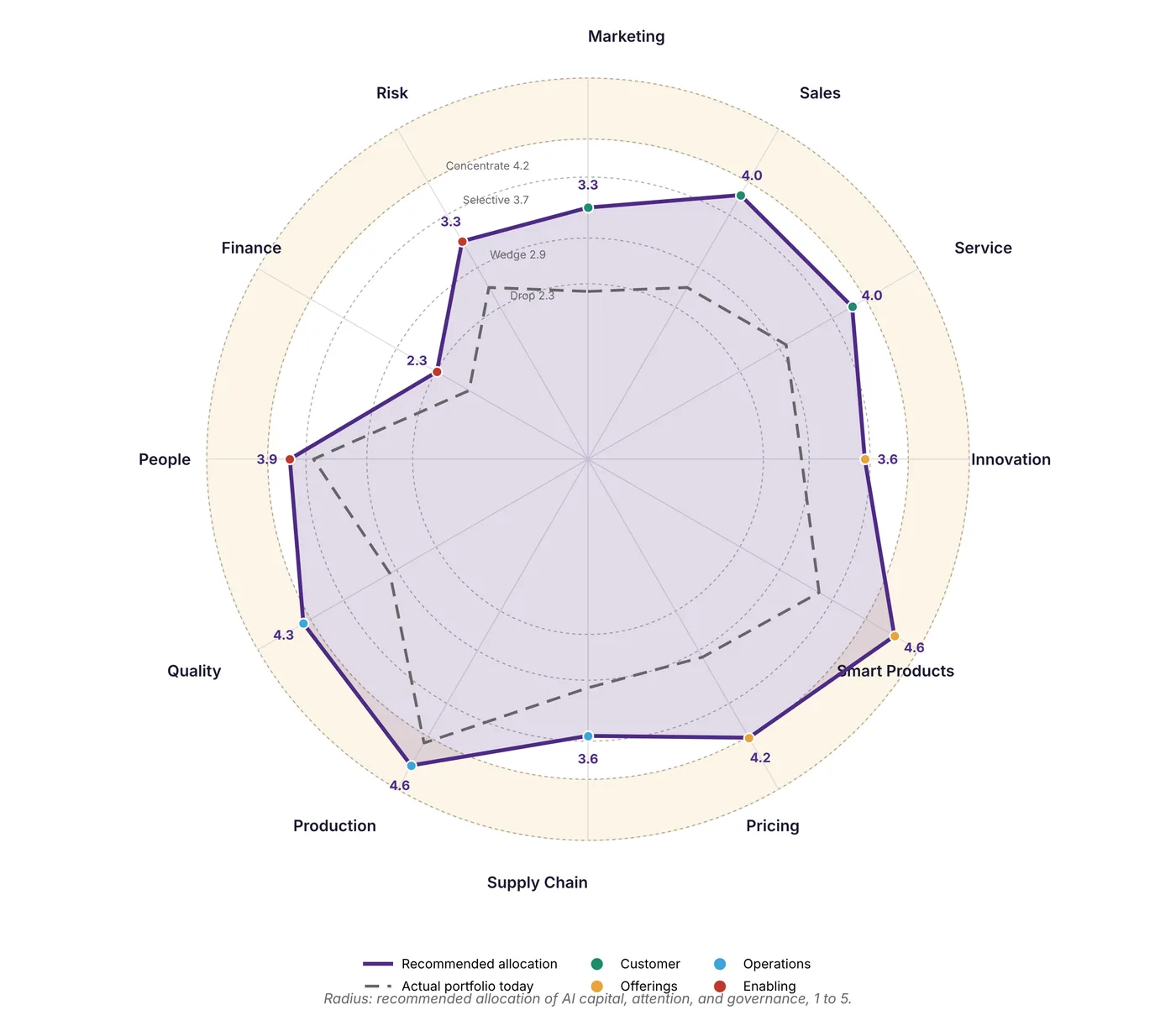
3.1 The four places to lead, split by what is already funded
Four dimensions reach the concentrate band, and the instruction is to split them by funding. Smart products and production compose to 4.6, the highest scores on the board, because capability, industry and strategy all reward them. Production is funded close to level: the July overlay places it at 4.3, within a third of a point of the recommendation, and the record shows why, with toolpath verification, the manufacturing execution system and the automated mold-polishing system in production and a factory gross margin near 49 percent (Protolabs 2026a; Protolabs 2026e; Protolabs 2026w). Smart products is funded at 3.5 against 4.6, a gap of more than a point, almost all of it the size effect: the design-analysis engine is compounding, and what is missing is the next generation of it, not a first one. Pricing composes to 4.2 on a capability score of 3, an industry weight of 5 and a strategy score of 5; it is a boundary case by 0.02 and is discussed in Section 8. It is funded at 3.0 against 4.2, and the gap is one third mix. Quality composes to 4.3 and is funded at 3.0, and its mix part is the largest negative among the four, which makes it the one lead dimension where the shape, not only the size, is wrong.
3.2 The size and shape reading
The two macro metrics separate the budget conversation from the allocation conversation. The AI Investment Index is 0.77, short. The Shape Drift Index (equation 5), computed on shares so that the size effect is removed first (equation 4), is 4.5 percent, in the aligned band, 0.5 points inside its boundary with the tilted band. The verdict cell is fund: raise the envelope, keep the shape. The July 2026 read of the same overlay against the earlier polygon returned 5.4 percent and a steer annotation; the annotation lapses here because the rebuilt recommendation lowers marketing and raises smart products and risk, which is a change in the instrument's reading of the strategy and the frontier, not a change in the portfolio, and Section 8 records it as such.
The guard against reading raw gaps as reallocation arguments matters here more than usual, because every spoke shows a negative raw gap. Equation 6 splits each gap into a size part, which every spoke carries in proportion to its recommendation when the whole portfolio is underfunded by 23 percent, and a mix part, which is the reallocation argument proper. Table 3 is the tilt tornado.
Table 3. The size-and-mix decomposition of each spoke's gap between the July 2026 actual and the October 2026 recommendation, on the 1-to-5 scale, ordered by mix part.
| Dimension | Raw gap | Size part | Mix part | Reading |
|---|---|---|---|---|
| Production | -0.34 | -1.06 | +0.72 | Over-weighted; hold share |
| People | -0.31 | -0.89 | +0.58 | Over-weighted; hold share |
| Supply Chain | -0.63 | -0.83 | +0.20 | Slightly over-weighted |
| Risk | -0.70 | -0.75 | +0.05 | In proportion |
| Finance | -0.49 | -0.52 | +0.03 | In proportion |
| Innovation | -0.83 | -0.83 | 0.00 | In proportion |
| Smart Products | -1.14 | -1.06 | -0.08 | In proportion; gap is size |
| Service | -1.00 | -0.91 | -0.09 | In proportion; gap is size |
| Pricing | -1.22 | -0.96 | -0.26 | Under-weighted |
| Quality | -1.31 | -0.98 | -0.33 | Under-weighted; a lead dimension |
| Marketing | -1.10 | -0.75 | -0.35 | Under-weighted; a wedge dimension |
| Sales | -1.40 | -0.91 | -0.49 | Most under-weighted |
The tornado tells the allocation story in one view. The portfolio tilts toward the factory and the workforce: production and people together carry a mix surplus of 1.3 points, which is the entire reallocation on the positive side. It tilts away from the commercial front end and from quality: sales, marketing, quality and pricing carry the deficit. The two largest raw gaps, smart products and pricing, are mostly size; the money is in the right place and there is too little of it. The reallocation the shape read asks for is small, about 4.5 percent of the portfolio, and it has a direction: from the production share that is already at level and from the workforce programs toward quality and the conversion programs. The mix parts sum to zero by construction and half their absolute sum over the actual total reproduces the 4.5 percent exactly (equation 7).
3.3 The selective and wedge dimensions
Sales, service and people reach the selective band, each at 3.9 to 4.0. Sales and service compose evenly on three 4s and carry the two customer-facing programs at the scaling stage; people composes on the library's only 5, a modest industry weight and a strategy score lifted by the India center. The wedge dimensions are innovation, supply chain, marketing and risk, at 3.3 to 3.6. Innovation is held at 3.6 by a capability reading that still calls AI in research and development emerging, and carries no separately evidenced program; the release cadence the strategy promises is being delivered by the product teams under the Chief Technology and AI Officer, and nothing in the record says a model is deciding what to build. Supply chain carries the Network routing system, in production, and nothing more; the tariff response of 2025 worked through pricing and sourcing algorithm changes that the company reports under Network margin, so this report homes it in pricing. Marketing is the dimension with the clearest unmet demand and no program. Risk is a floor.
4. What the business should grow, hold and stop, and how far each bet has come
Thirteen programs can be evidenced from the public record, and the inventory behind them is not public. Protolabs does not publish a program list, program budgets, user counts for its software, or outcome measurements for any AI use; the stages below are inferred from deployment evidence in the filings, calls, release notes, product pages, trade press and the company's open job postings, with the sponsor read from the executive whose remit the record names. Several of these programs have run for years and are described by the company as trade secrets, so the absence of a public outcome figure is a disclosure choice, not evidence of absence. Table 4 gives the adjudication.
Table 4. The brownfield adjudication: thirteen programs with sponsor, dimension, depth stage, verdict and forward condition, and one start.
| Program | Dimension | Sponsor | Stage | Verdict | Forward action and condition |
|---|---|---|---|---|---|
| Instant quoting and pricing engine for the owned factories (machine learning on 18 million designs; price returned interactively) | Pricing | Chief Technology and AI Officer | S5 | Grow | Extend from static quote pricing to lead-time and capacity-aware pricing, since customers "are paying more for speed" and CNC capacity is machine-count constrained; fund from the research and development line in the 2027 plan; metric is realized gross margin by service line; the 2026 postings confirm one shared engine across factory and Network fulfillment, service lines, and prototype and production, with A/B tests and backtests before release and an LLM capability for recommending pricing rules now being staffed, which the risk floor below must govern (Protolabs 2026a; Protolabs 2026i; Protolabs 2026o; Protolabs 2026aa) |
| Design-for-manufacturability engine (moldability analysis, machining advisories, DfAM, sheet metal DFM; delivered through ProDesk as AI-driven feedback) | Smart Products | Chief Technology and AI Officer | S5 | Grow | Fund the next generation announced for 2026 ("quoting and manufacturability software"); the metric is quote-to-order conversion on parts that received advisories; Stage 5 on reuse across all four services since 2023 (Protolabs 2026e; Protolabs 2026g; Protolabs 2026w) |
| ProDesk customer platform (real-time AI quoting, production catalog, sharing, support center; launched February 17, 2026) | Service | Chief Commercial Officer, with the e-commerce product director | S3 | Grow, conditional | Condition: a matched-cohort read of retention and revenue per customer for ProDesk users against non-users by June 2027; a Stage 3 program with no disclosed control group; fails to fix-or-kill if conversion and retention cannot be separated from the strategic-account mix (Protolabs 2026g; Protolabs 2026n) |
| Automated quoting of technical drawings for advanced CNC (automated front end, human review for complex jobs; launched October 2025) | Sales | Chief Commercial Officer | S3 | Grow | Fund the extension to tolerances and callouts that still route to an applications engineer; the Stage 4 milestone is a reported share of drawing-based quotes returned without human review, by the first quarter of 2027 (Protolabs 2025d; Protolabs 2026w) |
| Protolabs Network smart order routing (machine learning on millions of partner-made parts; about 250 vetted partners) | Supply Chain | Chief Operations Officer, Network operations | S4 | Hold, floor | Maintain at run rate; Network revenue was flat in the second quarter of 2026 and the go-to-market is being changed, which is a commercial fix, not a model fix (Protolabs 2026a; Protolabs 2026i; Protolabs 2026o) |
| Network pricing and sourcing algorithms (changed in 2025 to offset tariffs; Network margin 30.3 percent in the fourth quarter of 2025 to 33.6 percent in the second quarter of 2026) | Pricing | Chief Financial Officer and Network operations | S4 | Hold, harvest | Outcome reported; maintain; the reported margin recovery is the one measured AI outcome in the public record (Protolabs 2025d; Protolabs 2026e; Protolabs 2026o) |
| Automated quality inspection in injection molding, extended to the medical device production pilots with traceability and process validation | Quality | Chief Operations Officer and the senior director of global quality | S3 | Grow | Fund computer-vision inspection across molding and CNC from the production capital plan; the Stage 4 milestone is a reported defect or non-conformance rate for the two medical pilots by the second quarter of 2027; this is the under-weighted lead dimension; the company presented AI-assisted design review, automated inspection, similarity analysis and documentation support for medical work at DeviceTalks Boston in May 2026 without a figure, so the stage holds (Protolabs 2026a; Protolabs 2026e; Protolabs 2026o; Protolabs 2026ac) |
| CNC toolpath verification and automated manufacturing engineering | Production | Chief Operations Officer | S4 | Hold, floor | Mature; maintain; production is funded at level and over-weighted in the mix (Protolabs 2026a) |
| Proprietary manufacturing execution system linking quality systems and factory sensors (patented, held as a trade secret; the platform the company calls physical AI) | Production | Chief Technology and AI Officer | S4 | Hold, floor | Maintain as the platform; Stage 5 would require evidence that other programs build on it, which the record implies and does not show; no new share until the vision and cobot program below has a scope (Protolabs 2026o) |
| Intelligent machines, cobots and vision systems on the factory floor ("AI-influenced hardware") | Production | Chief Operations Officer | S2 | Fix-or-kill | No disclosed scope, budget line or measurement; define the scope, the pilot cell and the throughput or cycle-time metric by the first quarter of 2027 or fold the work into the execution-system program; no new money until then (Protolabs 2026t; Protolabs 2026u) |
| India Global Capability Center for innovation, AI and engineering (established 2026; team building) | People | Chief Technology and AI Officer | S2 | Hold, floor | Hold inside the reallocation already funded; people is over-weighted in the mix; Hyderabad, operating from April 2026 with a plan of 200 to 300 staff and an AI Center of Excellence on site; trade press reports it as the core development hub for ProDesk, a claim the company has not made; the Stage 3 test is a named AI deliverable shipped from the center (Protolabs 2026e; Protolabs 2026i; Siasat 2026; Manufactur3D 2026b; Protolabs 2026ab) |
| Internal AI platform and agent enablement for employees (shared AI platform on AWS Bedrock; AI customer success engineers who help business users build agents, apps and automations; staffed in 2026) | People | Chief Technology and AI Officer | S2 | Hold, floor | A new program surfaced by the top-up; hold inside the people share, which is over-weighted in the mix; the Stage 3 test is a reported count of active agents or users and one workflow with a measured before-and-after, by the second quarter of 2027 (Protolabs 2026ab) |
| Information security and AI risk program under the Chief Technology and AI Officer (ITAR, CMMC in progress; AI risk factor filed) | Risk | Chief Technology and AI Officer | S2 | Hold, floor | Maintain as the compliance floor; add a model inventory and a review cadence for any model touching defense customers' files before CMMC certification (Protolabs 2026b; Protolabs 2026o) |
| Start: reactivation and conversion models for lapsed and small customers | Marketing | Chief Commercial Officer | Start | Start, wedge | A narrow bet funded from the demand-generation budget already rising in 2026; the metric is ordering customer contacts, which have fallen for seven consecutive quarters; a Stage 2 pilot with a holdout group by the second quarter of 2027 (Protolabs 2026d; Protolabs 2026n; Protolabs 2026o) |
Nothing earns a stop. The money was placed thoughtfully, and the consequence is the harder one: every dollar of new allocation to quality, to the next generation of the design-analysis engine and to the customer-facing programs must come from growth in the envelope or from the two over-weighted dimensions, production and people. The reallocation instrument is the 2027 research and development and capital plan, the cycle is the annual budget the company builds in the fourth quarter, and the signatures are the chief financial officer's for the envelope and the chief executive's for the shape.
4.1 How deep the portfolio is
Figure 2 is the depth grid: the twelve dimensions against the five stages, with the count of programs in each cell. Stage names in full on first use: Exploring (a sponsor and no budget), Piloting (committed budget, a limited scope, a hypothesis not yet measured), Scaling (production deployment expanding, measurement in place), Producing (full deployment, outcomes reported, a named owner) and Compounding (infrastructure other programs build on).
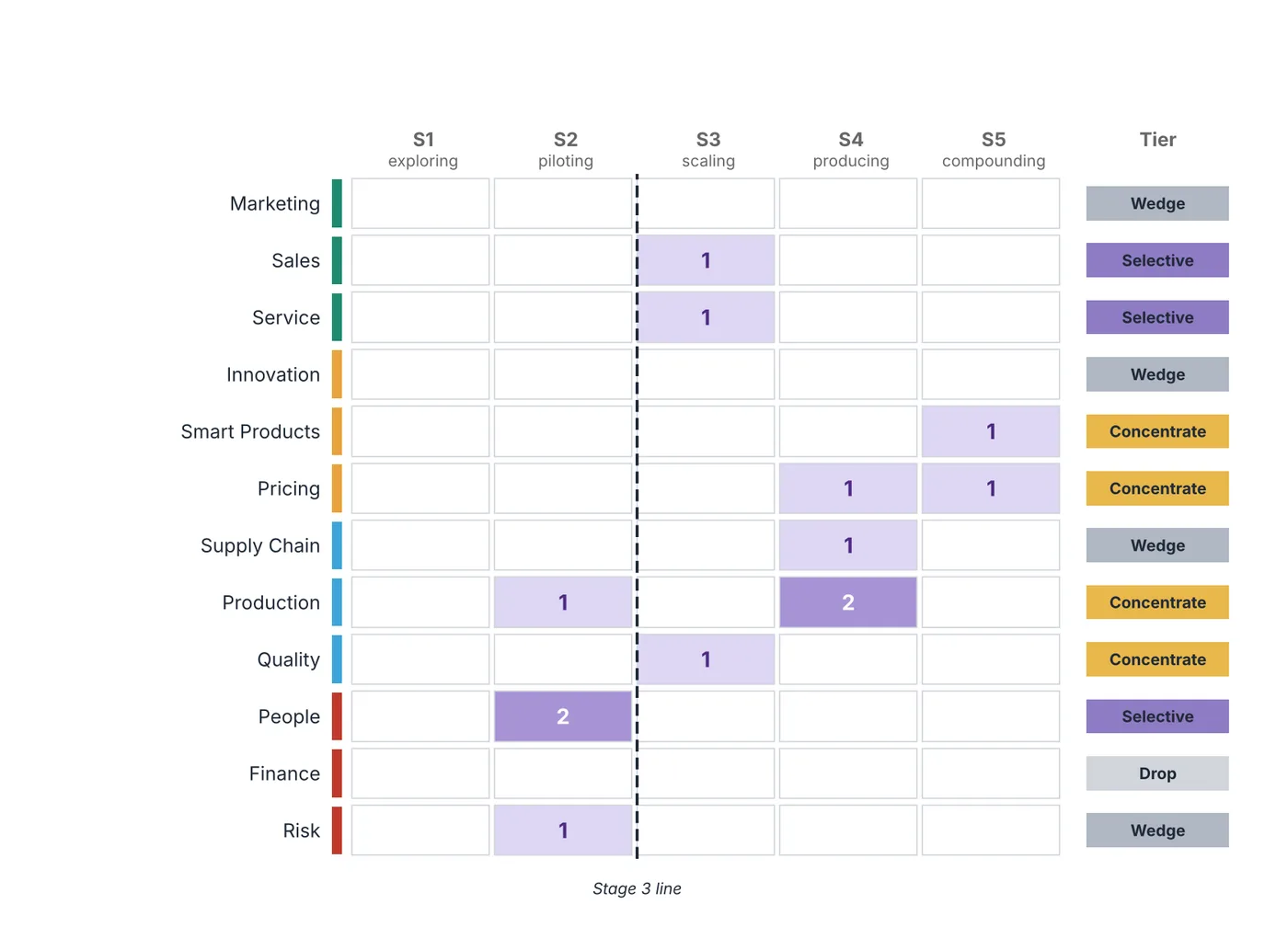
Thirteen programs; nine at Stage 3 or above, a share of 69 percent, in the band the Radar calls producing; mean stage 3.3. The first pass read twelve programs at 75 percent and a mean of 3.4; the internal AI platform, surfaced from the job postings at Stage 2, accounts for the whole change. The archetype carries no hardened depth benchmark, so the peer comparison is provisional. The shape of the grid is the finding. The core is deep: two programs at Compounding, both in the offerings anchor, and four at Producing, three of them in operations. The pilot layer is where the strategy is newest. The four Stage 2 programs are the physical-AI hardware on the factory floor, the India center, the internal AI platform and the AI risk program, and the three Stage 3 programs are the two customer-facing launches of the last twelve months and the quality inspection work. The Ring 3 maturity input is derived from this distribution: Protolabs is a mature AI operator in pricing, design analysis and routing, and an early-stage one in the factory-floor and customer-platform programs its new strategy leads with.
The three depth reads apply as follows. Shallow where it matters: quality is a concentrate dimension whose only program is at Stage 3, and the sequencing instruction is that the medical pilots report a measured defect rate before capital widens the inspection program. Deep where it does not matter: none; no Stage 4 or 5 program is in a refused dimension. Stalled: this is the first read of the inventory, so no program carries a four-quarter stage history, and none is flagged; the two programs to watch at the first quarterly review are the cobot and vision program, which has been described in three press releases since August 2026 without a scope, and ProDesk, which must show a control group to advance.
4.2 The coverage question
Every concentrate dimension carries a program at Stage 3 or above, which is unusual, and two of them carry a program at Stage 5. The gap is not coverage; it is the funding level across the board and the under-weighting of quality within it. The one dimension with evidenced demand and no program is marketing, a wedge, and it is addressed by the single start.
5. Where the business stands against the field
The peer set is the three digital manufacturing platforms that compete for the same uploaded CAD file: Xometry, Fictiv under MISUMI, and the Protolabs Network's own former competitor set of online brokers; the owned-factory model has no listed twin. On smart products and pricing, the field is moving faster in public than Protolabs is. Xometry files its marketplace as AI-native, publishes model-level results (a process recommender accepted more than 85 percent of the time, a 15 percent improvement in CNC cost-prediction accuracy "validated through live testing," adaptive sourcing models that score each supplier's machines, quality history and on-time record), and grew marketplace revenue 45 percent in the second quarter of 2026 with 2,039 accounts spending more than 50,000 dollars a year, up 23 percent (Xometry 2026b; Xometry 2026c). Its marketplace gross margin was 34.7 percent, which is close to the Protolabs Network's 33.6 percent and far below the owned factories' 49 percent (Xometry 2026b; Protolabs 2026o). Two moves by Xometry in 2026 bear directly on the Protolabs programs. Its first-quarter release added a conversion-rate model to its dynamic pricing, built on part geometry, quote configuration and customer history, and a machining lead-time model trained on a data set four times the size of its predecessor; and in May 2026 Siemens agreed to embed Xometry's manufacturability, pricing and sourcing tools inside its Xcelerator design software and to invest about 50 million dollars, which puts a rival's quote inside the engineer's CAD session before the file ever reaches a web upload (Digital Commerce 360 2026b). Xometry also changed chief executives on July 1, 2026, with Sanjeev Singh Sahni succeeding Randy Altschuler, and raised its 2026 growth guidance to 33 to 34 percent (Digital Commerce 360 2026b; Xometry 2026b). Fictiv, acquired by MISUMI for about 350 million dollars in June 2025, launched instant injection molding quotes in March 2026; MISUMI launched MISUMI Americas around Fictiv's platform in May 2026 under a group investment plan of about 1 billion dollars in AI and digital manufacturing, with a MISUMI AI unit working on predictive production (Fictiv 2026; The Robot Report 2026b). Instant quoting itself is no longer a differentiator; Chinese providers such as RapidDirect have offered upload-to-price quoting with automated design feedback since 2021, so the competition has moved to the accuracy of the price, the lead time and the routing behind it (Digital Engineering 2021). An earnings preview of October 9, 2026 frames the third-quarter call the same way: analysts will ask Protolabs to show that its automated quoting matches the AI-native platforms (BriefGlance 2026). Protolabs' advantage in this comparison is the pairing of the quote with a part made in its own factory, which gives its models a closed loop the brokers lack on 78 percent of its revenue, and its disadvantage is that it reports nothing about the models.
On production and quality the field is the company's own customers. The medical device and aerospace production work it is entering requires process validation, traceability and documented inspection, and the firms it names, Lockheed Martin, Anduril, AeroVironment, NASA, Amazon and Blue Origin, buy on exactly those terms (Protolabs 2025d; Protolabs 2026j; Protolabs 2026o). The actionable gaps are three: publish or at least internally measure the conversion effect of the design-analysis engine, so the compounding asset has an outcome figure; put computer-vision inspection on the same footing as the quoting engine, since the production pivot cannot scale on manual inspection; and decide what the physical-AI hardware program is before it is described a fourth time. The Siemens move adds another gap, outside the AI budget: Protolabs has no announced integration that places its quote inside a design tool, and the 10-K's design-analysis advantage counts for less if the engineer receives a rival's feedback first.
6. What will move the outcomes
Each lead and selective dimension carries a conversion contract: an outcome metric, a direction and a lag before the movement can be read with confidence. The sponsor signs the three fields when a bet is funded, and the metric is read at the lag horizon. Table 5 gives the contract. The priced earnings bridge, with unit coefficients and haircuts, belongs to the Innovation Radar 2.0 and is deferred.
Table 5. The conversion contract for the lead, selective and active wedge dimensions.
| Dimension | Outcome metric | Direction | Lag (months) | First reading |
|---|---|---|---|---|
| Smart Products | Quote-to-order conversion on parts that received design advisories; share of quotes returned without engineer review | Up | 12 to 24 | October 2027 |
| Pricing | Non-GAAP gross margin by service line and by channel; realized price for expedited lead times | Up | 3 to 9 | July 2027 |
| Production | Factory gross margin; cycle time from order to ship on CNC and molding | Up / Down | 6 to 18 | April 2027 |
| Quality | Line-item non-conformance rate on the owned factories and the Network (target below 1 percent); defect rate reported for the medical pilots | Down | 6 to 12 | April 2027 |
| Sales | Revenue per customer contact; drawing-based quote conversion | Up | 3 to 6 | April 2027 |
| Service | Retention of ProDesk users against a matched cohort; revenue per returning customer | Up | 6 to 12 | June 2027 |
| People | Named AI deliverables shipped from the India center; engineering output per head | Up | 3 to 12 | July 2027 |
| Marketing (wedge start) | Ordering customer contacts, year over year | Up | 3 to 6 | July 2027 |
Two of these metrics are already disclosed quarterly, revenue per contact and gross margin by channel, which makes the first readings cheap. The non-conformance target is the Network's own published goal (Protolabs 2026x). The lags are not decoration: a pricing read in three quarters and a smart-products read in two years reviewed on the same clock guarantees a wrong verdict on one of them.
7. What the business will not do
Finance is refused. It composes to 2.3, at the boundary between the drop and veto bands with no ring at its floor, on a capability reading that is emerging, an industry weight of 2 and a strategy that never names it; the SG&A leverage the strategy wants comes from the business operating system and the India center, not from a model in the close. The refusal releases nothing, because nothing is spent there, and it is stated so that the general and administrative line, which the chief financial officer says will stay elevated, does not acquire an AI program by default (Protolabs 2026o).
Marketing is held to one wedge bet. The strategy chooses share of wallet, and the record vindicates the choice: revenue per customer is up double digits for six quarters while the customer count falls. The one bet is reactivation of lapsed and small customers, because the fall in ordering contacts is the metric analysts raise on every call and the company's answer is always the same (Protolabs 2025d; Protolabs 2026e). No broader marketing AI program is recommended until that bet reports.
Innovation and supply chain are held as wedges with their current programs. Innovation carries no separate program and should not, until the capability library moves; the release cadence is a product-management discipline, not a model. Supply chain holds the Network routing system at run rate; the fix the Network needs in 2026 is commercial.
Risk is a floor with an obligation inside it. The firm handles defense customers' files under ITAR and is working toward CMMC, and its own 10-K names the unintended release of proprietary information as an AI risk (Protolabs 2026b; Protolabs 2026o). The floor is a model inventory and a review cadence for every model that touches a customer file, owned by the Chief Technology and AI Officer, before any customer-facing generative capability is added to ProDesk. No authority veto applies: no regulator bars any capability the strategy wants.
Two dimensions are held at their current share and are not grown, and this is the shape instruction. Production is funded at level and over-weighted in the mix; its programs are mature; the physical-AI hardware program must earn its scope before it earns capital. People is over-weighted in the mix; the India center and the internal AI platform are funded inside the reallocation already announced and should not grow beyond it until each ships a named, measured deliverable.
8. Boundary cases and what would change the answer
Three composites and two macro metrics are boundary cases, and the report says so, because the labels would otherwise carry more weight than the evidence.
Pricing composes to 4.217, within 0.02 of the concentrate boundary at 4.2. It is held there by the capability ring's score of 3, which reads algorithmic pricing as emerging across the economy because packaging and monetization models are still churning year over year (Growth Unhinged 2026). Protolabs is ahead of that reading: its pricing engine is thirty years old in concept, has compounded through the Network, and has a reported outcome. A capability score of 4 for pricing in a firm whose product is a price would compose to 4.64. The report keeps the library score and records the tension, because the library is shared and a firm-specific adjustment belongs in the strategy ring, where it already reads 5.
Finance composes to 2.29, within 0.01 of the drop-veto boundary at 2.3 with no ring at its floor; the instruction is the same in either band.
Smart products composes to 4.64 on a capability score of 4, which applies the library's software evidence to a platform business. The July 2026 read used 3 under the library's caveat for physical products, and composed to 4.22. Both are concentrate; the method judgement moves the score inside the band and nothing else. It is the most sensitive score on the board for one reason: if the capability reading for embedded intelligence in physical products stays at 3 and the strategy ring moves to 4 because ProDesk is read as a customer-experience program and not as an offering, the composite falls to 3.9, selective. The strategy ring holds at 5 on the company's own description of its "AI-enabled manufacturing platform" and on the 10-K's enumeration of AI uses inside the offering (Protolabs 2026a; Protolabs 2026g).
The Shape Drift Index at 4.5 percent is 0.5 points inside the aligned band; the July read of 5.4 percent was tilted. The movement is a method change in the strategy ring (marketing from 4 to 3) and a world change in the shared capability ring (risk from 3 to 4 on September 14, 2026, on the OWASP and NIST agent-control standards), plus the smart-products judgement above. The portfolio did not move; the instrument's reading of its target did. The practical reading is the same in both: the tilt is toward production and people and away from sales, marketing and quality, and it is small. The AI Investment Index at 0.77 is within 0.02 of the severely-short boundary at 0.75; a refresh of the revenue base to the 2026 guidance midpoint moved it by one hundredth, and a measured benchmark in place of a planned one would move it more, in the direction of adequate, since every measured series runs below the planned one.
Three dated triggers would change the answer. A new BCG AI Radar edition in January 2027 re-runs the dollar bridge. An outcome-grade study of AI in research and development throughput would lift the capability score for innovation to 4 and the composite to 4.0, selective. And the first disclosed outcome figure from Protolabs for any model, conversion lift from design analysis or defect reduction from vision inspection, would move the relevant program a stage and would be the first external evidence that the company's models perform as its filings imply.
9. What happens next
The ninety-day actions, with owners.
- The chief financial officer counts the AI envelope at the use-case layer under the three tests (requires a model at runtime; attributable to the use case; would be cut if the use case went away), refreshing the July 2026 snapshot, and brings the envelope decision to the board as a number: about 2.3 million dollars a year against the transformation posture, or a restated ambition.
- The chief commercial officer signs the conversion contract for sales and service and commissions a matched-cohort design for ProDesk, so that the June 2027 reading can separate the platform's effect from the strategic-account mix.
- The chief operations officer and the senior director of global quality sign the quality contract, fund computer-vision inspection across molding and CNC in the 2027 capital plan, and set the defect-rate reporting for the two medical pilots.
- The chief operations officer writes the scope, the pilot cell and the metric for the intelligent-machines, cobot and vision program, or folds it into the execution-system platform, by the first quarter of 2027.
- The Chief Technology and AI Officer stands up a model inventory and a review cadence for every model that touches a customer file or sets a price, including the LLM pricing-rule capability now being staffed, ahead of CMMC certification, and signs the smart-products and pricing contracts.
- The chief commercial officer funds the reactivation wedge from the demand-generation budget, with a holdout group, and reports ordering customer contacts as the metric.
The quarterly portfolio review reads the thirteen stages and the two metrics against this baseline, flags any program that has not advanced a stage in four quarters, and re-reads the overlay once the envelope is recounted. The next full reading is October 2027, or earlier on any of the three triggers in Section 8, or on the third-quarter 2026 results due October 29, 2026, against guidance of 145 to 153 million dollars of revenue (Protolabs 2026ad; BriefGlance 2026), if the company discloses production as a share of revenue, which would change the strategy ring's reading of the production pivot from stated to measured.
Appendix A. Evidence and Citations by Ring
The depth tier is Pro on the strategy ring and DIY on the data and workflow sub-score. Entries marked [snippet] were verified from a search result or a summary page and not from a fetched document; entries marked [library] are carried from the shared capability library of September 14, 2026 or from a prior run and were not re-fetched on this run. Dates are publication dates; accessed pages carry the access date of October 12, 2026. The first pass ran without web search and retrieved sources 1 to 70 directly by address; the top-up pass of October 12, 2026 ran 22 searches and added sources 71 to 91.
Where the deep pass moved from the shallow read. The July 2026 read carried a frozen recommended polygon from the skill's golden numbers and an actual overlay from an engagement record; the protolabs entry in the artifact's case file was not present in the copy supplied, and the golden numbers were taken from the skill's self-test. Three composites moved. Marketing moved from 3.63 to 3.30 on a strategy score of 3: brand-building and demand-generation spend is rising, and the pillars put the priority on conversion, retention and share of wallet, with the falling customer count acknowledged on every call and never adopted as a target (Protolabs 2025d; Protolabs 2026e; Protolabs 2026o). Smart products moved from 4.22 to 4.64 on a capability score of 4 in place of 3, a method judgement: the intelligence in the offering is a software platform, so the library's software evidence transfers; both scores are concentrate. Risk moved from 3.00 to 3.30 on the shared library's change of September 14, 2026, a world change. Every other composite is unchanged, which confirms the shallow read's shape. The industry ring was refined for digital manufacturing (smart products 4 to 5, pricing 3 to 5, marketing 2 to 3, sales 3 to 4, supply chain 5 to 4) and the refinements are recorded for the archetype library with their evidence. Against the rebuilt polygon the Shape Drift Index reads 4.5 percent in place of 5.4 and the steer annotation lapses; the Investment Index reads 0.77 in place of 0.78. Twelve programs were staged from the public record; the July read carried none.
Top-up pass, October 12, 2026. A search-led pass of 22 queries closed the gaps the first pass left open: trade press on ProDesk, the India center and the Network; the chief technology and AI officer's conference session and podcast and the chief executive's broadcast interview; the company's 76 open job postings and two closed machine-learning postings, read as revealed AI priorities; the competitive record of Xometry, Fictiv under MISUMI and the instant-quoting field; and a refresh of the spend benchmarks. No Ring 3 score moved. Pricing at 5 was re-checked and held, now with corroboration from the pricing postings, which describe one shared pricing engine across factory and Network, A/B tests and backtests before release, and an LLM capability for pricing rules (Protolabs 2026aa). Quality at 4 was re-checked and held: the May 2026 DeviceTalks session on AI-assisted design review, automated inspection, similarity analysis and documentation support for medical work is a product signal, and no filing or call raises quality to a stated strategic priority above the production pillar it serves (Protolabs 2026ac). People at 4 was re-checked and held on the Hyderabad center, now dated to April 2026 with a plan of 200 to 300 staff (Siasat 2026; UNI 2026). Ring 2 was re-checked and held at its refined weights; the Siemens embedding of Xometry's tools, Xometry's conversion-rate pricing model and the MISUMI investment confirm that quoting accuracy and pricing are the contested ground (Digital Commerce 360 2026b; The Robot Report 2026b). Because no score moved, the recommended polygon, the composites, the Investment Index of 0.77, the Shape Drift Index of 4.5 percent and the fund verdict are unchanged, and the size-and-shape metrics did not need recomputing. One program was added: an internal AI platform with agent enablement for employees, at Stage 2 in people, evidenced by the AI Center of Excellence posting (a shared AI platform on AWS Bedrock) and the AI customer success engineer postings (Protolabs 2026ab). Depth moved from twelve programs, 75 percent at Stage 3 or above and a mean of 3.4, to thirteen programs, 69 percent and a mean of 3.3, still producing. Every other stage was re-checked and held; the India center stays at Stage 2 because the report that it is the ProDesk development hub comes from trade press reading LinkedIn activity, not from the company (Manufactur3D 2026b). Three numbers were corrected or refreshed: the BCG January 2026 sample is 2,360 executives, where the first pass wrote about 2,400 (Mexico Business News 2026); the BCG September 2026 figures are now verified from a dated report and lose their [library] tag (BCG 2026b); and the chain-ratio corroboration moves from 0.14 to 0.5 percent to 0.06 to 0.44 percent of revenue on Avasant's 2025/2026 benchmark (Avasant 2025), which widens the divergence from the planned-spend figure without changing the envelope.
Ring 3, the company record.
- Protolabs 2026a. Proto Labs, Inc., Form 10-K for the fiscal year ended December 31, 2025, filed February 20, 2026, Item 1. Self-description as the fastest manufacturing service; four pillars quoted; digital thread and proprietary software for DFM and interactive quoting; Protolabs Network, "AI-infused smart order routing system built on machine learning data of millions of parts produced"; AI uses: "intelligent pricing and sourcing algorithms," "automated quality inspection in injection molding," "toolpath verification in CNC machining"; 60 US patents and over 60 trade secrets; 18 million designs, 700 million parts; over 48,000 customers a year; 2,280 employees; Eschenlohe closure and Putzbrunn DMLS exit completed in the fourth quarter of 2025. sec.gov.
- Protolabs 2026b. The same 10-K, Items 1A and 1C. AI and machine-learning risk factor quoted; "manufacturing automation technology may not enable us to process the large numbers of unique designs"; demand "sensitive to price"; international revenue 19 percent of total in 2025; information security overseen by the Chief Technology and AI Officer; third-party security program. sec.gov.
- Protolabs 2026c. The same 10-K, consolidated income statement. Revenue 533,127 thousand dollars; marketing and sales 98,315; research and development 42,808; general and administrative 69,813; income from operations 25,110; net income 21,241. sec.gov, report page R5.
- Protolabs 2026d. "Protolabs Reports Financial Results for the Fourth Quarter and Full Year 2025," February 6, 2026 (Form 8-K exhibit 99.1). Fourth-quarter revenue 136.5 million dollars, up 12.1 percent; full-year 533.1 million; service-line revenue; Factory 416.9 million and Network 116.2 million; customer contacts 48,415 against 51,552; revenue per contact up 13.3 percent; cash 142.4 million; 2026 growth guidance 6 to 8 percent; Krishna on 2026 as a year of "transformation and acceleration"; CEO transition costs 1.4 million. sec.gov.
- Protolabs 2026e. Fourth-quarter 2025 earnings call, February 6, 2026, transcript (Motley Fool) and summary (MarketBeat and Quartr). "Credible path to 1 billion dollars"; ProDesk as the first step from multiple storefronts; 2026 launches in quoting and manufacturability software; ISO 13485 for molding in January 2026; two medical device production pilots with traceability, process validation and automated inspection; technology reorganized under Kermisch with product management; India Global Capability Center under Ashish Sharma for innovation, AI and engineering; Europe reset; "smarter pricing and sourcing algorithms"; Factory gross margin 49 percent, Network 30.3 percent; no 2026 margin expansion, savings reinvested; "a year of getting organized."
- Protolabs 2026f. Fourth-quarter 2025 earnings presentation, February 6, 2026. 2026 priorities: internal restructuring, India Global Capability Center, Europe reset; pillar sub-bullets; Network revenue 30.5 million in the quarter. protolabs.gcs-web.com.
- Protolabs 2026g. "Protolabs Introduces ProDesk, an AI-Enabled Manufacturing Platform to Accelerate Projects from Prototyping to Production," February 17, 2026. Real-time AI-powered quoting; AI-driven DFM across injection molding, CNC machining and 3D printing; production catalog; support center; nearly 50,000 customers to access it in 2026; Mark Flannery, Global Product Director for E-commerce. protolabs.gcs-web.com.
- Protolabs 2026h. "Protolabs Reports Financial Results for the First Quarter of 2026," May 1, 2026 (8-K exhibit 99.1). Revenue 139.3 million, up 10.4 percent; CNC up 19.7 percent; non-GAAP gross margin 46.2 percent; customer contacts 19,826 against 21,627; revenue per contact up 20.4 percent; restructuring and transformation costs 1.4 million. sec.gov.
- Protolabs 2026i. First-quarter 2026 earnings call, May 1, 2026, summary with transcript (MarketBeat and Quartr). Product and technology combined under the Chief Technology and AI Officer; the company at an early point in building production capabilities; production share not disclosed; CNC machine-count capacity constraint; DMLS printers being added; Europe cost reductions and go-to-market realignment; India center "a critical enabler"; operating expenses to rise with "R&D, capital spending and software development"; targeted pricing actions in CNC; Network demand weak in 3D printing and go-to-market being changed.
- Protolabs 2026j. First-quarter 2026 earnings presentation. Network revenue 28.1 million, up 2 percent in constant currency; AS9100D certification in Europe; NASA, Lockheed Martin and Northrop Grumman named on Artemis II; capital expenditures 3.5 million. protolabs.gcs-web.com.
- Protolabs 2026k. Protolabs Investor Presentation, May 2026 (posted May 4, 2026). 100 billion dollar serviceable market, 20 billion prototype, 80 billion production "largely untapped"; "Only digital manufacturer combining in-house production with a global partner network"; a slide on automation as the basis for winning; ProDesk with "AI-driven manufacturability analysis and real-time pricing"; more than 85 percent of Fortune 500 in target industries; over 90 percent of revenue from returning customers; end-market shares; capital allocation priorities. protolabs.gcs-web.com.
- Protolabs 2026l. "Protolabs Strengthens Executive Leadership Team with Appointment of Bernardo Parlange as Chief Commercial Officer," May 7, 2026 (8-K exhibit 99.1). New role over sales, marketing and customer success, effective May 18, 2026; Mike Kenison to retire July 1, 2026. sec.gov.
- Protolabs 2026m. "Protolabs Accelerates Growth and Drone Innovation with On-Demand Manufacturing Capabilities," July 7, 2026. Drone revenue up more than 90 percent since 2023; HP Additive partnership for Multi Jet Fusion capacity; all Fortune 100 aerospace companies served. protolabs.gcs-web.com.
- Protolabs 2026n. "Protolabs Reports Financial Results for the Second Quarter of 2026," July 31, 2026 (8-K exhibit 99.1). Revenue 149.3 million, up 10.6 percent; CNC 70.4 million, molding 53.6 million, 3D printing 20.7 million, sheet metal 4.5 million; non-GAAP gross margin 46.8 percent; non-GAAP operating margin 12.0 percent; customer contacts 20,630 against 21,775; revenue per contact 7,239, up 16.7 percent; cash and investments 162.9 million; full-year growth guidance raised to 8 to 10 percent. sec.gov.
- Protolabs 2026o. Second-quarter 2026 earnings call, July 31, 2026, transcript (Motley Fool via Yahoo Finance) and summary (MarketBeat). Transformation "in the early stages"; one European legal entity and ERP from July 1; more than 15 million CAD drawings; "homegrown, patented" manufacturing execution system as a trade secret; AI improving pricing, quoting, DFM and sourcing; "physical AI"; Network revenue flat, Network gross margin 33.6 percent; aerospace and defense about 25 percent of revenue, up almost 20 percent; customers "paying more for speed"; AS9100, ITAR, ISO 13485, CMMC in progress; AeroVironment, Lockheed Martin and Anduril named; M&A pipeline on production capabilities; G&A "more sustained at this level"; Europe profitability a medium-term effort.
- Protolabs 2026p. Form 10-Q for the quarter ended June 30, 2026, filed July 31, 2026. Marketing and sales 25,682 thousand dollars in the quarter; research and development 10,791; restructuring and transformation costs 924 (2,345 year to date); capital expenditures 9,743 for six months; software platform intangible 14,554; a newly established entity in India; United States segment operating income 37,664 and Europe a loss of 6,570. sec.gov.
- Protolabs 2026q. Second-quarter 2026 earnings presentation, July 31, 2026. Revenue growth attributed to larger strategic-customer orders, key growth industries and price increases; capital expenditures 6.2 million; end markets listed. protolabs.gcs-web.com.
- Protolabs 2026r. "Protolabs Supports MIT Industrial Performance Center Research Fellows," August 13, 2026. Krishna: "developing and deploying physical AI to scale up the American manufacturing and supply chain." protolabs.gcs-web.com.
- Protolabs 2026s. "Protolabs Appoints Sam Ramahi as Chief Operations Officer," August 24, 2026 (8-K exhibit 99.1). Remit: global operations, supply chain, quality, sourcing and continuous improvement, effective August 31, 2026. sec.gov.
- Protolabs 2026t. "Protolabs Named to Business Insider's America's Most Innovative Businesses 2027 List," September 4, 2026. "More than 120 patents and trade secrets"; "AI-influenced hardware like intelligent machines, cobots, and vision systems." protolabs.gcs-web.com.
- Protolabs 2026u. "Protolabs Accelerates the Future of Robotics with Rapid Manufacturing," September 23, 2026. Robotics revenue more than doubled in the first half of 2026; "we are rapidly implementing technologies powered by physical AI"; encryption, access controls, auditing and system hardening for customer files. protolabs.gcs-web.com.
- Protolabs 2026v. Proto Labs, Inc., Definitive Proxy Statement, April 8, 2026. 2025 short-term incentive paid at 99 percent; PSUs on three-year relative TSR; Krishna's inducement PSUs on revenue metrics; board skills row for technology, IT, cybersecurity and AI marked for five directors; audit committee oversees cybersecurity. sec.gov.
- Protolabs 2026w. Product release notes, protolabs.com/resources/release-notes, accessed October 12, 2026. Sixty-three entries from January 2023 to September 11, 2026, none using the words AI or machine learning; ProDesk (February 17, 2026); advanced milling at four days (February 23, 2026); CNC quoting from technical drawings (September 3, 2025); improved molding inspections (September 22, 2025); production catalog (August 6, 2025); automated mold polishing covering 65 percent of surfaces (June 24, 2024); instant CNC quotes (March 15, 2024); sheet metal DFM (February 20, 2024); instant DfAM (January 23, 2023).
- Protolabs 2026x. "What is Protolabs Network?", protolabs.com, accessed October 12, 2026. About 250 vetted manufacturers; onboarding steps; first ten orders monitored; audits every two years; non-conformance target below 1 percent; cross docks in Amsterdam and Chicago.
- Protolabs 2026y. ProDesk page, protolabs.com/prodesk, accessed October 12, 2026. "An AI-enabled resource"; "instant, AI-driven feedback on your CAD model"; configurable lead times; production catalog; support center.
- Protolabs 2026z. "The Next Wave of Manufacturing Innovation" (Innovation in Manufacturing 2026), protolabs.com, accessed October 12, 2026. Secondary statistics; "software-first manufacturing model"; "accelerating our software development."
- Protolabs 2025a. "Protolabs Appoints Suresh Krishna as President and CEO," May 21, 2025 (8-K exhibit 99.1). Effective immediately; succeeds Rob Bodor; formerly chief executive of Northern Tool + Equipment. sec.gov.
- Protolabs 2025b. "Protolabs Appoints Marc Kermisch as New Chief Technology and AI Officer," October 3, 2025 (8-K exhibit 99.1). Effective October 13, 2025; succeeds Oleg Ryaboy; formerly chief digital and information officer at CNH; Kermisch: "AI has the capability to transform every business process." sec.gov.
- Protolabs 2025c. "Protolabs Reports Financial Results for the Third Quarter of 2025," October 31, 2025 (8-K exhibit 99.1). Revenue 135.4 million; Factory 105.3 million and Network 30.1 million; customer contacts 21,252 against 22,511. sec.gov.
- Protolabs 2025d. Third-quarter 2025 earnings call, October 31, 2025, summary with transcript (MarketBeat and Quartr). AI and machine learning used "for a long time"; advanced CNC with automated front end and human review for complex jobs; Network margin up about 80 basis points on pricing and sourcing algorithm changes to offset tariffs; customers using both factory and Network up about 35 percent; Amazon and Blue Origin named; unique developers at a multi-year low raised by Cantor Fitzgerald.
- Hubs 2026. Hubs.com (Protolabs Network) home page, accessed October 12, 2026. Quoting "uses machine learning algorithms to compare your CAD to millions of previously manufactured parts"; "hundreds of manufacturers in our network."
- Sawhney Enterprises 2026. Protolabs size-and-shape pass, July 2026 engagement record: actual portfolio by dimension and use-case-layer spend of about 7.7 million dollars; not public; carried as a dated snapshot.
- MarketBeat 2026. Proto Labs analyst ratings and earnings pages, accessed October 12, 2026. Needham upgrade to Buy with an 87 dollar target (August 3, 2026); Benchmark target raised to 91 dollars (July 2, 2026); Weiss and Zacks downgrades to Hold (October 2, 2026); consensus Moderate Buy on four analysts; EPS beats in every quarter since the third quarter of 2024; third-quarter 2026 results due October 29, 2026. [snippet]
- Zacks 2026. "Proto Labs (PRLB) Upgraded to Strong Buy," August 12, 2026. Consensus 2026 EPS 2.21 dollars, up 6.6 percent in three months. finance.yahoo.com.
- Simply Wall St 2026. "The Bull Case for Proto Labs Could Change Following COO Appointment," September 5, 2026. Fair value 95.50 dollars; risk of commoditized prototyping; concentration in aerospace and defense accounts. finance.yahoo.com.
- 3D Printing Industry 2025. "Suresh Krishna Joins Protolabs as President and CEO," May 27, 2025. Krishna: "$100 billion digital manufacturing market"; "the only digital manufacturer that combines in-house digital manufacturing with a network of manufacturing partners."
- 3D Printing Industry 2026. "Protolabs Reports Robotics Revenue More Than Doubled in First Half of 2026," September 29, 2026.
- 3DPrint.com 2026a. "Protolabs Reports a Steady 2025 as Digital Manufacturing and Metal Printing Gain Ground," February 2026. Krishna on ProDesk as "an important first step in improving the e-commerce experience" laying "the groundwork for a more unified digital platform." Figures in the article are not used.
- 3DPrint.com 2026b. "Protolabs Starts 2026 Strong, with Metal Printing Leading," May 2026. Twenty-five GE Additive Concept Laser machines; Krishna on the company being at an early point in building the capabilities needed for production.
- 3DPrint.com 2026c. "Xometry, Protolabs, and Lincoln Electric Post Strong Quarters," August 2026. Side-by-side second-quarter figures.
- StockAnalysis 2026. Proto Labs financials, accessed October 12, 2026. Trailing-twelve-month revenue to June 30, 2026 of 560.5 million dollars.
Ring 2, the category and industry record.
- Xometry 2026a. Xometry, Inc., Form 10-K for the fiscal year ended December 31, 2025, filed February 24, 2026, Item 1. "AI-native online marketplace"; "AI-native instant quoting engine"; machine learning "continuously learns from hundreds of millions of data inputs"; 81,821 active buyers and 4,996 active suppliers; 2025 revenue 686.6 million dollars. sec.gov.
- Xometry 2026b. "Xometry Reports Record Second Quarter 2026 Results," August 4, 2026. Revenue 229.3 million, up 41 percent; marketplace revenue up 45 percent; marketplace gross margin 34.7 percent; 89,557 active buyers; 2,039 accounts above 50,000 dollars; full-year growth guidance 33 to 34 percent; "product-led growth." investors.xometry.com.
- Xometry 2026c. Release on upgrades to its AI model architecture, July 20, 2026. Process recommender accepted more than 85 percent of the time; about 15 percent improvement in CNC cost-prediction accuracy "validated through live testing"; adaptive sourcing models. investors.xometry.com.
- Fictiv 2026. Fictiv newsroom, accessed October 12, 2026. Agreement to join MISUMI (April 16, 2025) completed June 18, 2025; instant injection molding quotes (March 17, 2026); MISUMI 1 billion dollar investment in AI and digital manufacturing (May 28, 2026); MISUMI AI-powered sourcing platform (June 1, 2026); MISUMI Ventures 50 million dollar physical-AI fund (September 17, 2026). [snippet]
- BCG 2026a. "AI Radar 2026: As AI Investments Surge, CEOs Take the Lead," January 15, 2026. About 2,400 executives including 640 CEOs in 16 markets; AI spend 0.8 percent of revenue in 2025 to about 1.7 percent planned in 2026; industrial goods under one percent; technology and financial institutions about two percent; planned, not measured.
- BCG 2026b. "AI Is Starting to Pay Off," press release on the Applied AI Index 2026, September 30, 2026. 1,330 executives; spend 1.7 percent to 3.3 percent of revenue; more than 80 percent outside the IT budget. Verified on the top-up pass from People Matters, "Nearly half of companies are now generating value from AI: BCG," September 30, 2026; the BCG release itself was not fetched.
- McKinsey 2026. "The State of AI in 2026: On the road to ROI," August 25, 2026. n = 1,719; 28 percent spend more than 10 percent of the ICT budget on AI, high performers more than twice as likely to exceed 15 percent; 37 percent report EBIT impact; 6 percent high performers.
- Avasant 2021. "IT Spending as a Percentage of Revenue by Industry, Company Size, and Region," January 2021. Discrete manufacturing 1.4 percent at the 25th percentile to 3.2 percent at the 75th; an aging benchmark used for the first-pass chain ratio and superseded on the top-up pass by source 90.
- Menlo Ventures 2025. "2025: The State of Generative AI in the Enterprise," December 9, 2025. United States enterprise generative-AI spend 37 billion dollars in 2025 against 11.5 billion in 2024; bottom-up model; survey of 495 decision-makers.
- Deloitte 2025. Tech Trends 2026, December 10, 2025, citing the 2025 Tech Spending Outlook (n = 302): about 93 percent of AI investment goes to technology and 7 percent to people.
Ring 1, the capability frontier (shared library of September 14, 2026).
- Gartner 2026a. CMO Spend Survey, May 11, 2026 (n = 401): AI at 15.3 percent of marketing budget; 30 percent ready to scale. Marketing 4. [library]
- Salesforce 2026a. State of Sales, February 3, 2026 (n = 4,050): 87 percent of sales organizations use AI, 54 percent have deployed agents. Sales 4. [library]
- Salesforce 2026b. State of Service, sixth edition, fielded March 9 to April 4, 2026 (n = 3,075): agent adoption in service 39 to 66 percent. Service 4. [library]
- Deloitte 2026. State of AI in the Enterprise 2026 (n = 3,235): 20 percent report increasing revenue via AI. Innovation 3. [library]
- ICONIQ 2026. State of AI 2026, second quarter 2026 (about 300 software executives): AI-embedded product revenue share 32 to 42 percent; gross margins 45 to 53 percent. Smart Products 4, applied to a software platform. [library]
- Growth Unhinged 2026. State of B2B SaaS and AI Monetization, fielded April to May 2026 (n = 230+): 75 percent changed pricing or packaging in the year. Pricing 3. [library]
- Gartner 2026b. Supply Chain Leaders Survey, February 25, 2026: 55 percent expect agentic AI to reduce entry-level hiring. Supply Chain 3. [library]
- Google Cloud DORA 2026. ROI of AI-Assisted Software Development, May 11, 2026 (about 5,000 professionals): roughly 90 percent developer adoption; value conditional on foundations. Production 4. [library]
- METR 2025. Preregistered randomized trial: experienced developers 19 percent slower with AI; late-2025 repeat minus 18 percent. Production 4. [library]
- arXiv 2026. "Security in the Age of AI Teammates," 2601.00477, January 2026 (33,000+ agent-authored pull requests): about 61 percent receive minimal review. Quality 4. [library]
- GitClear 2026. The Maintainability Gap (623 million code changes): duplication up 81 percent since 2023. Quality 4, corroborating. [library]
- Microsoft and Edelman 2026. Work Trend Index, May 5, 2026 (n = 20,000): agent usage up 15 times; organizational design explains twice the variance of individual effort. People 5. [library]
- Dell'Acqua et al. 2026. Organization Science paper on the jagged technological frontier, March 11, 2026 (n = 758): 22 to 34 percent gains inside the frontier, 14 to 25 percent degradation outside. People 5. [library]
- Anthropic 2026. Economic Index, June 26, 2026: 93 percent of conversations produce a work artifact. People 5. [library]
- Gartner 2026c. CFO survey, May 28, 2026 (n = 204): 63 percent slower-than-expected implementation; forecasting lowest for realized value. Finance 3. [library]
- McKinsey 2026b. State of AI Trust in 2026, March 25, 2026 (about 500 organizations): responsible-AI maturity 2.0 to 2.3; about 8 percent report incidents. Risk 4. [library]
- Cloud Security Alliance 2026. State of AI Cybersecurity 2026 (n = 1,500+) and CISO AI Risk Report (n = 235): 92 percent lack full visibility into agent identities. Risk 4. [library]
- OWASP 2026. 2026 Top 10 for LLM Applications and the Agent Control Standard, August 3, 2026; Agentic Top 10, December 9, 2025. Risk 3 to 4 on September 14, 2026. [library]
- NIST CAISI 2026. AI Agent Standards Initiative, February 17, 2026. Risk 4. [library]
Top-up pass sources, October 12, 2026.
- Protolabs 2026aa. Protolabs job postings on jobs.lever.co, accessed October 12, 2026: Senior Machine Learning Engineer, Amsterdam (published June 2, 2026, via startup.jobs): pricing models, cost estimation from CAD geometry, demand forecasting, partner routing probability, A/B tests and backtesting before deployment, drift monitoring; Engineering Manager, Pricing, Amsterdam: one pricing engine across factory and Network, service lines, prototype and production; applied ML and LLM engineers; LLM capabilities to recommend pricing rules; outcomes tied to margin, conversion and competitiveness.
- Protolabs 2026ab. Protolabs job postings, accessed October 12, 2026: IC4 ML Engineer, AI Center of Excellence, Hyderabad (closed; via joinsaarthi.com): models on geometries, part metadata, transactions and free text; manufacturability analysis, predictive maintenance, routing parts to experts, document understanding for technical drawings; AWS Bedrock-based AI platform; AI Customer Success Engineer, Maple Plain and Telford: help business users build agents, apps and automations on no-code platforms; ITAR eligibility; Quality Engineer, Analytics, Hyderabad; Mechanical Engineer, CNC and CAD/CAM Automation, Hyderabad; 76 open listings.
- Protolabs 2026ac. "Human-Led, AI-Powered: Rethinking Digital Manufacturing for Medical Devices," DeviceTalks Boston session page, protolabs.com, May 27, 2026; speakers Marc Kermisch and Ryan Kees; AI-enhanced DFM, automated inspection, intelligent similarity analysis, documentation support; ISO 13485 and traceability. The year is inferred from the 2026 speaker titles.
- Protolabs 2026ad. Release setting the third-quarter 2026 conference call, October 9, 2026; results before market open on October 29, 2026. Via stocktitan.net.
- Protolabs 2026ae. "Protolabs' Innovation in Manufacturing Report Details Industry's Rapid Digital Adoption," March 24, 2026; Kermisch: "pair human ingenuity with emerging AI technologies." Survey figures unsourced in the release and not used. businesswire.com.
- Digital Commerce 360 2026a. "Protolabs expands AI as it overhauls digital customer experience," February 10, 2026. Krishna: "multiple factory and network storefronts create unnecessary friction"; smarter pricing and sourcing algorithms; savings reinvested in digital improvements.
- Digital Commerce 360 2026b. Xometry first-quarter 2026 results, May 11, 2026. Revenue 205.1 million dollars, up 36 percent; conversion-rate model in dynamic pricing; lead-time model on a data set four times larger; Siemens Xcelerator embedding and about 50 million dollar Siemens investment; Sahni to succeed Altschuler as chief executive on July 1, 2026.
- Manufactur3D 2026a. Report on the ProDesk launch with AI-driven DFM and real-time quoting, March 8, 2026. Nearly 50,000 customers to access ProDesk in 2026; conversion and usage figures not disclosed.
- Manufactur3D 2026b. Abhimanyu Chavan, report on the Protolabs India GCC and ProDesk, March 10, 2026. Hyderabad location inferred from LinkedIn activity; center described as the core development hub for ProDesk.
- Siasat 2026. "Protolabs to set up Global Capability Centre in Hyderabad," April 17, 2026. Operations from April 2026; 200 to 300 staff, mainly engineering; delegation of CFO, CHRO and Chief Technology and AI Officer.
- UNI 2026. "Protolabs plans to set up GCC in Hyderabad, eyes 300 jobs," United News of India, April 16, 2026.
- The Robot Report 2026a. Mike Oitzman, "How Protolabs turns CAD files into parts in under 24 hours," podcast with Marc Kermisch, August 14, 2026. Summary page only; no figures. [snippet]
- The Robot Report 2026b. Report on MISUMI Group's 1 billion dollar investment in the Americas and in AI and digital manufacturing, May 30, 2026. Fictiv acquired for 350 million dollars; MISUMI Americas launched; MISUMI AI unit.
- Schwab Network 2026. "Proto Labs CEO on AI's Growing Role in Manufacturing," July 31, 2026. Summary page only: AI and proprietary data used to speed customers' product development. [snippet]
- Digital Engineering 2024. "Protolabs Revamps Its Manufacturing Partner Network," January 9, 2024. Hubs rebranded Protolabs Network; more than 250 vetted partners.
- Digital Engineering 2021. "RapidDirect Announces New Instant Quote Platform," June 11, 2021. Upload-to-price quoting with automated DfM feedback.
- BriefGlance 2026. Protolabs third-quarter 2026 earnings preview, October 9, 2026. Third-quarter guidance of 145 to 153 million dollars revenue and 0.56 to 0.64 dollars non-GAAP EPS; competition from AI-driven marketplaces framed as the question for the call.
- Mexico Business News 2026. "CEOs Leading Surge in Corporate AI Spending: BCG," January 19, 2026. BCG AI Radar 2026: 2,360 executives in 16 markets and nine industries; 1.7 percent of revenue in 2026; industrial and real estate under 1 percent; more than 30 percent of 2026 AI budgets to agents.
- People Matters 2026. "Nearly half of companies are now generating value from AI: BCG," September 30, 2026. Applied AI Index 2026 figures as in source 47.
- Avasant 2025. IT Spending and Staffing Benchmarks 2025/2026, Chapter 1 Executive Summary, 2025 (survey in the first half of 2025). Median IT spend 2.9 percent of revenue; AI 1.9 percent of the IT budget in its first year as a line item.
- BCG 2026c. BCG publication on 2026 IT budgets, bcg.com/publications/2026/it-budgets-ai-spending-priority, 2026. Survey of 423 IT buyers, May 2026; IT spend expected to grow 5.8 percent in 2026; 66 percent expect to increase AI and machine-learning spend. Context only.
Ring 1 refresh note. The shared library was last refreshed on September 14, 2026. One dimension moved at that refresh: risk, 3 to 4, on the OWASP and NIST agent-control standards, a change in the world. This run re-verified the McKinsey State of AI 2026 anchor and the Menlo Ventures measured-spend floor by direct fetch; the remaining anchors are carried at their library dates. The smart-products score applies the library's software reading to a platform business and is recorded as a method judgement in Section 8.
Appendix B. Mathematics
The seven equations below define the quantities used in the body. Equations (2), (3), (5), (6) and (7) are computed on the July 2026 actual overlay against the October 2026 recommendation, and will be recomputed when the envelope is recounted.
C_d = \sqrt[3]{R^{(1)}_d \, R^{(2)}_d \, R^{(3)}_d}(1)The composite for dimension d is the geometric mean of the capability, industry and strategy ring scores, so a floor on any ring parks the dimension whatever the other two say.
\mathrm{AII} = k = \frac{\sum_{d=1}^{12} a_d}{\sum_{d=1}^{12} r_d} = \frac{\bar{a}}{\bar{r}}(2)The AI Investment Index is the ratio of the mean actual radius \bar{a} to the mean recommended radius \bar{r}; between 0.9 and 1.1 the envelope is adequate, below 0.75 it is severely short; for Protolabs k is 0.77.
E^{*} = \beta \, m \, S, \qquad G = (1-k)\,E^{*}(3)The required envelope E^{*} is the peer baseline \beta (the industry's share of revenue from the current benchmark edition) times the posture multiplier m times revenue S; the funding gap G is the shortfall implied by the index, about 2.3 million dollars a year on an envelope of 9.9 million.
s^{a}_d = \frac{a_d}{\sum_{j=1}^{12} a_j}, \qquad s^{r}_d = \frac{r_d}{\sum_{j=1}^{12} r_j}(4)The shares express each polygon's radii as fractions of its own total, which removes the size effect before shape is read.
\mathrm{SDI} = \tfrac{1}{2} \sum_{d=1}^{12} \left| s^{a}_d - s^{r}_d \right|(5)The Shape Drift Index is the total variation distance between the two share vectors, and it reads directly as the share of the portfolio that must move to another dimension to match the recommended shape; for Protolabs it is 4.5 percent.
g_d = a_d - r_d = (k-1)\, r_d + \left( a_d - k\, r_d \right)(6)Each spoke's raw gap splits without residual into a size part, which every spoke carries in proportion to its recommendation, and a mix part, which is the reallocation argument proper; Table 3 lists both for every spoke.
\sum_{d=1}^{12} \left( a_d - k\, r_d \right) = 0, \qquad \mathrm{SDI} = \frac{\sum_{d=1}^{12} \left| a_d - k\, r_d \right|}{2 \sum_{d=1}^{12} a_d}(7)The mix parts sum to zero by construction, and half their absolute sum over the actual total equals the Shape Drift Index exactly, so the index and the investment index are two halves of one identity.
References
Sawhney, Mohanbir. 2026. The AI Radar: A Portfolio Framework for Diagnosing the Level and Allocation of Enterprise AI Investment. SSRN Working Paper, July 27, 2026. https://ssrn.com/abstract=7244301.
Sawhney, Mohanbir. 2026. The Innovation Radar 2.0: A Framework for Measuring and Diagnosing Business Innovation. SSRN Working Paper. https://ssrn.com/abstract=7244520.
Sawhney, Mohanbir, Robert C. Wolcott, and Inigo Arroniz. 2006. "The 12 Different Ways for Companies to Innovate." MIT Sloan Management Review 47 (3): 75–81.
AI Radar 2.0 (Sawhney Enterprises). Scores, drift, and recommendations grounded in evidence as of October 12, 2026.