Full diagnostic. Mission Innovation Diagnostic and Recommendations for the American Red Cross. Public-record research pass and top-up pass, October 2026.
A sample Radar from the public record
Mission Innovation Diagnostic and Recommendations for the American Red Cross, Sawhney Enterprises, October 2026, public-record research pass with a top-up pass. Postures are illustrative judgments from the public record with dated citations on every 4 and 5. The envelope shown is the midpoint of the capital-line range; no institution-wide strategic plan is published.
Context
This report diagnoses where the American Red Cross should concentrate its innovation effort and recommends which of its live programs should grow, hold, be fixed or stop. It applies the Mission Radar, a diagnostic instrument built for institutions that receive their purpose from a charter and serve people they do not choose. The instrument derives a target posture from the institution's mandate across twelve dimensions of mission innovation, each weighted by how much the mandate depends on it and some held at a floor the charter compels; it scores the actual posture from dated public evidence; it reads the distance between the two as mission drift; and, before any of that, it asks whether the money available for building new capability can fund the mandate at all. The Red Cross is read as one institution across its five lines of service: disaster relief, biomedical services and the blood supply, service to the armed forces, training services and international services. It publishes neither an innovation budget nor an institution-wide strategic plan, so the funding test is carried as a band and the institution-internal dimensions are banded wide. The evidence cutoff is 12 October 2026. The method is set out in Sawhney, M. (2026), The Mission Radar: A Blueprint for Innovation in Government Organizations, Working Paper v1.1, Kellogg School of Management, July 2026.
Executive Summary
The American Red Cross ended fiscal 2025 with the largest net assets in the fifteen years of tax filings read, and with its weakest operating record where the country leans on it most, in the blood supply. In fiscal 2025 it earned $3.96 billion, ran an operating surplus of $631 million, cut its debt to $297 million and held $1.77 billion of financial assets available within a year, all under an unmodified audit opinion. In the same period it collected 4.6 million blood donations for about 40 percent of the national supply while its donor base stood 40 percent below where it was two decades ago. In 2026 the shortfall became visible to every hospital in the country: a severe shortage in January after winter storms left about 20,000 donations uncollected, an emergency shortage in July, and on 27 July only the second national blood supply crisis in the organization's history, with less than one day of type O positive blood on hand and type O shipments to hospitals limited. The supply recovered in August, and on 17 August the Red Cross opened a five-year, $300 million fundraising campaign, the LifeBlood Fund, to rebuild collection capacity. Regional blood centers suffered the same summer: New York Blood Center declared a blood emergency in late May with less than two days of supply, and Vitalant reported a critical type O shortage in July. Disaster relief, by contrast, absorbed a 36 percent rise in relief operations in the first ten weeks of fiscal 2027 with a volunteer force that has grown by nearly a quarter in three years.
The instrument scores twelve areas of the institution on a one-to-five scale and compares each to the level the mandate requires. The Red Cross scores at or near target on the areas that rest on its scale and reputation: whom it serves, its core blood and mass-care capabilities, its volunteer workforce and public trust, where it ranks third of 68 American nonprofits. Seven areas fall short. The largest gap, and the only one below a level the charter compels, is mission operations, the reliability of the production cycle that turns donors into blood on hospital shelves; it scores 3 against a target of 5 and a compelled floor of 4. The next three gaps each carry the mandate's heaviest weight. Data and artificial intelligence scores 3 against 4: the Clara AI multi-agent assistant is a prototype funded by a grant of up to $200,000, and no forecasting or donor-behavior model has published an outcome. Delivery scores 3 against 4. Partnerships score 4 against a raised target of 5, because the federal partner with which the Red Cross co-leads mass care lost about 17 percent of its workforce in fiscal 2025 and its review council has recommended that responsibility for emergency sheltering move to the states.
The three questions the instrument asks have clear answers. Is the mandate fundable? Yes, from the Red Cross's own resources and not from its capital line. Closing the weighted gaps is estimated, as a band, at $400 to $800 million over four years, a required build rate of $100 to $200 million a year, against a capital program of $131.5 million a year that is mostly buildings. The fiscal 2025 unrestricted operating surplus of $396 million, a biomedical margin of about $186 million and the new campaign, which would add about $60 million a year if it meets its goal, can carry the build, provided the board directs part of them to it on purpose and holds a reserve against the heavy disaster year that will arrive. The fall in federal contract revenue from $545 million to $73 million, which the audited notes leave unexplained, coincides with the end of the hotel sheltering contract the State of Hawaii paid the Red Cross after the Maui fires; the report reads it as a one-time contract that expired. Is the shortfall an allocation problem or an execution problem? The blood supply is an execution failure: the largest share of the institution's effort, $2.12 billion of program spending, produces a posture at parity with peers. Data and AI is an allocation failure. Is the foundation sound enough to invest on? Yes: culture and stewardship are green, and the mandate is green inside and yellow on its external face because the federal mass-care partnership is being redrawn.
The recommendation is to lead on mission operations in the blood supply, on data and AI applied to donors and surge, and on partnerships with the states; to hold trust and mission operations at their compelled floors; and to keep smart systems and the industrial base at parity. Of the 25 live programs evidenced, nine should grow, eleven should hold, two should be fixed or killed and three should stop. Twenty screened candidates are offered; the five that score highest are lapsed-donor reactivation run as a controlled test, a forecast-driven seasonal collection plan, standing mass-care compacts with each state, automatic rebooking of storm-cancelled donations, and Clara AI fielded first for donor eligibility and scheduling. The compacts rose to the top tier in this pass because Hawaii's $350 million sheltering contract shows that a state will buy mass care from the Red Cross at scale.
Leadership must make one decision in its first budget cycle: tie the LifeBlood Fund and a named share of the biomedical margin and the unrestricted surplus to rebuilding the donor base and the collection plan, with a published target for days of supply, before the winter of 2027. The campaign announcement names no such target, and money raised without one would fund the plan that failed in 2026. The 90-day commitments are that decision and its owner, a forecast-driven winter collection plan, a field decision on Clara AI, and the opening of compact negotiations with the ten states that host the most Red Cross shelters.
1. What the mandate asks of the Red Cross
The American National Red Cross is a congressionally chartered humanitarian organization, established by Congress in 1905 and exempt from tax since 1938, that reaches people through about 65,000 disaster responses a year, most of them home fires, and through a blood program that supplies about 2,500 hospitals and transfusion centers (American Red Cross 2025a; American Red Cross n.d.a; American Red Cross 2025b, p. 11). Its fiscal 2025 program spending of $3.03 billion split into biomedical services at $2.12 billion, domestic disaster services at $625 million, training services at $143 million, service to the armed forces at $81 million, international relief at $49 million and community services at $15 million (American Red Cross 2025a). About 90 percent of its workforce, and 95 percent of its disaster workers, are volunteers; the audited statements count more than 325,000 volunteers a year (American Red Cross 2026f; American Red Cross n.d.a; American Red Cross 2025a).
The instrument is built for one mission-coherent institution. The Red Cross passes that gate with a condition. Its lines of service share one charter, one board, one brand, one volunteer force and one balance sheet, and the blood program and disaster relief call on the same donors, the same chapters and the same public trust. Biomedical services is nonetheless a regulated manufacturing business that earns its revenue from hospitals and consumes 64 percent of program spending, so the report treats the blood supply explicitly inside the operations dimensions and recommends a follow-on radar for biomedical services alone.
The mandate has two faces. Inward, it is the charge stated in the charter and the mission. The charter sets the purposes: to give volunteer aid to the sick and wounded of the armed forces in time of war under the Geneva Conventions, to perform the duties of a national society under those treaties, to serve as a channel of communication between the American people and the armed forces, to carry out a system of national and international relief in time of peace including the prevention of disasters, and to conduct other activities consistent with those purposes (36 U.S.C. 300102). The mission is to prevent and alleviate human suffering in the face of emergencies by mobilizing the power of volunteers and the generosity of donors. The Red Cross does not publish an institution-wide strategic plan. The public record shows two unit strategies: a Humanitarian Services Strategy 2030, which a Red Cross consulting brief of June 2026 cites without publishing, and an International Services strategy for July 2027 to June 2030 that the organization began commissioning in 2026 (Prepare Center 2026). The nearest published statement of strategy for the blood supply is the LifeBlood Fund announcement of 17 August 2026, which commits to expand donor engagement, adopt advanced technology and modernize facilities, against hospital demand the Red Cross projects to rise 12 percent by 2030 (American Red Cross 2026n). The chief executive's stated priorities on taking office in July 2024 were to build capacity for disasters that are growing more frequent and severe and to extend the organization's reach into underserved communities across all its lines of service (NonProfit Times 2024). Outward, the mandate is the set of authorities that bind or permit: the charter's governance provisions, under which the President appoints the chair on the board's recommendation and the organization reports its audited accounts to Congress through the Secretary of Defense (36 U.S.C. 300104; 36 U.S.C. 300110); the authority of the Comptroller General and the statutory ombudsman (36 U.S.C. 300111 to 300112); the National Response Framework, under which the Red Cross and FEMA are the primary agencies for mass care, with the Red Cross as co-lead for mass care in Emergency Support Function 6 (FEMA 2016); the Stafford Act requirement that relief organizations working under a federal declaration deliver assistance impartially (Harvard Environmental and Energy Law Program 2025); and FDA licensure of its blood establishments.
From these the report derives a target posture for each of the twelve dimensions, a priority weight that records how much the mandate depends on each, and a mandate floor where an authority compels a minimum. Table 1 sets out the derivation. The weights are illustrative judgments from the public record. Seven dimensions carry the highest weight of 3. Mission operations carries it because the charter's system of national relief and the national blood supply both depend on a production cycle that runs every day and must not fail in a crisis. Mission capabilities carries it because the core effects, blood products and mass care at national scale, are the reason the institution exists. Data and AI carries it because it amplifies every other dimension and because the binding problems of the moment, forecasting donor behavior and disaster surge, are data problems. Delivery carries it because aid and blood count only where they arrive. Partnerships carry it because mass care is delivered with governments, and the government side of that partnership is changing. Organization and talent and trust and legitimacy also carry a weight of 3, because the mission statement names volunteers and donors as the means of the mission.
Table 1. The mandate-derived target profile: target posture, priority weight, and mandate floors with their authority and status.
| Dimension | Target | Weight | Floor | Authority for the floor | Status |
|---|---|---|---|---|---|
| Constituents | 4 | 2 | 3 | Stafford Act impartiality requirement for relief organizations (42 U.S.C. 5151); the Movement's principle of impartiality carried by the charter's treaty duties (36 U.S.C. 300102) | Compelled |
| Mission Experience | 4 | 2 | none | ||
| Delivery & Adoption | 4 | 3 | none | ||
| Mission Capabilities | 4 | 3 | none | ||
| Smart Systems | 3 | 1 | none | ||
| Data & AI | 4 | 3 | none | ||
| Mission Operations | 5 | 3 | 4 | Charter duty to carry out a system of national relief (36 U.S.C. 300102(4)); co-lead for mass care under ESF 6; FDA licensure of blood establishments | Compelled |
| Industrial Base & Sourcing | 3 | 1 | none | ||
| Partnerships & Ecosystem | 5 | 3 | none | ||
| Organization & Talent | 4 | 3 | none | ||
| Funding & Operating Model | 4 | 2 | 3 | Board endowment spending policy and debt covenants on $297 million of debt | Elective |
| Trust & Legitimacy | 4 | 3 | 4 | Audited annual report to Congress (36 U.S.C. 300110); Comptroller General authority and ombudsman (36 U.S.C. 300111 to 300112); Congress's reserved right to amend the charter (36 U.S.C. 300113) | Compelled |
Three of the four floors are compelled, so they leave the set of dimensions that a prescription may starve. The funding floor is elective: the board could run the endowment at a lower draw or carry more debt, and the report names the cost of doing so, which is the liquidity that let the Red Cross carry a $949 million disaster year in fiscal 2024 while it waited on reimbursement for the Maui hotel sheltering. The mission operations target of 5 is the most demanding line in the table. The Red Cross supplies about 40 percent of the nation's blood, and when its collections fall short no other supplier can fill the gap in days; a posture at parity with regional blood centers is therefore below what the mandate requires of the largest one. Smart systems and the industrial base receive a target of 3 because the mandate asks the Red Cross to buy sensors, software and testing capacity and to spend its own scarce money on donors, volunteers and data.
2. How healthy is the foundation
The substrate check comes before any score, because a red reading on the external face converts the whole prescription from invest to repair. Table 2 records the reading. No element is red.
Table 2. The substrate check: Mandate, Culture and Stewardship on the internal and authorizing-environment faces, as of October 2026.
| Element | Internal face | Authorizing-environment face | Reading |
|---|---|---|---|
| Mandate | Charter purposes and mission statement clear; CEO priorities stated (July 2024); no published institution-wide plan; Humanitarian Services Strategy 2030 cited, not published; LifeBlood Fund (Aug 2026) states the blood priorities | ESF 6 co-lead role intact on paper; FEMA lost 4,300 staff in FY2025 and rescinded its strategic plan; GAO found FEMA withheld shelter program funds unlawfully (Sept 2025); Review Council (May 2026) recommends sheltering move to the states; H.R. 4669 awaits the House floor | Green inside, yellow outside |
| Culture | Costly mission-first choices observed: all platelets moved to pathogen reduction over hospital objections (2022 to 2023); Sickle Cell Initiative; innovation team and an incubator in Nashville | Hospitals and members of Congress contested the platelet change in 2022; no current oversight objection located | Green |
| Stewardship | Seven-year chief operating officer succeeded the fifteen-year chief executive in July 2024, who became board chair; sponsorship continuous | Unmodified KPMG opinion (Oct 2025); all six GAO recommendations of 2019 closed as implemented; CharityWatch A minus (July 2025) | Green |
Mandate is green on its internal face and yellow on its external face. Inside, the charge is unambiguous and the chief executive's priorities match it. The absence of a published institution-wide plan is a gap the report records without scoring it red; the unit strategies cited above and the LifeBlood Fund show that the organization plans by line of service, because the charter, the mission statement and the National Response Framework together state the priorities the target needs. Outside, the role that gives the Red Cross its place in national disaster response is under revision. FEMA, the other primary agency for mass care, separated more than 4,300 employees in fiscal 2025, a 55 percent rise over the year before, without a workforce analysis, and rescinded its strategic plan; GAO added FEMA's disaster workforce to its High Risk List in February 2025 (GAO 2026). Its surge capacity force for the 2026 hurricane season fell to 240 people from 600 (ASIS 2026). The President's council to assess FEMA reported on 7 May 2026 that disaster response should be locally executed, state managed and federally supported, and recommended that responsibility for emergency shelter move from FEMA to states and territories (Governing 2026; National Association of Counties 2026). In September 2025 GAO found that FEMA had violated the Impoundment Control Act by delaying fiscal 2025 funds for the Emergency Food and Shelter Program and the Shelter and Services Program (GAO 2025). None of the council's recommendations has passed Congress. The House bill that would make FEMA an independent agency, H.R. 4669, was ordered reported 57 to 3 in September 2025, still awaited floor action at the end of June 2026 and does not move sheltering to the states (Congressional Research Service 2026). The fiscal 2026 homeland security appropriation of 30 April 2026 replenished the Disaster Relief Fund with $26.4 billion and rejected further staffing cuts (Bipartisan Policy Center 2026). The permission is intact and the counterpart is changing, which the instrument reads as yellow.
Culture is green on observed conduct. The strongest observable in an institution of this kind is a costly choice made for the mission. In 2022 the Red Cross chose pathogen reduction for every platelet it supplies, the most expensive of the three options the FDA allowed at about $150 a unit, against the objection of academic medical centers and a letter from thirteen members of Congress, and held to the choice (KFF Health News 2022). It has run a sickle cell trait screening program since 2021 that reached more than 290,000 donors, and it opened its first humanitarian services incubator in fiscal 2025 (American Red Cross 2025b, pp. 10, 20). The internal risk posture toward innovation, as distinct from toward safety, is visible only through the organization's own statements, and the report marks the evidence announcement-tier.
Stewardship is green on both faces. Sponsorship has survived the one transition the record shows: Clifford Holtz, chief operating officer for seven years with responsibility for every line of service, succeeded Gail McGovern as chief executive on 1 July 2024, and she became chair of the board (NonProfit Times 2024; American Red Cross 2025b, p. 29). The Red Cross does not depend on appropriations, so its outward relationship is the accountability one: an unmodified audit opinion dated 21 October 2025, an annual report to Congress through the Secretary of Defense, a GAO record whose six recommendations on mass care from 2019 are all closed as implemented, and a CharityWatch rating of A minus with 91 percent of spending on programs (American Red Cross 2025a; GAO 2019; CharityWatch 2025).
Because no element is red, the prescription remains invest. Because the external face of the mandate is yellow, the report raises the target for partnerships and puts candidates in Section 7 that address the authorizing environment directly, at the level of the states.
3. Can the mandate be funded from the Red Cross's own resources
The yield test asks three numbers: the annual envelope available for building new capability, the cost of closing the weighted gaps to target, and the horizon the mandate allows. The test comes before the drift reading, because a mandate that cannot be funded makes a reallocation argument moot. The arithmetic appears as equation (6) in Appendix B.
The Red Cross does not publish a modernization or innovation budget, and the report does not estimate what it cannot read. The audited statements show the capital line and the operating result. Purchases of property were $131.5 million in fiscal 2025, down from $156.8 million, and most of the assets placed in service were buildings and improvements, up about $66.8 million, against about $14.4 million of equipment and software (American Red Cross 2025a). The envelope for new capability is therefore carried as a band from about $15 million a year, the equipment and software increment, to $130 million, the whole capital line. The only disclosed external money for artificial intelligence is the AWS Imagine Grant: up to $200,000 of unrestricted funding, $5,000 of cloud credits and implementation support (American Red Cross 2026c).
Outside the capital line the Red Cross holds four reservoirs. The first is the operating result: an unrestricted operating surplus of $396.4 million in fiscal 2025, within a total operating surplus of $631.1 million. The year was unusual, because corporate, foundation and individual giving rose from $640 million to $1.08 billion after the Los Angeles fires and $807 million of it was restricted by donors, while domestic disaster spending fell from $949 million to $625 million (American Red Cross 2025a). Revenue from contracts, including federal contracts, fell in the same year from $544.6 million to $73.3 million, and the audited notes give no cause (American Red Cross 2025a). The public record supplies one. After the Maui fires of August 2023 the Red Cross and the State of Hawaii moved more than 6,000 displaced residents into hotels under a sheltering program that FEMA funded and the state and the Red Cross managed; the state paid the Red Cross $350 million through 30 June 2024, the last day of the Red Cross's fiscal 2024, and the program ended in July 2024 (Honolulu Civil Beat 2024a; Honolulu Civil Beat 2024b; American Red Cross 2024; County of Maui 2024). The fiscal 2024 contract line and part of that year's disaster spending were therefore a pass-through for one disaster, and the report removes them from any reading of the Red Cross's federal funding trend. The second is the biomedical margin: biomedical revenue of $2,305 million against program spending of $2,119 million leaves about $186 million before overhead, up from $160 million a year earlier (derived from American Red Cross 2025a). The third is the balance sheet: $1.77 billion of financial assets available within a year and an endowment of $1.46 billion, from which the board cancelled distributions from February 2024 through fiscal 2025 and approved a 1 percent draw for fiscal 2026 (American Red Cross 2025a). The cancellation followed the heavier of the two disaster years in the statements read, and it is the clearest sign that the institution's funding swings with the weather. The fourth reservoir is new: the LifeBlood Fund, a campaign launched on 17 August 2026 to raise $300 million over five years for donor engagement, technology and facilities in the blood program, opened with a $15 million commitment from two volunteer leaders (American Red Cross 2026n). If it meets its goal it adds about $60 million a year, dedicated to the blood supply.
The closure cost is built from the gaps in Table 3 and carried as a band, labeled illustrative. Raising mission operations from 3 to 5 in the blood supply requires rebuilding the donor base, adding collection capacity in communities with high shares of type O donors, and a forecast-driven collection plan; the report takes $250 to $500 million over the horizon. Raising data and AI from 3 to 4, delivery from 3 to 4 and experience from 3 to 4, with the data platform the three share, is estimated at $90 to $180 million. Lifting partnerships to 5, chiefly standing agreements, liaison staff and a shared shelter system with the states, is estimated at $50 to $100 million. Funding model and smart systems work adds $10 to $20 million. The total is $400 to $800 million.
The horizon is four years. The winter of 2027 is the next test of the blood supply, and the FEMA reforms that would move sheltering to the states would take years to legislate and implement, by the account of state emergency managers (Governing 2026). The required build rate is therefore $100 to $200 million a year. Against the capital line of $15 to $130 million the mandate is unfundable across most of the band. Against the reservoirs it is fundable: the biomedical margin alone covers the bottom of the band, the fiscal 2025 unrestricted surplus covers the top, and the LifeBlood Fund at its goal would pay for between a half and all of the blood-supply share of the build, which runs at $62.5 to $125 million a year. Pledges are not cash, so the report counts the campaign as a reservoir and leaves the verdict on the margin and the surplus. The test therefore returns the most useful sentence this report holds for the board: the Red Cross can pay for its mandate without outside money, provided it decides to spend the surplus of a good year on the build and holds a rule for the bad year. The elective parts of the target that could be descoped are small. Smart systems and the industrial base are already at parity, and the training and international lines carry no gap. Every other gap lies on a dimension weighted 2 or 3 or on a compelled floor.
Intensity, the ratio of the actual profile's magnitude to the target's, is about 0.84 (equation (4) in Appendix B). The Red Cross has the right shape and is somewhat under-built against its mandate, and because the money exists inside the institution, the finding routes to allocation and execution, which licenses the drift reading below.
4. Where the Red Cross stands against its mandate
Table 3 records the actual posture on each dimension against the target, the signed gap, the priority weight and the weighted gap, and Figure 1 draws the two profiles. The posture scale runs from 1 (dormant) to 5 (defining), with 3 the level of peer institutions, and the evidence discipline is the one in Appendix A: official records and documented outcomes can justify a 5, named oversight and research bodies a 4, and announcements cap a score at 3. Every 4 carries a dated citation.
Table 3. The twelve-dimension profile: target, actual, signed gap, priority weight, weighted gap and role, as of October 2026.
| Dimension | Target | Actual | Gap | Weight | Weighted gap | Role |
|---|---|---|---|---|---|---|
| Mission Operations | 5 | 3 | -2 | 3 | -6 | Lead (floor breach, execution failure) |
| Data & AI | 4 | 3 | -1 | 3 | -3 | Lead (allocation failure) |
| Delivery & Adoption | 4 | 3 | -1 | 3 | -3 | Build |
| Partnerships & Ecosystem | 5 | 4 | -1 | 3 | -3 | Lead (authorizing shift) |
| Mission Experience | 4 | 3 | -1 | 2 | -2 | Build |
| Funding & Operating Model | 4 | 3 | -1 | 2 | -2 | Build (execution gap) |
| Smart Systems | 3 | 2 | -1 | 1 | -1 | Watch |
| Constituents | 4 | 4 | 0 | 2 | 0 | Sustain |
| Mission Capabilities | 4 | 4 | 0 | 3 | 0 | Sustain |
| Organization & Talent | 4 | 4 | 0 | 3 | 0 | Sustain |
| Trust & Legitimacy | 4 | 4 | 0 | 3 | 0 | Hold floor (compelled) |
| Industrial Base & Sourcing | 3 | 3 | 0 | 1 | 0 | Watch |
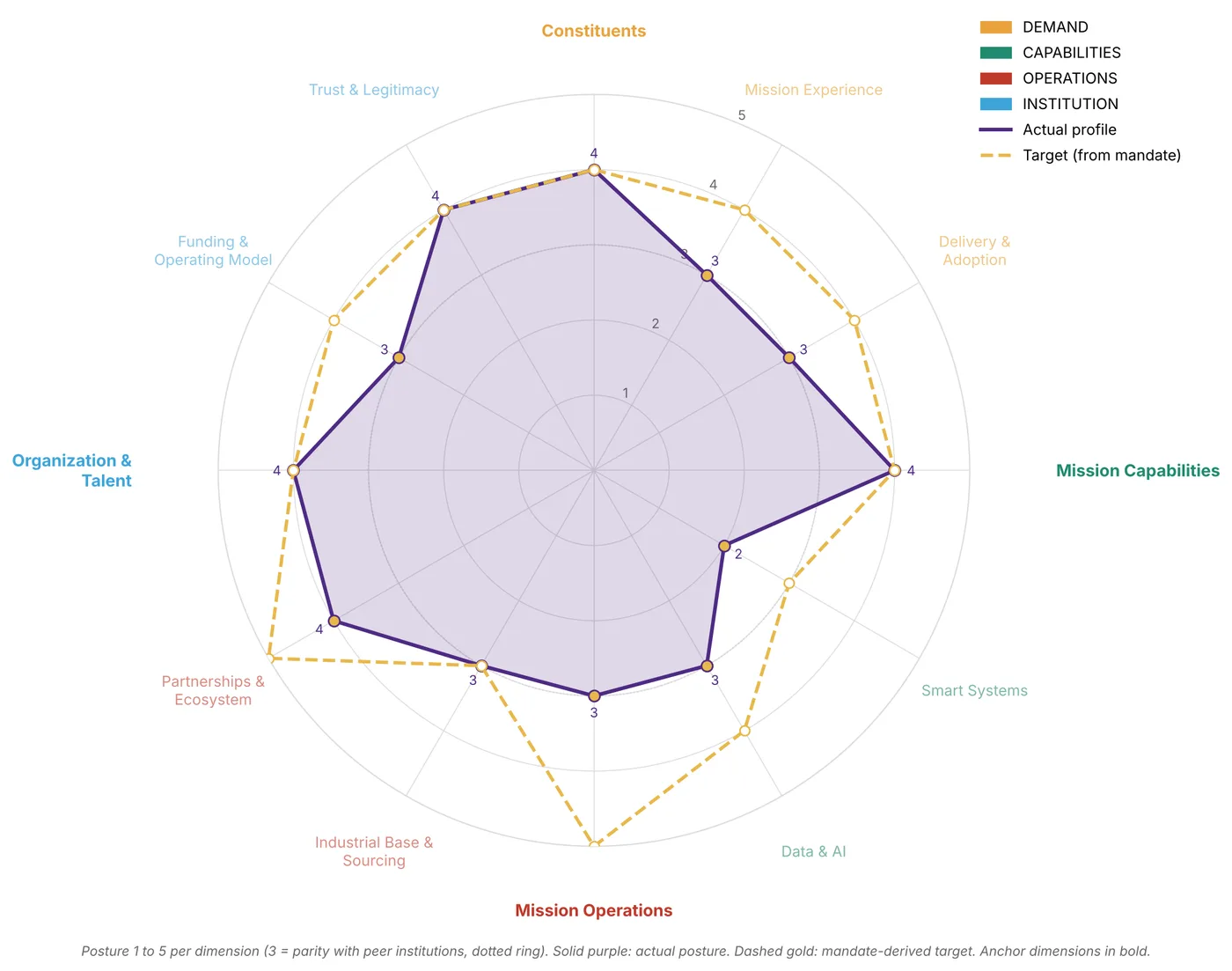
The unweighted drift, the sum of absolute gaps, is 8 of a possible 48; the priority-weighted drift is 20 (equations (1) to (3) in Appendix B). Three quarters of the weighted drift falls on four dimensions weighted 3, and nearly a third of it on one: mission operations. Five of the twelve dimensions are at target, and all five rest on the assets the Red Cross has accumulated over a century: its reach, its products, its volunteers and its name.
4.1 The blood supply is the weakest link in a strong institution
Mission operations scores 3 against a target of 5 and a compelled floor of 4. The dimension measures throughput, cycle time and reliability of the production cycle, and the Red Cross runs two production cycles under one score. The disaster cycle performed: the organization initiated 75 relief operations in the first ten weeks of fiscal 2027, 36 percent more than a year earlier and nine of them at national level, and 7,380 responders filled about 14,600 relief positions (American Red Cross 2026m). The blood cycle did not. In fiscal 2025 the Red Cross collected 4.6 million blood donations and 1.1 million platelet donations from 2.5 million donors and distributed 6.4 million products, while 1,500 cancelled drives left 40,000 donations uncollected and the donor base stood 40 percent below its level of two decades earlier (American Red Cross 2025b, pp. 9 to 11). In January 2026 the national supply fell about 35 percent in a month and the Red Cross declared a severe shortage; by early February more than 500 drives had been cancelled by winter storms and about 20,000 donations had gone uncollected (American Red Cross 2026b; American Red Cross 2026d; AHA News 2026). In June the supply fell nearly 25 percent, with distributions running about 3,500 units a week above expectations, and on 27 July 2026 the Red Cross declared its second national blood supply crisis, the first since January 2022, with less than one day's supply of type O positive and type O shipments to individual hospitals limited (American Red Cross 2026h; American Red Cross 2026k; Healthline 2026).
A score of 3 records parity: every American blood collector faces the summer trauma season, school holidays, flu and storms, and the Red Cross's own explanation names those causes. The mandate asks more of the largest collector. Two shortage declarations and one crisis in six months, each answered by appeals and a $20 gift card, are the operating signature of a system that has no buffer against a predictable season. The floor breach is the first headline finding. It is also an execution failure, because the dimension absorbs the largest share of the institution's effort: $2.12 billion of biomedical program spending in fiscal 2025, 64 percent of the total, for a posture at parity (American Red Cross 2025a).
The strongest counter-reading is that the shortages are a national phenomenon the Red Cross reports and cannot cure, and that any blood collector with 40 percent of the market would declare shortages in the same months. The peer record supports the first half. New York Blood Center, which serves more than 400 hospitals, declared a blood emergency on 26 May 2026 with less than two days of supply overall and less than one day of type O, about 4,500 donations short of hospital demand (New York Blood Center Enterprises 2026; NY1 2026). Vitalant reported a critical type O shortage at a two-year low in July, and OneBlood issued an alarm on type O in Florida in June (KKTV 2026; Hoodline 2026). The Red Cross's supply recovered during August (WALB 2026). The peer record confirms the score of 3, which is parity, and rules out a 2. It leaves the floor breach in place, because the floor of 4 rests on the Red Cross's charter duty and its 40 percent share, which no regional center carries, and because the regional centers had no national supplier to draw on when the Red Cross also fell short. The report holds the score. The donor-base decline of 40 percent over twenty years is a slow variable, the seasonal pattern recurs every year, and both are the kind of problem that forecasting, donor reactivation and collection planning address. National data point to the cohort that needs the work: between 2019 and 2021 the share of first-time donors fell from 31 to 26 percent and donations from adults under 25 fell 32 percent, as school drives were curtailed (AHA News 2024). The Red Cross publishes neither days of supply by blood type nor donor retention by cohort, so the report cannot benchmark its own buffer against those of peers. It holds the largest donor file in the country and a mobile app with 140,000 ratings averaging 4.9 stars (Apple 2026). The assets to run that plan already exist inside the institution.
4.2 Data and AI are at prototype stage where the mandate needs them in the field
Data and AI scores 3 against a target of 4. Two data systems are fielded. RC View, the organization's geospatial portal, combines weather, population, hazard and power data with a disaster assessment aggregator, emergency vehicle visibility and a national shelter system that tracks residents and remaining capacity in open shelters (QBE Foundation 2023). The Clara blood donor chatbot on RedCrossBlood.org answers eligibility questions, manages appointments and hands frustrated donors to live agents, at up to 20,000 users a month by the organization's award entry (Shorty Awards n.d.). The artificial intelligence the Red Cross describes beyond those systems is at prototype or claim stage. In December 2025 AWS named the Red Cross a winner of its Imagine Grant in the generative AI category for Clara AI, a multi-agent platform on Amazon's AgentCore that would coordinate specialized agents for disaster relief, blood services, military families and training (Amazon 2025; AWS 2025); the Red Cross's own release of 29 January 2026 describes the work as prototyping and testing for empathy and support (American Red Cross 2026c). A 2024 trade article reported that algorithms analyze demand, storage and expiry data to allocate blood, without a figure (TechTarget 2024). The fiscal 2025 annual report adds a pilot that writes exam questions from training textbooks and a proposed generative AI chatbot for instructors and students (American Red Cross 2025b, p. 20).
The shallow read credited the Red Cross with machine-learning damage assessment after disasters. The deep pass found that the published damage-assessment work belongs to 510, the data initiative of the Netherlands Red Cross, with Microsoft's AI for Good laboratory, and to a University of Massachusetts project with the same partner (Gholami et al. 2022; University of Massachusetts n.d.). The report credits the American Red Cross with access to that work through the Movement and scores nothing on it.
Every institutional item on this dimension is announcement-tier or vendor-issued, which caps the score at 3, and no item reports an outcome on the dimension's own measure, the speed and quality of decisions across the institution. The weighted gap of 3 is an allocation failure: the only disclosed money is a grant of up to $200,000 against a dimension weighted 3 in an institution that spends $1.35 billion a year on salaries (American Red Cross 2025a).
4.3 Partnerships are strong and the partner is changing
Partnerships and ecosystem scores 4 against a target raised to 5. The record is dense. The Red Cross co-leads mass care with FEMA under the National Response Framework (FEMA 2016). GAO's 2019 review of the 2017 hurricanes asked it to build mechanisms to work with local community groups, and GAO closed the recommendation as implemented after the Red Cross launched an online collaboration platform in 2020 (GAO 2019). In fiscal 2025, 120 partners responded alongside it and reached more than 76,000 people, its Community Adaptation Program worked with more than 300 local partners in 19 counties across 13 states, and its international work ran with partner societies in about 30 countries, including the Measles and Rubella Partnership (American Red Cross 2025b, pp. 5 to 8). The score of 4 rests on the GAO record and the audited annual report.
The target rises to 5 because the counterpart is changing. If the review council's recommendation stands, the Red Cross will co-lead mass care with fifty state emergency management agencies and several territories, each with its own capacity and budget, instead of with one federal agency (National Association of Counties 2026). FEMA's surge force is already smaller, and its workforce reductions were made without the analysis GAO says the mission required (GAO 2026; ASIS 2026). A Wyoming emergency manager and former president of the state directors' association told Governing that she expects FEMA grant money passed through to local offices to disappear and urged closer planning with nonprofit partners (Governing 2026). The Maui response shows what the new arrangement can look like: a state, with federal money, contracted the Red Cross to run eleven months of hotel sheltering and paid it $350 million (Honolulu Civil Beat 2024b; County of Maui 2024). The re-test against the congressional record holds the target at 5. The leading House bill leaves sheltering with FEMA and would let governors take small disasters as block grants. Meanwhile the federal partner's capacity is shrinking by administrative action without legislation, through the workforce cuts and the shelter funds GAO found withheld (Congressional Research Service 2026; GAO 2025; GAO 2026). The gap is the second headline finding, and it is one the Red Cross can close by agreement.
4.4 Delivery, experience and the funding model are one point short
Delivery and adoption scores 3 against a target of 4. The Red Cross launched the Red Cross Delivers app nationwide for scheduled and urgent blood dispatch and piloted a digital inventory system in fiscal 2025 (American Red Cross 2025b, p. 20); no fill-rate or delivery-time outcome is published. On the disaster side, it delivered $138.9 million of financial assistance to about 117,000 households in fiscal 2025, and more than $51 million to households after the Los Angeles fires (American Red Cross 2025b, p. 6; American Red Cross 2026a). Those are reach figures at the level peers would expect of the largest provider. The limits on type O shipments in July 2026 belong to the operations score and are not counted twice.
Mission experience scores 3 against a target of 4. The donor experience is the strongest part of it: the app books and reschedules appointments, completes the RapidPass health questionnaire before the visit, tracks each donation to the hospital and charts blood pressure and hemoglobin over time, and the fiscal 2025 health screenings alerted about 80,000 donors to concerning A1C levels and about 69,000 to stage 2 hypertension (Apple 2026; American Red Cross 2025b, p. 11). The enhanced first aid, CPR and AED program launched in December 2025 added digital instructor materials, adaptive learning and a 2-to-1 student-to-manikin ratio (American Red Cross 2025d). The experience of people at the moment of disaster, the encounter Clara AI is meant to improve, has no published measure. The evidence is the organization's own and caps at 3.
The funding and operating model scores 3 against a target of 4. The balance sheet is sound and conventional: an operating surplus, falling debt, ample liquidity and a program ratio of 91 percent (American Red Cross 2025a; CharityWatch 2025). The operating model shows two weaknesses for an institution whose mandate grows with the weather. Disaster relief is funded almost entirely by donations that arrive after a disaster, and the institution's response to a heavy year was to cancel endowment distributions for more than a year (American Red Cross 2026f; American Red Cross 2025a). The fall in contract revenue from $544.6 million to $73.3 million between fiscal 2024 and 2025 reflects the end of the Maui sheltering contract (Section 3) and does not count against the score. The posture is parity with large charities that fund relief the same way.
4.5 Where the Red Cross is at target
Constituents scores 4. The Home Fire Campaign has installed more than 3 million smoke alarms since 2014 and the Red Cross attributes 2,462 lives saved to it, including 775 children; the Sickle Cell Initiative and the outreach to Latino and LGBTQ+ donors exceeded their fiscal 2025 goals, and more than 290,000 Black, African American or multiracial donors have received sickle cell trait screening since 2021 (American Red Cross 2025b, pp. 5, 10 to 11). Mission capabilities scores 4: every platelet the Red Cross supplies is pathogen-reduced, a dual-split process now yields four platelet products from one donation, the organization supplies a pathogen-reduced fibrinogen product and starting materials for cell and gene therapy, and it supports a prehospital transfusion program with emergency medical services (KFF Health News 2022; American Red Cross n.d.c). On the disaster side it delivered 5.1 million meals and snacks and 274,000 overnight shelter and hotel stays in fiscal 2025 (American Red Cross 2025b, p. 6).
Organization and talent scores 4. The audited statements count more than 325,000 volunteers a year (American Red Cross 2025a), and the volunteer force grew nearly 25 percent in three years, with Generation Z now 42 percent of it, mostly through student-led clubs (American Red Cross 2026e). The fiscal 2025 Form 990 reports 17,907 employees in calendar 2024 alongside the 325,000 volunteers, which gives about eighteen volunteers for each paid employee; the return does not split staff by line of service (American Red Cross 2026o). The report located no American humanitarian peer with a volunteer force of that size. The watch item is depth in deployable disaster roles: 7,380 responders filled 14,600 positions in ten weeks, about two assignments each, and the organization's September appeal asks for more (American Red Cross 2026m).
Trust and legitimacy scores 4 at its compelled floor. Morning Consult's 2026 tracking of 68 nonprofits, fielded from October 2025 to June 2026, ranked the Red Cross third with a net trust score of 53.2, behind St. Jude Children's Research Hospital and Make-A-Wish (Morning Consult 2026). CharityWatch rated it A minus in July 2025 and Charity Navigator rates it four of four stars (CharityWatch 2025; Charity Navigator 2026). The report located no adverse oversight finding from 2024 to 2026. The older record, the Haiti and Sandy reporting of 2014 to 2015 and the FDA consent decree that ended in 2015, is the reason the floor is set at 4 and held there (NonProfit Times 2023).
The industrial base scores 3 at target: testing runs through Creative Testing Solutions, in which the Red Cross holds 40 percent, pathogen reduction through a multi-year Cerus contract, training scheduling through Skedulo on Salesforce, and Clara AI on AWS (American Red Cross 2025a; KFF Health News 2022; Skedulo n.d.). Smart systems scores 2 against a target of 3. The only evidence is a 2021 conference session on edge applications at blood drives, with no description of what was fielded, and a CPR manikin that pairs with a tablet (Foundry 2021; American Red Cross 2025b, p. 13).
5. Why the gaps exist: effort against posture
Posture says where the Red Cross stands; effort says why. The Red Cross publishes spending by line of service and by natural category, and the report uses both. The reading is partial, because modernization spending is not separated from operating spending.
The blood supply is the textbook execution failure. Biomedical services absorbs $2.12 billion, 64 percent of program spending, and the institution's $1.35 billion of salaries are not reported by line of service; the posture of the collection cycle is parity, with a crisis declaration in July (American Red Cross 2025a). The remedy is a milestone discipline on outcomes the institution already measures: donors reactivated, days of supply by blood type, drives cancelled and rebooked. The LifeBlood Fund shows that the board has accepted the need to spend on the blood supply; its announcement names no outcome target, and adding money to the same plan would repeat 2026.
Data and AI is the textbook allocation failure: a dimension weighted 3 on which the only disclosed money is a grant of up to $200,000 and $5,000 of credits, and on which the fielded systems date from before 2023. The capital line confirms the pattern, with about $14 million of equipment and software placed in service against about $67 million of buildings (American Red Cross 2025a). The remedy is a named budget with an owner.
Partnerships show moderate effort and an advanced posture whose target has moved. The effort the record shows is the 2020 collaboration platform, the Community Adaptation Program and the ESF 6 role. The remedy is new agreements, which cost little in money and much in leadership time.
Each remedy therefore names a different instrument, which in a donor-funded institution means a different board decision. Mission operations needs a performance plan for biomedical services with published targets and a reinvestment rule for its margin. Data and AI needs an allocation from unrestricted reserves with an owner and a two-year budget. Partnerships need a negotiating mandate for state compacts. The funding model needs a rule for reserves and endowment draws tied to disaster severity, so that the next heavy year draws on a rule instead of a cancellation.
6. What the Red Cross should grow, hold, fix and stop
Table 4 adjudicates the 25 live programs the public record evidences, each assigned to one dimension by its primary job and sponsor. The verdicts are the instrument's four: grow, hold, fix-or-kill and stop. Programs inside regions and chapters that the public record does not reach cannot be judged, and the list should be completed from internal materials.
Table 4. The adjudication of live programs: dimension, sponsor, stage, verdict and condition, October 2026.
| Program | Dimension | Sponsor | Stage | Verdict | Condition |
|---|---|---|---|---|---|
| Clara AI multi-agent platform (AWS Imagine Grant) | Data & AI | VP Innovation | Prototype; grant Dec 2025 | Grow | Field first for donor eligibility and scheduling; measure against a control group by mid-2027 |
| RC View and the National Shelter System | Data & AI | Disaster Cycle Services | Fielded | Grow | Offer the shelter picture to state partners |
| AI-assisted blood allocation | Data & AI | Biomedical Services | Described 2024; no outcome published | Fix-or-kill | Publish forecast accuracy or fold into the inventory system by mid-2027 |
| Machine-learning damage assessment (shallow read) | Data & AI | None located | Work belongs to the Netherlands Red Cross | Stop | Source from 510 through the Movement (candidate 15) |
| Blood Donor App with RapidPass and donation tracking | Mission Experience | Biomedical Services | Version 3.0, Sept 2026 | Grow | Add automatic rebooking of cancelled donations |
| Clara blood donor chatbot | Mission Experience | Biomedical Services | Fielded; up to 20,000 users a month | Hold | Fold into Clara AI |
| AI exam-question tool | Mission Experience | Training Services | Pilot FY2025 | Hold | Report instructor time saved |
| Proposed standalone training chatbot | Mission Experience | Training Services | Proposal FY2025 | Stop | Route through Clara AI |
| Enhanced First Aid/CPR/AED program | Mission Experience | Training Services | Launched Dec 2025 | Hold | Measure skill retention against a control group |
| Donor health insights (A1C, blood pressure, sickle cell trait) | Constituents | Biomedical Services | Fielded | Grow | Report the return-donation rate of alerted donors |
| Sickle Cell Initiative and diverse-donor engagement | Constituents | Biomedical Services | FY2025 goals exceeded | Grow | Tie to type O collection targets |
| Home Fire Campaign | Constituents | Disaster Cycle Services | 3 million alarms since 2014 | Hold | Keep the outcome count audited |
| Long-term recovery assistance (Los Angeles, Texas) | Constituents | Disaster Cycle Services | Operating | Hold | Publish time from disaster to payment |
| Red Cross Delivers app | Delivery & Adoption | Biomedical Services | National FY2025 | Hold | Publish fill rate and delivery time |
| Prehospital transfusion program | Mission Capabilities | Biomedical Services | Operating; EMS outreach Nov 2026 | Grow | Count EMS agencies and units supplied |
| Pathogen-reduced platelets and the dual-split process | Mission Capabilities | Biomedical Services | Fielded since 2023 | Hold | Track waste from the five-day shelf life |
| Pathogen-reduced fibrinogen complex | Mission Capabilities | Biomedical Services | Fielded 2025 | Hold | Hospital uptake report |
| Digital inventory system | Mission Operations | Biomedical Services | Pilot FY2025 | Grow | Field nationally by FY2027 with hospital visibility |
| Edge computing at blood drives | Smart Systems | Chief Innovation Officer | Session 2021; no later record | Fix-or-kill | Show fielded use by mid-2027 or stop |
| Community Adaptation Program | Partnerships & Ecosystem | Disaster Cycle Services | 300 partners, 13 states | Grow | Template for state compacts |
| Measles and Rubella Partnership | Partnerships & Ecosystem | International Services | Operating since 2001 | Hold | Report under reduced donor funding |
| Volunteer growth through student clubs | Organization & Talent | Volunteer Management | +25% in three years | Grow | Convert a share to deployable disaster roles |
| Humanitarian Services incubator | Organization & Talent | Humanitarian Services | First site FY2025 | Hold | Publish what it fields within a year |
| Cell and gene therapy starting materials | Funding & Operating Model | Biomedical Services | On Scientist.com | Hold | Report margin contribution |
| Suspension of endowment distributions and the 1% draw | Funding & Operating Model | Board | Feb 2024 to FY2026 | Stop | Replace with a severity-indexed rule (candidate 8) |
Nine programs grow, and their common condition is a measured outcome. Clara AI grows because it carries the data and AI priority and because AWS supplies the engineering; its condition is that the first agent goes into the field where the volume and the mandate both are, the donor eligibility and scheduling questions that already run through the older chatbot, with a test cell and a control group so that the board learns whether it raises completed appointments. RC View grows because a working shelter system is the asset the states will need if sheltering moves to them. The donor app, the health insights and the diverse-donor programs grow because the donor base is the binding constraint and each of them keeps donors coming back. The digital inventory pilot grows into a national system because hospitals rationed by phone in July 2026 would plan better with shared visibility. The Community Adaptation Program grows because it is already the Red Cross's working model of a standing local partnership.
Two programs are fix-or-kill. The blood allocation algorithms described in 2024 have no published outcome, and the instrument's verdict is a dated decision: publish forecast accuracy against actual demand or fold the work into the inventory system by mid-2027. The edge computing work has no public record after a 2021 session, and it gets the same deadline.
Three programs stop, and the instrument records each stop as a decision. The proposed standalone chatbot for training should be routed through Clara AI, so that the Red Cross builds one conversational platform. The damage-assessment work the shallow read credited is not an American Red Cross program, and the Red Cross should source it from its sister society. The ad hoc suspension of endowment distributions should be replaced by a rule.
7. Candidates to close the gaps
The four dimensions with the largest weighted gaps, mission operations, data and AI, delivery and partnerships, become lenses, with experience and the funding model as two more where a candidate serves them. Each candidate is screened on three reads scored 1 to 5 and composed multiplicatively (equation (7) in Appendix B): mission value, read against the priority weight; feasibility at the level the Red Cross can deploy today; and authority, whether the Red Cross holds the legal authority, governance approval and funding source to execute. A score of 1 on any read parks the candidate with its named authority and a dated trigger. Composites of 64 and above are fund now, 30 to 63 fund next, below 30 watch. Scores are illustrative judgments on the public record. Candidates were sought in the three places the method names: idle authorities and assets the Red Cross already holds, exemplars from peer institutions, and partnership vehicles.
Table 5. Twenty screened candidates: lens, source, mission value, feasibility, authority, composite and verdict.
| # | Candidate | Lens | Source | MV | F | A | Score | Verdict |
|---|---|---|---|---|---|---|---|---|
| 1 | Lapsed-donor reactivation scored by a propensity model, run as test cells against a control group | Operations | Idle asset (donor file) | 5 | 4 | 5 | 100 | Fund now |
| 2 | Forecast-driven seasonal collection plan, with summer and winter drives booked six to eight weeks ahead | Operations | Idle asset (collection data) | 5 | 4 | 5 | 100 | Fund now |
| 3 | Automatic in-app rebooking when storms or heat cancel drives | Experience | Idle asset (app) | 4 | 4 | 5 | 80 | Fund now |
| 4 | Clara AI fielded first for donor eligibility and scheduling | Data & AI | Partnership (AWS) | 4 | 4 | 5 | 80 | Fund now |
| 5 | Standing mass-care compacts with each state emergency management agency | Partnerships | Authority shift | 5 | 5 | 4 | 100 | Fund now |
| 6 | National blood inventory visibility shared with hospital customers | Delivery | Idle asset (inventory pilot) | 4 | 4 | 4 | 64 | Fund now |
| 7 | RC View shelter picture offered to states and counties as a shared service | Partnerships | Idle asset | 4 | 4 | 4 | 64 | Fund now |
| 8 | Disaster-severity reserve with a rule for releasing unrestricted reserves and endowment draws | Funding | Idle authority | 4 | 4 | 4 | 64 | Fund now |
| 9 | Reinvestment rule for a share of the biomedical margin, directed to collection capacity and forecasting | Funding | Idle authority | 4 | 4 | 4 | 64 | Fund now |
| 10 | Collection capacity in communities with high shares of type O donors | Operations | Stated aim | 4 | 3 | 5 | 60 | Fund next |
| 11 | Surge matching of volunteers to disaster assignments | Data & AI | Idle asset (Volunteer Connection) | 4 | 3 | 5 | 60 | Fund next |
| 12 | Mass-care course for county emergency managers through Training Services | Partnerships | Idle asset | 3 | 4 | 5 | 60 | Fund next |
| 13 | Demand-sharing data agreements with hospital customers for forecasting | Data & AI | Partnership | 4 | 3 | 4 | 48 | Fund next |
| 14 | Prehospital whole blood supply extended to more EMS agencies | Delivery | Stated aim | 4 | 3 | 4 | 48 | Fund next |
| 15 | Damage-assessment models from 510, the Netherlands Red Cross, adopted for U.S. operations | Data & AI | Movement partnership | 3 | 4 | 4 | 48 | Fund next |
| 16 | Temperature sensors on blood transport and storage | Smart Systems | Peer exemplar | 2 | 4 | 5 | 40 | Fund next |
| 17 | Digital payment rail compatible with a single federal direct payment to survivors | Delivery | Authority shift | 4 | 3 | 3 | 36 | Fund next |
| 18 | Pre-committed corporate giving released when an event crosses a set threshold | Funding | Peer exemplar | 3 | 3 | 4 | 36 | Fund next |
| 19 | Edge computing for donor eligibility at drives without connectivity | Smart Systems | Idle asset | 2 | 2 | 4 | 16 | Watch |
| 20 | A federally funded strategic blood reserve contract | Funding | External offer | 4 | 2 | 1 | parked | Authority floor: no appropriation or contracting vehicle exists; trigger: a congressional vehicle or an HHS solicitation |
The nine candidates at fund now share a property: each uses an asset or authority the Red Cross already holds. The donor file and the collection history exist, and a propensity model with a control group is a small build that will tell the board within one season how many lapsed donors return. The app exists, and rebooking a storm-cancelled appointment is a feature. Clara AI has a grant and an engineering partner. The shelter system exists, and the states will need one. The board already decides the endowment draw and the use of the surplus, so the reserve rule and the reinvestment rule need only a vote.
Candidates 1, 2, 3 and 9 reinforce one another and should be read as one bet on the blood supply: the model finds the donors, the plan books them ahead of the season, the app keeps their appointments when the weather turns, and the margin rule pays for the three. Read together they are the build that the yield test prices at $250 to $500 million over four years, and they address the floor breach directly. Candidates 5, 7 and 12 are a second combination for the states, and the Maui contract raised the feasibility of the compact from 4 to 5 in the top-up pass: the compact sets the roles, the shelter system gives both parties one picture, and the course trains the county officials who will run the shelters. Candidate 20 is parked on authority, and the report records it so that nobody reopens it quietly.
The two-currency reconciliation states the limit. In posture points, the nine fund-now candidates address every weighted gap of 3 and the floor breach, and together they could move mission operations from 3 to 4 within two seasons; a 5 requires the second set, chiefly new collection capacity, to deliver as well. In dollars, the candidates are inside the $400 to $800 million band and outside the capital line, so the dial the board must choose is the share of the surplus and the margin it directs to the build. Lowering the ambition is unavailable on the compelled floor, and the adjudication in Section 6 on its own closes less than half the weighted drift.
8. What the Red Cross should not do
The valleys are choices and the report states them with the same confidence as the peaks. Smart systems and the industrial base stay at 3. The Red Cross should not build its own AI models, run its own computing infrastructure or develop its own sensors; it should buy and partner, as it does with AWS, Salesforce, Cerus and Creative Testing Solutions, and spend its own money on donors, volunteers and the data only it holds. It should not stand up a separate damage-assessment capability when its sister society has published one.
It should not accept the sheltering role the states may inherit as an unfunded substitute for federal capacity. The compacts in candidate 5 should state who pays for shelter staffing, supplies and hotel stays before the next large declaration, because a Red Cross that absorbs the cost of a retreating federal partner by default will find its disaster spending set by the weather and its reserves set by its donors' generosity in the weeks after a storm.
It should not pay cash for whole blood donations. Federal labeling rules require units from paid donors to say so (21 C.F.R. 606.121), and the all-volunteer donor base is part of the trust the report scores at its floor; the gift-card incentives the Red Cross already offers keep it inside that line. Two candidates are watched or parked. Edge computing at drives scores low on mission value and feasibility while connectivity at most sites is adequate. A federally funded strategic blood reserve would buy resilience the mandate wants, and no authority or appropriation for it exists; the authority read is 1. Two floors will be held even where the Red Cross will not lead: trust and legitimacy at 4, which it meets, and mission operations at 4, which it must regain.
9. What happens next
The 90-day actions, each with an owner:
- Commit the money for the blood supply. The chief executive and the chief financial officer bring the board a reinvestment rule for a share of the biomedical margin and an allocation from unrestricted reserves, tied with the LifeBlood Fund to one plan, with the president of biomedical services as owner and a published target for days of supply by blood type (candidates 1, 2 and 9).
- Plan the winter of 2027 now. Biomedical services books the January and February collection plan from a demand and cancellation forecast before November, with rebooking built into the app for every storm cancellation (candidates 2 and 3).
- Decide what Clara AI does first. The vice president of innovation names donor eligibility and scheduling as the first field use and designs the test with a control group, so the result is in hand by mid-2027 (candidate 4).
- Open the state compacts. Disaster cycle services opens negotiations with the ten states that host the most Red Cross shelters, using the Community Adaptation Program as the template and the shelter system as the shared tool (candidates 5 and 7).
- Replace the cancellation with a rule. The board's endowment trustees adopt a severity-indexed rule for reserve release and endowment draws (candidate 8).
- Put deadlines on the two open questions. Biomedical services publishes the accuracy of its allocation algorithms or folds them into the inventory system, and the innovation team shows fielded use of edge computing or stops it, both by mid-2027.
Four gaps in the public record limit the scores and should be closed from internal data: modernization spending by dimension, which would convert the effort reading in Section 5 from line-of-service shares to program shares; donor retention and reactivation rates by cohort; days of supply by blood type over the past three years, which neither the Red Cross nor the national blood center associations publish in a form the report could read; and the staff count by line of service, which neither the audited statements nor the Form 990 report. The radar should be re-run in October 2027, after the winter collection season, the first Clara AI field result, the first state compacts and the fiscal 2026 and 2027 statements, with the guardrail that a score moves only on two consecutive reads or one confirmed change in evidence.
Appendix A. Method Note and Source Ledger
A.1 Method and passes
The diagnostic ran the Mission Radar's staged assessment from public sources only, at the third stage of the construction ladder (records retrieved and cited per score) without the Delphi or interview stages, which require access to the institution. Two passes ran. The strategy pass read the charter sections that set the purposes, governance, reporting and oversight of the corporation, the FEMA mass-care annex, the fiscal 2025 consolidated financial statements and annual report, the Form 990 data for fiscal 2025, the chief executive's appointment record and the governance page. The dimension pass ran 30 web searches (26 extended) and 60 usable full-page reads of 69 attempts across Red Cross releases, the GAO, the FEMA Review Council coverage by the National Association of Counties, Governing and the Bipartisan Policy Center, ASIS, AHA News, Healthline, KFF Health News, the NonProfit Times, Devex, AWS and Amazon, TechTarget, the App Store, Morning Consult, CharityWatch, Charity Navigator and Independent Sector. The evidence cutoff is 12 October 2026. Nine reads failed on robots, proxy or client errors (the CRS insight on the Review Council, the Review Council's own report, three attempts on the Form 990 full text, a direct download of the financial statements, the fiscal 2026 statements at their expected address, a hematology trade article, and the Code chapter index) and were replaced by alternative sources on the same facts; the fiscal 2026 statements had not been posted at the cutoff. Entries marked [snippet] were verified from a search result only; none of the scores of 4 rests on one.
Evidence tiers follow the posture scale: Tier A is official records, audited statements, statutes, GAO products and the institution's audited annual report; Tier B is named oversight and research bodies, polling organizations, charity evaluators and named-byline press; Tier C is Red Cross releases, web pages and vendor material, which cap a score at 3; Tier D is commentary and reference works, which corroborate only. Two sources count as independent only if each generates its own evidence; Red Cross national and regional releases are one source. Confidence is derived: High needs two independent Tier A or B sources within twelve months, Medium is one Tier A source with Tier C corroboration or older Tier B, Low is Tier C only or a coverage gap. Source counts after the top-up pass: Tier A 14, Tier B 28, Tier C 33, Tier D 4, a total of 79; rejected at the provenance gate: 4 (two SWOT-analysis vendor pages with no stated basis, a Glassdoor review page, and a news aggregator page republishing the July 2026 release).
A top-up pass on 12 October 2026 ran 14 further web searches and 17 usable full-page reads of 20 attempts, aimed at seven gaps: a published strategy, the cause of the fall in federal contract revenue, staff by line of service, days of supply and donor retention, oversight since 2024, the fiscal 2026 statements and peer benchmarks for the blood operation. It read the fiscal 2025 statements again for the contract note, the fiscal 2025 Form 990, the LifeBlood Fund release, two Honolulu Civil Beat reports and the County of Maui's FEMA summary on the Maui sheltering contract, the CRS report on H.R. 4669, GAO decision B-337204, the ACS Brief and Axios on the July crisis, New York Blood Center's release and coverage of it and of Vitalant, the WALB report of recovery, AHA News on national donor statistics and the Prepare Center consulting brief. Three reads failed (the fiscal 2023 statements on robots, a policy archive copy of the fiscal 2024 statements and a U.S. News article). The fiscal 2026 statements were still unposted at the cutoff.
A.2 Where the deep pass moved scores from the shallow read
The shallow read of October 2026 scored the Red Cross at 4 on delivery, mission experience, mission operations, mission capabilities, trust, partnerships and constituents, and at 3 on data and AI, smart systems, the industrial base, organization and talent and the funding model; it read every substrate element green. The deep pass moved five scores and held seven. Mission operations moves from 4 to 3, and is read as a breach of the compelled floor of 4, on the January shortage, the July emergency shortage and the 27 July crisis declaration, the second in the organization's history. Delivery moves from 4 to 3 because no fill-rate or delivery-time outcome is published and the dispatch app and inventory pilot are Tier C. Mission experience moves from 4 to 3 because the Clara AI empathy testing is a prototype and the donor experience evidence is the organization's own. Smart systems moves from 3 to 2 because the only edge computing evidence is a 2021 session page with no description of a fielded system. Organization and talent moves from 3 to 4 on the audited count of more than 325,000 volunteers and the documented growth of nearly a quarter in three years. Data and AI, trust, partnerships, constituents, mission capabilities, the industrial base and the funding model are continuous with the shallow read; the deep pass supplies the dated evidence the shallow read lacked, and the industrial base and the funding model now rest on the audited statements.
Three targets and six weights moved. Partnerships rises from 4 to 5 and from weight 2 to 3 on the FEMA Review Council's recommendation that sheltering move to the states. Delivery falls from 5 to 4 and mission capabilities stays at 4 with its weight raised to 3, because the binding constraint is collection reliability, which the mission operations target of 5 already carries. Trust falls from 5 to 4 with its weight raised from 2 to 3: the compelled floor is 4, and the record shows the Red Cross already there. Organization and talent rises from weight 1 to 3 and the funding model from 1 to 2, because the mission statement names volunteers and donors as the means of the mission. Mission experience falls from weight 3 to 2. The substrate moved from all green to a yellow external face on the mandate. The shallow read's credit for machine-learning damage assessment is withdrawn because the published work belongs to the Netherlands Red Cross.
The top-up pass moved no dimension score, no target and no weight, so the drift figures, the intensity and Figure 1 are unchanged. It re-tested two readings. The mission operations floor breach holds: peer centers declared emergencies in the same summer, which confirms the score of 3 as parity and rules out a 2, and the floor of 4 rests on the Red Cross's national share, which no peer carries; the August recovery and the LifeBlood Fund are effort without an outcome yet. The partnerships target of 5 holds: the leading House bill leaves sheltering with FEMA, while the GAO impoundment decision and the FEMA workforce record show the federal partner shrinking by administrative action, and the Maui contract shows a state buying mass care from the Red Cross at scale. One candidate score moved: the state compacts (candidate 5) rise from feasibility 4 to 5 and from 80 to 100 on the Maui precedent; the verdict stays fund now and the count of fund-now candidates stays nine. Three numbers were corrected or explained: the fall in contract revenue from $544.6 million to $73.3 million is attributed to the end of the Maui sheltering contract, for which Hawaii paid the Red Cross $350 million through 30 June 2024; the staff count of 17,907 now rests on the Form 990 instead of a reference work; and the yield test gains a fourth reservoir, the $300 million LifeBlood Fund, without a change to the verdict. The pass located no published institution-wide strategic plan, no GAO or congressional oversight product on the Red Cross since 2019, no staff count by line of service and no published days of supply or donor retention series for the Red Cross or its peers.
A.3 Derivation box: the mission operations score
Signal 1, shipped moves with dates: 75 relief operations in ten weeks of fiscal 2027, nine national, 14,600 positions filled (15 Sept 2026); 4.6 million blood donations, 1.1 million platelet donations and 6.4 million products distributed in fiscal 2025; digital inventory pilot in fiscal 2025. Signal 2, outcome evidence on the dimension's own metric (throughput, cycle time, reliability): severe shortage declared 20 January 2026 with supply down about 35 percent; about 20,000 donations uncollected by 2 February; emergency shortage 13 July with supply down nearly 25 percent; national blood supply crisis 27 July with less than one day of type O positive and type O shipments limited; corroborated by AHA News (21 January) and Healthline (5 August). Signal 3, recognition: no external body names the Red Cross's collection operation a model for peers. Anchor test: the dimension asks whether the production cycle runs reliably at the level the mandate requires of the institution; the disaster cycle meets the level of an advanced institution, and the blood cycle meets parity with a recurring failure the largest collector is expected to buffer. Tier: A for the fiscal 2025 counts, B for the 2026 corroboration, C for the 2026 releases. Score 3, confidence High. A reader who disputes the score is invited to run the same chain against the sources below.
A.4 Source Ledger by dimension
Constituents (score 4, Medium). American Red Cross 2025b: Annual Report 2025 (fiscal year ended 30 June 2025), pp. 5, 10 to 11, redcross.org, Tier A. American Red Cross 2026a: "A Year After 2025's Devastating Wildfires, Help Continues for Los Angeles Communities," 6 Jan 2026, Tier C. American Red Cross 2025c: "Long-Term Recovery Program Provides More Than $1M in Additional Financial Assistance to Texas Flood Survivors," 21 Nov 2025, Tier C. American Red Cross 2026g: "A Year Later, Red Cross Continues to Support Survivors of Deadly Texas Hill Country Floods," 30 June 2026, Tier C. Harvard Environmental and Energy Law Program 2025: Perls, "Proposed Changes to FEMA and the Future of Federal Disaster Response," 27 Feb 2025, Tier B.
Mission Experience (score 3, Medium). Apple 2026: App Store listing, "Blood Donor American Red Cross," version 3.0.0, Sept 2026, 4.9 stars on 140,000 ratings, Tier C. Shorty Awards n.d.: "Clara: The American Red Cross Blood Donor Bot," 13th Shorty Awards entry, c. 2021, Tier C. American Red Cross 2025d: "American Red Cross Elevates Instructor Excellence with Enhanced First Aid/CPR/AED Program," 2 Dec 2025, Tier C. American Red Cross 2025b, pp. 11, 13, 20, Tier A.
Delivery & Adoption (score 3, Medium). American Red Cross 2025b, pp. 6, 20 (Red Cross Delivers app; $138.9 million to 117,000 households), Tier A. American Red Cross 2026a, Tier C. American Red Cross n.d.c: Biomedical Services, News and Announcements page, accessed Oct 2026, Tier C.
Mission Capabilities (score 4, High). American Red Cross 2025b, pp. 6, 11, Tier A. KFF Health News 2022: Appleby, "As Red Cross Moves to Pricey Blood Treatment Method, Hospitals Call for More Choice," 17 May 2022, Tier B. American Red Cross n.d.c, Tier C. American Red Cross 2025a: Consolidated Financial Statements, 30 June 2025 and 2024, KPMG opinion 21 Oct 2025 (Biomedical revenue $2,305.2 million), Tier A.
Smart Systems (score 2, Low). Foundry 2021: session page, "How the Red Cross Boosts Productivity with Edge Applications," Foundry Events, page modified 1 Oct 2021, Tier C. American Red Cross 2025b, p. 13 (SMART manikin), Tier A. Chatbot Summit n.d.: American Red Cross company page (voice and chat channels), accessed Oct 2026, Tier D.
Data & AI (score 3, Medium). American Red Cross 2026c: "American Red Cross Receives AWS Grant to Prototype Aid Platform with Generative AI," 29 Jan 2026, Tier C. Amazon 2025: "Amazon Announces 39 AWS Nonprofit Imagine Grant Awardees," 2 Dec 2025, Tier C. AWS 2025: "AI for impact: AWS awards Imagine Grants," AWS Public Sector Blog, 8 Dec 2025, Tier C. TechTarget 2024: Kaylor, "American Red Cross Tackles National Blood Shortage with Technology," 10 Jan 2024, Tier B. QBE Foundation 2023: "American Red Cross RC View Resilience Technology," page dated Aug 2023, Tier C. Shorty Awards n.d., Tier C. Gholami et al. 2022: "On the Deployment of Post-Disaster Building Damage Assessment Tools using Satellite Imagery," Microsoft AI for Good and 510 (Netherlands Red Cross), c. 2022, Tier B. University of Massachusetts n.d.: Data Science for the Common Good, Red Cross project page, accessed Oct 2026, Tier C. The Key Executives 2026: "AWS Funds Red Cross Project to Improve Humanitarian Assistance with AI," 12 Mar 2026, Tier D [snippet].
Mission Operations (score 3, High). American Red Cross 2025b, pp. 9 to 11, Tier A. American Red Cross 2025a (Biomedical program spending $2,119.4 million), Tier A. American Red Cross 2026b: "Red Cross Declares Severe Shortage after Blood Supply Falls 35% in Past Month," 20 Jan 2026, Tier C. AHA News 2026: "Red Cross announces severe blood shortage, urges donations," 21 Jan 2026, Tier B. American Red Cross 2026d: "Severe Winter Weather Intensifying Blood Shortage; 20,000 Donations Uncollected," 2 Feb 2026, Tier C. American Red Cross 2026h: "Red Cross Declares Emergency Blood Shortage after Blood Supply Falls 25%," 13 July 2026, Tier C. American Red Cross 2026k: "American Red Cross Declares Second-Ever National Blood Supply Crisis," 27 July 2026, Tier C. Healthline 2026: French and Peeples, "American Red Cross Declares National Blood Supply Crisis," 5 Aug 2026, Tier B. Axios 2026: Scribner, "America's blood supply alarmingly low, patient care at risk, Red Cross says," 28 July 2026, Tier B. American College of Surgeons 2026: "US Faces a Blood Supply Crisis That Could Impact Surgery," ACS Brief, 4 Aug 2026, Tier B. WALB 2026: Parker, "Red Cross blood supply stable after summer shortage, national blood supply crisis," 10 Sept 2026, Tier B. American Red Cross 2026n: "American Red Cross launches multi-year fundraising campaign to strengthen nation's blood supply," 17 Aug 2026, Tier C. Peer benchmarks: New York Blood Center Enterprises 2026: "New York Blood Center & New Jersey Blood Services Declares Blood Emergency as Blood Supply Drops to Critical Level," 26 May 2026, Tier C. NY1 2026: Ferry, "New York Blood Center declares blood emergency," 1 June 2026, Tier B. KKTV 2026: Sintas, "Vitalant facing 'critical' shortage of type O blood," 6 July 2026, Tier B. Hoodline 2026: "Tampa blood crisis: OneBlood sounds alarm on O positive and O negative," June 2026, Tier D [snippet]. AHA News 2024: "Groups release updated statistics on U.S. blood donation, use" (America's Blood Centers and ADRP data, 2019 to 2021), 29 Jan 2024, Tier B. America's Blood Centers 2023: "Drivers of Blood Donor Retention," ABC Newsletter, 4 Aug 2023, Tier B. American Red Cross 2026m: "Red Cross Initiates 36% More Relief Operations in FY 27 Than Last Year," 15 Sept 2026, Tier C. American Red Cross 2026j: "Red Cross Responding to Disasters Coast to Coast and Beyond," 24 July 2026, Tier C. American Red Cross 2026l: "2026 A Busy Disaster Year for Red Cross," 21 Aug 2026, Tier C.
Industrial Base & Sourcing (score 3, Medium). American Red Cross 2025a (equity interests in Creative Testing Solutions, 40 percent, and ARC-One Solutions, 50 percent), Tier A. KFF Health News 2022 (Cerus pathogen-reduction system), Tier B. Skedulo n.d.: "Case Study: American Red Cross Reduces Resource Underutilization," c. 2019, Tier C.
Partnerships & Ecosystem (score 4, High). FEMA 2016: Emergency Support Function #6: Mass Care, Emergency Assistance, Temporary Housing, and Human Services Annex, June 2016, Tier A. GAO 2019: GAO-19-526, Disaster Response: FEMA and the American Red Cross Need to Ensure Key Mass Care Organizations are Included in Coordination and Planning, 19 Sept 2019, with recommendation status, Tier A. American Red Cross 2025b, pp. 5 to 8, Tier A. National Association of Counties 2026: "FEMA review council releases final report recommending sweeping changes," 11 May 2026, Tier B. Governing 2026: Smith, "Long-Awaited FEMA Council Report Sets the Stage for Reform," 14 May 2026, Tier B. Bipartisan Policy Center 2026: Gimont and Winkler, "FEMA Reform: Comparing the Review Council's Recommendations and Congressional Proposals," 26 May 2026, Tier B. National Mass Care Strategy 2026: "FEMA Review Council Report," public comment page, May 2026, Tier C. Devex 2025: "The Red Cross is losing thousands of jobs," 4 Dec 2025 (ICRC cuts of 2,900 positions), Tier B. Honolulu Civil Beat 2024a: Dobbyn, "State Ends Shelter Program For Maui Wildfire Survivors," 11 July 2024, Tier B. Honolulu Civil Beat 2024b: Lovell, "Hawaii Spent Millions Responding To The Maui Wildfires. Here's Who Got Paid," 19 Aug 2024, Tier B. County of Maui 2024: "One Year Later, Maui Wildfire Recovery Continues with Nearly $3 Billion in Federal Support," FEMA content on MauiRecovers.org, 6 Aug 2024, Tier A. American Red Cross 2024: "One Year Later, Red Cross and Partners Continue to Support Maui Wildfire Survivors," 8 Aug 2024, Tier C. Congressional Research Service 2026: R49028, Fixing Emergency Management for Americans Act of 2025: Context, Overview, Summary of Provisions, 10 July 2026, Tier B.
Organization & Talent (score 4, Medium). American Red Cross 2025a (more than 325,000 volunteers a year; salaries $1,348.2 million), Tier A. American Red Cross 2026e: "Red Cross Volunteer Force Surges 25%, Driven by Gen Z," 4 Mar 2026, Tier C. American Red Cross 2026f: "Red Cross aids thousands after early 2026 disasters," 24 Mar 2026, Tier C. American Red Cross n.d.a: Disaster Relief Services page, accessed Oct 2026, Tier C. American Red Cross 2025e: "2025 Disasters: Stories of Hope and Community," Dec 2025, Tier C. NonProfit Times 2024: "Cliff Holtz New CEO At American Red Cross," 2 July 2024, Tier B. Wikipedia 2026: "American Red Cross" (used only to locate sources), accessed Oct 2026, Tier D. American Red Cross 2026o: Form 990 for the fiscal year ended 30 June 2025 (17,907 employees in calendar 2024 and 325,000 volunteers, read from the form layout), redcross.org, Tier A.
Funding & Operating Model (score 3, High). American Red Cross 2025a, Tier A. ProPublica 2026: Nonprofit Explorer, American National Red Cross, Form 990 for fiscal year ending June 2025, filed 23 Mar 2026, Tier A. CharityWatch 2025: American Red Cross rating, July 2025, Tier B. American Red Cross n.d.d: Publications page (fiscal 2026 statements not posted), accessed 12 Oct 2026, Tier C. Chronicle of Philanthropy 2003: "Red Cross Lays Off 231 Workers," 26 June 2003 (the last institution-wide layoff located), Tier B.
Trust & Legitimacy (score 4, High). Morning Consult 2026: Most Trusted Nonprofits 2026, fielded 1 Oct 2025 to 30 June 2026, Tier B. American Red Cross 2026i: "American Red Cross named one of America's most trusted nonprofits," 15 July 2026, Tier C. CharityWatch 2025, Tier B. Charity Navigator 2026: American Red Cross profile, four of four stars, accessed Oct 2026, Tier B. Independent Sector 2026: Trust in Nonprofits and Philanthropy, July 2026, Tier B. NonProfit Times 2023: "ARC's McGovern To Retire, Holtz To Be New CEO," 31 Oct 2023, Tier B. GAO 2019, Tier A.
Context and substrate. 36 U.S.C. 300102 (Purposes), Tier A. 21 C.F.R. 606.121 (container label; paid-donor labeling), cited from the regulation, not fetched, Tier A. 36 U.S.C. 300104 (Board of governors), Tier A. 36 U.S.C. 300110 (Annual report and audit), Tier A. 36 U.S.C. 300111 to 300113 (Comptroller General, Office of the Ombudsman, reservation of right to amend), Tier A. American Red Cross n.d.b: Governance page, accessed Oct 2026, Tier C. GAO 2026: GAO-26-108427, FEMA Workforce: Staff Reductions and Lack of Planning May Impact Mission Readiness, 4 Aug 2026, Tier A. ASIS 2026: "FEMA Workforce Reductions Affected Emergency Response Capacity, GAO Finds," Security Management, 5 Aug 2026, Tier B. GAO 2025: B-337204.1, Department of Homeland Security: Application of the Impoundment Control Act to Federal Emergency Management Agency Fiscal Year 2025 Federal Assistance Appropriations, 15 Sept 2025, Tier A. Prepare Center 2026: "Terms of Reference: International Services Strategy 2030 Consultant, American Red Cross," 10 June 2026, Tier C.
Appendix B. Mathematics
The seven equations below define the quantities used in the body. Let T be the target profile and A the actual profile, each a vector of twelve posture scores on the one-to-five scale, and let w be the vector of mission-priority weights. The dimension index d runs over the twelve dimensions in the order of Table 1.
g_d = A_d - T_d(1)The signed gap on dimension d is actual posture minus target; a negative gap is a shortfall against the mandate and a positive gap an over-build.
D = \sum_{d=1}^{12} \left| g_d \right|(2)The unweighted drift is the sum of absolute gaps; for the Red Cross it is 8 of a possible 48.
D_w = \sum_{d=1}^{12} w_d \left| g_d \right|(3)The priority-weighted drift is the sum of weighted absolute gaps; for the Red Cross it is 20, two and a half times the unweighted drift, because every gap but one lies on a dimension weighted 2 or 3.
I = \frac{\lVert A \rVert}{\lVert T \rVert} = \frac{\sqrt{\sum_{d=1}^{12} A_d^{2}}}{\sqrt{\sum_{d=1}^{12} T_d^{2}}}(4)Intensity is the ratio of the magnitudes of the two profiles; a value well below one with a defensible shape routes the diagnosis to the yield test. For the Red Cross the squared magnitudes are 138 and 196, and the ratio is about 0.84.
T_d = \mathrm{band}\!\left( \sum_{p} \pi_p \, c_{d,p} \right), \qquad T_d \ge F_d(5)The target posture is derived from the mandate: each dimension's contribution c_{d,p} to each stated priority p with priority share \pi_p rolls up and is banded onto the one-to-five scale, then floored at the mandate floor F_d where one is compelled or elected.
\frac{C}{H} \gtrless E(6)The yield test compares the closure cost C divided by the mandate horizon H to the annual envelope E for new capability; when the required rate exceeds the envelope the mandate is unfundable at the current level. For the Red Cross, C is $400 to $800 million, H is four years and E is $15 to $130 million on the capital line, so the required rate of $100 to $200 million a year exceeds the capital envelope across most of the band and falls inside the reservoirs of the biomedical margin (about $186 million) and the fiscal 2025 unrestricted operating surplus ($396 million).
S_i = \mathrm{MV}_i \times F_i \times A_i, \qquad \min\left( \mathrm{MV}_i, F_i, A_i \right) = 1 \Rightarrow \text{parked}_i(7)The composite for candidate i multiplies mission value, feasibility and authority, each scored 1 to 5, so it runs from 8 to 125 for a candidate that survives; any read of 1 parks the candidate with its named authority and a dated trigger.
References
Sawhney, Mohanbir. 2026a. The Mission Radar: A Blueprint for Innovation in Government Organizations. Working Paper, Version 1.1, Kellogg School of Management, Northwestern University, July 2026.
Sawhney, Mohanbir. 2026b. The Innovation Radar 2.0: A Framework for Measuring and Diagnosing Business Innovation. SSRN Working Paper. https://ssrn.com/abstract=7244520.
AHA News. 2024. "Groups release updated statistics on U.S. blood donation, use." American Hospital Association, 29 January 2024.
AHA News. 2026. "Red Cross announces severe blood shortage, urges donations." American Hospital Association, 21 January 2026. https://www.aha.org/news/headline/2026-01-21-red-cross-announces-severe-blood-shortage-urges-donations.
Amazon. 2025. "Amazon Announces 39 AWS Nonprofit Imagine Grant Awardees Across Three Continents, Giving Over $21M in Grants Since 2018." 2 December 2025. https://press.aboutamazon.com/aws/2025/12/amazon-announces-39-aws-nonprofit-imagine-grant-awardees-across-three-continents-giving-over-21m-in-grants-since-2018.
America's Blood Centers. 2023. "Drivers of Blood Donor Retention." ABC Newsletter, 4 August 2023.
American College of Surgeons. 2026. "US Faces a Blood Supply Crisis That Could Impact Surgery." ACS Brief, 4 August 2026.
American Red Cross. 2024. "One Year Later, Red Cross and Partners Continue to Support Maui Wildfire Survivors." 8 August 2024.
American Red Cross. 2025a. The American National Red Cross Consolidated Financial Statements, June 30, 2025 and 2024. Independent auditors' report by KPMG LLP, 21 October 2025. https://www.redcross.org/content/dam/redcross/about-us/publications/2025-publications/2025-Consolidated-Financial-Statement.pdf.
American Red Cross. 2025b. Bringing Communities Hope: Annual Report 2025. https://www.redcross.org/content/dam/redcross/about-us/publications/2025-publications/510901-02-FY25-Annual-Report-EN-Final.pdf.
American Red Cross. 2025c. "Long-Term Recovery Program Provides More Than $1M in Additional Financial Assistance to Texas Flood Survivors." 21 November 2025.
American Red Cross. 2025d. "American Red Cross Elevates Instructor Excellence with Enhanced First Aid/CPR/AED Program." 2 December 2025.
American Red Cross. 2025e. "2025 Disasters: Stories of Hope and Community." December 2025.
American Red Cross. 2026a. "A Year After 2025's Devastating Wildfires, Help Continues for Los Angeles Communities." 6 January 2026.
American Red Cross. 2026b. "Red Cross Declares Severe Shortage after Blood Supply Falls 35% in Past Month." 20 January 2026.
American Red Cross. 2026c. "American Red Cross Receives AWS Grant to Prototype Aid Platform with Generative AI." 29 January 2026.
American Red Cross. 2026d. "Severe Winter Weather Intensifying Blood Shortage; 20,000 Donations Uncollected Due to Winter Storms." 2 February 2026.
American Red Cross. 2026e. "Red Cross Volunteer Force Surges 25%, Driven by Gen Z." 4 March 2026.
American Red Cross. 2026f. "Red Cross aids thousands after early 2026 disasters, as forecasters warn of elevated spring risks nationwide." 24 March 2026.
American Red Cross. 2026g. "A Year Later, Red Cross Continues to Support Survivors of Deadly Texas Hill Country Floods." 30 June 2026.
American Red Cross. 2026h. "Red Cross Declares Emergency Blood Shortage after Blood Supply Falls 25%." 13 July 2026.
American Red Cross. 2026i. "American Red Cross named one of America's most trusted nonprofits." Missouri-Arkansas Region, 15 July 2026.
American Red Cross. 2026j. "Red Cross Responding to Disasters Coast to Coast and Beyond; Blood Supply Crisis Possible." 24 July 2026.
American Red Cross. 2026k. "American Red Cross Declares Second-Ever National Blood Supply Crisis, Urges Immediate Blood Donations." 27 July 2026.
American Red Cross. 2026l. "2026 A Busy Disaster Year for Red Cross; As Many As 280 Disasters in First Six Months." 21 August 2026.
American Red Cross. 2026m. "Red Cross Initiates 36% More Relief Operations in FY 27 Than Last Year As Response Number Grows." 15 September 2026.
American Red Cross. 2026n. "American Red Cross launches multi-year fundraising campaign to strengthen nation's blood supply." 17 August 2026.
American Red Cross. 2026o. Form 990: Return of Organization Exempt From Income Tax, fiscal year ended 30 June 2025. https://www.redcross.org/content/dam/redcross/about-us/publications/2025-publications/2025-American-Red-Cross-Form-990.pdf.
American Red Cross. n.d.a. "Disaster Relief Services." Accessed October 2026. https://www.redcross.org/about-us/our-work/disaster-relief.html.
American Red Cross. n.d.b. "Governance." Accessed October 2026. https://www.redcross.org/about-us/who-we-are/governance.html.
American Red Cross. n.d.c. "Biomedical Services: News and Announcements." Accessed October 2026. https://www.redcrossblood.org/biomedical-services/news-and-announcements.html.
American Red Cross. n.d.d. "Publications." Accessed 12 October 2026. https://www.redcross.org/about-us/news-and-events/publications.html.
Apple. 2026. "Blood Donor American Red Cross." App Store listing, version 3.0.0, September 2026. https://apps.apple.com/app/id911428916.
ASIS. 2026. "FEMA Workforce Reductions Affected Emergency Response Capacity, GAO Finds." Security Management, 5 August 2026.
Axios. 2026. Scribner, Herb. "America's blood supply alarmingly low, patient care at risk, Red Cross says." 28 July 2026.
AWS. 2025. "AI for impact: AWS awards Imagine Grants to pioneering nonprofits across three continents." AWS Public Sector Blog, 8 December 2025.
Bipartisan Policy Center. 2026. Gimont, Stan, and Andy Winkler. "FEMA Reform: Comparing the Review Council's Recommendations and Congressional Proposals." 26 May 2026.
Charity Navigator. 2026. "American Red Cross." Profile, EIN 53-0196605. Accessed October 2026.
CharityWatch. 2025. "American Red Cross." Rating issued July 2025, fiscal year ended 30 June 2024.
Chatbot Summit. n.d. "American Red Cross." Company page. Accessed October 2026.
Congressional Research Service. 2026. Fixing Emergency Management for Americans Act of 2025: Context, Overview, Summary of Provisions. R49028, 10 July 2026.
County of Maui. 2024. "One Year Later, Maui Wildfire Recovery Continues with Nearly $3 Billion in Federal Support." MauiRecovers.org, 6 August 2024.
Chronicle of Philanthropy. 2003. "Red Cross Lays Off 231 Workers." 26 June 2003.
Devex. 2025. "The Red Cross is losing thousands of jobs. What will happen to its work?" 4 December 2025.
FEMA. 2016. Emergency Support Function #6: Mass Care, Emergency Assistance, Temporary Housing, and Human Services Annex. June 2016.
Foundry. 2021. "How the Red Cross Boosts Productivity with Edge Applications." Session page, Foundry Events, modified 1 October 2021.
GAO. 2019. Disaster Response: FEMA and the American Red Cross Need to Ensure Key Mass Care Organizations are Included in Coordination and Planning. GAO-19-526, 19 September 2019.
GAO. 2025. Department of Homeland Security: Application of the Impoundment Control Act to Federal Emergency Management Agency Fiscal Year 2025 Federal Assistance Appropriations. B-337204.1, 15 September 2025.
GAO. 2026. FEMA Workforce: Staff Reductions and Lack of Planning May Impact Mission Readiness. GAO-26-108427, 4 August 2026.
Gholami, Shahrzad, Caleb Robinson, Anthony Ortiz, Siyu Yang, Jacopo Margutti, Cameron Birge, Rahul Dodhia, and Juan Lavista Ferres. 2022. "On the Deployment of Post-Disaster Building Damage Assessment Tools using Satellite Imagery." Microsoft AI for Good Research Lab and 510, Netherlands Red Cross.
Governing. 2026. Smith, Carl. "Long-Awaited FEMA Council Report Sets the Stage for Reform." 14 May 2026.
Harvard Environmental and Energy Law Program. 2025. Perls, Hannah. "Proposed Changes to FEMA and the Future of Federal Disaster Response." 27 February 2025.
Healthline. 2026. French, Mandy, and Jase Peeples. "American Red Cross Declares National Blood Supply Crisis." 5 August 2026.
Honolulu Civil Beat. 2024a. Dobbyn, Paula. "State Ends Shelter Program For Maui Wildfire Survivors." 11 July 2024.
Honolulu Civil Beat. 2024b. Lovell, Blaze. "Hawaii Spent Millions Responding To The Maui Wildfires. Here's Who Got Paid." 19 August 2024.
Hoodline. 2026. "Tampa blood crisis: OneBlood sounds alarm on O positive and O negative." June 2026.
Independent Sector. 2026. Trust in Nonprofits and Philanthropy. July 2026.
KKTV. 2026. Sintas, Tyson. "Vitalant facing 'critical' shortage of type O blood, urging donors to make appointment." 6 July 2026.
KFF Health News. 2022. Appleby, Julie. "As Red Cross Moves to Pricey Blood Treatment Method, Hospitals Call for More Choice." 17 May 2022.
Morning Consult. 2026. Most Trusted Nonprofits 2026. Fielded 1 October 2025 to 30 June 2026.
National Association of Counties. 2026. "FEMA review council releases final report recommending sweeping changes." 11 May 2026.
National Mass Care Strategy. 2026. "FEMA Review Council Report." Public comment page, May 2026.
New York Blood Center Enterprises. 2026. "New York Blood Center & New Jersey Blood Services Declares Blood Emergency as Blood Supply Drops to Critical Level." 26 May 2026.
NY1. 2026. Ferry, Shannan. "New York Blood Center declares blood emergency." 1 June 2026.
NonProfit Times. 2023. "ARC's McGovern To Retire, Holtz To Be New CEO." 31 October 2023.
NonProfit Times. 2024. "Cliff Holtz New CEO At American Red Cross." 2 July 2024.
ProPublica. 2026. Nonprofit Explorer: American National Red Cross, Form 990 for fiscal year ending June 2025, filed 23 March 2026.
Prepare Center. 2026. "Terms of Reference: International Services Strategy 2030 Consultant, American Red Cross." 10 June 2026.
QBE Foundation. 2023. "American Red Cross RC View Resilience Technology." August 2023.
Shorty Awards. n.d. "Clara: The American Red Cross Blood Donor Bot." 13th Annual Shorty Awards.
Skedulo. n.d. "Case Study: American Red Cross Reduces Resource Underutilization."
TechTarget. 2024. Kaylor, Alivia. "American Red Cross Tackles National Blood Shortage with Technology." 10 January 2024.
The Key Executives. 2026. "AWS Funds Red Cross Project to Improve Humanitarian Assistance with AI." 12 March 2026.
Code of Federal Regulations. Title 21, section 606.121, Container label.
United States Code. Title 36, Chapter 3001, American National Red Cross, sections 300102, 300104, 300110, 300111, 300112 and 300113.
University of Massachusetts. n.d. "Red Cross." Data Science for the Common Good project page.
WALB. 2026. Parker, Quinlan. "Red Cross blood supply stable after summer shortage, national blood supply crisis." 10 September 2026.
Wikipedia. 2026. "American Red Cross." Accessed October 2026.
Source: Public record as of 12 October 2026; scores, weights and candidate screens are illustrative judgments by the author on that record.