Full diagnostic. AI Project Portfolio Diagnostic and Recommendations for Sephora. Public-record research pass and top-up pass, October 2026.
A sample Radar from the public record
AI Project Portfolio Diagnostic and Recommendations for Sephora, Sawhney Enterprises, October 2026, public-record research pass with a top-up pass. Scores and stages are illustrative judgments from the public record. Sephora and LVMH do not publish AI spend, so the size and shape readings are not run.
Context
This report diagnoses Sephora's AI project portfolio and recommends where the business should concentrate its AI investment and how far each program in flight has come. It applies the AI Radar 2.0, a portfolio framework that asks three questions of a firm's AI investment: whether the firm is investing enough for the ambition it has declared, whether the investment is going where its strategy says it should, and how far its programs have advanced on a maturity scale that compares across firms. The framework scores twelve dimensions of the enterprise on three rings, what AI can do today, what the industry's economics reward, and what the firm's own strategy values, composes them multiplicatively into a recommended allocation, adjudicates the portfolio in flight against that allocation, reads the level and the allocation of investment as size and shape, and reads the maturity of the programs in flight as depth. Sephora does not publish its AI spend, so this report reads shape and depth from the public record and states where size cannot be read. The method is set out in Sawhney, M. (2026), The AI Radar: A Portfolio Framework for Diagnosing the Level and Allocation of Enterprise AI Investment, SSRN Working Paper, July 27, 2026, https://ssrn.com/abstract=7244301.
Executive Summary
Sephora is placing its AI money where its strategy says it should, and most of that money is already past the pilot stage. The business wins on exclusive products, an advisor-led store experience, and a loyalty community of more than 80 million active members, and it refuses to compete on price. Its AI programs follow the same pattern: diagnostic tools that feed the advisor, personalization that feeds the community, and conversational shopping that carries the advisor's judgment into channels Sephora does not own. The one place where the record and the strategy pull apart is conversational commerce. Three of the fifteen programs we could evidence are bets on selling through AI chat, on Sephora's own site and inside ChatGPT and Google, and the retail economics behind this diagnostic treat conversion as a secondary value pool. That tension is the most consequential judgment in this report, and we return to it below.
The instrument asks three questions. Is Sephora investing enough? We cannot say, because neither Sephora nor LVMH discloses AI spend at the business level, and a size reading built on an estimate would be a guess dressed as a finding. We hand that question upstream with an indicative bracket. Is the investment going where the strategy says? Yes, with one tilt: the programs cluster in the two areas of the enterprise this diagnostic rates highest, marketing and service, and in a third area, sales conversion, that it rates as a narrow entry point. How far have the programs come? Nine of fifteen programs are at the scaling stage or beyond, which places the portfolio in the producing band, well ahead of a typical retailer.
The findings that matter are five. First, marketing and service are the two areas where AI capability, retail economics and Sephora's strategy all align, and both already carry a program at full deployment. Second, the diagnostic layer built over fourteen years, Color IQ shade matching, in-store skin scans at more than 180,000 a month, and the online Smart Skin Scan with more than 80 percent completion, is the asset every newer program draws on. Third, the proprietary AI Beauty Chat converts, with more than a fifth of its users buying the same day, while the two platform pilots have reported no outcome. Fourth, the advisor-facing AI tools the 2025 annual report promises have no disclosed scope, which makes the people dimension the shallowest where the strategy is loudest. Fifth, the only program with no visible movement in four years is demand forecasting, which is held as a floor.
We recommend that Sephora lead with marketing and service, hold the diagnostic layer as the foundation it has become, grow the proprietary chat on the condition of a controlled measurement of incremental conversion, hold the ChatGPT and Google pilots as low-cost presence until checkout produces a number, and starve pricing, production and finance. Leadership must decide one thing: whether to treat conversational commerce as a narrow entry point, as the industry overlay says, or as a structural shift, as McKinsey's projection that AI platforms could carry up to 35 percent of e-commerce transactions implies. The 90-day commitments are a control-group read on AI Beauty Chat, a named pilot scope for advisor tools, and a sponsor and budget line for AI-driven retention on Beauty Insider.
1. How the business is positioned to absorb AI
Sephora is the prestige beauty retail business of LVMH, scoped here as a single business with one value chain: curating about 500 brands plus its own Sephora Collection, selling them through more than 3,000 points of sale in 35 markets and through e-commerce that accounts for about 30 percent of sales, and wrapping the sale in an advisor-led experience delivered by more than 39,000 beauty advisors out of about 52,000 employees (LVMH n.d.; Faithfull 2026). LVMH is a diversified parent spanning fashion, wines, watches and beauty manufacturing, and its other maisons run different value chains, so the group is out of scope. LVMH reports Sephora inside Selective Retailing, together with DFS and Le Bon Marché. That segment earned EUR 18.3 billion in 2025, up 4 percent organically, with profit from recurring operations of EUR 1.78 billion, up 28 percent, and an operating margin of 9.7 percent, up two points (LVMH 2026a). The first half of 2026 brought EUR 8.4 billion of segment revenue, up 5 percent organically, at a 10.6 percent margin (LVMH 2026f). Sephora's standalone revenue is not disclosed; management describes it as the growth engine of the segment and as having gained market share in many countries while opening around a hundred stores in 2025 (LVMH 2026b). Analysts treat it the same way. HSBC called Sephora a leader in a rapidly growing category and speculated about an eventual spin-off, while cautioning that margin potential is limited for a retailer (Jing Daily 2025).
1.1 The strategy in the company's own words
The strategy is stated, and it discriminates. The chief executive, Guillaume Motte, names four pillars: product, experience, community and teams. On product, "one out of two products we sell can only be found at Sephora," and the merchants who curate the assortment are expected to hold "a point of view on beauty." On experience, "Customers, especially Gen Z, want to go to the store," and "Experience is also about embracing technology, so our advisors are even better equipped." On community, the loyalty program had 74 million active members at the time of the interview and more than 80 million by March 2026. On teams, the advisors are the differentiator (Ojea 2025; Sephora 2026a). The 2025 annual report carries the same four pillars into the 2026 outlook: Sephora "will continue to pursue its strategy of differentiation through products and experiences," will strengthen the omnichannel model so that it delivers personalized, high-quality advice at every stage of the customer relationship, including "the global rollout of skin scan and shade finder tools," and will keep investing in its advisors through "Sephora University and advanced new tools underpinned by technology and artificial intelligence" (LVMH 2026c, p. 151). The president of Sephora North America, Artemis Patrick, put the hierarchy plainly: "Our secret source 100% is our beauty advisors" (Chain Store Age 2025).
The refusals are as clear as the pillars, which is what makes the statement usable. Sephora does not compete on price. Sitewide discounts are rare and reserved for a twice-yearly loyalty sale; the head of loyalty's view is that "anyone can offer a discount" (Montemayor 2025). When an analyst asked about Amazon's aggressive pricing in April 2025, the LVMH chief financial officer, Cécile Cabanis, said the group avoids price-led competition, and in October 2025 she answered the same question with "Sephora is everything Amazon is not," a destination where one brand in two is exclusive and where customers meet beauty consultants (Fortune 2025; Zwieglinska 2025). Sephora does not manufacture; its own label is a small share of a curated assortment. Finance is not named as a source of advantage anywhere in the record. These refusals set the floors of the strategy ring.
1.2 How the strategy maps to the twelve areas of the enterprise
The dimensions this diagnostic scores are twelve areas of the enterprise grouped under four anchors: customer (marketing, sales, service), offerings (innovation, smart products, pricing), operations (supply chain, production, quality) and enabling functions (people, finance, risk). The strategy lifts five of them. Community and storytelling lift marketing. The advisor-led experience lifts service. The diagnostic tools named in the 2026 outlook lift smart products. The teams pillar and the promise of AI tools for advisors lift people. Curation and the innovation record, from the 2015 Innovation Lab to the Accelerate brand incubator, lift innovation to a moderate priority. The refusals hold pricing low, put production at the floor, and put finance at the floor. Supply chain, quality and risk are necessities rather than sources of advantage, and each is scored that way and labelled.
1.3 Data, workflow and the governance debt
Sephora's data advantage is unusually legible from outside. The loyalty program gives it identity on most transactions, the diagnostic tools give it skin and shade data that a marketplace cannot collect, and the review corpus of about 14 million reviews is what the ChatGPT app draws on (Faithfull 2026). The chief digital officer, Anca Marola, frames the advantage as the use of that data across every touchpoint rather than the data itself, and describes the goal as one conversational layer that connects search, chatbot and customer service (Houston 2026). The workflow reality is harder to read. The group data platform was built on Google Cloud in 2021 and 2022 and serves 75 maisons with their data kept separate; group-wide generative AI use ran at more than 40,000 monthly users and 1.5 million queries a month in mid-2025, mostly document digestion and translation (Le Moal 2025). In October 2026 Sephora's director of data science and AI, Clément Marchal, left after ten years to head AI solutions at the LVMH AI Factory, which reports to the group's chief omnichannel and data officer (Retail Technology Innovation Hub 2026). The move signals that the group is centralizing applied AI capability, and it leaves open whether Sephora's own machine-learning teams in the United States, Europe, China and Southeast Asia, which are hiring for recommendation systems and multi-agent applications, keep their priority (LVMH 2026g; Sephora 2026c).
The governance debt is specific and dated. Sephora paid the first penalty ever imposed under the California Consumer Privacy Act, USD 1.2 million in August 2022, for treating third-party advertising trackers as something other than a sale of personal information and for ignoring opt-out signals; the judgment imposed a two-year compliance program and annual reporting (Wilson Sonsini 2022). Its in-store Virtual Artist mirror drew a biometric privacy class action in Illinois in 2018 that settled in December 2020 with no public statement (Northwestern JTIP 2023). The regulatory ground has moved since. California's new privacy regulations took effect on January 1, 2026 and require risk assessments for processing that sells or shares data for cross-context behavioral advertising, the conduct behind the 2022 penalty, with the first assessments due at the end of 2027 (Skadden 2025). The Seventh Circuit held in April 2026 that Illinois's 2024 amendment limiting biometric damages to one recovery per person applies retroactively, which lowers the exposure of face-scanning tools without changing the liability standard (Sidley 2026). Sephora now runs a selfie diagnostic in its app and more than 180,000 in-store scans a month, and stores results only when the customer opts in (Faithfull 2026; Glossy 2026a). The strategy leads with the technologies that carry its regulatory record.
1.4 The public record this diagnostic rests on
Sephora is a private business inside a listed parent, so the public-record pass drew on the parent's filings and calls where Sephora is discussed, the 2025 annual report, the business's own press releases and product pages, executive interviews, analyst commentary and trade coverage. The depth tier is Pro on the strategy ring, where every priority score is grounded in a cited passage, and DIY on the data and workflow sub-score, where no internal document was read. Appendix A lists the sources by ring.
2. Is the ambition funded
The public record does not answer the size question. Neither Sephora nor LVMH discloses AI spend for the business, Selective Retailing's operating investments of EUR 516 million in 2025 cover stores and systems without a technology split, and the group's chief financial officer described AI initiatives in July 2026 without a number (LVMH 2026d; LVMH 2026h). We therefore report size as not read rather than estimate it. The overlay exhibit, the AI Investment Index (the ratio of actual to recommended investment, equation 2) and the funding gap (equation 3) are not computed.
The record does supply the bracket against which the answer would be read. The only systematic cross-industry source for AI spend as a share of revenue is BCG's AI Radar of January 2026, which reports self-reported intended spend of about 0.8 percent of revenue in 2025 rising to about 1.7 percent in 2026 across 2,360 executives in 16 markets, with the consumer sector between 1.6 and 1.7 percent for 2026; these are intentions, not measured outlays (BCG 2026). Sephora's declared posture is growth: about 150 store openings a year, entries into Belgium, Croatia and Ireland in 2026, and a hundred Marks and Spencer shop-in-shops in the United Kingdom from spring 2027 (Faithfull 2026; LVMH 2026h; Cosmetics Business 2026). A growth posture carries a multiplier of about 1.5 on the peer baseline, which puts the required envelope near 2.5 percent of revenue. Illustratively, on the segment revenue of EUR 18.3 billion, the peer baseline would be roughly EUR 300 million and the requirement roughly EUR 450 million a year at the use-case layer, meaning model licenses, vendor fees, integration, change management and sponsor time, with cloud and data platforms excluded. The segment figure overstates Sephora's revenue by the DFS and Le Bon Marché share, so the Sephora-only bracket is somewhat lower. The question for the board is whether the business's actual use-case-layer spend falls inside that bracket. The answer requires the internal number, and the first act of any engagement at Pro depth is to count it under the use-case-layer rule before comparing it to anything.
3. Where the business invests today, and where its strategy says it should
The shape question has an answer, because the programs in flight are visible and the strategy is stated. Table 1 gives the twelve dimensions with their three ring scores, the composite, the band and the position of the portfolio today. The capability ring is the shared September 2026 reading of what AI can do at the median serious enterprise, dimension by dimension; the industry ring is the retail archetype, which weights marketing, pricing and supply chain highest because the merchandising-to-fulfillment loop is where retail economics put the value; the strategy ring is read from the passages in Section 1. The composite is the geometric mean of the three (equation 1), so a floor on any ring parks the dimension. Composites fall into bands that carry an instruction: concentrate (4.2 and above, allocate capital and attention), selective (3.7 to 4.1, fund where cheap and adjacent), wedge (2.9 to 3.6, narrow entry bets only), drop (2.3 to 2.8, refuse for now) and veto (any ring at its floor, park with a dated trigger).
Table 1. The twelve-dimension profile: capability, industry and strategy ring scores, composite, band and portfolio position as of October 2026.
| Dimension | Capability | Industry | Strategy | Composite | Band | Programs in flight |
|---|---|---|---|---|---|---|
| Marketing | 4 | 5 | 5 | 4.6 | Concentrate | 3 (personalization at S4; content for AI surfaces and creative localization at S2) |
| Sales | 4 | 3 | 4 | 3.6 | Wedge | 3 (AI Beauty Chat at S3; ChatGPT app and Google agentic checkout at S2) |
| Service | 4 | 4 | 5 | 4.3 | Concentrate | 2 (in-store skin scan at S4; unified conversational service layer at S1) |
| Innovation | 3 | 3 | 4 | 3.3 | Wedge | None evidenced |
| Smart Products | 4 | 3 | 4 | 3.6 | Wedge | 3 (Color IQ at S5; Virtual Artist and Smart Skin Scan at S4) |
| Pricing | 3 | 5 | 2 | 3.1 | Wedge | None evidenced |
| Supply Chain | 3 | 5 | 3 | 3.6 | Wedge | 1 (forecasting and replenishment at S3) |
| Production | 4 | 3 | 1 | 2.3 | Veto | None |
| Quality | 4 | 3 | 2 | 2.9 | Wedge (boundary) | None |
| People | 5 | 3 | 4 | 3.9 | Selective | 2 (group generative AI platform at S3; advisor AI tools at S2) |
| Finance | 3 | 2 | 1 | 1.8 | Veto | None |
| Risk | 4 | 3 | 3 | 3.3 | Wedge | 1 (consent, biometric and AI governance at S3) |
Every score of 4 or 5 in Table 1 rests on a dated source. On the strategy ring: marketing on Motte's community and storytelling pillars and the 2026 outlook (Ojea 2025; LVMH 2026c); sales on the in-chat checkout and the two platform channels (Glossy 2026a; Sephora 2026a); service on the advisor-led experience (Chain Store Age 2025; LVMH 2026c); innovation on the standing priority to maintain innovative momentum and the test-and-learn posture (LVMH 2026d; Faithfull 2026); smart products on the global rollout of skin scan and shade finder tools (LVMH 2026c); people on Sephora University and the AI tools promised for advisors (LVMH 2026c). On the industry ring, the retail archetype's top weights on marketing, pricing and supply chain are seed weights from the archetype library, corroborated for marketing by McKinsey's finding that retailers will use AI personalization to differentiate from marketplaces (McKinsey 2026); the service weight of 4 rests on loyalty economics (Montemayor 2025). On the capability ring, each score of 4 or 5 carries its anchor in Appendix A (Gartner 2026a; Salesforce 2026; Microsoft 2026; Google Cloud DORA 2026; OWASP 2026).
Two dimensions reach the concentrate band, where all three rings reward the bet. Marketing scores highest, at 4.6, because the capability is scaling (Gartner's May 2026 survey puts AI at 15.3 percent of marketing budgets), retail rewards demand creation above every other dimension, and Sephora's strategy is built on community, storytelling and exclusivity (Gartner 2026a; Ojea 2025). Service reaches 4.3 because the capability is the fastest-diffusing in the library (66 percent of service organizations now use AI agents, up from 39 percent a year earlier), retail rewards retention through loyalty, and the advisor-led experience is the strategy's first pillar (Salesforce 2026; LVMH 2026c). People reaches the selective band at 3.9 on the strongest capability score in the library and the strategy's explicit promise of AI tools for advisors, held back only by the retail archetype's moderate weight on knowledge work (Microsoft 2026; LVMH 2026c).
Seven dimensions fall in the wedge band, where only narrow entry bets are justified, and three of those seven carry most of the program activity. Sales reaches 3.6 because conversion is a secondary value pool in the retail archetype even though the capability is scaling and the strategy now values conversational selling. Smart products reaches 3.6 for the same reason: the diagnostic tools are named in the strategy, the capability for embedded intelligence is scaling, and the retail archetype treats the product as something the retailer buys rather than builds. Supply chain reaches 3.6 on a heavy industry weight pulled down by an emerging capability score and a strategy that treats availability as a necessity. Pricing reaches 3.1 because retail rewards pricing intelligence heavily and Sephora's strategy refuses it; this is the deliberate valley of the polygon, and we treat it as a choice rather than a gap. Innovation and risk reach 3.3, and quality reaches 2.9, a boundary case discussed in Section 8. Production and finance are parked by the strategy veto: Sephora does not manufacture and does not treat finance as a source of advantage.
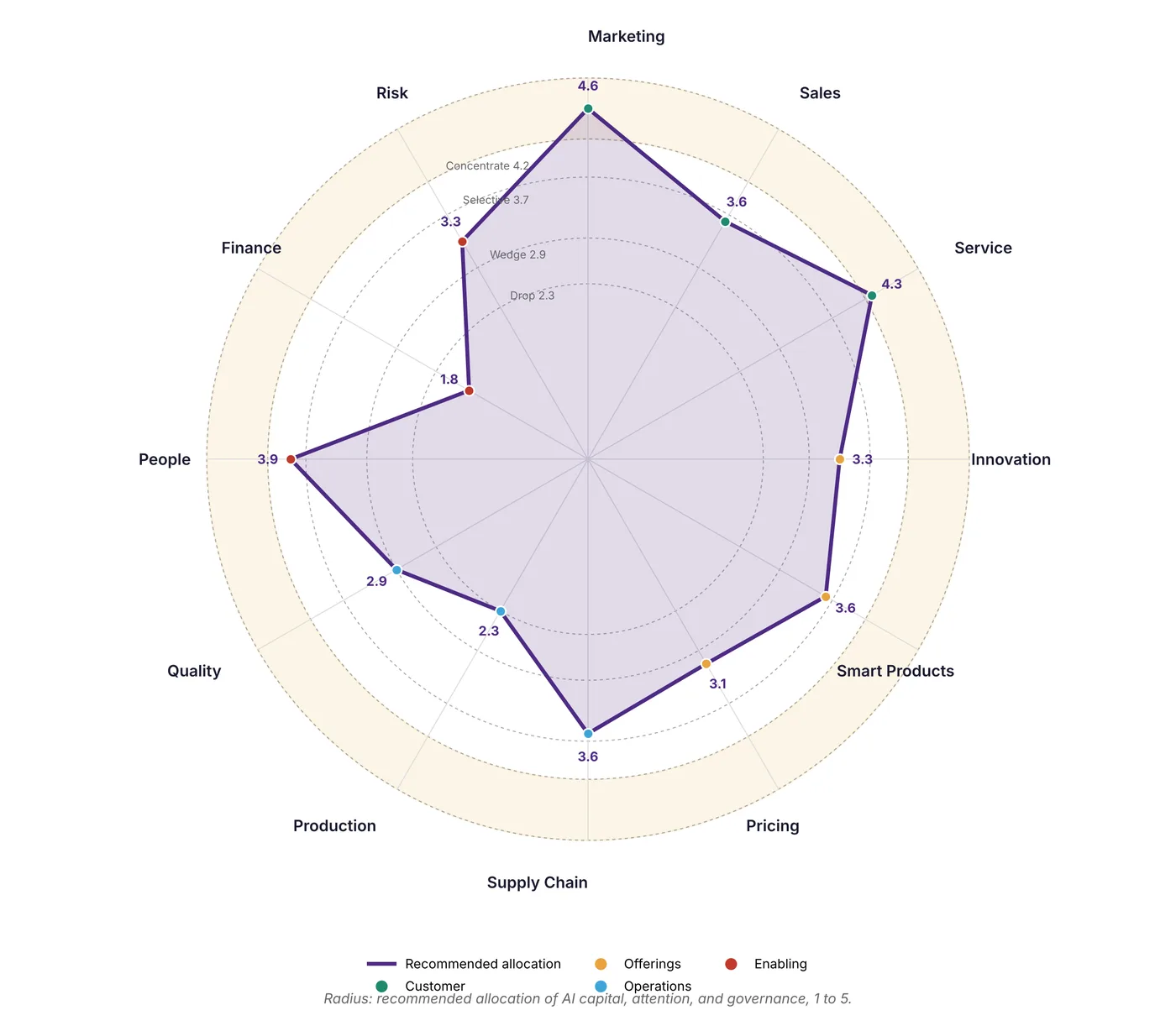
The polygon is lopsided in the way a real allocation should be. It peaks at marketing and service, holds a shoulder at people, and runs a flat wedge plateau through sales, smart products and supply chain before falling away at pricing, quality, production and finance. The actual-portfolio overlay, the Shape Drift Index (the share of the portfolio that would have to move to another dimension to match the recommended shape, equation 5) and the tilt tornado are not drawn, because they require spend by dimension, which is not public. What the program inventory does show is where the money is revealed to be going. Nine of the fifteen programs are in the customer anchor. Three are in smart products, all mature. One each is in supply chain, risk and the group platform for people. Read against the polygon, the revealed allocation tracks the recommended one in marketing and service, over-weights sales relative to its wedge band, carries smart products at a depth its wedge band would not justify on its own, and leaves people, the selective dimension with the strategy's loudest promise, with the shallowest evidence.
The sales over-weight deserves the stance this report takes on it. The stated strategy and the revealed spend agree: Marola describes the ChatGPT pilot as a response to seeing the consumer evolve, and the general manager of e-commerce for North America, Nadine Graham, says that large language models are where consumers now start their discovery and that Sephora will be there with its best experience if they move (Faithfull 2026; Glossy 2026a). The retail archetype is the ring that disagrees, and it is a seed vector built before agentic checkout existed. Two pieces of evidence argue that the overlay is behind the market. Adobe's holiday 2025 data, built on more than a trillion visits to United States retail sites, found traffic from generative AI tools up 693 percent year over year with those visitors converting 31 percent better than other traffic (Adobe 2026). McKinsey's June 2026 beauty report projects that AI platforms could drive up to 35 percent of e-commerce transactions within three to five years and notes that Amazon and TikTok's combined core beauty sales could overtake Sephora and Ulta's combined sales in 2026 (McKinsey 2026). If the retail industry weight on sales moves from 3 to 4 on that evidence, the composite moves to 4.0 and the dimension enters the selective band, which would convert the holds in Section 4 into conditional grows. We hold the seed vector for this baseline because the anti-thrash rule requires a confirmed evidence change or two consecutive reads, and we name the re-weighting as the first trigger for the next reading.
4. What the business should grow, hold and stop, and how far each bet has come
Fifteen programs can be evidenced from the public record, each with a named sponsor function and a primary dimension. Table 2 gives each program its depth stage and its verdict. The five stages are absolute: exploring (a sponsor and a scope, no committed budget or users), piloting (committed budget and a stated hypothesis, no measurement against a control group), scaling (production deployment expanding across the target population with measurement in place), producing (full deployment with reported outcomes and a named owner) and compounding (a capability other programs build on). A sponsor's assertion without evidence caps a program at piloting, and an announcement caps it at the same stage. The four verdicts are grow, hold, fix-or-kill and stop; a start is an allocation act where a concentrate dimension carries no program. Past spend plays no part; forward return is the only basis.
Table 2. The brownfield adjudication: fifteen programs with sponsor, dimension, depth stage, verdict and forward condition.
| Program | Dimension | Sponsor | Stage | Verdict | Forward action and condition |
|---|---|---|---|---|---|
| Personalization and recommendation engine (web, app, SEA real-time recommendations) | Marketing | Digital and e-commerce | S4 | Grow | Extend the real-time layer to every market from the omnichannel budget in the 2027 plan; first reading of incremental conversion at six months against a holdout group (Conversio n.d.; Sephora 2026c) |
| Multimodal content for AI surfaces (generative engine optimization) | Marketing | Digital | S2 | Grow, with a Stage 3 milestone | Stage 3 by Q2 2027: AI-referred traffic share and conversion measured against organic traffic in test cells and a control group of product pages (Glossy 2026a) |
| AI-assisted localization of messaging and creative across markets | Marketing | Marketing | S2 | Grow, conditional | Condition: content cost per market and engagement by market read by Q3 2027; move to fix-or-kill if local teams do not adopt (Faithfull 2026) |
| AI Beauty Chat (proprietary, web and app) | Sales | Chief Digital Officer | S3 | Grow, conditional | Condition: a control-group read of incremental same-day conversion by Q2 2027; funded from the digital operating budget; the 20 percent same-day purchase figure is a usage statistic until the control group exists (Glossy 2026a) |
| Sephora app in ChatGPT (United States pilot) | Sales | Chief Digital Officer | S2 | Hold, floor | Presence on the discovery channel at low cost; Stage 3 milestone is checkout live with conversion measured against sephora.com; no scaling capital before that (Sephora 2026a) |
| Google agentic checkout | Sales | Chief Digital Officer | S2 | Hold, floor | Same floor logic; flag as stalled if no outcome is disclosed by June 2027, four quarters after launch (Glossy 2026a) |
| In-store Beauty Skin Scan (24 countries, 180,000 scans a month) | Service | Store operations | S4 | Grow | Fund the global rollout named in the 2026 outlook from the store capital program; metric is attachment rate and repeat visits of scanned clients against unscanned (LVMH 2026c; Faithfull 2026) |
| Unified conversational service layer (search, chat and customer service in one) | Service | Chief Digital Officer | S1 | Grow, with a Stage 3 milestone | Name the budget line in the 2027 plan; Stage 3 by Q4 2027 with resolution rate and retention measured on a pilot population (Houston 2026) |
| AI-driven retention on Beauty Insider | Service | Loyalty | Start | Start | A sponsor and a budget line; the loyalty team reads Reddit and social comments by hand today, and the dimension has no AI retention program end to end (Glossy 2026b) |
| Color IQ and shade finder | Smart Products | Merchandising and stores | S5 | Hold, floor | The data layer other programs reuse; maintain and extend shade libraries as new brands enter; no new capital (Chain Store Age 2015; LVMH 2026c) |
| Virtual Artist augmented-reality try-on | Smart Products | Digital | S4 | Hold, harvest | Keep in the app at run rate; every change in capture or storage passes the biometric review of the risk program (Retail IT Insights 2016) |
| Smart Skin Scan (online selfie diagnostic) | Smart Products | Digital | S4 | Hold, floor | Maintain; its value is as the on-ramp for personalization and the conversational layer, which is where new money goes (Glossy 2026a) |
| Demand forecasting and automated replenishment (RELEX) | Supply Chain | Supply chain | S3 | Hold, floor | Stalled on the public record: no outcome disclosed since 2021; the quarterly review reads availability and forecast error before re-issuing the verdict (RELEX 2021) |
| Advisor-facing AI tools and Sephora University | People | Retail operations and HR | S2 | Grow, conditional | Stage 3 by Q3 2027: a named pilot in test-cell stores and a control group, metric sales per advisor hour and attachment rate; capped at piloting until a scope is disclosed (LVMH 2026c) |
| Group generative AI workplace platform (document digestion, translation) | People | LVMH CIO | S3 | Hold, floor | Group-funded; Sephora's share of the 40,000 monthly users is not disclosed; no Sephora capital decision (Le Moal 2025) |
| Consent, biometric and AI governance for diagnostic and agentic channels | Risk | Legal and privacy | S3 | Hold, floor | Floor obligation: the 2026 California risk assessments due by end of 2027; opt-in storage of scan results; brand-safety terms with AI platforms (Skadden 2025; Faithfull 2026) |
Nothing on the board earns a stop. That is a genuine finding: the money was placed where the strategy points, and the dimensions the strategy refuses carry no programs. It also means every increment of new allocation must come from growth in the envelope or from the capped dimensions, which is a harder conversation than a cleanup. The holds in smart products are the place to look first, because three mature programs at run rate are the most likely source of redeployable engineering capacity.
Four programs earn an unconditional or milestone grow and three earn a conditional grow. The personalization engine is the only program in a concentrate dimension at full deployment with a reported outcome, a 4.11 percent conversion lift in the United Kingdom on Dynamic Yield, and the Singapore team's real-time recommendation work shows the capability is being rebuilt in-house (Conversio n.d.; Sephora 2026c). The in-store skin scan is the second, and the annual report has already committed to its global rollout (LVMH 2026c). AI Beauty Chat is the most interesting conditional grow. Its reported figure, more than a fifth of users purchasing the same day, is a usage statistic rather than an incremental one: the customers who open a beauty chat are already shopping. A controlled read against matched non-users is the Stage 4 test, and it is cheap. The advisor tools are the conditional grow with the widest band, because the public record contains the promise and nothing else.
The holds are annotated, because a floor and a harvest are managed differently. Color IQ, the online skin scan and the governance program are floors: each maintains an asset or an obligation that other programs depend on. Virtual Artist is a harvest: it remains in the app, it carries the biometric history, and no new capital should chase it. The two platform pilots are floors by design. Being present where discovery starts costs little, and the capital decision waits for checkout to produce a number.
4.1 How deep the portfolio is
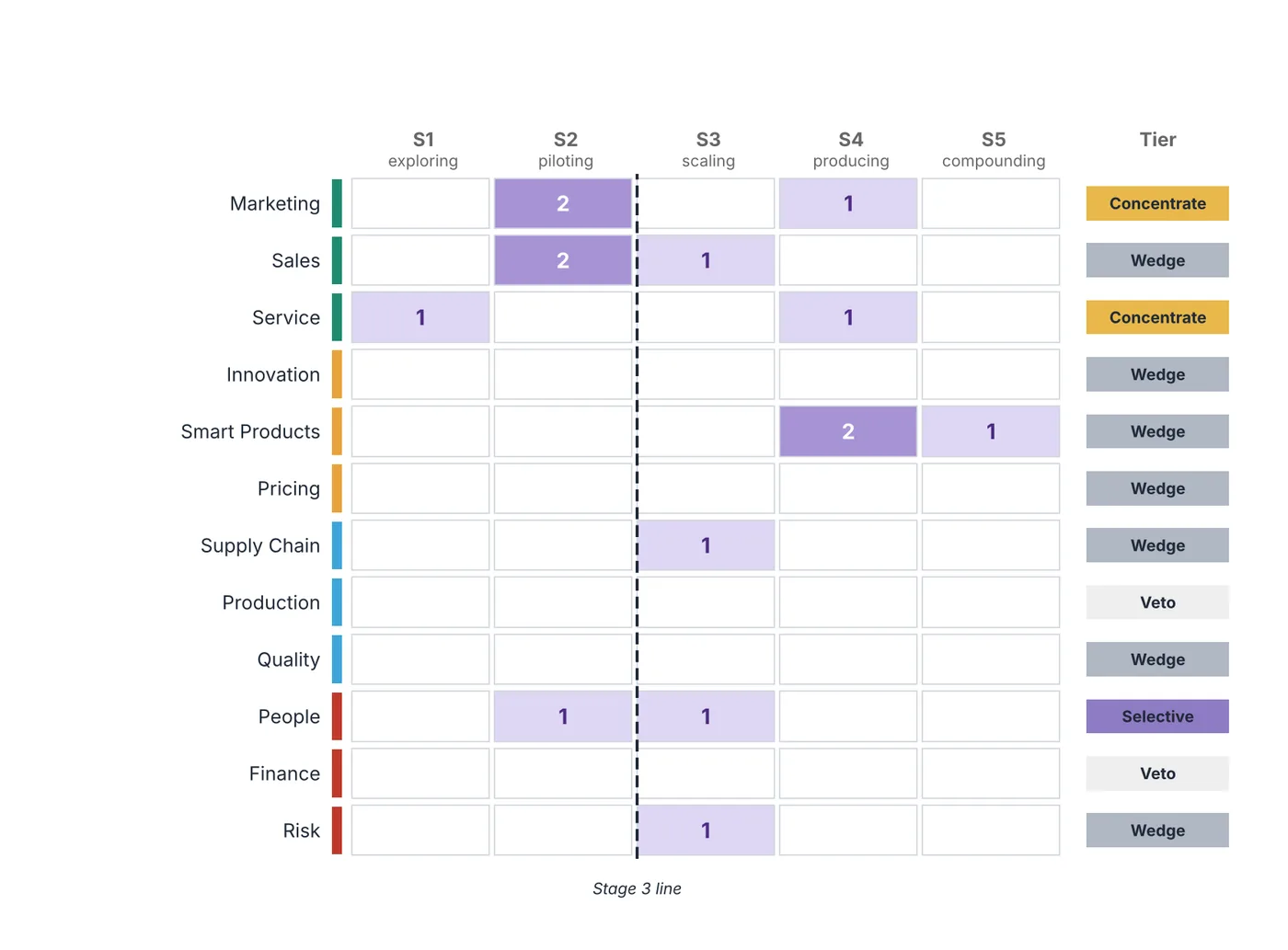
Nine of fifteen programs are at Stage 3 or beyond, a share of 60 percent, which places the portfolio in the producing band (50 to 75 percent); the mean stage is 2.9. The peer comparison is provisional, because the retail archetype's depth distribution is a seed that hardens only at twenty staged inventories, so the honest statement is that this is a deep portfolio by the absolute definition of the stages and that we do not yet know how deep the typical prestige retailer is.
Three depth reads follow. Shallow where it matters: marketing carries one program at Stage 4 and two at Stage 2, and service carries one at Stage 4 and one at Stage 1, so each concentrate dimension has its foundation but its newest bets have no control group; the next milestone for both is Stage 3, and it comes before more capital. People is the sharper case: the strategy's only explicit AI promise, tools for advisors, has no disclosed pilot. Deep where it does not matter, read strictly, does not apply, because no Stage 4 or 5 program lives in a refused dimension; smart products is a wedge, and its depth is what makes the concentrate bets possible, since the skin and shade data the diagnostic tools collect is the input the personalization engine and the conversational layer consume. The redeploy annotation is therefore not about moving the team out of smart products; it is about pointing its next increment of effort at the two concentrate dimensions that consume its output. Stalled: demand forecasting has stayed at Stage 3 on the public record since October 2021 with no disclosed outcome. The record may be silent rather than the program, and the quarterly review reads availability and forecast error before the verdict is re-issued, but the flag stands until a number appears.
4.2 The coverage question
Marketing is covered end to end: intent surfacing, content and personalization each have an owner. Service is covered on the diagnostic side and uncovered on retention: the loyalty program has the data and reads customer sentiment by hand, and no AI retention program exists. That is the start entry in Table 2, and it is the one allocation act this diagnostic recommends in a concentrate dimension.
5. Where the business stands against the field
In the two concentrate dimensions, Sephora is ahead of its direct peers on depth and roughly level on breadth. Ulta Beauty launched Ulta AI on Gemini Enterprise in April 2026, drawing on 46 million loyalty members, and took transactions into Google's AI Mode and Gemini app through the Universal Commerce Protocol; its chief executive called early results promising and gave no figure (GCI 2026; Digital Commerce 360 2026). Sephora's proprietary chat has a reported purchase figure and its skin diagnostics have fourteen years of history, which Ulta cannot match. The informal comparison that Glossy's reporters ran in May 2026 found Sephora's assistant shorter and more conversational than Ulta's or ChatGPT's, with three to four products per answer against eleven to fifteen, which is consistent with an advisor's judgment carried into the chat (Jensen 2026).
The frontier is elsewhere. Amazon competes on price and on search, and the chief financial officer's answer to the Amazon question is to compete on exclusivity and advisors rather than to match it (Zwieglinska 2025). TikTok is about 2 percent of United States beauty sales and the fastest-growing beauty retailer, with shoppable video carrying two thirds of its beauty sales (McKinsey 2026). L'Oréal reports that more than a fifth of its direct-to-consumer online sales in Brazil arrive through conversational commerce on WhatsApp, which is the clearest evidence that chat converts at scale in beauty (PYMNTS 2026). The gaps that are actionable for Sephora are two: the controlled measurement of conversation-driven conversion that L'Oréal already has, and the social-video discovery layer that TikTok owns and that Sephora's AppStories format, shown at VivaTech 2026, begins to answer inside its own app (LVMH 2026e).
6. What will move the outcomes
Each lead and selective dimension carries a conversion contract of three fields: the outcome metric, the direction it should move, and the lag in months before a movement is readable. The sponsor signs the three fields when a bet is funded, and the reading at the lag horizon feeds the next adjudication.
Table 3. The conversion contract for the lead, selective and active wedge dimensions.
| Dimension | Outcome metric | Direction | Lag (months) | First reading |
|---|---|---|---|---|
| Marketing | Incremental conversion and revenue per visit from personalized and AI-referred traffic, against a holdout | Up | 3 to 6 | April 2027 |
| Service | Repeat-visit rate and 12-month retention of scanned and chat-served clients against matched clients | Up | 6 to 12 | October 2027 |
| People | Sales per advisor hour and attachment rate in pilot stores against control stores | Up | 3 to 12 | October 2027 |
| Sales (wedge, active) | Incremental same-day conversion of chat users against matched non-users; agentic checkout orders as a share of United States online orders | Up | 3 to 6 | April 2027 |
| Smart Products (wedge, floor) | Scan completion and scan-to-basket rate | Up | 12 to 36 | Annual |
The lags differ on purpose. A marketing reading at six months is honest; a service reading at six months is not, because retention is a twelve-month metric. The priced earnings bridge, which converts these movements into an operating profit range with unit coefficients and haircuts, belongs to the Innovation Radar 2.0 and is deferred.
7. What the business will not do
Pricing is the deliberate valley. Retail economics reward pricing intelligence as heavily as any dimension, and Sephora's strategy refuses it: prices are largely set by the brands it curates, sitewide discounts are rare, and the stated answer to Amazon's price cuts is to be what Amazon is not (Montemayor 2025; Zwieglinska 2025). The wedge band leaves room for narrow bets, and the only one worth naming is the economics of the loyalty currency itself, the points multipliers and redemption options the loyalty team already tunes by hand; an optimization model there would be a small wedge bet, and it would be funded from the loyalty budget, never as a pricing program.
Production is parked by the strategy veto. Sephora does not manufacture, and its delivery convenience is bought from partners, same-day delivery through DoorDash and rides through Lyft, rather than built (Montemayor 2025). Finance is parked for the same reason: the group runs AI in corporate functions and cost management at the maison level, and nothing in Sephora's record treats finance as a source of advantage (LVMH 2026h). Both parks carry a dated trigger: a disclosed program with a Sephora sponsor would reopen the dimension at the next reading.
Quality, innovation and supply chain are held as floors. Quality in a retailer means product authenticity, review integrity and the accuracy of the content that AI surfaces now read; the risk program covers the last of these, and no separate quality program is warranted at a composite of 2.9. Innovation means deciding what to build, and for Sephora that is assortment curation by merchants with a point of view and brand incubation through Accelerate; the capability score is emerging and the record contains no AI program there, so the floor is the merchants' judgment. Supply chain is a necessity, held by the forecasting program at run rate.
Risk is held as a floor and not led, with one qualification. Sephora's record contains two enforcement events on the exact technologies its strategy leads with, and the 2026 California regulations require risk assessments on the advertising data flows that drew the first penalty. The floor is therefore not small. It is the governance program in Table 2, and its first deliverable is the risk assessment due by December 2027.
8. Boundary cases and what would change the answer
Three scores fall within a few hundredths of a band edge, and one judgment decides the reading of the whole board.
Quality's composite is 2.88, which rounds to 2.9 and places it at the lower edge of the wedge band; a strategy score of 2 is the floor of the honest range, so the direction of any movement is upward, and the practical instruction, no program beyond the governance floor, is the same on either side of the line. Sales and smart products both compose to 3.63, inside the wedge band and 0.07 below the selective edge; each would cross into selective on a one-point rise in the industry weight, and each is discussed in Section 3. Production composes to 2.29 under the strategy veto; if the strategy score were read as 2 rather than 1, on the ground that two-hour click and collect is execution the business does care about, the composite would be 2.88 and the dimension would move from parked to a boundary case at the drop edge, with the same practical instruction.
The most sensitive score on the board is the retail industry weight on sales. It rests on a seed vector that predates agentic checkout, and the two sources in Section 3 argue that the structural event the archetype library names as a re-weighting trigger, a value-chain change, has occurred. A one-point move lifts sales to the selective band, turns the two platform holds into conditional grows, and makes the control-group read on AI Beauty Chat the most valuable experiment in the portfolio. We did not move the weight on this reading because the anti-thrash rule requires a confirmed evidence change or two consecutive reads, and we record it as the first trigger below.
The capability ring moved on September 14, 2026, when risk rose from 3 to 4 on the publication of voluntary agent-control standards; that was a change in the world, and it is the only capability change since the July 2026 baseline. No change in the method affected this reading. The July 2026 refresh had lowered eight capability scores, roughly half on a tightened independence rule and half on cautionary 2026 research, and those scores carry into this baseline as they stand.
The triggers for an early reading are four. A re-weighting of the retail archetype on sales, on a second independent source confirming the shift of discovery and checkout into AI platforms. A disclosed outcome from the ChatGPT or Google channels, which would move either program to Stage 3. A disclosed scope for the advisor tools, which would move that program to Stage 3 and lift the people reading. And the January 2027 edition of the envelope benchmark, which re-runs the bracket in Section 2.
9. What happens next
The ninety-day actions are five, each with an owner.
- The chief digital officer stands up a control group for AI Beauty Chat and signs the sales conversion contract, with the first reading in April 2027.
- The president of retail operations, with the head of Sephora University, names the pilot scope for advisor-facing AI tools, the test-cell stores and the control stores, and signs the people contract.
- The head of loyalty names a sponsor and a 2027 budget line for AI-driven retention on Beauty Insider, the one start in a concentrate dimension.
- The chief digital officer and the chief marketing officer sign the marketing contract for personalization and content on AI surfaces, with the holdout design agreed before the holiday season.
- The chief financial officer of Sephora counts the AI envelope at the use-case layer, so that the size question can be answered at the next reading, and the head of privacy schedules the California risk assessments.
The quarterly portfolio review reads each funded bet's metric at its own lag, re-reads every program's stage, and flags any program that has not advanced in four quarters; the forecasting program enters the first review already flagged. The next full reading is the annual refresh in October 2027, or earlier on any of the four triggers in Section 8. This reading is stamped as the baseline.
Appendix A. Evidence and Citations by Ring
The depth tier is Pro on the strategy ring and DIY on the data and workflow sub-score. Entries marked [snippet] were verified from a search result rather than a fetched document; entries marked [library] are carried from the shared capability library of September 14, 2026 and were not re-fetched on this run. Dates are publication dates; accessed pages carry the access date of October 12, 2026.
Where the deep pass moved from the shallow read. The twelve ring scores of the earlier outside-in read held on the evidence. Two program stages moved. AI Beauty Chat moved from producing to scaling, because the reported purchase figure is a usage statistic with no control group and no disclosed steady-state owner, which is the Stage 3 test rather than the Stage 4 test. The in-store skin scan was re-homed from smart products to service under the sponsor rule, because advisors operate it inside the consultation and the job it does is the advisor-led experience; the online selfie scan stays in smart products. Six programs were added from the record: content for AI surfaces, creative localization, the unified conversational service layer, the group generative AI platform, the governance program, and the retention start. One program, the forecasting engine, acquired the stalled flag.
Ring 3, the company record.
- LVMH 2026a. Letter to Shareholders, January 2026, Selective retailing. FY2025 segment revenue EUR 18,348 million, +4 percent organic; profit from recurring operations EUR 1,780 million, +28 percent; margin 9.7 percent; about 100 store openings. lvmh.com.
- LVMH 2026b. Full-year 2025 results release, January 27, 2026. Group revenue EUR 80,807 million; Sephora "remarkable performance," market share gains. lvmh.com.
- LVMH 2026c. 2025 Annual Report, interactive edition, p. 151, Sephora 2026 outlook: differentiation through products and experiences; global rollout of skin scan and shade finder tools; Sephora University and AI-underpinned tools for advisors. hosting.fluidbook.com.
- LVMH 2026d. 2025 Annual Report, p. 146: Selective Retailing operating investments EUR 516 million; "Maintain Sephora's innovative momentum in stores and online." hosting.fluidbook.com.
- LVMH 2026e. LVMH x VivaTech 2026, Maisons x Tech Partners: Sephora AppStories; Sephora x ChatGPT x Gemini with purchases inside the conversational platforms. lvmh.com.
- LVMH 2026f. Letter to Shareholders, July 2026, Selective retailing. H1 2026 revenue EUR 8,406 million, +5 percent organic; profit EUR 893 million; margin 10.6 percent; Belgium and Croatia entries. lvmh.com.
- LVMH 2026g. Job posting 287999, Lead Engineer, Machine Learning, Sephora, United States, 2026: LLM applications, retrieval pipelines, multi-agent systems. lvmh.com.
- LVMH 2026h. First-half 2026 earnings call, July 27, 2026, transcript via Investing.com: Cabanis on AI across clienteling, demand forecasting, prototyping and corporate functions; growth "half-half" expansion and like-for-like; Ireland and UK openings.
- LVMH 2026i. First-quarter 2026 revenue release, April 13, 2026: Selective Retailing EUR 4,048 million, +4 percent organic; Sephora growth in all regions. lvmh.com.
- LVMH 2025. Third-quarter 2025 revenue release, October 14, 2025: nine-month Selective Retailing EUR 12,613 million, +3 percent organic; Q3 +7 percent. lvmh.com.
- LVMH n.d. Sephora maison page, accessed October 12, 2026: about 52,000 employees including more than 39,000 beauty advisors; 35 markets; more than 3,000 points of sale; about 500 brands; more than 70 million loyal members. lvmh.com.
- Ojea, Sabela. 2025. "Sephora Bets on Brand Exclusivity and Experience to Power Global Push." BeautyMatter, October 2, 2025. Motte's four pillars; one product in two exclusive; 74 million active members; 3,400 stores; advisors better equipped through technology.
- Montemayor, Cristina. 2025. "How Sephora Drives Customer Loyalty Without Leaning on Discounts." BeautyMatter, October 12, 2025. Rare sitewide discounts; Rouge tier; DoorDash and Lyft partnerships; Rouge Celebration results.
- Zwieglinska, Zofia. 2025. "'Sephora is everything Amazon is not.'" Glossy, October 14, 2025. Cabanis on Amazon; nine-month segment growth; Rhode as the largest-ever launch.
- Fortune 2025. "LVMH says Amazon is being very aggressive on price," April 15, 2025. Cabanis on avoiding price-led competition; US e-commerce momentum.
- Retail Week 2024. "Sephora CEO Guillaume Motte reveals the secrets of beauty retailer's stellar success," World Retail Congress coverage (date inferred from the reference to 2023 results): "The heartbeat of Sephora is our stores"; investment in technology to enrich the experience; 160 million customers.
- Chain Store Age 2025. "Sephora to redesign entire store fleet across North America," January 16, 2025. Patrick: all 700-plus stores within about five years; 111 done; sales up in revamped stores; advisors as the differentiator.
- Sephora 2026a. "Sephora App in ChatGPT Brings a New Personalized Beauty Experience," press release, March 24, 2026. US pilot; Beauty Insider linking; checkout planned; more than 80 million active members; Marola and Graham quotes.
- Carrara, Alessandro. 2026. "Sephora bets on artificial intelligence with ChatGPT app launch." Cosmetics Business, March 25, 2026. Marola on piloting new intelligent channels; global expansion goal.
- Houston, Rafe. 2026. "Sephora at Shoptalk Spring 2026: Building a Next-Generation Shopping Experience." ClickZ, March 24, 2026. Marola on connecting search, chatbot and customer service into one layer; agentic commerce as the longer-term aim.
- Glossy 2026a. "Sephora is bringing prestige beauty shopping into Google's AI ecosystem," June 3, 2026. First prestige beauty retailer on Google Agentic Checkout; AI Beauty Chat more than 20 percent same-day purchase; Smart Skin Scan more than 80 percent completion; in-store scan more than 180,000 a month; multimodal content for LLM surfaces.
- Faithfull, Mark. 2026. "Sephora Pioneers BeautyTech." The Robin Report, May 25, 2026. Marola at World Retail Congress: skin scan in 24 countries; opt-in storage; 14 million reviews; two-hour click and collect; AI localization of creative; about 150 openings a year; 36 markets.
- Jensen, Emily. 2026. "Is agentic shopping the next big thing in beauty?" Glossy, May 28, 2026. Reporter comparison of Sephora, Ulta and ChatGPT assistants.
- Glossy 2026b. "How Sephora is evolving its loyalty program in a competitive retail environment," August 18, 2026. Berlind; more than 46 million US members; 30 percent in a Challenge; Kohl's shops above 1,000.
- Sephora 2026b. AI Beauty Chat product page, accessed October 12, 2026: add to basket and check out in chat; 24/7; saved chats; labelled new. sephora.com.
- Sephora n.d. Smart Skin Scan product page, accessed October 12, 2026: selfie diagnostic across seven concerns; four-step routine; deep learning. sephora.com.
- Sephora 2026c. Job posting, Machine Learning Engineer, Singapore, September 20, 2026: real-time recommendation systems; LLM agents; SEA, ANZ and India; global ML teams in Europe, China and the US. jobs.sephora.com.
- Sephora 2025. My Sephora Storefront launch, press release, September 17, 2025. Creator affiliate platform with Motom; 250-plus Squad creators.
- Chain Store Age 2015. "Sephora offers colorful store services," September 15, 2015. Color IQ launched 2012 with Pantone; 27 images in 1.8 seconds; lip and concealer matching in all US stores.
- Retail IT Insights 2016. "Sephora Launches New Virtual Artist App," February 22, 2016. ModiFace lip mapping; filtering by Color IQ; Innovation Lab.
- RELEX 2021. "Sephora Implements AI-Based Solution from RELEX to Improve Availability Across Distribution Network," October 21, 2021. Forecasting and automated replenishment; no outcome disclosed.
- Conversio n.d. "Sephora: Building a Personalisation Programme with Competitive Edge," case study, accessed October 12, 2026. Dynamic Yield in the United Kingdom; 4.11 percent conversion lift.
- Le Moal, Franck. 2025. Interview, "Inside LVMH's perfectly manicured data estate." Google Cloud Transform, June 9, 2025. Platform for 75 maisons; 40,000 monthly generative AI users; client advisor agents.
- Retail Technology Innovation Hub 2026. "Clément Marchal leaves Sephora and starts a new chapter as Head of AI Solutions at LVMH," October 2, 2026.
- IADS 2026. "How Sephora is redefining the value of physical retail through innovation in China," July 2026 (WWD republication). 21 months of offline traffic growth; RedNote, Douyin and WeChat links.
- BeautyMatter 2024. "Sephora at Kohl's Surpasses $1.4 Billion in Sales," March 17, 2024. More than 900 shops; USD 2 billion target for 2025.
- Cosmetics Business 2026. "Sephora partners with Marks and Spencer on new UK beauty destination," September 29, 2026. About 100 sites from spring 2027; Spindler quotes.
- FashionUnited 2026. "M&S and Sephora partner to launch shop-in-shops across 100 UK locations," September 30, 2026.
- Jing Daily 2025. "LVMH may spin off Sephora amid corporate restructuring: HSBC," February 12, 2025. Margin potential limited as a retailer.
- ad-hoc-news 2026. "Sephora's UK rollout offers LVMH a bright spot as Bernstein flags Louis Vuitton softness," October 4, 2026. Bernstein downgrade on China; UK plan.
- Wilson Sonsini 2022. "California Attorney General Settles First-Ever CCPA Enforcement Action," August 2022. USD 1.2 million; trackers as a sale; two-year compliance program.
- Northwestern JTIP 2023. "Sephora's Biometric Scandal: An Analysis of Data Privacy Crisis Management in the Beauty Industry," November 6, 2023. Salkauskaite v. Sephora, filed December 2018, settled December 2020.
- Sidley 2026. "Seventh Circuit Limits Potential Damages Under BIPA, Holds 2024 Amendment Applies Retroactively," April 8, 2026. Clay v. Union Pacific, April 1, 2026.
- Skadden 2025. "California Finalizes CPPA Regulations," October 3, 2025. Effective January 1, 2026; risk assessments for cross-context behavioral advertising; first due December 31, 2027.
Ring 2, the category and industry record.
- McKinsey 2026. State of Beauty 2026, June 18, 2026. USD 590 billion by 2030; AI platforms up to 35 percent of e-commerce transactions in three to five years; Amazon and TikTok against Sephora and Ulta; generative engine optimization.
- Circana 2026. "US Prestige and Mass Beauty Retail Deliver a Positive Performance in 2025," February 10, 2026. Prestige USD 36 billion, +4 percent; mass USD 72.7 billion, +5 percent.
- Adobe 2026. "AI-driven traffic surges across industries," Adobe Analytics, January 12, 2026. Generative AI traffic to US retail sites +693 percent; AI referrals convert 31 percent better; more than one trillion visits.
- GCI 2026. "Ulta Leans Into Google's AI Checkout As Sephora Bets on ChatGPT Discovery," Global Cosmetic Industry, April 23, 2026. Universal Commerce Protocol; Ulta AI on Gemini Enterprise; 46 million members.
- Digital Commerce 360 2026. "Ulta Beauty shares early AI assistant results," June 5, 2026. Online comps mid-teens; "Initial results have been promising."
- PYMNTS 2026. "Beauty Giants Race to Own the AI Shopping Moment," April 22, 2026. L'Oréal Brazil conversational commerce above 20 percent of direct online sales; Fenty on WhatsApp.
- BCG 2026. AI Radar 2026, "As AI Investments Surge, CEOs Take the Lead," January 15, 2026. n = 2,360; 0.8 percent of revenue in 2025 to 1.7 percent expected in 2026; consumer sector 1.6 to 1.7 percent; self-reported intended spend.
- Coresight 2025. "Transforming Beauty Retail: AI Across the Value Chain," June 23, 2025 (preview). Personalization, loyalty and content at scale as the beauty value pools.
- National Law Review 2023. "Biometric Privacy Class Actions Take Aim at Virtual Try-On Retailers." Kukovec v. Estée Lauder (N.D. Ill., November 7, 2022); Shores v. Wella (December 2022).
- Privacy World 2025. "2025 Year-In-Review: Biometric Privacy Litigation," December 2025. Melzer (D.N.J., March 7, 2025) on AI skin assessment from facial images.
Ring 1, the capability frontier (shared library, refreshed September 14, 2026).
- Gartner 2026a. 2026 CMO Spend Survey, May 11, 2026 (n = 401): AI at 15.3 percent of marketing budgets; 30 percent ready to scale. [snippet]
- Salesforce 2026. State of Service, AI Agents Edition, May 20, 2026 (n = 3,075, fielded March 9 to April 4, 2026): 66 percent use AI agents, up from 39 percent; 70 percent see measurable value within 60 days.
- Salesforce 2026b. State of Sales, February 3, 2026 (n = 4,050): 87 percent use some AI; 54 percent have deployed agents. [library]
- ICONIQ 2026. State of AI 2026, Q2 2026 (about 300 software executives): AI-embedded product revenue share 32 to 42 percent. [library]
- Growth Unhinged 2026. State of B2B SaaS and AI Monetization, April to May 2026 (n = 230-plus): 75 percent changed pricing or packaging. [library]
- Gartner 2026b. Supply Chain Leaders Survey, February 25, 2026: 55 percent expect agentic AI to reduce entry-level hiring. [library]
- Google Cloud DORA 2026. ROI of AI-Assisted Software Development, May 11, 2026: about 90 percent developer adoption; AI as a multiplier of existing conditions. [library]
- METR 2025. Preregistered randomized trial of experienced developers, with late-2025 repeat: 19 percent slower with AI. [library]
- arXiv 2601.00477, January 2026. Security in the Age of AI Teammates (n = 33,000-plus agent-authored pull requests): 61 percent minimal review. [library]
- GitClear 2026. The Maintainability Gap (n = 623 million code changes): duplication up 81 percent since 2023. [library]
- Microsoft 2026. Work Trend Index, May 5, 2026 (n = 20,000): agent usage up 15 times year over year; organizational design explains twice the variance of individual effort. [library]
- Dell'Acqua et al. 2026. The jagged technological frontier, preregistered field experiment, Organization Science, March 11, 2026 (n = 758): 22 to 34 percent gains inside the frontier. [library]
- Anthropic 2026. Economic Index, June 26, 2026: 93 percent of conversations produce a work artifact. [library]
- Gartner 2026c. CFO survey, May 28, 2026 (n = 204): forecasting rated lowest for realized value. [library]
- Deloitte 2026a. CFO Signals Q2 2026, July 23, 2026 (n = 200): 43 percent confident in AI governance. [library]
- Hackett Group 2026. Finance Key Issues Study, March 19, 2026: accounts payable furthest along at 33 percent scaling. [library]
- McKinsey 2026b. State of AI Trust in 2026, March 25, 2026 (about 500 organizations): responsible-AI maturity 2.0 to 2.3. [library]
- Cloud Security Alliance 2026. State of AI Cybersecurity 2026 (n = 1,500-plus): 92 percent lack full visibility into agent identities. [library]
- OWASP 2026. 2026 Top 10 for LLM Applications and Agent Control Standard, August 3, 2026; Agentic Top 10, December 9, 2025. [library]
- NIST CAISI 2026. AI Agent Standards Initiative, February 17, 2026. [library]
- McKinsey 2026c. The State of AI in 2026: On the road to ROI, August 25, 2026 (n = 1,719): 37 percent report any EBIT impact. [library]
- Deloitte 2026b. State of AI in the Enterprise 2026 (n = 3,235): 20 percent report increasing revenue through AI. [library]
Ring 1 refresh note. One capability score moved since the July 30, 2026 baseline: risk rose from 3 to 4 on September 14, 2026, on the publication of OWASP's agent-control standard and 2026 LLM Top 10 and NIST CAISI's agent standards initiative, a change in the world. No method change affected this reading. The July 2026 refresh had lowered eight of twelve scores, about half on the tightened independence rule for a top score and half on cautionary 2026 research.
Appendix B. Mathematics
The seven equations below define the quantities used in the body. Equations (2), (3), (5), (6) and (7) require the actual portfolio by dimension, which is not public for Sephora, and are stated so that the reading can be completed when the envelope is counted.
C_d = \sqrt[3]{R^{(1)}_d \, R^{(2)}_d \, R^{(3)}_d}(1)The composite for dimension d is the geometric mean of the capability, industry and strategy ring scores, so a floor on any ring parks the dimension whatever the other two say.
\mathrm{AII} = k = \frac{\sum_{d=1}^{12} a_d}{\sum_{d=1}^{12} r_d} = \frac{\bar{a}}{\bar{r}}(2)The AI Investment Index is the ratio of the mean actual radius \bar{a} to the mean recommended radius \bar{r}; between 0.9 and 1.1 the envelope is adequate, below 0.75 it is severely short.
E^{*} = \beta \, m \, S, \qquad G = (1-k)\,E^{*}(3)The required envelope E^{*} is the peer baseline \beta (the industry's share of revenue from the current benchmark edition) times the posture multiplier m times revenue S; the funding gap G is the shortfall implied by the index.
s^{a}_d = \frac{a_d}{\sum_{j=1}^{12} a_j}, \qquad s^{r}_d = \frac{r_d}{\sum_{j=1}^{12} r_j}(4)The shares express each polygon's radii as fractions of its own total, which removes the size effect before shape is read.
\mathrm{SDI} = \tfrac{1}{2} \sum_{d=1}^{12} \left| s^{a}_d - s^{r}_d \right|(5)The Shape Drift Index is the total variation distance between the two share vectors, and it reads directly as the share of the portfolio that must move to another dimension to match the recommended shape.
g_d = a_d - r_d = (k-1)\, r_d + \left( a_d - k\, r_d \right)(6)Each spoke's raw gap splits without residual into a size part, which every spoke carries in proportion to its recommendation, and a mix part, which is the reallocation argument proper.
\sum_{d=1}^{12} \left( a_d - k\, r_d \right) = 0, \qquad \mathrm{SDI} = \frac{\sum_{d=1}^{12} \left| a_d - k\, r_d \right|}{2 \sum_{d=1}^{12} a_d}(7)The mix parts sum to zero by construction, and half their absolute sum over the actual total equals the Shape Drift Index exactly, so the index and the investment index are two halves of one identity.
References
Sawhney, Mohanbir. 2026. The AI Radar: A Portfolio Framework for Diagnosing the Level and Allocation of Enterprise AI Investment. SSRN Working Paper, July 27, 2026. https://ssrn.com/abstract=7244301.
Sawhney, Mohanbir. 2026. The Innovation Radar 2.0: A Framework for Measuring and Diagnosing Business Innovation. SSRN Working Paper. https://ssrn.com/abstract=7244520.
Sawhney, Mohanbir, Robert C. Wolcott, and Inigo Arroniz. 2006. "The 12 Different Ways for Companies to Innovate." MIT Sloan Management Review 47 (3): 75–81.
AI Radar 2.0 (Sawhney Enterprises). Scores, drift, and recommendations grounded in evidence as of October 12, 2026.