Full diagnostic. Innovation Portfolio Diagnostic and Recommendations for SharkNinja. Public-record research pass and top-up pass, October 2026.
A sample Radar from the public record
Innovation Portfolio Diagnostic and Recommendations for SharkNinja, Sawhney Enterprises, October 2026, public-record research pass with a top-up pass. Actual postures from public disclosures under the evidence tier gates. The envelope here is research plus advertising, the basis on which the report certifies the yield; on research alone the yield reads 2.4 against the firm's own historical 3.0.
Context
This report diagnoses the innovation portfolio of SharkNinja, the consumer durables business that designs, sources and markets Shark and Ninja appliances across cleaning, cooking, beverage, food preparation, beauty, home environment and outdoor, and recommends how much the firm should invest in innovation and where that investment should go. It applies the Innovation Radar 2.0, a diagnostic instrument that asks two questions of an innovation budget: whether the firm is investing enough to deliver the growth it has promised, and whether the investment is going where its strategy says it should. The framework translates the firm's stated strategy into a target profile across twelve dimensions of business innovation, measures the actual profile from shipped evidence under tiered evidence rules, and reads the distance between the two as strategy drift; before any of that, it tests whether the firm's innovation envelope can fund its growth ambition at all. The evidence cutoff is October 12, 2026, and the read is outside-in from the public record. The method is set out in Sawhney, M. (2026), The Innovation Radar 2.0: A Framework for Measuring and Diagnosing Business Innovation, SSRN Working Paper, https://ssrn.com/abstract=7244520.
Executive Summary
SharkNinja innovates where its strategy says it should, and it spends less on research than its growth would suggest because launch media, not laboratory spending, carries most of the load. Revenue reached $6.4 billion in 2025, up 16 percent in a United States market that shrank, and the company has raised its 2026 outlook to 16 to 17 percent growth. It launches about 25 products a year, entered its fortieth subcategory in August 2026, and has converted its European and Latin American distributors into direct operations. The gaps between the record and the strategy are narrow and specific. Management describes artificial intelligence as reshaping the company and names an always-on consumer insight engine as the source of its product edge, yet that engine reads mostly public reviews and social posts that any rival can read, and the company has published no measured outcome from its AI programs. The strategy also leans on direct and social selling, yet the company discloses neither the share of sales nor the margin those owned channels produce, while three retailers buy 46 percent of its output and the largest of them took 26.5 percent of sales in the second quarter of 2026. Scored on the same twelve areas from their own public records, Dyson, Groupe SEB and Breville show that SharkNinja's clear lead is in products alone. All three rivals have built direct and online channels to the same level, Groupe SEB already holds a consumer database of more than 50 million members, and Breville publishes measured gains from its AI programs, which SharkNinja has not done.
The instrument asks two questions. Is SharkNinja investing enough? Yes. A growth target of about 10 percent, plus the 3 to 5 points of annual erosion a consumer appliance business suffers when it stops innovating, requires roughly $1.0 billion of new or defended revenue each year on the 2026 base. Research spending of about $430 million would have to produce about 2.4 dollars of that revenue per dollar, a ratio the Radar calls the implied yield. That is high against the range typical of technology hardware, and below the 3 to 4 dollars SharkNinja itself has produced in each of the last two years, so the budget is adequate and the ambition is, if anything, modest against the record. Is the investment going where the strategy says? Almost entirely. Nine of the twelve areas of innovation the Radar scores are at their target. Three are one point short on a five-point scale: data and intelligence, channels, and operations. The Radar reads the portfolio as adequately sized and only slightly tilted in shape, with about 5 percent of its emphasis needing to move, and its prescription is to scale, meaning keep the budget and the direction while closing the three named gaps.
Five findings carry the diagnosis. First, the data and intelligence gap is an allocation gap: the company spends about 10 percent of sales on advertising and under 6 percent on research, and a small, recent fraction of either on the first-party data that would make its insight edge proprietary. No scored rival has reached 4 on this dimension, so a measured first-party data program would give SharkNinja a lead no appliance maker in the comparison holds. Second, the channels gap is a disclosure and conversion gap: the money is flowing into the direct and social build, and the measured outcome is missing; every scored rival reaches the same posture of 4, so SharkNinja earns the 5 its strategy asks for only by showing that its social commerce lead, about 28 percent of revenue among the top 40 TikTok Shop storefronts in four European markets on third-party estimates, changes its economics. Third, the product moat rests on speed more than on patents; a Paris division of the Unified Patent Court found SharkNinja's air fryer patent likely invalid against Groupe SEB in April 2026, and copies of the SLUSHi reached marketplaces fast enough to require a mass lawsuit. Fourth, the company holds a one-time tariff refund of about $247 million, and management has said part of it may go to media; that money belongs in the data gap. Fifth, the growth beyond the existing categories that the double-digit ambition requires, the wedge the new bets must fill, is 3 to 4 points of growth, or $225 to $300 million of revenue a year.
We recommend that SharkNinja lead on Offerings, Channels and Data and Intelligence; hold Brand and Supply Network at their current level as floors; and keep Platform starved by choice. Of 21 live bets in the record, 12 should grow, 7 hold, one enforcement program should be fixed or killed, and one proposed use of the tariff refund should be redirected. Of 37 scored net-new plays, six earn a pursue-now verdict, led by an AI concept-to-prototype pipeline with a published cycle-time ledger, a consented first-party consumer data spine, a connected-product learning loop, and a returns and service root-cause loop. Priced through SharkNinja's own margin structure and cut by a 40 percent execution haircut, the agenda is worth $55 to $110 million of annual EBITDA by fiscal 2028, about 4 to 8 percent of the 2026 base, on lags of one to three years.
Leadership must decide one thing: to publish the owned-channel share and margin and an AI outcome ledger with test cells and a control group, and to put the 2026 tariff refund behind the data spine. The dial we recommend is to improve the portfolio, with no change to the ambition and no increase to the envelope; the 90-day commitments are in Section 9.
1. How healthy is the foundation
The foundation beneath SharkNinja's innovation portfolio reads green on the two elements an outside analyst can observe, and the third is unobservable from outside. The instrument treats purpose, culture and leadership as a multiplier on every dimensional investment, and it checks them first because capital poured above a weak foundation converts at a discount.
Purpose reads green. The company states its mission as positively affecting people's lives "every day in every home" and describes its product test as solving consumer problems with five-star products (SharkNinja 2026c; SharkNinja 2025b). The costly evidence that this purpose binds commercial behavior is a product design choice. In April 2026 Shark launched the BreatheClear Max purifier with filtration rated to last up to six years without routine replacement and advertised savings of up to $350 against rivals' filter costs (SharkNinja 2026e), and its robot bases carry a NeverTouch self-maintenance design (SharkNinja 2026d). A firm that sells filters and pods on subscription (SharkNinja 2026m) and still designs the replacement filter out of a flagship purifier has refused recurring revenue in favor of a consumer benefit. That refusal is the strongest purpose observable in the record.
Leadership reads green, with one governance caution. The chief executive sponsors the AI program in person, funds it with a $1 million prize and grant pool, and reviews eight large and twenty quick-win projects on a two-week cycle (SharkNinja 2026c; SharkNinja 2026l). He has also set a public constraint that only a committed leadership team would set: growing into 2027 on roughly flat headcount (SharkNinja 2026l). The caution concerns incentives. The 2025 annual incentive paid on adjusted net sales growth at 40 percent and adjusted net profit growth at 60 percent, against targets of 11 and 14 percent, and the performance share units vest on sales, profit and operating cash (SharkNinja 2026f). Nothing in the pay plan rewards the share of sales from recent launches, the owned-channel share, or a measured AI outcome, which are the three things this report asks the company to lead on. The board chair holds his seat under a right tied to a 30 percent ownership stake and also chairs JS Global, the former parent (SharkNinja 2026f); the sourcing services agreement with JS Global ended on July 31, 2025 (SharkNinja 2025c), and related-party cost of sales fell from $27.5 million to $12.8 million between the first quarters of 2025 and 2026 (SharkNinja 2026i), so the operational dependence is unwinding.
Culture is marked unobservable. The observable signals are favorable: the outdoor line began at a company hackathon, the 2026 HackWeek produced 20 cross-functional and more than 400 departmental projects, and the AI program drew more than 150 employee submissions (SharkNinja 2026h). These are counts of activity, and they tell us nothing about tolerance for failure or decision speed, so we do not score culture. No element is red, and the prescription is to invest.
2. Is the ambition funded
The envelope is adequate for the ambition, and the instrument therefore licenses the drift diagnosis that follows. Table 1 records the five quantities the test needs, each with the kind of knowledge it represents.
Table 1. The Ambition Ledger for SharkNinja, with the epistemic class of each entry.
| Entry | Value | Basis | Class |
|---|---|---|---|
| Organic growth target, g* | 10 percent | "A long-term double-digit growth company" (Q4 2024 call, Feb 13, 2025); existing categories mid to high single digits plus international and new categories reach double digits (Q2 2026 call, Aug 5, 2026); 2026 opening guidance of 10 to 11 percent; 2025 incentive target of 11 percent. No acquisitions to net out | Disclosed fact, low end of a stated range |
| Revenue base | $7.46 billion forward (fiscal 2026) | Fiscal 2025 net sales $6,399 million grown at the 16.5 percent midpoint of the August 2026 outlook | Disclosed fact, derived forward |
| Core decay rate, d | 3 to 5 points, carried at 4 | Consumer products band; the United States market outside SharkNinja fell low to mid single digits in 2025 and early 2026 (Circana, cited on the Q4 2025 and Q1 2026 calls); the United Kingdom's largest category, air fryers, declined in 2025; Cleaning grew 4 percent in Q2 2026 | Derived estimate, band |
| Innovation envelope | About $430 million a year (research and development); about $630 million with capital expenditure | R&D $208 million in the first half of 2026, up 17.6 percent, annualized on the 2025 seasonal split; fiscal 2025 R&D $368 million, 5.8 percent of sales. Capital expenditure guidance of $190 to $210 million mixes tooling, technology and offices and is shown separately | Disclosed fact, annualized |
| Wedge | $225 to $300 million of revenue a year | Three to four points of growth from new categories and international expansion beyond the mid to high single-digit growth of existing categories | Derived estimate, band |
The arithmetic is short. Required new revenue each year is the growth target plus the decay rate, applied to the base (equation 1 in Appendix B): 14 percent of $7.46 billion is about $1.04 billion, with a band of $970 million to $1.12 billion as the decay assumption moves from 3 to 5 points. Divided by the research envelope of about $430 million, the implied yield is about 2.4. Table 2 sets that figure against the three references the record supports.
Table 2. Three readings of the implied yield against three reference bands.
| Envelope definition | Envelope | Implied yield | Reference and reading |
|---|---|---|---|
| Research and development only | $430 million | 2.4 | SharkNinja's own record: about 4.3 in 2024 and 3.0 in 2025 on the same definition. Inside and below its own history |
| Research plus capital expenditure | $630 million | 1.7 | Generic band for firms mixing hardware and software, 0.5 to 1.5. Slightly above |
| Research plus advertising, the launch fuel | $1.17 billion | 0.9 | Generic band, 0.5 to 1.5. Inside |
The firm's own historical yield is the most rigorous reference the instrument recognizes, and it decides the verdict. In 2025 SharkNinja added $869 million of sales and defended roughly $220 million against decay with $368 million of research, a yield near 3.0; in 2024 it added more than $1.3 billion on about $340 million of research, a yield above 4 (SharkNinja 2025a; SharkNinja 2026a). The 2026 outlook implies a yield near 3.0 again. A target that asks for 2.4 is funded with room to spare. The generic band of 0.5 to 1.5 was calibrated on enterprise hardware and software firms whose research budgets carry the whole innovation load, and it misreads a business that converts a lean research budget into revenue through a launch model financed by $633 million of advertising (SharkNinja 2026c). Counting that launch media as innovation spending brings the yield to 0.9, inside the generic band. All three readings agree that the envelope is adequate.
Two consequences follow. A request to raise research spending as a share of sales in order to hit the double-digit ambition should be refused, because the constraint lies in allocation and conversion. The second consequence is a caution. The ambition is modest against the machine: the company is running at 16 to 17 percent in 2026, and the chief executive has said that durable double-digit growth at this size in a flat market is "hard to believe" (SharkNinja 2026l). The record supports his doubt in one specific way. Each year the base grows by roughly a billion dollars, and the wedge that new categories and new countries must fill grows with it, from $190 to $260 million on the 2025 base to $245 to $330 million on a 2027 base of about $8.2 billion. The envelope passes today, and the test should be rerun when the 2027 research budget is set, because the flat-headcount commitment will hold research spending down while the wedge rises.
3. Where we innovate today, and where our strategy says we should
3.1 The strategy in SharkNinja's own words
SharkNinja publishes enough of its strategy to serve as a directional ground truth, and we read the drift against it as directional rather than complete. The company describes a three-pillar growth strategy: gain share in existing categories through relentless innovation, enter new and adjacent categories at a rate of at least two subcategories a year, and expand internationally through direct operations, retailer partnerships and social commerce (SharkNinja 2026c; SharkNinja 2026l). About 20 of the 25 annual launches go into existing categories. The stated sources of advantage are "always-on" consumer insights, including software that reads product reviews, a 24-hour global engineering cycle, and four value points of speed, performance, quality and value (SharkNinja 2026c). The 2026 priorities add AI: AI-enabled products in coffee, air purification and robotics, 100 new software engineers, and AI to compress what management calls the fuzzy front end of innovation (SharkNinja 2026b; SharkNinja 2026l). The long-range aspiration is to earn half the business outside the United States (SharkNinja 2025c), against about 38 percent in 2025 including Canada.
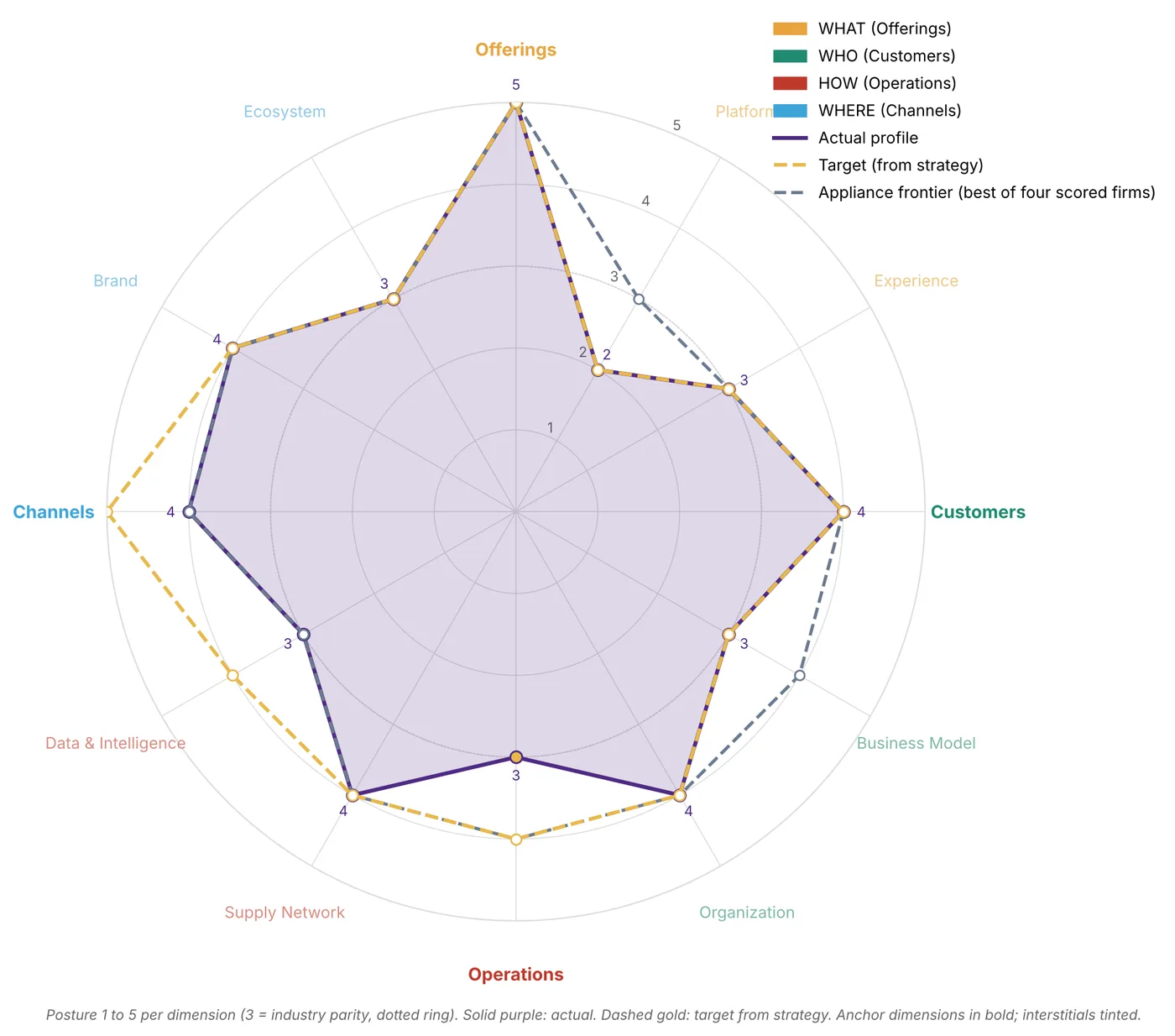
Read as a statement of intended asymmetry, the strategy names three dimensions to lead. Offerings carries a target of 5, because the company's theory of advantage is the five-star product delivered faster than rivals across forty subcategories. Channels carries a target of 5, because the international and omnichannel pillar and the direct and social build are where the company says growth will come from. Data and Intelligence carries a target of 4, because the insight engine is the stated source of the product edge and AI is the stated accelerant; the strategy does not claim AI leadership as an end in itself, so the target stops short of 5. Customers carries a target of 4 and a high weight, because the new-category pillar exists to bring new consumers into the brands, as beauty has done. Brand and Supply Network are floors at 4: the two billion-dollar brands and the social-first demand engine are what every launch trades on, and tariffs have made sourcing a quarterly earnings variable. Organization and Operations carry targets of 4 at low weight, because the 24-hour engineering cycle and the flat-headcount commitment are explicit. Experience, Business Model and Ecosystem are held at parity, and Platform is a deliberate valley at 2.
3.2 The twelve-dimension profile
Table 3 gives the profile. Every score of 4 or 5 carries a dated citation; Offerings is the one dimension that earns a 5, and Appendix A boxes its derivation because it is the score most likely to be contested. Effort shares by dimension are not public, so the effort column records the directional read the record allows.
Table 3. The twelve-dimension profile: target, actual, gap, priority weight, directional effort read and role, as of October 2026.
| Dimension | Target | Actual | Gap | Weight | Effort (directional) | Role |
|---|---|---|---|---|---|---|
| Offerings | 5 | 5 | 0 | 3 | High: most of $368 million R&D; 25 launches a year | Lead, defended peak |
| Platform | 2 | 2 | 0 | 1 | Low: companion apps only | Starve by choice |
| Experience | 3 | 3 | 0 | 1 | Medium: rebuilt sharkninja.com | Sustain |
| Customers | 4 | 4 | 0 | 3 | Medium: beauty, outdoor, new markets | Sustain |
| Business Model | 3 | 3 | 0 | 1 | Low: Subscribe and Save on consumables | Sustain |
| Organization | 4 | 4 | 0 | 1 | Medium: design hubs, Jailbreak | Sustain |
| Operations | 4 | 3 | −1 | 1 | Low to medium: Palantir, AWS, service AI | Watch; pilots unmeasured |
| Supply Network | 4 | 4 | 0 | 1 | High: re-sourcing out of China | Hold (floor) |
| Data & Intelligence | 4 | 3 | −1 | 3 | Low: recent and small against media | Lead; allocation gap |
| Channels | 5 | 4 | −1 | 3 | High: direct conversions, DTC, TikTok Shop | Lead; disclosure and conversion gap |
| Brand | 4 | 4 | 0 | 3 | High: $633 million advertising | Hold (floor) |
| Ecosystem | 3 | 3 | 0 | 1 | Low | Sustain |
Offerings earns its 5 on all three signals. The shipped record is dense: the Ninja Crispi glass air fryer and Crispi Pro, the Luxe Café espresso platform and the AutoBarista, the SLUSHi frozen drink maker, the CryoGlow mask and FacialPro skincare devices, the TurboBlade fan and ChillPill personal cooler, the FlexFlame and Fireside360 outdoor line, the PowerDetect UV Reveal robot, and in August 2026 the Crispi Microwave, which took the subcategory count to 40 and opened a pool management sizes at more than $3 billion (SharkNinja 2026c; SharkNinja 2026l). The measured outcome is on the dimension's own metric. Beauty and Home Environment grew 45 percent in 2025 and 65 percent in the second quarter of 2026; Cooking and Beverage grew 37 percent in that quarter on Luxe Café and Crispi; and SharkNinja grew its United States business 10 percent in the first quarter of 2026 while the market outside it shrank low to mid single digits on Circana data (SharkNinja 2026a; SharkNinja 2026h; SharkNinja 2026k). Recognition comes from outside the company: TIME named the CryoGlow mask one of its best inventions of 2025 (TIME 2025) and named SharkNinja to its 2025 list of the most influential companies, citing its innovation engine (SharkNinja 2025d), and the most telling form of recognition, imitation, arrived fast enough that SharkNinja sued a schedule of online sellers over SLUSHi copies in April 2026 (SharkNinja 2026j).
The same evidence shows where the peak is fragile, and that finding shapes the prescription. The peak rests on speed. In April 2026 the Paris division of the Unified Patent Court refused SharkNinja a preliminary injunction against Groupe SEB because its multi-function air fryer patent was "more likely than not invalid" (MLex 2026; Law360 2026). The long dispute with Dyson ended in a settlement in January 2025, with the United States case dismissed with prejudice and each side bearing its own costs (WIPR 2025; PatSnap 2025). SharkNinja holds about 1,087 issued United States patents (SharkNinja 2026c), and the record shows they deter copying less than cadence does. A 5 on Offerings is a 5 for as long as the launch cycle outruns the copy cycle.
Channels earns a 4 and falls one point short of its target. The shipped moves are large and dated: direct operations in the Nordics, Poland and Benelux in the fourth quarter of 2025, in Italy and Spain by mid-2026, and in Mexico in 2025, with South Africa launched in May 2026; a rebuilt DTC site on Salesforce live in the United States, Canada, the United Kingdom, Germany and France, heading for 14 European countries; and TikTok Shop live in seven countries in June 2026 against none a year earlier (SharkNinja 2026b; SharkNinja 2026h; SharkNinja 2026l). The outcome is measured for international sales, which grew 21 percent in 2025 and 37 percent in the second quarter of 2026 (SharkNinja 2026a; SharkNinja 2026k). Recognition is real: trade press analyzing seller data describes TikTok Shop in Europe as a market SharkNinja has preempted, with Carrefour and Darty responding (Mind Retail 2026). What holds the score at 4 is the missing outcome on the part of the strategy that changes the company's economics. SharkNinja discloses no DTC share, no social commerce revenue and no owned-channel margin. The financial statement notes name DTC as one of three customer types and give no figure for it (SharkNinja 2026n), and in September 2026 management declined to size TikTok Shop until it has a full fiscal year of sales (Investing.com 2026). The concentration figures move the other way. The largest customer took 19.9 percent of sales in 2023, 23.1 percent in 2024, 23.8 percent in 2025 and 26.5 percent in the second quarter of 2026, while the three largest together held near 45 to 46 percent across the three years (SharkNinja 2026n; SharkNinja 2026o). Merchant and processing fees, the cost line that tracks card and marketplace payments, grew 13.5 percent in 2025 to $80 million, slower than sales (SharkNinja 2026n). The best outside measure of the social build is a third-party estimate: SharkNinja storefronts took about 28.5 percent of 30-day revenue among the top 40 TikTok Shop storefronts in Germany, France, Spain and Italy in June and July 2026, about €10.8 million in 30 days, a figure the analyst marks as a ceiling (Lengow 2026). Annualized, that is about €130 million, or about 2 percent of forward sales. The chief financial officer says social commerce "does come at a higher structural gross margin" (SharkNinja 2026l); the company has not published the number.
Data and Intelligence is held at 3, and this is the pass-two finding of the report. The insight engine is real and old: the 10-K describes software that scours product reviews as part of an always-on consumer insight process (SharkNinja 2026c). In 2026 the company added AI that raised its capture of social conversation to more than 60 percent accuracy, after finding that fewer than 20 percent of user posts about its products carry a brand hashtag (SharkNinja 2026l), and AI now scores nearly every contact-center interaction against under 5 percent sampled before (SharkNinja 2026b). The raw material of this engine is public: reviews on Amazon, Walmart and Costco, and posts on TikTok and Instagram. Roborock, Dreame, Dyson and every Chinese marketplace seller can read the same reviews. The proprietary layer, consented first-party data on who owns which product and how they use it, is thin, because most units ship through retailers who own the customer record and few products report usage. The AI-enabled products are announcement grade: the PowerDetect UV Reveal uses on-device navigation AI and a UV camera (SharkNinja 2026d), the BreatheClear Max describes "intelligent" air analysis without the word AI (SharkNinja 2026e), and coverage of the AutoBarista calls it "AI-inspired" without describing a function (Simply Wall St 2026). No named measured outcome exists for the Palantir or AWS programs beyond management's "promising" phase one (SharkNinja 2026l). The financial statements show how small and how hidden the data investment is. SharkNinja reports its insight spending inside one line, "advertising expenses and consumer insight initiatives," of $632.9 million in 2025, so the insight share cannot be read; capitalized cloud software, the closest visible proxy for data infrastructure, was $47.8 million (SharkNinja 2026n). The rival overlay re-tests the gap and confirms it. Groupe SEB reports a consumer database of more than 50 million members and about one million monthly users of its cooking apps (Groupe SEB 2026a), the largest first-party consumer base disclosed by any firm in the comparison, and publishes no outcome from it. Dyson and Breville describe AI in products and processes and publish no consumer data outcome. Every scored firm stands at 3. Tier C evidence caps the score at parity.
Operations is held at 3, one point below a target the flat-headcount commitment sets. The programs are named and dated: promotions optimization with Palantir moving to a four-month phase two, a media optimization system with AWS live at the end of September 2026, and AI quality scoring in the contact center (SharkNinja 2026b; SharkNinja 2026l). Adjusted operating expense improved about 100 basis points as a share of sales in the first quarter, the fourth consecutive quarter of leverage (SharkNinja 2026h), and that is company-level leverage that sales growth alone would produce. The first program-level result appeared in September 2026, when management said the Palantir work had cut weekly point-of-sale analysis from days to about two hours (Investing.com 2026); the source is a conference summary, and the figure is a single process time with no financial effect attached. The rival overlay sets the bar higher. Breville filed four measured AI outcomes with its fiscal 2026 results in August 2026: recipe production 6.3 times faster, interface prototypes five times faster with firmware handoff two to three months earlier, and a 40-country launch built in eight months against 14 months for eight markets before AI (Breville Group 2026). That record earns Breville a 4 on Operations and makes it the frontier on this dimension. SharkNinja holds at 3 until it publishes a comparable ledger.
Supply Network and Brand hold their 4s. SharkNinja can now make nearly all United States volume outside China, dual-sources most products, and reports that about two-thirds of its business can switch production between China and other countries (SharkNinja 2026b; SharkNinja 2026h); in 2025 it expanded gross margin 90 basis points to 49.0 percent while absorbing tariffs (SharkNinja 2026a). The $247 million tariff refund expected in the third quarter of 2026 is a windfall and is excluded from the score (SharkNinja 2026k). Brand rests on two billion-dollar brands, a social following that grew 119 percent to 3.9 million in 2025 against 8 percent for peers, and a social-first marketing model that puts about 40 percent of digital spending into social channels (SharkNinja 2026c; Retail Brew 2025).
The remaining dimensions are treated briefly. Customers earns a 4: beauty has made Shark the leading facial skincare device brand in the United States on Circana data (SharkNinja 2025c) and has carried a segment to $826 million, and Latin America grew at triple-digit rates in 2025 (SharkNinja 2026b). Organization earns a 4: more than 700 cross-functional engineering and design associates at December 31, 2025 in the 10-K, more than 800 design engineers by the April 2026 court filing, consistent with the 100 software engineers hired in 2026 and the $13.2 million rise in research personnel cost that the second-quarter release attributes to higher headcount (SharkNinja 2026k), a 200-engineer hub at Battersea, a New York design center and a company-wide AI program with incentives (SharkNinja 2026c; SharkNinja 2026j; SharkNinja 2025c). Experience is parity: the rebuilt site shows higher engagement, conversion and order value with no figures (SharkNinja 2026c). Business Model is parity: Subscribe and Save on Thirsti flavor pods and HydraSense filters (SharkNinja 2026m) matches the appliance industry norm, and the launch practice of pricing new products high and adjusting to demand (SharkNinja 2026h) is disciplined pricing without a new model. Ecosystem is parity: retail, marketplace, technology and celebrity partnerships with no disclosed partner-originated revenue. Platform is a 2 by design.
3.3 What the drift means
The polygon matches its target on nine spokes and falls one point short on three. The Investment Index, the sum of the actual scores over the sum of the targets (equation 2), is 0.93, inside the 0.90 to 1.10 band the instrument calls adequate. The Shape Drift Index, half the sum of the absolute differences between each dimension's share of the actual profile and its share of the target (equations 3 and 4), is about 5 percent, at the boundary between aligned and tilted; it reads as the share of the portfolio's emphasis that must move to match the strategy. The tilts are three, each about 0.7 points below the size-adjusted target, on Data and Intelligence, Operations and Channels, with every other dimension carrying a small positive mix part of 0.1 to 0.3 that offsets them exactly (equations 5 and 6). The priority-weighted gap, the sum of the absolute gaps multiplied by strategic weight (equation 7), is 7 points, of which 6 fall on the two lead dimensions. The verdict cell is scale with a light steer: keep the envelope and the direction, and close the three gaps.
A near-perfect match carries its own warning, and we state it before the gaps. The strategy concentrates on Offerings, Channels and Brand, which is the classic consumer-goods concentration the instrument calls dimensional myopia, and the rival overlay in Section 5 shows Dyson, Groupe SEB and Breville all at 4 on Channels and Dyson level with SharkNinja on Brand. A firm that matches a target this closely should ask whether the target is still right. Section 6 escalates one play that argues it is not.
The two headline gaps call for opposite remedies. Channels carries high effort: four waves of distributor conversions, a DTC platform rebuild across 14 countries and a TikTok Shop expansion from zero to seven countries in a year. Effort that high against a posture held down by missing measurement is a disclosure and conversion gap. The remedy is to instrument and publish the owned-channel share and margin, never to spend more on the build. Data and Intelligence carries low effort relative to the two budgets that dwarf it. The company spends about $740 million a year on advertising at the 2025 rate and about $430 million on research, and the visible data investment is 100 software engineers, two partner programs and a $1 million prize pool. Low effort against a lead target is an allocation gap, and the remedy is to fund it now. The tariff refund supplies the money: management has said it may reinvest part of the 2026 portion in retail activation, media, technology and AI (SharkNinja 2026k), and the drift says the share going to media should go to the data spine instead. Operations is a smaller version of the data gap, and the same programs close it.
4. What we grow, what we hold, and what we kill
The public record yields 21 live bets, listed in Table 4 with the dimension each advances and its verdict against the target. Spend by bet is not public, so the ledger adjudicates posture and role. The kill list carries two entries: a patent enforcement approach the courts have weakened, and a proposed use of one-time money that would pile into a dimension already at its floor.
Table 4. The adjudication ledger: 21 live bets from the public record, with primary dimension, stage and verdict.
| Bet | Primary dimension (secondary) | Stage | Verdict | Rationale |
|---|---|---|---|---|
| Two or more new subcategories a year (39th outdoor air blaster, 40th Crispi Microwave, 41st due Q3 2026) | Offerings (Customers) | Scaling | Grow | The new-category pillar; each entry adds a measured pool |
| Ninja Luxe Café and AutoBarista | Offerings | Scaling | Grow | Best-selling United States espresso SKU in under a year; two renovations in 2026 |
| Ninja Crispi franchise, global rollout | Offerings | Scaling | Grow | Driver of 37 percent Cooking and Beverage growth in Q2 2026 |
| Shark Beauty skincare and hair, skincare launches over 12 to 18 months | Customers (Offerings) | Scaling | Grow | Brings new consumers; segment up 65 percent in Q2 2026 |
| Fans and personal cooling, European scale-up | Offerings | Scaling | Grow | Sold out in Q2 2026; scale in Europe in 2027 |
| Outdoor (FlexFlame, Fireside360, grills, fire pits) | Offerings | Early scale | Hold | No disclosed outcome; seasonal and propane-regulated |
| Wellness category, possible 2027 entry | Offerings (Customers) | Concept | Hold | Undefined; enter through the two-a-year gate when scoped |
| Core cleaning renovation (corded uprights, cordless, carpet extraction) | Offerings | Mature | Hold | Cleaning grew 4 percent in Q2 2026; defend share |
| PowerDetect UV Reveal and AI-enabled robotics, coffee and purification | Offerings (Data & Intelligence) | Launched 2026 | Grow, gated | Grow on a published outcome per product: stain removal, return rate, app retention |
| International direct conversions (Nordics, Poland, Benelux, Italy, Spain, Mexico, South Africa; Ecuador and Peru next) | Channels (Customers) | Scaling | Grow | International up 37 percent in Q2 2026; penetration under 10 percent in EMEA |
| DTC platform on Salesforce, 14 European countries by Q4 2026 | Channels (Experience) | Scaling | Grow, with disclosure | Grow on condition that owned-channel share and margin are published |
| TikTok Shop expansion, 7 to 13 or more countries | Channels (Brand) | Scaling | Grow | Higher structural gross margin by management's account; preempted position in Europe |
| Social-first marketing and celebrity collaborations | Brand | Mature | Hold (floor) | Advertising at 9.9 percent of sales; hold the share, do not add |
| Jailbreak SharkNinja, 100 software engineers, AI Sharks | Organization (Data & Intelligence) | Scaling | Grow | Builds the lead gap; tie prizes to measured outcomes |
| Palantir promotions optimization, phase two | Operations (Business Model) | Pilot | Grow, gated | Scale only past a pre-agreed promotional margin hurdle against a control region |
| AWS media optimization | Operations (Brand) | Launched Sept 2026 | Grow, gated | Same governance; measure media return in test cells against a control group |
| AI quality scoring in the contact center | Operations | Scaling | Hold | Instrumented; extend from scoring to resolution (Section 6) |
| Supply diversification and dual sourcing; JS Global sourcing agreement ended | Supply Network | Mature | Hold (floor) | The floor that absorbed 2025 tariffs; protect it |
| Battersea hub and New York design center | Organization | Scaling | Hold | Sound architecture for the 24-hour cycle |
| Utility patent enforcement on cooking platforms (UPC action against Groupe SEB) | Offerings | Contested | Fix or kill | Patent found likely invalid; shift protection toward speed, design rights and marketplace takedowns |
| Reinvesting part of the 2026 tariff refund in incremental media | Brand | In progress | Kill (redirect) | Brand is at its floor and heavily funded; by September 2026 the refund was offsetting commodity costs, pulling 2027 projects forward and held partly in reserve; send the unspent share to the data spine |
The reallocation story is small in budget terms and large in direction. Nothing in the ledger needs new research money. The capital at stake is the 2026 half of the tariff refund, about $124 million of which flows into adjusted results (SharkNinja 2026k). In September 2026 the chief financial officer said the refund was offsetting commodity costs already in 2026, that some projects had moved forward from 2027, and that part was held in reserve against competitive pressure the company had not yet seen (Investing.com 2026); the reserve is the money this report asks to redirect. Redirecting even a third of it from media to first-party data and connected-product software would roughly double the visible data investment for a year. The other movements are governance: the Palantir and AWS programs move from promising pilots to measured ones with control groups, the DTC build moves from a platform project to a disclosed channel, and patent enforcement moves from utility patents on cooking functions toward design rights and automated marketplace takedowns that match the speed of the copy cycle.
5. Where we stand against the field
We scored three rivals on the same twelve dimensions, under the same evidence tiers, from their own public records: Dyson, the premium rival in cleaning, hair care and purification; Groupe SEB, the largest small-appliance maker in the comparison and SharkNinja's opponent in the air fryer patent case; and Breville Group, the closest rival in espresso and food preparation. Conair is private and publishes too little to score. Rival scores are outside-in reads at low to medium confidence, and each one is derived in Appendix A. Table 5 sets the four profiles side by side with the frontier line, which takes the highest posture any of the four firms reaches on each dimension, and Figure 2 draws SharkNinja against each rival.
Table 5. The competitor overlay: SharkNinja and three rivals scored on the twelve dimensions from the public record, with the frontier line and the zone each dimension falls in, October 2026.
| Dimension | SharkNinja | Dyson | Groupe SEB | Breville | Frontier | Zone |
|---|---|---|---|---|---|---|
| Offerings | 5 | 4 | 3 | 4 | 5 | Divergence, SharkNinja leads |
| Platform | 2 | 2 | 3 | 3 | 3 | Rivals lead; SharkNinja starves by choice |
| Experience | 3 | 3 | 3 | 3 | 3 | Convergence at parity |
| Customers | 4 | 3 | 3 | 3 | 4 | Divergence, SharkNinja leads |
| Business Model | 3 | 3 | 4 | 4 | 4 | Divergence, Groupe SEB and Breville lead |
| Organization | 4 | 3 | 3 | 3 | 4 | Divergence, SharkNinja leads |
| Operations | 3 | 3 | 3 | 4 | 4 | Divergence, Breville leads |
| Supply Network | 4 | 3 | 4 | 4 | 4 | Convergence at 4; Dyson lags |
| Data & Intelligence | 3 | 3 | 3 | 3 | 3 | Convergence at parity; white space at 4 |
| Channels | 4 | 4 | 4 | 4 | 4 | Convergence at 4 |
| Brand | 4 | 4 | 3 | 3 | 4 | Shared lead with Dyson |
| Ecosystem | 3 | 3 | 3 | 3 | 3 | Convergence at parity |
| Sum of scores | 42 | 38 | 39 | 41 | 45 |
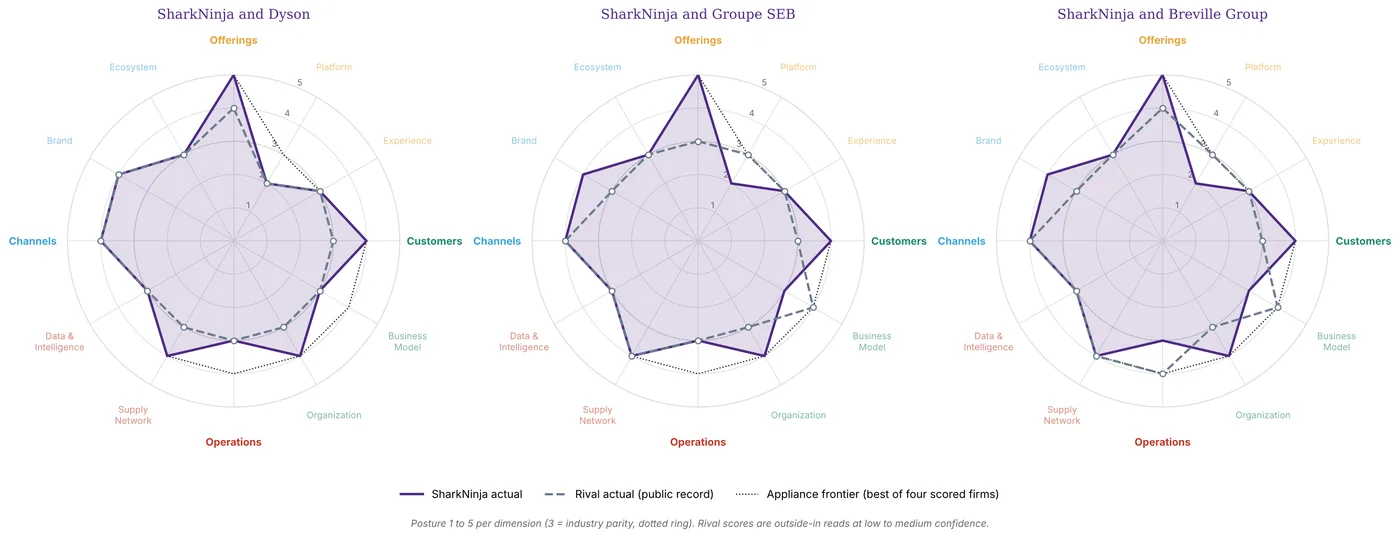
The product lead is real, and the growth record confirms it. SharkNinja grew 16 percent in 2025 and 22 percent in the second quarter of 2026. Dyson's revenue fell about 7 percent in 2025, its second year of decline, even though it launched a record 13 products on more than £400 million of research (Dyson 2026; Business Matters 2026). Groupe SEB grew 0.3 percent like for like in 2025 and 1.7 percent in the first half of 2026 on about €320 million of innovation spending, and its new plan commits it to cut development time by a third, which is the speed SharkNinja already has (Groupe SEB 2026a; Groupe SEB 2026b). Breville grew 9.7 percent in constant currency in fiscal 2026 on coffee and cooking launches (Breville Group 2026). SharkNinja is the only firm of the four at 5 on Offerings, and it also leads alone on Customers and Organization. Those three spokes, with Brand, carry its sum of 42 against 38 to 41 for the rivals.
The frontier line exceeds SharkNinja on three spokes, and each one reads differently. On Platform, Groupe SEB's cooking apps and connected professional coffee machines and Breville's beanz roaster marketplace sit one point above a valley SharkNinja has chosen; the valley stands. On Business Model, Groupe SEB earns about a third of its professional revenue from service and spare parts and labels more than 90 percent of its small appliances repairable for 15 years, and Breville sells specialty coffee on subscription through beanz (Groupe SEB 2026a; Breville Group 2026). Two rivals at 4 strengthen the case for the owner membership escalated in Section 6. On Operations, Breville is the frontier because it publishes measured AI outcomes, and that is the gap SharkNinja's own target already names.
The overlay changes how the three gaps should be read. Channels is a convergence zone. Groupe SEB sells 45 percent of consumer sales online, grew its own brand sites 19 percent in 2025, runs about 1,300 dedicated stores and opened 13 TikTok Shops outside China in 2025; Breville has converted distributors to direct operations in China, the Middle East, Korea and Mexico, where sales grew 74 percent; Dyson has run its own stores since 2000 (Groupe SEB 2026a; Breville Group 2026; Dyson 2022; Fortune 2024). SharkNinja's international conversions match that pattern; what it alone holds is the social commerce lead, which the trade data confirm (Lengow 2026). A 5 on Channels will therefore come from proving that lead changes margins and reduces dependence on the largest retailer, and more conversions will not supply it. Data and Intelligence is convergence at parity with white space above it: every firm stands at 3, Groupe SEB owns the largest disclosed consumer base and has published no result from it, and the first firm to show a measured return on first-party data will hold a lead no rival in this set has. Dyson's Spot+Scrub Ai and Shark's PowerDetect UV Reveal shipped the same vision-based stain detection within six months of each other, which places AI features inside products in the table stakes (Dyson 2026; SharkNinja 2026d). Operations is the one gap where a named rival is ahead, and Breville's filing shows the form of evidence SharkNinja needs to publish.
The earlier read named a consented first-party data spine as white space for every appliance maker. The overlay corrects that claim: Groupe SEB already holds such a base at scale. The white space that remains is a measured one, a published return on owner data, and SharkNinja's direct site, social audience and launch cadence give it the means to fill it first.
6. The net-new bets
The generation pass swept the twelve dimensions as lenses, heated by the weighted gaps, and produced 52 raw candidates. The strategy gate removed eight already in motion (AI-enabled coffee, purification and robotics products; the wellness category; Palantir phase two; AWS media optimization; distributor-to-direct conversions; TikTok Shop expansion; the European DTC rollout; local creator networks), parked one for thickening the Platform valley, and escalated one as a strategy question. Five were vetoed at scoring. Thirty-seven survive with scores. Each is scored on three rings from 1 to 5: Real (is the underlying shift durable, large and specific to SharkNinja), Worth (what is the play worth against the wedge and the drift, with any 4 or 5 carrying an order-of-magnitude prize priced through the dimension's P&L signature), and Win (can SharkNinja win rather than merely enter, drawn from its asset inventory). The rings multiply (equation 8), so a composite runs from 1 to 125, and any ring at 1 vetoes the play. Boldness is graded Extend, Stretch, Step out or Transform.
Table 6. The scored net-new plays, ranked by composite, with primary dimension, boldness grade, ring scores and verdict.
| ID | Play | Dimension (boldness) | R | W | Wn | Score | Verdict |
|---|---|---|---|---|---|---|---|
| D3 | AI concept-to-prototype pipeline with a published cycle-time ledger (concept to tooling, tooling to shelf) | Data & Intelligence, Operations (Extend) | 5 | 4 | 5 | 100 | Pursue now |
| D1 | Consented first-party consumer data spine joining DTC, TikTok Shop, product registration, warranty and service records | Data & Intelligence, Customers (Stretch) | 5 | 4 | 4 | 80 | Pursue now |
| D2 | Connected-product learning loop: usage data from robots, Luxe Café, purifiers and smart SLUSHi feeding post-launch iteration | Data & Intelligence, Offerings (Stretch) | 5 | 4 | 4 | 80 | Pursue now |
| D4 | Returns, reviews and service root-cause loop to cut return, warranty and recall cost | Data & Intelligence, Operations (Extend) | 4 | 4 | 5 | 80 | Pursue now |
| Op1 | Agentic service resolution, extending contact-center AI from scoring to fixing, toward flat headcount | Operations (Extend) | 4 | 4 | 5 | 80 | Pursue now |
| B5 | Launch price testing in DTC test cells against a control group | Business Model, Data & Intelligence (Extend) | 4 | 4 | 4 | 64 | Pursue next |
| S2 | AI should-cost models and supplier cost-down across the dual-source base | Supply Network (Extend) | 4 | 4 | 4 | 64 | Pursue next |
| D5 | Viral demand sensing and launch allocation across 38 markets | Data & Intelligence, Supply Network (Extend) | 4 | 4 | 4 | 64 | Pursue next |
| Br1 | Shark Beauty clinical evidence program and a distinct beauty-technology brand architecture | Brand, Customers (Stretch) | 4 | 4 | 4 | 64 | Pursue next |
| Org1 | AI product squads: the 100 software engineers embedded in category teams on the two-week cycle | Organization (Extend) | 4 | 3 | 5 | 60 | Pursue next |
| Ch1 | Owned-channel ledger: publish DTC and social commerce share and margin, and route social demand to owned checkout | Channels (Extend) | 5 | 3 | 4 | 60 | Pursue now |
| O3 | Mid-priced robot line for United States retailers after iRobot's bankruptcy | Offerings, Customers (Extend) | 4 | 4 | 3 | 48 | Pursue next |
| B1 | Beverage consumables attach on Luxe Café, Thirsti and SLUSHi through DTC | Business Model (Extend) | 4 | 4 | 3 | 48 | Pursue next |
| Ch5 | Retail media data exchange with the three largest retailers | Channels, Data & Intelligence (Extend) | 4 | 4 | 3 | 48 | Pursue next |
| S1 | Final assembly in Mexico for the United States and Latin America | Supply Network (Step out) | 4 | 4 | 3 | 48 | Pursue next |
| Ch3 | Direct operations in the Gulf states | Channels (Extend) | 4 | 3 | 4 | 48 | Pursue next |
| Ch6 | Brazil entry with the Mercado Libre partnership | Channels (Extend) | 4 | 3 | 4 | 48 | Pursue next |
| Org3 | Innovation vitality metric (sales from products under three years old) in the annual incentive | Organization (Extend) | 4 | 3 | 4 | 48 | Pursue next |
| D8 | AI brand protection that finds and files against copy listings within days of launch | Data & Intelligence, Brand (Extend) | 4 | 3 | 4 | 48 | Pursue next |
| D9 | Product data built for AI shopping assistants on retailer and general platforms | Data & Intelligence, Channels (Extend) | 4 | 3 | 4 | 48 | Pursue next |
| C4 | First-home starter bundles sold through creators | Customers, Channels (Extend) | 4 | 3 | 4 | 48 | Pursue next |
| X1 | Creator co-design program with a revenue share | Ecosystem, Brand (Extend) | 4 | 3 | 4 | 48 | Pursue next |
| B2 | Certified refurbished and trade-up program on DTC | Business Model, Brand (Extend) | 4 | 3 | 4 | 48 | Pursue next |
| X2 | Retailer co-developed exclusives built from shared sell-through data | Ecosystem, Channels (Extend) | 3 | 3 | 4 | 36 | Watch |
| B3 | In-house protection plans sold on DTC | Business Model (Extend) | 3 | 3 | 4 | 36 | Watch |
| E1 | One owner companion app across Shark and Ninja | Experience, Data & Intelligence (Stretch) | 4 | 3 | 3 | 36 | Watch, feeds D1 |
| E2 | AI cooking assistant for onboarding on Ninja appliances | Experience (Extend) | 3 | 3 | 4 | 36 | Watch |
| C2 | Ageing-in-place line: robotics, purification and easy-grip kitchen designs for older households | Customers (Step out) | 4 | 3 | 3 | 36 | Watch |
| O6 | Design for repair with swappable batteries across cordless lines | Offerings (Extend) | 3 | 3 | 4 | 36 | Watch |
| Op2 | Supplier qualification twin to shorten time to a second source | Operations, Supply Network (Stretch) | 3 | 3 | 4 | 36 | Watch |
| Ch2 | India entry through marketplaces | Channels (Step out) | 4 | 4 | 2 | 32 | Watch |
| P2 | Matter interoperability for robots and purifiers | Platform (Extend) | 4 | 2 | 4 | 32 | Watch, capped at floor |
| C1 | Men's grooming beyond hair | Customers (Stretch) | 3 | 3 | 3 | 27 | Watch |
| S3 | India sourcing node | Supply Network (Stretch) | 3 | 3 | 3 | 27 | Watch |
| Org2 | Regional product hub in Mexico City for Latin American designs | Organization (Stretch) | 3 | 3 | 3 | 27 | Watch |
| O4 | Modular countertop base with interchangeable cooking attachments | Offerings (Step out) | 3 | 3 | 2 | 18 | Re-scope |
| B4 | Robot vacuum subscription with swap and repair | Business Model (Step out) | 2 | 2 | 2 | 8 | Re-scope |
Ch1 earns a pursue-now verdict at a composite of 60 because it is the disclosure that moves the Channels score; its Worth ring stays at 3 because SharkNinja publishes no owned-channel margin to price it against. Five plays were vetoed and are displayed with the failing ring. Large kitchen appliances (Offerings, Transform) scored 3 on Real, 4 on Worth and 1 on Win, because SharkNinja has no installation or field-service network and its cadence advantage does not apply to ten-year replacement cycles. A chain of owned stores (Channels, Step out) scored 1 on Win against a model built on retailers that carry 46 percent of sales. A consumer financing arm (Business Model, Step out) scored 1 on Win. A proprietary home AI foundation model (Data and Intelligence, Transform) scored 1 on Win against hyperscaler scale. Entry into mainland China (Channels, Step out) scored 1 on Win, because local makers lead every category SharkNinja would enter and match its speed at lower cost. One play was parked at the gate: an open recipe and pod platform with third-party creators and a revenue share thickens the Platform valley the strategy refuses.
One play was escalated rather than scored. A Shark and Ninja owner membership (Experience and Business Model, Stretch) would combine consumables, extended protection, early access to launches, trade-up credits and app features under one paid tier sold on the owned channels. It scores high enough on Real and Win to argue that the Experience and Business Model targets should rise from 3 to 4, and the overlay in Section 5 adds weight: Groupe SEB and Breville already stand at 4 on Business Model through service revenue and coffee subscriptions, which would move SharkNinja from selling products to owning a relationship with the households that buy them. The purpose finding in Section 1 cuts against it: a company that designs filters out of its purifiers will need to show the membership adds value to the owner. That is a decision for leadership, and Section 8 records it as open.
Four reinforcing combinations score higher together than apart. The first, the owned demand loop, pairs D1 the data spine with Ch1 the owned-channel ledger and E1 the companion app: social demand lands on owned checkout, the buyer registers, and the registration feeds the insight engine with data no rival can read. The second, learn after launch, pairs D2 connected-product learning with D4 the returns loop, D3 the cycle-time pipeline and D8 brand protection: it makes the product peak depend on a learning rate, which is harder to copy than a patent claim, and it is the direct answer to the Groupe SEB ruling. The third, the flat-headcount program, pairs Op1 agentic service with Org1 AI squads and S2 should-cost models. The fourth, robots after iRobot, pairs O3 the mid-priced robot line with D2 and P2.
The two-currency reconciliation closes in posture and splits in dollars. In posture points, D1, D2, D3 and D4 supply the named, measured, published outcomes that lift Data and Intelligence from 3 to 4 within 18 to 24 months; Op1 with the gated Palantir and AWS programs lifts Operations from 3 to 4 when one program publishes a measured result against a control group; and Ch1 supplies the disclosure that, with continued international growth and the recognition already in the record, lifts Channels from 4 to 5. In dollars, the revenue-bearing plays (D1 with D2 and Ch1, O3, Ch3 and Ch6, B1) are worth $240 to $480 million of annual revenue by fiscal 2028 before any hit rate, and $120 to $240 million at a 50 percent portfolio hit rate, against a wedge of $225 to $300 million a year. The net-new portfolio covers about half to most of one year's wedge on its own and shares the rest with the bets already in flight, principally the two-subcategory cadence, the Crispi global rollout and the European direct build. The spend the portfolio implies, mostly software engineers already being hired plus the redirected tariff refund, fits inside the certified envelope. The dial we recommend is to improve the portfolio: hold the double-digit ambition, hold the envelope, and run the plays against the hurdles in Section 7.
7. What will move the P&L
A radar score converts to money only through initiatives, on a lag, at a rate set by each dimension's operating metric and a unit coefficient computed from SharkNinja's own disclosed margin structure. Table 7 prices the five rows that pass the screen; each was graded High or defensible Medium on the weakest of pool size, responsiveness and durability. The coefficient bases are stated so a finance team can rerun them.
One coefficient underlies the revenue rows and deserves its own sentence. SharkNinja earned 49.0 percent gross margin in 2025 and spent 22.8 percent of sales on sales and marketing, which carries advertising, distribution and fulfillment (SharkNinja 2026a). Treating research and administration as fixed, an incremental dollar of revenue contributes about 26 cents to EBITDA. That is the figure the bridge uses for revenue rows, and it is lower than the 49 percent gross margin an enthusiastic reading would apply.
Table 7. The Innovation P&L Bridge: priced rows with operating metric, unit coefficient and basis, targeted movement, gross impact, lag and proof metric.
| Bet | Operating metric | Unit coefficient and basis | Targeted movement | Gross impact | Lag | Proof metric |
|---|---|---|---|---|---|---|
| D3 with Org1 and Op1: AI productivity toward flat headcount | Adjusted operating expense as a share of sales | About $37 million EBITDA per 50 basis points on a $7.46 billion forward base; adjusted operating expense ran about 35 percent of sales in Q1 2026 (SharkNinja 2026g; SharkNinja 2026h) | 25 to 50 basis points beyond the leverage sales growth produces | $19 to $37 million | In-year to 2 years | Operating expense ratio; headcount; concept-to-shelf cycle time |
| D4: returns, warranty and recall cost | Returns and quality cost as a share of sales | About $7.5 million per 10 basis points of net sales at full flow-through, forward base. Warranty provisions were $57.0 million in 2025, 89 basis points of sales against 76 in 2024; the year-end returns accrual was $59.8 million (SharkNinja 2026n) | 15 to 30 basis points: reverse the 2025 rise in warranty cost and cut returns modestly; the returns flow is not disclosed | $11 to $23 million | 1 to 2 years | Return rate by SKU; warranty provisions; recall accruals |
| B5: launch price testing in DTC test cells | Realized price | About $34 million EBITDA per 50 basis points of realized price: forward base × 0.5 percent × 90 percent flow-through | 25 to 50 basis points | $17 to $34 million | 1 year | Realized price in test cells against a control group |
| D1 with D2 and Ch1: owned demand and learning loop | Revenue from owned channels and repeat purchase | 26 percent contribution on incremental revenue: 49.0 percent gross margin less 22.8 percent sales and marketing, fiscal 2025 (SharkNinja 2026a) | $100 to $200 million of incremental revenue by fiscal 2028; illustrative | $26 to $52 million | 2 to 3 years | Owned-channel share; registered owners; repeat rate |
| S2: AI should-cost and supplier cost-down | Landed cost | About $17 million per 50 basis points of a $3.8 billion forward cost of sales (51 percent of the forward base) at 90 percent flow-through (SharkNinja 2026a) | 50 to 100 basis points | $17 to $34 million | In-year to 2 years | Landed cost per unit on the top 100 SKUs |
The stack is $90 to $180 million of gross annual impact by fiscal 2028. A 40 percent execution haircut, the rate defensible for a company running a European direct build, a DTC platform rollout and two new subcategories a year at the same time, brings it to $54 to $108 million, which we round to $55 to $110 million: 4 to 8 percent of a fiscal 2026 adjusted EBITDA base of about $1.36 billion, the midpoint of the August 2026 outlook. The range is wide because one row rests on an illustrative movement and the returns row on a partly disclosed base; the pilots in Section 9 narrow it. The Data and Intelligence multiplier is set at one, because the dimension is at parity and not below it; if the data spine lifts it to 4, the responsiveness of the AI-dependent rows improves and the bridge should be re-priced at the 2027 re-read. No in-year conversion of a long-lag row is promised: the owned demand loop pays in 2028 and compounds after.
Governance is the condition on every row. Each coefficient is a prior; the pilot produces the posterior. B5 runs in two DTC markets for two quarters with a pre-agreed hurdle of 25 basis points of realized price against a control market. D4 runs on the 50 highest-volume SKUs with a hurdle of 15 basis points of returns and warranty cost. Op1 runs in one region's contact center with a hurdle on cost per resolved contact. D1 runs in the United Kingdom, where DTC and TikTok Shop are both live, with a hurdle on registered owners per unit sold. Nothing scales before its hurdle, and no coefficient is negotiated backward from the double-digit ambition the agenda serves.
8. What we will not do
The valleys are choices, stated with the same confidence as the peaks. SharkNinja will not build a Platform in this cycle: no open pod or recipe platform, no third-party developer program and no smart-home hub of its own; it will meet the Matter interoperability floor and stop there. It will not enter large appliances, open owned stores, start a financing arm, train its own foundation model or enter mainland China. It will not add media spending from the tariff refund, because Brand is at its floor and already carries $633 million of advertising. It will not lift research intensity to chase the ambition, because the yield test says the budget is adequate. It will not rely on utility patents as the primary defense of its cooking franchises after the Groupe SEB ruling; it will defend with cadence, design rights and fast takedowns. The owner membership remains open as a strategy question: if leadership answers yes, the Experience and Business Model targets move to 4 and the profile is re-read.
Two floors are held even though SharkNinja will not lead there: Brand at 4, because every launch trades on the two brands and the social audience, and Supply Network at 4, because United States tariff rates on its sourcing countries changed several times between 2025 and mid-2026 and the dual-source base absorbed each change. The deliberately parked plays stay visible. India entry is held at watch because the company has no channel or sourcing presence there. The robot subscription and the modular countertop base are re-scoped because SharkNinja holds no reverse-logistics capability and the attachment economics are unproven.
9. What happens next
The 90-day program has seven commitments, each with an owner by role.
- Publish the owned-channel ledger. The chief financial officer reports DTC and social commerce share of sales and their gross margin against wholesale, by region, in the fourth-quarter 2026 results, alongside the return rate and warranty cost as a share of sales.
- Redirect the tariff refund. The chief executive and the chief financial officer commit the share of the 2026 refund earmarked for media to the data spine (D1) and connected-product software (D2), and report the amount at the fourth-quarter call.
- Start the data spine pilot in the United Kingdom. The chief digital officer joins DTC, TikTok Shop, registration and service records for consenting owners, with a hurdle on registered owners per unit sold.
- Publish the first AI outcome ledger. The executive sponsor of Jailbreak SharkNinja reports the Palantir and AWS results against control groups and the concept-to-shelf cycle time for the 2026 launches, in the fourth-quarter 2026 materials.
- Run the launch price test. The DTC leader sets up test cells and a control market for two early-2027 launches against the 25-basis-point hurdle.
- Add the vitality metric. The compensation committee adds sales from products under three years old to the 2027 annual incentive alongside sales and profit growth.
- Schedule the re-read. The profile is re-scored after the fiscal 2026 10-K in early 2027, the first annual report filed as a domestic issuer, when owned-channel figures, the AI ledger and the full-year research spend arrive; Data and Intelligence, Channels and Operations are the scores capped by pending disclosure, and the yield test is rerun against the 2027 research budget.
Appendix A. Source Ledger
Run header. Run date October 12, 2026; scope SharkNinja as one business with one value chain (Shark and Ninja across Cleaning, Cooking and Beverage, Food Preparation, and Beauty and Home Environment, domestic and international, which the company reports as one segment). Two passes completed: pass one assembled the 2025 Annual Report and 10-K with the shareholder letter, the fourth-quarter 2025, first-quarter 2026 and second-quarter 2026 results and calls, the third-quarter 2025 results and call, the fourth-quarter 2024 call, the first-quarter 2026 10-Q and the 2026 proxy; pass two hunted dimension by dimension through product releases, court filings and patent decisions, rival results, analyst coverage and trade press. We found no investor day in the period, and SharkNinja publishes no multi-year financial framework; the growth target is taken from management's stated ambition, guidance and the incentive plan. Sources counted: 66 after the top-up pass (Tier A 19, Tier B 27, Tier C 10, Tier D 9, and the method paper). Sources rejected at the provenance gate: 13, listed below. Coverage gaps flagged low confidence: effort shares by dimension (not public); DTC and social commerce share and margin (not disclosed in the filings; bounded from outside by third-party TikTok Shop estimates); the returns flow (only the year-end accrual is disclosed); culture (unobservable). Changes against the earlier outside-in read: eleven of twelve scores, all targets and all weights held; Operations moved from 4 to 3, because the earlier read inferred it without evidence and the deep pass found programs at pilot stage with no published outcome; Supply Network gained a named floor at 4; the yield test now runs, at about 2.4 on the research envelope against a historical yield of 3 to 4.
Top-up pass, October 12, 2026. The pass scored three rivals on the twelve dimensions, re-tested the Channels, Data and Intelligence and Operations gaps against them, read the financial statement notes of the 2025 Form 10-K and the second-quarter 2026 Form 10-Q, and read trade press and analyst coverage published since July 2026. Seventeen web searches were used. The narrative body of both filings, including Item 7, could not be read: the fetch tool returned the 10-K text only through the risk factors and the 10-Q text only through Note 6, at the SEC primary documents, the annual report PDF and paged offsets alike, and the filing index and the XBRL note pages (R pages) supplied the figures instead. No SharkNinja score moved. Channels held at 4: the notes disclose no DTC figure, the largest customer's share rose from 23.8 percent in 2025 to 26.5 percent in the second quarter of 2026, and all three rivals also stand at 4. Data and Intelligence held at 3: every scored firm is at 3, and Groupe SEB's 50-million-member database corrected the earlier claim that no rival holds a first-party consumer base. Operations held at 3: one process-time result from a conference summary (Tier D) does not meet the Tier A or B gate, while Breville's filed outcomes earn it a 4. The drift metrics, the yield test and all verdicts are unchanged; the recomputed drift metrics give an Investment Index of 0.93, a Shape Drift Index of about 5 percent and a priority-weighted gap of 7. Corrected and added numbers: warranty provisions $57.0 million in 2025 (0.89 percent of sales, up from $42.2 million and 0.76 percent), warranty liability $38.2 million at year-end and $35.5 million at June 30, 2026; accrued returns $59.8 million against $86.6 million a year earlier; accrued customer incentives $409.7 million against $291.4 million; largest customer 19.9, 23.1 and 23.8 percent of sales in 2023 to 2025 and 26.5 percent in the second quarter of 2026; merchant and processing fees $80.0 million, up 13.5 percent; "advertising expenses and consumer insight initiatives" $632.9 million as one line. Research headcount is reconciled: more than 700 engineering and design associates at December 31, 2025 (10-K) and more than 800 design engineers by April 2026 (court filing) describe one population growing with the 2026 software hires; the figure of 1,000 appears only in Zacks commentary with no stated basis and is dropped. The D4 bridge row moved from an illustrative 20 to 40 basis points to 15 to 30 basis points anchored on disclosed warranty cost; gross bridge impact moved from $94 to $187 million to $90 to $180 million, and the net figure stays at $55 to $110 million after rounding. The polygon now carries the frontier line, and Figure 2 adds the rival overlay.
Table 8. The Source Ledger: sources counted, with date, tier and use.
| ID | Source | Date | Tier | Used for |
|---|---|---|---|---|
| S1 | SharkNinja, 2025 Annual Report, Form 10-K and shareholder letter | Feb to Apr 2026 | A | Strategy, engineers, patents, customers, sourcing, advertising, AI plans, domestic filer status |
| S2 | SharkNinja, Q4 and full-year 2025 results (Form 6-K Exhibit 99.1) | Feb 11, 2026 | A | FY2025 sales, segments, margins, R&D, outlook |
| S3 | SharkNinja, Q4 2025 earnings call (roic.ai transcript) | Feb 11, 2026 | A | AI products, 100 engineers, contact center AI, sourcing, social followers |
| S4 | SharkNinja, Q1 2026 results release | May 6, 2026 | A | R&D drivers, margins, EBITDA |
| S5 | SharkNinja, Q1 2026 earnings call (Motley Fool transcript) | May 6, 2026 | A | 39th subcategory, Jailbreak, DTC, Circana, opex leverage |
| S6 | SharkNinja, Form 10-Q for Q1 2026 | May 2026 | A | Related-party costs, prototypes, recall, segment |
| S7 | SharkNinja, Q2 2026 results (Form 8-K Exhibit 99.1) | Aug 5, 2026 | A | Q2 figures, raised outlook, tariff refund |
| S8 | SharkNinja, Q2 2026 earnings call (Motley Fool and roic.ai transcripts) | Aug 5, 2026 | A | 40 subcategories, AI programs, TikTok Shop, flat headcount, growth algorithm |
| S9 | SharkNinja, Q3 2025 results release | Nov 6, 2025 | A | Q3 figures, JS Global fee |
| S10 | SharkNinja, Q3 2025 earnings call (roic.ai transcript) | Nov 6, 2025 | A | 50 percent outside the United States, JS Global agreement end, design centers |
| S11 | SharkNinja, Q4 2024 earnings call (corrected transcript) | Feb 13, 2025 | A | "Long-term double-digit growth company"; 2024 growth |
| S12 | SharkNinja, 2026 proxy statement (DEF 14A) | Apr 27, 2026 | A | Incentive metrics, board, JS Global links |
| S13 | SharkNinja v. Schedule A defendants, complaint, S.D. Fla. No. 1:26-cv-23083 | Apr 30, 2026 | A | SLUSHi copying, 800 design engineers |
| S14 | Docket summary, SharkNinja v. Dyson, D. Mass. No. 1:23-cv-12372 (PatSnap) | Feb 2025 | B | Dismissal with prejudice, Jan 31, 2025 |
| S15 | Dyson, 2025 financial results | Mar 26, 2026 | A | Rival revenue, EBITDA, R&D, launches, Spot+Scrub Ai |
| S16 | MLex, UPC Paris refuses SharkNinja injunction against Groupe SEB | Apr 13, 2026 | B | Patent likely invalid |
| S17 | Law360, "SharkNinja Can't Block Rival's Cooker Sales At UPC" | Apr 13, 2026 | B | Corroboration of S16 |
| S18 | World IP Review, Dyson and SharkNinja settle | Jan 3, 2025 | B | Settlement timing |
| S19 | MLex, Dyson and SharkNinja UPC dispute paused | Jan 7, 2025 | B | UPC stay after the United States agreement |
| S20 | IDC (J. Ubrani), Chinese smart vacuum makers and the sale of iRobot | Dec 18, 2025 | B | Robot frontier, iRobot |
| S21 | The Edge Malaysia, Dyson results coverage | Oct 2, 2026 | B | Corroboration of S15 |
| S22 | Mind Retail, TikTok Shop sellers in Europe (Lengow and Kalodata data) | Sept 7, 2026 | B | SharkNinja position, retailer response |
| S23 | Retail Brew, "Inside SharkNinja's social-first marketing strategy" | June 23, 2025 | B | Ad mix, social share, TurboBlade |
| S24 | TIME Best Inventions 2025, via NewBeauty | Oct 13, 2025 | B | CryoGlow recognition |
| S25 | Zacks via Yahoo Finance, innovation and scale | Mar 25, 2026 | B | 1,000 engineers and designers, 5,500 patents, analyst stance |
| S26 | Zacks via Yahoo Finance, valuation and margin headwinds | Mar 25, 2026 | B | Valuation, tariff assumptions |
| S27 | Zacks via Yahoo Finance, AI roadmap | Mar 25, 2026 | B | App companion features |
| S28 | Zacks via Yahoo Finance, AI for consumer insights | Oct 6, 2026 | B | AI programs, Rank #2, share performance |
| S29 | MarketBeat, analyst consensus | Oct 12, 2026 | B | 12 Buy ratings, average target $188.59 |
| S30 | A&O Shearman, UPC injunction for Dyson against Dreame | June 8, 2026 | B | Dyson enforcement against Chinese rivals |
| S31 | Fortune, iRobot files for bankruptcy [snippet] | Dec 16, 2025 | B | Corroboration of S20 |
| S32 | Oppenheimer price target raise, via Yahoo Finance [snippet] | 2026 | B | Analyst stance |
| S33 | JPMorgan price target $207, via MarketBeat [snippet] | Aug 6, 2026 | B | Analyst stance |
| S34 | Alimarket, SharkNinja launches on TikTok Shop Spain [snippet] | 2026 | B | Corroboration of S8 |
| S35 | eMarketer, TikTok Shop share of social commerce [snippet] | 2025 | B | Channel context |
| S36 | SharkNinja, PowerDetect UV Reveal release | Mar 3, 2026 | C | Robot features, price, Dreame benchmark |
| S37 | SharkNinja, BreatheClear Max with NeverChange release | Apr 8, 2026 | C | Six-year filtration, purpose observable |
| S38 | SharkNinja, Subscribe and Save product pages, sharkninja.com | 2026 | C | Consumables model |
| S39 | SharkNinja, TIME100 Most Influential Companies release | June 25, 2025 | C | Recognition (TIME list counted as B) |
| S40 | SharkNinja, Inc. Best in Business release | Dec 2, 2025 | C | Recognition |
| S41 | SharkNinja, Q2 2025 results release [snippet] | Aug 7, 2025 | C | Prior-year comparisons (navigation) |
| S42 | Bloomberg Law, SharkNinja sues to fend off Dyson claims [snippet] | 2023 | C | Litigation history |
| S43 | SharkNinja newsroom, declaratory action against iRobot [snippet] | 2019 | C | Litigation history |
| S44 | Simply Wall St, AutoBarista coverage | June 1, 2026 | D | AutoBarista launch, "AI-inspired" claim |
| S45 | Flanders-China, robot vacuum market note | 2025 | D | Corroboration of S20 |
| S46 | Simply Wall St, outlook and buyback coverage [snippet] | Aug 2026 | D | Corroboration of S7 |
| S47 | Sawhney, Innovation Radar 2.0, SSRN 7244520 | July 2026 | Method | Framework |
| S48 | SharkNinja, Form 10-K financial statement notes (XBRL pages: concentration, revenue disaggregation, product warranty, segment expenses, accrued liabilities, accounting policies) | Mar 2, 2026 | A | Warranty, returns, incentives, concentration, merchant fees, insight spending line |
| S49 | SharkNinja, Form 10-Q for the quarter ended June 30, 2026 | Aug 5, 2026 | A | Q2 2026 customer concentration; warranty at June 30, 2026 |
| S50 | Investing.com, SharkNinja at the Goldman Sachs Global Consumer and Retail Conference (AI-generated summary) | Sept 15, 2026 | D | TikTok Shop position, Palantir process result, tariff refund use; used only where consistent with Tier A or B |
| S51 | Lengow (Adrian Gmelch), "TikTok Shop Europe, Q2 2026" (Kalodata estimates) | July 13, 2026; updated Oct 9, 2026 | B | SharkNinja share of top-40 storefront revenue in four markets |
| S52 | Digital Commerce 360, SharkNinja adds an AI agent to its new ecommerce site | Oct 2025 | B | Agentforce on the DTC site; no physical stores |
| S53 | TIKR, SharkNinja insider selling and analyst targets | Sept 2, 2026 | D | Analyst count and mean target, insider sales |
| S54 | Simply Wall St via Yahoo Finance, Ninja PREPi launch | Oct 7, 2026 | D | October 2026 food preparation launch |
| S55 | CPSC recall of about 1.8 million Ninja Foodi pressure cookers, press coverage [snippet] | May 1, 2025 | B | Recall context for warranty cost |
| S56 | MarketBeat, Q3 2026 earnings date [snippet] | Oct 2026 | D | Re-read timing (Nov 5, 2026) |
| S57 | Groupe SEB, 2025 Universal Registration Document | Mar 26, 2026 | A | Rival profile: innovation spend, channels, CRM, apps, plants, services, Rebound plan |
| S58 | Groupe SEB, 2025 Activity Report | May 2026 | C | Corroboration of S57; launch share, X-Clean |
| S59 | Groupe SEB, First-half 2026 sales and results (Business Wire) | July 22, 2026 | A | Rival growth, AI use cases, restructuring |
| S60 | Breville Group, FY26 results investor presentation (ASX) | Aug 19, 2026 | A | Rival profile: growth, direct markets, beanz, AI outcomes, sourcing |
| S61 | Investing.com, Breville FY26 earnings call transcript | Aug 18, 2026 | D | Corroboration of S60; China-sourced share of 120-volt gross profit |
| S62 | Investing.com, Breville FY26 slides | Aug 18, 2026 | D | Corroboration of S60 |
| S63 | Business Matters, "Dyson hit by £440m sales drop as Trump tariffs bite" | Mar 27, 2026 | B | Dyson tariff exposure, Malaysian and Philippine production |
| S64 | Fortune (Ryan Hogg), Dyson cuts 1,000 UK jobs | Oct 2, 2024 | B | Dyson restructuring; store opening |
| S65 | The Edge Malaysia Weekly, Dyson and Johor manufacturing | Sept 2018 | B | Dyson contract manufacturing model (context, outside the recency window) |
| S66 | Dyson newsroom, Demo Store Owner Center, Dallas | Aug 25, 2022 | C | Dyson owned stores since 2000 |
Rejected at the gate: dexteragent.ai (AI-generated Dyson profile with a SharkNinja comparison), gripsintelligence.com and ecdb.com (modelled e-commerce revenue for Dyson with no stated method), kalkine.com.au (templated summaries of Breville results; figures taken from S60), homevacuumzone.com (unsourced blog), copies of a Dyson manufacturing page on unrelated staging domains (content farm), gloom.sh (AI-generated risk-factor summaries), koalagains.com (AI-generated competitive analysis with unsourced figures), briefglance.com (unattributed corporate profile), metaintro.com (blog restating the Jailbreak program without sources), sharkninjaus.it.com (a look-alike storefront domain, rejected and flagged), panabee.com (unsourced earnings page), and the Investing.com AI-generated Q2 2026 transcript summary (used for navigation only; every figure re-verified against S7 and S8).
Table 9. Per-dimension evidence rows: sources, three-signal read, score and derived confidence.
| Dimension | Sources | Shipped moves | Outcome evidence | Market recognition | Score | Confidence |
|---|---|---|---|---|---|---|
| Offerings | S1, S2, S5, S7, S8, S13, S24, S39 | 25 launches a year; 40 subcategories | B&HE +45 percent FY25, +65 percent Q2 26; US +10 percent against a shrinking market | TIME Best Inventions; TIME100; copies sued | 5 | High |
| Platform | S27, S36 | Companion apps | None | None | 2 | Medium |
| Experience | S1, S3 | Rebuilt DTC site | Unquantified engagement gains | None | 3 | Medium |
| Customers | S2, S3, S10 | Beauty, outdoor, Latin America | B&HE $826 million; LatAm triple digit | No. 1 facial skincare device brand (Circana via company) | 4 | Medium |
| Business Model | S38, S5, S37 | Subscribe and Save; launch pricing | None disclosed | None | 3 | Medium |
| Organization | S1, S10, S13, S5 | Design hubs; Jailbreak | Opex leverage (company level) | TIME100 cites the innovation engine | 4 | Medium |
| Operations | S3, S8, S28 | Palantir, AWS, contact center AI | No program outcome | None | 3 | Medium |
| Supply Network | S1, S3, S5, S2 | Out of China; dual sourcing | GM +90 bps in 2025 under tariffs | Analysts credit execution (S25, S26) | 4 | High |
| Data & Intelligence | S1, S3, S8, S36, S37, S44 | Review-reading insight software; AI social listening; AI products | Coverage metrics only | Rivals ship the same architecture | 3 | Low to Medium |
| Channels | S1, S2, S5, S7, S8, S22 | Direct conversions; DTC; TikTok Shop | International +21 percent FY25, +37 percent Q2 26; owned share undisclosed | Preempted TikTok Shop Europe (S22) | 4 | Medium to High |
| Brand | S1, S3, S23 | Social-first model; celebrity collaborations | Followers +119 percent against 8 percent for peers | Trade press coverage | 4 | Medium |
| Ecosystem | S8, S3 | Retail, marketplace and technology partners | None disclosed | None | 3 | Low |
Table 10. Rival scores from the public record: Dyson, Groupe SEB and Breville Group, with the basis for each score, October 2026.
| Dimension | Dyson | Groupe SEB | Breville Group |
|---|---|---|---|
| Offerings | 4: 13 launches in 2025, a record; R&D above £400 million; 252 patents; revenue down 7 percent caps it (S15, S63) | 3: €320 million innovation; 30 percent of sales from products since 2023; growth 0.3 percent; plan to cut development time a third (S57, S59) | 4: coffee and cooking up double digits; 9.7 percent growth; Oracle, Lelit, Baratza launches (S60) |
| Platform | 2: companion app only | 3: cooking apps with about 1 million monthly users; 170,000 connected professional coffee machines (S57) | 3: beanz marketplace joins specialty roasters and machine owners (S60) |
| Experience | 3: owned stores and owner centers; loan-machine promise announced for 2026 (S15, S66) | 3: 15-year repairability label; refurbished range (S57) | 3: NFC coffee onboarding live in 40 countries from September 2026, announced (S60) |
| Customers | 3: beauty and scalp care; growth in Turkey, India, Poland (S15) | 3: professional coffee buyers; China through Supor (S57) | 3: direct entry to China, Korea, Mexico, Middle East (S60) |
| Business Model | 3: premium pricing; beauty formulations | 4: service and parts about a third of professional revenue; refurbishment; parts platform (S57, S59) | 4: beanz coffee subscription in several countries; bean bundles with machines (S60) |
| Organization | 3: 1,000 UK roles cut in 2024; Singapore headquarters (S64) | 3: about 3,000 innovation staff; restructuring under the Rebound plan (S57, S59) | 3: more than half of staff using AI in daily work (S60) |
| Operations | 3: cost cuts lifted EBITDA 18 percent; no program outcome (S15) | 3: 800 AI use cases identified; €200 million savings plan; outcomes not published (S59) | 4: four measured AI outcomes filed, including 6.3 times faster recipe production and an 8-month 40-country rollout (S60) |
| Supply Network | 3: contract manufacturing in Malaysia and the Philippines; tariffs called "particularly damaging" (S63, S65) | 4: 47 plants, 60 percent made in house (S57) | 4: 85 percent of 120-volt gross profit sourced outside China; new plants (S60, S61) |
| Data & Intelligence | 3: Spot+Scrub Ai vision; AI in R&D; no data outcome (S15) | 3: CRM of more than 50 million members; no outcome published (S57) | 3: enterprise data opened to AI tools; no consumer data outcome (S60) |
| Channels | 4: owned stores since 2000 and direct sites in more than 80 markets (S64, S66, S63) | 4: 45 percent online; brand sites up 19 percent; about 1,300 dedicated stores; 13 TikTok Shops (S57) | 4: distributor-to-direct conversions; direct markets up 74 percent (S60) |
| Brand | 4: premium brand with design awards and TIME recognition of PencilVac (S15) | 3: Tefal and Supor about €2 billion each; social investment to triple by 2028 (S57) | 3: Breville and Sage premium coffee brands (S60) |
| Ecosystem | 3: farming, university and award partnerships (S15, S65) | 3: La Poste, Nestlé and Luckin Coffee partnerships (S57) | 3: roaster network; Nespresso machine distribution (S60) |
Derivation box: Offerings at 5. Signal one, shipped moves: about 25 launches a year with four new subcategories in 2024, two in 2025 and three in 2026 to date, including the Crispi Microwave in August 2026 (S8, S11). Signal two, outcome evidence on the dimension's own metric: Beauty and Home Environment grew 45 percent in 2025 and 65 percent in Q2 2026; Cooking and Beverage grew 37 percent in Q2 2026 on two franchises launched within two years; the United States business grew about 10 percent in Q1 2026 while the market outside SharkNinja fell low to mid single digits on Circana data (S2, S5, S7). Two independent Tier A sources inside twelve months carry these outcomes: the audited 2025 results and the Q2 2026 filing, with Circana as third-party share data. Signal three, market recognition: TIME Best Inventions 2025 (S24), the TIME100 citation of the innovation engine (S39), and imitation fast enough to require a Schedule A action (S13). Anchor test: a firm whose launches grow segments 45 to 65 percent in a shrinking market, and whose products are copied within months, meets "the industry benchmarks against this firm." Counter-reading: the Groupe SEB ruling (S16) shows the moat is speed; the score measures posture today, and the re-read should test whether cadence holds. Tier A with recognition; confidence High; re-read early 2027.
Appendix B. Mathematics
The nine equations below define the quantities used in the body. Equations (1) through (7) are the instrument's minimum set; (8) and (9) govern the generation and pricing passes.
Y = \frac{(g^{*} + d)\, B}{E}(1)The implied yield Y is the revenue the ambition requires each year, the growth target g^{*} plus the core decay rate d applied to the base B, divided by the innovation envelope E; for SharkNinja it is about 2.4 on the research envelope, against a historical yield of 3 to 4.
k = \frac{\sum_{i=1}^{12} A_i}{\sum_{i=1}^{12} T_i}(2)The Investment Index k is the sum of the actual scores A_i over the sum of the targets T_i; between 0.90 and 1.10 the size is adequate, and SharkNinja reads 0.93.
s^{A}_i = \frac{A_i}{\sum_{j=1}^{12} A_j}, \qquad s^{T}_i = \frac{T_i}{\sum_{j=1}^{12} T_j}(3)The shares express each profile's scores as fractions of its own total, which removes the size effect before shape is read.
\mathrm{SDI} = \tfrac{1}{2} \sum_{i=1}^{12} \left| s^{A}_i - s^{T}_i \right|(4)The Shape Drift Index is the total variation distance between the two share vectors and reads as the share of the portfolio's emphasis that must move to match the target; SharkNinja reads about 5 percent.
g_i = A_i - T_i = (k-1)\, T_i + \left( A_i - k\, T_i \right)(5)Each spoke's raw gap splits without residual into a size part, carried by every spoke in proportion to its target, and a mix part, which is the reallocation argument proper.
\sum_{i=1}^{12} \left( A_i - k\, T_i \right) = 0, \qquad \mathrm{SDI} = \frac{\sum_{i=1}^{12} \left| A_i - k\, T_i \right|}{2 \sum_{i=1}^{12} A_i}(6)The mix parts sum to zero by construction, and half their absolute sum over the actual total equals the Shape Drift Index exactly, so the two headline metrics are two halves of one identity.
G_w = \sum_{i=1}^{12} w_i \left| A_i - T_i \right|(7)The priority-weighted gap multiplies each absolute gap by its strategic weight w_i and is the operative per-dimension signal; for SharkNinja it is 7, of which 6 fall on Data and Intelligence and Channels.
C = R \cdot W \cdot W_n, \qquad \min(R, W, W_n) = 1 \Rightarrow \text{veto}(8)The RWW-I composite multiplies the Real, Worth and Win rings so that a weak ring cannot hide behind strong ones, and any ring at 1 vetoes the play.
\Delta \mathrm{EBITDA} = (1-h) \sum_{b} c_b\, \Delta m_b(9)The bridge sums, across priced bets b, the unit coefficient c_b times the targeted movement in the operating metric \Delta m_b, and cuts the total by the execution haircut h; each term is delivered on its dimension's lag.
References
Sawhney, Mohanbir. 2026. The Innovation Radar 2.0: A Framework for Measuring and Diagnosing Business Innovation. SSRN Working Paper. https://ssrn.com/abstract=7244520.
Breville Group. 2026. "FY26 Full Year Results Investor Presentation." ASX announcement, August 19, 2026.
Business Matters. 2026. "Dyson Hit by £440m Sales Drop as Trump Tariffs Bite." March 27, 2026.
Dyson. 2022. "Dyson Demo Store Owner Center Opens in Dallas." Dyson newsroom, August 25, 2022.
Dyson. 2026. "Dyson Financial Results 2025." March 26, 2026.
Fortune. 2024. Ryan Hogg, report on Dyson's 1,000 UK job cuts and family dividend. October 2, 2024.
Groupe SEB. 2026a. 2025 Universal Registration Document and Annual Financial Report. March 26, 2026.
Groupe SEB. 2026b. "First-half 2026 Sales and Results." July 22, 2026.
IDC. 2025. Jitesh Ubrani, "The Rise of Chinese Smart Vacuum Giants and the Fall and Sale of iRobot." December 18, 2025.
Investing.com. 2026. "SharkNinja at Goldman Sachs Conference: Growth Broadens beyond Core." September 15, 2026.
Law360. 2026. "SharkNinja Can't Block Rival's Cooker Sales At UPC." April 13, 2026.
Lengow. 2026. Adrian Gmelch, "TikTok Shop Europe, Q2 2026: €500m across Four Markets." July 13, 2026, updated October 9, 2026.
Mind Retail. 2026. "Facing SharkNinja's Hegemony, Carrefour and Darty Gain Ground on TikTok Shop." September 7, 2026.
MLex. 2026. Report on the Unified Patent Court Paris Local Division refusal of a preliminary injunction in SharkNinja v. Groupe SEB. April 13, 2026.
PatSnap. 2025. Docket summary, SharkNinja Operating LLC v. Dyson Limited, No. 1:23-cv-12372 (D. Mass.), stipulation of dismissal January 31, 2025.
Retail Brew. 2025. Erin Cabrey, "Inside SharkNinja's Social-First Marketing Strategy." June 23, 2025.
SharkNinja. 2025a. Fourth-quarter 2024 earnings call, corrected transcript. February 13, 2025.
SharkNinja. 2025b. "SharkNinja Reports Third Quarter 2025 Results." November 6, 2025.
SharkNinja. 2025c. Third-quarter 2025 earnings call transcript. November 6, 2025.
SharkNinja. 2025d. "SharkNinja Named to TIME's List of the TIME100 Most Influential Companies of 2025." June 25, 2025.
SharkNinja. 2026a. "SharkNinja Reports Fourth Quarter and Full Year 2025 Results." Exhibit 99.1, February 11, 2026.
SharkNinja. 2026b. Fourth-quarter 2025 earnings call transcript. February 11, 2026.
SharkNinja. 2026c. 2025 Annual Report, Form 10-K and letter to shareholders. 2026.
SharkNinja. 2026d. "Shark Launches PowerDetect UV Reveal." March 3, 2026.
SharkNinja. 2026e. "SharkNinja Introduces Shark BreatheClear Max with NeverChange." April 8, 2026.
SharkNinja. 2026f. Definitive proxy statement (DEF 14A). April 27, 2026.
SharkNinja. 2026g. "SharkNinja Reports First Quarter 2026 Results." May 6, 2026.
SharkNinja. 2026h. First-quarter 2026 earnings call transcript. May 6, 2026.
SharkNinja. 2026i. Form 10-Q for the quarter ended March 31, 2026. May 2026.
SharkNinja. 2026j. Complaint, SharkNinja Operating LLC v. The Individuals, Partnerships and Unincorporated Associations Identified on Schedule A, No. 1:26-cv-23083 (S.D. Fla.). April 30, 2026.
SharkNinja. 2026k. "SharkNinja Reports Second Quarter 2026 Results." Form 8-K Exhibit 99.1, August 5, 2026.
SharkNinja. 2026l. Second-quarter 2026 earnings call transcript. August 5, 2026.
SharkNinja. 2026m. Subscribe and Save product pages for Thirsti flavor pods and HydraSense filters. sharkninja.com, 2026.
SharkNinja. 2026n. Form 10-K for fiscal 2025, notes to the consolidated financial statements (XBRL detail pages). March 2, 2026.
SharkNinja. 2026o. Form 10-Q for the quarter ended June 30, 2026. August 5, 2026.
Simply Wall St. 2026. Coverage of the Ninja AutoBarista launch. June 1, 2026.
The Edge Malaysia. 2026. Coverage of Dyson Holdings 2025 results. October 2, 2026.
TIME. 2025. "The Best Inventions of 2025," beauty entries as reported by NewBeauty. October 13, 2025.
WIPR. 2025. "Dyson and SharkNinja Settle Patent Dispute over Vacuum Technology." World IP Review, January 3, 2025.
Sawhney, Mohanbir, Robert C. Wolcott, and Inigo Arroniz. 2006. "The 12 Different Ways for Companies to Innovate." MIT Sloan Management Review 47 (3): 75–81.
Innovation Radar 2.0 (Sawhney Enterprises). Scores, drift, and coefficients grounded in evidence as of October 12, 2026.