Full diagnostic. Innovation Portfolio Diagnostic and Recommendations for Tractor Supply. Public-record research pass and top-up pass, October 2026.
A sample Radar from the public record
Innovation Portfolio Diagnostic and Recommendations for Tractor Supply, Sawhney Enterprises, October 2026, public-record research pass with a top-up pass. The target shown is the recommended reset; the report reads the 2024 target beside it. New-store capital is netted out of the envelope; initiative operating spend is not disclosed.
Context
This report diagnoses the innovation portfolio of Tractor Supply Company, the rural lifestyle retailer that operates Tractor Supply and Petsense stores, the Allivet pet pharmacy, the VIP Petcare clinic business and the distribution and final-mile network behind them, treated here as one retail business with one value chain. It recommends how much the firm should invest in innovation and where that investment should land. It applies the Innovation Radar 2.0, a diagnostic instrument that asks two questions of an innovation budget: whether the firm is investing enough to deliver the growth it has promised, and whether the investment is going where its strategy says it should. The framework translates the firm's stated strategy into a target profile across twelve dimensions of business innovation, measures the actual profile from shipped evidence under tiered evidence rules, and reads the distance between the two as strategy drift; before any of that, it tests whether the firm's innovation envelope can fund its growth ambition at all. The evidence cutoff is October 12, 2026, ten days before the third-quarter results, and the read is outside-in from the public record. The method is set out in Sawhney, M. (2026), The Innovation Radar 2.0: A Framework for Measuring and Diagnosing Business Innovation, SSRN Working Paper, https://ssrn.com/abstract=7244520.
Executive Summary
Tractor Supply promised more growth than its innovation spending can buy, and in July 2026 it said so. The December 2024 plan, which the company calls Life Out Here 2030, asked for comparable store sales growth of 3 to 5 percent a year on top of about 100 new stores a year. The comparable-sales half of that promise depends on the change budget: store remodels, technology and the distribution network, about $510 million in 2025. To deliver 4 percent comparable growth while offsetting the 1 to 2 points a year the core loses to a shrinking dog population, rural parcel delivery from Amazon and Walmart, and trip consolidation, each dollar of that budget had to return about $1.70 of new revenue a year. It returned about $0.80 in 2025, and less in 2026, when comparable sales turned negative even though the company spent about a quarter more on that budget in the first half of the year than a year earlier. On July 23, 2026 management withdrew the long-term framework and promised a new one with its year-end results.
The instrument asks two questions. Is Tractor Supply investing enough? Against the 2024 promise, no: the ratio of required new revenue to the change budget, which the Radar calls the implied yield, was above the range retailers and technology firms normally achieve, and the withdrawal was the correct reading of that arithmetic. Against the more modest ambition management now voices, comparable growth of about 2.5 percent, the same budget is adequate, provided the 2027 capital cut falls on the completed distribution build and on fewer new stores, and spares the change budget. That proviso decides the case. Management has said 2027 capital will fall below 4 percent of sales; if that ceiling binds gross spending, the 85 to 90 new stores leave about $330 million for change, and the interim ambition would need a yield near 1.9, the 2024 error at a lower level. Is the investment going where the strategy says? Broadly yes, but thinly. The Radar scores twelve areas of the enterprise (its offerings, customers, channels, data and so on) on a five-point scale and compares them with the posture the strategy implies. Tractor Supply falls one point short on six of the twelve, so its overall posture is about 87 percent of what the 2024 plan required; the Radar calls this short in size and tilted in shape, and prescribes funding the shortfall. Because the funding cannot rise, we recommend the honest alternative: reset the target to three leads and close the gaps that remain.
Five findings carry the diagnosis. First, pet is an execution failure: the company spent about $270 million buying Allivet and VIP Petcare and reset its dog and cat aisles, while companion animal comparable sales fell 4.2 percent in the first quarter of 2026 and 2.9 percent in the second, and its dog food sales fell 5 percent in the year to August. Second, final-mile delivery is the best-evidenced innovation in the portfolio: deliveries in the first half of 2026 equaled all of 2025, team-member delivery baskets run $200 to $1,000 against $50 to $100 for third-party drivers, and management is accelerating it, correctly. Third, the data assets are idle against the problem the business now has. The loyalty program identifies more than 80 percent of sales, an associate AI assistant has run in every store since 2024, and cameras measure traffic and conversion in hundreds of stores, yet the company has published no measured outcome from any of them, and it stopped disclosing the loyalty membership count in 2026 while transactions fell 1.7 percent. Fourth, the retail media network that tripled its revenue in 2025 has gone unmentioned on every 2026 call. Fifth, the firm already owns the asset its pet recovery needs: VIP Petcare ran clinics in about 1,700 Tractor Supply stores for more than a decade, serving more than a million pets a year, before the company bought it in May 2026. Against its two closest rivals, Chewy in pet and Rural King in farm and home, Tractor Supply leads on Channels and Supply Network and trails Chewy on Offerings, Business Model, and Data and Intelligence, where Chewy publishes the measured outcomes that Tractor Supply does not (Section 5).
We recommend that Tractor Supply lead on Customers, Offerings, and Data and Intelligence, built around one pet-household record and the member data it already holds; hold Channels, Experience, Supply Network and Brand at their current level of four as floors; keep Business Model and Operations at parity; and leave Platform as a deliberate valley. Of 22 live bets, nine should grow, nine hold, one be fixed, one be fixed or killed and one be harvested, and one is already partly killed: the 75 Petsense closures prove leadership can kill. Of 35 scored net-new plays, eight earn a pursue-now verdict, led by a lapsed-member recovery program run in test cells against a control group, feed and bedding on subscription through the final-mile hubs, a pet-household membership tier, and in-home setup for big-ticket purchases. Priced through Tractor Supply's own margins and cut by a 40 percent execution haircut, the agenda is worth $60 to $90 million of annual operating income by fiscal 2028, about 4 to 6 percent of the 2026 base, on lags of one to three years.
Leadership must decide one thing before the new framework is published: whether to state a comparable-growth ambition the change budget can fund, near 2.5 percent, and to protect that budget at about $500 million a year inside the lower 2027 capital plan. We recommend lowering the ambition, which the company has begun, and improving the portfolio's yield; we do not recommend raising the envelope. The 90-day commitments are in Section 9.
1. How healthy is the foundation
The foundation beneath the portfolio is sound on the two elements an outside analyst can observe, and the third is unobservable. The instrument treats purpose, culture and leadership as a multiplier on every dimensional investment, and it checks them first because capital poured above a weak foundation converts at a discount.
Purpose reads green. Tractor Supply states a mission and values it traces back more than 85 years and hires people who live the rural lifestyle it sells to, farmers, ranchers and pet owners among them (Tractor Supply 2026i). The costly decisions of 2026 follow that purpose. The company bought VIP Petcare, whose community clinics price a vaccine visit at more than 50 percent below a traditional veterinary visit, explicitly to make it "an affordable, convenient pet care provider in rural and exurban markets" (Tractor Supply 2026g). It closed about 75 Petsense stores, a small-box pet format that management describes as disconnected from the core, and took $71.7 million of impairment and restructuring charges to do it (Tractor Supply 2026e; Tractor Supply 2026h). A purpose that shapes an acquisition and a closure program in the same quarter binds commercial behavior.
Leadership reads green, with one caution. The strongest observable is the July 2026 withdrawal of the long-term framework: a chief executive who unveiled Life Out Here 2030 at an investor day nineteen months earlier told investors that "we no longer believe it is appropriate to anchor investors to the long-term financial algorithm" (Tractor Supply 2026f). In the same call he cut 2027 openings from about 100 stores to 85 to 90 and redirected capital toward remodels and final mile. Sponsorship of the named initiatives is visible and senior: an executive vice president for technology, digital commerce and strategy who owns the AI program and the OpenAI relationship (Modern Retail 2025), a chief supply chain officer who opened the automated Idaho distribution center in September 2026 (Supply Chain Dive 2026), and merchandising and store leaders who report pet, direct sales and final mile on every call. The caution concerns measurement. The technology chief told Modern Retail that the company prioritizes employee adoption over specific metrics when it judges AI use (Modern Retail 2025). That is a defensible stance for a first year and a weak one for a third, and it explains much of the Data and Intelligence finding in Section 3. The incentive plan repeats the caution. The 2026 proxy states that the annual cash incentive pays on net income goals and unnamed strategic initiatives, that performance share units vest on net sales growth and earnings per share growth with a relative shareholder return modifier, and that the chief executive's off-cycle retention award is 60 percent performance shares tied to five-year shareholder return against the S&P 500 (Tractor Supply 2026i). No customer, pet-household or AI outcome appears in the plan language we could read; the weights, goals and payouts in the compensation tables fell outside the retrievable portion of the proxy and remain not read.
Culture is marked unobservable. Tractor Supply has been certified as a Great Place to Work for six consecutive years, district managers average about ten years of tenure and store managers about seven, and customer satisfaction scores improved for seventeen consecutive quarters through the third quarter of 2025 (Tractor Supply 2026a; Tractor Supply 2025). Those facts describe a stable, service-minded workforce. They tell us nothing about tolerance for productive failure or decision speed, and we do not guess. No element is red, so the prescription is to invest, with the measurement repair in Section 9 as the one foundation task.
2. Is the ambition funded
The 2024 ambition was not funded, and the company has already begun to say so. The interim ambition management now voices is funded, if the change budget survives the 2027 capital cut. This section shows the arithmetic, and the verdict it reaches licenses the drift diagnosis in Section 3 against the interim ambition only.
One adjustment makes the test fit a store-based retailer. Tractor Supply grows in two ways. It replicates a proven box, opening about 100 stores a year that reach 65 to 70 percent of a mature store's sales in their first year (Tractor Supply 2026d), and it changes the existing business through remodels, new services, delivery and data, which shows up in comparable store sales. Replication is a capital program with its own known conversion; it is the retail analogue of growth bought through acquisition, and we net it out of the ambition and out of the envelope, exactly as the instrument nets out acquisitions. What remains is the comparable-sales promise and the change budget that must fund it. Table 1 records the five quantities the test needs, each with the kind of knowledge it represents.
Table 1. The Ambition Ledger for Tractor Supply, with the epistemic class of each entry.
| Entry | Value | Basis | Class |
|---|---|---|---|
| Comparable growth target, stated in 2024 | 4 percent (3 to 5 percent) | Long-term algorithm, Investment Community Day, December 5, 2024: net sales growth 6 to 8 percent, comparable store sales 3 to 5 percent, operating margin 10 to 10.5 percent; reaffirmed on the January 29, 2026 call ("we remain very committed to our long-term algorithm on our comp sales"); withdrawn July 23, 2026 | Disclosed fact, withdrawn |
| Comparable growth target, interim | 2.5 percent (2 to 3 percent) | Management's stated margin inflection at a "low 2 percent comp" (Q4 2025 call), "we continue to believe we are a growth company" (Q2 2026 call), historical comparable growth of 3 to 4 percent (Barclays, September 9, 2026); the company will publish an updated framework with its fourth-quarter 2026 results (Q2 2026 release) | Derived from management statements, band |
| Revenue base | $16.0 billion forward (fiscal 2026) | Fiscal 2025 net sales $15.52 billion grown at the 3 percent midpoint of the July 2026 outlook of 2.5 to 3.5 percent | Disclosed fact, derived forward |
| Core decay rate, d | 1 to 2 points, carried at 1.5 | Companion animal, 24 percent of sales, comped minus 4.2 and minus 2.9 percent in the first two quarters of 2026 (about 0.7 to 1.0 point of total drag); the U.S. dog population fell from about 96 million to about 92 million between 2023 and 2025; Amazon is spending more than $4 billion to triple its rural delivery network by the end of 2026 | Derived estimate, band |
| Innovation envelope (change budget) | About $510 million a year | Fiscal 2025 capital expenditure on existing stores $223.9 million, information technology $158.1 million and distribution centers $127.8 million ($533.3 million on the same lines in 2024); new-store capital of $376.0 million netted out with the replication engine; first-half 2026 spending on the same lines $249.8 million, up 24 percent, on pace for $600 to $650 million; operating spend on final mile and direct sales is not disclosed and is excluded | Disclosed fact; 2026 pace derived; operating component not read |
| Wedge | $200 to $320 million of revenue a year | 1.3 to 2.0 points of comparable growth beyond the 0.5 to 1.2 percent the current profile produces in a normal year | Derived estimate, band |
The arithmetic is short. Required new revenue each year is the comparable-growth target plus the decay rate, applied to the base (equation 1 in Appendix B). Table 2 runs it three ways.
Table 2. The yield test under the 2024 promise and the interim ambition, with the 2025 and 2026 outcomes and the 2026 spending pace.
| Reading | Comparable target plus decay | Required new revenue | Envelope | Implied yield | Verdict |
|---|---|---|---|---|---|
| 2024 promise | 4.0 + 1.5 = 5.5 percent | $880 million | $510 million | 1.7 (band 1.3 to 2.2) | Above the band: a level gap |
| Interim ambition | 2.5 + 1.5 = 4.0 percent | $640 million | $510 million | 1.25 | Inside the band: envelope certified |
| 2025 outcome | 1.2 + 1.5 = 2.7 percent | $420 million | $510 million | 0.8 | What the portfolio delivered |
| 2024 promise on the 2026 spending pace | 4.0 + 1.5 = 5.5 percent | $880 million | $600 to $650 million | 1.4 (band 1.35 to 1.47) | At the top of the band; nearly double any realized yield |
| 2026 outcome (July outlook) | −0.5 + 1.5 = 1.0 percent | $160 million | $600 to $650 million | 0.25 | What the larger budget delivered |
Two benchmarks read the yield. The instrument's cross-sectional band for firms that mix products and services runs 0.5 to 1.5. Tractor Supply's own replication engine supplies a second, firm-specific benchmark: about $376 million of new-store capital opened 99 stores in 2025, and at 65 to 70 percent of an average store's roughly $6.1 million of sales those stores produce about $400 million of revenue in their first year, a yield near 1.1 that rises toward 1.6 as they mature (Tractor Supply 2026b; Tractor Supply 2026d). A change budget asked to return 1.7 in a single year was being asked to outperform the company's most reliable capital program, and in 2025 it returned half that.
Three consequences follow. The first is that the 2024 promise failed the yield test before it failed in the market, and the withdrawal in July was the test arriving. The 2026 outcome is worse than 2025: on the July outlook of flat to minus 1 percent comparable sales, the change budget will return about $160 million of new or defended revenue against spending on pace for $600 to $650 million, a yield near 0.25, depressed by drought in the Southeast, fuel prices and soft big-ticket demand (Tractor Supply 2026e; Tractor Supply 2026f). The second is that the interim ambition is fundable and should be stated as the new framework's comparable-growth floor; at 2.5 percent the implied yield of 1.25 falls inside both benchmarks. The third is a caution about the 2027 capital plan. Management told the Barclays conference that 2027 capital spending will be the lowest in six to seven years and below 4 percent of sales (Barclays 2026), which on a 2027 base near $16.4 billion is under about $660 million. If the cut comes out of the distribution budget, which falls naturally once the $200 million Idaho center is open, and out of the 10 to 15 stores removed from the 2027 opening plan, the change budget survives. The guidance is stated net of sale-leaseback proceeds, and the gap is large: first-half 2026 gross capital of $435.7 million puts the year on pace for about $1.1 billion against a net plan of $675 to $725 million, which implies roughly $400 million of proceeds (Tractor Supply 2026e; Tractor Supply 2026k). If the 4 percent ceiling binds net spending and those proceeds continue, the change budget can hold near $500 million. If it binds gross spending, the 85 to 90 new stores take about $325 to $340 million at the 2025 cost per store, the change budget falls to about $320 to $400 million, the interim ambition's yield rises to 1.6 to 2.0, and the company will have repeated the 2024 error at a lower level.
The 2026 spending pace answers a question the 2025 figures leave open: whether a larger budget would have rescued the 2024 promise. The company raised spending on existing stores by 22 percent, on technology by 7 percent and on distribution by 67 percent in the first half of 2026 (Tractor Supply 2026e). On that larger budget the 2024 promise needs a yield of about 1.4, at the top of the band, and the budget returned about 0.25. The binding constraint is conversion, and a larger envelope does not loosen it, which is why the recommendation in this report holds the envelope and works on yield.
The wedge deserves its own sentence because the rest of the report has to close it. In 2025, a year with about a point of help from hurricane recovery, the business comped 1.2 percent; in 2026 it will comp between minus 1 percent and flat, with the named initiatives contributing positively and the base business "more than" offsetting them (Tractor Supply 2026f). A normal-year trajectory of 0.5 to 1.2 percent against an interim target of 2.5 percent leaves 1.3 to 2.0 points to find, which on the forward base is $200 to $320 million of revenue a year.
3. Where we innovate today, and where our strategy says we should
3.1 The strategy in Tractor Supply's own words
Tractor Supply publishes enough of its strategy to serve as a directional ground truth, and we read the drift against it as directional. The 10-K states a five-part growth strategy: deepen the customer base, evolve the customer experience through digital, offer relevant assortments across exclusive and national brands, drive operational excellence and supply chain capability, and make selective acquisitions (Tractor Supply 2026a). Life Out Here 2030, unveiled in December 2024 and restated in the 2026 shareholder letter, adds six named initiatives on top of the existing program of remodels, garden centers and new stores: store localization, direct sales to larger farms and businesses, pet and animal prescriptions, final-mile delivery, a retail media network as "a new profit stream," and expanded private and exclusive brands (Tractor Supply 2024; Tractor Supply 2026i). The theory of advantage is the loyalty program, Neighbor's Club, which the company calls "a key differentiator" and which carries more than 80 percent of sales (Retail Dive 2025), served through stores close to rural customers and staffed by people who live the lifestyle.
Read as a statement of intended asymmetry, that strategy names three dimensions of advantage, each carrying a strategic weight of three. Customers carries a target of 5: the loyalty program, the direct sales program for the segment management calls Big Barn, and the pet-owning household are the three customer bets. Channels carries a target of 5: final mile, ship-from-store fulfillment of about 80 percent of online orders and the direct sales force are the routes the plan depends on. Offerings carries a target of 4: four of the six new initiatives (localization, pet and animal prescriptions, exclusive brands, and the garden and outdoor assortments) change what the stores sell. Three dimensions are floors the firm cannot fall through: Experience at 4, because legendary service is the reason a rural customer drives past a big-box store; Supply Network at 4, because 81 percent of store merchandise flows through the company's own distribution centers; and Brand at 4, because Life Out Here is the brand. The plan also implies a 4 on Business Model (retail media), Operations (the margin path to 10 to 10.5 percent) and Data and Intelligence (the 10-K names AI in personalization, forecasting, inventory and labor planning, and fulfillment), each at a weight of one. Organization and Ecosystem are held at parity, and Platform is the deliberate valley: the company runs no marketplace and invites no third parties to build on its infrastructure.
3.2 The twelve-dimension profile
Table 3 gives the profile against the 2024 target and against the reset target this report recommends in Section 3.4. Every score of 4 carries a dated citation; no dimension earns a 5, because none meets the test of two independent top-tier sources with a measured outcome within twelve months plus market recognition. Effort shares by dimension are not public, so the effort column records the directional read the record allows.
Table 3. The twelve-dimension profile: 2024 target, reset target, actual, gap, priority weight, directional effort and role, as of October 2026.
| Dimension | Target 2024 | Reset target | Actual | Gap to 2024 | Weight 2024 | Effort (directional) | Role |
|---|---|---|---|---|---|---|---|
| Offerings | 4 | 4 | 3 | −1 | 3 | High: Allivet, VIP, resets, Freshpet, Fusion | Lead; execution gap |
| Platform | 2 | 2 | 2 | 0 | 1 | Low | Starve by choice |
| Experience | 4 | 4 | 4 | 0 | 1 | Medium: Hey GURA, service model | Hold (floor) |
| Customers | 5 | 5 | 4 | −1 | 3 | Medium: loyalty, direct sales | Lead |
| Business Model | 4 | 3 | 3 | −1 | 1 | Low: retail media quiet | Sustain at parity |
| Organization | 3 | 3 | 3 | 0 | 1 | Medium: direct sales force | Sustain |
| Operations | 4 | 3 | 3 | −1 | 1 | Medium: OpenAI, cameras | Sustain; watch |
| Supply Network | 4 | 4 | 4 | 0 | 1 | High: Idaho DC, RELEX | Hold (floor) |
| Data & Intelligence | 4 | 4 | 3 | −1 | 1 | Medium to high: data platform, AI | Lead (reset); execution and disclosure gap |
| Channels | 5 | 4 | 4 | −1 | 3 | High: final-mile hubs, digital | Hold (floor) at 4 |
| Brand | 4 | 4 | 4 | 0 | 1 | Medium: price perception campaign | Hold (floor) |
| Ecosystem | 3 | 3 | 3 | 0 | 1 | Low | Sustain |
Channels earns its 4 on a measured outcome. Final mile covered more than 210 delivery centers and nearly a quarter of the store base at the end of 2025, is planned to reach about 375 hubs covering more than half the stores by the end of 2026, and delivered as many orders in the first half of 2026 as in all of 2025 (Tractor Supply 2026c; Tractor Supply 2026f). Each hub serves three to four stores with two dedicated drivers; team members make more than 15,000 deliveries a week; their orders run $200 to $1,000 against $50 to $100 for orders sent through a third-party courier; and customer satisfaction on team-member deliveries is almost 15 points higher than on standard purchases (Barclays 2026). Freight savings of about $10 million a year help fund the build (Tractor Supply 2026c). Digital sales grew at a high-single-digit rate in 2025, above 20 percent in the first quarter of 2026 and at a double-digit rate in the second, led by delivery from stores, and stores fulfill nearly 80 percent of online orders (Tractor Supply 2025; Tractor Supply 2026d; Digital Commerce 360 2026b). Digital Commerce 360 ranks the company 83rd in its database of the largest North American online retailers (Digital Commerce 360 2026b). The score stops at 4 because the company discloses neither digital penetration nor delivery revenue, and no independent source names it a leader. The 2024 target of 5 asked for recognition this business has no route to by 2028, which is one reason the reset target lowers it.
Customers earns its 4 on disclosed shares and a measured segment outcome. Neighbor's Club members account for more than 80 percent of Tractor Supply sales and 85 percent of Petsense sales, membership passed 38 million in early 2025, and the company reported record new customers and retention of high-value customers in 2024 (Retail Dive 2025). The direct sales program, launched in 2025, ended the year with about 50 specialists covering 375 stores; the Big Barn customers it serves were comping near 50 percent with tickets about seven times the company average, and December 2025 sales passed $2 million (Tractor Supply 2025; Tractor Supply 2026c). Two facts hold the score below 5 and are the reason this dimension leads the reset. The company stopped disclosing the membership count in 2026, saying only that membership grows "at about the same pace" and restating the more-than-80-percent share of sales in January and July (Tractor Supply 2026c; Tractor Supply 2026d; Digital Commerce 360 2026b), and transactions fell 1.7 percent in the second quarter as customers consolidated trips (Tractor Supply 2026e). A loyalty program that identifies four-fifths of sales and cannot hold the trip count is a capability the business has not yet turned on its central problem.
Experience, Supply Network and Brand hold their 4s as floors. Experience rests on seventeen consecutive quarters of improving customer satisfaction, all-time highs reported in the 2025 shareholder letter, a tie for the top of its segment in the American Customer Satisfaction Index, and the delivery satisfaction premium above (Tractor Supply 2025; Tractor Supply 2026i; Retail Dive 2024). Supply Network rests on mid-single-digit distribution productivity gains in 2025, imports held to 11.4 percent of sales, a 2025 tariff program absorbed through domestic sourcing and alternate countries, and the September 2026 opening of the 865,000-square-foot Idaho center, the first in the network with an automated storage and retrieval system (Tractor Supply 2026b; Tractor Supply 2025; Supply Chain Dive 2026). Brand rests on Life Out Here and on a measured price-perception gain: the "Unbeatable Price" campaign, funded in part by $35 to $40 million of tariff refunds on about 50 high-velocity items, lifted customer price perception by about 180 to 200 basis points (Tractor Supply 2026f; Barclays 2026).
Offerings is scored 3, and this is the score the deep pass moves. The record of effort is long: Allivet bought for $135 million in December 2024 and selling about $100 million in 2025; VIP Petcare bought for $133.8 million in May 2026; dog and cat aisle resets; Freshpet in more than 300 stores with a goal of 700; owned and exclusive brands at 30 percent of sales, with Field and Stream passing $100 million; garden centers or live-goods tents in more than 1,000 stores (Tractor Supply 2026a; Tractor Supply 2026c; Tractor Supply 2026d; Tractor Supply 2026h; Barclays 2026). The outcome record runs the other way on the category the strategy leans on. Companion animal comparable sales were minus 4.2 percent in the first quarter of 2026 and minus 2.9 percent in the second, with a third-quarter exit rate in the low-to-mid single digits negative (Barclays 2026). YipitData's receipt panel shows Tractor Supply's dog food sales down 5 percent and total pet down 3 percent in the year to August 2026, while two regional farm chains in the same panel grew pet sales by 22 and 9 percent from smaller bases (PetfoodIndustry 2026). Owned-brand penetration has stayed at 29 to 30 percent for three years (Tractor Supply 2026a). Shipped moves without a measured gain on the dimension's own metric score at parity, and on pet the measured direction is negative.
Data and Intelligence is held at 3, and the derivation is boxed in Appendix A because it is the score most likely to be contested. The capability ceiling is high. Hey GURA, a voice assistant that answers associates' product and stock questions through a headset, was piloted in 200 stores in late 2023 and deployed to every store in 2024; TractorVision cameras alert associates to queues and to customers who need help and report traffic and conversion, with a 2024 goal of 700 stores; a customer data platform went live in 2024; an enterprise integration with OpenAI connects to a Snowflake data lake; RELEX runs forecasting and replenishment; and the marketing team builds churn models and its own pet-symptom language model (CIO 2024; Tractor Supply 2025; Modern Retail 2025; DC Velocity 2023; Chief Marketer 2026). The 2024 CIO 100 award recognized the store work (Business Wire 2024). The floor is what the gate scores, and on the floor there is no published outcome. No time saved, no conversion lift and no sales effect has been reported for Hey GURA or TractorVision in two and a half years; the OpenAI program is judged by adoption; and the two public counts of its reach disagree (about 1,500 users on the third-quarter 2025 call, about 1,500 automated processes in Modern Retail). AI and personalization went unmentioned on the first- and second-quarter 2026 calls while the company explained a decline in transactions (Tractor Supply 2026d; Tractor Supply 2026f). Spending continues: information technology capital rose 7 percent to $73.4 million in the first half of 2026, which the first-quarter 10-Q attributes to store growth, digital initiatives and company-wide strategic initiatives (Tractor Supply 2026e; Tractor Supply 2026k). Shipped without a measured outcome is the definition of parity.
The remaining five dimensions are treated briefly. Business Model is parity: the retail media network tripled its revenue in 2025 with partner count up more than 80 percent, and pet subscriptions exceed $200 million a year and grow at triple-digit rates, but neither carries a disclosed revenue line and retail media vanished from the 2026 calls after being named a 2026 gross-margin driver in January; its only public appearance since is a September vendor-award citation of Cargill's work with the company on retail media (Tractor Supply 2025; Tractor Supply 2026c; Tractor Supply 2026j; Barclays 2026). Operations is parity: store labor productivity and AI-assisted planogram checks are credited by management, but adjusted selling and administrative expense deleveraged 118 basis points in the second quarter and the operating margin outlook fell from 9.3 to 9.6 percent to 8.5 to 8.8 percent adjusted (Tractor Supply 2026e; Tractor Supply 2026f). Organization is parity: a new direct sales force, 75 percent hired from outside with an average of eleven years of farm and ranch experience, and field activity support teams are sensible architecture without a measured result (Tractor Supply 2026c). Ecosystem is parity: VIP Petcare was a decade-long host partnership before it became an acquisition, Freshpet and the Field and Stream license are working brand alliances, and RELEX forecasts are shared with vendors, with no partner-originated revenue disclosed (Tractor Supply 2026g; DC Velocity 2023). Platform is 2 and is the chosen valley.
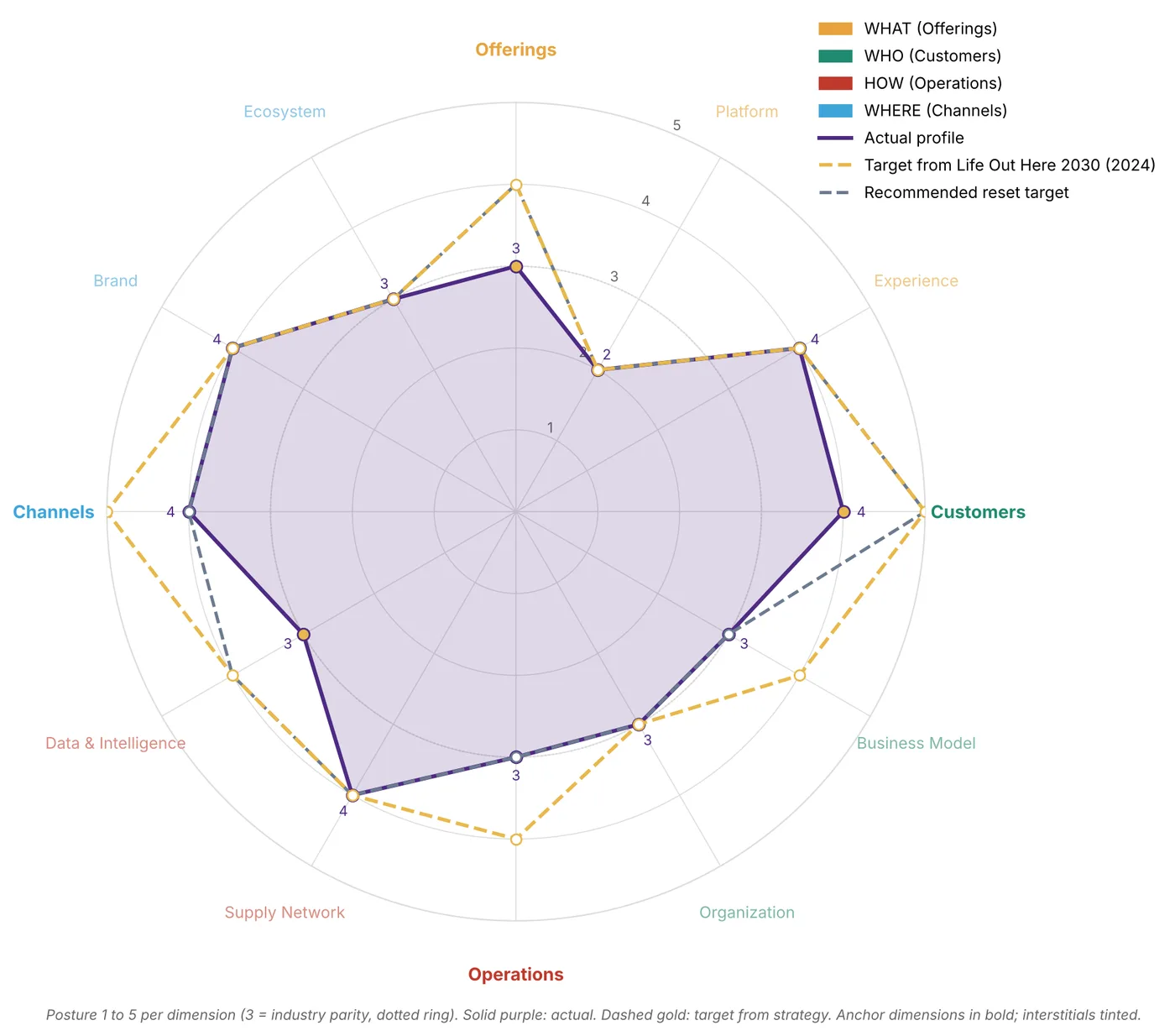
3.3 What the drift means
The polygon has the right shape and too little height. The Investment Index, the sum of the actual scores over the sum of the 2024 targets (equation 2), is 0.87, inside the 0.75 to 0.90 band the instrument calls short. The Shape Drift Index, half the sum of the absolute differences between each dimension's share of the actual profile and its share of the target (equations 3 and 4), is about 6 percent, in the tilted band, which reads as the share of the portfolio's emphasis that would have to move to match the 2024 shape. The per-dimension tilts are small and evenly spread. Offerings, Business Model, Operations and Data and Intelligence each fall about half a point below their size-adjusted targets, Customers and Channels about a third of a point below, and Experience, Supply Network, Brand, Organization, Ecosystem and Platform carry small positive mix parts that sum to the same total (equations 5 and 6). The priority-weighted gap, the sum of the absolute gaps multiplied by strategic weight (equation 7), is 12 points, nine of them on the three weighted leads. The verdict cell is fund with a steer.
That verdict collides with Section 2, and the collision is the finding. The posture read says the 2024 plan was under-built on six fronts at once; the yield test says the money to build all six does not exist at the conversion the portfolio achieves; and the 2027 capital plan says the envelope is going down. Funding is the one dial leadership has already closed. A profile one point short on half its dimensions, with no single deep hole, is the signature of prioritization myopia: six new initiatives launched together on top of remodels, garden centers, a pet pharmacy, a clinic acquisition and a new distribution center, each advancing a little. The remedy is to concentrate the target and close the gaps that remain.
3.4 The reset target and the gaps that remain
The reset target in Table 3 lowers three 2024 targets and moves one weight. Channels drops from 5 to 4 and becomes a floor: final mile is working and funded, the 2024 target of 5 asked for market recognition no rural retailer can earn against Amazon's $4 billion rural build and Walmart's same-day coverage of 93 percent of households (FreightWaves 2025), and Section 4 keeps every channel bet growing. Business Model and Operations drop from 4 to parity, because neither retail media nor the margin program can carry a lead while comparable sales are negative. Data and Intelligence takes the third strategic weight from Channels, because the member data, the pet records and the store cameras are the cheapest route to the transaction recovery the interim ambition needs, and because the instrument treats Data and Intelligence as a multiplier on every other dimension.
Against the reset target the Investment Index is 0.93, adequate; the Shape Drift Index is about 5 percent, at the boundary of aligned and tilted; and the priority-weighted gap is 9 points, all on three leads, each one point short. The verdict cell becomes scale with a steer: keep the change budget at about $510 million and redirect emphasis toward Customers, Offerings, and Data and Intelligence. The two readings tie by the exact identity in equation 6, so the reader can check that the reset moves the size gap to the board and leaves a small shape gap with the portfolio owner.
The three remaining gaps call for different remedies, which is why the effort read matters even when effort shares are unpublished. Offerings carries high effort and a negative measured direction on pet: about $270 million of acquisitions, two aisle resets and a fresh-food program, against falling dog food sales. That is an execution failure, and the remedy is to fix how the pieces connect, never to add money. Data and Intelligence carries medium-to-high effort, $158 million of information technology capital in 2025 and $73 million in the first half of 2026 (Tractor Supply 2026b; Tractor Supply 2026e), against parity posture and no published outcome: an execution and disclosure gap whose remedy is to instrument and publish. Customers carries medium effort and strong posture, and its gap is a conversion gap: the program exists, identifies the customers and has stopped reporting its own size. The pet finding has an uncomfortable second reading that ties all three together. Tractor Supply hosted VIP Petcare's clinics in about 1,700 of its stores for more than a decade, and those clinics see more than a million pets a year (Tractor Supply 2026g). Neighbor's Club began collecting pet prescription and veterinarian details in 2025 (Retail Dive 2025). Allivet holds the prescriptions. The company now owns all three records and has disclosed no plan to join them, while the pet household is the customer it is losing.
4. What we grow, what we hold, and what we kill
The public record yields 22 live bets, listed in Table 4 with the dimension each advances and its verdict against the reset target. Spend by bet is not public beyond the two acquisitions and the distribution center, so the ledger adjudicates posture and role. The kill list is short and real: the 75 Petsense closures were executed in the second quarter at a cost of $71.7 million, and two technology bets receive fix-or-kill verdicts.
Table 4. The adjudication ledger: 22 live bets from the public record, with primary dimension, stage and verdict.
| Bet | Primary dimension (secondary) | Stage | Verdict | Rationale |
|---|---|---|---|---|
| Neighbor's Club | Customers (Data & Intelligence) | Mature | Grow, gated | The lead asset; growth gated on restored disclosure of members, active members and trips per member by Q4 2026 |
| Direct sales to farms and businesses | Customers (Channels) | Scaling | Grow | Big Barn tickets about seven times average; about 40 basis points of comparable sales at scale by management's estimate |
| Final-mile hubs and team-member delivery | Channels (Supply Network) | Scaling | Grow | Strongest measured outcome in the portfolio; accelerate as planned |
| Digital, ship-from-store and subscriptions | Channels (Business Model) | Scaling | Grow | Above 20 percent growth in Q1 2026; pet subscriptions above $200 million |
| VIP Petcare clinics | Offerings (Customers) | Integration | Grow, gated | $133.8 million; growth gated on a joined pet record and a measured pet-household retention metric |
| Allivet pet and animal prescriptions | Offerings (Business Model) | Scaling | Fix | About $100 million in 2025 with slow early adoption; fold into one pet health unit with VIP |
| Dog and cat resets, Freshpet expansion | Offerings | Scaling | Grow | More than 40 percent of Freshpet buyers were new or reactivated pet food buyers |
| Store localization in Fusion remodels | Offerings (Data & Intelligence) | Scaling | Grow | About 200 localized stores outperform the rest of the Fusion base |
| Project Fusion remodel program | Experience (Offerings) | Mature | Hold | Near 60 percent of stores; 160 to 170 Fusion projects with localization planned for 2026; hold at that pace as the vehicle for localization |
| Garden centers and live goods | Offerings | Mature | Hold | More than 1,000 stores; live goods among the best 2025 categories |
| Exclusive and owned brands | Offerings (Brand) | Mature | Hold | Penetration flat at 29 to 30 percent for three years; hold pending a pet-value role |
| Outdoor and wildlife conversions | Offerings | Scaling | Hold | About 700 stores by year-end 2026 |
| Retail media network | Business Model (Data & Intelligence) | Scaling, undisclosed | Hold, re-scope | Tripled in 2025 and silent in 2026; re-scope as closed-loop member media in Section 6 |
| Customer data platform and personalization | Data & Intelligence (Customers) | Live since 2024 | Grow, gated | The core of the reset; gated on the first published test-cell result |
| OpenAI enterprise program | Data & Intelligence (Operations) | Scaling | Grow, gated | Gated on a value ledger replacing the adoption measure |
| Hey GURA associate assistant | Experience (Data & Intelligence) | Mature | Hold | Chainwide since 2024; publish its effect on conversion and attachment |
| TractorVision cameras | Operations (Data & Intelligence) | Pilot to scale, stalled in the record | Fix or kill | 700-store goal set for 2024; no outcome in two years; tie to labor scheduling or stop |
| Idaho distribution center with automated storage | Supply Network | Opened Sept 2026 | Hold (floor) | Measure the automation before any retrofit elsewhere |
| RELEX forecasting and replenishment | Supply Network (Data & Intelligence) | Mature | Hold (floor) | Inventory turns 3.24; add member-level demand signals (Section 6) |
| New stores toward 3,200 | Channels | Ongoing | Hold at 85 to 90 a year | The replication engine, netted out of the change budget |
| Price campaign funded by tariff refunds | Brand (Business Model) | Executed | Harvest | One-time funding of $35 to $40 million; retain the perception gain through owned-brand value |
| Petsense small-box format | Customers (Channels) | Closures under way | Kill (75 executed); harvest the rest | Negative four-wall cash flow in the closed stores; the remaining stores carry the format until a decision |
The reallocation story is modest in dollars and large in attention. The capital freed by the Petsense closures and the trimmed 2027 store plan already flows to remodels and final mile by management's account (Tractor Supply 2026f). What moves is governance: pet moves from three businesses bought or reset separately to one pet-household offer with one owner and one metric; the data assets move from adoption programs to measured ones; and the retail media network moves from an unreported line to a disclosed one. The shape moves toward the reset target when those three changes are made, and only then. The Orscheln integration, completed in 2023 with 81 stores retained after the Federal Trade Commission required the divestiture of 85 of the 166 acquired (Tractor Supply 2022), is recorded as harvested; its lesson for the plays in Section 6 is that buying a regional rival is closed to this company.
5. Where we stand against the field
We benchmark Tractor Supply against the two rivals whose businesses overlap most with its own. Chewy competes for the pet household, the category that makes up about a quarter of Tractor Supply's sales and is the one falling. Rural King competes for the farm and home customer in the same store format, and it is the second-largest chain in YipitData's farm and ranch panel, with 14 percent of tracked pet sales against Tractor Supply's 76 percent (PetfoodIndustry 2026). Home Depot and Walmart overlap on garden, tools and parcels but serve a different trip, so we leave them out of the overlay. We scored each rival from public evidence on the same five-point scale and under the same evidence gates. Chewy's profile rests on its September 2026 call and trade coverage. Rural King is a private, family-owned company with a thin public record, so we score a dimension with no shipped move in the record at 2 and hold the whole profile at low confidence. Table 5 gives the scores and Figure 2 overlays them.
Table 5. Competitor overlay: Tractor Supply against Chewy and Rural King on the twelve dimensions, with the benchmarking zone and the evidence behind each rival score, as of October 2026.
| Dimension | Tractor Supply | Chewy | Rural King | Zone | Basis for the rival scores |
|---|---|---|---|---|---|
| Offerings | 3 | 4 | 3 | Divergence (Chewy leads) | Chewy: pharmacy, clinics, SmartPak equine growing at mid-double digits for seven quarters. Rural King: own tractor line and farm assortment; pet sales declining |
| Platform | 2 | 2 | 1 | White space | No rival runs a services or third-party platform in the record |
| Experience | 4 | 4 | 3 | Convergence (leaders) | Chewy: the Kai assistant resolves about 30 percent of chats. Rural King: free popcorn and coffee, mobile and self-checkout |
| Customers | 4 | 4 | 3 | Convergence (leaders) | Chewy: 21.7 million active customers at $602 each; Chewy+ paid membership. Rural King: Rewards members get rotating Hot Deals; no count |
| Business Model | 3 | 5 | 2 | Divergence (Chewy leads) | Chewy: Autoship 84.6 percent of net sales. Rural King: no subscription or media program in the record |
| Organization | 3 | 3 | 2 | Parity | Chewy: no measured organizational change. Rural King: $75 million support campus; no shipped change |
| Operations | 3 | 3 | 2 | Parity | Chewy: AI savings guided, not yet realized. Rural King: none in the record |
| Supply Network | 4 | 3 | 2 | Divergence (Tractor Supply leads) | Chewy: not re-read in this pass. Rural King: no network disclosure |
| Data & Intelligence | 3 | 4 | 2 | Divergence (Chewy leads) | Chewy: published self-service rate; AI savings of low tens of millions in fiscal 2026, about $50 million in 2027. Rural King: none |
| Channels | 4 | 3 | 3 | Divergence (Tractor Supply leads) | Chewy: online, with about 60 Chewy Vet Care clinics expected by fiscal year-end and 29 Modern Animal clinics. Rural King: more than 150 stores in 17 states, still opening stores; no delivery program in the record |
| Brand | 4 | 3 | 3 | Divergence (Tractor Supply leads) | Neither rival has a dated brand outcome in this pass |
| Ecosystem | 3 | 3 | 2 | Parity | Chewy: Modern Animal and vet partners. Rural King: 4-H, FFA and veterans' charities |
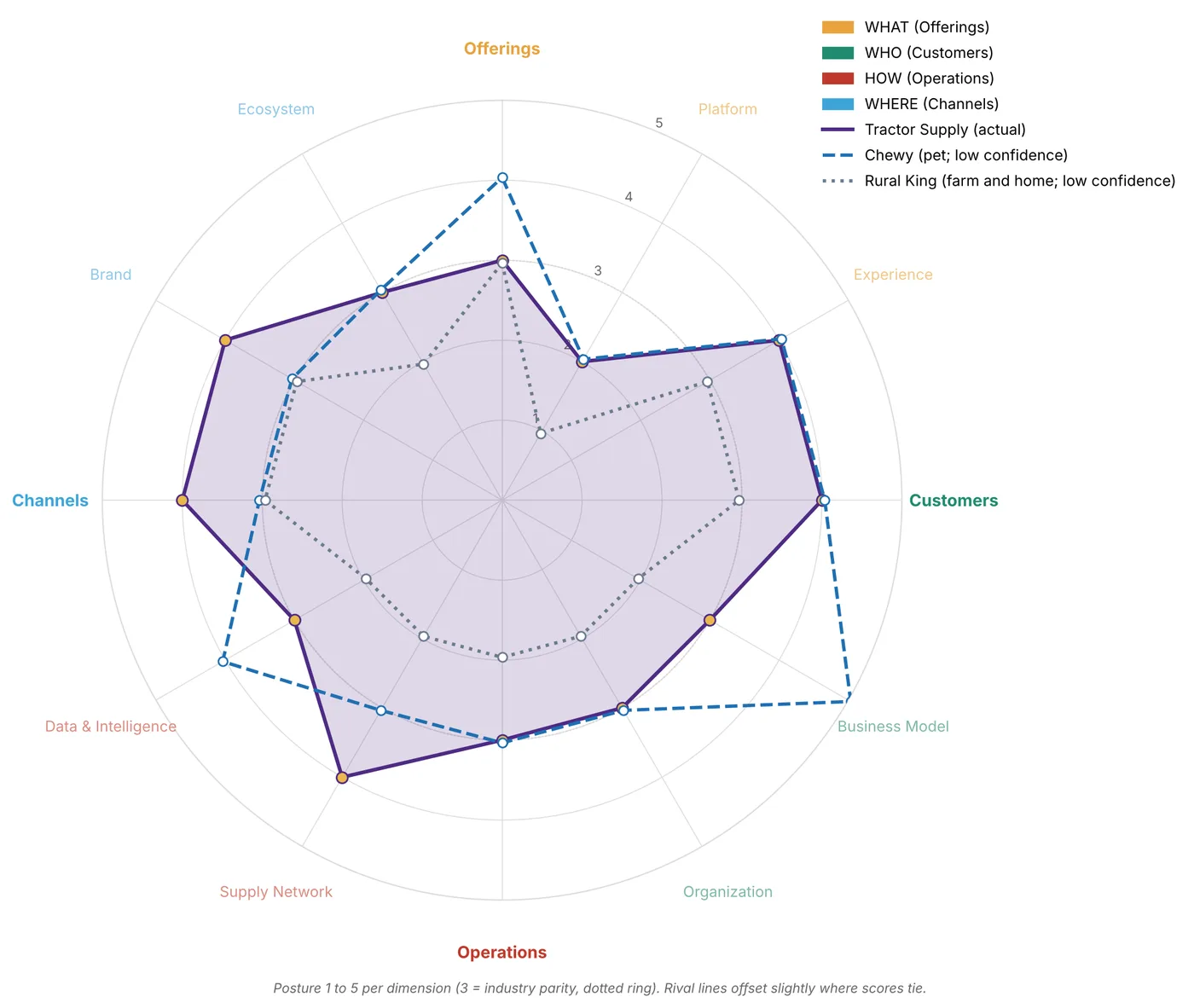
Channels and Supply Network are a divergence in Tractor Supply's favor, and the company should defend it. Amazon is spending more than $4 billion to triple its rural delivery network by the end of 2026, and Walmart's same-day delivery reaches 93 percent of U.S. households (FreightWaves 2025); GlobalData's Neil Saunders judged that Amazon's push mainly affects commodity products (Retail Dive 2026). Neither network carries a pallet of feed, a gun safe or a zero-turn mower to a farm with a trained associate, which is the $200 to $1,000 basket Tractor Supply's final mile serves. Chewy ships parcels, and Rural King is still adding stores, including a June 2026 opening in Anderson, South Carolina, and its public record shows no delivery program (Rural King 2026). The company should defend that divergence and stop competing in the parcel zone it cannot win.
Pet health and recurring revenue are a divergence in Chewy's favor. Autoship produced 84.6 percent of Chewy's $3.33 billion of second-quarter net sales, 21.7 million active customers spend $602 a year each, members of the Chewy+ paid program order more often and adopt Autoship at higher rates, and the SmartPak equine business has grown at mid-double-digit rates for seven straight quarters, which reaches into Tractor Supply's horse customer (Chewy 2026; Retail TouchPoints 2026). Chewy expects about 60 Chewy Vet Care clinics by the end of its fiscal 2026 (Zacks 2026) and added 29 more with Modern Animal (Retail TouchPoints 2026). Tractor Supply's pet subscriptions, above $200 million a year, are about 1.3 percent of its sales. Its position is different in kind: mobile clinics in about 1,700 of its own stores and about 1,000 other retail sites, 2,500 contracted veterinarians and prices below half a clinic visit (Tractor Supply 2026g). In rural and exurban markets that footprint is a counterweight Chewy cannot build quickly, provided it becomes a retail and prescription relationship; the pet-household tier (C1) and clinic-to-cart (O1) in Section 6 are how it does. Rural King's pet sales also fell over the same period, while two smaller chains grew from small bases (PetfoodIndustry 2026). The pet decline is shared across farm and ranch, so the remedy lies in what Tractor Supply offers the pet household, and price alone will not close it.
Data and Intelligence is a divergence that the closest pet rival already leads. Chewy publishes measured outcomes: its Kai assistant resolves about 30 percent of chats without an agent, and it guides AI cost savings of low tens of millions of dollars in fiscal 2026, rising to about $50 million a year in 2027 (Chewy 2026; Retail TouchPoints 2026). That is the frontier posture this report asks Tractor Supply to reach. No farm and ranch rival has a published outcome; Rural King's record shows a rewards program with rotating member deals priced at least 25 percent below market, and no data or AI program (Retail Customer Experience 2026). The 10-K warns that the company could fall behind competitors that use such technology more effectively (Tractor Supply 2026a), and the overlay shows where that has already happened.
Platform is white space: no player in the overlay scores above 2. The rural services marketplace escalated in Section 6 would be first in the field, and leadership should answer the Platform question before anyone builds it. Experience and Customers are convergence zones among the leaders, where the instrument prescribes holding the floor. The overlay moves no Tractor Supply score. It sharpens two of the three reset leads, Offerings and Data and Intelligence, because those are the dimensions on which the closest pet rival leads, and it confirms Channels as the floor to defend.
6. The net-new bets
The generation pass swept the twelve dimensions as lenses, heated by the weighted gaps against the reset target, and produced 47 raw candidates. The strategy gate removed four already in motion (the Freshpet expansion to 700 stores, doubling the direct sales force, AI feedback on planogram photos, and fee-developed stores), parked two that would thicken the Platform valley (a third-party seller marketplace on the website and pickup lockers at independent feed mills), and escalated one as a strategy question. Five were vetoed at scoring. Thirty-five survive with scores. Each is scored on three rings from 1 to 5: Real (is the underlying shift durable, large and specific to Tractor Supply), Worth (what is the play worth against the wedge and the drift, with any 4 or 5 carrying an order-of-magnitude prize priced through the dimension's profit signature), and Win (can Tractor Supply win, drawn from its own assets). The rings multiply (equation 8), so a composite runs from 1 to 125, and any ring at 1 vetoes the play. Boldness is graded Extend, Stretch, Step out or Transform.
Table 6. The scored net-new plays, ranked by composite, with primary dimension, boldness grade, ring scores and verdict.
| ID | Play | Dimension (boldness) | R | W | Win | Score | Verdict |
|---|---|---|---|---|---|---|---|
| C3 | Lapsed-trip recovery: value offers to members whose visit frequency fell, run in test cells against a control group | Customers, Data & Intelligence (Extend) | 5 | 4 | 5 | 100 | Pursue now |
| B3 | Feed, bedding and hay on subscription, delivered from final-mile hubs on a fixed route day | Business Model, Channels (Extend) | 5 | 4 | 5 | 100 | Pursue now |
| C1 | Pet-household tier in Neighbor's Club bundling clinic visits, auto-ship and pet wash for an annual fee | Customers, Business Model (Stretch) | 5 | 4 | 4 | 80 | Pursue now |
| O1 | Clinic-to-cart: a VIP vaccine visit writes the Allivet prescription and an auto-ship order to the member's pet profile | Offerings, Data & Intelligence (Extend) | 5 | 4 | 4 | 80 | Pursue now |
| D2 | One pet record joining VIP visit history (with consent), Allivet prescriptions and Neighbor's Club pet profiles | Data & Intelligence, Offerings (Stretch) | 5 | 4 | 4 | 80 | Pursue now |
| E2 | Delivery, setup and haul-away for mowers, safes, sheds and trailers by team-member crews | Experience, Channels (Extend) | 4 | 4 | 5 | 80 | Pursue now |
| O4 | Model-set local assortments for every remodel, extending the 200 localized stores | Offerings, Data & Intelligence (Extend) | 4 | 4 | 4 | 64 | Pursue next |
| B2 | Closed-loop member media: vendor campaigns targeted on member data and measured on member sales | Business Model, Data & Intelligence (Extend) | 4 | 4 | 4 | 64 | Pursue next |
| Op1 | Labor scheduling driven by camera traffic counts and conversion | Operations, Data & Intelligence (Extend) | 4 | 4 | 4 | 64 | Pursue next |
| D1 | Member-level demand signals fed into store-SKU forecasting | Data & Intelligence, Supply Network (Extend) | 4 | 4 | 4 | 64 | Pursue next |
| Org2 | AI value office publishing a quarterly ledger of tested effects with test cells and a control group | Organization, Data & Intelligence (Extend) | 4 | 3 | 5 | 60 | Pursue now |
| Org1 | Single pet health unit with one owner across VIP, Allivet and companion animal merchandising | Organization, Offerings (Extend) | 4 | 3 | 5 | 60 | Pursue now |
| B1 | Paid unlimited-delivery membership for heavy and bulky orders | Business Model, Channels (Stretch) | 4 | 3 | 4 | 48 | Pursue next |
| C2 | Trade credit and net-30 terms for business accounts through a partner lender | Customers, Business Model (Stretch) | 4 | 3 | 4 | 48 | Pursue next |
| C4 | New-to-rural household onboarding from movers' data into Neighbor's Club | Customers (Stretch) | 4 | 3 | 4 | 48 | Pursue next |
| O2 | Livestock health program: large-animal prescriptions and medicated-feed paperwork through Allivet | Offerings (Stretch) | 4 | 3 | 4 | 48 | Pursue next |
| O3 | Owned-brand pet food value push, using the price-perception gain | Offerings, Brand (Extend) | 4 | 3 | 4 | 48 | Pursue next |
| E1 | Member-facing pet care assistant built on the associates' pet-symptom model, with handoff to clinic telehealth | Experience, Data & Intelligence (Stretch) | 4 | 3 | 4 | 48 | Pursue next |
| S2 | Forecast and sell-through sharing with the top 50 vendors | Supply Network, Ecosystem (Extend) | 4 | 3 | 4 | 48 | Pursue next |
| D3 | Weather- and drought-triggered local demand sensing and offers | Data & Intelligence, Customers (Extend) | 4 | 3 | 4 | 48 | Pursue next |
| Ch3 | Business purchasing portal: tax-exempt accounts, invoicing and reorder lists | Channels, Customers (Extend) | 4 | 3 | 4 | 48 | Pursue next |
| X3 | Pet insurance through a partner, sold to pet-household members | Ecosystem, Business Model (Extend) | 4 | 3 | 3 | 36 | Watch |
| Op3 | Automated pallet replenishment for feed at high-volume stores | Operations, Supply Network (Extend) | 3 | 3 | 4 | 36 | Watch |
| O5 | Equipment rental in stores: log splitters, tillers, trailers | Offerings, Business Model (Step out) | 3 | 3 | 3 | 27 | Watch |
| E3 | Mower and small-engine service bays | Experience, Offerings (Stretch) | 3 | 3 | 3 | 27 | Watch |
| S1 | Automation retrofit of two older distribution centers | Supply Network (Stretch) | 3 | 3 | 3 | 27 | Watch, after Idaho is measured |
| D5 | Catalog and store inventory exposed to AI shopping agents with pickup and delivery | Data & Intelligence, Channels (Stretch) | 3 | 3 | 3 | 27 | Watch |
| Br2 | Licensed outdoor brands extended into pet | Brand, Offerings (Extend) | 3 | 3 | 3 | 27 | Watch |
| X1 | Telehealth partnership with independent large-animal veterinarians | Ecosystem, Offerings (Stretch) | 3 | 3 | 3 | 27 | Watch |
| C5 | Large-animal farm calls extending VIP beyond companion animals | Customers, Offerings (Step out) | 4 | 3 | 2 | 24 | Re-scope |
| C6 | Youth agriculture member program with 4-H and FFA chapters | Customers, Brand (Extend) | 3 | 2 | 4 | 24 | Watch |
| B5 | Protection plans on big-ticket equipment | Business Model (Extend) | 3 | 2 | 4 | 24 | Watch |
| Br1 | Published rural know-how guides from the Hey GURA knowledge base | Brand, Experience (Extend) | 3 | 2 | 4 | 24 | Watch |
| Ch2 | Trailer showrooms at county fairs and livestock auctions with direct sales specialists | Channels, Customers (Stretch) | 3 | 2 | 3 | 18 | Watch |
| X2 | Agronomy data partnerships with cooperatives and extension services | Ecosystem (Step out) | 2 | 2 | 2 | 8 | Re-scope |
Five plays were vetoed and are displayed with the failing ring. Full-service veterinary hospitals under the Tractor Supply name (Offerings, Step out) scored 4 on Real, 3 on Worth and 1 on Win: the business just bought an asset-light mobile model and has no route to the veterinarians a hospital chain needs. Acquiring a regional farm and ranch chain (Customers, Step out) scored 1 on Win, because the Federal Trade Commission required the divestiture of half the Orscheln stores in 2022 (Tractor Supply 2022). Propane and fuel delivery to homes and farms (Channels, Step out) scored 1 on Win on licensing and hazardous-materials logistics. A captive equipment finance company (Business Model, Step out) scored 1 on Win; C2 routes credit through a partner lender instead. Fresh grocery in rural stores (Offerings, Transform) scored 2 on Real and 1 on Win. One play was escalated: a rural services marketplace connecting members with local fencing contractors, farriers, well drillers and livestock haulers, with Tractor Supply supplying the materials (Platform, Transform). It is strong enough to argue that the Platform target should rise from 2, which would make the store a hub for rural services. That is a decision for leadership, and Section 8 records it as open.
Four reinforcing combinations score higher together than apart. The first, one pet household, pairs D2 the joined record with O1 clinic-to-cart, C1 the membership tier and Org1 the single pet unit: the clinic visit creates the record, the record writes the order, the tier prices the relationship, and one owner answers for the pet-household metric. Read as one bet, it is the fix for the Offerings execution gap. The second, the trip back, pairs C3 lapsed-trip recovery with Org2 the value office and D3 weather sensing: the member data finds the lapsing customer, the test cells prove the effect, and the ledger publishes it, which is the evidence that lifts Data and Intelligence. The third, the route day, pairs B3 feed subscription with E2 delivery and setup and B1 the delivery membership: the hubs already exist, feed is the largest traffic driver in the business (Tractor Supply 2026d), and a fixed route day turns a delivery cost into a recurring order. The fourth, member media, pairs B2 with D1 member-level forecasting, so vendors fund the campaigns and the same signal improves the stock position the campaign sells.
The two-currency reconciliation closes in posture points and splits in dollars. In posture points, the eight pursue-now plays map onto the three leads of the reset target. The one-pet-household combination supplies a measured pet-household outcome and a disclosed pet health revenue line, which lifts Offerings from 3 to 4 within 18 months if companion animal comparable sales turn positive. The trip-back combination supplies the published test-cell results that lift Data and Intelligence from 3 to 4 in the same period. Customers reaching 5 requires two independent top-tier sources with a measured outcome plus market recognition, and lies beyond a 36-month horizon; we say so. In dollars, the net-new revenue plays (C3, the one-pet-household combination, and B3 with E2) are worth $210 to $315 million of annual revenue by fiscal 2028 before any hit rate, and $105 to $160 million at a 50 percent portfolio hit rate, against a wedge of $200 to $320 million. The net-new portfolio closes about half the wedge and shares the rest with the bets in flight, principally the direct sales program, worth about $64 million at scale by management's estimate, the recovery of farm and ranch demand from the 2026 drought and fuel shock, Freshpet and the dog and cat resets, and new-store maturation. The spend the portfolio implies is mostly redirection of existing data, marketing and store staff, plus vehicles for the route-day program inside the final-mile budget, and fits inside the $510 million change budget the yield test certified at the interim ambition. The dial we recommend is to improve the portfolio: hold the interim ambition of about 2.5 percent, hold the change budget, and run the plays against the hurdles in Section 7.
7. What will move the P&L
A radar score converts to money only through initiatives, on a lag, at a rate set by each dimension's operating metric and a unit coefficient computed from Tractor Supply's own disclosed margin structure. Table 7 prices the six rows that pass the screen: each was graded High or defensible Medium on the weakest of pool size, responsiveness and durability. The coefficient bases are stated so a finance team can rerun them.
One coefficient governs four of the six rows and deserves its own paragraph. Tractor Supply earned a 36.4 percent gross margin in fiscal 2025 on $15.52 billion of sales, with selling and administrative expense at 27.0 percent and an operating margin of 9.45 percent (Tractor Supply 2026b). Management places the margin inflection at comparable growth in the low 2 percent range and expects 5 to 20 basis points of operating margin expansion a year above it (Tractor Supply 2025; Tractor Supply 2026c), which implies a high flow-through on comparable sales once fixed store costs are covered. We price incremental comparable sales at 25 percent operating flow-through: the 36.4 percent gross margin less about 11 points of variable selling cost (store hours, card fees, delivery). The assumption is labeled and conservative against the margin swing management reports; the pilots replace it. On a $16.0 billion base, one point of comparable sales is $160 million of revenue and about $40 million of operating income.
Table 7. The Innovation P&L Bridge: priced rows with operating metric, unit coefficient and basis, targeted movement, gross impact, lag and proof metric.
| Bet | Operating metric | Unit coefficient and basis | Targeted movement | Gross impact | Lag | Proof metric |
|---|---|---|---|---|---|---|
| C3 with Org2 and D3: lapsed-trip recovery | Transactions per member | About $40 million operating income per point of comparable sales: $16.0 billion × 1 percent × 25 percent flow-through (Tractor Supply 2026b; 2026e) | Recover 0.5 to 0.75 point of comparable sales from trip frequency by fiscal 2028 | $20 to $30 million | 1 to 2 years | Trips per member in test cells against a control group |
| One pet household: D2, O1, C1, Org1 | Companion animal comparable sales | About $9.6 million per point of category comparable sales: companion animal 24 percent of a $16.0 billion base × 1 percent × 25 percent (Tractor Supply 2026a) | Lift companion animal from about minus 3 percent to flat or better: 2 to 3 points | $19 to $29 million | 1 to 3 years | Pet-household retention; Rx and auto-ship attach per clinic visit |
| B3 with E2: route-day feed subscription and big-ticket delivery | Recurring feed revenue; delivered big-ticket sales | 25 percent flow-through on incremental sales, with delivery cost inside the hub budget; freight savings of $10 million a year already funded (Tractor Supply 2026c) | $50 to $80 million of incremental revenue by fiscal 2028 | $13 to $20 million | 1 to 2 years | Subscribed tons per hub; deliveries per hub day |
| Direct sales at scale (in flight), with C2 and Ch3 | Business-account sales | About 40 basis points of comparable sales at scale, management's estimate (Tractor Supply 2026c), at 20 percent flow-through after sales-force cost | $64 million of revenue by fiscal 2028 | $13 million | 1 to 2 years | Sales per specialist; account retention |
| B2 with D1: closed-loop member media | Media revenue | Illustrative: 70 percent flow-through on incremental media revenue; Tractor Supply discloses no media revenue, so the coefficient is a labeled assumption the pilot replaces | $20 to $35 million of incremental media revenue | $14 to $25 million | 1 to 2 years | Disclosed media revenue; vendor return measured on member sales |
| Op1: labor scheduling on camera traffic | Store labor as a share of sales | About $16 million per 10 basis points of sales: $16.0 billion × 0.1 percent; selling and administrative expense 27.0 percent of sales (Tractor Supply 2026b) | 10 to 20 basis points in camera-equipped stores, scaled to the chain | $16 to $32 million | In-year to 2 years | Labor hours per $1,000 of sales in test stores against control stores |
The stack is $95 to $149 million of gross annual operating income by fiscal 2028. A 40 percent execution haircut, the rate defensible for a retailer integrating two pet acquisitions, closing 75 stores and opening an automated distribution center in the same year, brings it to $57 to $89 million, which we state as $60 to $90 million: about 4 to 6 percent of a fiscal 2026 adjusted operating income base near $1.38 billion (the 8.5 to 8.8 percent outlook on $16.0 billion). The Data and Intelligence multiplier is set at one, because the dimension is at parity; the instrument's rule lowers the screen grade of AI-dependent rows only when the dimension falls below parity. If the outcome ledger lifts it to 4, the responsiveness of the trip-recovery, pet and media rows improves and the bridge should be re-priced at the 2027 re-read. No in-year conversion of a long-lag dimension is promised.
Governance is the condition on every row. Each coefficient above is a prior; the pilot produces the posterior. C3 runs on one region's lapsing members for two quarters with a hurdle of a 2 percent lift in trips per member against a control group. The pet-household program runs in 100 stores with clinic days against 100 matched stores, with a hurdle of a 10 percent lift in Rx and auto-ship attach per clinic visit. B3 runs on ten hubs with a hurdle of 30 subscribed customers per hub in 90 days. B2 runs with five vendors and a hurdle of vendor-measured return on member sales. Op1 runs in 50 camera stores against 50 control stores with a hurdle of 10 basis points of labor. Nothing scales before its hurdle, and no coefficient is negotiated backward from the framework the new outlook will publish.
8. What we will not do
The valleys are choices and are stated with the same confidence as the peaks. Tractor Supply will not build a platform in this cycle. Platform stays at 2: no third-party sellers on the website and no marketplace infrastructure until leadership answers the escalated question of whether the store should become a hub for rural services. If the answer is yes, the Platform target moves to 3, the services marketplace is scored, and the profile is re-read. Business Model and Operations stay at parity: retail media is re-scoped and disclosed and the margin program continues, and neither receives lead funding while comparable sales are negative. Tractor Supply will not buy a regional farm chain, open full-service veterinary hospitals, deliver propane, finance equipment through a captive lender or sell fresh groceries. It will not extend Petsense beyond the stores that earn their four-wall cash flow, and it will not retrofit automation into older distribution centers until the Idaho center's productivity is measured.
Four floors are held even though Tractor Supply will not lead on them in this cycle: Channels at 4, because final mile and ship-from-store are the delivery routes the pet and feed subscriptions run on; Experience at 4, because legendary service is the reason a rural customer drives past a supercenter; Supply Network at 4, because a distribution failure in spring or the cold-weather season costs a half-year; and Brand at 4, because the price-perception gain the tariff refunds bought will fade unless owned brands carry it.
The deliberately parked plays stay visible. A website marketplace for third-party sellers and pickup lockers at independent feed mills are parked as valley-thickeners. Large-animal farm calls are re-scoped until VIP's companion-animal integration is measured. Agronomy data partnerships with cooperatives are re-scoped because the company holds no field data of its own.
9. What happens next
The 90-day program has seven commitments, each with an owner by role.
- Set the new framework on a funded ambition. The chief executive and chief financial officer publish a comparable-growth floor near 2.5 percent with the new framework, and state the change budget, remodels, technology and distribution, separately from new-store capital.
- Protect the change budget. The chief financial officer takes the 2027 capital reduction from the completed distribution build and the trimmed store plan, and holds remodels and technology at no less than the 2025 level of about $380 million combined; the company discloses the bridge from gross capital to net, including sale-leaseback proceeds, so investors can see the change budget.
- Restore member disclosure. The chief marketing officer reports Neighbor's Club members, active members and trips per member with the fourth-quarter 2026 results.
- Name the pet-household owner. The chief executive assigns one leader with a profit-and-loss statement across VIP, Allivet and companion animal merchandising, measured on pet-household retention, and starts the joined pet record with member consent.
- Start the trip-recovery test. The technology and marketing chiefs run lapsed-trip offers in one region with test cells and a control group, reporting at the first-quarter 2027 call.
- Launch the route-day pilot. The supply chain and store leaders put feed and bedding subscriptions on ten final-mile hubs against the 30-customer hurdle.
- Schedule the re-read. The profile is re-scored after the third-quarter 2026 results on October 22, 2026, and again when the company publishes its updated framework with the fourth-quarter 2026 results and the fiscal 2026 10-K in early 2027; Offerings and Data and Intelligence are the two scores capped by pending outcomes, and both are re-read then.
Appendix A. Source Ledger
Run header. Run date October 12, 2026; scope Tractor Supply Company as one retail business with one value chain (Tractor Supply stores, Petsense, Allivet, VIP Petcare, digital, direct sales, distribution and final mile). Two passes completed: pass one assembled the fiscal 2025 10-K (Items 1 and 1A read; the MD&A fell beyond the retrievable portion), the 2025 annual report and 2026 proxy (shareholder letter and governance read; compensation discussion not retrieved), the December 2024 Investment Community Day release, the fourth-quarter 2025 and second-quarter 2026 results releases, the second-quarter 2026 10-Q (notes read; MD&A not retrieved), and the third-quarter 2025, fourth-quarter 2025, first-quarter 2026 and second-quarter 2026 call transcripts, plus the September 2026 Barclays conference; pass two hunted dimension by dimension through acquisition releases, technology and trade press, analyst commentary, receipt-panel data and competitor records. Web searches run: 20, with 35 full-document reads. Sources counted: 56 after the top-up pass (Tier A 20, Tier B 24, Tier C 7, Tier D 4, and the method paper). Sources rejected at the provenance gate: 6, retained here to show the screening happened. Coverage gaps flagged low confidence: effort shares by dimension (not public); initiative operating spend (not disclosed); digital penetration, retail media revenue and loyalty membership since 2025 (not disclosed); annual incentive weights, goals and payouts (not read; the metric names were read in the top-up pass); culture (unobservable). Changes against the earlier outside-in read: Customers moved from 5 to 4 (membership disclosure stopped in 2026, transactions fell 1.7 percent, no recognition within twelve months); Offerings moved from 4 to 3 (pet comparable sales negative in both 2026 quarters, dog food down 5 percent, owned-brand share flat); Operations moved from 4 to 3 (no measured program outcome; selling and administrative deleverage of 118 basis points); Ecosystem moved from 2 to 3 (the decade-long VIP host partnership and vendor forecast sharing); Data and Intelligence held at 3 with its weight moved from 3 to 1 in the 2024 target, because Life Out Here 2030 names no AI initiative, and to 3 in the reset target as a recommendation; Channels held at 4 against a 2024 target of 5; Experience, Brand, Supply Network, Business Model, Organization and Platform held. The growth target moved from the 2025 guidance used in the shallow read to the withdrawn 2024 framework and the interim ambition, and the yield test, not run in the shallow read, now runs on the disclosed capital categories.
Top-up pass, October 12, 2026. A second, targeted pass ran 12 web searches and 29 document fetches (two failed) to close the gaps the first pass left open. Filings: the fiscal 2025 10-K was paged by offset on sec.gov and on a mirror; the retrievable text ends in Items 1A to 2 because the reading tool truncates the 1.8-megabyte filing, so its MD&A remains not read, and the capital split it would give was taken instead from the fourth-quarter 2025 release filed as an 8-K exhibit, read in full, which also gives the 2024 split. The first-quarter 2026 10-Q was read through Item 2 (MD&A); the second-quarter 10-Q truncates in the notes, and its capital table was read from the second-quarter release. The 2026 proxy was read through the committee letter and the opening of the compensation discussion: the metric names are recorded in Section 1, while weights, goals and payouts remain not read. Calls and investor materials: the fourth-quarter 2025 and first-quarter 2026 transcripts (a second source for each) supplied the January reaffirmation of the 3 to 5 percent comparable algorithm, the 160 to 170 Fusion projects planned for 2026, the 176 hubs added in 2026 and the confirmation that the company no longer discloses membership; the second-quarter release supplied the withdrawal language and the promise of an updated framework with the fourth-quarter 2026 results, which corrects the earlier statement that it might come with the third quarter. Digital penetration, retail media revenue and the Neighbor's Club count remain undisclosed: the company reports digital growth rates only, retail media appears in 2026 only in a January margin comment and a September vendor award, and membership is described only as more than 80 percent of sales. Score moves: none; all twelve Tractor Supply scores were re-checked against the new evidence and held. Numbers corrected or added: the 2026 change budget is running 24 percent above 2025 (first half $249.8 million against $201.8 million), on pace for $600 to $650 million; the yield test was re-run with two new rows (the 2024 promise needs about 1.4 on the 2026 pace, and the 2026 outcome is about 0.25 against that pace, where the first pass used $500 million and 0.3); the 2027 risk band moved from $350 to $400 million to $320 to $400 million and the interim yield under that risk from 1.6 to 1.8 to 1.6 to 2.0, using the 4 percent of sales ceiling and the 2025 cost per new store; the Fusion row in Table 4 now cites the 2026 plan of 160 to 170 projects. The headline verdicts hold: the 2024 promise fails on the 2025 envelope and sits at the top of the band on the larger 2026 envelope with a realized yield far below it, and the interim ambition is certified on either envelope. Competitor overlay: Chewy (pet) and Rural King (farm and home) were scored on the twelve dimensions at low confidence and are shown in Table 5 and Figure 2; the overlay moves no Tractor Supply score. Sources added: 11 (S46 to S56), bringing the counted total to 56.
Table 8. The Source Ledger: sources counted, with date, tier and provenance status.
| ID | Source | Date | Tier | Used for |
|---|---|---|---|---|
| S1 | Tractor Supply, Form 10-K for fiscal 2025 (Items 1, 1A) | Feb 19, 2026 | A | Strategy pillars, mix, stores, DCs, Allivet, AI risk factor, headcount |
| S2 | Tractor Supply, 2025 Annual Report and 2026 Proxy (Form ARS) | May 14, 2026 | A | Shareholder letter, Fusion near 60 percent, 700 garden centers, officers |
| S3 | Tractor Supply, 2026 proxy statement (DEF 14A), partial read | Apr 2026 | A | Life Out Here 2030 priorities, CEO retention awards, culture; CD&A not read |
| S4 | Tractor Supply, Q4 and fiscal 2025 results release | Jan 29, 2026 | A | FY2025 figures, capital categories, 2026 outlook, owned brands 30 percent |
| S5 | Tractor Supply, Q4 2025 earnings call (ROIC transcript) | Jan 29, 2026 | A | Final mile hubs, direct sales, Allivet $100 million, inflection, OpenAI |
| S6 | Tractor Supply, Q1 2026 earnings call (ROIC transcript) | Apr 21, 2026 | A | Digital 20 percent plus, membership disclosure stopped, new-store productivity, dog population |
| S7 | Tractor Supply, Q1 2026 results release | Apr 21, 2026 | A | Q1 figures [snippet] |
| S8 | Tractor Supply, Q2 2026 results release | Jul 23, 2026 | A | Q2 figures, transactions minus 1.7 percent, lowered outlook, framework withdrawn |
| S9 | Tractor Supply, Q2 2026 earnings call (ROIC transcript) | Jul 23, 2026 | A | Withdrawal rationale, Petsense, VIP, final mile, 2027 stores, price perception |
| S10 | Tractor Supply, Form 10-Q for Q2 2026 | Jul 2026 | A | VIP price $133.8 million, Petsense charges $71.7 million |
| S11 | Tractor Supply, Q3 2025 earnings call (ROIC transcript) | Oct 23, 2025 | A | Satisfaction streak, 80 percent store fulfillment, retail media tripled, AI stack, direct sales |
| S12 | Tractor Supply, Q3 2025 results release | Oct 23, 2025 | A | Q3 figures [snippet] |
| S13 | Tractor Supply, Investment Community Day release (8-K Ex. 99.1) | Dec 5, 2024 | A | Life Out Here 2030 initiatives and long-term algorithm |
| S14 | Tractor Supply, VIP Petcare acquisition release (8-K Ex. 99.1) | May 28, 2026 | A | Clinic network, 1,700 host stores, rationale |
| S15 | Tractor Supply, Orscheln clearance release (8-K Ex. 99.1) | Oct 11, 2022 | A | 166 acquired, 85 divested, FTC |
| S16 | YipitData receipt panel via PetfoodIndustry | Oct 7, 2026 | A | Dog food minus 5 percent, 76 percent of tracked farm and ranch pet sales |
| S17 | Tractor Supply at Barclays Global Consumer Staples Conference (Investing.com summary) | Sept 9, 2026 | B | Pet comps by quarter, final mile economics, subscriptions, 2027 capex, Allivet and VIP revenue |
| S18 | Retail Dive, Q2 2026 results with GlobalData commentary | Jul 23, 2026 | B | Saunders assessment, Amazon and Walmart context |
| S19 | Supply Chain Dive, Idaho distribution center | Oct 12, 2026 | B | Knapp ASRS, $200 million, AI innovation team, 81 percent through DCs |
| S20 | Modern Retail, OpenAI as primary AI partner | Dec 4, 2025 | B | 1,500 automated processes, adoption over metrics |
| S21 | CIO.com, Hey GURA and computer vision | Apr 12, 2024 | B | Deployment timeline, 700-store camera goal, no outcomes |
| S22 | Retail Dive, Tractor Supply AI at NRF | Jan 23, 2024 | B | Gura origin on Azure, ACSI tie |
| S23 | Chief Marketer, CMO on AI and customer segments | Jul 10, 2026 | B | Five segments, churn models, pet-symptom model |
| S24 | Retail Dive, Neighbor's Club cross-banner | Feb 11, 2025 | B | 38 million members, 80 and 85 percent of sales, pet profiles |
| S25 | Retail TouchPoints, Life Out Here 2030 coverage | Dec 9, 2024 | B | Corroboration of S13 |
| S26 | FreightWaves, Amazon rural delivery investment | May 5, 2025 | B | $4 billion, 200 stations; Walmart 93 percent same-day |
| S27 | Zacks via Nasdaq, Chewy veterinary services | Jun 15, 2026 | B | About 60 clinics, $54 billion pet health market |
| S28 | MarketBeat, analyst consensus | Oct 12, 2026 | B | Hold consensus, average target $39.15 |
| S29 | MarketBeat, Robert W. Baird target cut to $38 | Jul 20, 2026 | B | Analyst stance [snippet] |
| S30 | MarketBeat, Argus lowered expectations | Jul 28, 2026 | B | Analyst stance [snippet] |
| S31 | Yahoo Finance and Zacks, Q2 2026 comps coverage | Jul 2026 | B | Corroboration of S8 [snippet] |
| S32 | Chain Store Age, Q4 2025 and 100 stores in 2026 | Jan 2026 | B | Corroboration of S4 [snippet] |
| S33 | Investing.com, Q2 2026 slides summary | Jul 23, 2026 | B | Corroboration of S8 [snippet] |
| S34 | Business Wire, Tractor Supply wins 2024 CIO 100 Award | Mar 20, 2024 | C | Recognition of store AI (counted as B for recognition) |
| S35 | DC Velocity, RELEX selected (company release) | Nov 9, 2023 | C | Forecasting, replenishment, allocation; 2,100 stores, nine DCs |
| S36 | RELEX Solutions, Tractor Supply customer page | Nov 2023, modified Sept 2026 | C | No outcomes disclosed |
| S37 | Epsilon, Tractor Supply loyalty blog | Nov 25, 2024 | C | 37 million members, 75 percent retention (vendor-issued) |
| S38 | TTEC, wearable AI at Tractor Supply | 2024 | C | "Very high rates of adoption"; no metrics |
| S39 | Tractor Supply, Q3 2026 conference call webcast notice | Oct 2026 | C | Results date October 22, 2026 [snippet] |
| S40 | Tractor Supply, Petsense Fall Adoptathon release | 2026 | C | Petsense activity [snippet] |
| S41 | Hardware Retailing, Q2 2026 net sales | Jul 2026 | D | Corroboration of S8 [snippet] |
| S42 | Retail Touchpoints, VIP acquisition coverage | May 2026 | D | Corroboration of S14 [snippet] |
| S43 | Global Pet Industry, VIP acquisition coverage | May 2026 | D | Corroboration of S14 [snippet] |
| S44 | Customer Experience Dive, Neighbor's Club revamp | 2024 | D | Corroboration of S24 [snippet] |
| S45 | Sawhney, Innovation Radar 2.0, SSRN 7244520 | July 2026 | Method | Framework |
| S46 | Tractor Supply, Form 10-Q for Q1 2026, Item 2 (MD&A) | Apr 2026 | A | Q1 capital by category, 2026 capital plan, IT spend rationale, SG&A deleverage |
| S47 | Tractor Supply, Q4 2025 earnings call (Motley Fool transcript) | Jan 29, 2026 | B | Corroboration of S5; algorithm reaffirmed, 160 to 170 Fusion projects, retail media as margin driver |
| S48 | Tractor Supply, Q1 2026 earnings call (Motley Fool transcript) | Apr 21, 2026 | B | Corroboration of S6; membership not disclosed, 176 hubs in 2026 |
| S49 | Digital Commerce 360, Q4 2025 results | Jan 30, 2026 | B | Digital high single digits; Allivet $100 million; Top 2000 rank |
| S50 | Digital Commerce 360, Q2 2026 results | Jul 28, 2026 | B | Digital double digits led by delivery from stores; Neighbor's Club above 80 percent; rank 83 |
| S51 | Tractor Supply, 2026 Top Vendor Partners release | Sept 3, 2026 | A | Only 2026 retail media mention (Cargill) |
| S52 | Chewy, Q2 2026 earnings call (Motley Fool transcript) | Sept 9, 2026 | A | Rival scores: Autoship 84.6 percent, 21.7 million actives, Kai, AI savings, SmartPak |
| S53 | Retail TouchPoints, Chewy builds loyalty | Sept 9, 2026 | B | Chewy+ behavior, Modern Animal 29 clinics, Kai 30 percent |
| S54 | Rural King, Anderson store release (PR Newswire) | Jun 15, 2026 | A | More than 150 stores in 17 states, Rewards, self-checkout |
| S55 | Area Development, Rural King Mattoon campus | Jun 16, 2026 | B | $75 million support campus, family ownership |
| S56 | Retail Customer Experience, Rural King Hot Deals | Sept 3, 2026 | B | Rewards member deals at least 25 percent below market |
Rejected at the gate: the Larridin AI tracker (an aggregator that assigns its own maturity scores and attributes figures inconsistently; used only to locate the Modern Retail and RELEX sources, every figure re-verified or dropped); three AI-generated company-profile sites (portersfiveforce.com, matrixbcg.com and growthsharematrix.com) asserting unsourced strategy claims; a pricing-platform claim about Revionics surfaced only through the aggregator and not verified against a primary release; and a third-party research newsletter (Bearhold Research) whose page failed to load and could not be checked.
Table 9. Per-dimension evidence rows: sources, three-signal read, score and derived confidence.
| Dimension | Sources | Shipped moves | Outcome evidence | Market recognition | Score | Confidence |
|---|---|---|---|---|---|---|
| Offerings | S1, S4, S5, S6, S10, S16, S17 | Allivet, VIP, resets, Freshpet, owned brands, garden centers | Pet comps minus 4.2 and minus 2.9 percent; dog food minus 5 percent; owned brands flat at 30 percent | Regional chains growing pet faster | 3 | High (disclosed and panel data) |
| Platform | S1 | None | None | None | 2 | Medium |
| Experience | S2, S11, S17, S21, S22 | Hey GURA, delivery, service model | Satisfaction up 17 quarters; delivery satisfaction plus 15 points | ACSI tie; CIO 100 | 4 | Medium |
| Customers | S5, S6, S8, S11, S24, S37 | Loyalty, cross-banner, direct sales | 80 percent of sales; Big Barn comping near 50 percent; transactions minus 1.7 percent | None independent | 4 | Medium |
| Business Model | S5, S11, S17 | Retail media, subscriptions | Media tripled 2025; subscriptions above $200 million | None | 3 | Low (no revenue lines) |
| Organization | S5, S9 | Direct sales force, field support teams | None measured | None | 3 | Medium |
| Operations | S8, S9, S20, S21 | OpenAI, cameras, planogram AI | SG&A deleverage 118 bps | None | 3 | Medium |
| Supply Network | S1, S4, S11, S19, S35 | Idaho DC, RELEX, sourcing shift | DC productivity mid-single digits; imports 11.4 percent | Trade press on automation | 4 | High |
| Data & Intelligence | S11, S20, S21, S22, S23, S34, S35 | Data platform, OpenAI, Hey GURA, cameras, RELEX | None published | CIO 100 (2024) | 3 | Medium |
| Channels | S5, S6, S9, S11, S17, S26 | Final mile hubs, ship-from-store, digital | Deliveries doubled; baskets $200 to $1,000; freight savings $10 million | None independent | 4 | High |
| Brand | S2, S9, S17 | Life Out Here, price campaign | Price perception up 180 to 200 bps | Great Place to Work | 4 | Medium |
| Ecosystem | S14, S35 | VIP host partnership, vendor forecasts, licenses | None disclosed | None | 3 | Low |
Derivation box: Data and Intelligence at 3. Signal one, shipped moves: Hey GURA piloted in 200 stores in late 2023 and deployed chainwide in 2024 (S21, S38); TractorVision in more than 100 stores with a 700-store goal for 2024 (S21); a customer data platform implemented in 2024 and an enterprise OpenAI integration on a Snowflake data lake (S11, S20); RELEX forecasting and replenishment selected in 2023 (S35); churn models and a pet-symptom language model in marketing (S23). Signal two, outcome evidence: none published for any of these; the technology chief states that adoption, not a performance metric, is the measure (S20); the two public counts of the OpenAI program's reach disagree (S11, S20); the 2026 calls do not mention AI or personalization while explaining a transaction decline (S6, S9). Signal three, market recognition: the 2024 CIO 100 award (S34) is peer recognition for deployment, dated beyond twelve months, with no measured outcome. Anchor test: "shipped without measured outcome" meets the definition of parity; "shipped and measured, recognition contested" would require a published effect on trips, conversion or labor, which is absent. Tier B and C evidence supports 3 and does not lift it. Confidence Medium; re-read after the fiscal 2026 10-K.
Appendix B. Mathematics
The nine equations below define the quantities used in the body. Equations (1) through (7) are the instrument's minimum set; (8) and (9) govern the generation and pricing passes. In equation (1) the growth target is the comparable-sales target, because new-store growth is netted out with its own capital, as Section 2 explains.
Y = \frac{(c^{*} + d)\, B}{E}(1)The implied yield Y is the revenue the ambition requires each year, the comparable-growth target c^{*} plus the core decay rate d applied to the base B, divided by the change budget E; a yield inside the 0.5 to 1.5 band certifies the envelope.
k = \frac{\sum_{i=1}^{12} A_i}{\sum_{i=1}^{12} T_i}(2)The Investment Index k is the sum of the actual scores A_i over the sum of the targets T_i; between 0.90 and 1.10 the size is adequate, and between 0.75 and 0.90 it is short.
s^{A}_i = \frac{A_i}{\sum_{j=1}^{12} A_j}, \qquad s^{T}_i = \frac{T_i}{\sum_{j=1}^{12} T_j}(3)The shares express each profile's scores as fractions of its own total, which removes the size effect before shape is read.
\mathrm{SDI} = \tfrac{1}{2} \sum_{i=1}^{12} \left| s^{A}_i - s^{T}_i \right|(4)The Shape Drift Index is the total variation distance between the two share vectors and reads as the share of the portfolio's emphasis that must move to match the target.
g_i = A_i - T_i = (k-1)\, T_i + \left( A_i - k\, T_i \right)(5)Each spoke's raw gap splits without residual into a size part, carried by every spoke in proportion to its target, and a mix part, which is the reallocation argument proper.
\sum_{i=1}^{12} \left( A_i - k\, T_i \right) = 0, \qquad \mathrm{SDI} = \frac{\sum_{i=1}^{12} \left| A_i - k\, T_i \right|}{2 \sum_{i=1}^{12} A_i}(6)The mix parts sum to zero by construction, and half their absolute sum over the actual total equals the Shape Drift Index exactly, so the two headline metrics are two halves of one identity.
G_w = \sum_{i=1}^{12} w_i \left| A_i - T_i \right|(7)The priority-weighted gap multiplies each absolute gap by its strategic weight w_i and is the operative per-dimension signal; for Tractor Supply it is 12 against the 2024 target and 9 against the reset target.
C = R \cdot W \cdot W_n, \qquad \min(R, W, W_n) = 1 \Rightarrow \text{veto}(8)The RWW-I composite multiplies the Real, Worth and Win rings so that a weak ring cannot hide behind strong ones, and any ring at 1 vetoes the play.
\Delta \mathrm{EBIT} = (1-h) \sum_{b} c_b\, \Delta m_b(9)The bridge sums, across priced bets b, the unit coefficient c_b times the targeted movement in the operating metric \Delta m_b, and cuts the total by the execution haircut h; each term is delivered on its dimension's lag.
References
Sawhney, Mohanbir. 2026. The Innovation Radar 2.0: A Framework for Measuring and Diagnosing Business Innovation. SSRN Working Paper. https://ssrn.com/abstract=7244520.
Barclays. 2026. Tractor Supply at the Barclays 19th Annual Global Consumer Staples Conference. Transcript summary, Investing.com, September 9, 2026.
Area Development. 2026. "Rural King Expands Mattoon, Illinois, Operations." June 16, 2026.
Business Wire. 2024. "Tractor Supply Wins 2024 CIO 100 Award." March 20, 2024.
Chief Marketer. 2026. "Tractor Supply CMO Aims to Balance AI With the Human Connection." July 10, 2026.
Chewy. 2026. Second-quarter fiscal 2026 earnings call transcript. Motley Fool, September 9, 2026.
CIO. 2024. "Tractor Supply Enlists AI to Deliver Legendary Customer Service." April 12, 2024.
DC Velocity. 2023. "Tractor Supply Co. Taps RELEX to Boost Supply Chain Visibility Across 2,100 Stores." November 9, 2023.
Digital Commerce 360. 2026a. "Tractor Supply Q4 Sales Rise via AI, Ecommerce, Delivery Network." January 30, 2026.
Digital Commerce 360. 2026b. "Tractor Supply Grows Digital Sales Despite a Challenging Q2." July 28, 2026.
FreightWaves. 2025. "Analyst: Amazon's $4B Rural Delivery Investment Aimed at Slowing Walmart." May 5, 2025.
Modern Retail. 2025. "Tractor Supply Bets on OpenAI as Its Primary AI Partner." December 4, 2025.
PetfoodIndustry. 2026. "Tractor Supply Dog Food Sales Fell 5% in Past Year," reporting YipitData. October 7, 2026.
Retail Customer Experience. 2026. "Rural King Launches Hot Deals for Rewards Members." September 3, 2026.
Retail Dive. 2024. "Tractor Supply Bets on AI for Customer Service." January 23, 2024.
Retail Dive. 2025. "Tractor Supply Expands Loyalty Across Petsense and Allivet." February 11, 2025.
Retail Dive. 2026. "Tractor Supply Sputters in Q2, Lowers Outlook." July 23, 2026.
Retail TouchPoints. 2026. "Chewy Builds Loyalty Amid Pet Market Pressure." September 9, 2026.
Rural King. 2026. "Rural King Opens New Store in Anderson, Expanding South Carolina Footprint." PR Newswire, June 15, 2026.
Supply Chain Dive. 2026. "Tractor Supply Opens Idaho Distribution Center With Automation, Dedicated AI Team." October 12, 2026.
Tractor Supply. 2022. "Tractor Supply Company Receives FTC Clearance to Close Orscheln Farm and Home Acquisition." Form 8-K Exhibit 99.1, October 11, 2022.
Tractor Supply. 2024. "Tractor Supply Unveils Life Out Here 2030 Strategy at 2024 Investment Community Day." Form 8-K Exhibit 99.1, December 5, 2024.
Tractor Supply. 2025. Third-quarter 2025 earnings call transcript. October 23, 2025.
Tractor Supply. 2026a. Form 10-K for the fiscal year ended December 27, 2025. February 19, 2026.
Tractor Supply. 2026b. "Tractor Supply Company Reports Fourth Quarter and Fiscal Year 2025 Financial Results; Provides Fiscal Year 2026 Outlook." January 29, 2026.
Tractor Supply. 2026c. Fourth-quarter 2025 earnings call transcript. January 29, 2026.
Tractor Supply. 2026d. First-quarter 2026 earnings call transcript. April 21, 2026.
Tractor Supply. 2026e. "Tractor Supply Company Reports Second Quarter 2026 Financial Results; Updates Fiscal Year 2026 Outlook." July 23, 2026.
Tractor Supply. 2026f. Second-quarter 2026 earnings call transcript. July 23, 2026.
Tractor Supply. 2026g. "Tractor Supply Company Acquires VIP Petcare Veterinary Services Business." Form 8-K Exhibit 99.1, May 28, 2026.
Tractor Supply. 2026h. Form 10-Q for the quarter ended June 27, 2026. July 2026.
Tractor Supply. 2026i. 2025 Annual Report and 2026 Proxy Statement. May 14, 2026.
Tractor Supply. 2026j. "Tractor Supply Recognizes 2026 Top Vendor Partners During Annual Partnership Conference." September 3, 2026.
Tractor Supply. 2026k. Form 10-Q for the quarter ended March 28, 2026. April 2026.
Zacks. 2026. "CHWY's Push Into Veterinary Services Broadens Its Addressable Market." Nasdaq, June 15, 2026.
Sawhney, Mohanbir, Robert C. Wolcott, and Inigo Arroniz. 2006. "The 12 Different Ways for Companies to Innovate." MIT Sloan Management Review 47 (3): 75–81.
Innovation Radar 2.0 (Sawhney Enterprises). Scores, drift, and coefficients grounded in evidence as of October 12, 2026.