Full diagnostic. Innovation Portfolio Diagnostic and Recommendations for Zebra Technologies. Public-record research pass and top-up pass, October 2026.
A sample Radar from the public record
Innovation Portfolio Diagnostic and Recommendations for Zebra Technologies, Sawhney Enterprises, October 2026, public-record research pass with a top-up pass. Actual postures from public disclosures under the evidence tier gates; rival profiles are scored from their public record. Effort shares are not public.
Context
This report diagnoses the innovation portfolio of Zebra Technologies, the enterprise asset intelligence business that supplies mobile computers, printers, scanners, RFID, machine vision and the software that runs on them to frontline operations, and recommends how much the firm should invest in innovation and where that investment should land. It applies the Innovation Radar 2.0, a diagnostic instrument that asks two questions of an innovation budget: whether the firm is investing enough to deliver the growth it has promised, and whether the investment is going where its strategy says it should. The framework translates the firm's stated strategy into a target profile across twelve dimensions of business innovation, measures the actual profile from shipped evidence under tiered evidence rules, and reads the distance between the two as strategy drift; before any of that, it tests whether the firm's innovation envelope can fund its growth ambition at all. The evidence cutoff is October 12, 2026, and the read is outside-in from the public record. The method is set out in Sawhney, M. (2026), The Innovation Radar 2.0: A Framework for Measuring and Diagnosing Business Innovation, SSRN Working Paper, https://ssrn.com/abstract=7244520.
Executive Summary
Zebra is spending enough on innovation, and most of that spending is going where its strategy points. It funds research at about 10.5 percent of sales, holds first positions in its four hardware categories, has moved its supply base out of China, and has raised its 2026 outlook to 14 to 16 percent sales growth, about 7 points of it organic. The two places where the record and the strategy part company are the two places the strategy depends on most. Zebra positions itself as the foundation for intelligent operations and the leader in AI for the frontline, yet after two years of announcements it has disclosed no named customer with a measured outcome from its AI agents, no attach rate, and no AI software revenue line. And the strategy leans on software and recurring revenue to lift margins into the mid-twenties, yet services and software were 18 percent of 2025 sales, grew more slowly than hardware, and gave back 330 basis points of gross margin during the year; in the first half of 2026 their share of sales fell to 16.5 percent, and the contracted revenue Zebra has yet to recognize slipped from $1.19 billion to $1.15 billion even with Elo added.
The instrument asks two questions. Is Zebra investing enough? Yes. The growth target of 5 to 7 percent organic, plus the two to three points of annual erosion any enterprise hardware business suffers at zero innovation, requires roughly $500 to $560 million of new or defended revenue each year, and the research envelope of about $650 million can be expected to produce it; the ratio of the two, which the Radar calls the implied yield, is about 0.8 and inside the normal band. The conversation about innovation at Zebra is therefore never a budget conversation, and a request for more research money should be refused. Is the investment going where the strategy says? Mostly. Ten of twelve dimensions are at target. The two shortfalls, each two posture points below target on a scale of 1 to 5, fall on Data and Intelligence and on Business Model, and because the strategy weights those two most heavily, the Radar reads the portfolio as adequately sized and tilted in shape: about 8 percent of its emphasis must move. Its prescription is to steer, meaning redirect existing effort toward those two dimensions rather than add or cut budget.
Five findings carry the diagnosis. First, the AI shortfall is an execution and disclosure gap: Zebra has funded an agent suite, an AI strategy office and an on-device model stack, and still scores at industry parity because every claim rests on company announcements with unnamed customers. Second, the Business Model shortfall is an allocation gap: no priced, packaged recurring offer exists beyond maintenance contracts, and the one new commercial format shipped in 2026 is a four-month device rental. Third, Zebra owns and sells a demand and pricing intelligence engine to retailers while disclosing no internal use of it, at the very moment price actions contribute two points of its own 2026 growth; this is the cheapest recommendation in the report. Fourth, services and software earn 48 to 51 percent gross margin, roughly what hardware earns, so a hardware-to-software mix shift is worth almost nothing in margin today and must be valued for revenue durability instead. Fifth, the growth the current profile produces without price is about 5 percent, the bottom of the band, and the wedge the strategy must find is one to two points of organic growth, or $60 to $120 million of revenue a year.
We also scored three named rivals on the same evidence rules. Zebra leads Honeywell's former productivity business, now owned by Brady, and Datalogic on supply, channels and brand, and matches Cognex on product. On AI, Cognex is ahead: it took its AI vision platform to general availability in May 2026 with three named customers reporting measured results, the step Zebra has yet to take, and it did so in machine vision, a category Zebra names as a growth engine. On the business model, no device maker in the set runs a recurring model beyond service contracts, while Samsara, which sells connected-operations software to the same frontline buyers, discloses $2.1 billion of recurring revenue growing 30 percent. Both gaps hold against the field, and neither rival result changes the verdict.
We recommend that Zebra lead on Data and Intelligence and on Business Model, with Offerings held as the defended peak; hold the floors on Supply Network, Channels and Brand at their current level; and keep Platform and Ecosystem at parity by choice. Of the live bets we could evidence, eight should grow, seven should hold, one is harvested and one was already killed; the robotics exit proves the firm can kill. Of 35 scored net-new plays, six earn a pursue-now verdict, led by turning the demand and pricing engine on Zebra's own price book, productizing proof-of-delivery AI for the 2027 last-mile refresh, predictive service on fleet telemetry, and a per-device subscription for the mid-market. Priced through Zebra's own margin structure and cut by a 40 percent execution haircut, the agenda is worth $45 to $60 million of annual EBITDA by fiscal 2028, about 3 to 4 percent of the 2026 EBITDA base, on lags of one to three years.
Leadership must decide one thing: to publish the AI outcome ledger that the posture score waits on, with named customers, test cells and a control group, and to put a named owner and a separate revenue line on recurring software by the fourth quarter. The portfolio closes the posture gap and about half the revenue wedge on its own; the rest depends on the 2027 transportation refresh and Elo cross-selling already in flight. We recommend improving the portfolio, with no change to the ambition and no increase to the envelope; the 90-day commitments are in Section 9.
1. How healthy is the foundation
The foundation beneath Zebra's innovation portfolio is sound on the two elements an outside analyst can observe, and the third is unobservable from outside. The instrument treats purpose, culture and leadership as a multiplier on every dimensional investment rather than as dimensions themselves, and it checks them first because capital poured above a weak foundation converts at a discount.
Purpose reads green. Zebra states its purpose as a frontline operations vision, "digitized, automated and intelligent" (Zebra Technologies 2026c), and the costly decisions of the last eighteen months follow it. The company paid $1,303 million for Elo, about 9 percent of its own market capitalization, to extend the connected frontline from the associate's hand to the customer-facing kiosk and point of sale (Zebra Technologies 2026c), and it exited the robotics automation business it had bought with Fetch in 2021, taking $76 million of exit and restructuring charges in the fourth quarter of 2025 in order, in its own words, to prioritize RFID, machine vision and AI-powered solutions (Zebra Technologies 2026a; Zebra Technologies 2026p). A purpose that reshapes a $1.3 billion acquisition and a divestiture in the same year is binding commercial behavior.
Leadership reads green. The robotics exit is the strongest observable: a chief executive who was the product chief when Fetch was bought chose to write it off rather than defend it, and the chief financial officer described it at the Citi conference as removing a loss leader to reallocate capital (Zebra Technologies 2026i). Sponsorship of the AI program is named and senior: a vice president of AI strategy, a senior director of AI and advanced development, and a chief technology officer who fronted the June 2026 platform launch (Zebra Technologies 2026j; Zebra Technologies 2026k). Incentives point the same way. The 2025 annual incentive weights adjusted EBITDA at 40 percent, net sales at 40 percent and a Strategic Growth Index at 20 percent, and the performance share units vest on net sales growth, EBITDA margin and cash conversion (Zebra Technologies 2026p). One caution follows from that design: nothing in the published incentive plan rewards recurring revenue or software mix specifically, and the Strategic Growth Index is undefined in the proxy, so the two dimensions this report asks Zebra to lead on have no visible line in the pay plan.
Culture is marked unobservable. Employer-ranking recognition exists (Zebra Technologies 2026t), and the 10-K's own statement that AI development "remains in the early phases" (Zebra Technologies 2026c) is unusually candid for a company that calls itself the frontline AI leader, which we read as a healthy sign of internal honesty. Neither observation tells us about tolerance for productive failure or decision speed, and we do not guess. No element is red, so the prescription is to invest, with the disclosure repair in Section 9 as the one foundation task.
2. Is the ambition funded
The envelope is adequate for the ambition, and the instrument therefore licenses the drift diagnosis that follows. Table 1 records the five quantities the test needs, each with the kind of knowledge it represents.
Table 1. The Ambition Ledger for Zebra Technologies, with the epistemic class of each entry.
| Entry | Value | Basis | Class |
|---|---|---|---|
| Organic growth target, g* | 6 percent (midpoint of 5 to 7 percent) | Long-term organic growth profile for both segments, investor presentation Feb 12, 2026, slide 7; reaffirmed on the Q1 and Q2 2026 calls and at Citi, Sept 9, 2026 | Disclosed fact |
| Revenue base | $6.2 billion forward (fiscal 2026) | Fiscal 2025 net sales $5,396 million grown at the 15 percent midpoint of the August 2026 outlook, of which about 8 points are acquisitions and currency | Disclosed fact, derived forward |
| Core decay rate, d | 2 to 3 points, carried at 2.5 | Enterprise hardware band; Zebra's own disclosures show price contributing 0.5 to 1 point in 2025 and 2 points in 2026 only because memory and tariff costs forced industry-wide increases, and management says it would prefer not to raise price again | Derived estimate, band |
| Innovation envelope | About $650 million a year | Research and development of $165 million in Q1 and $159 million in Q2 2026, annualized; fiscal 2025 R&D was $593 million, 11.0 percent of sales. Growth capital expenditure is not separable from the $26 million of first-half capex and is excluded | Disclosed fact, annualized |
| Wedge | $60 to $120 million of revenue a year | One to two points of organic growth beyond the roughly 5 percent the current profile produces without price | Derived estimate, band |
The arithmetic is short. Required new revenue each year is the growth target plus the decay rate, applied to the base (equation 1 in Appendix B): 8.5 percent of $6.2 billion is about $527 million, with a band of $496 to $558 million as the decay assumption moves from 2 to 3 points. Divided by the $650 million envelope, the implied yield is about 0.8, inside the 0.5 to 1.5 band that firms mixing hardware and software normally achieve. The cross-sectional prior agrees: research intensity for enterprise technology firms runs 1.5 to 2.0 times sustained organic growth, which for a 6 percent target brackets 9 to 12 percent of sales, and Zebra's 2026 intensity of about 10.5 percent falls inside it (Zebra Technologies 2026e; Zebra Technologies 2026g).
Two consequences follow. The first is that the problem Zebra has, to the extent it has one, is allocation and conversion, never spending. A board presented with a request to lift research spending in order to reach the frontline AI ambition should refuse it. The second is a caution about the direction of travel. The chief financial officer told the Citi conference that AI-assisted engineering tools will let the company run research closer to 9 percent of sales entering 2027 (Zebra Technologies 2026i). On a 2027 base near $6.6 billion that is an envelope of about $595 million against a requirement near $560 million, an implied yield of about 0.95, still inside the band but moving toward the top of it at the same time that price, which contributed 2 of the 7 organic points in 2026, stops contributing. The envelope passes today; the test should be rerun when the 2027 research budget is set.
The wedge deserves its own sentence because the rest of the report has to close it. Fiscal 2025 organic growth was 6.2 percent with about a point of price, and the 2026 outlook is 7 organic points with 2 of price (Zebra Technologies 2026b; Zebra Technologies 2026h). Volume growth in both years is therefore about 5 percent, the bottom of the band. Sustaining the 6 percent midpoint once the memory-driven price actions wash out requires one to two points of growth the current profile does not produce, which on the forward base is $60 to $120 million of revenue a year.
3. Where we innovate today, and where our strategy says we should
3.1 The strategy in Zebra's own words
Zebra publishes enough of its strategy to serve as a directional ground truth, and we read the drift against it as directional rather than complete. The company describes itself as "the foundation for intelligent operations," offering "connected frontline, asset visibility and automation solutions powered by AI," with first positions in enterprise mobile computing, thermal printing, data capture and RFID readers and a served market above $35 billion (Zebra Technologies 2026b). Its chief executive says the company is "uniquely positioned to be the leading AI solutions provider for the front line" (Zebra Technologies 2026d). The growth engines it names are RFID, machine vision, software and AI, with self-service added through Elo. The margin story is that higher-margin categories, machine vision, software and AI, carry EBITDA into the mid-twenties at about half a point a year (Zebra Technologies 2026i). The monetization logic for AI is explicit: higher average selling prices on devices with more memory and processing, then AI software revenue, first in 2026 and scaling from 2027 (Zebra Technologies 2025b).
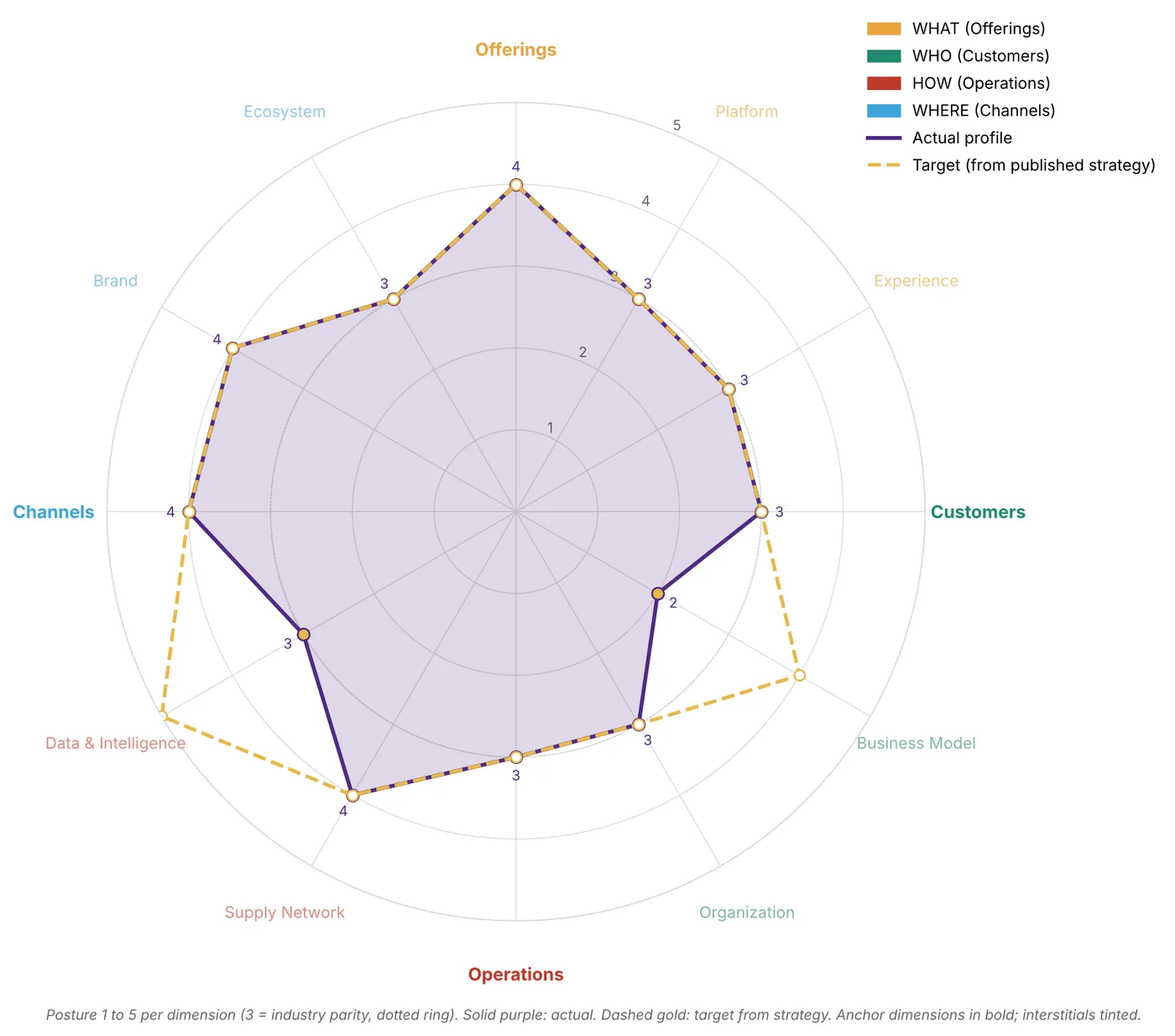
Read as a statement of intended asymmetry, that strategy names three dimensions of advantage. Data and Intelligence is the headline claim and carries a target of 5. Business Model, because the margin and durability case rests on software and recurring revenue rather than hardware refresh, carries a target of 4. Offerings, where the first positions live and where RFID and machine vision are the double-digit growers, carries a target of 4 and must be defended. Three dimensions are floors the firm cannot fall through even though it does not lead there: Supply Network at 4, because tariffs and memory have made sourcing a quarterly earnings variable; Channels at 4, because three distributors carry 59 percent of sales and 10,000 partners carry the rest; and Brand at 4, because the first positions are a brand asset. The remaining six are held at parity. Platform and Ecosystem are the two the strategy could have elevated and did not; Section 6 escalates one play that argues the Platform target should change.
3.2 The twelve-dimension profile
Table 2 gives the profile. Every score of 4 carries a dated citation; no dimension earns a 5, because no dimension meets the test of two independent top-tier sources with a measured outcome within twelve months plus market recognition. Effort shares by dimension are not public, so the effort column records the directional read the record allows and the role column carries the diagnosis.
Table 2. The twelve-dimension profile: target, actual, gap, priority weight, directional effort read and role, as of October 2026.
| Dimension | Target | Actual | Gap | Weight | Effort (directional) | Role |
|---|---|---|---|---|---|---|
| Offerings | 4 | 4 | 0 | 3 | High: $1.4 billion of acquisitions, most of R&D | Lead, defended peak |
| Platform | 3 | 3 | 0 | 1 | Medium: Nucleus and SDK shipped | Sustain |
| Experience | 3 | 3 | 0 | 1 | Low | Sustain |
| Customers | 3 | 3 | 0 | 1 | Medium: healthcare, QSR via Elo | Sustain |
| Business Model | 4 | 2 | −2 | 3 | Low: no packaged recurring offer | Lead; allocation gap |
| Organization | 3 | 3 | 0 | 1 | Medium: reorganization, exit | Sustain |
| Operations | 3 | 3 | 0 | 1 | Medium: internal AI, restructuring | Sustain; watch upward |
| Supply Network | 4 | 4 | 0 | 1 | High: re-sourcing, memory | Hold (floor) |
| Data & Intelligence | 5 | 3 | −2 | 3 | High: agent suite, AI office, Antuit | Lead; execution and disclosure gap |
| Channels | 4 | 4 | 0 | 1 | Medium | Hold (floor) |
| Brand | 4 | 4 | 0 | 1 | Low | Hold (floor) |
| Ecosystem | 3 | 3 | 0 | 1 | Low | Starve by choice |
Offerings earns its 4 on independent recognition and shipped product. VDC Research ranks Zebra first in enterprise mobile computing, thermal barcode printing, data capture and RFID readers (Zebra Technologies 2026b, citing VDC), and the 2026 product cadence is dense: the TC501 and TC701 handhelds on the Qualcomm Dragonwing Q-6690, the ET401 tablet with integrated RFID, the DS82-HC clinical scanner, the CV70 machine vision camera and the Photoneo 3D line (Zebra Technologies 2026j; Zebra Technologies 2026l; Zebra Technologies 2026m). The outcome signal is mixed, which is why the score is 4 rather than 5: machine vision declined in 2025 before growing double digits in the first half of 2026, and RFID, after several years of double-digit growth, declined in the first quarter and was flat in the second on project timing (Zebra Technologies 2025b; Zebra Technologies 2026f; Zebra Technologies 2026h). The Business Insider innovation list that named Zebra in October 2026 is reputation and patent based and is recorded as corroboration only (Business Insider 2026).
Supply Network earns its 4 on a measured outcome. The share of North American imports sourced from China fell from more than 80 percent six years ago to less than 20 percent, with management guiding to the teens, and the fiscal 2025 tariff cost after mitigation was about $24 million on $5.4 billion of sales (Zebra Technologies 2025b). In 2026 the same organization absorbed a memory shock that doubled contract DRAM prices in the first quarter (TrendForce 2026) by qualifying ten new suppliers, moving to direct relationships with the three largest memory vendors, and securing enough supply to beat the high end of its second-quarter guidance (Zebra Technologies 2026h; Zebra Technologies 2026i). The $73 million of tariff recoveries booked in the second quarter is a windfall rather than an innovation and is excluded from the score.
Channels and Brand hold their 4s. The channel is the largest in the category by partner count, 10,000 active partners in 179 countries, and received CRN's five-star rating in March 2026 (Zebra Technologies 2026n), while three distributors account for 29, 15 and 15 percent of sales (Zebra Technologies 2026c). That concentration is a floor to hold rather than a peak to extend. Brand rests on the first positions and on third-party trust and employer rankings (Forbes 2024; TIME 2026); the "foundation for intelligent operations" positioning is the newest brand move and is announcement-grade so far.
Data and Intelligence is held at 3, and the derivation is boxed in Appendix A because it is the score most likely to be contested. The capability ceiling is high: a Frontline AI Suite with on-device enablers, workflow blueprints and Companion agents; an AI Data Capture SDK that ships OCR, barcode, shelf and pallet models for Qualcomm neural processors; a demand and pricing intelligence business inherited from Antuit; and a chief technology office that has been building vision models for a decade (Zebra Technologies 2026j; Zebra Technologies 2026s; Zebra Technologies 2025c). The floor is what the gate scores. The January 2026 claim that Knowledge and Sales agents "are now deployed by leading retailers" names none of them (Zebra Technologies 2026j). Target is described as exploring the Merchandising Agent, with no scale and no outcome (Zebra Technologies 2026r). The specialty retailer that reported better conversions and faster onboarding is unnamed and unquantified (Zebra Technologies 2025b). Management's own words in May 2026 were "very early days," and the 10-K says AI development "remains in the early phases" (Zebra Technologies 2026f; Zebra Technologies 2026c). The record since July adds no outcome: the second-quarter 10-Q describes the Connected Frontline segment as "unifying teams, customers, and AI agents" without a figure, the September KC401 self-service kiosk launch names no AI feature and no customer, and the trade and analyst coverage of the quarter reports no AI or software revenue (Zebra Technologies 2026w; Investing.com 2026a; Simply Wall St 2026). The one independent measured outcome on this dimension belongs to the demand intelligence suite: Nucleus Research found an average 14 percent gain in forecast accuracy and at least a 5 percent cut in carrying costs among the retailers it interviewed, with one consumer goods retailer at 30 percent (Nucleus Research 2025). That is a second-tier source with unnamed customers and supports parity, which is where the score stays.
Business Model is scored 2 on well-evidenced grounds, and this is the one place the deep pass corrects the arithmetic of the earlier read. Services and software were $978 million of fiscal 2025 sales, 18 percent of the total, up 1.3 percent against 10 percent for hardware; their gross margin fell from 51.5 to 48.2 percent, 330 basis points, against 48.0 percent for tangible products (Zebra Technologies 2026a). In the first quarter of 2026 the line earned 50.8 percent, flat on the prior year and 1.4 points above hardware (Zebra Technologies 2026e). The notes to the 10-K and the two 2026 quarterly reports add three readings. The remaining performance obligation, the contracted revenue not yet recognized, fell from $1,190 million at the end of 2024 to $1,170 million at the end of 2025 and $1,150 million in July 2026, although Elo joined in October 2025 (Zebra Technologies 2026u; Zebra Technologies 2026v; Zebra Technologies 2026w). Services and software grew 4.3 percent in the first half of 2026 while total sales grew 17 percent, so the line's share of sales fell from 18.6 to 16.5 percent, even as its gross margin recovered to about 51 percent (Zebra Technologies 2026w). And the revenue policy recognizes term software licenses at shipment and only Company-hosted software over time, without reporting the hosted line separately (Zebra Technologies 2026u). A page-by-page search of the notes and the second-quarter MD&A found no software revenue, recurring revenue, attach rate or AI revenue figure. The company discloses no annual recurring revenue, no software revenue, no attach rate and no AI revenue line, and the only new commercial format of 2026 is a device rental with a four-month minimum and a 250-unit floor (Zebra Technologies 2026q). The price increases that added 2 points to 2026 growth are a pricing action, which belongs to this dimension, and they were forced by costs rather than designed into a model. A dimension with isolated pilots and no shipped recurring offer is a 2.
The remaining six dimensions are at parity and are treated briefly. Platform has shipped real infrastructure, Zebra Nucleus as the single console for the DNA suite and the Workcloud IO integration layer in June 2026, plus an SDK that third-party developers can build on, but with no disclosed participant counts or third-party revenue the evidence is company-issued and caps at 3 (Zebra Technologies 2026k; Zebra Technologies 2026s). Experience is parity: OneCare and the managed device service are mature, rising repair costs on an aging installed base pushed service margins down in the fourth quarter, and management expects those costs to level out during 2026 (Zebra Technologies 2026d). Customers is parity with a positive direction: healthcare was the fastest-growing vertical in the second quarter, the Orchestrated Care framework and the Texas Children's Hospital RFID work give the vertical a named reference, and Elo opens quick-service restaurants and hospitality, but no outcome is yet measured (Zebra Technologies 2026h; Zebra Technologies 2026l; VDC Research 2025). Organization is parity: the segment reorganization into Connected Frontline and Asset Visibility and Automation, the robotics exit, and new inside-sales and overlay teams for machine vision, RFID and AI are sensible architecture (Zebra Technologies 2026i). Operations is parity with an upward watch: internal AI in software engineering, sales propensity, supply-chain forecasting and service response is credited by management with operating leverage, and adjusted operating expense improved 170 basis points as a share of sales in the second quarter, but the evidence is management commentary and company-level margin, not a measured program outcome (Zebra Technologies 2026f; Zebra Technologies 2026h). Ecosystem is parity: Qualcomm, Google Cloud, Salesforce, Impinj and Tecsys are real alliances and Zebra Ventures invested in Apera AI in April 2026, but partner-originated revenue is undisclosed (Zebra Technologies 2025d; Zebra Technologies 2026o).
3.3 What the drift means
The polygon is the right shape with two missing teeth. The Investment Index, the sum of the actual scores over the sum of the targets (equation 2), is 0.91, inside the 0.90 to 1.10 band the instrument calls adequate. The Shape Drift Index, half the sum of the absolute differences between each dimension's share of the actual profile and its share of the target (equations 3 and 4), is 8 percent, in the tilted band, and it reads as the share of the portfolio's emphasis that must move to match the strategy. The per-dimension tilts are exactly two: Business Model at 1.6 points below its size-adjusted target and Data and Intelligence at 1.5 points below, with every other dimension carrying a small positive mix part of 0.3 to 0.4 that sums to the same total (equations 5 and 6). The priority-weighted gap, the sum of the absolute gaps multiplied by strategic weight (equation 7), is 12 points, every one of them on those two dimensions. The verdict cell is scale with a steer: keep the envelope, redirect the emphasis.
The two headline gaps call for opposite remedies, which is why the effort read matters even when effort shares are unpublished. Data and Intelligence carries high effort: an acquired forecasting business, a funded agent suite, a dedicated AI strategy office, a developer SDK and a research budget that management says is now partly AI-assisted. Effort that high against parity posture is the signature of an execution gap, and in this case specifically a disclosure gap, since the firm may well have outcomes it has not published. The remedy is to instrument and publish, never to spend more. Business Model carries low effort: no named owner of recurring revenue, no packaging, no disclosed metric. Low effort against a target of 4 is an allocation gap, and the remedy is to fund and staff it now. Adding money to the AI suite would treat an execution gap as an allocation gap; starving the business model work because the software margins disappointed would treat an allocation gap as an execution gap. The 2025 services-and-software margin decline has an uncomfortable second reading that reinforces the point: management attributes it to repair costs on an aging installed base (Zebra Technologies 2026d), which is to say that the line the strategy counts on for margin expansion is still priced and delivered as a hardware maintenance business.
4. What we grow, what we hold, and what we kill
The public record yields seventeen live bets, listed in Table 3 with the dimension each advances and its verdict against the target. Spend by bet is not public, so the ledger adjudicates posture and role rather than dollars. A kill list with one entry means the target is binding, and the one entry is the robotics exit, already executed and recorded here because the refusal is part of the record.
Table 3. The adjudication ledger: seventeen live bets from the public record, with primary dimension, stage and verdict.
| Bet | Primary dimension (secondary) | Stage | Verdict | Rationale |
|---|---|---|---|---|
| Frontline AI Suite and Companion agents | Data & Intelligence (Business Model) | Pilot to early scale | Grow, gated | Builds the chosen peak; growth gated on a published outcome ledger with named customers, test cells and a control group by Q4 2026; no added money |
| Workcloud Demand Intelligence, sold to retailers | Data & Intelligence | Mature | Hold | The one independently measured AI outcome; internal use is a net-new play (Section 6) |
| AI Data Capture SDK and Frontline AI Enablers | Platform (Data & Intelligence) | Scaling | Grow | Third-party developers can build on it; the seed of any future platform elevation |
| Zebra Nucleus, Workcloud IO and BI | Platform (Business Model) | Launched June 2026 | Grow | The unified platform management expects to lift software margin from H2 2026 |
| RFID embedded across the device line | Offerings (Data & Intelligence) | Scaling | Grow | All devices now RFID-enabled; the double-digit grower with the broadest vertical pull |
| Photoneo and machine vision (Aurora, CV70) | Offerings | Scaling | Grow | Double-digit growth in H1 2026 after a 2025 decline; the manufacturing overlay team supports it |
| Elo integration and cross-sell | Offerings (Customers) | Integration | Hold | $1.3 billion bet running to plan at mid-single-digit growth with $10 million of integration savings identified; Elo's chief executive of 14 years steps down in November 2026; hold to plan, do not extend |
| Orchestrated Care healthcare program | Customers | Scaling | Grow | Fastest-growing vertical; named reference at Texas Children's; needs a measured outcome |
| Inside sales and overlay teams for MV, RFID, AI | Organization (Channels) | Scaling | Grow | Direct capacity for the categories the strategy names |
| Internal AI productivity program | Operations | Scaling | Grow | Credited with operating leverage and a research intensity of about 9 percent in 2027; publish the measured gains |
| China re-sourcing and memory multi-sourcing | Supply Network | Mature | Hold (floor) | The floor that made 2026 possible; protect, do not extend into new geographies for its own sake |
| 2026 price actions ($90 million) | Business Model | Executed | Harvest | A cost-forced pricing action; retaining part of it is a net-new play, the action itself is one-time |
| Device Rental Service | Business Model (Experience) | Launched Jan 2026 | Hold, re-scope | Rental is not subscription; re-scope into the per-device subscription in Section 6 |
| Salesforce Retail Cloud POS on Android | Ecosystem (Offerings) | Launched Oct 2025 | Hold | Sound alliance; no disclosed revenue |
| Zebra Ventures (Apera AI and portfolio) | Ecosystem | Ongoing | Hold | Options on physical AI vision at low cost |
| PartnerConnect program | Channels | Mature | Hold (floor) | CRN five stars; add the AI specialization track in Section 6 |
| Robotics automation business (Fetch) | Offerings | Exited Dec 2025 | Kill (executed) | A valley the strategy refused; $76 million of charges; the proof that leadership can kill |
The reallocation story is modest in dollars and large in attention. Nothing in the ledger needs new money. The capital freed by the robotics exit has already gone to RFID, machine vision and AI by management's account (Zebra Technologies 2026p). What moves is governance: the AI suite moves from an announcement program to a measured one, the rental service moves from a logistics convenience to the first element of a recurring model, and the price action moves from a harvested windfall to a capability. The shape moves toward the target when those three changes are made, and only then.
5. Where we stand against the field
Zebra leads its closest rivals on the dimensions it has chosen to defend, and on the two dimensions its strategy leans on most, the field shows what is within reach. We scored three named rivals on the same twelve dimensions, under the same evidence tiers, from their own filings and investor materials. Honeywell's Productivity Solutions and Services business (PSS) is the nearest rival in mobile computers, scanners and printers; Brady Corporation bought it for $1.4 billion and took control on August 3, 2026 (Brady Corporation 2026b). Datalogic, the Italian maker of retail and industrial scanners, mobile computers and vision sensors, overlaps Zebra in data capture. Cognex, the machine vision specialist, competes with the Asset Visibility and Automation segment where Zebra has placed Photoneo and the CV70. We considered Impinj and set it aside, because Zebra builds on Impinj chips and partners with it on Gen2x, which makes it an ally on most of the value chain. The frontier reference line takes the best posture any scored player shows on each dimension, with one outside reference: on Business Model the line is set by Samsara, which sells connected-operations software to the same frontline buyers and discloses $2,125 million of annual recurring revenue growing 30 percent at a 77 percent gross margin (Samsara 2026). Table 4 gives the scores and Figure 2 overlays them on Zebra's profile.
Table 4. Zebra against three named rivals and the frontier reference line, twelve dimensions, 1-to-5 posture scale, with the zone each dimension falls in, October 2026.
| Dimension | Zebra | PSS | Datalogic | Cognex | Frontier | Zone |
|---|---|---|---|---|---|---|
| Offerings | 4 | 3 | 3 | 4 | 4 | Divergence: Zebra across four categories, Cognex in machine vision |
| Platform | 3 | 3 | 2 | 3 | 3 | Convergence |
| Experience | 3 | 3 | 3 | 3 | 3 | Convergence |
| Customers | 3 | 3 | 3 | 3 | 3 | Convergence |
| Business Model | 2 | 2 | 2 | 3 | 5 | White space for device makers; software firms hold the frontier |
| Organization | 3 | 2 | 3 | 3 | 3 | Convergence; PSS in an ownership transition |
| Operations | 3 | 3 | 3 | 3 | 3 | Convergence |
| Supply Network | 4 | 2 | 3 | 3 | 4 | Divergence in Zebra's favor |
| Data & Intelligence | 3 | 3 | 3 | 4 | 4 | Divergence: Cognex leads in the machine vision overlap |
| Channels | 4 | 3 | 3 | 3 | 4 | Divergence in Zebra's favor |
| Brand | 4 | 3 | 3 | 3 | 4 | Divergence in Zebra's favor |
| Ecosystem | 3 | 3 | 3 | 3 | 3 | Convergence |
| Sum of scores | 39 | 33 | 34 | 38 | 43 |
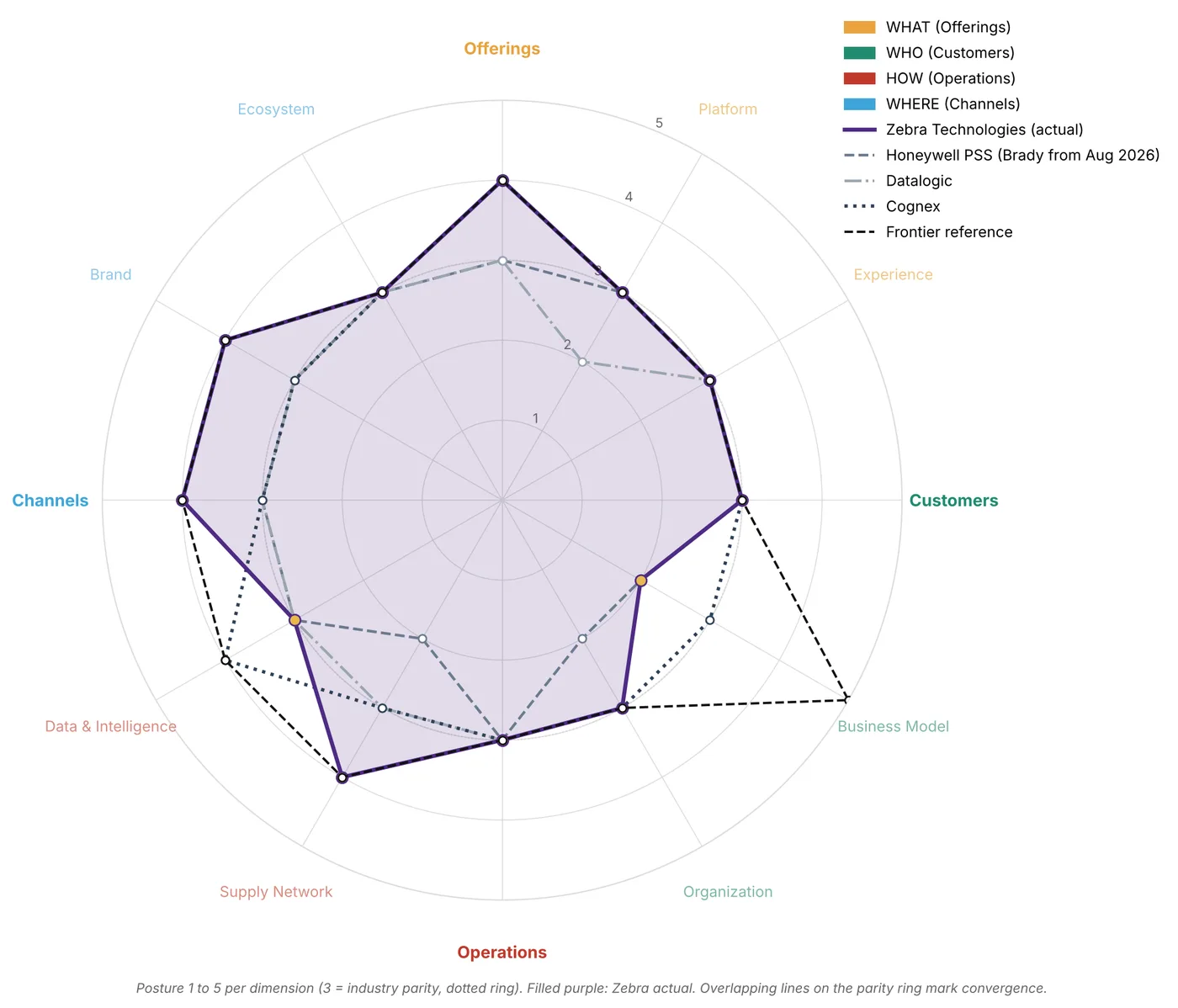
Zebra's divergence zones are widening. Honeywell PSS had 2025 revenue of about $1.1 billion, down almost 6 percent, while Zebra grew 6.2 percent organically (Manufacturing Dive 2026; Zebra Technologies 2026b). Brady's own 10-K records that PSS keeps significant manufacturing and inventory in China, and warns that distributors and channel partners may leave during the integration (Brady Corporation 2026b). Zebra cut China to less than 20 percent of its North American imports and holds 10,000 partners, so its leads on Supply Network and Channels grow while its largest handheld rival changes owners. Datalogic runs a credible product engine, with 25.2 percent of 2025 sales from new products and research at 13.2 percent of revenue, but revenue of €500.1 million grew 1.3 percent and fell 10.8 percent in the Americas (Datalogic 2026a; Datalogic 2026b). On Offerings, Cognex matches Zebra at 4: revenue grew 9 percent to $994 million in 2025 and 24 percent in the first quarter of 2026, at a 71 percent gross margin, on two new AI vision systems (Cognex 2026a; Cognex 2026b).
On Data and Intelligence the overlay changes the first-pass reading. Honeywell PSS and Datalogic stand with Zebra at parity: PSS shipped an AI assistant on its handhelds and announced agentic AI services, and Datalogic ships AI in its vision sensors and its loss-prevention scanners, with no named customer outcome from either (Mobile World Live 2025; Datalogic 2026b). Cognex is the exception. It took its OneVision AI platform to general availability in May 2026 after a beta with more than 100 customers, and three named customers reported results at launch: Schneider Electric doubled yield and cut false rejects, Essity built a sealing inspection in under a day against more than a year before, and 3M described faster labeling and deployment (Investing.com 2026b). Under the gates that hold Zebra at 3, that record earns Cognex a 4. The gap therefore holds and sharpens. Cognex sets the frontier inside the industry one point above Zebra, in machine vision, the category Zebra names as a growth engine, and the distance between the two firms is a published ledger of named-customer outcomes. Zebra's target of 5 lies beyond any frontier the record shows today; reaching 4 is a disclosure and measurement task that a direct rival completed in 2026.
On Business Model the overlay confirms the gap and shows that disclosure is a choice. Cognex captures the value of its software inside the device price, with a 67 percent gross margin in 2025 and services under 10 percent of revenue, and discloses no subscription line; that is a working model at parity (Cognex 2026a). Honeywell PSS stays at 2, yet its buyer published what Zebra does not: more than $200 million of annual recurring service, software and voice revenue, about 18 percent of PSS revenue, with revenue retention above 90 percent among customers of five years or more (Brady Corporation 2026a). Zebra's services and software line is about five times larger and carries no comparable figure. Samsara sets the frontier at 5. No device maker in the set has moved toward it, which leaves the dimension as white space for the incumbents, and the first step toward the frontier is a disclosed recurring revenue line with a retention rate, a step Brady took for PSS within months of signing the deal.
The overlay leaves the verdict where it was and adds urgency to two recommendations. It confirms the elevation choices: Zebra already leads where the strategy asks it to hold floors, and its two shortfalls are the two dimensions on which a rival or the frontier stands higher. It moves Data and Intelligence from a convergence zone to a divergence zone held by a rival, which raises the cost of delay on the outcome ledger in Section 9. The rival profiles carry Low to Medium confidence: each rests on one or two filings and an investor document, and the dimensions we could not read for a rival (PSS Operations and Ecosystem, Datalogic Experience and Ecosystem, Cognex Experience) are plotted at parity and marked in Appendix A.
6. The net-new bets
The generation pass swept the twelve dimensions as lenses, heated by the weighted gaps, and produced 44 raw candidates. The strategy gate removed three that are already in motion (AI processing in wearables, AI-assisted engineering, and the five-plus memory option program), escalated one as a strategy question, and parked none for valley-thickening. Five were vetoed at scoring. Thirty-five survive with scores. Each is scored on three rings from 1 to 5: Real (is the underlying shift durable, large and specific to Zebra), Worth (what is the play worth against the wedge and the drift, with any 4 or 5 carrying an order-of-magnitude prize priced through the dimension's P&L signature), and Win (can Zebra win rather than merely enter, drawn from its asset inventory). The rings multiply (equation 8), so a composite runs from 1 to 125, and any ring at 1 vetoes the play. Boldness is graded Extend, Stretch, Step out or Transform.
Table 5. The scored net-new plays, ranked by composite, with primary dimension, boldness grade, ring scores and verdict.
| ID | Play | Dimension (boldness) | R | W | Wn | Score | Verdict |
|---|---|---|---|---|---|---|---|
| D1 | Run Workcloud Pricing and Demand Intelligence on Zebra's own price book and channel inventory | Data & Intelligence, Business Model (Extend) | 5 | 4 | 5 | 100 | Pursue now |
| D5 | Productize on-device proof-of-delivery AI as a per-parcel blueprint for the 2027 last-mile refresh | Data & Intelligence, Offerings (Extend) | 5 | 4 | 4 | 80 | Pursue now |
| D6 | RFID-native inventory intelligence service fusing reads from all devices into store-level accuracy and fresh-food shrink | Data & Intelligence, Offerings (Stretch) | 5 | 4 | 4 | 80 | Pursue now |
| D7 | Predictive service on fleet telemetry to cut repair cost and pre-empt failures | Data & Intelligence, Operations (Extend) | 4 | 4 | 5 | 80 | Pursue now |
| Op1 | AI-run repair and depot operations to recover services margin | Operations (Extend) | 4 | 4 | 5 | 80 | Pursue now |
| B1 | Per-device subscription (device, OneCare, DNA, AI) for mid-market through distributors, partner-financed | Business Model, Channels (Stretch) | 4 | 4 | 4 | 64 | Pursue now |
| B2 | AI software attach priced per device per month inside refresh contracts | Business Model, Data & Intelligence (Extend) | 4 | 4 | 4 | 64 | Pursue next |
| D3 | Fleet benchmark data product from anonymized telemetry across millions of devices | Data & Intelligence (Stretch) | 4 | 4 | 4 | 64 | Pursue next |
| O2 | Fresh-food freshness bundle: RFID, vision and demand intelligence as one offer for grocers | Offerings (Extend) | 4 | 4 | 4 | 64 | Pursue next |
| D2 | AI outcome ledger: named customers, test cells and a control group, published quarterly | Data & Intelligence (Extend) | 4 | 3 | 5 | 60 | Pursue now |
| B4 | Seasonal elastic subscription replacing the four-month rental for retail peaks | Business Model (Extend) | 4 | 3 | 5 | 60 | Pursue next |
| B7 | Supplies and tag auto-replenishment subscription driven by printer and reader telemetry | Business Model, Supply Network (Extend) | 4 | 3 | 5 | 60 | Pursue next |
| B5 | Elo kiosk-as-a-service with a payments revenue share on Tap to Pay terminals | Business Model, Customers (Step out) | 4 | 4 | 3 | 48 | Pursue next |
| B8 | Trade-in and certified refurbishment program with refresh credits | Business Model, Brand (Extend) | 4 | 3 | 4 | 48 | Pursue next |
| O3 | Self-checkout loss-prevention bundle: Wallaby SCO with Aurora vision | Offerings, Experience (Extend) | 4 | 3 | 4 | 48 | Pursue next |
| C1 | Packaged mid-market bundles sold through distributors | Customers, Channels (Extend) | 4 | 3 | 4 | 48 | Pursue next |
| C2 | India manufacturing and logistics push with Elo's new in-country presence | Customers (Extend) | 4 | 3 | 4 | 48 | Pursue next |
| Ch2 | PartnerConnect AI specialization track with co-sell on Companion | Channels, Ecosystem (Extend) | 4 | 3 | 4 | 48 | Pursue next |
| X2 | Neutral vision supplier alliance program for robot makers after the robotics exit | Ecosystem, Offerings (Extend) | 4 | 3 | 4 | 48 | Pursue next |
| Org1 | Software and AI profit center with a separate revenue line and an incentive metric | Organization, Business Model (Extend) | 4 | 3 | 4 | 48 | Pursue next |
| D8 | Agentic task generation on Workcloud IO from device and inventory signals | Data & Intelligence, Platform (Stretch) | 4 | 3 | 3 | 36 | Watch |
| D9 | Inspection foundation model trained on Aurora and Matrox imaging data | Data & Intelligence, Offerings (Step out) | 4 | 3 | 3 | 36 | Watch |
| B10 | Per-item-tagged pricing for RFID consumables and reads | Business Model (Stretch) | 4 | 3 | 3 | 36 | Watch |
| E1 | Zero-touch rollout with a guaranteed time-to-productive, sold on Nucleus | Experience, Platform (Extend) | 3 | 3 | 4 | 36 | Watch |
| Ch3 | Companion embedded inside ISV applications through APIs | Channels, Platform (Stretch) | 4 | 3 | 3 | 36 | Watch |
| B3 | Outcome-based pricing for demand intelligence as a share of inventory savings | Business Model (Step out) | 3 | 3 | 3 | 27 | Watch |
| P2 | Open Nucleus to manage third-party device fleets | Platform (Step out) | 3 | 3 | 3 | 27 | Watch, capped at floor |
| C3 | Hospitality and gaming through Elo's installed base | Customers (Stretch) | 3 | 3 | 3 | 27 | Watch |
| X1 | Hyperscaler marketplace co-sell for Workcloud | Ecosystem (Extend) | 3 | 3 | 3 | 27 | Watch |
| D10 | Clinical documentation companion on healthcare devices | Data & Intelligence, Customers (Step out) | 4 | 3 | 2 | 24 | Re-scope |
| P3 | Retailer-to-supplier data sharing on RFID reads | Platform, Ecosystem (Transform) | 3 | 4 | 2 | 24 | Re-scope |
| Br1 | Frontline AI category brand built on published outcomes | Brand (Extend) | 3 | 2 | 4 | 24 | Watch, follows D2 |
| Ch1 | Direct online configure-and-buy for small business | Channels (Stretch) | 3 | 3 | 2 | 18 | Re-scope |
| C4 | Public-sector rugged device program | Customers (Extend) | 3 | 2 | 3 | 18 | Watch |
| S1 | Memory recovery and second-life component program from returned devices | Supply Network (Stretch) | 3 | 2 | 3 | 18 | Watch |
Five plays were vetoed and are displayed with the failing ring. Vision-guided robot picking cells built from Photoneo and Apera (Offerings, Step out) scored 4 on Real and 3 on Worth and 1 on Win, because the firm exited robotics ten months ago and a cell business would re-enter it by another door. A Zebra-trained frontline foundation model (Data & Intelligence, Transform) scored 1 on Win against hyperscaler scale; the SDK already runs third-party models. A consumer-grade device line for gig drivers through carriers (Customers, Step out) scored 1 on Win on brand and channel mismatch. A retail media network run on store devices (Platform, Transform) scored 2 on Real and 1 on Win. A captive financing arm for subscriptions (Business Model, Step out) scored 1 on Win; B1 routes financing through distributors and partners instead. One play was escalated rather than scored: a third-party AI model marketplace on the SDK and Nucleus with revenue share (Platform, Stretch) is strong enough to argue that the Platform target should be 4, which would make "foundation for intelligent operations" a platform strategy rather than a positioning line. That is a decision for leadership, and Section 8 records it as open.
Four reinforcing combinations score higher together than apart. The first, the intelligent fleet, pairs D7 predictive service with Op1 AI-run repair and B1 per-device subscription: telemetry pre-empts failures, the depot runs on it, and the subscription monetizes the uptime; read as one bet it carries the services margin recovery and the recurring base at once. The second, priced by its own engine, pairs D1 internal pricing intelligence with Org1 the software profit center and D2 the outcome ledger: the engine Zebra sells is run on Zebra, its result is published, and the published result becomes the first entry in the ledger that moves the posture score. The third, fresh and found, pairs D6 inventory intelligence with O2 the fresh-food bundle and B10 per-tag pricing. The fourth, last mile 2027, pairs D5 proof-of-delivery with B2 AI attach and Ch2 the partner AI track, timed to the transportation refresh management expects to begin in 2027 (Zebra Technologies 2026h).
The two-currency reconciliation closes in posture and splits in dollars. In posture points, the six pursue-now plays map onto the two gap dimensions: D1, D2, D5, D6 and D7 supply the named, measured, published outcomes that lift Data and Intelligence from 3 to 4 within 18 months, and B1 with the harvested price capability lifts Business Model from 2 to 3 in the same period and to 4 by 2028 if a recurring revenue line is disclosed and growing. The 5 on Data and Intelligence requires market recognition, a rival adopting Zebra's architecture or an analyst naming it the leader on a measured basis, and that lies beyond a 36-month horizon; we say so rather than round it to success. In dollars, the revenue-bearing plays (B2, D5, D6 with O2, B7, B5) are worth $65 to $130 million of annual revenue by fiscal 2028 before any hit rate, and $35 to $65 million at a 50 percent portfolio hit rate, against a wedge of $60 to $120 million. The net-new portfolio closes about half the wedge on its own and shares the rest with the bets already in flight, principally the 2027 transportation refresh, machine vision and Elo cross-sell. The spend the portfolio implies, mostly redirection of existing research and software staff plus partner financing for B1, fits inside the certified envelope. The dial we recommend is to improve the portfolio: hold the 5 to 7 percent ambition, hold the envelope, and run the plays above against the hurdles in Section 7.
7. What will move the P&L
A radar score converts to money only through initiatives, on a lag, at a rate set by each dimension's operating metric and a unit coefficient computed from Zebra's own disclosed margin structure. Table 6 prices the four rows that pass the screen: each was graded High or defensible Medium on the weakest of pool size, responsiveness and durability. The coefficient bases are stated so a finance team can rerun them.
One screening result changes the precedent and deserves its own paragraph. The disclosed services-and-software line earned 48.2 percent gross margin in fiscal 2025 and 50.8 percent in the first quarter of 2026, against 48.0 and 49.4 percent for tangible products (Zebra Technologies 2026a; Zebra Technologies 2026e). On the disclosed line, a point of revenue mix shifted from hardware to services and software is worth 0 to 1.4 points of margin differential on $62 million, or $0 to $0.9 million of gross profit per point: close to nothing. The earlier outside-in read priced the same shift at 18 to 20 basis points of consolidated margin per point on an assumed 45 versus 65 percent segment split; the disclosure does not support that split, because Zebra reports software bundled with maintenance services, and the bundled line carries hardware-like margins. A pure software margin may well be far higher, and management expects software margin gains as customers move to the unified platform from the second half of 2026 (Zebra Technologies 2026d), but a coefficient that cannot name its basis does not enter the bridge. The Business Model plays are therefore priced for revenue durability and for the services margin recovery, never for mix.
Table 6. The Innovation P&L Bridge: priced rows with operating metric, unit coefficient and basis, targeted movement, gross impact, lag and proof metric.
| Bet | Operating metric | Unit coefficient and basis | Targeted movement | Gross impact | Lag | Proof metric |
|---|---|---|---|---|---|---|
| D1 with Org1 and D2: price intelligence on Zebra's own book | Realized price | About $28 million EBITDA per 50 basis points of realized price: $6.2 billion forward base × 0.5 percent × 90 percent flow-through (Zebra Technologies 2026g; 2026h) | Retain 50 basis points of the roughly 145 basis points of 2026 price as memory costs normalize in 2027 and 2028, instead of giving it back | $28 million | 1 to 2 years | Quarterly price realization; channel inventory days; discount variance by deal size |
| D7 with Op1 and Nucleus: services margin recovery | Services and software gross margin | About $10.5 million gross profit per 100 basis points on a $1.05 billion services-and-software run rate ($264 million in Q1 2026) (Zebra Technologies 2026e) | Recover 250 basis points by fiscal 2028, against 330 lost in fiscal 2025 | $26 million | In-year to 2 years | Services-and-software gross margin; repair cost per device; mean time to repair |
| B2 with D5: AI software attach in refresh contracts | AI software revenue and attach rate | Illustrative: 60 percent contribution on incremental software revenue; Zebra discloses no software margin, so the coefficient is a labeled assumption to be replaced by the pilot | $25 to $50 million of AI software revenue by fiscal 2028 | $15 to $30 million | 2 to 3 years | Disclosed AI software revenue; attach rate on refreshed devices; net retention |
| D6 with O2: fresh-food RFID and inventory intelligence bundle | Revenue from offerings under three years old | 48 percent gross margin on bundled hardware and software, the disclosed consolidated rate (Zebra Technologies 2026a) | $20 to $40 million of bundle revenue by fiscal 2028 | $10 to $19 million | 1 to 2 years | Bundle revenue; shrink reduction measured in test stores against a control group |
The stack is $79 to $103 million of gross annual impact by fiscal 2028. A 40 percent execution haircut, the rate defensible for an enterprise running an acquisition integration and a memory supply program at the same time, brings it to $47 to $62 million, which we round to $45 to $60 million: 3 to 4 percent of a fiscal 2026 EBITDA base of about $1.47 billion (the 23.5 to 24.0 percent outlook on $6.2 billion). The Data and Intelligence multiplier is set at one, because the dimension is at parity rather than below it; if the outcome ledger lifts it to 4, the responsiveness of every AI-dependent row improves and the bridge should be re-priced upward at the 2027 re-read. No in-year conversion of a long-lag dimension is promised: the AI attach row pays in 2028 and compounds after.
Governance is the condition on every row. Each coefficient above is a prior; the pilot produces the posterior. D1 runs on one product family and one region for two quarters with a pre-agreed hurdle of 25 basis points of retained price against a control region. D7 and Op1 run on one repair depot with a hurdle of 150 basis points of depot margin. B2 runs inside one transportation refresh contract with a hurdle of 30 percent attach. D6 runs in a set of test stores with a control group and a hurdle of a measured shrink reduction. Nothing scales before its hurdle, and no coefficient is negotiated backward from the 5 to 7 percent framework the agenda serves.
8. What we will not do
The valleys are choices and are stated with the same confidence as the peaks. Zebra will not elevate Platform or Ecosystem in this cycle. Both stay at parity: the SDK, Nucleus and the alliance set are maintained, but no investment is made in third-party take rates, developer subsidies or marketplace infrastructure until leadership answers the escalated question of whether "foundation for intelligent operations" is a platform strategy. If the answer is yes, the Platform target moves to 4, the model marketplace is scored, and the profile is re-read. Zebra will not re-enter robotics by any door, including vision-guided picking cells; Photoneo and Apera supply vision to robot makers as a neutral supplier. Zebra will not build its own foundation model, run a retail media network, launch a consumer device line, or stand up a captive finance company. Zebra will not extend the Elo bet beyond its integration plan until the first-year integration savings are measured, and will not add geographies to the supply network for their own sake. Three floors are held even though Zebra will not lead there: Supply Network at 4, because a quarter of memory or tariff exposure can erase a year of software progress; Channels at 4, because the distributors and 10,000 partners are the only route to the mid-market the subscription play needs; and Brand at 4, because the first positions are the asset every other play trades on.
The deliberately parked plays stay visible. Direct online commerce for small business is re-scoped into the distributor-led bundle because channel conflict with partners carrying 59 percent of sales outweighs the margin. Retailer-to-supplier data sharing is re-scoped because the firm has no right to share its customers' read data. The clinical documentation companion is re-scoped until a regulated-device partner is found.
9. What happens next
The 90-day program has seven commitments, each with an owner by role.
- Publish the AI outcome ledger. The vice president of AI strategy names at least three Companion and proof-of-delivery deployments with customer consent, each with test cells and a control group and a measured operating metric, in the fourth-quarter 2026 earnings materials.
- Turn the engine on Zebra. The chief financial officer and the senior vice president of software run Workcloud Pricing and Demand Intelligence on one product family in one region, with the 25-basis-point retention hurdle and a control region, reporting at the first-quarter 2027 call.
- Name the owner of recurring revenue. The chief executive assigns a software and AI profit center with a separate revenue line, and the compensation committee adds a recurring revenue metric to the Strategic Growth Index before the 2027 plan is set.
- Pilot the per-device subscription. The chief revenue officer and two distributors launch the mid-market subscription with partner financing, folding the rental service into it, with a 250-unit pilot per distributor.
- Start the depot pilot. The services leader runs predictive service and AI-assisted triage at one repair depot against the 150-basis-point hurdle.
- Re-run the yield test when the 2027 research budget is set. The chief financial officer confirms that research at about 9 percent of sales still yields inside the band once the 2 points of 2026 price fall away.
- Schedule the re-read. The profile is re-scored in April 2027 after the fiscal 2026 10-K, when the services-and-software margin, any disclosed software revenue, the AI ledger and the Elo integration savings figure arrive; Data and Intelligence and Business Model are the two scores capped by pending disclosure, and both are re-read then.
Appendix A. Source Ledger
Run header. Run date October 12, 2026; scope Zebra Technologies as one business with one value chain (Connected Frontline and Asset Visibility and Automation together). Two passes completed: pass one assembled the fiscal 2025 10-K and annual report, the February 2026 investor presentation, the Q3 2025, Q4 2025, Q1 2026 and Q2 2026 results and call transcripts, the 2026 proxy, the Citi conference transcript and the Elo and Photoneo acquisition records; pass two hunted dimension by dimension through company releases, product documentation, analyst commentary, trade press and the rivals' records. Sources counted: 63 after the top-up pass (Tier A 30, Tier B 12, Tier C 15, Tier D 6). Sources rejected at the provenance gate: 6 (an AI-generated 10-K summary site, two AI-generated earnings-summary articles used for navigation only, two unsourced financial-profile sites, and a template market-size report), retained here to show the screening happened. Coverage gaps flagged low confidence: effort shares by dimension (not public); software revenue, recurring revenue, attach and net retention (searched for in the 10-K notes and the 2026 quarterly reports and not disclosed); culture (unobservable). Changes versus the earlier outside-in read: all twelve scores held; the yield test moved from 0.86 to about 0.8 on the larger forward base and the 2026 research run rate; the China sourcing figure moved from about 30 percent to less than 20 percent on the Q3 2025 call; the mix-shift coefficient was withdrawn because the disclosed services-and-software margin does not support it; the price contribution moved from 1 point to 2 points on the Q2 2026 call.
Top-up pass, October 12, 2026. A second, targeted pass closed three gaps the first run left open. It read the notes to the fiscal 2025 10-K through the filing's XBRL note pages (revenues, performance obligations, deferred revenue, segment information and the revenue recognition policy), the Q1 2026 10-Q notes, and the Q2 2026 10-Q including its MD&A in full; the 10-K's own Item 7 text could not be reached, because the fetch tool stops at about 112,000 characters of the sec.gov document and of the investor-site PDF, both of which end inside Item 1A or Item 1C. It read the trade and analyst coverage of Zebra's AI agents and Elo published since July 2026, and it scored three named rivals and a frontier reference from their filings and investor materials (Section 5). Searches used: 16. Score moves on Zebra: none; all twelve held. Re-checks that held: Business Model at 2 (the contracted revenue not yet recognized fell from $1,190 million to $1,150 million between December 2024 and July 2026 with Elo included, services and software fell to 16.5 percent of first-half 2026 sales, and no software, recurring, attach or AI revenue figure appears in any note or MD&A read; S47 to S49); Data and Intelligence at 3 (no named customer outcome since July; S49 to S52; the February 2025 report of a 25 percent staffing reduction at an unnamed North American retailer is Tier D and does not move the score, S54). Numbers added: the remaining performance obligation series, deferred revenue of $842 million at December 2025 and $835 million at July 2026, the first-half services-and-software figures ($505 million against $484 million, about 51 percent gross margin), and segment gross margins computed from the segment note (Connected Frontline 47.2 percent, Asset Visibility and Automation 50.0 percent in 2025). The top-up pass found no earlier number in error. The drift metrics, the yield test and the verdict are unchanged because no Zebra score moved; the overlay changes the zone reading on Data and Intelligence from convergence to divergence held by Cognex.
Rival scoring basis. Honeywell PSS, scored as of October 2026 under Brady ownership: Offerings 3 (2025 revenue about $1.1 billion, down almost 6 percent; CT70 with RAIN RFID; S55, S33); Platform 3 and Experience 3 (more than 3 million devices under active service contracts; S56); Customers 3 (about 55 percent of revenue from retail and transportation and logistics; S56); Business Model 2 (more than $200 million of recurring service, software and voice revenue, retention above 90 percent among long-tenure customers, no subscription offer described; S56); Organization 2 (carve-out under integration, channel retention risk; S57); Supply Network 2 (significant manufacturing and inventory in China; S57); Data and Intelligence 3 (AI assistant shipped, agentic AI announced, no outcome; S33); Channels 3 and Brand 3 (partner network and brand in transition; S57); Operations and Ecosystem not read, plotted at 3. Datalogic: Offerings 3 (vitality index 25.2 percent, revenue up 1.3 percent; S58, S59); Platform 2 (device management cloud only); Customers 3 (Americas down 10.8 percent, EMEAI up 11.1 percent); Business Model 2 (no software or recurring line disclosed); Operations 3 (adjusted EBITDA margin up 1.6 points to 10.6 percent); Supply Network 3 (production in Slovakia, Hungary and Vietnam, no measured outcome); Data and Intelligence 3 (AI shipped in vision sensors and scanners, no named outcome; S59); Organization, Channels and Brand 3; Experience and Ecosystem not read, plotted at 3. Cognex: Offerings 4 (revenue up 9 percent in 2025 and 24 percent in Q1 2026, two AI vision systems shipped; S60, S61); Platform 3 (unified software architecture, no third-party participation disclosed); Business Model 3 (67 to 71 percent gross margin captured in the device price, services under 10 percent, no subscription disclosed; S60, S61); Data and Intelligence 4 (OneVision general availability May 2026, more than 100 beta customers, three named customers with measured results; S62); Organization 3 (new chief executive June 2025, sales force rebuilt); Customers, Operations, Supply Network, Channels, Brand and Ecosystem 3; Experience not read, plotted at 3. Frontier reference: the highest posture among the four scored firms on each dimension, with Business Model set at 5 by Samsara's disclosed recurring revenue, growth and margin (S63). Confidence: Low to Medium for every rival profile.
Table 7. The Source Ledger: sources counted, with date, tier and provenance status.
| ID | Source | Date | Tier | Used for |
|---|---|---|---|---|
| S1 | Zebra Technologies, Form 10-K for fiscal 2025 (Items 1, 1A) | Feb 2026 | A | Strategy, segments, R&D, customer concentration, manufacturing, AI risk language |
| S2 | Zebra Technologies, 2025 Annual Report and shareholder letter | Feb 2026 | A | Elo and Photoneo terms, served market, robotics exit |
| S3 | Zebra Technologies, Q4 and full-year 2025 results release and tables | Feb 12, 2026 | A | Product-line sales and margins, opex, FCF, 2026 outlook |
| S4 | Zebra Technologies, investor presentation | Feb 12, 2026 | A | FY2025 $5,396 million, 6.2 percent organic, 5 to 7 percent framework, VDC first positions, capital framework |
| S5 | Zebra Technologies, Q4 2025 earnings call (Motley Fool transcript) | Feb 12, 2026 | A | Memory headwind, price actions, AI pilots, services margin, Elo |
| S6 | Zebra Technologies, Q1 2026 results release | May 12, 2026 | A | Q1 figures, product-line cost of sales, R&D |
| S7 | Zebra Technologies, Q1 2026 earnings call (Motley Fool transcript) | May 12, 2026 | A | 5 to 7 percent for both segments, internal AI uses, "very early days", machine vision inflection |
| S8 | Zebra Technologies, Q2 2026 results release (8-K Exhibit 99.1) | Aug 4, 2026 | A | Q2 figures, tariff recoveries, outlook, debt |
| S9 | Zebra Technologies, Q2 2026 earnings call (Equibles transcript) | Aug 4, 2026 | A | 7 organic points with 2 of price, $90 million price, memory suppliers, Elo integration savings, RFID timing |
| S10 | Zebra Technologies, Q3 2025 results release | Oct 28, 2025 | A | Q3 figures, prior segment structure, tariff cost |
| S11 | Zebra Technologies, Q3 2025 earnings call (Motley Fool transcript) | Oct 28, 2025 | A | China share under 20 percent, AI revenue timing, specialty retailer pilot, RFID history |
| S12 | Zebra Technologies, 2026 proxy statement (DEF 14A) | Apr 2026 | A | Incentive metrics, board, robotics rationale |
| S13 | Zebra Technologies at Citi Global TMT Conference (Investing.com transcript summary) | Sept 9, 2026 | B | R&D toward 9 percent, mid-twenties EBITDA, memory supplier strategy, RFID embedded, internal AI |
| S14 | Zebra Technologies, NRF 2026 release | Jan 9, 2026 | C | Frontline AI Suite, Companion agents "deployed by leading retailers", new devices, rental service |
| S15 | Zebra Technologies, ZONE 2026 release (Nucleus, Workcloud IO and BI) | June 2, 2026 | C | Platform launch |
| S16 | Zebra Technologies, HIMSS26 release | Mar 5, 2026 | C | Orchestrated Care, Texas Children's Hospital, DS82-HC |
| S17 | Zebra Technologies, Automate 2026 release | June 22, 2026 | C | CV70, Aurora, Photoneo demonstrations |
| S18 | Zebra Technologies, PartnerConnect CRN rating release | Mar 12, 2026 | C | 10,000 partners; CRN five stars (recognition counted as B) |
| S19 | Zebra Technologies, Apera AI investment release | Apr 29, 2026 | C | Zebra Ventures |
| S20 | Zebra Technologies, Frontline AI Summit release | Sept 15, 2025 | C | Workcloud Pricing and Allocation in the portfolio |
| S21 | Zebra Technologies, Target success story | 2026 (undated) | C | Target "exploring" the Merchandising Agent |
| S22 | Zebra Technologies, AI Data Capture SDK 4.0 documentation | 2026 | C | Models, devices, third-party development, licensed models |
| S23 | Zebra Technologies, Device Rental Service flyer | 2026 | C | Rental terms |
| S24 | Zebra Technologies and Salesforce, Retail Cloud POS release | Oct 14, 2025 | C | Alliance |
| S25 | Zebra Technologies, 2026 industry trends release | Dec 2025 | C | Positioning language |
| S26 | Elo Touch Solutions, NRF 2026 release | Jan 8, 2026 | C | Elo installed base, Wallaby SCO, Pay Z30 |
| S27 | VDC Research, "Zebra Agrees to Acquire Elo" | Aug 11, 2025 | B | Elo revenue, rationale, channel conflict risk |
| S28 | Nucleus Research, value of Zebra's Demand Intelligence Suite | Feb 10, 2025 | B | 14 percent forecast accuracy, 5 percent carrying cost, 30 percent at one retailer |
| S29 | Nucleus Research, Workforce Management Technology Value Matrix | 2024 | B | Workcloud Workforce leader (dated) |
| S30 | Gartner Magic Quadrant for Indoor Location Services (via Zebra release) | 2024 | B | Leader (dated) |
| S31 | IDC MarketScape, Retail Promotions Management (via Zebra release) | 2025 | B | Major Player |
| S32 | TrendForce via The Register, DRAM contract prices | Feb 2, 2026 | B | Memory price shock context |
| S33 | Mobile World Live, Honeywell AI services and CT70 | Oct 16, 2025 | B | Rival direction |
| S34 | Supply Chain 247, Zebra plan to exit robotics | Dec 2025 | B | Exit timing |
| S35 | Business Insider, America's Most Innovative Businesses 2027 (via Webull) | Oct 5, 2026 | C | Recognition, method reputation-based |
| S36 | TIME, World's Best Companies 2026 (via Webull) | 2026 | C | Brand corroboration |
| S37 | Forbes, Most Trusted Companies in America (via Business Wire) | Dec 18, 2024 | C | Brand corroboration |
| S38 | Computerworld, Best Places to Work in IT 2026 | 2026 | C | Employer recognition |
| S39 | Oxford Economics and Zebra retail AI study (via ZONE release) | June 2026 | C | Retail AI pilot rates |
| S40 | Kiosk Industry, Zebra connected frontline for kiosks | 2026 | D | Corroboration of Elo strategy |
| S41 | RFID Journal, Zebra retail AI solutions | Jan 2026 | D | Corroboration of S14 |
| S42 | Robotics 24/7, Photoneo acquisition close | Feb 2025 | D | Corroboration of S2 |
| S43 | Zebra Technologies, Antuit.ai acquisition release | Oct 2021 | C | Provenance of the demand intelligence engine |
| S44 | TipRanks, Morgan Stanley price target raise | 2026 | B | Analyst stance |
| S45 | Yahoo Finance and Zacks, Q2 2026 earnings coverage | Aug 2026 | B | Analyst stance |
| S46 | Sawhney, Innovation Radar 2.0, SSRN 7244520 | July 2026 | Method | Framework |
| S47 | Zebra Technologies, Form 10-K for fiscal 2025, notes via XBRL pages (revenues, performance obligations, deferred revenue, segments, revenue policy) | Feb 2026 | A | Revenue by segment and type; RPO $1,170 million; deferred revenue $842 million; segment gross margins; software recognition policy |
| S48 | Zebra Technologies, Form 10-Q for Q1 2026, Note 3 | May 2026 | A | RPO $1,150 million; services and software $264 million; deferred revenue $832 million |
| S49 | Zebra Technologies, Form 10-Q for Q2 2026, notes and MD&A (investor-site PDF) | Aug 4, 2026 | A | RPO, deferred revenue, first-half services and software, organic growth by segment, Elo contribution, R&D |
| S50 | Investing.com, "Zebra Technologies launches KC401 self-service kiosk" | Sept 17, 2026 | C | Elo-backed self-service portfolio; no AI feature or customer named |
| S51 | Kiosk Industry, "Leadership Changes in Self-Service" | Oct 10, 2026 | D | Elo chief executive transition |
| S52 | Simply Wall St via Yahoo Finance, Q2 2026 coverage | Aug 5, 2026 | D | No AI or software revenue reported |
| S53 | Benzinga via Yahoo Finance, KeyBanc upgrade to Overweight | May 13, 2026 | B | Analyst stance |
| S54 | AI News, "Zebra Technologies and enterprise AI in the APAC" | Feb 4, 2025 | D | Unnamed retailer, 25 percent staffing reduction claim |
| S55 | Manufacturing Dive, Honeywell completes PSS sale to Brady | Apr 21, 2026 (closing note Aug 5, 2026) | B | PSS 2025 revenue and decline, 3,000 staff, close |
| S56 | Brady Corporation, PSS transaction investor presentation | Apr 20, 2026 | A | PSS revenue, gross margin, recurring revenue above $200 million, retention, service contracts |
| S57 | Brady Corporation, Form 10-K for fiscal 2026 | Sept 2026 | A | Close on Aug 3, 2026; China manufacturing; channel retention risk |
| S58 | Datalogic, fiscal 2025 results release | Mar 19, 2026 | A | Revenue, margins |
| S59 | Datalogic, Annual Report 2025 | 2026 | A | Revenue by business and region, R&D, vitality index, AI products |
| S60 | Cognex, Form 10-K for fiscal 2025 | Feb 2026 | A | Revenue, margin, services share, AI positioning, manufacturing |
| S61 | Cognex, first-quarter 2026 results release | May 6, 2026 | A | Growth, gross margin, AI vision systems |
| S62 | Investing.com, "Cognex launches AI vision platform after customer trials" | May 13, 2026 | B | OneVision general availability; named customer results |
| S63 | Samsara, second-quarter fiscal 2027 results (8-K Exhibit 99.1) | Sept 3, 2026 | A | Frontier reference: ARR $2,125 million, growth 30 percent, gross margin 77 percent |
Rejected at the gate: an AI-generated 10-K summary page (used only to locate the filing), Investing.com AI-generated slide summaries for Q4 2025 and Q2 2026 (navigation only, every figure re-verified against S3 and S8), two unsourced financial-profile sites asserting segment revenue, and a templated rugged-handheld market-size report.
Table 8. Per-dimension evidence rows: sources, three-signal read, score and derived confidence.
| Dimension | Sources | Shipped moves | Outcome evidence | Market recognition | Score | Confidence |
|---|---|---|---|---|---|---|
| Offerings | S4, S14, S16, S17, S7, S9, S35 | Dense 2026 cadence; Elo; Photoneo | MV double digits H1 2026 after 2025 decline; RFID flat in Q2 | VDC first positions in four categories | 4 | Medium (VDC dated, cited by company) |
| Platform | S15, S22, S5 | Nucleus, Workcloud IO, SDK 4.0 | None disclosed | None | 3 | Low |
| Experience | S5, S23 | OneCare, managed service, rental | Services margin down on repair costs | None | 3 | Medium |
| Customers | S9, S16, S27 | Healthcare program, Elo verticals, India | Healthcare fastest-growing Q2 2026; unquantified | None | 3 | Medium |
| Business Model | S3, S6, S23, S9, S11 | Rental; price actions; subscriptions bundled in services | S&S 18 percent of sales, margin down 330 bps; no ARR | None | 2 | High (disclosed figures) |
| Organization | S1, S12, S13 | Reorganization, exit, overlay teams | Opex leverage (company level) | None | 3 | Medium |
| Operations | S7, S9, S13 | Internal AI in engineering, sales, supply chain, service | Opex 170 bps leverage Q2; program-level outcome undisclosed | None | 3 | Medium |
| Supply Network | S11, S9, S13, S32 | Re-sourcing; ten new memory suppliers; direct top-three | China under 20 percent; tariffs mitigated; Q2 beat on supply | Analysts credit execution | 4 | High |
| Data & Intelligence | S14, S21, S11, S7, S1, S28, S22, S20 | Suite GA, SDK, agents in pilots and unnamed deployments | Nucleus 14 percent forecast accuracy (demand suite); agents unquantified | None independent | 3 | Low to Medium |
| Channels | S1, S18, S27 | PartnerConnect; inside sales | 59 percent via three distributors | CRN five stars | 4 | Medium |
| Brand | S4, S36, S37, S35 | Positioning refresh | First positions | TIME, Forbes lists | 4 | Medium |
| Ecosystem | S24, S19, S14 | Qualcomm, Google, Salesforce, Impinj, Tecsys, Ventures | None disclosed | None | 3 | Low |
Derivation box: Data and Intelligence at 3. Signal one, shipped moves: the Frontline AI Suite was introduced at NRF in January 2025 and expanded in January 2026; Companion Knowledge and Sales agents are stated to be deployed by leading retailers; the AI Data Capture SDK 4.0 ships named models for Qualcomm neural processors; the demand intelligence suite has been sold since 2021 (S14, S22, S43). Signal two, outcome evidence: the only independent measured outcome is Nucleus Research's 14 percent average forecast-accuracy gain on the demand suite (S28), a second-tier source with unnamed customers; the agent deployments carry no named customer, scale or metric (S14, S21, S11), and management says "very early days" (S7). Signal three, market recognition: no analyst names Zebra the leader in frontline AI on a measured basis, Honeywell PSS and Datalogic make equivalent claims at parity (S33, S59), and Cognex has published three named-customer outcomes for its AI vision platform (S62), which places the industry frontier on this dimension one point above Zebra. Anchor test: "shipped without measured outcome" meets the definition of parity; "shipped and measured, recognition contested" would require a named, quantified deployment, which is absent. Tier C caps at 3; the Tier B demand-suite outcome supports 3 and does not lift it. Confidence Low to Medium; re-read April 2027.
Appendix B. Mathematics
The nine equations below define the quantities used in the body. Equations (1) through (7) are the instrument's minimum set; (8) and (9) govern the generation and pricing passes.
Y = \frac{(g^{*} + d)\, B}{E}(1)The implied yield Y is the revenue the ambition requires each year, the growth target g^{*} plus the core decay rate d applied to the base B, divided by the innovation envelope E; a yield inside the 0.5 to 1.5 band certifies the envelope.
k = \frac{\sum_{i=1}^{12} A_i}{\sum_{i=1}^{12} T_i}(2)The Investment Index k is the sum of the actual scores A_i over the sum of the targets T_i; between 0.90 and 1.10 the size is adequate.
s^{A}_i = \frac{A_i}{\sum_{j=1}^{12} A_j}, \qquad s^{T}_i = \frac{T_i}{\sum_{j=1}^{12} T_j}(3)The shares express each profile's scores as fractions of its own total, which removes the size effect before shape is read.
\mathrm{SDI} = \tfrac{1}{2} \sum_{i=1}^{12} \left| s^{A}_i - s^{T}_i \right|(4)The Shape Drift Index is the total variation distance between the two share vectors and reads as the share of the portfolio's emphasis that must move to match the target.
g_i = A_i - T_i = (k-1)\, T_i + \left( A_i - k\, T_i \right)(5)Each spoke's raw gap splits without residual into a size part, carried by every spoke in proportion to its target, and a mix part, which is the reallocation argument proper.
\sum_{i=1}^{12} \left( A_i - k\, T_i \right) = 0, \qquad \mathrm{SDI} = \frac{\sum_{i=1}^{12} \left| A_i - k\, T_i \right|}{2 \sum_{i=1}^{12} A_i}(6)The mix parts sum to zero by construction, and half their absolute sum over the actual total equals the Shape Drift Index exactly, so the two headline metrics are two halves of one identity.
G_w = \sum_{i=1}^{12} w_i \left| A_i - T_i \right|(7)The priority-weighted gap multiplies each absolute gap by its strategic weight w_i and is the operative per-dimension signal; for Zebra it is 12, all on two dimensions.
C = R \cdot W \cdot W_n, \qquad \min(R, W, W_n) = 1 \Rightarrow \text{veto}(8)The RWW-I composite multiplies the Real, Worth and Win rings so that a weak ring cannot hide behind strong ones, and any ring at 1 vetoes the play.
\Delta \mathrm{EBITDA} = (1-h) \sum_{b} c_b\, \Delta m_b(9)The bridge sums, across priced bets b, the unit coefficient c_b times the targeted movement in the operating metric \Delta m_b, and cuts the total by the execution haircut h; each term is delivered on its dimension's lag.
References
Sawhney, Mohanbir. 2026. The Innovation Radar 2.0: A Framework for Measuring and Diagnosing Business Innovation. SSRN Working Paper. https://ssrn.com/abstract=7244520.
Brady Corporation. 2026a. "Acquisition of Honeywell Productivity Solutions and Services." Investor presentation, April 20, 2026.
Brady Corporation. 2026b. Form 10-K for the fiscal year ended July 31, 2026. September 2026.
Cognex Corporation. 2026a. Form 10-K for the fiscal year ended December 31, 2025. February 2026.
Cognex Corporation. 2026b. "Cognex Reports First Quarter 2026 Results." May 6, 2026.
Datalogic. 2026a. "Board of Directors Approves Consolidated Annual Financial Report at December 31, 2025." March 19, 2026.
Datalogic. 2026b. Annual Report 2025. 2026.
Investing.com. 2026a. "Zebra Technologies launches KC401 self-service kiosk." September 17, 2026.
Investing.com. 2026b. "Cognex launches AI vision platform after customer trials." May 13, 2026.
Kiosk Industry. 2026. "Leadership Changes in Self-Service: Elo, Mood Media, Oracle and More." October 10, 2026.
Manufacturing Dive. 2026. "Honeywell completes $1.4B productivity solutions unit sale." April 21, 2026, with a closing note dated August 5, 2026.
Samsara. 2026. "Samsara Reports Second Quarter Fiscal Year 2027 Financial Results." Form 8-K Exhibit 99.1, September 3, 2026.
Simply Wall St. 2026. "Zebra Technologies (ZBRA) Is Up 30.3% After Record Q2 2026 Beat and Raised Full-Year Outlook." Yahoo Finance, August 5, 2026.
Business Insider. 2026. "America's Most Innovative Businesses 2027." Reported via Webull, October 5, 2026.
Forbes. 2024. "Most Trusted Companies in America." Zebra Technologies release via Business Wire, December 18, 2024.
Mobile World Live. 2025. "Honeywell updates AI services, handheld range." October 16, 2025.
Nucleus Research. 2025. "The Value of Zebra's Demand Intelligence Suite for Enterprise Retailers." Research Z20, February 10, 2025.
TIME. 2026. "World's Best Companies 2026." Zebra Technologies release via Webull, 2026.
TrendForce. 2026. DRAM contract price forecast for Q1 2026, reported by The Register, February 2, 2026.
VDC Research. 2025. "Zebra Agrees to Acquire Elo." AutoID and Data Capture blog, August 11, 2025.
Zebra Technologies. 2025a. "Zebra Technologies Announces Third-Quarter 2025 Results." October 28, 2025.
Zebra Technologies. 2025b. Third-quarter 2025 earnings call transcript. October 28, 2025.
Zebra Technologies. 2025c. "Zebra Technologies Showcases AI for the Frontline at Inaugural Frontline AI Summit." September 15, 2025.
Zebra Technologies. 2025d. "Zebra and Salesforce Introduce Retail Cloud POS Solution on Android." October 14, 2025.
Zebra Technologies. 2026a. "Zebra Technologies Announces Fourth-Quarter and Full-Year 2025 Results." February 12, 2026.
Zebra Technologies. 2026b. Investor presentation. February 12, 2026.
Zebra Technologies. 2026c. Form 10-K for the fiscal year ended December 31, 2025. February 2026.
Zebra Technologies. 2026d. Fourth-quarter 2025 earnings call transcript. February 12, 2026.
Zebra Technologies. 2026e. "Zebra Technologies Announces First-Quarter 2026 Results." May 12, 2026.
Zebra Technologies. 2026f. First-quarter 2026 earnings call transcript. May 12, 2026.
Zebra Technologies. 2026g. "Zebra Technologies Announces Second Quarter 2026 Results." Form 8-K Exhibit 99.1, August 4, 2026.
Zebra Technologies. 2026h. Second-quarter 2026 earnings call transcript. August 4, 2026.
Zebra Technologies. 2026i. Remarks at Citi's 2026 Global TMT Conference. September 9, 2026.
Zebra Technologies. 2026j. Press release on retail frontline AI solutions and new devices for NRF 2026. January 9, 2026.
Zebra Technologies. 2026k. Press release on Zebra Nucleus, Workcloud IO and Workcloud BI at ZONE 2026. June 2, 2026.
Zebra Technologies. 2026l. "Zebra Technologies Introduces 'Orchestrated Care' Approach to Enhance Patient Care at HIMSS26." March 5, 2026.
Zebra Technologies. 2026m. Press release on machine vision and Photoneo demonstrations at Automate 2026. June 22, 2026.
Zebra Technologies. 2026n. "Zebra Technologies' PartnerConnect Program Earns Top Rating in 2026 CRN Partner Program Guide." March 12, 2026.
Zebra Technologies. 2026o. "Zebra Technologies Makes Strategic Investment in Apera AI." April 29, 2026.
Zebra Technologies. 2026p. Definitive proxy statement (DEF 14A) for the May 19, 2026 annual meeting. April 2026.
Zebra Technologies. 2026q. Device Rental Service flyer. 2026.
Zebra Technologies. 2026r. Success story on Target exploring generative AI in retail. 2026.
Zebra Technologies. 2026s. AI Data Capture SDK 4.0 documentation. techdocs.zebra.com, 2026.
Zebra Technologies. 2026t. "Computerworld Names Zebra Technologies to 2026 List of Best Places to Work in IT." 2026.
Zebra Technologies. 2026u. Form 10-K for the fiscal year ended December 31, 2025, notes to the financial statements (Revenues; Segment Information). February 2026.
Zebra Technologies. 2026v. Form 10-Q for the quarter ended April 4, 2026. May 2026.
Zebra Technologies. 2026w. Form 10-Q for the quarter ended July 4, 2026. August 4, 2026.
Sawhney, Mohanbir, Robert C. Wolcott, and Inigo Arroniz. 2006. "The 12 Different Ways for Companies to Innovate." MIT Sloan Management Review 47 (3): 75–81.
Innovation Radar 2.0 (Sawhney Enterprises). Scores, drift, and coefficients grounded in evidence as of October 12, 2026.