Full diagnostic. Innovation Portfolio Diagnostic and Recommendations for Zions Bancorporation. Public-record research pass and top-up pass, October 2026.
A sample Radar from the public record
Innovation Portfolio Diagnostic and Recommendations for Zions Bancorporation, Sawhney Enterprises, October 2026, public-record research pass with a top-up pass. Actual postures from public disclosures under the evidence tier gates. The technology run and change split is not disclosed, so the yield is read on total technology spend with a run-share sensitivity.
Context
This report diagnoses the innovation portfolio of Zions Bancorporation, the $89 billion regional commercial bank that serves businesses, households and local governments in eleven Western states through seven locally branded affiliate banks on one shared core system, and recommends how much the bank should invest in innovation and where that investment should land. It applies the Innovation Radar 2.0, a diagnostic instrument that asks two questions of an innovation budget: whether the firm is investing enough to deliver the growth it has promised, and whether the investment is going where its strategy says it should. The framework translates the firm's stated strategy into a target profile across twelve dimensions of business innovation, measures the actual profile from shipped evidence under tiered evidence rules, and reads the distance between the two as strategy drift; before any of that, it tests whether the firm's innovation envelope can fund its growth ambition at all. The evidence cutoff is October 12, 2026, one week before the third-quarter 2026 results, and the read is outside-in from the public record. The method is set out in Sawhney, M. (2026), The Innovation Radar 2.0: A Framework for Measuring and Diagnosing Business Innovation, SSRN Working Paper, https://ssrn.com/abstract=7244520.
Executive Summary
Zions has finished the hardest part of its innovation agenda and has not yet collected on it. By July 2024 the bank had replaced three forty-year-old loan systems and one deposit system with a single real-time core, consolidated its charters, cleansed its data and rebuilt its digital front ends, a program that still carries $230 million of capitalized cost. The strategy that justified it is clear in the bank's own materials: win as a collection of locally led banks whose bankers know their customers, on a granular small-business deposit base and top-quartile credit, with the core making bankers faster and customers' experience better. The record through mid-2026 shows the engine running, the products relaunched, fee businesses growing at double digits and operating leverage positive. It also shows the two capabilities the core was built to enable, data-driven intelligence and a customer experience visibly faster than rivals', still at parity or one step short of target, and the chief executive conceding that customers do not choose a bank for its core system.
The instrument asks two questions. Is Zions investing enough? Yes, with room to spare. Management's guidance of moderately increasing revenue, which its chief financial officer defines as mid-single digits, plus the two to three points of annual erosion a regional bank suffers at zero innovation, requires roughly $200 to $300 million of new or defended revenue each year on a $3.4 billion base. Total technology spend runs at about $510 million a year. The ratio of the two, which the Radar calls the implied yield, is about 0.5, at the bottom of the normal band; even if only half of that spend changes the bank, the yield is about 1.0 and still inside the band; the conversation at Zions is never a budget conversation. Is the investment going where the strategy says? Nine of twelve dimensions are at target. The three that fall one posture point short on a scale of 1 to 5 are Experience, Operations and Data and Intelligence, the three the strategy weights most heavily. The Radar reads the portfolio as adequately sized and aligned in shape, with about 5 percent of its emphasis to move; its prescription is to scale with a steer, meaning keep the envelope and redirect emphasis toward converting the core into capabilities customers can see.
Five findings carry the diagnosis. First, the real-time core is an idle customer-facing asset: Zions says it is one of the only banks in the nation able to post and settle transactions in real time, yet no real-time customer product has shipped, and the tokenized-deposit platform its vendor offers is, in the president's words, "not announced." The gap is one of conversion: the capability exists and the product does not. Second, Data and Intelligence is an allocation gap: the data was cleansed as a by-product of the core, and the 10-K still describes AI as being in its early stages; the $50 million charge-off of October 2025, which management said did not come across the radar as early as it wished, shows what an unfunded intelligence layer costs. Third, Experience is at 4 on independent evidence: Coalition Greenwich ranks Zions first in the nation on middle-market satisfaction and trust; the speed the core was built to deliver is undisclosed. Fourth, the fee engine is working: capital markets fees have doubled since 2020 and SBA 7(a) volume rose 86 percent to a national rank of 11th. Fifth, once margin expansion ends the balance sheet produces 3 to 4 percent growth; the wedge is one to two points, or $35 to $70 million a year. Scored against three peer regionals, Zions matches KeyCorp and First Horizon on relationship service, leads all three on organizational design, and trails Western Alliance, a Western rival of the same size, on data and intelligence and on deposits gathered through software that its business clients already use.
We recommend that Zions lead on Experience and Data and Intelligence, with Operations held as the defended peak and harvested for the funding; hold the floors on Brand and on the risk uses of Data and Intelligence; keep Platform and Supply Network low by choice. Of eighteen live bets, nine grow, six hold, one is harvested and one was killed. Of 35 scored net-new plays, eight earn a pursue-now verdict, led by instant small-business onboarding with a same-day credit decision on the core, a commercial early-warning model on the single data set, real-time cash intelligence inside treasury management, and the outsourcing and straight-through processing program the president has named. Priced through Zions' own disclosed structure and cut by a 40 percent execution haircut, the agenda is worth $40 to $60 million of annual pre-provision net revenue by fiscal 2028, 3 to 5 percent of the 2025 adjusted base, on lags of one to three years.
Leadership must decide one thing: to name the owner of the customer-visible dividend from the core, with a published cycle-time and real-time product ledger by the fourth-quarter 2026 results, and to fund the intelligence layer with a budget line and an accountable executive. The portfolio closes the posture gaps and about two thirds of the revenue wedge; the bets in flight carry the rest. We recommend improving the portfolio, with no change to the ambition or the envelope; the 90-day commitments are in Section 9.
1. How healthy is the foundation
The foundation beneath Zions' innovation portfolio is sound on the two elements an outside analyst can observe, and the third is unobservable from outside. The instrument treats purpose, culture and leadership as a multiplier on every dimensional investment rather than as dimensions themselves, and it checks them first because capital poured above a weak foundation converts at a discount.
Purpose reads green. Zions describes itself as "a collection of extraordinary, locally led and community-focused banks" and states in its 10-K that it emphasizes "local authority and accountability, including locally informed pricing and product customization" (Zions Bancorporation 2026a). The costly decisions of the last two years follow that purpose rather than contradict it. The bank deliberately constrained growth in loans to non-depository financial institutions for several years, a category peers grew, and after the October 2025 loss its chief executive said the bank would not grow that book "in any kind of meaningful way" (Zions Bancorporation 2026c; Zions Bancorporation 2026d). It sold the Amegy factoring portfolio in June 2026 (Commercial Funding 2026), it limits commercial real estate growth below the portfolio average by choice, and its chief executive has told investors three times in a year that the bank is "not looking for deals" and does not grow "for growth's sake" (Zions Bancorporation 2025b; Zions Bancorporation 2026d). A purpose that refuses revenue in three places is binding commercial behavior.
Leadership reads green, with one caution. The sponsors of the innovation program are named, senior and long-tenured: a chairman and chief executive and a president who have run the company together for more than a decade, a Chief Technology and Operations Officer who ran the core program from 2015 until her departure in March 2026, and her two successors, a Chief Information Officer recruited from Capital One and Discover and a Chief Transformation and Operations Officer with 24 years at the bank, who now lead Enterprise Technology and Operations jointly (Zions Bancorporation 2026g). The board added a former PwC banking leader with technology and cybersecurity risk experience in June 2026 and lists five directors with digital, data or technology backgrounds (Zions Bancorporation 2026h; Zions Bancorporation 2026i). Leadership can kill: the factoring sale and the refusal to grow the non-depository book are exits, and the decision to consolidate charters and eliminate the holding company after the core went live was an organizational subtraction few banks make. The caution is tenure. Average director tenure is 12.5 years, and the two executives who conceived the core in 2013 are the ones judging its return; the outside view that follows should be read as a second opinion they have not yet commissioned.
Culture is marked unobservable. The president describes a continuous improvement discipline that removes about 2 percent of the expense base each year (Zions Bancorporation 2025b), the annual report says most employees returned to the office five days a week (Zions Bancorporation 2026b), and the 10-K's statement that the bank is "in the early stages of integrating AI into certain aspects of our business operations" is unusually plain for a bank that calls its core AI-enabled (Zions Bancorporation 2026a). None of these observations reaches tolerance for productive failure or decision speed, and we do not guess. No element is red, so the prescription is to invest.
2. Is the ambition funded
The envelope is more than adequate for the ambition, and the instrument therefore licenses the drift diagnosis that follows. Table 1 records the five quantities the test needs, each with the kind of knowledge it represents. Zions publishes no numeric growth framework; it guides each line of the income statement in bands, and its chief financial officer told the January 2026 call that "moderately increasing" means mid-single digits (Zions Bancorporation 2026d). We take that definition as the published ambition.
Table 1. The Ambition Ledger for Zions Bancorporation, with the epistemic class of each entry.
| Entry | Value | Basis | Class |
|---|---|---|---|
| Organic growth target, g* | 5 percent (band 4 to 6) | Revenue guided "moderately increasing" for net interest income and customer-related fees in every outlook since January 2026; "moderately" defined by the CFO as mid-single digits on the Q4 2025 call; positive operating leverage of 100 to 150 basis points for 2026 | Disclosed guidance, quantified by management's own definition |
| Revenue base | $3.4 billion (fiscal 2025) | Net interest income $2,627 million plus noninterest income $758 million, Q4 2025 release, January 20, 2026 | Disclosed fact |
| Core decay rate, d | 2 to 3 points, carried at 2.5 | Regional bank band: consumer loan run-off guided to contract, debit interchange rule change sized by the bank at about $10 million, deposit attrition to credit unions named as prominent in Utah and Idaho, and margin normalization once the 2024 to 2025 repricing ends (net interest margin flat at 3.27 percent for two quarters) | Derived estimate, band |
| Innovation envelope | About $510 million a year of total technology spend, running at about $530 million in 2026 | Nine months 2025 total technology spend $379 million (Q3 2025 10-Q, p. 17), annualized; first half 2026 $266 million, up 7 percent (Q2 2026 10-Q); fiscal 2024 about $470 million on the same basis; marketing of $64 million in 2025, doubled against 2024 by 2026, is the second discretionary line | Disclosed fact, annualized |
| Wedge | $35 to $70 million of revenue a year | One to two points of revenue growth beyond the 3 to 4 percent that loan growth of 3 percent and deposit growth of 4 percent produce at a flat margin | Derived estimate, band |
The arithmetic is short. Required new revenue each year is the growth target plus the decay rate, applied to the base (equation 1 in Appendix B): 7.5 percent of $3.4 billion is about $255 million, with a band of $205 to $305 million as the two assumptions move across their ranges. Divided by the $510 million envelope, the implied yield is about 0.5, at the bottom of the 0.5 to 1.5 band. The bank discloses no split of its technology spend between running the bank and changing it, so we cannot narrow the envelope to its discretionary share; the 10-Q's own breakdown shows capitalized technology investments of $46 million in nine months, up 77 percent, against $205 million of technology expense and $186 million of technology-related salaries (Zions Bancorporation 2025d). If only half the envelope changes the bank, the yield is about 1.0 and still inside the band. The first-half 2026 run rate of about $530 million moves the full-spend yield to 0.48 and changes nothing (Zions Bancorporation 2026o). Both readings return the same verdict: the envelope is certified, and a request to raise technology spending in order to grow faster should be refused. One peer disclosure tests the verdict. Western Alliance told investors in May 2026 that running the bank takes 70 percent of its technology budget (Western Alliance Bancorporation 2026); if Zions has the same split, about $160 million changes the bank and the yield on that share is about 1.6, just above the band. The certification therefore rests on the instrument's broad definition of the envelope and on a run share below about 65 percent, and the April 2027 rerun should begin by asking the bank for its own split.
Two consequences follow. The first is that Zions' problem, to the extent it has one, is conversion: a $510 million technology budget that must produce $255 million of revenue has an easier task than most, and the question is why the posture on the customer-facing dimensions has not moved more than it has. The second is a caution about where the envelope is going. Technology expense rose 6 percent in 2025 and 11 percent year over year in the second quarter of 2026, and management attributes the rise to "application software, licensing, and maintenance," to vendor price increases and to technology consulting (Zions Bancorporation 2026e; Zions Bancorporation 2026f). The second-quarter 10-Q adds "expanded professional and outsourced technology services" and shows capitalized technology investment down 41 percent in the quarter (Zions Bancorporation 2026o). An envelope that grows through contractual run costs is an envelope whose discretionary share shrinks; the chief executive's hope that AI will temper vendor pricing is a hope, and the yield test should be rerun when the 2027 technology budget is set.
The wedge deserves its own sentence because the rest of the report has to close it. Fiscal 2025 revenue grew 8 percent, of which the net interest margin expansion from 3.00 to 3.21 percent supplied most; the margin has now been flat for two quarters at 3.27 percent (Zions Bancorporation 2026e; Zions Bancorporation 2026f). Loan growth of 3 percent and customer deposit growth of 4 percent produce 3 to 4 percent revenue growth at a flat margin. Sustaining a 5 percent revenue trajectory therefore requires one to two points from new fee and deposit capabilities, $35 to $70 million a year on the current base.
3. Where we innovate today, and where our strategy says we should
3.1 The strategy in Zions' own words
Zions publishes enough of its strategy to serve as a directional ground truth, and we read the drift against it as directional rather than complete. The value-drivers slide that closes every 2026 earnings deck lists five claims: a distinctive local operating model with local decision-making; a focus on small and medium-sized businesses that supports "a granular deposit franchise and a long-term funding advantage"; net credit losses consistently in the top quartile of peers; a core transformation "to a modern, real-time architecture" that improves banker productivity and customer experience, with new digital products and services; and an eleven-state footprint producing about 35 percent of national output (Zions Bancorporation 2026f). The 10-K says the bank's "competitive strengths lie in the quality of service we provide" (Zions Bancorporation 2026a). The growth engines management names are capital markets, treasury management, small business and SBA lending, the mass-affluent Gold account, wealth management under a new leader, and the agency multifamily platform bought from Basis (Zions Bancorporation 2026b; Zions Bancorporation 2026k). The monetization logic for the core is explicit and modest: it makes the bank faster and cheaper, and its chief executive says "customers don't choose a bank because of your core systems" (Zions Bancorporation 2026j).
Read as a statement of intended asymmetry, that strategy names three dimensions of advantage. Experience, because relationship quality is the stated theory of advantage, carries a target of 5. Operations, because the real-time core is the asset the bank spent a decade and the largest project in its history to build, carries a target of 5. Data and Intelligence, because the bank says the cleansed single data set "will serve us well in an era of artificial intelligence" and expects AI use "to accelerate over the course of the coming year and beyond" (Zions Bancorporation 2025a; Zions Bancorporation 2026b), carries a target of 4, with a floor of 3 set by fraud, anti-money-laundering and credit surveillance obligations no bank can fall below. Two further dimensions carry a target of 4 and strategic weight: Customers, because the granular small-business deposit base is the funding advantage, and Offerings, because the fee businesses are the named growth engines. Organization carries a target of 4 without strategic weight, because the affiliate structure is the bank's distinctive architecture. Brand holds a floor of 4, because trust is the asset the local brands trade on and the October 2025 credit event tested it. Business Model, Channels and Ecosystem are held at parity. Platform and Supply Network are the two the strategy has deliberately left low: the bank has no external participants building on its core, and its outsourcing share is a lever it is only now beginning to pull.
3.2 The twelve-dimension profile
Table 2 gives the profile. Every score of 4 carries a dated citation; no dimension earns a 5, because no dimension meets the test of two independent top-tier sources with a measured outcome within twelve months plus market recognition. Effort shares by dimension are not public, so the effort column records the directional read the record allows and the role column carries the diagnosis.
Table 2. The twelve-dimension profile: target, actual, gap, priority weight, directional effort read and role, as of October 2026.
| Dimension | Target | Actual | Gap | Weight | Effort (directional) | Role |
|---|---|---|---|---|---|---|
| Offerings | 4 | 4 | 0 | 3 | High: capital markets build-out, Basis, Gold, Business Beyond | Lead, defended peak |
| Platform | 2 | 2 | 0 | 1 | Low: Quartz evaluated, not announced | Starve by choice |
| Experience | 5 | 4 | −1 | 3 | Medium: products and marketing high, systems-led speed low | Lead; conversion gap |
| Customers | 4 | 4 | 0 | 3 | High: SBA, Gold, Business Beyond, multifamily | Lead, defended peak |
| Business Model | 3 | 3 | 0 | 1 | Low | Sustain |
| Organization | 4 | 4 | 0 | 1 | Medium: charter consolidation, outsourcing | Sustain |
| Operations | 5 | 4 | −1 | 3 | Very high through 2024; now harvest | Lead; harvest to fund |
| Supply Network | 2 | 2 | 0 | 1 | Low: outsourcing at 3 percent | Starve by choice; watch |
| Data & Intelligence | 4 | 3 | −1 | 3 | Low: a handful of projects, one lab | Lead; allocation gap |
| Channels | 3 | 3 | 0 | 1 | Medium: digital front ends, Coachella branches | Sustain |
| Brand | 4 | 4 | 0 | 1 | Medium: marketing doubled, centralized | Hold (floor); watch |
| Ecosystem | 3 | 3 | 0 | 1 | Low | Sustain |
Operations earns its 4 on a regulatory filing and a measured cost. The final phase of the core loan and deposit replacement was completed in July 2024, moving substantially all commercial, commercial real estate and non-mortgage consumer loans and all deposit accounts onto one platform; the capitalized cost, net of amortization, was $230 million at September 30, 2025, amortizing to 2033 (Zions Bancorporation 2025d). The president describes the result as "one integrated loan and deposit system with 1 data model" replacing three loan systems and one deposit system, each about forty years old, with real-time processing (Zions Bancorporation 2025b). The shipped move is beyond dispute and the organizational by-products are documented: deposit products rationalized, loan operations consolidated, charters merged, the holding company eliminated (Zions Bancorporation 2025a). Outcome evidence is where the score stops at 4. The bank's claim that the new platform saved customers "an estimated three million hours in wait time" is a company estimate without method (Zions Bancorporation 2026b); the headcount decline from a peak of about 10,300 in 2019 to 9,039 in June 2026 and the efficiency ratio improvement from 64.2 to 62.6 percent are real but are bank-level results with several causes (Zions Bancorporation 2026d; Zions Bancorporation 2026e). The recognition claim, "first-in-the-U.S. modern integrated deposit and loan core banking system" among larger banks, is the bank's own (Zions Bancorporation 2026g). Independent recognition exists but is older and mixed: a Cornerstone Advisors partner called the program "the first successful large-scale U.S. bank core transformation from an international core provider" and added that "it didn't have the industry impact that many of us hoped," since few banks have followed; the one measured by-product in that account is a cut in deposit products from about 500 to about 100 (Cross 2024). A 5 requires an independent measured outcome within twelve months and a rival adopting the architecture; neither is in the record.
Experience earns its 4 on the strongest independent evidence in this report. Coalition Greenwich, on about 25,000 interviews across more than 500 banks, gave Zions fifteen Best Bank awards for 2026 across middle-market and small-business clients, its seventeenth year of recognition, and ranked it first in the nation on overall satisfaction, trust, long-term relationship values, ease of doing business and net promoter score among middle-market clients, with a net promoter score of 54 against a major-bank average of 40 (Zions Bancorporation 2026l; Zions Bancorporation 2026m). That is a large-sample third-party measurement on the dimension's own metric, within twelve months, and it supports a 4. The reason it does not support a 5 is what the measurement measures: satisfaction with the relationship manager, advice, trust and ease. The strategy promises a second kind of experience, speed delivered by the core, and that half is at announcement grade. Onboarding time, decision time on small-business credit, and any real-time payment or balance product are undisclosed; the chief executive's own example of the core's speed is the 2020 Paycheck Protection Program (Zions Bancorporation 2026j). Zions has a 4 on the banker and a 3 on the system, and the dimension is scored on the floor of the two with the independent recognition lifting it to 4.
Customers earns its 4 on measured segment outcomes. SBA 7(a) loans booked rose 86 percent to 1,116 in the SBA's fiscal 2025, lifting the bank from 20th to 14th nationally, and to 11th in the first half of fiscal 2026, against a stated goal of the top ten within three years (Zions Bancorporation 2026b; Zions Bancorporation 2026j). The relaunched Gold account for mass-affluent consumers opened about 4,000 accounts a quarter at average balances near $10,000, and the Gold and Business Beyond accounts together passed 10,000 openings by mid-2026 (Zions Bancorporation 2026d; Zions Bancorporation 2026k). The Coachella Valley branch purchase added about $630 million of deposits in 12,000 accounts, and the Basis acquisition, closed August 3, 2026, gives the bank Fannie Mae DUS and Freddie Mac Optigo licenses to serve multifamily developers nationally (Zions Bancorporation 2026b; Zions Bancorporation 2026n). The segment choices are coherent: small business for deposits, mass affluent for balances, multifamily sponsors for fees. Recognition is Greenwich's eight small-business awards. The outcomes are account counts and rankings, with no revenue figure attached, which is why the score is 4 and the confidence Medium.
Offerings earns its 4 on disclosed fee growth. Capital markets fees excluding valuation adjustments rose 25 percent in 2025 and have doubled since Zions Capital Markets was formed in 2020, from about $70 million to $125 million net of credit valuation adjustments, with commodity hedging, middle-market advisory and, from August 2026, agency multifamily lending added to the product set (Zions Bancorporation 2026c; Zions Bancorporation 2026d; Zions Bancorporation 2026b). Treasury management is about 30 percent of customer fee income and grew "very nicely" in 2026 (Zions Bancorporation 2026k). The consumer and small-business product sets were rebuilt: Gold, Business Beyond, Tap to Pay on iPhone, fraud alerts and credit scores in the app (Zions Bancorporation 2026b). Recognition is Greenwich's award for product capabilities in small-business cash management. The caveat is concentration: the outsized grower is capital markets, which management itself calls lumpy, and commercial account fees grew 1.6 percent in 2025 (Zions Bancorporation 2026c).
Organization holds its 4 on the structure itself. Seven separately managed, geographically defined divisions with local pricing and product authority, consolidated under one charter and one back office, is a rare architecture at $89 billion of assets, and the Greenwich results on trust and ease of doing business are the measured consequence (Zions Bancorporation 2026a; Zions Bancorporation 2026m). The 2026 moves are consistent with it: a centralized marketing team supporting local brands, a joint technology and operations leadership, commercial lending service teams that process $1 million to $5 million requests centrally for speed (Zions Bancorporation 2026b; Zions Bancorporation 2026g). Brand holds its 4 on the same Greenwich evidence, first in the nation as a "bank you can trust" among middle-market and small-business clients (Zions Bancorporation 2026m), with a watch: the October 2025 charge-off cut the share price 13 percent in a day and drew securities class action investigations (Rosen Law Firm 2025), and the marketing budget, up 42 percent in 2025 and doubled against 2024 in 2026, is spending whose return the bank has not yet disclosed.
Data and Intelligence is held at 3, and the derivation is boxed in Appendix A because it is the score the bank is most likely to contest. The capability ceiling is high: one data model across every loan and deposit, a data governance organization built during the core program, an AI knowledge base called Zia used for about 170,000 employee searches a month, AI in document, contract and appraisal review, in wire-room false positives and in credit review coverage, a Customer 360 view in beta, and an Innovation Lab inside technology and operations (Zions Bancorporation 2026b; Zions Bancorporation 2026j; Zions Bancorporation 2025b). In 2026 the bank began building an enterprise AI platform on Google Gemini, says AI reading of unstructured documents has sped account opening and loan origination, and has a Data and AI Governance Committee and an AI program for risk management called Innovate2Optimize (Wack 2026; Zions Bancorporation 2026i). The floor is what the gate scores. Every outcome is internal and unquantified, the president describes the program as "a small couple of handfuls of projects" after an exploratory phase, and the 10-K says AI is in its early stages (Zions Bancorporation 2026d; Zions Bancorporation 2026a). Pass two found the contradiction announcements conceal: the bank applies AI to wires and anti-money-laundering alerts, and the largest credit loss in a decade, $50 million on two related revolving lines in which "apparent irregularities and misrepresentations" were detected, was, in the chief executive's words, "not something that came across the radar screen as early as we would have wished" (Zions Bancorporation 2025c; Zions Bancorporation 2025e). The intelligence layer exists for payments and is absent from commercial loan surveillance. Two facts from the trade record keep that finding in proportion: the loans were originated in 2016 and 2017, and Western Alliance, which reports measured AI results, lent about $99 million to the same borrowers and found the problem no sooner (Coleman 2025; Wang 2025). The alleged fraud concerned lien positions on collateral held outside the bank, which a model trained on the bank's own transactions would not see. None of the 2026 additions carries a measured outcome, so the dimension stays at 3.
The remaining four dimensions are at parity or at their chosen low levels and are treated briefly. Business Model is parity: the bank earns spread and analyzed-account fees in the traditional way, and the one structural shift it names, tokenized deposits, is unannounced (Zions Bancorporation 2026j); in March 2026 the bank told the trade press it would place the vendor's tokenized-deposit software in its innovation lab and experiment later in the year, which is the definition of a 2 on Platform (Wack 2026). Channels is parity: digital account opening and digital applications for most consumer and small-business loans shipped with the core, 407 branches remain, and the Coachella Valley purchase was a branch deal (Zions Bancorporation 2025a; Zions Bancorporation 2026a). The regulatory record agrees: the OCC's most recent Community Reinvestment Act evaluation rated the bank Satisfactory overall and Outstanding on investment, and gave its online and mobile channels no weight because the bank had no data on their use by low- and moderate-income customers (OCC 2024). Ecosystem is parity: TCS, nCino and Basis are real partners, the strategic partnership with Basis's funds is announced, and partner-originated revenue is undisclosed (Zions Bancorporation 2026n; nCino 2025). Platform is 2 and Supply Network is 2 by design: no external participant builds on the core, and the bank outsources about 3 percent of its workforce against a peer range of 10 to 15 percent, a gap the president now calls an opportunity (Zions Bancorporation 2026k).
3.3 What the drift means
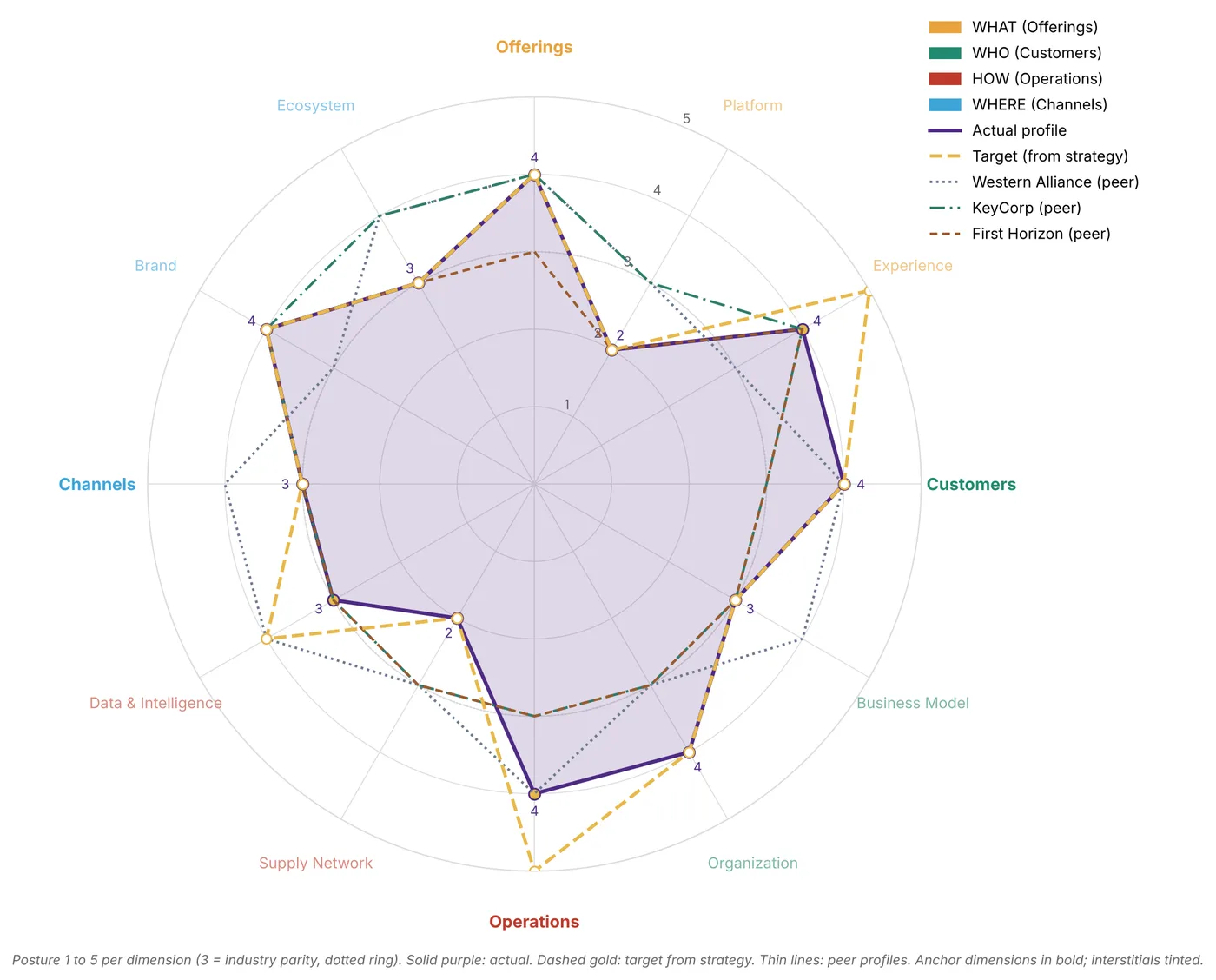
The polygon is the right shape, one step short on its three tallest spokes. The Investment Index, the sum of the actual scores over the sum of the targets (equation 2), is 0.93, inside the 0.90 to 1.10 band the instrument calls adequate. The Shape Drift Index, half the sum of the absolute differences between each dimension's share of the actual profile and its share of the target (equations 3 and 4), is about 5 percent, on the boundary between aligned and tilted, and it reads as the share of the portfolio's emphasis that must move to match the strategy. The per-dimension tilts are three and small: Experience and Operations each about 0.7 points below their size-adjusted targets and Data and Intelligence about 0.7 below, with the other nine dimensions carrying small positive mix parts that sum to the same total (equations 5 and 6). The priority-weighted gap, the sum of absolute gaps multiplied by strategic weight (equation 7), is 9 points, every one of them on those three dimensions. The verdict cell is scale with a steer: keep the envelope, move the emphasis.
The three headline gaps are two kinds of problem, and the effort read separates them even though effort shares are unpublished. Operations carried very high effort through 2024 and now carries amortization in place of investment; a 4 against a target of 5 with effort falling is a peak to harvest, and the harvest is the funding for everything else. Experience carries high effort on products and marketing and low effort on systems-led speed: the bank has relaunched its accounts and doubled its advertising, and it has not shipped the faster onboarding, same-day decisions or real-time products that a real-time core exists to deliver. That pattern, money flowing to the dimension and the strategy's specific promise not appearing, is a conversion gap, and the remedy is to redirect the existing program toward the promise; added money would not help. Data and Intelligence carries low effort against a target of 4: a lab, a handful of projects, and a data set that is, by the bank's account, cleaner than most of its peers'. That is an allocation gap, and the remedy is to fund and staff it now. Adding money to the Experience program would treat a conversion gap as an allocation gap; starving the intelligence layer because its outcomes are unmeasured would treat an allocation gap as an execution gap. The second-order explanation is the same for both: the incentive and disclosure system counts none of the things the strategy promises. The 2025 annual incentive plan funds on five financial measures, pre-provision net revenue to risk-weighted assets against peers (35 percent), net charge-offs to loans against peers (15 percent), pre-provision net revenue less charge-offs (20 percent), the efficiency ratio (15 percent) and return on average assets (15 percent), with a strategic multiplier the board left at 100 percent; the chief executive's cited achievements include "deployment of innovative AI and digital capabilities" without a measure attached (Zions Bancorporation 2026i). None of the five counts a cycle time, a real-time product or a model in production.
4. What we grow, what we hold, and what we kill
The public record yields eighteen live bets, listed in Table 3 with the dimension each advances and its verdict against the target. Spend by bet is not public, so the ledger adjudicates posture and role rather than dollars. The kill list has one executed entry, which shows the target is binding, and one bet is held pending a leadership decision the record shows has not been made.
Table 3. The adjudication ledger: eighteen live bets from the public record, with primary dimension, stage and verdict.
| Bet | Primary dimension (secondary) | Stage | Verdict | Rationale |
|---|---|---|---|---|
| Core loan and deposit platform on TCS BaNCS | Operations (Data & Intelligence) | Mature, completed July 2024 | Harvest | The defended peak; amortization runs to 2033; the return now comes from what is built on it |
| nCino lending platform with Banking Advisor and pricing analytics | Experience (Operations) | Scaling since 2025 | Grow, gated | The vehicle for same-day decisions; gate on a published cycle-time ledger by Q4 2026 |
| Commercial Lending Services teams for $1 to 5 million requests | Operations (Experience) | Scaling | Grow | Central processing for speed; the measured turnaround is the proof metric |
| Gold account relaunch | Customers (Offerings) | Scaling, 2025 to 2026 | Grow | About 4,000 openings a quarter; 20,000 targeted for 2026; balances above plan |
| Business Beyond small-business account | Customers (Offerings) | Launched Q2 2026 | Grow | The tiered deposit and payments account the small-business strategy needs; measure net new clients, as the CFO said |
| SBA 7(a) and 504 push toward the top ten | Customers (Offerings) | Scaling | Grow | From 20th to 11th in eighteen months; the clearest measured outcome in the ledger |
| Zions Capital Markets build-out (hedging, advisory, syndications, commodities) | Offerings | Scaling | Grow | Doubled since 2020; commodity hedging adds $7 to 10 million a year on management's estimate |
| Basis agency multifamily platform | Offerings (Customers) | Closed August 2026 | Hold to plan | Terms undisclosed; consumes capital; hold to the integration plan until the first servicing and origination figures are published |
| Wealth management under new leadership | Offerings (Customers) | Restart, June 2026 | Grow | Management expects high-single to low-double-digit growth; the Gold account is the feeder |
| Zia knowledge base, AI document and credit review, Innovation Lab | Data & Intelligence | Pilot to early scale | Grow and fund | The starved strategic peak; the reallocation headline of this report |
| Customer 360 banker view | Data & Intelligence (Experience) | Beta | Grow | The pricing and relationship view the local-pricing model depends on; take to general availability |
| TCS Quartz tokenized deposits and stablecoin payments | Platform (Offerings) | Evaluated, not announced | Hold, decide | Planned for 2026 in the annual report, "not announced" on the Q1 call; the hold waits on a decision |
| Tap to Pay on iPhone and app fraud alerts | Offerings (Channels) | Launched 2025 | Hold | Parity features; keep current |
| Marketing centralization and doubling of spend | Brand (Customers) | Scaling | Hold, measure | Doubled against 2024; the return is undisclosed; hold at the 2026 level until account economics are published |
| Outsourcing expansion with three partners | Organization (Supply Network) | Starting | Grow, with hurdle | From 3 percent to the peer range; the president's own expense opportunity; hurdle in Section 7 |
| Coachella Valley branch acquisition | Channels (Customers) | Integrated 2025 | Hold | A tuck-in that worked; no extension for its own sake |
| Non-depository financial institution lending | Customers | Constrained | Kill (growth) | Deliberately not grown for five years; the refusal that defines the credit floor |
| Amegy factoring portfolio | Offerings | Sold June 2026 | Kill (executed) | A product the strategy did not need; the proof that leadership can exit |
The reallocation story is modest in dollars and large in sequence. Nothing in the ledger needs new money; the president has already identified $40 million of savings initiatives inside the 2026 expense outlook and an outsourcing lever he sizes against peers (Zions Bancorporation 2026d; Zions Bancorporation 2026k). What moves is where the savings go. Today they fund marketing and revenue producers, which is sound, and they fund contractual technology cost increases, which is not a choice. The shape moves toward the target when a stated share of the harvest from Operations and the outsourcing program is assigned to the intelligence layer and to the systems-led half of Experience, with owners and proof metrics, and only then.
5. Where we stand against the field
We scored three peer regionals from their public record on the same twelve dimensions, under the same evidence rules, and Table 4 gives the result; Figure 1 shows the three profiles as thin lines on the Zions polygon. Western Alliance is the closest comparison: a $99 billion commercial bank headquartered in Phoenix, in Zions' footprint, which disclosed its technology and business-line economics at an investor day in May 2026 (Western Alliance Bancorporation 2026). KeyCorp, at $191 billion, is the relationship-led commercial bank with a long record in embedded payments (KeyCorp 2026a; Streeter 2022; Cross 2022). First Horizon, a Southeastern regional of similar scale to Zions, competes for the same middle-market and small-business clients on service and is hiring relationship bankers (First Horizon 2026a; First Horizon 2026c). Each rival was read in a single pass, so every rival score carries at most Medium confidence, and Supply Network for all three is inferred from the Zions president's statement that peers outsource 10 to 15 percent of their work.
Table 4. Peer profiles scored from the public record on the twelve dimensions, with the evidence behind each score that differs from parity, October 2026.
| Dimension | Zions | Western Alliance | KeyCorp | First Horizon | Basis for peer scores away from 3 |
|---|---|---|---|---|---|
| Offerings | 4 | 4 | 4 | 3 | WAL commercial fee income $72 million (2023) to $153 million (2025); Key cards and payments fees +11 percent year over year in Q2 2026 |
| Platform | 2 | 3 | 3 | 2 | WAL 24/7 transfer rails for 130 digital-asset clients; Key payment facilitation offered to software firms; FHN stablecoin consortium in development |
| Experience | 4 | 3 | 4 | 4 | Key and FHN 2026 Coalition Greenwich national awards on satisfaction, trust, ease and cash management; no WAL Greenwich record read |
| Customers | 4 | 4 | 3 | 3 | WAL banks 44,000 homeowners associations and is the second-largest correspondent mortgage lender |
| Business Model | 3 | 4 | 3 | 3 | WAL deposit businesses built for verticals supply 37 percent of deposits |
| Organization | 4 | 3 | 3 | 3 | No peer discloses a structural equivalent to seven local brands with pricing authority on one charter |
| Operations | 4 | 4 | 3 | 3 | WAL all business applications in the cloud; noninterest expense 1.7 percent of assets against a 2.4 percent peer median |
| Supply Network | 2 | 3 | 3 | 3 | Inferred from the Zions peer statement; Low confidence |
| Data & Intelligence | 3 | 4 | 3 | 3 | WAL lending cycle time −25 percent and financial-crimes triage 60 to 80 percent faster with AI; Key's measured assistant results date from 2022 |
| Channels | 3 | 4 | 3 | 3 | WAL digital consumer deposits about $7 billion, 52 percent annual growth 2023 to 2025 |
| Brand | 4 | 3 | 4 | 4 | Key and FHN Greenwich national trust awards |
| Ecosystem | 3 | 4 | 4 | 3 | WAL integrations with homeowners-association and legal software, American Banker 2025 Innovation of the Year; Key embedded banking with eight fintech partners |
The overlay shows three zones. The convergence zone is relationship service and trust. Coalition Greenwich gave KeyCorp nine 2026 Best Bank awards, six of them national and including trust and customer service, and gave First Horizon national awards on overall satisfaction, trust, ease of doing business and cash management product capabilities (KeyCorp 2026b; First Horizon 2026b). Greenwich names several winners in each category, so Zions' rank of first on middle-market satisfaction is a lead inside a group of strong regionals, and it is the reason Experience reaches 4 without approaching 5. Offerings and Channels converge at 3 to 4 as well. Holding these floors is necessary; contesting them with more marketing would buy little.
The divergence zones run both ways. Zions leads on Organization, because no peer discloses an equivalent to seven local brands with pricing authority on one charter, and it shares the lead on Operations with Western Alliance by a different route: one real-time core at Zions, a full move of business applications to the cloud at Western Alliance. Western Alliance leads on four dimensions where Zions sits at parity, and the four connect into one model. Its homeowners-association, legal-settlement and business-escrow units sit inside the software their clients run, process more than 20 million association payments and 31 million legal-settlement transactions a year, and supply 37 percent of its deposits; its treasury volumes rose 74 percent in ACH and 42 percent in positive pay between 2023 and 2025; and it reports AI deployments with measured results, a 25 percent cut in lending cycle time among them, on a technology budget of about 10 percent of revenue (Western Alliance Bancorporation 2026). Zions spends about 15 percent of revenue on technology and publishes no comparable outcome. Zions' own efficiency ratio of 62.6 percent also runs above those of Fifth Third, Regions, M&T and Pinnacle (Wack 2026). The rival record therefore sharpens the conversion finding of Section 3: the bank with the more advanced core converts less of its technology into measured customer and intelligence results than the neighbor with the cheaper stack.
The white space remains real time. No player in the overlay scores above 3 on Platform, and the closest move, Western Alliance's 24/7 transfer rails for digital-asset firms, serves a niche. Instant settlement, programmable payments and tokenized deposits for ordinary business clients are unclaimed among these regionals; First Horizon is working on a bank-led stablecoin with peers (First Horizon 2026a) and Zions plans to experiment with its vendor's tokenized-deposit software (Wack 2026). The president's claim that Zions can innovate there at a fraction of rivals' cost (Zions Bancorporation 2026j) is the one frontier claim in the record where a $90 billion bank holds a structural advantage, because it alone runs a real-time core. Western Alliance shows the deposit economics a real-time product can earn when it is built into clients' workflows, which is the logic of the real-time bank combination in Section 6 and the deposit coefficient in Section 7. Section 6 generates the plays; Section 8 records the decision leadership must take before any of them is funded.
6. The net-new bets
The pipeline produced 43 raw candidates across the twelve dimensions, heated toward Experience, Data and Intelligence and Operations. The strategy gate removed three as already in motion (the outsourcing program, the Business Beyond rollout and the SBA push), parked two as valley-thickeners, vetoed five on a failing ring, and escalated one as a strategy question. Table 5 ranks the 35 scored survivors by the product of three rings: Real (is the space durable and specific to Zions), Worth (what the play is worth against the wedge, priced where it scores 4 or 5), and Win (can Zions win it with the assets it holds). Any ring at 1 vetoes the play.
Table 5. The scored net-new plays, ranked by composite, with primary dimension, boldness grade, ring scores and verdict.
| ID | Play | Dimension (boldness) | R | W | Wn | Score | Verdict |
|---|---|---|---|---|---|---|---|
| E1 | Instant small-business onboarding with a same-day credit decision under $250,000 on nCino and the core, with a published turnaround | Experience, Customers (Extend) | 5 | 4 | 5 | 100 | Pursue now |
| D1 | Commercial early-warning model on the single data set: cash-flow, covenant and collateral anomalies flagged to bankers and credit review | Data & Intelligence, Operations (Extend) | 5 | 4 | 5 | 100 | Pursue now |
| D2 | Real-time cash intelligence inside treasury management: forecasts, idle-balance alerts and sweep suggestions from the real-time core | Data & Intelligence, Offerings (Stretch) | 5 | 4 | 4 | 80 | Pursue now |
| O1 | Straight-through processing of $1 to 5 million commercial requests with AI document extraction, measured in days | Operations, Experience (Extend) | 4 | 4 | 5 | 80 | Pursue now |
| O2 | Back-office outsourcing from 3 to 10 percent of the workforce, with AI replacing part of the outsourced work | Organization, Supply Network (Extend) | 4 | 4 | 5 | 80 | Pursue now |
| D3 | Customer 360 to general availability with next-best-action for every banker, tied to local pricing authority | Data & Intelligence, Experience (Extend) | 4 | 4 | 4 | 64 | Pursue now |
| E2 | Real-time business payments: instant send and receive on business accounts with the real-time posting the core already does | Experience, Offerings (Stretch) | 4 | 4 | 4 | 64 | Pursue next |
| B1 | Usage-priced treasury management bundle with an earnings-credit model that rewards operational balances | Business Model, Customers (Extend) | 4 | 4 | 4 | 64 | Pursue next |
| D4 | SBA underwriting assistant to lift 7(a) throughput toward the top ten without adding underwriters | Data & Intelligence, Customers (Extend) | 4 | 3 | 5 | 60 | Pursue next |
| D5 | Fraud and business-email-compromise protection sold to small business, built from the wire-room models | Data & Intelligence, Offerings (Stretch) | 4 | 3 | 5 | 60 | Pursue next |
| C1 | Professional practices program (medical, dental, legal) with practice lending, treasury and wealth in one offer | Customers (Extend) | 4 | 3 | 5 | 60 | Pursue next |
| Of1 | Workforce and affordable housing bundle: agency permanent financing with construction lending and treasury for sponsors | Offerings, Customers (Extend) | 4 | 4 | 3 | 48 | Pursue next |
| D6 | Published intelligence outcome ledger: named use cases, test cells and a control group, quarterly | Data & Intelligence (Extend) | 4 | 3 | 4 | 48 | Pursue now |
| Of2 | Tokenized-deposit settlement for one use case, real estate escrow and closing, on Quartz | Offerings, Platform (Step out) | 4 | 4 | 3 | 48 | Pursue next, after the Section 8 decision |
| Ch1 | Accountant and CPA referral channel for SBA and Business Beyond with a shared client view | Channels, Customers (Extend) | 4 | 3 | 4 | 48 | Pursue next |
| E3 | Digital treasury onboarding with service activation in days instead of weeks | Experience, Operations (Extend) | 4 | 3 | 4 | 48 | Pursue next |
| Of3 | Commodity hedging extended from oil and gas to agriculture and metals clients across the footprint | Offerings (Extend) | 4 | 3 | 4 | 48 | Pursue next |
| Org1 | Product owner for the customer-visible core dividend, with a cycle-time metric in the incentive plan | Organization (Extend) | 4 | 3 | 4 | 48 | Pursue now |
| C2 | Mass-affluent digital wealth on-ramp from the Gold account into Wealth Select | Customers, Offerings (Extend) | 4 | 3 | 4 | 48 | Pursue next |
| Of4 | Embedded payments and ERP integrations for middle-market treasury clients | Offerings, Channels (Stretch) | 4 | 3 | 3 | 36 | Watch |
| D7 | Deposit pricing intelligence for local pricing decisions, with elasticity measured by affiliate | Data & Intelligence, Business Model (Stretch) | 4 | 3 | 3 | 36 | Watch |
| C3 | Hispanic-owned small business program in Texas, Arizona and California with bilingual bankers and digital | Customers (Extend) | 3 | 3 | 4 | 36 | Watch |
| Ch2 | Branch-light expansion in growth corridors of Texas with banker teams and no branch network | Channels (Stretch) | 3 | 3 | 4 | 36 | Watch |
| X1 | Fintech partner program on the core's APIs for payroll, invoicing and accounting integrations | Ecosystem, Platform (Stretch) | 3 | 3 | 3 | 27 | Watch |
| E4 | Proactive service alerts: banker notified of a client's unusual balance, payment or payroll event | Experience, Data & Intelligence (Extend) | 3 | 3 | 3 | 27 | Watch |
| Br1 | Trust campaign built on published fraud-protection and early-warning outcomes | Brand (Extend) | 3 | 2 | 4 | 24 | Watch, follows D6 |
| B2 | Subscription small-business bundle beyond Business Beyond: fixed monthly fee for payments, cards and advice | Business Model (Stretch) | 3 | 3 | 3 | 27 | Watch |
| X2 | Co-innovation agreement with the core vendor on tokenized deposits and real-time products | Ecosystem (Extend) | 3 | 3 | 3 | 27 | Watch |
| C4 | Municipal and public-sector treasury expansion from the public finance franchise | Customers (Extend) | 3 | 3 | 3 | 27 | Watch |
| O3 | Agentic reconciliation and exception handling in deposit operations | Operations (Stretch) | 3 | 3 | 3 | 27 | Watch |
| Of5 | Deposit-linked small-business insurance and benefits marketplace | Offerings (Step out) | 3 | 3 | 2 | 18 | Re-scope |
| Ch3 | Direct digital-only brand for out-of-footprint deposits | Channels (Step out) | 3 | 3 | 2 | 18 | Re-scope |
| D8 | Customer-facing AI assistant in the consumer app | Data & Intelligence, Channels (Step out) | 3 | 2 | 3 | 18 | Watch |
| S1 | Multi-vendor cloud and data platform sourcing to cut contractual cost growth | Supply Network (Extend) | 3 | 2 | 3 | 18 | Watch, capped at valley |
| P1 | Developer sandbox on the core for approved partners | Platform (Stretch) | 2 | 2 | 3 | 12 | Watch, capped at valley |
Five plays were vetoed and are displayed with the failing ring. Private credit origination and fund finance growth (Customers, Stretch) scored 4 on Real and 1 on Win, because the bank has refused that book for five years and the chief executive has said why. Banking-as-a-service for fintech deposit programs on the core (Platform, Transform) scored 1 on Win: the regulatory and reputational exposure of sponsor banking contradicts the trust floor. A national digital small-business lender outside the footprint (Channels, Step out) scored 1 on Win on brand and credit-model mismatch. An in-house stablecoin issuance (Offerings, Transform) scored 2 on Real and 1 on Win against the chief executive's own stated preference for tokenized deposits over stablecoins. A captive fintech venture fund (Ecosystem, Step out) scored 1 on Worth: the SBIC gains of 2026 were valuation, and venture is not where this balance sheet earns. One play was escalated instead of scored: offering the core platform and its operations as a service to community banks in the footprint (Platform, Transform) is strong enough on Real and Worth to argue that the Platform target should be 3 or 4 rather than 2. That would make Zions a technology provider to the banks it competes with, a decision for the board, and Section 8 records it as open.
Four reinforcing combinations score higher together than apart. The first, the fast bank, pairs E1 instant onboarding with O1 straight-through processing and Org1 the product owner: the core's speed becomes a customer promise with a number, an owner and an incentive. The second, the watchful bank, pairs D1 early warning with D5 fraud protection and D6 the outcome ledger: the models that protect the bank are sold to its clients, and the published results become the first entries in the ledger that moves the posture score. The third, the real-time bank, pairs E2 real-time payments with D2 cash intelligence and B1 the usage-priced bundle: the real-time core becomes a treasury product and the product is priced for the operational balances that fund the bank. The fourth, the sponsor bank, pairs Of1 the housing bundle with the Basis platform and C1 the practices program, extending the one-stop-shop logic management used to justify Basis into two more segments.
The two-currency reconciliation closes in posture and splits in dollars. In posture points, the eight pursue-now plays, two of them enablers scored below the ranking line, map onto the three gap dimensions: E1 and O1 with Org1 supply the measured cycle times that lift the systems half of Experience and let the dimension reach 5 within 24 months if the Greenwich recognition holds; D1, D2, D3 and D6 supply the named, measured intelligence outcomes that lift Data and Intelligence from 3 to 4 within 18 months; and O2 with the core's amortization is the harvest that funds both. Operations stays at 4 by choice, because a 5 requires market recognition the bank should not spend to earn. In dollars, the revenue-bearing plays (D2, B1, E2, Of1, C1, D4) are worth $40 to $80 million of annual revenue by fiscal 2028 before any hit rate, and $25 to $45 million at a 50 percent portfolio hit rate, against a wedge of $35 to $70 million. The net-new portfolio closes about two thirds of the wedge on its own and shares the rest with the bets in flight, principally capital markets and the Basis platform. The spend the portfolio implies, mostly redirection of the technology and operations staff plus the outsourcing savings, fits inside the certified envelope. The dial we recommend is to improve the portfolio: hold the mid-single-digit ambition, hold the envelope, and run the plays above against the hurdles in Section 7.
7. What will move the P&L
A radar score converts to money only through initiatives, on a lag, at a rate set by each dimension's operating metric and a unit coefficient computed from Zions' own disclosed structure. Table 6 prices the four rows that pass the screen: each was graded High or defensible Medium on the weakest of pool size, responsiveness and durability. The coefficient bases are stated so the finance team can rerun them.
One screening result deserves its own paragraph. The largest pool in a bank is funding cost, and the bank's own disclosures price it. Interest-bearing deposits cost 2.27 percent at the spot rate on June 30, 2026, brokered deposits and short-term borrowings cost more, and the president said in April 2026 that deposits brought back from off-balance-sheet programs are priced 25 to 35 basis points below brokered deposits (Zions Bancorporation 2026f; Zions Bancorporation 2026j). A dollar of noninterest-bearing operational deposit that replaces wholesale funding is therefore worth at least the interest-bearing spot rate and up to the wholesale rate, and we price it at 250 basis points, below the midpoint, because operational deposits carry service and analysis costs. The plays that grow such deposits, the fast bank and the real-time bank, are priced on that coefficient and nothing else; fee income from the same products is excluded to avoid double counting.
Table 6. The Innovation P&L Bridge: priced rows with operating metric, unit coefficient and basis, targeted movement, gross impact, lag and proof metric.
| Bet | Operating metric | Unit coefficient and basis | Targeted movement | Gross impact | Lag | Proof metric |
|---|---|---|---|---|---|---|
| E1 with O1 and E2: the fast bank and the real-time bank | Operational deposits replacing wholesale funding | About $25 million of net interest income per $1 billion of operational deposits: 250 basis points, between the 2.27 percent interest-bearing deposit spot rate at June 30, 2026 and the wholesale rate (Zions Bancorporation 2026f; 2026j) | $1.0 to 1.5 billion of incremental operational deposits by fiscal 2028, about 1.5 percent of the deposit base a year | $25 to 38 million | 1 to 2 years | Net new business clients; noninterest-bearing deposits; brokered deposits and short-term borrowings; onboarding and decision cycle time |
| O2 with O1: outsourcing and straight-through processing | Operating expense productivity | About $14.7 million per 100 full-time equivalents: salaries and benefits of $1,350 million over 9,195 employees in 2025 (Zions Bancorporation 2026c) | 300 to 400 net equivalents after vendor cost, beyond the $40 million of savings already in the 2026 outlook | $25 to 35 million | In-year to 2 years | Full-time equivalents; outsourced share; adjusted expense; cost per loan processed |
| D1 with D6: commercial early warning | Net charge-offs | About $31 million per 5 basis points of net charge-offs on $62.5 billion of loans (Zions Bancorporation 2026e) | Avoid one loss event of the October 2025 size every three years, about 3 basis points a year on average; illustrative | $8 to 12 million | 1 to 2 years | Days from first anomaly to credit review; criticized migration caught before delinquency; loss given a flagged event in test cells against a control group |
| D2 with B1 and D4: treasury intelligence, usage pricing, SBA throughput | Fee income from treasury management and SBA | Treasury management at about 30 percent of $662 million of customer fees, about $200 million, so one point of growth is $2 million (Zions Bancorporation 2026k; 2026c); SBA gain on sale priced illustratively because loan size and premium are undisclosed | Treasury growth from 4 to 7 percent a year, plus 500 more 7(a) loans a year | $10 to 15 million | 1 to 3 years | Account analysis revenue; treasury clients onboarded; 7(a) loans per underwriter; SBA rank |
The stack is $68 to $100 million of gross annual impact by fiscal 2028. A 40 percent execution haircut, the rate defensible for a bank integrating an acquisition, starting an outsourcing program and changing technology leadership in the same year, brings it to $41 to $60 million, which we round to $40 to $60 million: 3 to 5 percent of the fiscal 2025 adjusted pre-provision net revenue base of $1,266 million. The Data and Intelligence multiplier is set at one, because the dimension is at parity rather than below it; if the outcome ledger lifts it to 4, the responsiveness of the early-warning and treasury rows improves and the bridge should be re-priced upward at the 2027 re-read. No in-year conversion of a long-lag dimension is promised: the deposit row builds over two years and the fee row over three.
Governance is the condition on every row. Each coefficient above is a prior; the pilot produces the posterior. E1 runs in two affiliates for two quarters with a pre-agreed hurdle of a published median decision time under two business days and a measured lift in net new business clients against the other five affiliates as a control group. O2 runs with one partner and one back-office function against a hurdle of 25 percent net cost reduction on the function. D1 runs on the commercial and industrial book of one affiliate for two quarters with a hurdle of flagging half of subsequent downgrades at least sixty days before the human process did. D2 runs with fifty treasury clients against a control group of fifty with a hurdle of a measured increase in operational balances. Nothing scales before its hurdle, and no coefficient is negotiated backward from the mid-single-digit outlook the agenda serves.
8. What we will not do
The valleys are choices and are stated with the same confidence as the peaks. Zions will not elevate Platform or Supply Network in this cycle. Platform stays at 2 until the board answers the escalated question of whether the core should be offered to other banks as a service; until then no developer program, no sponsor-bank relationship and no marketplace is funded, and the one Platform-adjacent play that proceeds, tokenized-deposit settlement for real estate closings, is scoped as an Offering for existing clients and gated on the same decision. Supply Network stays at 2 by design even as the outsourcing program runs, because the program is an Organization lever and the bank should not build a sourcing capability beyond the three partners it has named. Zions will not grow private credit or fund finance lending by any door, will not issue a stablecoin, will not launch a national digital lender or a digital-only deposit brand outside its footprint, and will not stand up a venture fund. It will not extend the Basis platform beyond its integration plan until the first year's origination and servicing figures are published, and it will not add branches outside the Western footprint. Two floors are held even though Zions will not lead there: Brand at 4, because trust is the asset every affiliate trades on and the 2025 credit event showed how fast the market reprices it; and the risk half of Data and Intelligence at 3, because fraud, anti-money-laundering and credit surveillance are obligations whose failure a regulator, not a strategist, adjudicates.
The deliberately parked plays stay visible. The small-business insurance marketplace is re-scoped because the bank has no right to win in insurance distribution and the referral economics are thin. The digital-only out-of-footprint brand is re-scoped because it contradicts the local model the strategy is built on. The consumer AI assistant stays on the watch list because the bank's evidence base for customer-facing AI is empty and the regulatory posture on explainability, which the 2024 letter itself raised, is unsettled. The escalated question, the core as a service, is recorded here as open: it is the one play in the record that would change what Zions is, and the instrument scores bets, never identities.
9. What happens next
The 90-day program has seven commitments, each with an owner by role.
- Name the owner of the core dividend. The president assigns a product owner for the customer-visible return on the core, with a published ledger of onboarding time, small-business decision time and real-time products shipped, first reported with the fourth-quarter 2026 results.
- Start the fast-bank pilot. The Chief Information Officer and two affiliate chief executives launch instant onboarding and same-day decisions under $250,000 in two affiliates, with the two-business-day hurdle and the other affiliates as the control group, reporting at the first-quarter 2027 call.
- Fund the intelligence layer as a business. The chief executive moves the Innovation Lab's credit, fraud and treasury models under a named executive with a budget line, and the Chief Credit Officer sponsors the early-warning pilot on one affiliate's commercial book against the sixty-day hurdle.
- Decide on tokenized deposits. The board takes a position on the Quartz platform and on the core-as-a-service question before the 2027 plan is set, so that the real-time white space is either entered or declined on the record.
- Set the outsourcing hurdle. The Chief Transformation and Operations Officer runs the first function with one partner against a 25 percent net cost hurdle and reports the outsourced share quarterly.
- Add the metric to the plan. The compensation committee ties the strategic multiplier in the 2027 annual incentive plan, which can move funding by up to 30 percent and was left at 100 percent for 2025, to a published cycle-time and net-new-client measure, so that the dimensions this report asks the bank to lead on have a line in the pay plan.
- Schedule the re-read. The profile is re-scored in April 2027 after the fiscal 2026 10-K, when the technology spend table, any real-time product, the intelligence ledger, the first Basis figures and the outcome of the October 2025 recovery action arrive; Experience and Data and Intelligence are the two scores capped by pending disclosure, and both are re-read then. The yield test is rerun at the same time on the 2027 technology budget.
Appendix A. Source Ledger
Run header. Run date October 12, 2026; scope Zions Bancorporation, N.A., as one business with one value chain across its seven affiliate brands. Two passes completed: pass one assembled the fiscal 2025 10-K (Items 1 and 1A), the 2025 and 2024 annual reports, the Q3 2025, Q4 2025, Q1 2026 and Q2 2026 results releases and presentations, the Q2 2025 and Q3 2025 10-Qs, the 2026 proxy and five earnings call transcripts; pass two hunted dimension by dimension through company releases, the lending-platform vendor's announcement, the acquisition record, the credit-event record and analyst consensus. The first run was made without search-engine discovery, reading directly from the bank's investor document host, the newswire, the transcript service and the vendor's newsroom. A top-up pass on October 12, 2026 ran 23 searches and read the trade press (American Banker, Bloomberg Law, The Financial Brand, Coleman Report), the regulatory record (the OCC's Community Reinvestment Act evaluation), the 2026 proxy's compensation discussion from the SEC's EDGAR copy, the second-quarter 2026 10-Q, analyst actions, and the public record of three peers. Sources counted: 50 (Tier A 26, Tier B 9, Tier C 13, Tier D 2). Sources rejected at the provenance gate: 7 (three syndicated analyst-rating items on a stock-news aggregator, one law-firm solicitation used only for a dated stock-price fact, two machine-written summaries of a conference appearance and an analyst downgrade, and one filing-summary page whose AI commentary was not the filing's language), retained here to show the screening happened. Coverage gaps flagged low confidence: effort shares by dimension (not public); the fiscal 2025 total technology spend and the split between run and change (the 10-K's management discussion was again not readable, because both the EDGAR and investor-site copies stop before Item 7 in the reader; the second-quarter 2026 10-Q's technology table substitutes for the 2026 run rate); long-term incentive metrics (the proxy's long-term plan section was not reached); treasury management revenue (disclosed only as a share); Basis terms; culture (unobservable); rival Supply Network postures (inferred). Changes versus the earlier outside-in read: Operations moved from 5 to 4 because the "first in the U.S." and "three million hours" claims are company-issued and no independent measured outcome exists; Platform moved from 4 to 2 on a boundary ruling, because a single core with no external participants is Operations architecture and the only platform candidate, tokenized deposits, is unannounced; Experience moved from 4 at target 3 to 4 at target 5 on the Coalition Greenwich measurements and the strategy's own service claim; Channels moved from 4 to 3 because digital front ends are table stakes; Customers moved from inferred 3 to 4 on the SBA rankings and account openings; Organization moved from 3 to 4 on the affiliate structure and its measured consequence; Supply Network moved from inferred 2 to a scored 2; the yield test, which the earlier read did not run, now runs on the disclosed technology spend table.
Re-check of the scores of 4 after the top-up pass. No score moved, and each 4 was re-tested against the Tier-A rule. Offerings, Customers and Organization keep Tier-A support from the 10-K, the results releases and the calls, and the proxy adds nothing that changes them. Operations gains independent Tier-B recognition (Cross 2024: the Cornerstone Advisors judgment and the cut from about 500 to about 100 deposit products) but no measured outcome dated within twelve months and no rival adopting the architecture, so it holds at 4 and does not reach 5. Experience keeps its Tier-A citation in the first-quarter 2026 presentation; the peer record shows KeyCorp and First Horizon winning national Greenwich awards in the same categories, which leaves the score in place and confirms that a 5 is out of reach on relationship evidence alone. Brand keeps its 4 on the same Greenwich trust ranking and the Tier-A annual report; its confidence falls from Medium to Low to Medium, because trust awards are shared among strong regionals and the October 2025 share-price fall also struck Western Alliance on the same borrowers (Wang 2025). Data and Intelligence was tested for a move to 4 and stays at 3: the Gemini enterprise platform, the AI speed-up in account opening, the governance committee and the Innovate2Optimize program are shipped or announced moves without a measured outcome (Wack 2026; Zions Bancorporation 2026i). Platform holds at 2 on the trade-press record of planned experimentation. The ambition ledger moved one entry: the 2026 technology run rate of about $530 million (S36) replaces nothing and lowers the full-spend yield from 0.50 to 0.48; the peer run share of 70 percent (S40) adds a sensitivity at which the yield reaches 1.6, reported in Section 2. The proxy's incentive metrics (S18) confirm, with figures, the second-order explanation of Section 3.3 and sharpen commitment 6 in Section 9.
Table 7. The Source Ledger: sources counted, with date, tier and provenance status.
| ID | Source | Date | Tier | Used for |
|---|---|---|---|---|
| S1 | Zions Bancorporation, Form 10-K for fiscal 2025, Items 1 and 1A | Feb 2026 | A | Business description, affiliates, 407 branches, 9,195 employees, local pricing authority, competition, AI "early stages", $100 billion threshold, Regulation II, Section 1033 |
| S2 | Zions Bancorporation, 2025 Annual Report, "Reaching Higher" | Mar 2026 | A | Shareholder letter: Gold, Business Beyond, SBA 1,116 loans and 14th rank, capital markets $125 million, real-time posting, Quartz plan, Zia 170,000 searches, Innovation Lab, Customer 360, three million hours, marketing +42 percent, Greenwich, Coachella, NDFI loss |
| S3 | Zions Bancorporation, 2024 Annual Report | Feb 2025 | A | FutureCore completed summer 2024, 500 people at peak, scope, data governance, charter consolidation, digital front ends, SBA 20th and top-ten goal, generative AI "early innings" |
| S4 | Zions Bancorporation, Q4 and full-year 2025 results release | Jan 20, 2026 | A | Full-year income statement by line, technology expense $276 million, marketing $64 million, efficiency 62.6 percent, adjusted PPNR $1,266 million, loans, deposits, CET1, employees |
| S5 | Zions Bancorporation, Q4 2025 earnings presentation | Jan 20, 2026 | A | FY2026 outlook verbatim, value drivers, Greenwich third in middle market, NDFI slide |
| S6 | Zions Bancorporation, Q4 2025 earnings call transcript (roic.ai) | Jan 20, 2026 | A | "Moderately" as mid-single digits, 100 to 150 bps operating leverage, $40 million savings, AI projects "a small couple of handfuls", outsourcing 3 percent, headcount peak 10,300, capital markets doubled, SBA, Gold, buyback timing, $100 billion threshold, M&A stance |
| S7 | Zions Bancorporation, Q1 2026 results release | Apr 20, 2026 | A | EPS, operating leverage 2.7 percent, fees +9 percent, deposits, classified −19 percent, Basis announcement |
| S8 | Zions Bancorporation, Q1 2026 earnings presentation | Apr 20, 2026 | A | 1Q27 outlook, value drivers, Greenwich cash management scores and ranks, credit, Basel and AOCI |
| S9 | Zions Bancorporation, Q1 2026 earnings call transcript (roic.ai) | Apr 20, 2026 | A | "Customers don't choose a bank because of your core systems", data quality, AI uses, headcount −20 percent since 2008, Quartz "not announced", Gold 4,000, Business Beyond pilot, SBA 11th, off-balance-sheet deposits at 25 to 35 bps below brokered, Basel 9 to 10 percent RWA relief |
| S10 | Zions Bancorporation, Q2 2026 results release (8-K Exhibit 99.1) | Jul 20, 2026 | A | Q2 income statement by line, technology expense $72 million, loans by type, deposits, CET1 11.8 percent, employees 9,039, Visa and SBIC gains |
| S11 | Zions Bancorporation, Q2 2026 earnings presentation | Jul 20, 2026 | A | 2Q27 outlook verbatim, deposit spot rates, credit by portfolio, NDFI, Greenwich 2025 metrics, AOCI projection |
| S12 | Zions Bancorporation, Q2 2026 earnings call transcript (roic.ai) | Jul 20, 2026 | A | Business Beyond, 10,000 accounts, treasury management 30 percent of fees, marketing doubled, technology vendor pricing, "token math", outsourcing and AI, capital markets durability, Cantor legal costs, buybacks, M&A |
| S13 | Zions Bancorporation, Q3 2025 results release | Oct 20, 2025 | A | $50 million charge-off, "apparent irregularities and misrepresentations", legal action, Q3 figures, deposit migration, technology expense explanation |
| S14 | Zions Bancorporation, Form 10-Q for Q3 2025 | Nov 2025 | A | Technology spend table ($131 million quarter, $379 million nine months), capitalized core cost $230 million by phase, July 2024 completion, credit event provision |
| S15 | Zions Bancorporation, Form 10-Q for Q2 2025 | Aug 2025 | A | Technology spend table ($125 million quarter, $248 million six months), core cost $241 million, Coachella Valley loans and deposits |
| S16 | Zions Bancorporation, Q3 2025 earnings call transcript (roic.ai) | Oct 20, 2025 | A | "Not something that came across the radar screen as early as we would have wished", external review, NDFI 3 percent, capital markets doubling goal, account analysis +4 percent, SBA 14th, call programs |
| S17 | Zions Bancorporation, Q2 2025 earnings call transcript (roic.ai) | Jul 21, 2025 | A | "One integrated loan and deposit system with 1 data model", real-time core, tokenized deposits preferred, AI in wire room, 2 percent continuous improvement, capital markets $81 to 107 million, Gold +78 percent, SBA +91 percent, tiering |
| S18 | Zions Bancorporation, 2026 proxy statement (governance portion and compensation discussion, EDGAR copy) | Mar 18, 2026 | A | Board independence and tenure, technology expertise, Level 1 technology risk, generative AI oversight; 2025 annual incentive metrics and weights, 100 percent strategic multiplier, payouts, Innovate2Optimize, Data and AI Governance Committee |
| S19 | Zions Bancorporation, Q4 2024 earnings presentation | Jan 21, 2025 | A | FY2024 base figures, FY2025 outlook, value drivers |
| S20 | Zions Bancorporation, Pillar 3 disclosures index | 2026 | A | Capital context (listed, not scored) |
| S21 | Zions Bancorporation, release on technology and operations leadership | Mar 3, 2026 | C | CIO and Chief Transformation and Operations Officer appointments, "first-in-the-U.S." core claim, Technology Center |
| S22 | Zions Bancorporation, Coalition Greenwich 2026 awards release | Feb 20, 2026 | C | Fifteen awards, categories, methodology (recognition counted as B on Greenwich's method) |
| S23 | Zions Bancorporation, Basis acquisition announcement | Mar 23, 2026 | C | Scope, licenses, partnership, rationale |
| S24 | Zions Bancorporation, Basis acquisition completion | Aug 3, 2026 | C | Close date, agency head appointment |
| S25 | Zions Bancorporation, wealth management head appointment | Apr 29, 2026 | C | Selfridge background |
| S26 | Zions Bancorporation, board election of Daniel J. Ryan | Jun 2, 2026 | C | Technology and cyber risk expertise |
| S27 | Zions Bancorporation, Zions Bank leadership change | Dec 22, 2025 | C | Affiliate succession |
| S28 | Zions Bancorporation, share repurchase and dividend release | Jul 30, 2026 | C | $75 million quarterly buyback, $300 million 2026 target, dividend $0.48 |
| S29 | Commercial Funding Inc., acquisition of Amegy factoring portfolio | Jun 1, 2026 | C | Exit evidence |
| S30 | nCino, Zions implementation announcement | Apr 15, 2025 | C | Lending platform scope, McLean quote on speed |
| S31 | Coalition Greenwich 2025 customer metrics, via Q1 and Q2 2026 presentations | 2026 | B | Satisfaction, trust, ease, cash management scores and ranks |
| S32 | MarketBeat, ZION analyst consensus and analyst-action pages | Oct 2026 | B | Nineteen analysts (6 buy, 10 hold, 3 sell), $71.82 target; BofA target cut to $68 from $71 on Oct 9, 2026; target cuts by Truist, JPMorgan and Piper Sandler in early October 2026 |
| S33 | Rosen Law Firm, investigation notice | Dec 9, 2025 | D | 13.14 percent share price decline on October 16, 2025 (corroboration only) |
| S34 | Wack, American Banker, "Zions' revamped tech leadership team eyes AI, stablecoins" | Mar 10, 2026 | B | Gemini enterprise AI platform; AI in document processing speeding account opening and origination; Quartz in the innovation lab; efficiency ratio against Fifth Third, Regions, M&T, Pinnacle; Jefferies view on AI in fraud detection |
| S35 | Cross, American Banker, "Zions leaders reflect on lessons learned from 11-year core upgrade" | Aug 21, 2024 | B | Cornerstone Advisors judgment on the core program and its limited industry impact; deposit products 500 to 100; funding gates; "single organization as opposed to a series of fiefdoms" |
| S36 | Zions Bancorporation, Form 10-Q for Q2 2026 (management discussion) | Aug 2026 | A | Total technology spend $131 million in the quarter and $266 million in six months, +7 percent; capitalized technology investment −41 percent; outsourced technology services; efficiency ratio 62.2 percent |
| S37 | Wang, Bloomberg Law, "Zions, Western Alliance plunge on losses from alleged fraud" | Oct 16, 2025 | B | Zions −13 percent, Western Alliance −11 percent; loans to the same borrowers through California Bank & Trust |
| S38 | Coleman, Coleman Report, "Fraud Friday" column | Nov 14, 2025 | B | Loans originated 2016 and 2017; Western Alliance exposure about $99 million; allegations concern lien positions on collateral |
| S39 | Office of the Comptroller of the Currency, CRA Performance Evaluation, Zions Bancorporation, N.A. (charter 4341) | Jul 8, 2024 | A | Satisfactory overall; Investment Test Outstanding; online and mobile channels given no weight |
| S40 | Western Alliance Bancorporation, Investor Day 2026 presentation (Form 8-K) | May 12, 2026 | A | Peer profile: national business lines, deposit mix, technology spend and run share, AI outcomes, treasury volumes, efficiency, Innovation of the Year |
| S41 | KeyCorp, second-quarter 2026 earnings presentation | Jul 2026 | A | Peer profile: cards and payments fees, priority fee businesses, assets, efficiency |
| S42 | KeyCorp, Coalition Greenwich 2026 awards release | Feb 24, 2026 | C | Nine awards, six national including trust and customer service (recognition counted as B on Greenwich's method) |
| S43 | First Horizon, Coalition Greenwich 2026 awards page | 2026 | C | National middle-market and small-business awards on satisfaction, trust, ease, cash management (recognition counted as B on Greenwich's method) |
| S44 | First Horizon, 2025 Annual Report to shareholders (EDGAR ARS) | Mar 2026 | A | Peer profile: change-the-bank projects, cloud migration, new digital platform in development, bank-led stablecoin work |
| S45 | First Horizon, second-quarter 2026 earnings call transcript (Mitrade) | Jul 22, 2026 | A | Peer profile: AI for back-office scale, fraud investment, treasury management calls, banker hiring |
| S46 | Streeter, The Financial Brand, "Why KeyBank believes embedded banking is the future" | Apr 4, 2022 | B | Peer profile: embedded payments, Rectangle Health, eight fintech channel partners, payments revenue $1.5 billion |
| S47 | Yurcan, The Financial Brand, "Digging into KeyBank's conversational AI strategy" | Nov 14, 2022 | B | Peer profile: assistant launched 2022 with 84 percent containment (dated outcome) |
| S48 | Cross, American Banker, "KeyBank moves more applications to Google Cloud" | Feb 3, 2022 | B | Peer profile: cloud migration 2022 to 2025 with Deloitte |
| S49 | Finextra, KeyBank company news index | 2024 | D | Peer corroboration: XUP Payments acquisition, KeyVAM, Laurel Road |
| S50 | TCS, "Zions Bancorporation unifies lending operations with TCS BaNCS" | 2019 | C | Commercial lending conversion; affiliate systems retired |
Rejected at the gate: three syndicated rating-change items on a stock-news aggregator (used only to confirm the October 2026 target changes already visible on the consensus page); the law-firm solicitation's characterization of claims (the dated price fact was retained, the characterization was not); a machine-written summary of the Morgan Stanley conference appearance, whose own page warns it may be wrong (its claim of a top-five SBA goal was not used); a machine-written report of a JPMorgan downgrade on a German finance site; and a filing-summary page whose AI commentary is not the filing's language.
Table 8. Per-dimension evidence rows: sources, three-signal read, score and derived confidence.
| Dimension | Sources | Shipped moves | Outcome evidence | Market recognition | Score | Confidence |
|---|---|---|---|---|---|---|
| Offerings | S2, S4, S6, S12, S17, S23, S24 | Capital markets products, Gold, Business Beyond, Basis, Tap to Pay | Capital markets fees +25 percent 2025, doubled since 2020; commercial account fees +1.6 percent | Greenwich cash management product award | 4 | High (disclosed figures) |
| Platform | S2, S9, S17, S34 | Quartz evaluated | None; not announced | None | 2 | Medium |
| Experience | S22, S31, S9, S30, S34, S42, S43 | Relationship model; nCino; digital front ends | Greenwich first on satisfaction, trust, ease, NPS 54 vs 40; no cycle-time disclosure | Greenwich 15 awards, 17th year | 4 | High on relationship; Low on speed |
| Customers | S2, S3, S6, S9, S12, S15, S24 | SBA push, Gold, Business Beyond, Coachella, Basis | SBA 20th to 11th; 10,000 accounts; $630 million Coachella deposits | Greenwich small-business awards | 4 | Medium |
| Business Model | S9, S12, S17 | Analyzed accounts; usage pricing unchanged | None | None | 3 | Medium |
| Organization | S1, S3, S21, S31, S6, S35 | Seven divisions, one charter, central ops, CLS teams, outsourcing start | Greenwich trust and ease; headcount −12 percent since 2019 | None independent | 4 | Medium |
| Operations | S14, S15, S17, S21, S3, S2, S35, S50 | Core completed July 2024; $230 million capitalized | Efficiency 64.2 to 62.6 percent; three million hours (company estimate); deposit products 500 to 100 | Cornerstone Advisors judgment, 2024, mixed | 4 | Medium |
| Supply Network | S6, S12 | Three outsourcing partners | 3 percent outsourced vs 10 to 15 | None | 2 | Medium |
| Data & Intelligence | S2, S9, S6, S17, S1, S13, S16, S18, S34, S37, S38 | Zia, document and credit review, wire-room models, Customer 360 beta, Innovation Lab, Gemini platform, Innovate2Optimize | 170,000 searches (company); no measured outcome; October 2025 detection lag | None | 3 | Low to Medium |
| Channels | S3, S1, S15, S39 | Digital account opening, digital lending applications, branch purchase | None disclosed | None | 3 | Medium |
| Brand | S22, S31, S2, S33, S37, S42, S43 | Local brands, centralized marketing, spend doubled | Greenwich "bank you can trust" first | Greenwich, shared with Key and FHN | 4 | Low to Medium |
| Ecosystem | S23, S24, S30 | TCS, nCino, Basis partnership | None disclosed | None | 3 | Low |
Derivation box: Data and Intelligence at 3. Signal one, shipped moves: a single data model across loans and deposits since July 2024 with a data governance organization (S3, S14); Zia in production for employee search (S2); AI in document, contract and appraisal review, financial statement spreading, wire-room false positives and credit review coverage (S6, S9, S17); Customer 360 in beta (S2); an Innovation Lab (S2). Signal two, outcome evidence: the only quantified result is a usage count, 170,000 monthly searches (S2); no cycle time, loss, fraud or revenue outcome is disclosed; the president describes the program as a handful of projects (S6) and the 10-K says early stages (S1); the October 2025 loss on two related borrowers was detected later than management wished (S16), on a book where the AI surveillance the bank describes applies to payments and has no credit counterpart. Signal three, market recognition: none; no analyst or peer cites Zions for intelligence capability, and the bank's own technology claim concerns the core (S21). Anchor test: "shipped without measured outcome" meets the definition of parity; "shipped and measured, recognition contested" would require a named, quantified deployment, which is absent. Tier A disclosure of the moves supports 3; the absence of any outcome stops it there. Confidence Low to Medium; re-read April 2027.
Appendix B. Mathematics
The nine equations below define the quantities used in the body. Equations (1) through (7) are the instrument's minimum set; (8) and (9) govern the generation and pricing passes.
Y = \frac{(g^{*} + d)\, B}{E}(1)The implied yield Y is the revenue the ambition requires each year, the growth target g^{*} plus the core decay rate d applied to the base B, divided by the innovation envelope E; a yield inside the 0.5 to 1.5 band certifies the envelope, and for Zions it is about 0.5 on the full technology spend.
k = \frac{\sum_{i=1}^{12} A_i}{\sum_{i=1}^{12} T_i}(2)The Investment Index k is the sum of the actual scores A_i over the sum of the targets T_i; between 0.90 and 1.10 the size is adequate, and for Zions it is 0.93.
s^{A}_i = \frac{A_i}{\sum_{j=1}^{12} A_j}, \qquad s^{T}_i = \frac{T_i}{\sum_{j=1}^{12} T_j}(3)The shares express each profile's scores as fractions of its own total, which removes the size effect before shape is read.
\mathrm{SDI} = \tfrac{1}{2} \sum_{i=1}^{12} \left| s^{A}_i - s^{T}_i \right|(4)The Shape Drift Index is the total variation distance between the two share vectors and reads as the share of the portfolio's emphasis that must move to match the target; for Zions it is about 5 percent.
g_i = A_i - T_i = (k-1)\, T_i + \left( A_i - k\, T_i \right)(5)Each spoke's raw gap splits without residual into a size part, carried by every spoke in proportion to its target, and a mix part, which is the reallocation argument proper.
\sum_{i=1}^{12} \left( A_i - k\, T_i \right) = 0, \qquad \mathrm{SDI} = \frac{\sum_{i=1}^{12} \left| A_i - k\, T_i \right|}{2 \sum_{i=1}^{12} A_i}(6)The mix parts sum to zero by construction, and half their absolute sum over the actual total equals the Shape Drift Index exactly, so the two headline metrics are two halves of one identity.
G_w = \sum_{i=1}^{12} w_i \left| A_i - T_i \right|(7)The priority-weighted gap multiplies each absolute gap by its strategic weight w_i and is the operative per-dimension signal; for Zions it is 9, all on three dimensions.
C = R \cdot W \cdot W_n, \qquad \min(R, W, W_n) = 1 \Rightarrow \text{veto}(8)The RWW-I composite multiplies the Real, Worth and Win rings so that a weak ring cannot hide behind strong ones, and any ring at 1 vetoes the play.
\Delta \mathrm{PPNR} = (1-h) \sum_{b} c_b\, \Delta m_b(9)The bridge sums, across priced bets b, the unit coefficient c_b times the targeted movement in the operating metric \Delta m_b, and cuts the total by the execution haircut h; each term is delivered on its dimension's lag.
References
Sawhney, Mohanbir. 2026. The Innovation Radar 2.0: A Framework for Measuring and Diagnosing Business Innovation. SSRN Working Paper. https://ssrn.com/abstract=7244520.
Coleman, Bob. 2025. "Fraud Friday." Coleman Report, November 14, 2025.
Commercial Funding Inc. 2026. "Commercial Funding Inc. Accelerates Growth with Strategic Acquisition of Amegy Business Bank's Factoring Portfolio from Zions Bancorporation, N.A." PR Newswire, June 1, 2026.
Cross, Miriam. 2022. "KeyBank Moves More Applications to Google Cloud." American Banker, February 3, 2022.
Cross, Miriam. 2024. "Zions Leaders Reflect on Lessons Learned from 11-Year Core Upgrade." American Banker, August 21, 2024.
Finextra. 2024. KeyBank company news index.
First Horizon Corporation. 2026a. 2025 Annual Report to Shareholders. March 2026.
First Horizon Corporation. 2026b. Coalition Greenwich 2026 Best Bank Awards. 2026.
First Horizon Corporation. 2026c. Second-quarter 2026 earnings call transcript. July 2026.
KeyCorp. 2026a. Second-quarter 2026 earnings presentation. July 2026.
KeyCorp. 2026b. "KeyBank Recognized as Best Bank in Small Business and Middle Market Banking with Nine National and Regional Coalition Greenwich 2026 Awards." February 24, 2026.
nCino. 2025. "Zions Bancorporation to Implement nCino's Intelligent Platform as the Technology Foundation for Its Lending Transformation." April 15, 2025.
Office of the Comptroller of the Currency. 2024. Community Reinvestment Act Performance Evaluation, Zions Bancorporation, National Association, charter 4341. July 8, 2024.
Rosen Law Firm. 2025. Notice of securities class action investigation concerning Zions Bancorporation, N.A. PR Newswire, December 9, 2025.
Streeter, Bill. 2022. "Why KeyBank Believes 'Embedded Banking' Is the Future." The Financial Brand, April 4, 2022.
Tata Consultancy Services. 2019. "Zions Bancorporation Unifies Lending Operations with TCS BaNCS."
Wack, Kevin. 2026. "Zions' Revamped Tech Leadership Team Eyes AI, Stablecoins." American Banker, March 10, 2026.
Wang, Yizhu. 2025. "Zions, Western Alliance Plunge on Losses from Alleged Fraud." Bloomberg Law, October 16, 2025.
Western Alliance Bancorporation. 2026. Investor Day 2026, "Where Diversification Meets Innovation." Form 8-K, May 12, 2026.
Yurcan, Bryan. 2022. "Digging Into KeyBank's Conversational AI Strategy." The Financial Brand, November 14, 2022.
Zions Bancorporation. 2025a. 2024 Annual Report and shareholder letter. February 2025.
Zions Bancorporation. 2025b. Second-quarter 2025 earnings call transcript. July 21, 2025.
Zions Bancorporation. 2025c. "Zions Bancorporation, National Association Reports Third Quarter Financial Results." October 20, 2025.
Zions Bancorporation. 2025d. Form 10-Q for the quarter ended September 30, 2025. November 2025.
Zions Bancorporation. 2025e. Third-quarter 2025 earnings call transcript. October 20, 2025.
Zions Bancorporation. 2026a. Form 10-K for the fiscal year ended December 31, 2025. February 2026.
Zions Bancorporation. 2026b. 2025 Annual Report, "Reaching Higher," and shareholder letter. March 2026.
Zions Bancorporation. 2026c. "Zions Bancorporation, National Association Reports Fourth Quarter Financial Results." January 20, 2026.
Zions Bancorporation. 2026d. Fourth-quarter 2025 earnings call transcript. January 20, 2026.
Zions Bancorporation. 2026e. "Zions Bancorporation, National Association Reports Second Quarter Financial Results." Form 8-K Exhibit 99.1, July 20, 2026.
Zions Bancorporation. 2026f. Second-quarter 2026 earnings presentation. July 20, 2026.
Zions Bancorporation. 2026g. "Leadership Changes Announced at Zions Bancorporation's Technology and Operations." March 3, 2026.
Zions Bancorporation. 2026h. "Zions Bancorporation Elects Daniel J. Ryan to Its Board of Directors." June 2, 2026.
Zions Bancorporation. 2026i. Proxy statement for the May 1, 2026 annual meeting, including the Compensation Discussion and Analysis. March 18, 2026.
Zions Bancorporation. 2026j. First-quarter 2026 earnings call transcript. April 20, 2026.
Zions Bancorporation. 2026k. Second-quarter 2026 earnings call transcript. July 20, 2026.
Zions Bancorporation. 2026l. "Zions Bancorporation Receives 15 Coalition Greenwich Best Bank Awards for 2026." February 20, 2026.
Zions Bancorporation. 2026m. First-quarter 2026 earnings presentation, including Coalition Greenwich 2025 customer metrics. April 20, 2026.
Zions Bancorporation. 2026n. "Zions Bancorporation Completes Acquisition of Fannie Mae and Freddie Mac Multifamily Business Line from Basis Investment Group." August 3, 2026.
Zions Bancorporation. 2026o. Form 10-Q for the quarter ended June 30, 2026. August 2026.
Sawhney, Mohanbir, Robert C. Wolcott, and Inigo Arroniz. 2006. "The 12 Different Ways for Companies to Innovate." MIT Sloan Management Review 47 (3): 75–81.
Innovation Radar 2.0 (Sawhney Enterprises). Scores, drift, and coefficients grounded in evidence as of October 12, 2026.